































How Much Does It Cost to Develop an eCommerce Platform like The Iconic in Australia?


- Why “The Iconic” Stands Out in the Australian Market
- A Comprehensive Look at the Cost to Develop eCommerce Platform in Australia
- Factors That Influence the Cost to Build an eCommerce Platform Like The Iconic
- Hidden Cost Drivers Businesses Often Miss When Building an eCommerce Platform Like The Iconic
- Cost Optimization Strategies for Building an eCommerce Platform Like The Iconic
- Crafting the Experience: Essential Features of an eCommerce Platform Like The Iconic
- Advanced Features That Can Help You Build Beyond The Iconic
- How to Develop an App like The Iconic?
- Multiple Ways eCommerce Apps Like The Iconic Earns Money
- How to Make an eCommerce App Stand Out in Australia
- Why Businesses Partner with Appinventiv to Build Fashion Marketplaces at Scale
- FAQs

Key takeaways:
- Building an eCommerce platform like The Iconic in Australia can cost anywhere from AUD $46,500 to AUD $775,000+ depending on scale and sophistication.
- The real eCommerce cost drivers are backend architecture, integrations, compliance, and system reliability, not just design screens.
- Platforms like The Iconic succeed because they combine shopping experience, logistics, and payments into one connected system.
- Enterprise eCommerce apps require user, seller, and admin systems to work seamlessly together.
- AI, AR, smart pricing, and automation turn eCommerce platforms from stores into retail engines.
- Winning eCommerce in Australia depends on mastering local delivery challenges, consumer law, and customer expectations.
Online fashion retail in Australia has grown into a high-speed game. Customers browse on their phone during lunch, track deliveries in real time, and expect returns to be as smooth as checkout. Brands that win here are not just selling clothes; they are running full-scale digital operations. In that landscape, The Iconic did not simply launch an online store. It built a system that connects product discovery, logistics, payments, and customer experience into one engine.
That is why more Australian retailers today are not asking how to launch a website. They are asking how to build an eCommerce app like The Iconic and whether that level of experience is even realistic for their budget. The short answer is yes, but only if you understand what you are actually paying for.
When people look up the cost to develop an eCommerce platform in Australia, they often expect a single number. In reality, there is no flat rate. A basic store and a platform operating at The Iconic’s scale are two entirely different builds. Your budget depends on how deep functionality goes, how much automation you need, how your systems integrate, and what standards you must meet across security, data handling, and reliability.
To put it in context, the eCommerce app development cost in Australia varies widely from AUD $46,500 for a simple MVP to AUD $775,000+ for an enterprise-grade solution. The overall budget is based on factors like performance targets, integration with supply chains, personalization engines, and support for peak traffic. What looks simple on the screen is usually the result of complex systems working quietly in the background.
Before investing in app development, it’s crucial to validate your business concept by exploring eCommerce business models suited for the Australian market, and understanding the fundamentals of how to develop an app in Australia will help ensure your investment aligns with local consumer demands and regulatory requirements.
This guide is written for Australian businesses that want clarity. Whether you want to make an app like The Iconic or create your own category leader, we will break down where the money really goes. You will see what influences the build cost, what can be phased, and where shortcuts usually backfire. We will also cover how experienced teams approach planning, architecture, and compliance in the Australian market.
Along the way, we will touch on topics like mobile eCommerce development for Australian retailers, what features matter early versus later, and how teams validate your eCommerce app idea before committing serious investment. You will also get a practical look at local compliance and the role of the Australian eCommerce platform compliance checklist in shaping budgets.
If you are planning to compete with serious platforms and not just publish another online store, this is where your budgeting should start.
Get clarity on cost, structure, and technology with experts who build for scale!

Why “The Iconic” Stands Out in the Australian Market
The Iconic isn’t just another online store – it’s the benchmark for online retail across Australia and New Zealand. Launched back in 2011, they quickly carved out serious market space by actually understanding what Australian consumers wanted: Fast fashion, diverse brands, and a hassle-free shopping experience.
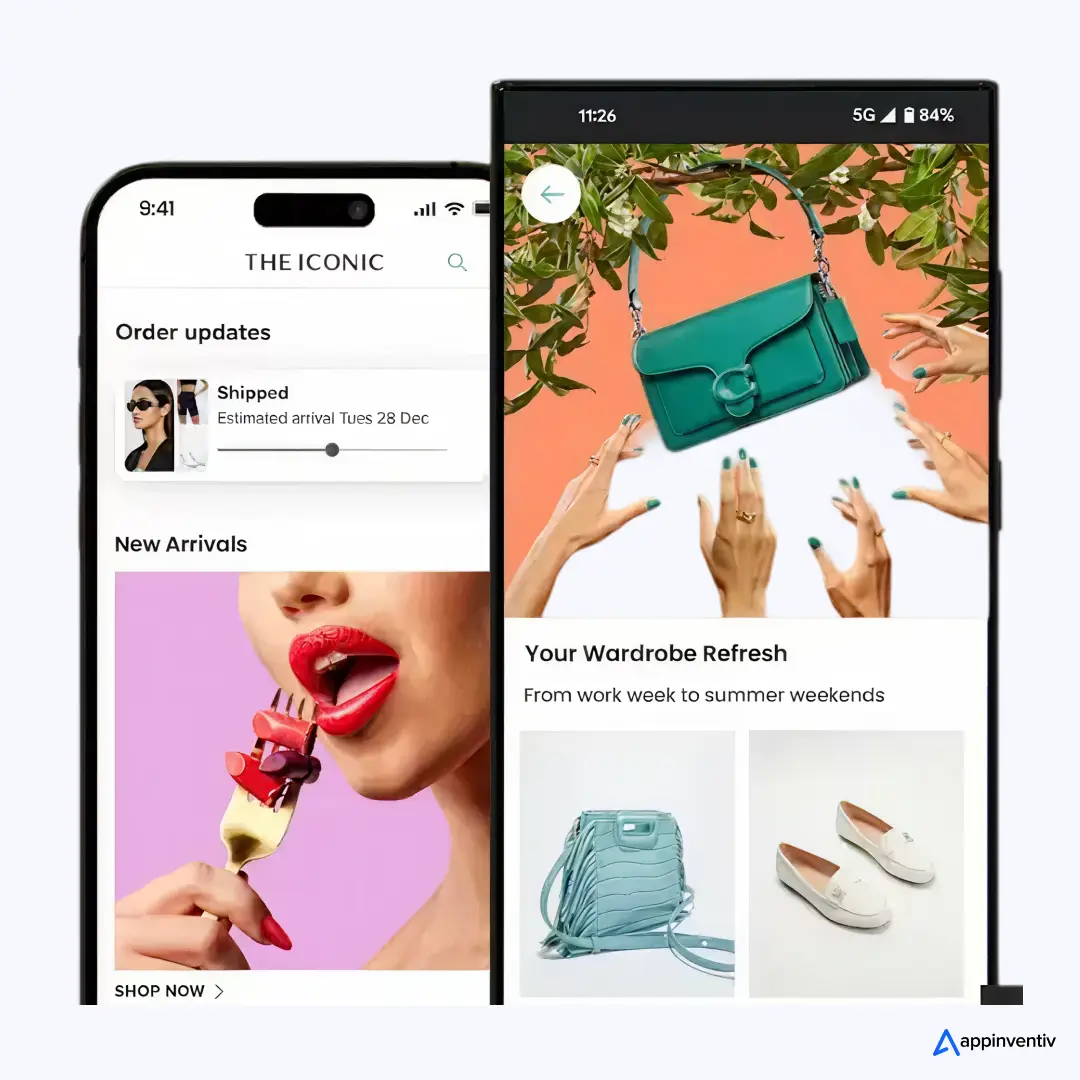
Why it Captivates Shoppers (USPs):
- Speedy Delivery: They completely transformed Australian e-commerce through rapid delivery – same-day options included. This set a fresh standard for local logistics across the board.
- Vast & Curated Selection: Their approach? High-quality, carefully curated fashion, sports, and lifestyle products. They nail Australian tastes while maintaining broad appeal.
- Exceptional User Experience: The platform’s reputation speaks volumes. Intuitive design meets seamless navigation. Clear product details plus engaging visuals create that in-store shopping feel, digitally.
- Hassle-Free Returns: Customer trust wasn’t built overnight. Their generous, straightforward returns policy did the heavy lifting. Free returns often eliminate purchase hesitation. Smart move.
- Strong Brand Story & Marketing: They invested seriously in a locally resonant brand identity. Marketing campaigns featuring diverse Australian models? That fostered genuine community connection. Not just selling but belonging.
Market Performance and Impact:
The Iconic has firmly established itself as a major player in Australian e-commerce. While the company does not publicly disclose exact revenue figures, its growth trajectory is clear from investor confidence and market presence. The brand has raised $92 million in funding from JPMorgan and Verlinvest, signaling strong faith in its long-term potential and business model. Combined with over 1 million app downloads, this level of traction reflects deep market penetration and operational scale across Australia and New Zealand.
They’ve fundamentally shifted consumer expectations for online retail in Australia. Competitors now pour more investment into speed, service, and user experience, just to keep pace. Their success story proves the massive potential for mobile eCommerce development for Australian retailers who actually commit to excellence.
Australia Post’s 2024 eCommerce Report tells the bigger picture. Australian households dropped over AUD $69 billion online back in 2024, setting a fresh record. We’re talking about 9.8 million households shopping digitally. That’s a robust, continuously expanding market. But platforms like The Iconic? They’ve figured out how to tap into it effectively.
If a local Australian brand could grow into a powerhouse by building the right digital foundation, there is no reason your business cannot follow a similar path at your own scale. The Iconic did not succeed because of luck. It succeeded because it invested early in experience, technology, logistics, and customer trust.
And today, the market is even more ready than it was in 2011. With Australian online spending at record levels and customer expectations fully formed, the opportunity is no longer emerging. It is active right now. Whether you want to launch lean or build toward something ambitious, now is the moment to act. The infrastructure, the tools, and the market demand already exist. What matters is whether you choose to move while the window is wide open.
Also Read: How to Build an App like Shein Australia: Features, Tech Stack, and Development Costs
A Comprehensive Look at the Cost to Develop eCommerce Platform in Australia
When building a platform like The Iconic, the overall cost isn’t a single lump sum. It breaks down into several key areas, influenced by your ambition, chosen features, and even where your development talent is located. Let’s dissect these layers of investment.
Cost Breakdown by Complexity Levels:
Your vision’s complexity directly dictates the development time, team size, and expertise required, thus driving the overall eCommerce app development cost in Australia.
| App Development Tier | What It Is | Cost Range | Factors Influencing Cost |
|---|---|---|---|
| The Focused Starter (MVP) | A foundational app with essential features like user registration, product listings, basic search, shopping cart, and one payment gateway. Focused on quick launch and validation. | AUD $46,500 – AUD $155,000 (USD $30,000 – USD $100,000) | Professional UI/UX design, secure backend, basic testing, streamlined features. |
| The Growing Contender (Mid-Range Platform) | Enhances the MVP with advanced UI/UX, search, reviews, wishlists, personalization, and third-party integrations, providing core functionality for scalable eCommerce. | AUD $155,000 – AUD $465,000 (USD $100,000 – USD $300,000) | Depth of personalization, integrations, and complexity of inventory management. |
| The Market Leader (Enterprise-Grade Platform) | A fully custom, scalable, robust platform with AI/ML, AR, extensive personalization, loyalty programs, multi-vendor support, and comprehensive analytics for market leadership. | AUD $465,000 – AUD $775,000+ (USD $300,000 – USD $500,000+) | Bespoke development, advanced features, high-availability infrastructure, security, and specialized developer teams. |
Cost Breakdown by Development Stages:
Every app project follows a lifecycle, with each stage demanding specific expertise and incurring unique costs.
Discovery & Planning: This crucial initial phase defines your project. It involves in-depth market research tailored to Australia, competitor analysis, detailed requirement gathering, and technical mobile app architecture planning. This strategic groundwork ensures your investment is directed efficiently from the outset.
- Estimated Cost: AUD $8,000 – AUD $23,000 (USD $5,000 – USD $15,000).
- Time: 2-3 weeks.
UI/UX Design: This stage transforms your vision into a tangible, user-friendly, and appealing interface. It includes wireframing, prototyping, and creating comprehensive visual designs, ensuring seamless user flows that resonate with Australian aesthetic preferences and usability standards.
- Estimated Cost: AUD $23,000 – AUD $46,500 (USD $15,000 – USD $30,000).
- Time: 4-8 weeks.
Development & Engineering: The largest portion of the budget, where the actual coding happens. This includes building the front-end (what users see), the back-end (server-side logic, database management), and integrating various APIs. The complexity of your features directly impacts development hours as well as the cost to develop an eCommerce platform in Australia.
- Estimated Cost: From AUD $38,750 (USD $25,000) for an MVP, up to AUD $620,000 (USD $400,000) for an enterprise solution.
- Time: 7-15+ months.
Quality Assurance (QA) & Testing: This critical stage ensures the app is robust, reliable, and provides a flawless user experience. It involves comprehensive testing for functionality, usability, performance (under load), security, and compatibility across various devices and scenarios relevant to Australia. Thorough QA prevents costly post-launch issues.
- Estimated Cost: AUD $15,500 – AUD $38,750 (USD $10,000 – USD $25,000).
- Time: 3-5 weeks (concurrent with development).
Deployment & Launch: This phase focuses on making your app publicly available. It includes preparing for app store submission (Apple App Store, Google Play Store), configuring robust server infrastructure, and final system setups. A smooth deployment ensures your app reaches your target audience without technical hitches.
- Estimated Cost: AUD $4,650 – AUD $15,500 (USD $3,000 – USD $10,000).
- Time: 1-2 weeks.
Post-Launch Maintenance & Support: Development doesn’t end at launch. This is an ongoing, crucial investment to keep your app competitive, secure, and performing optimally. It includes regular bug fixes, applying security patches, updating for OS compatibility, and continuous feature enhancements based on user feedback and market trends.
- Estimated Annual Cost: Typically 15-20% of the initial development cost.
How to Estimate Your Costs (A Simple Formula):
General formula to ballpark your eCommerce app development cost in Australia? Pretty straightforward:
Total Cost = (Total Estimated Development Hours) x (Average Hourly Rate of Development Team)
Here’s how it breaks down. A complex e-commerce app might need 3000-5000+ hours. You’re looking at AUD $360,000 to AUD $600,000. Offshore team at AUD $50/hour drops that to AUD $150,000 to AUD $250,000.
Time and Effort Estimates:
- MVP: 2-3 months typically.
- Mid-Range App: 6-9 months realistically.
- Enterprise-Grade App: 9-12+ months minimum.
Word of warning, though – rushing development backfires badly, often leading to costly rework, inflating your eCommerce app development cost in Australia, and delaying success.
Plan properly from the start.
Factors That Influence the Cost to Build an eCommerce Platform Like The Iconic
Before fixing a budget, Australian retailers need to understand one core reality. The cost to build an eCommerce platform like The Iconic is not decided by design screens alone. It is shaped by operational logic, inventory movement, customer behaviour, compliance frameworks, and how well the platform performs when traffic spikes. If you are planning to build an eCommerce app like The Iconic for the Australian market, these are the real factors that determine the investment behind eCommerce platform development.
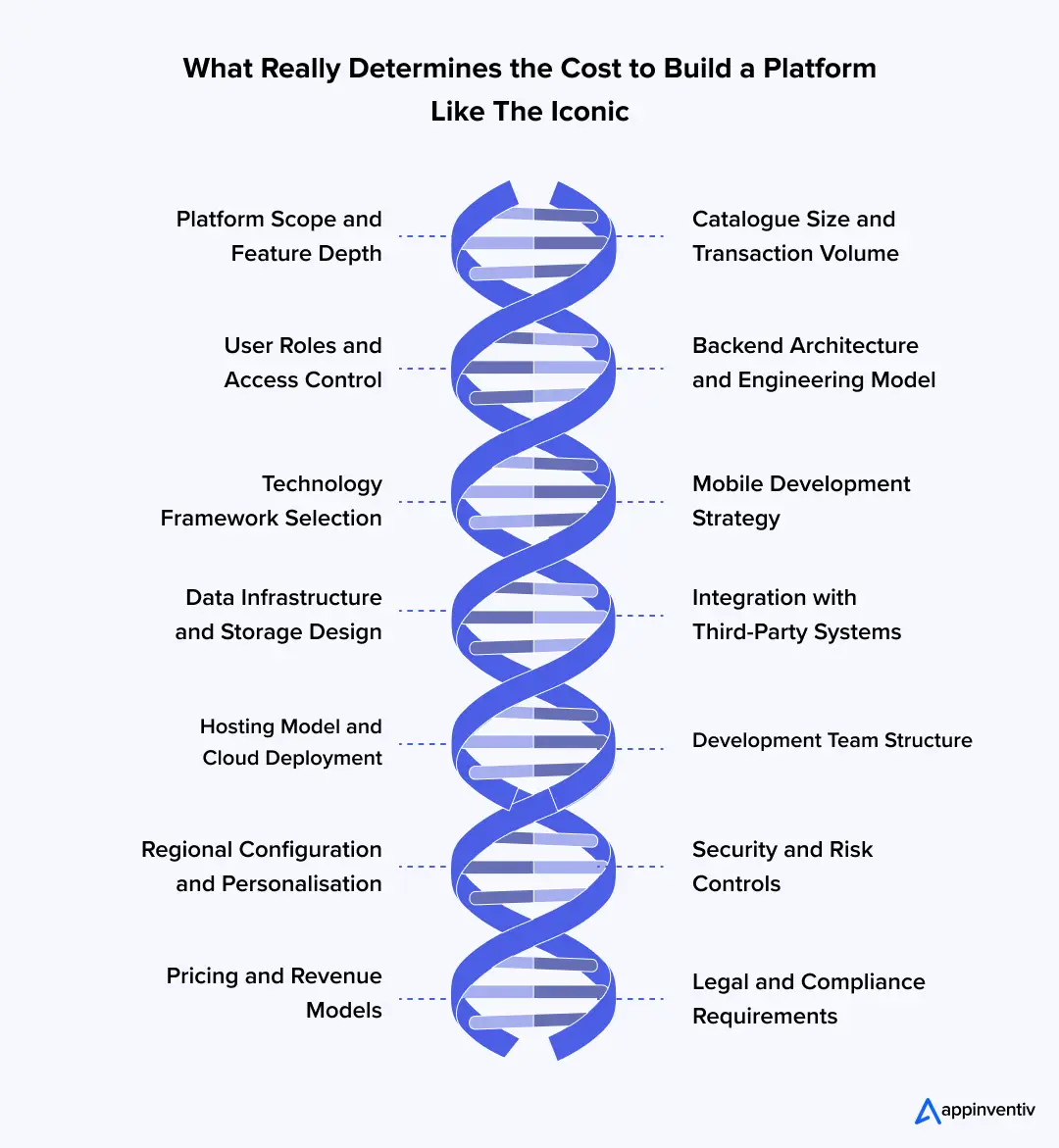
Platform Scope and Feature Depth
A simple storefront does not compare to a full-scale eCommerce engine. Platforms like The Iconic manage dynamic pricing, real-time stock updates, returns automation, customer accounts, promotions, and fulfillment workflows at the same time. The wider the scope, the larger the engineering effort. This is why the cost to develop an eCommerce platform in Australia grows as businesses move beyond static shops and into operational ecosystems.
Catalogue Size and Transaction Handling
A platform selling fifty products behaves very differently from one handling thousands daily. Search performance, inventory reconciliation, order processing speed, and error handling become critical. High transaction volume demands stronger infrastructure. This is one of the biggest drivers behind eCommerce app development cost in Australia.
User Roles and Access Logic
Customers, warehouse teams, finance teams, and support staff all work inside the same system. Each role requires different access permissions. More role complexity leads to more testing, validation, and backend logic.
Architecture and System Engineering
Systems built for long-term scale cost more upfront. Modular services, redundancy planning, and integration-ready architecture are expensive early but prevent failures later. This is often where businesses underestimate the real eCommerce website development cost in Australia.
Technology Selection
Every stack has a cost profile. Some reduce build time. Others ensure resilience under load. Your tech stack for eCommerce app development in Australia directly affects operating cost, performance, and maintenance demands over time.
| Component | MVP Impact | Enterprise Impact | Strategic Effect |
|---|---|---|---|
| Mobile App Strategy | Cross-platform reduces cost | Native increases budget | Speed vs. performance |
| Backend Design | Monolithic approach | Distributed services | Growth readiness |
| Database Model | Single DB setup | Hybrid models | Scalability |
| Team Structure | Generalists | Specialists | Reliability |
| Infrastructure | Low monthly cost | High-performance hosting | Stability |
Regional Deployment and Localization
Australia has its own taxation, fulfilment, and privacy landscape. Platforms tailored for the local market reduce friction and improve retention. Supporting postcode-based delivery logic, GST handling, and compliance workflows increases build effort but is unavoidable.
Risk and System Security
User data and payments demand defence-grade systems. Authentication, encryption, audit trails, and fraud controls add depth to development. These factors directly affect the overall cost to develop an eCommerce platform in Australia.
Revenue Engine Complexity
Discount models, loyalty programs, and promotional workflows are not cosmetic features. They control revenue. Platforms that engineer monetisation too late often pay twice.
Compliance and Legal Frameworks
Australian privacy regulation, consumer law, and payment standards shape eCommerce systems. Every serious platform follows an internal Australian eCommerce platform compliance checklist. Compliance engineering increases build discipline but reduces operational risk.
Hidden Cost Drivers Businesses Often Miss When Building an eCommerce Platform Like The Iconic
When teams calculate the cost to develop an eCommerce platform in Australia, they usually focus on development hours and design effort. What they miss are the costs that appear after users arrive, orders grow, and support becomes operational. These are not visible in proposals but surface steadily over time.
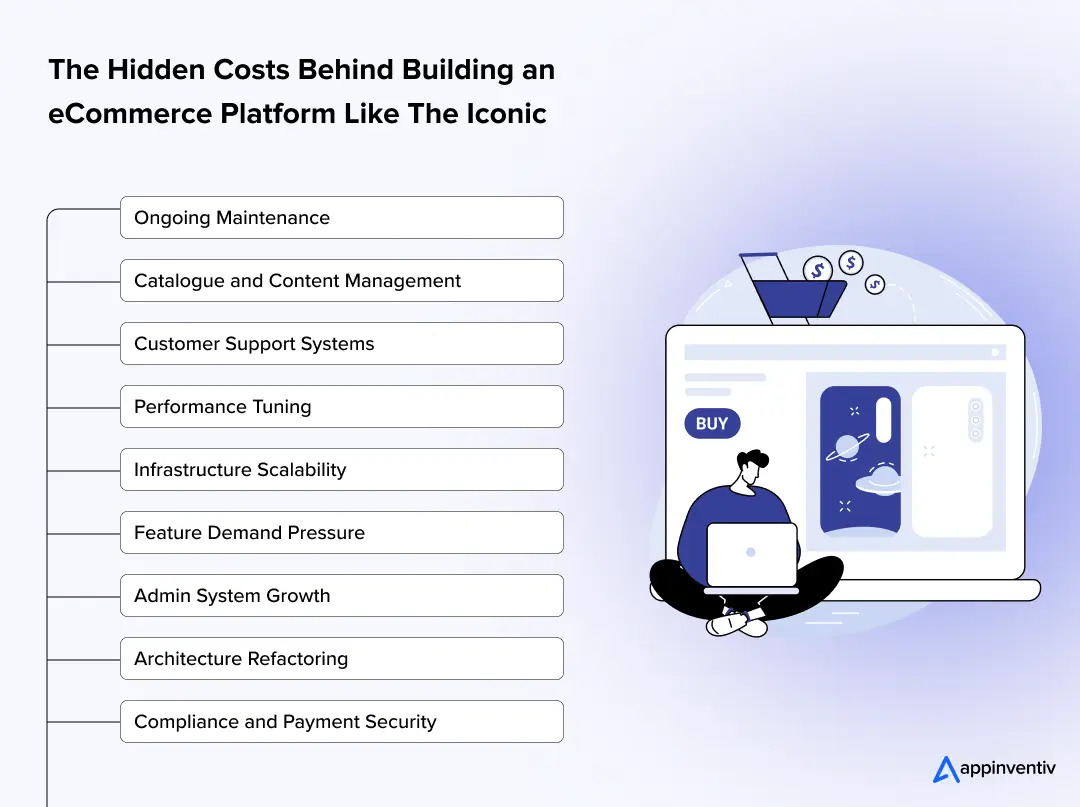
Ongoing Platform Maintenance
Updates never stop. iOS releases break layouts. Browsers change standards. APIs shift. The maintenance budget grows quietly and becomes a standard when it comes to calculating the overall eCommerce app development cost in Australia.
Catalogue Management
Pricing changes, promotions rotate, and stock updates are constant. Managing product intelligence at scale requires operational tooling, automation, and oversight.
Customer Support Infrastructure
Returns, refunds, and complaints need live systems. Support becomes software-driven, not manual. This is where business complexity begins to surface beneath the interface.
Performance Tuning
Search speed, checkout reliability, and image delivery demand ongoing optimisation. Businesses building large-scale retail platforms quickly realise performance engineering is not optional.
Infrastructure Scaling
Cloud bills grow with usage. Traffic brings cost. Storage expands. What worked for launch fails under growth.
Feature Pressure
Once traction begins, users request more. Payment options, smart filters, recommendations. Many features of an eCommerce platform become unavoidable after launch.
Admin System Growth
Reports evolve into dashboards. Dashboards into operations hubs. Admin logic grows alongside business complexity. What starts as a simple control panel slowly becomes a business command center that requires continuous engineering effort.
Refactoring
Early shortcuts cost later. Systems built fast often need rebuilding to scale. As traffic and features grow, teams are forced to redesign core components to keep the platform stable and responsive.
Compliance and Security
Processing payments triggers regulatory responsibility. Australian data law compliance and fraud prevention become mandatory as volume grows. Understanding government regulations for eCommerce Australia becomes part of daily operations.
Cost Optimization Strategies for Building an eCommerce Platform Like The Iconic
A large budget does not guarantee success. Teams overspend by building too much, scaling too early, or choosing technology that does not support growth. Control comes from planning, not from spending cuts. Businesses that manage the cost to develop an eCommerce platform in Australia well are the ones that design for longevity, not just launch.
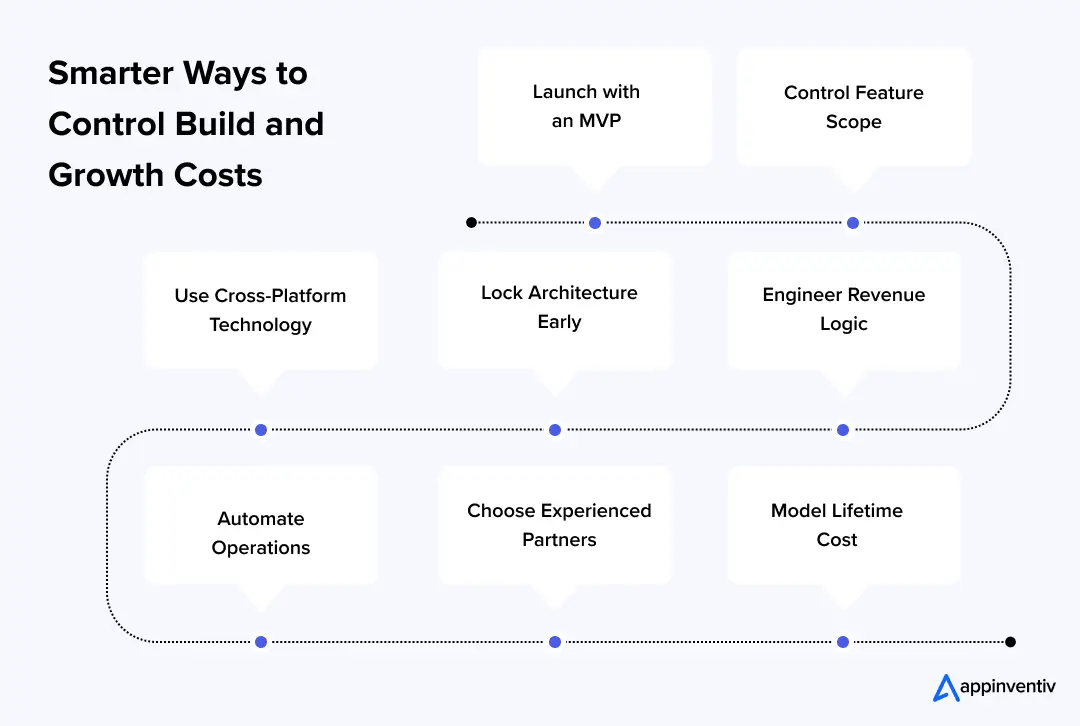
Launch with an MVP
Start with a version of your platform that supports the most critical user journeys first such as product discovery, checkout, orders, and account handling. Launching early helps teams gather real customer behaviour instead of guessing. This also allows businesses to validate direction before investing deeply across Australian eCommerce logistics, recommendations, and automation.
Control Feature Scope
Feature creep is a hidden budget killer. Every new function increases test time, upgrade complexity, and support load. Teams that clearly define what belongs in phase one avoid unnecessary spend and reduce confusion during development. Features should earn their place based on business value, not enthusiasm.
[Also Read: Top 10 eCommerce app features for startups and enterprises]
Use Cross-Platform Technology
One shared codebase reduces development duplication and cuts release timelines. Mobile eCommerce development for Australian retailers benefits strongly from cross-platform frameworks that keep experiences consistent while lowering cost across iOS and Android.
Lock Architecture Early
Backend decisions affect everything from speed to stability. Rethinking architecture halfway through development triggers rewrites and delays. Systems designed with growth in mind prevent downtime when demand increases.
Engineer Revenue Logic
Pricing engines, promotions, and subscriptions should not be layered on later. When revenue logic is engineered early, the platform moves faster during campaign launches and financial reconciliation. This also reduces the chance of future structural changes.
Automate Operations
Manual task handling does not scale. Inventory syncing, order processing, reporting, and refunds should be automated wherever possible. Automation lowers staff cost over time while improving accuracy.
Choose Experienced Partners
Low-cost development often leads to high repair costs. Skilled teams write cleaner systems and anticipate failure scenarios. Experience limits defect rates and improves release confidence.
Model Lifetime Cost
Hosting, compliance, upgrades, security monitoring, and maintenance are permanent realities and can impact the overall cost to develop an eCommerce platform in Australia. Planning only initial development costs leads to operational strain later. Smart teams account for growth cost from the first sprint, not after launch.
Crafting the Experience: Essential Features of an eCommerce Platform Like The Iconic
An eCommerce platform only succeeds when every user gets what they need without friction. Shoppers want speed and confidence. Operations teams want clarity and control. Admin teams want visibility and automation. Platforms like The Iconic stand out because these experiences work together seamlessly. The real strength of a retail platform is not the interface alone. It is how well the customer experience connects with inventory control, fulfilment, and support behind the scenes.
User-Side Features
These features shape how customers discover products, complete purchases, and build trust with the platform over time. Here are the must-have features of an Australian eCommerce app:
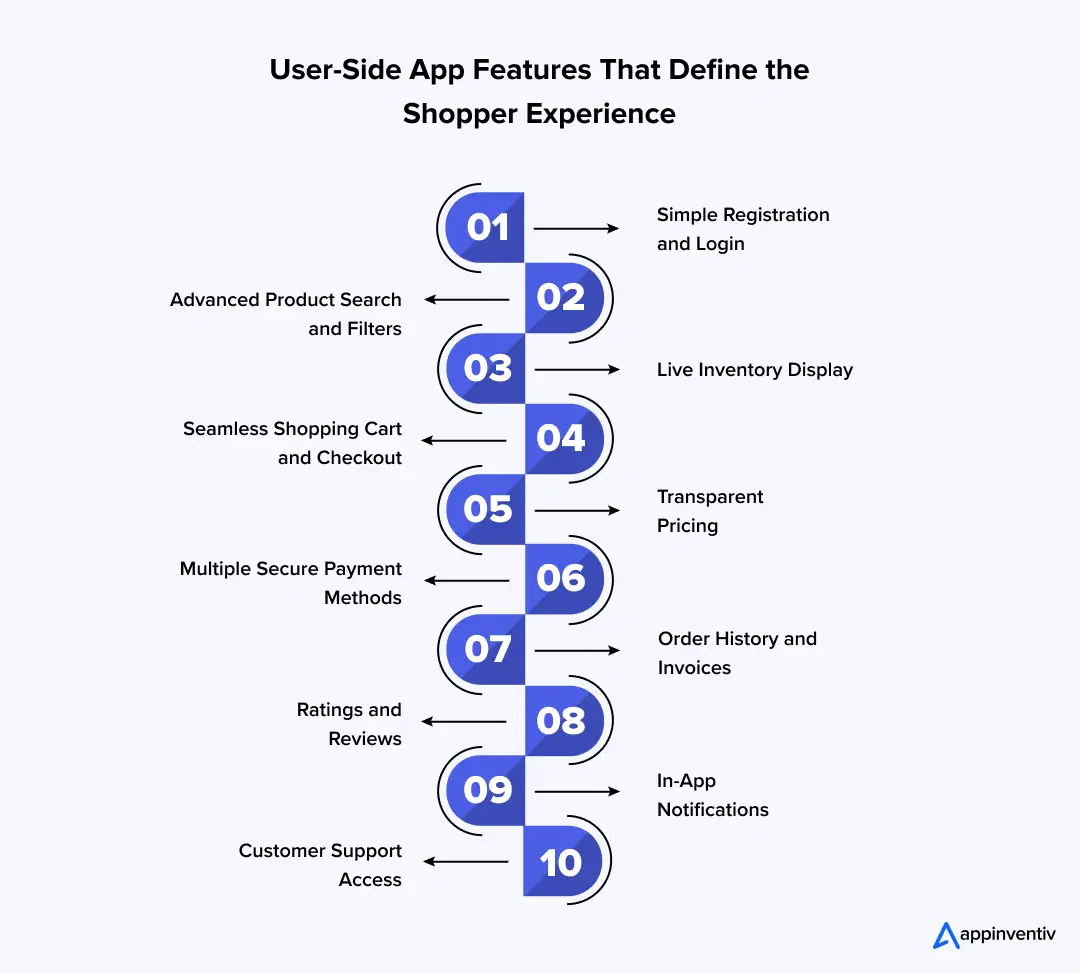
Simple Registration and Login
Customers should be able to start shopping instantly. Email, mobile number, and social login options reduce friction during sign-up. When access is easy, retention improves and abandoned sessions drop significantly.
Advanced Product Search and Filters
Fast and accurate search determines whether a user stays or leaves. Filters by size, price, brand, colour, availability, and delivery timeframe help customers reach decisions without frustration.
Live Inventory Display
Displaying real-time stock reduces cancellations and support issues. Customers expect product availability to match what is shown at checkout.
Seamless Shopping Cart and Checkout
Checkout should be intuitive and predictable. Delivery estimates, return information, and payment confirmation must be visible before final submission.
Transparent Pricing
Customers trust platforms that show complete cost breakdowns upfront. Shipping fees, discounts, and taxes must be visible early in the process.
Multiple Secure Payment Methods
Providing flexible payment methods increases conversion. Support for cards, wallets, and local gateways improves accessibility for Australian users.
Order History and Invoices
Users should always have access to bills, tracking information, and return status. This builds trust and reduces reliance on customer service.
Ratings and Reviews
Customer feedback shapes purchasing decisions. Reviews increase confidence and guide expectations about product quality.
In-App Notifications
Order confirmations, delivery alerts, refund updates, and restock notifications keep customers informed without opening support tickets.
Customer Support Access
Help should never feel hidden. Live chat, email support, and help desk access reassure users when something goes wrong.
Seller-Side Features
These features give brands and merchants full control over how they present products, fulfil orders, and track performance. A strong seller experience directly affects product quality, delivery reliability, and customer satisfaction across the entire platform.
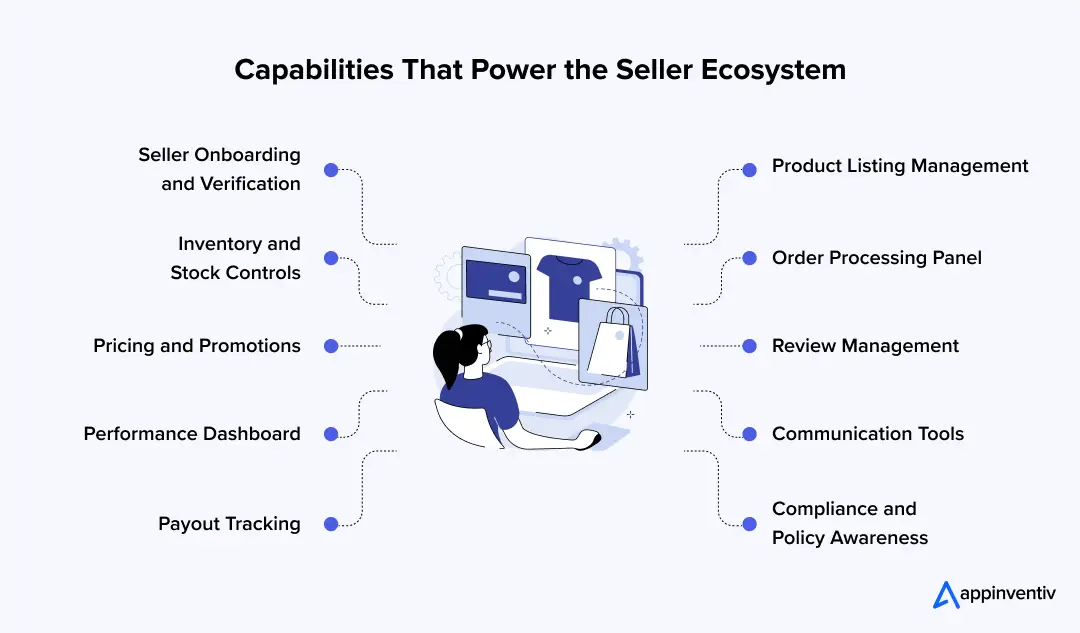
Seller Onboarding and Verification
Sellers submit business details, identity documents, and brand credentials for approval before they can list products. A structured verification flow protects the platform from low-quality vendors and builds customer trust from day one.
Product Listing Management
Sellers manage product titles, descriptions, pricing, and images from one interface. Bulk upload support and simple editing tools help large sellers update catalogues without delays.
Inventory and Stock Controls
Stock levels update automatically as orders are placed. Sellers can adjust availability, pause listings, and schedule restocks to avoid overselling and delivery issues.
Order Processing Panel
Every order appears in a single workspace showing customer details, dispatch status, and expected delivery timelines. Sellers handle confirmations, cancellations, and fulfilment with full visibility.
Pricing and Promotions
Sellers run discounts, create bundles, and schedule campaigns. The system supports time-based offers and inventory-based pricing without manual intervention.
Performance Dashboard
Sellers see daily sales figures, return rates, and revenue trends. This view helps them understand what products perform well and where improvements are needed.
Communication Tools
Built-in messaging connects sellers with support teams and operations staff. Sellers resolve queries without relying on email or external tools.
Review Management
Sellers view customer feedback in one place and respond directly. Visible engagement with reviews builds credibility and improves buyer confidence.
Payout Tracking
Earnings, deductions, and settlement timelines are displayed clearly. Sellers always know what they have earned and when payments will reach them.
Compliance and Policy Awareness
Platform policies, updates, and seller guidelines are posted within the dashboard so sellers stay aligned with operational and legal expectations.
Admin-Side Features
These features determine whether the business scales cleanly or struggles as volume increases.
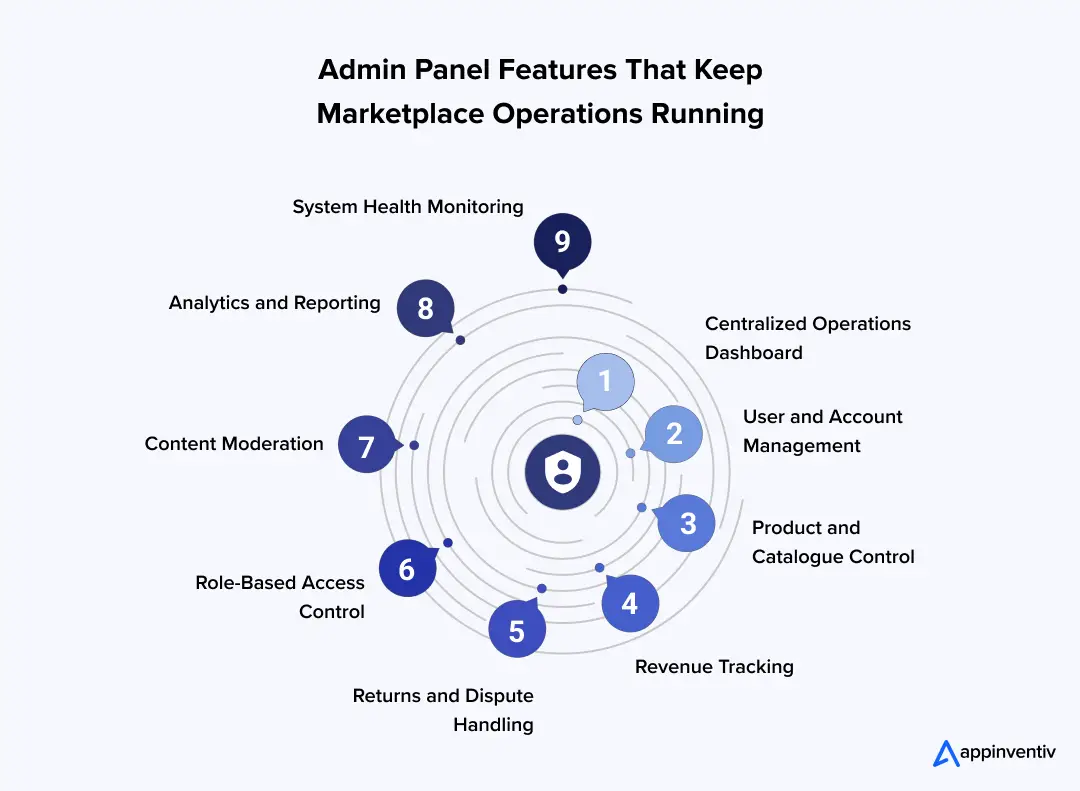
Centralized Operations Dashboard
Admins require one interface where everything is visible. Orders, cancellations, fulfilment delays, and traffic spikes should surface in real time.
User and Account Management
Admin teams must manage suspicious users, manual verifications, and blocked accounts without system limitations.
Product and Catalogue Control
Prices, descriptions, offers, and stock must be editable instantly. Accuracy at this layer directly affects customer trust.
Revenue Tracking
Live access to sales performance, refunds, and margin data helps decision-makers identify issues early.
Returns and Dispute Handling
Admin workflows should support refunds, complaints, and chargeback documentation from one system.
Role-Based Access Control
Finance, support, and marketing teams require different permissions. Access management prevents errors and ensures accountability.
Content Moderation
User reviews, uploads, and seller listings must be monitored to maintain platform quality.
Analytics and Reporting
Sales trends, user activity, and conversion rates influence feature decisions and marketing spend.
System Health Monitoring
Admins should detect slowdowns, errors, or failed payments instantly before shoppers complain.
Advanced Features That Can Help You Build Beyond The Iconic
Surpassing a market leader requires more than copying screens and checkout flows. It requires systems that think, react, and improve without constant human instruction. Retail platforms in 2026 will win through automation, intelligence, and experience design rather than catalogue size alone. These advanced features represent the difference between running an online store and operating a digital retail ecosystem. Let’s look into the features for developing an eCommerce platform like The Iconic:
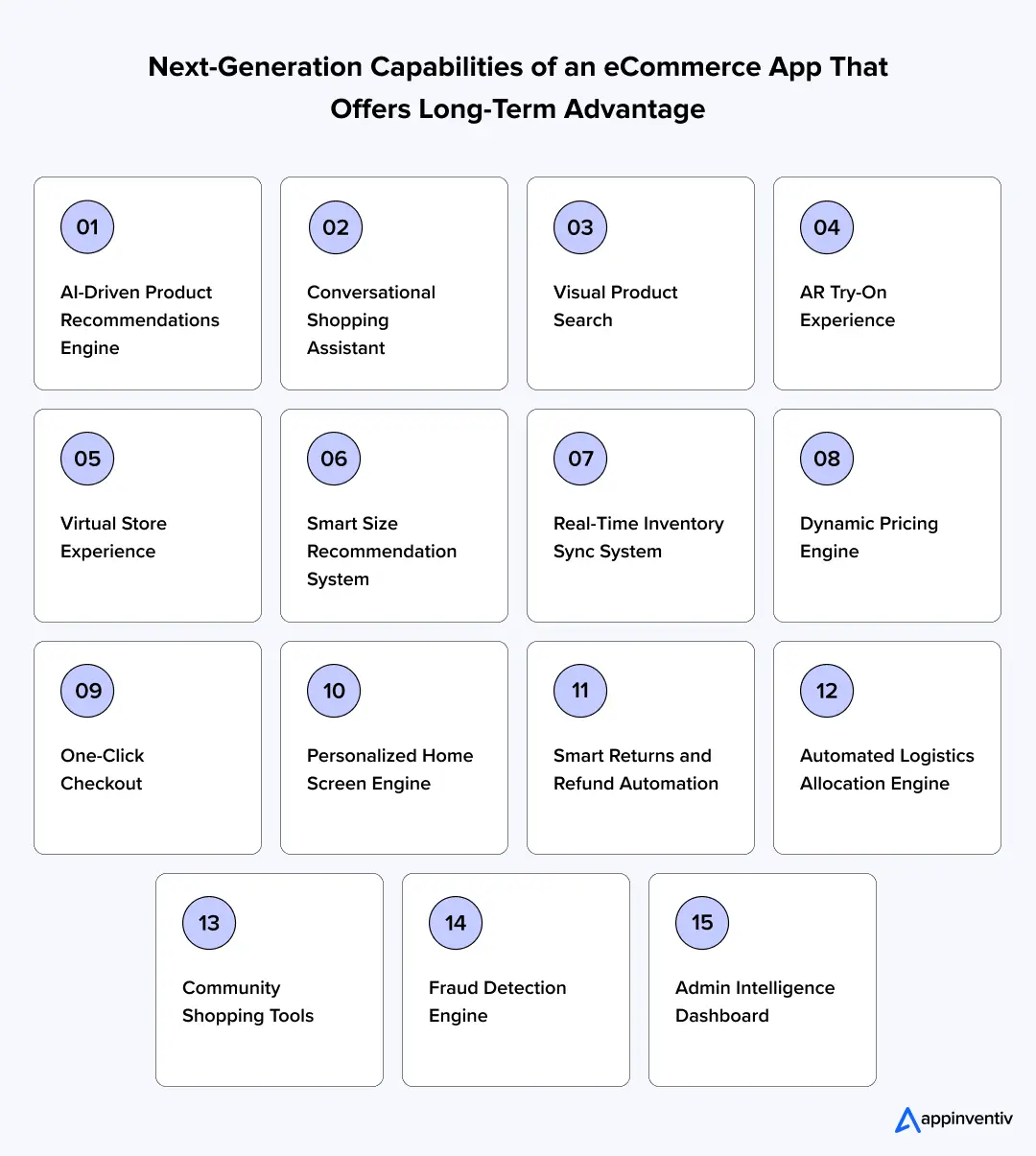
AI-Driven Product Recommendations Engine
Shows personalised recommendations based on browsing behaviour, previous purchases, and product interactions. As data grows, recommendations refine automatically and start predicting needs before users search. This builds engagement without pushing products aggressively.
[Also Read: Machine Learning Recommendation Systems: Types, Applications, Real-Life Examples, Implementation Techniques & Costs]
Conversational Shopping Assistant
Enables users to talk to the platform naturally instead of navigating menus. It answers questions, suggests products, updates orders, and guides decisions through conversation. The interface feels more like assistance than software.
Visual Product Search
Customers upload images to find visually similar products instantly. Inspiration turns into purchase faster when users do not waste time guessing names or filters. Discovery becomes instinctive.
AR Try-On Experience
Users see products on them before purchasing using their phone camera. Virtual try-on reduces guesswork, improves confidence, and adds entertainment value to the buying journey. Shoppers spend more time exploring confidently.
Virtual Store Experience
Collections appear as curated environments instead of long grids. Seasonal themes, categories, and promotions feel organised rather than scattered. Browsing becomes intentional instead of endless scrolling.
Smart Size Recommendation System
Size suggestions improve accuracy by learning from returns and fit feedback. Customers stop guessing and start trusting the platform. Orders increase as hesitation drops.
Real-Time Inventory Sync System
Stock levels update instantly across all screens and locations. Customers no longer encounter out-of-stock surprises after payment. Reliability becomes a brand advantage.
Dynamic Pricing Engine
Prices adapt automatically based on demand, stock levels, and campaign performance. The system protects margins without confusing customers. Promotions become purposeful rather than random.
One-Click Checkout
Checkout completes in seconds using secure data storage. Fewer steps mean fewer drop-offs. Convenience becomes the strongest reason to return.
Personalized Home Screen Engine
Homepages adapt based on viewing history and buying behaviour. Promotions and collections reposition themselves logically. Every visit feels considered.
Smart Returns and Refund Automation
Returns are processed digitally with labels, tracking, and updates built in. Support pressure reduces while transparency increases. Customers trust refund processes more.
Automated Logistics Allocation Engine
Shipping routes and carriers are assigned automatically based on speed, cost, and reliability. Deliveries become consistent and predictable. Operations no longer slow growth.
Community Shopping Tools
Live content, creator sessions, and exclusive launches happen inside the app. Shopping becomes interactive instead of isolated. Engagement becomes emotional.
Fraud Detection Engine
Suspicious activity is flagged instantly using behaviour tracking. Genuine users shop freely without interruptions. Protection stays invisible but effective.
Admin Intelligence Dashboard
Leaders see real-time data on revenue, failures, returns, and behaviour patterns. Decisions are made with clarity instead of guesswork. Issues surface early.

How to Develop an App like The Iconic?
Building an app at the level of The Iconic is not about copying screens or layouts. It is about treating the app as the front door to your entire retail operation. That means planning how products are managed, how orders move, how customers are supported, and how everything holds up when traffic spikes. The process has to be structured so you do not jump into design or coding before the foundations are clear. Below are the practical steps to build an eCommerce app like The Iconic:
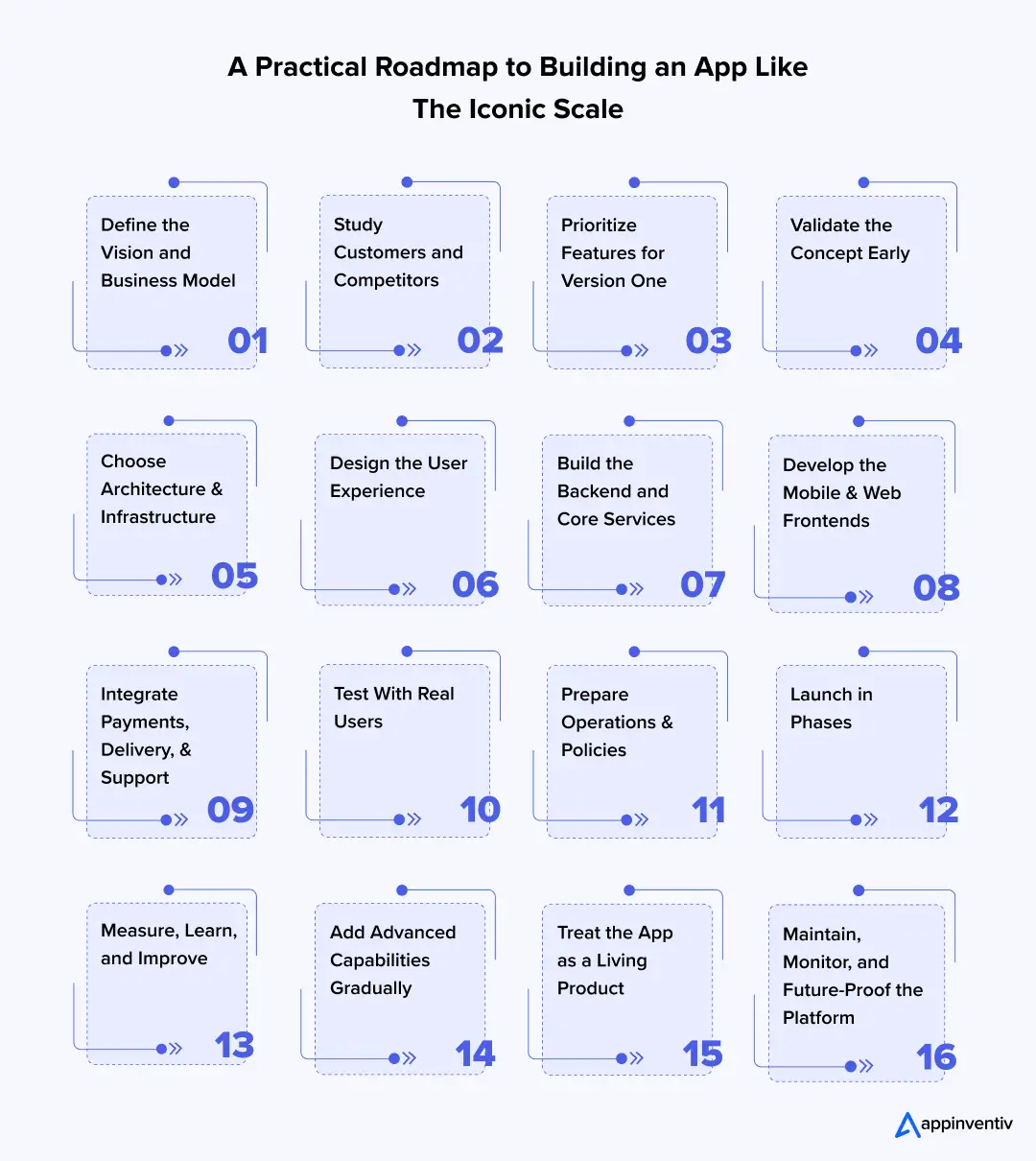
Step 1: Define the Vision and Business Model
Start by writing down what role the app will play in your business. Decide what you want to sell, who you are selling to, how you will earn, and what makes your experience different from other retailers. This clarity becomes your filter for every later decision.
Step 2: Study Customers and Competitors
Look at how shoppers currently browse, buy, and return products. Map their frustrations with existing platforms. At the same time, study leading apps, not to copy them, but to understand what users already consider normal. Your aim is to meet those expectations first, then improve on them.
Step 3: Prioritize Features for Version One
List everything you think the app should do, then divide it into essentials and nice to have items. Essentials usually include search, product pages, cart, checkout, payments, order tracking, and basic account features. Keep version one focused so that you can launch without being stuck in endless development.
Step 4: Validate the Concept Early
Before full development, test your idea with simple prototypes or limited trials. You can use design mockups or a very small working version to see how people respond. Early feedback helps you avoid building features that nobody needs.
Step 5: Choose Architecture and Infrastructure
Decide how your system will be structured. You need to think about your backend, database, security, and how the app will connect with other systems like inventory, shipping, or marketing tools. A solid technical foundation prevents painful rebuilds later when traffic grows.
Step 6: Design the User Experience
Create clear, simple user flows for browsing, searching, viewing products, and checking out. The design should minimize confusion at every step. Focus on clean navigation, readable content, and quick access to key actions such as adding to cart or viewing size details.
Step 7: Build the Backend and Core Services
Start with the parts that users never see but rely on the most. This includes product management, pricing, stock handling, order creation, payment processing, and notification systems. If this layer is unstable, no amount of beautiful design will save the app.
Step 8: Develop the Mobile and Web Frontends
Once the backend is in place, build the mobile app and, if required, the web storefront. Make sure the experience feels consistent across devices. Pay attention to load time, image quality, and how well the app behaves on different network conditions.
Step 9: Integrate Payments, Delivery, and Support
Connect the app with payment gateways, shipping partners, and support tools. Test real world flows such as failed payments, delayed deliveries, and customer complaints. The way you handle exceptions is as important as the smooth journeys.
Step 10: Test With Real Users
Run structured testing rounds that include both internal teams and a small pool of real customers. Look for issues such as confusing steps, slow screens, and broken flows. Fix these before you think about a full scale launch. Do understand that the overall cost to develop an eCommerce platform in Australia can vary as per the testing techniques integrated in the process.
Step 11: Prepare Operations and Policies
Set up clear rules for returns, refunds, discounts, customer support working hours, and escalation paths. An app like The Iconic works well because the business behind it is organised, not only because the software looks good.
Step 12: Launch in Phases
Avoid a big bang release. Start with a soft launch for a limited audience. Monitor performance, errors, and customer feedback closely. Use this period to stabilise your systems before opening the doors wider.
Step 13: Measure, Learn, and Improve
After launch, track how customers actually use the app. See where they drop off, which categories perform well, and what generates complaints. Use this data to refine features, improve speed, and shape your next release.
Step 14: Add Advanced Capabilities Gradually
Do not start with every advanced feature on day one. Introduce things like smarter recommendations, better search, richer product media, or improved delivery options once the basics are stable. This keeps the app evolving without risking its core stability.
Step 15: Treat the App as a Living Product
An app at this level is never finished. New devices, new customer expectations, and new business needs will keep appearing. Plan for continuous updates, regular reviews, and ongoing investment rather than treating the build as a one time project.
Step 16: Maintain, Monitor, and Future-Proof the Platform
Launching the app is only the starting line. Once real customers begin using it daily, maintenance becomes a continuous responsibility. Bugs surface, systems age, and user behaviour changes. Regular updates are required to keep payments secure, performance smooth, and compatibility intact with new device versions.
Understand how our services fit into your growth plan.

Multiple Ways eCommerce Apps Like The Iconic Earns Money
An app like The Iconic is not just a storefront. It is a fully operating retail business built on digital rails. Revenue is generated through multiple channels at the same time, some visible to customers and others running quietly in the background. Understanding these income streams is important because profits do not come from product sales alone. They come from pricing strategy, partnerships, customer behaviour, and how efficiently the platform routes money through the business. Here are the primary ways a platform at this scale generates revenue.
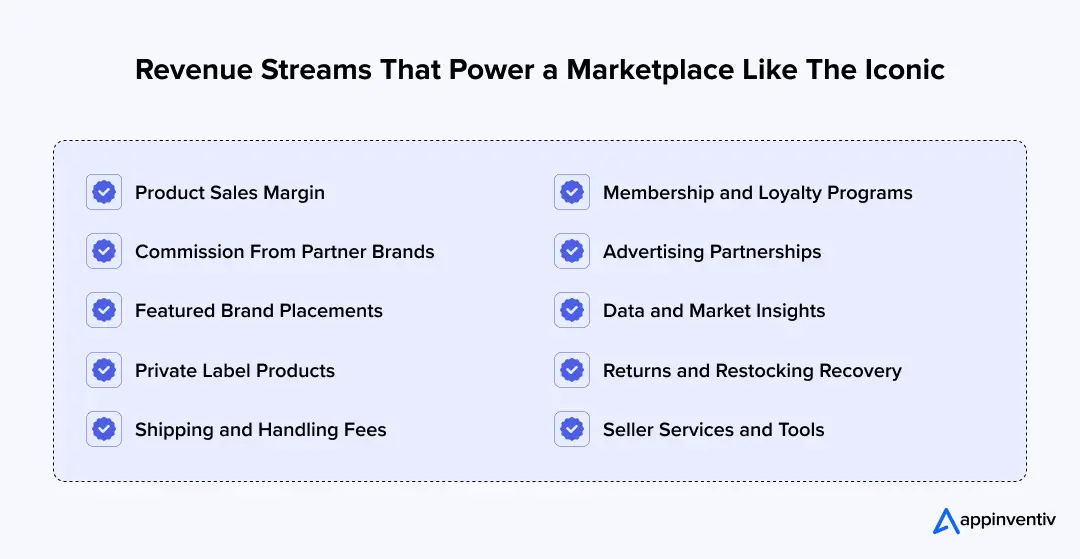
Product Sales Margin
The most direct source of income is the margin between what the platform pays brands and what customers pay at checkout. Success depends not just on volume but on how well pricing is optimised across categories and seasons.
Commission From Partner Brands
Some brands sell through the platform in exchange for a percentage of each sale. The platform earns without holding inventory, reducing risk while expanding product range.
Featured Brand Placements
Brands pay for premium visibility within the app. Featured placements, homepage banners, and seasonal promotions are sold as inventory in the digital storefront.
Private Label Products
Many platforms develop their own in-house brands. These products deliver higher margins and give control over pricing and design.
Shipping and Handling Fees
Delivery charges, express options, and special handling create additional revenue beyond product prices.
Membership and Loyalty Programs
Paid memberships offer exclusive benefits such as early access, free returns, or faster delivery. These programs improve customer retention while generating predictable income.
Advertising Partnerships
External brands pay to access the platform’s audience. Sponsored product listings and promotional collaborations provide revenue without disrupting user experience.
Data and Market Insights
At scale, anonymised shopping and trend data becomes valuable. Insights can guide partnerships, buying decisions, and collaborations.
Returns and Restocking Recovery
While returns cost money, smart policies recover part of the loss through reselling, outlet sales, and damage assessments.
Seller Services and Tools
Platforms charge some partners for access to analytics dashboards, sales tools, or promotional opportunities.
How to Make an eCommerce App Stand Out in Australia
Australia is not an easy market to win digitally. Distances are long, competition is strong, and customers have high expectations. Shoppers often compare experiences with major platforms instantly, and poor service is rarely forgiven twice. To stand out here, an app must solve Australian realities instead of following global templates. Logistics, law, and local behaviour have more impact than design trends.
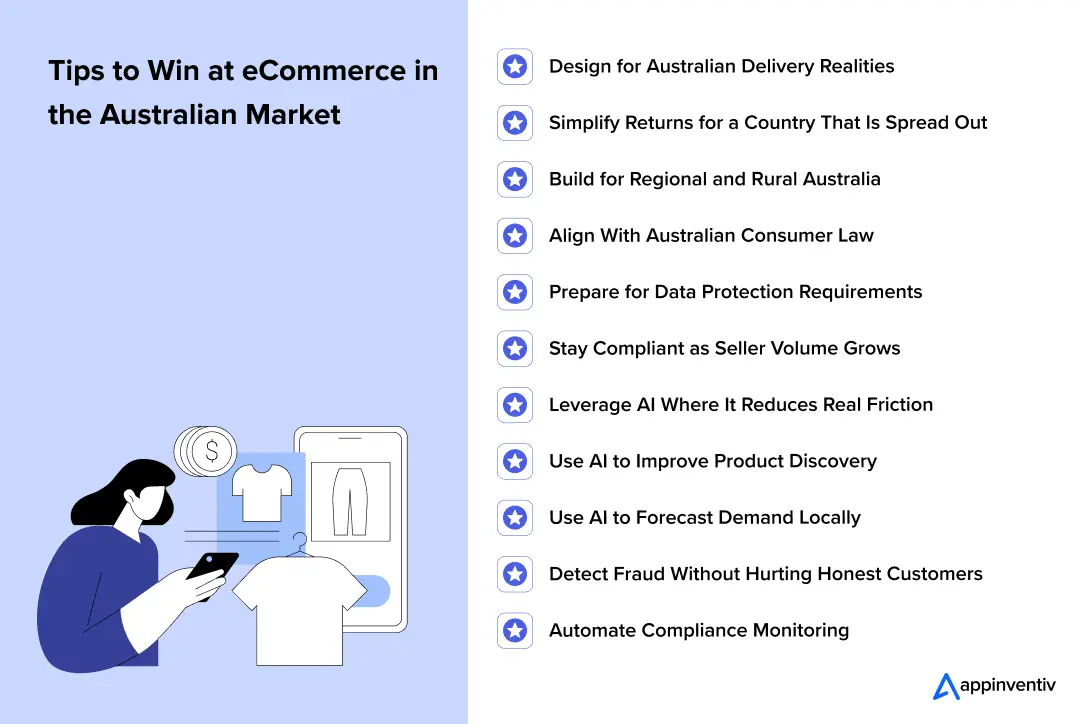
Design for Australian Delivery Realities
A promise that works in Sydney may fail in Western Australia or regional Queensland. Delivery timelines must adapt by postcode, not by averages. Customers respond better to honest estimates than inflated speed claims. Trust grows when delivery times reflect geography.
Simplify Returns for a Country That Is Spread Out
Returns in Australia involve distance, expense, and waiting. Platforms that offer easy labels, clear instructions, and fast refunds reduce anxiety during checkout. Customers are more willing to purchase when returns do not feel like a burden.
Build for Regional and Rural Australia
Retail does not stop at capital cities. Many platforms fail to customize service for remote areas. Fair shipping costs, realistic delivery dates, and strong tracking reduce dropout rates from regional users.
Align With Australian Consumer Law
Compliance is not optional in Australia. Refunds, product descriptions, and complaint handling are governed by strict regulations. When policies are unclear or misaligned, penalties and reputational damage follow quickly. Apps must reflect legal rights accurately, not bury them in small print.
| Law / Regulation | Area Covered | Why It Matters |
|---|---|---|
| Australian Consumer Law | Refunds, returns, pricing | Protects customer rights and prevents misleading practices |
| Privacy Act 1988 | Personal data handling | Requires secure storage and breach reporting |
| Spam Act 2003 | Email and SMS marketing | Enforces consent and opt-out rules |
| PCI DSS | Payment security | Protects card data and reduces fraud |
| Electronic Transactions Act | Online contracts | Makes digital transactions legally valid |
Prepare for Data Protection Requirements
Handling customer details brings responsibility under privacy regulations. Consent handling, data storage, breach notification, and policy design must reflect local law. Weak arrangements risk fines and loss of trust.
Stay Compliant as Seller Volume Grows
Marketplace platforms face added complexity. Seller behaviour, listings, and payments also fall under regulatory oversight. Monitoring tools and reporting systems become essential for risk control.
Leverage AI Where It Reduces Real Friction
AI should not be decorative. It should solve practical problems. It can improve delivery accuracy through smarter routing, reduce return rates through better size guidance, and flag payment risks early. Applied correctly, it reduces failure points instead of adding complexity.
[Also Read: 10+ Ways AI is Helping Australian eCommerce Businesses Scale Faster]
Use AI to Improve Product Discovery
Search engines can adapt to language variations, misspellings, and browsing habits. This shortens paths to purchase, especially for large catalogues.
Use AI to Forecast Demand Locally
Sales patterns across Australia are not uniform. Predictive systems adjust stock and delivery planning by state and climate, reducing overstock and lost sales.
Detect Fraud Without Hurting Honest Customers
Behaviour monitoring offers better protection than passwords alone. Intelligent security reduces false declines and improves user trust.
Automate Compliance Monitoring
Manual audit work does not scale. Automation helps track seller behaviour, transactions, and unusual activity before issues grow.
Why Businesses Partner with Appinventiv to Build Fashion Marketplaces at Scale
If you’re planning to build a fashion marketplace like The Iconic, the choice of development partner will shape more than your app. It will shape your operations, your customer trust, and your growth curve. A marketplace does not fail quietly. When checkout breaks, stock mismatches, or payments slow down, customers leave instantly. There is no margin for instability at this scale.
As a mobile app development company in Australia, we do not treat retail platforms as design exercises. We treat them as operating systems for your business. From the start, we focus on how your platform behaves when traffic surges, orders stack up, and customer service load rises. We design for real-world pressure, not ideal conditions.
Our approach begins with understanding the mechanics of your business – How orders move, returns flow, sellers operate, team monitors issues and so much more. Every interface is built around daily use, not just first impressions. The goal is not to launch quickly and hope performance holds but it is to build a platform that stays reliable when demand multiplies.
Scalability is designed into the core architecture, not added later in panic. Our eCommerce app development services providers ensure that security standards, payment protection, and data handling frameworks are included from the first planning stages. Performance tuning is continuous, not reactive. Integration planning is structured so your app can expand without ripping apart what already works.
We also do not vanish after launch. Marketplace success depends on maintenance, optimisation, and improvement over time. Our teams stay involved through upgrades, performance monitoring, and feature evolution so your platform stays aligned with your business direction, not frozen in its launch state.
If you want to build more than an online store, then let’s talk. Because platforms like The Iconic were not built by accident. They were built carefully, deliberately, and with the right technical foundation from day one.
FAQs
Q. How much does it cost to build an eCommerce platform like The Iconic in Australia?
A. The cost to develop an eCommerce platform in Australia can vary a lot, and that’s because no two platforms are built to the same depth. A basic first version with essential features such as browsing, search, checkout, and order tracking typically falls between AUD $46,500 to AUD $155,000. This covers a working product that lets you test the market and start operating.
However, building at the level of The Iconic is a very different project. When the platform includes advanced personalisation, automation, complex integrations, and high-performance architecture, the investment usually starts around AUD $775,000 and moves upward depending on how far the system is taken.
The largest influences on cost are functional scope, level of automation, visual design quality, third-party integrations, and how much scale the platform is expected to handle from the start.
Q. What compliance and payment systems are required for eCommerce apps in Australia?
A. Operating in Australia comes with clear legal obligations. Consumer rights must be built into the platform, not added as fine print. Refund rules, accurate product descriptions, pricing transparency, and customer complaint handling must follow Australian Consumer Law.
Data protection is also not optional. Once your business reaches certain revenue levels, the Privacy Act applies. That means secure storage, restricted access, and breach reporting procedures should be part of the system design, not afterthoughts.
On the payments side, customers expect flexibility. Local users rely heavily on cards, digital wallets, and Buy Now Pay Later options. Services such as Afterpay and Zip are widely adopted and skipping them can directly affect conversion. Established gateways like Stripe and PayPal are commonly used for safe handling of transactions.
Q. How can you validate an eCommerce app idea in Australia?
A. Jumping straight into development is usually a mistake. Validation should happen before serious money is spent. Start by understanding the local market. Identify what customers already use and where they feel frustrated. Look closely at competitors, but focus more on what they miss than what they do well.
This stage is also where many of the real benefits of developing an eCommerce app begin to show clearly. When you see how users respond during validation, you understand what will actually improve convenience, speed, and trust rather than guessing based on assumptions.
Direct conversations matter more than reports. Short interviews, online surveys, and feedback sessions reveal how customers actually shop. The most reliable method is releasing a small working version of your idea to a limited audience. Real usage behaviour tells you more than opinions ever will. Refining early prevents expensive changes later.
Q. What should CTOs focus on when building an eCommerce platform?
A. The technical direction of the platform determines how well it performs one year and five years later. Architecture has to support scale from the beginning. Decisions around databases, infrastructure, and integrations affect speed, reliability, and cost of growth.
Security must be treated as foundation work, not a later upgrade. Encryption, access controls, and operational safeguards should be designed early. The challenge is also to choose where sophistication makes sense and where simplicity works better. Not every new capability needs to exist at launch.
A strong technical plan also includes long-term maintenance and delivery strategy. Platform stability, integration flexibility, and readiness for growth are all part of the responsibility.
Q. How long does it take to build a platform like The Iconic?
A. Timelines depend mainly on how complex the build is. A basic working platform usually takes 2 to 3 months when the feature set is kept tight.
A more complete platform with richer functionality typically runs between 6 and 12 months, especially when integrations and custom workflows are involved.
Building an advanced system with deep automation, custom design, and intelligent experiences takes longer. Projects at that level often extend beyond 12 months, including time for planning, development, testing, and deployment. Platforms built carefully take longer at the start but save time later by avoiding unstable shortcuts.

- In just 2 mins you will get a response
- Your idea is 100% protected by our Non Disclosure Agreement.

How Much Does It Cost to Build an eCommerce Marketplace App Like Poshmark?
Key takeaways: Poshmark-like marketplaces enable unlocking new sources of revenue through transforming social interaction into low-capital-intensity repeat purchases. A marketplace app would cost between $40,000 and $400,000 to develop, depending on its features, platform and enterprise scalability needs. Special implementation, beginning with tests or single categories, confirms supply, demand, and monetization in 6-12 months. Trust,…

How Much Does It Cost to Build a Fashion Marketplace App Like Depop in the UK?
Key takeaways: A Depop-style fashion marketplace in the UK usually costs £32,000 to £320,000, depending on how simple or advanced you want the app to be. The UK’s resale-fashion scene is growing quickly, so demand for social, pre-loved fashion apps is only going up. Costs increase when you add things like AI recommendations, logistics integrations,…

Key takeaways: Global eCommerce fraud losses are expected to exceed $107 billion by 2029. Digital growth, Buy Now Pay Later features, and rising automation are all opening up new avenues for fraudsters to exploit. First-party abuse and refund abuse have ended up being the greatest source of pain globally, affecting nearly half of all online…