



























AI Trading Agents: How Intelligent Automation Is Optimizing Financial Markets

- How Does an AI Trading Agent Work?
- How to Build AI Trading Agents: A Step-by-Step Development Process
- Core Features of AI Trading Agent Development
- 10+ Ways AI Trading Agents Are Optimizing Financial Markets
- What Trading Desks Typically Discover in the First 60 Days of AI Agent Deployment
- Real-World Examples of AI Trading Agents in Action
- How Much Does it Cost to Build an AI Trading Agent?
- Tech Stack for AI Trading Agent Development
- Challenges of AI Trading Agents & How to Overcome
- AI Trading Agent Development Solutions: Helping Gain Competitive Advantage
- Future Trends Shaping the Next Generation of AI Trading Agents
- How Appinventiv Can Help with AI Trading Agents Development

Key takeaways:
- AI trading agents now outperform traditional systems, delivering faster decisions, cleaner execution, and stronger risk control.
- Institutions are adopting AI in algorithmic trading at scale, driven by real-time insights, automation, and 24/7 global coverage.
- AI enhances market efficiency through predictive analytics, sentiment analysis, arbitrage detection, and high-frequency trading optimization.
- Challenges like model bias, compliance pressure, and black-box behavior still exist — but are manageable with stronger governance and hybrid human–AI oversight.
- The future of trading belongs to adaptive, explainable, autonomous AI systems that are reshaping how portfolios, risks, and market strategies are built.
AI Trading Agents are no longer side experiments for quant desks. In 2026, they are production systems that ingest tick data, news, and alternative signals, then execute trades inside strict latency and compliance boundaries. The upside is speed and consistency. The risk is the “black box” problem, if your model cannot explain decisions to internal risk teams or regulators. That’s why leading firms now evaluate agents not just on alpha, but on auditability, market impact, and inference latency cost.
For institutions, the real risk is no longer adopting AI, it’s deploying trading agents that move faster than governance, compliance, and human oversight can keep up.
The scale of this shift is already visible in the numbers. A recent report from Grand View Research estimates that the global AI trading platform market was about USD 11.23 billion in 2024 and is projected to reach USD 33.45 billion by 2030, growing at a 20 percent CAGR. That kind of growth signals more than a trend. It shows how deeply AI in algorithmic trading and other machine learning systems are starting to influence capital flows, risk management, and trading decisions across the financial world.
For funds, traders, and enterprises, AI is no longer optional. It gives teams sharper insights, faster reactions, and cleaner execution.
In this blog, we break down 10+ ways AI trading agents are reshaping financial markets, from smarter predictions to automated trading and better risk control, and what this evolution means for the future of trading. You’ll also see real AI-powered market analysis solutions, practical AI-powered trading agent use cases, and how AI agent adoption in finance is reshaping investment strategies.
The AI trading platform market is projected to reach $33.45 billion by 2030, proving how fast institutions are adopting intelligent trading systems.
How Does an AI Trading Agent Work?
Think of an AI trading agent as a trader that never gets distracted. It constantly keeps an eye on the market, quietly absorbing price moves, news updates, and changes in sentiment. This steady observation is what makes AI trading automation useful in fast markets where things change quickly.
When something unusual or interesting shows up, the system doesn’t rush. It checks the situation against the strategy and risk rules it has been given. If the setup makes sense, it takes the trade. If not, it simply waits. That calm, rule-based behaviour is why many teams prefer AI for algorithmic trading: it offers consistency.
The workflow is simple and practical:
- Watch: Follow market movements, signals, and news in real time.
- Check: Compare what’s happening with strategy and risk limits.
- Act: Execute trades through autonomous trading systems only when conditions fit.
- Learn: Review outcomes and adjust for future decisions.
After each trade, the agent looks at what happened. Was the timing good? Did the idea actually work? That feedback helps it improve gradually, rather than repeating the same mistakes. This is why firms are increasingly using intelligent trading agents for enterprises to support decision-making without removing human oversight.
At the end of the day, the process is straightforward: watch, decide, act, learn, and keep moving. The advantage isn’t magic. Its consistency, especially when markets feel noisy and unpredictable, helps teams move toward steady AI market optimization over time.
How to Build AI Trading Agents: A Step-by-Step Development Process
Building AI trading agents isn’t about rushing into model training. The real work is designing systems that can survive real markets, where latency, risk, and compliance matter as much as strategy performance. Strong AI trading automation comes from a structured process, not shortcuts.
1) Define the Trading Objective Clearly
Start by deciding what the agent is supposed to do and where it operates.
- Strategy type: intraday, HFT, portfolio management, or execution optimization
- Asset classes and market scope
- Risk limits, exposure rules, and compliance boundaries
2) Design the Operating Model
Most businesses don’t want full automation without control. The balance between human judgment and machine execution matters.
- Human override checkpoints
- Safety controls and kill switches
- Clear decision ownership between dethe sk and the system
3) Build the Data Foundation
Strong data is the backbone of AI in algorithmic trading. Poor inputs create unreliable outcomes.
- Market data feeds and order book information
- News, sentiment, and macro signals
- Data cleaning, validation, and feature engineering
4) Choose the Right Modeling Approach
Different goals require different intelligence layers.
- Predictive models for signals and price movement
- Reinforcement learning for execution timing
- Hybrid systems combining rules + learning models
5) Test Under Real-World Conditions
Backtests are not enough. Markets behave differently in production.
- Walk-forward testing across market regimes
- Latency and slippage simulation
- Stress testing for volatility spikes
6) Add Risk and Governance Controls Early
Enterprise-ready systems are built around control, not just performance.
- Pre-trade risk checks
- Position limits and exposure monitoring
- Continuous monitoring for abnormal behavior
7) Integrate Compliance into the Core System
Regulatory awareness should be built into the workflow.
- Automated policy checks
- Detailed trade logs and audit trails
- Explainable decision records
8) Build Scalable Execution Infrastructure
Execution quality is critical for AI for high-frequency trading optimization and large-scale strategies.
- Low-latency execution engines
- Smart routing and order management
- Infrastructure built for scale and resilience
9) Run Phased Deployment
No enterprise moves straight into live capital deployment.
- Paper trading and shadow mode
- Small capital pilots
- Gradual scaling based on stability
10) Monitor and Evolve Continuously
Markets change constantly. That’s why modern autonomous trading systems need ongoing tuning.
- Performance monitoring and drift detection
- Controlled retraining cycles
- Regular reviews with trading and risk teams
Following this process helps firms build intelligent trading agents for enterprises that are not only fast but also dependable. The goal is long-term AI market optimization, where systems stay stable, auditable, and effective even as markets evolve.
Core Features of AI Trading Agent Development
A good AI trading agent isn’t just fast. It’s reliable when markets get messy, clear enough for teams to trust, and flexible enough to adapt when conditions change. The goal of modern AI trading automation is simple: help traders make better decisions without losing control.
- Real-time market awareness: AI agents constantly watch live prices, news, and signals so decisions happen in the moment, not minutes later. This is where AI in algorithmic trading really changes the game.
- Adaptive decision-making: Instead of following fixed rules forever, the system adjusts as market behavior shifts. It learns what works and what doesn’t, which is why firms are investing in autonomous trading agents in finance.
- Built-in risk control: Strong systems never trade without limits. Position sizes, exposure, and risk boundaries are automatically monitored so strategies remain disciplined, especially within autonomous trading systems used by large institutions.
- Fast and clean execution: Good ideas mean little without proper execution. Low-latency infrastructure helps reduce delays and supports AI for high-frequency trading optimization, where timing matters most.
- Multi-source data understanding: Modern agents look beyond charts. They combine market data, sentiment, and macro signals to create a clearer picture, helping teams achieve smarter AI market optimization.
- Human oversight and transparency: Even the smartest systems need supervision. The best intelligent trading agents for enterprises include monitoring, explainable decisions, and clear override controls so trading teams stay in charge.
At the end of the day, these features are about balance. Speed with control. Automation with clarity. Intelligence that actually helps people trade better.
10+ Ways AI Trading Agents Are Optimizing Financial Markets
Modern trading floors are being reshaped by a new generation of AI trading agents that think, react, and adapt faster than any manual setup ever could. As AI in algorithmic trading matures, it’s giving traders and investment firms a sharper, clearer edge across both everyday strategies and high-pressure market moments. Here are the 10+ ways these intelligent automation systems are transforming how markets operate.
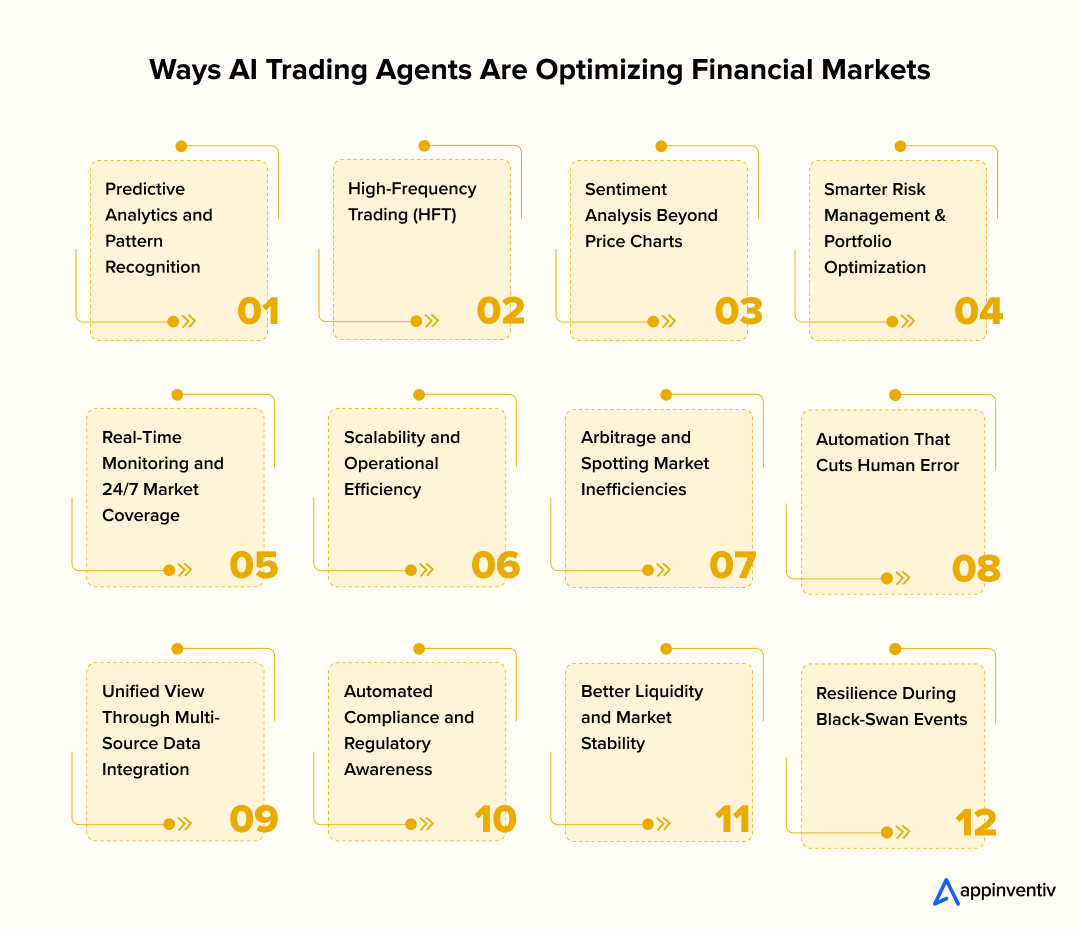
1. Predictive Analytics and Pattern Recognition
AI agents for trading are great at noticing things most traders simply gloss over. They go back through old price movements, compare them with what’s happening now, and pick up on tiny shifts that often hint at bigger moves ahead. It’s the kind of slow, detailed work that humans rarely have time for, and it’s where predictive AI in stock trading genuinely shines.
When something meaningful shows up, the system turns those clues into a simple, useful signal. Traders get a heads-up before the rest of the market catches on, giving them a chance to position themselves early. These insights are one of the clearest benefits of AI trading systems today.
2. High-Frequency Trading (HFT)
Speed decides who wins in high-frequency trading, and AI has turned it into a completely different game. These systems can fire off trades quicker than a blink, catching opportunities that appear and disappear almost instantly. This is the foundation of AI for high-frequency trading optimization.
Those micro-movements might look insignificant on their own, but when an AI agent repeats this process thousands of times a day, it adds up to real gains. It’s a volume game, and AI plays it flawlessly, especially when supported by smart algorithmic trading AI setups.
3. Sentiment Analysis Beyond Price Charts
Markets aren’t always driven by logic. A piece of news, a viral quote, or a rumor can shake things up faster than a chart can show. AI sentiment analysis-powered agents track this emotional side of the market by watching headlines, analyst commentary, and social buzz in real time, giving traders deeper AI-powered market analysis solutions.
This gives traders a sense of sentiment long before it shows up in price movements. It’s like having an extra sense that helps them figure out when the mood is about to swing — a key AI-powered trading agent use case many firms now rely on.
4. Smarter Risk Management & Portfolio Optimization
AI keeps an eye on every position at once, checking how they behave as conditions shift. If volatility spikes or something unexpected happens, it adjusts exposure automatically to prevent things from getting out of hand. This makes AI trading risk management far more adaptive.
This makes the portfolio more responsive. Instead of waiting for someone to review risk reports at the end of the day, the system reacts immediately to changes, unlocking stronger AI agents for portfolio optimization.
5. Real-Time Monitoring and 24/7 Market Coverage
Trading doesn’t stop just because one market closes. AI can track what’s happening across time zones without missing a beat. It watches liquidity, news, and price changes the same way a human would, just without needing breaks. This reliability is why autonomous trading agents in finance are becoming mainstream.
If something surprising hits, AI reacts right away. This helps traders stay ahead, especially during unpredictable global events where AI in financial markets truly proves its worth.
Also Read: Agentic AI in Finance: Revolutionizing Efficiency & Security
6. Scalability and Operational Efficiency
AI agents handle huge amounts of market data without slowing down. As firms expand into new markets or add more trading strategies, the system simply ramps up to match the load, a hallmark trait of autonomous trading systems.
For firms juggling multiple strategies, this reliability is a game-changer. Even on busy trading days, the system remains quick and steady, supporting large-scale AI trading automation setups.
7. Arbitrage and Spotting Market Inefficiencies
Small price gaps between exchanges don’t last long. AI spots them instantly and jumps in before anyone else realizes they’re there, one of the most profitable AI-powered trading agent use cases across global markets.
This not only helps traders capture profit but also smooths out inconsistencies between markets. In a way, AI contributes directly to healthier AI market optimization dynamics.
8. Automation That Cuts Human Error
Trading is stressful, and stress leads to mistakes. AI removes that by handling repetitive tasks like rebalancing or placing routine orders. It follows the rules exactly as they’re written, which is the core promise behind intelligent trading agents for enterprises.
With fewer manual steps, error rates drop sharply. The system follows the plan consistently, even during noisy markets, a major benefit of AI trading systems.
9. Unified View Through Multi-Source Data Integration
There’s more data in the trading world today than anyone could realistically process. AI combines price data, news, sentiment indicators, and economic trends into one clear view, becoming a powerful AI-driven market forecasting tool in the process.
This broader perspective helps traders understand the reasoning behind each move. It’s one of the reasons machine learning trading systems have been so widely adopted across investment firms.
10. Automated Compliance and Regulatory Awareness
Rules keep changing, and keeping track manually is exhausting. AI helps by automatically monitoring compliance requirements, directly supporting regulatory compliance for ai agents in trading.
It also keeps detailed logs in the background. This reduces stress around audits and keeps firms on the safe side of rapidly evolving regulations.
11. Better Liquidity and Market Stability
AI-driven systems help keep markets active by consistently placing orders. This tightens spreads, improves stability, and supports smoother overall AI-driven algorithmic trading.
More liquidity ultimately creates a better trading environment. Traders can smoothly move in and out of positions, which strengthens broader AI agent adoption in finance.
12. Resilience During Black-Swan Events
During sudden, unexpected events, markets behave in ways that catch everyone off guard. AI agents notice early signals, unusual activity, volatility spikes, or strange order flow, thanks to their AI-driven market forecasting tools.
They shift strategies immediately, helping control losses during turbulent periods. This ability is a cornerstone of modern autonomous trading systems.
| Feature | Traditional Algorithmic Trading | AI-Agentic Trading (2026) | Enterprise ROI Impact |
|---|---|---|---|
| Logic Type | Hard-coded rules | Adaptive learning + policy constraints | More resilient in volatile regimes |
| Data Intake | Mostly structured price/volume | Multi-modal (news, sentiment, voice, filings) | Faster news-to-trade reaction |
| Maintenance | Manual recalibration | Continuous learning with guardrails | Lower quant-hours, reduced OpEx |
| Compliance | Post-trade audit logs | Real-time “compliance-as-code” checks | Fewer audit surprises, safer scaling |
From predictive analytics to high-frequency execution, AI trading agents are already reshaping institutional trading.

What Trading Desks Typically Discover in the First 60 Days of AI Agent Deployment
- Execution strategies that perform well in backtests but degrade under live latency and liquidity pressure
- Hidden compliance gaps where models act correctly but fail audit explainability
- Signal overload where too many features dilute real decision quality
- Infrastructure bottlenecks that increase inference cost during volatile sessions
- Over-automation risks where human override paths are unclear or too slow
Real-World Examples of AI Trading Agents in Action
Even though a lot of the conversation around AI in financial markets sounds theoretical, some of the biggest names on the Street already run serious AI trading agents in production. Here are a few concrete examples.
1. JPMorgan – LOXM for AI-Driven Equity Execution
JPMorgan built an AI-driven execution system, LOXM, to optimize how it executes large equity orders across global markets. The platform uses deep reinforcement learning, trained on billions of historical and simulated trades, to decide when and how to slice orders, aiming to reduce market impact and improve prices.
Internal trials showed that LOXM outperformed both manual and older automated methods, delivering better execution and cost savings, making it a clear, large-scale example of AI trading automation at a tier-one investment bank.
Also Read: AI in Banking Software Development
2. BlackRock – Aladdin & Production-Grade AI Agents
BlackRock’s Aladdin platform sits at the core of how the firm and its clients manage portfolios, risk, and trading decisions across trillions in assets. Recent work on Aladdin Copilot and related tools layers in AI and “agentic” architectures to provide real-time portfolio insights, scenario analysis, and decision support for front-office teams.
BlackRock’s own engineering leaders have publicly described how they’ve built production AI agents into Aladdin to help investment teams act faster on risk and market signals, making it one of the most mature examples of intelligent trading agents for enterprises at a global scale.
3. Citadel Securities – AI-Enhanced Market-Making
Citadel Securities, one of the largest market makers in U.S. equities and options, has openly credited machine learning as a core part of its trading stack for more than two decades. Their teams use ML models to process huge volumes of tick data, react faster to price changes, and refine their market-making strategies.
By combining deep trading expertise with AI-powered analytics, Citadel delivers high-speed liquidity and tighter spreads across markets, which is exactly where AI trading agents for investment firms show their value in day-to-day trading, not just research labs.
4. Morgan Stanley & Aladdin Wealth – AI-Enabled Portfolio Decisions
On the wealth side, Morgan Stanley Wealth Management has rolled out an AI-enabled commentary tool on top of BlackRock’s Aladdin Wealth platform. The tool uses AI to generate portfolio insights and risk commentary for advisors inside Morgan Stanley’s portfolio risk platform, helping them act faster and more precisely on client portfolios.
This isn’t pure trading on its own, but it shows how AI agent adoption in finance is extending from institutional trading desks into day-to-day portfolio and risk decisions for clients, powered by the same underlying technology foundations.
How Much Does it Cost to Build an AI Trading Agent?
There isn’t one fixed price for an AI trading agent. The cost really depends on how serious the system needs to be. A small prototype built to test an idea is very different from a live trading setup that handles real money, adheres to strict risk limits, and undergoes compliance checks.
In practice, most builds fall somewhere between $40,000 and $400,000. The lower side is usually enough to prove a concept. The higher side is where you start seeing full-scale AI trading automation designed for real institutional use.
Here’s a simple way to look at it:
| Development Stage | Estimated Cost | What You’re Actually Building |
|---|---|---|
| Starter/Proof of Concept | $40,000 – $80,000 | A basic model to test strategy ideas. Limited data, simple logic, and usually paper trading instead of real execution. |
| Early Production Build | $80,000 – $180,000 | Real-time data handling, basic risk controls, and a working foundation for AI in algorithmic trading. Good for firms moving beyond experimentation. |
| Enterprise-Level System | $180,000 – $300,000 | Stronger infrastructure, multi-strategy support, better monitoring, and more stable autonomous trading systems built for daily use. |
| Advanced Institutional Platform | $300,000 – $400,000 | Fully customized architecture, fast execution layers, deep analytics, and scalable intelligent trading agents for enterprises running across markets. |
Why Does the Cost Change so Much?
A few things usually drive the budget:
- How complex the strategy is
- Number of markets and data feeds involved
- Speed and infrastructure are needed for AI for high-frequency trading optimization
- Compliance, monitoring, and security requirements
- How much autonomy is the system allowed to have
Most teams don’t start big. They build something smaller, test it in real conditions, and then expand. That step-by-step approach keeps risk low and helps firms move toward smarter AI market optimization without burning budget early.
Tech Stack for AI Trading Agent Development
A strong trading agent isn’t built on fancy tools alone. What matters is having a clean, dependable stack that keeps the system fast, stable, and easy to manage when markets get busy. Most teams don’t chase every new technology. They pick tools that work well together and support steady AI trading automation in real conditions.
Here’s a practical look at what usually sits under the hood:
| Layer | Common Technologies | Why It Matters |
|---|---|---|
| Programming Languages | Python, C++, Java | Python is widely used for research and model building. C++ or Java usually handle the execution side where speed matters most. |
| AI & ML Frameworks | TensorFlow, PyTorch, Scikit-learn | Help build predictive models and decision logic used in AI in algorithmic trading. |
| Data Processing & Streaming | Kafka, Spark, Pandas | Keeps live market data moving smoothly so autonomous trading systems can react in real time. |
| Databases & Storage | PostgreSQL, MongoDB, Redis, Time-series DBs | Store historical data, trade logs, and model outputs for quick access and audits. |
| Execution & OMS Layer | FIX Protocol, custom execution engines | Handles order routing and supports fast execution, especially important for AI for high-frequency trading optimization. |
| Cloud & Infrastructure | AWS, Azure, GCP, Kubernetes | Helps teams scale systems safely as intelligent trading agents grow within enterprises. |
| Monitoring & Observability | Grafana, Prometheus, ELK Stack | Shows system health, latency, and performance, so problems are spotted early. |
| Security & Compliance | Encryption, access controls, audit logs | Keeps data safe and ensures trading activity remains traceable and compliant. |
At the end of the day, a good stack isn’t about complexity. It’s about reliability. When the foundation is simple and stable, teams can focus less on technical fires and more on improving strategy and long-term AI market optimization.
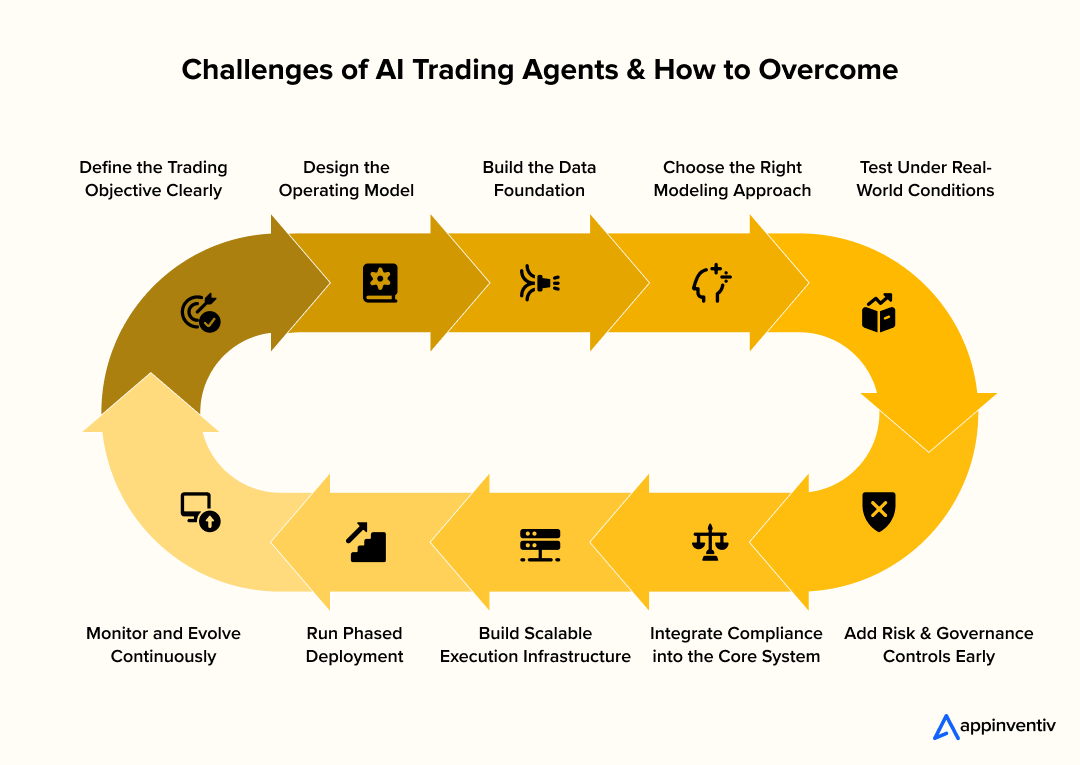
Challenges of AI Trading Agents & How to Overcome
Even the most advanced AI agents for trading run into real-world hurdles when markets move unpredictably or data turns unreliable. As adoption of AI grows across global desks, firms must learn to manage these challenges while still getting the most out of AI in financial markets.
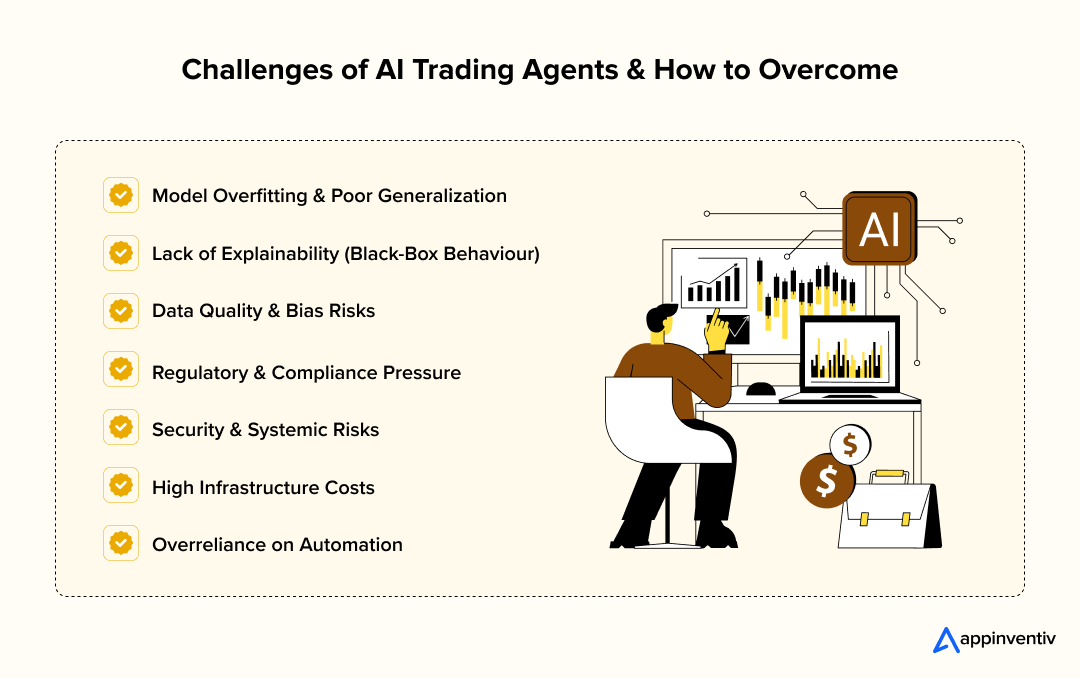
1. Model Overfitting & Poor Generalization
Many machine learning trading systems look impressive in backtests but fall apart when real markets behave differently. They learn patterns too closely, making them fragile during regime shifts or unexpected news cycles.
How to overcome: Use robust validation, diverse datasets, and regular retraining. Firms often combine predictive AI in stock trading with human supervision for sanity checks.
2. Lack of Explainability (Black-Box Behaviour)
A major concern, especially for enterprises, is that some advanced autonomous trading systems behave like black boxes. Traders don’t always know why a model took a particular action, which raises trust and compliance issues.
How to overcome: Adopt ethical AI trading systems and explainable AI frameworks that make decisions traceable. This helps meet internal oversight standards and supports stronger AI trading risk management.
3. Data Quality & Bias Risks
Poor or biased data can mislead even the most advanced AI trading automation. If the input is flawed, forecasts and execution decisions become unreliable.
How to overcome: Invest in strong data pipelines and cleaning processes. Many investment firms now rely on AI-powered market analysis solutions that filter, label, and validate data before models ever touch it.
4. Regulatory & Compliance Pressure
Financial rules evolve constantly, and failing to meet them can mean penalties. With AI moving trades at speed, maintaining regulatory compliance for AI trading becomes challenging.
How to overcome: Integrate compliance into the architecture itself. Automated logs, audit trails, and rule-based risk filters ensure every action aligns with global regulations.
5. Security & Systemic Risks
As more firms adopt AI in algorithmic trading, the risk of system-wide issues increases. A single glitch or feedback loop can cause large disruptions, especially during volatile hours.
How to overcome: Use isolated test environments, real-time monitors, and fallback controls. Some enterprises add custom trading agent development to create safety layers tailored to their strategies.
6. High Infrastructure Costs
Building and deploying intelligent trading agents for enterprises requires processing power, premium data feeds, and low-latency environments. This becomes expensive for firms scaling across markets.
How to overcome: Cloud-based AI trading platform integration and GPU-based scaling reduce upfront costs and allow teams to expand only when needed.
7. Overreliance on Automation
Relying too heavily on automation can make teams slow to react when something unusual happens. Even the best AI in financial market systems doesn’t entirely replace trader judgment.
How to overcome: Adopt hybrid models: pair AI with human review at critical points. Many firms blend AI trading agents with human oversight to balance speed and intuition.
Hybrid models, LLM-driven analysis, and autonomous systems are redefining the future of trading.
AI Trading Agent Development Solutions: Helping Gain Competitive Advantage
In fast-moving markets, the real advantage doesn’t come from trading more. It comes from making better decisions, faster and more consistently. That’s where AI trading agent development solutions make a difference.
These solutions help firms move beyond manual workflows and rigid systems by introducing smarter AI-driven trading automation into everyday operations. Instead of reacting late, teams gain tools that continuously analyze data, adapt to changing conditions, and support clearer decision-making.
Key advantages usually include:
- Faster execution and quicker reaction to market changes
- Improved consistency through AI in algorithmic trading strategies
- Better risk visibility and controlled automation
- Scalable autonomous trading systems that grow with trading volume
- Stronger insights for desks using intelligent trading agents for enterprises
At a practical level, the goal isn’t to replace traders. It’s to give them sharper systems that reduce noise, improve precision, and create a steady competitive edge in increasingly data-driven markets.
Future Trends Shaping the Next Generation of AI Trading Agents
As AI trading agents grow more capable, they’re setting the stage for a new era of smarter, more adaptive trading systems. The next wave of innovation will reshape how strategies are built, how risk is managed, and how market decisions are made.
- Hybrid human, AI models will become the norm, blending trader experience with fast, data-driven insights from AI trading automation.
- LLM-powered intelligence in finance will help systems interpret news, research reports, and earnings calls, making generative AI for trading far more practical.
- Multimodal data engines will merge charts, sentiment, macro signals, and alternative datasets to deliver richer AI-powered market analysis solutions.
- Autonomous trading systems will keep learning from every trade and every market cycle, adjusting strategies on their own.
- AI-driven market forecasting tools will simulate different market scenarios to help firms prepare for volatility.
- Compliance will get smarter too, with built-in controls that support regulatory compliance for AI trading without slowing execution.
- More firms will invest in developing custom trading agents, building tools tailored to their own strategies and risk profiles.
- As adoption grows, the push for ethical AI trading systems will intensify, ensuring that models remain transparent, fair, and trustworthy.
This next phase won’t just make trading faster- it will make it more intuitive, resilient, and aligned with how modern financial markets operate.
Trading firms engaging AI agent architecture and governance early typically avoid costly rework, compliance retrofits, and execution instability during live deployment.
How Appinventiv Can Help with AI Trading Agents Development
Building fast, dependable, and compliant AI trading agents isn’t just about writing code; it’s about understanding how real markets behave. That’s where Appinventiv stands out. As a leading AI consulting company, we’ve deployed more than 100 autonomous AI agents, trained 150+ custom AI models, and built solutions backed by a team of 200 data scientists and AI engineers who know how to turn complex data into clear decisions.
Our work with brands like MyExec and Mudra shows what this looks like in practice. With MyExec, we built an AI-powered business consultant capable of interpreting documents and offering strategic advice, the same kind of multi-agent reasoning and intelligence needed in advanced trading systems. Mudra, our AI-led finance and budgeting platform, proves how real-time insights, forecasting, and automated guidance can be engineered reliably, the same fundamentals behind strong AI agent development services for trading.
We align delivery with enterprise security expectations, including controls commonly mapped to ISO 27001 and SOC 2 Type II programs, plus encrypted data flows, least-privilege access, and immutable audit logs for trading actions.
For trading firms, this means one thing: AI systems that actually perform under pressure. Whether you need smarter forecasting, automated execution, portfolio intelligence, or compliance-ready workflows, we build solutions that match your strategy and scale with your ambition. With Appinventiv, you get a partner that knows how to turn AI into a real trading advantage, not just a technical experiment. Let’s talk!
FAQs
Q. How are AI trading agents improving financial market efficiency?
A. AI trading agents improve efficiency by analyzing huge volumes of market data instantly, spotting patterns earlier, and executing trades with greater precision than manual systems. Their ability to automate decisions reduces delays, tightens spreads, and strengthens the overall flow of AI in financial markets.
Q. What benefits do AI agents bring to institutional trading?
A. Institutions gain faster execution, cleaner insights, and more consistent strategies with AI trading agents. They help eliminate emotional bias, support high-volume strategies, and improve decision accuracy, making them essential for firms looking to scale advanced AI trading automation.
Q. How can AI trading agents reduce risk and improve returns?
A. These systems evaluate risk in real time and adjust positions automatically when conditions shift. Through smarter forecasting and continuous learning, AI trading agents identify opportunities earlier and help traders avoid sudden losses, ultimately improving long-term returns.
Q. What types of AI agents are used in financial markets?
A. Common types include predictive modeling agents, algorithmic trading AI agents, sentiment analysis agents, arbitrage agents, portfolio optimization agents, and autonomous execution systems. Each serves a different role in modern AI in algorithmic trading workflows.
Q. How can Appinventiv help build AI trading agent systems for enterprises?
A. Appinventiv builds custom, enterprise-grade AI systems using advanced ML models, deep-learning architectures, and secure engineering practices. From forecasting models to execution engines, our AI trading agents are designed for speed, compliance, and scale, making us a trusted partner for firms seeking powerful AI trading automation.
Q. What are the regulatory and compliance considerations for AI trading agents?
A. Firms must address auditability, transparency, and rule-based controls when deploying AI. Modern systems include built-in logs, automated checks, and clear decision pathways to meet evolving global regulations. Strong regulatory compliance for AI trading ensures that every trade is traceable and in compliance with market rules.
Q. Why Should You Invest in Our Custom AI Trading Agent Development?
A. Custom AI trading agent development helps you build systems that match your exact trading strategy, risk framework, and compliance needs. Instead of using generic tools, you get a solution designed for real market conditions, better scalability, and long-term performance aligned with your business goals.
Q. Can you integrate an AI agent with my existing trading system?
A. Yes. AI agents can be integrated with most existing trading platforms through APIs, data pipelines, and execution layers. The goal is to enhance your current setup, not replace it, allowing you to adopt AI trading automation while keeping your existing infrastructure and workflows intact.

- In just 2 mins you will get a response
- Your idea is 100% protected by our Non Disclosure Agreement.
How AI in Manufacturing in Australia is Transforming Factory Operations and Improving Productivity
Key takeaways: AI in manufacturing in Australia is becoming essential to offset labour shortages, rising energy costs, and global competition pressures. High-impact use cases like predictive maintenance and AI quality inspection deliver measurable productivity gains within existing factory infrastructure. Success requires integrating modern AI with legacy factory floor hardware without disrupting active production cycles. Implement…

How to Implement a RAG System for Retail: Architecture, Integration, and Best Practices
Key takeaways: A successful RAG system implementation for retail depends more on architecture and integration than on model selection. RAG integration with retail systems like PIM, ERP, OMS, and POS is critical to ensure accuracy and prevent misinformation. Hybrid retrieval, structured metadata, and freshness controls are essential for reliable RAG-powered systems in retail. Measuring operational,…
Simple Steps to Hire AI Governance Consultants in 2026
Key Takeaways Define AI risk tolerance and compliance goals before hiring consultants. Look for multidisciplinary teams combining governance, ML auditing, and MLOps expertise. Ensure consultants understand frameworks like the EU AI Act, NIST RMF, and ISO 42001. Prioritize experts who can operationalize governance inside ML pipelines. Embed responsible AI practices directly into CI/CD and model…