




























Appinventiv’s AI Center of Excellence: Structure, Roles, and Business Impact for Enterprises

- Why Enterprises Need an AI Center of Excellence Today
- The Appinventiv AI CoE Framework: Built for Enterprise Reality
- AI CoE Structure for Enterprises: How Ownership Actually Works
- Enterprise AI CoE Operating Model: How Work Flows Through the CoE
- Case Studies That Demonstrate Real Impact
- Business Impact: How Enterprises Measure Value
- Future-Proofing Your AI CoE: Looking Ahead to 2026
- How Appinventiv Supports Enterprise AI CoE Adoption
- FAQs

- Enterprises struggle less with AI ideas and more with turning those ideas into repeatable outcomes.
- An AI Center of Excellence provides structure, ownership, and clarity as AI initiatives scale.
- Clear roles, a practical operating model, and built-in governance are what keep AI programs from stalling.
- Measuring maturity and business impact helps enterprises decide what to scale and what to stop.
- A future-ready AI CoE adapts as priorities change, without forcing teams to rebuild how they work.
Enterprises are not short on AI ideas. What they often lack is a reliable way to turn those ideas into something that works again and again. Even now, most organizations are still stuck between promise and execution. According to McKinsey, while 88 percent of companies use advanced technologies in at least one area, only about one in three has managed to scale those efforts beyond pilots. The gap between experimentation and real impact remains wide.
Most enterprise AI initiatives don’t fail because of weak models. They stall because ownership, governance, and scaling frameworks are introduced too late. By the time enterprises attempt to structure AI programs, complexity has already multiplied across teams, vendors, and platforms.
For large enterprises, AI adoption itself is no longer the hurdle. That part is already underway. The harder problem is control. As teams experiment across functions, efforts tend to multiply. Standards drift. Similar issues get solved in parallel. Over time, it becomes harder to see which initiatives are actually moving the business forward.
This is where an AI Center of Excellence matters. An Enterprise AI Center of Excellence gives organizations a steady point of reference. It brings clarity to how AI is designed, governed, and scaled, replacing scattered pilots with a shared AI CoE framework that leadership can rely on.
At Appinventiv, AI Center of Excellence consulting is shaped by what happens after the pilot stage. Through InventivAI, the team helps enterprises put in place practical structures that support long-term growth, including the groundwork for a scalable generative AI center for excellence. In the sections ahead, we look at how this structure comes together, how responsibilities are defined, and how enterprises move AI from isolated efforts into a dependable business capability.
If your teams are already experimenting with AI but results feel uneven, it may be time to step back and look at structure, ownership, and governance before scaling further.

Why Enterprises Need an AI Center of Excellence Today
As AI adoption becomes part of everyday operations, many enterprises are discovering a new challenge. Innovation is moving faster than coordination. Teams build and deploy AI solutions, but ownership, standards, and visibility often lag.
This gap shows up quickly at the leadership level. Questions around reliability, security, and business impact become harder to answer as AI initiatives multiply. What enterprises begin to realize is that AI needs a clear owner and a shared way of working, not just capable teams.
An AI Center for Excellence provides that ownership. It gives enterprises a defined structure for deciding what to build, how to govern it, and when it is ready to scale. Instead of treating AI as a series of isolated projects, an Enterprise AI Center of Excellence creates a coordinated approach that leadership can stand behind.
What typically pushes enterprises toward an AI CoE
- Inconsistent AI practices across teams: Different tools, models, and standards make scaling difficult.
- Limited visibility for leadership: Progress exists, but impact is hard to track.
- Rising risk exposure: As AI influences core decisions, the cost of failure increases.
- Pressure to show measurable value: AI investments need to compound, not reset with each initiative.
By introducing a shared AI CoE framework, enterprises establish a centralized center of excellence model that brings clarity without slowing innovation. It becomes the foundation for controlled growth, stronger governance, and sustainable AI outcomes.
Up next, we look at how Appinventiv designs this framework in practice and how its AI Center of Excellence framework translates enterprise intent into execution.
The Appinventiv AI CoE Framework: Built for Enterprise Reality
At Appinventiv, an AI Center of Excellence is designed as an operating system for enterprise AI, not a static governance layer. The intent is simple: help organizations scale AI in a way that leadership can trust, teams can execute, and the business can measure over time.
This AI CoE framework is shaped by how large enterprises actually work. AI initiatives compete for budgets, data lives across systems, and AI risks cannot be addressed after deployment. The framework brings structure without slowing momentum, allowing AI to mature from isolated wins into a dependable enterprise capability.
How the Framework Comes Together
Appinventiv’s AI Center of Excellence framework is designed around connected capabilities shaped by real delivery experience and proven AI Center of Excellence best practices, rather than theoretical models.
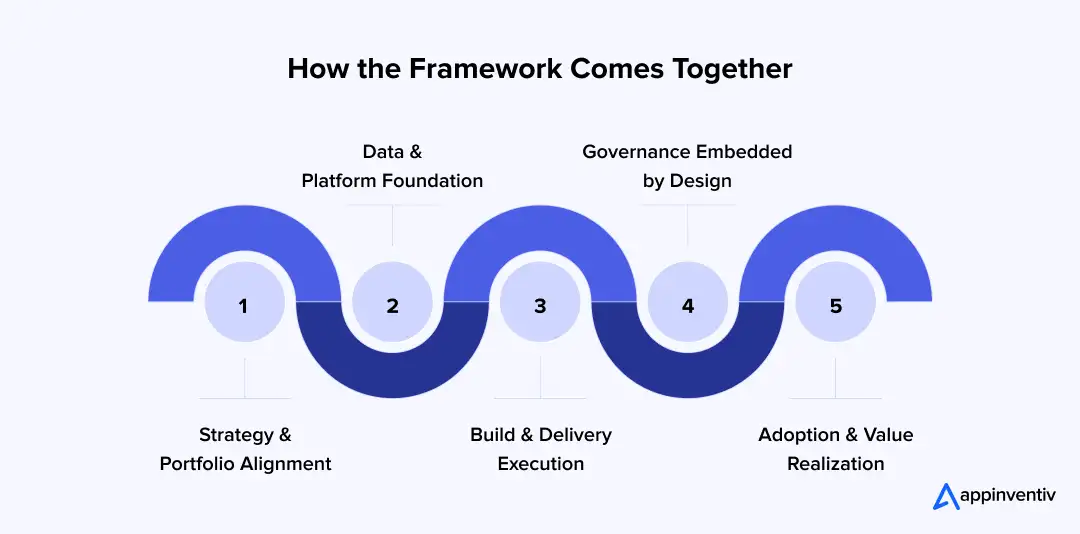
- Strategy and portfolio alignment: AI initiatives are reviewed against business priorities, readiness, and expected outcomes. This keeps the Enterprise AI Center of Excellence focused on work that delivers value, rather than ideas that look good on paper but struggle to scale.
- Data and platform foundation: Shared data practices, scalable platforms, and dependable tooling give teams a stable base to work from. This setup supports both predictive use cases and a growing generative AI center of excellence, while reducing friction as adoption increases.
- Build and delivery execution: Cross-functional teams work within a consistent AI Center of Excellence operating model. This makes it easier to move solutions into production, reuse existing components, and maintain quality across different use cases.
- Governance embedded by design: The artificial intelligence center of excellence governance model brings validation, monitoring, and risk checks into day-to-day delivery. This approach supports centralized AI data governance for enterprises without slowing teams down or creating extra handoffs.
- Adoption and value realization: AI initiatives are regularly reviewed to ensure they are used and deliver results. The focus stays on business impact, not just technical completion.
Why Enterprises Scale With this Approach
The framework supports gradual adoption through a clear AI CoE implementation roadmap. Enterprises can begin with centralized ownership and evolve toward a federated Enterprise AI CoE operating model as maturity grows.
The result is a practical foundation for scaling AI through a Center of Excellence, backed by Appinventiv’s hands-on AI Center of Excellence consulting experience across industries.
Next, we examine the AI CoE structure in enterprises, including the roles and responsibilities that keep this framework running at scale.
AI CoE Structure for Enterprises: How Ownership Actually Works
Even the strongest AI strategy can stall when ownership is unclear. In most large organizations, the issue is not talent or ambition. There is uncertainty around who makes decisions, who carries responsibility, and who steps in when AI systems move into business-critical areas.
This is where the AI CoE structure for enterprises comes into play. At Appinventiv, the structure of an Enterprise AI Center of Excellence is shaped by how organizations actually function, not how org charts look on paper. The aim is to keep things moving without losing control, and to allow AI efforts to scale without being rebuilt every year.
Most AI programs stall not due to lack of talent, but because decision authority and operational accountability remain fragmented across teams.
How Appinventiv Approaches Enterprise AI CoE Structure
Rather than relying on one large central team, the structure is layered. This keeps decision-making clear while keeping work close to the business.
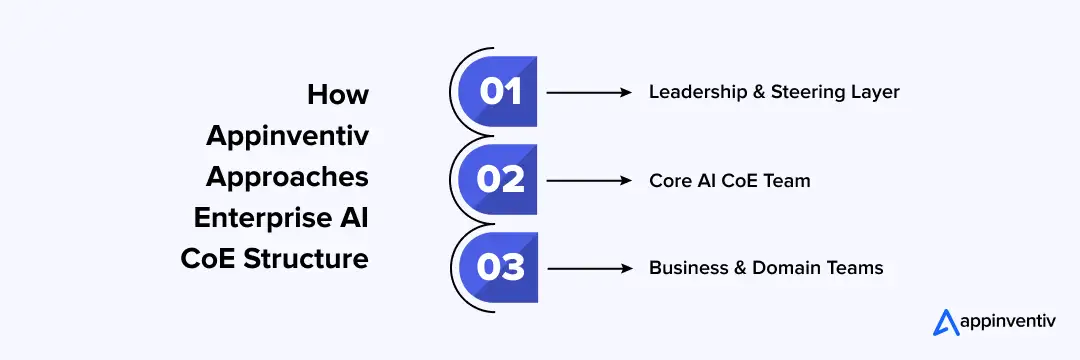
- Leadership and steering layer: This group sets direction and takes ownership of the bigger calls. It decides where AI investment makes sense, which initiatives move forward, and how AI supports broader enterprise goals. Just as important, it gives senior leaders a clear view of progress without pulling them into day-to-day execution.
- Core AI CoE team: This team focuses on shared practices. It defines how data, models, platforms, and delivery should work across the organization. The intent is not to slow teams down, but to remove repeated effort by offering patterns and guardrails that others can rely on.
- Business and domain teams: As confidence grows, more AI work shifts into business units. These teams work on problems specific to their domain, while still following the broader Enterprise AI operating model set by the CoE. This keeps execution flexible without letting standards drift.
Roles that Keep the Structure Grounded
Job titles vary, but successful AI CoEs tend to rely on a similar set of responsibilities.
- The AI CoE lead keeps direction clear and ensures business priorities, technology decisions, and governance stay aligned.
- Strategy and portfolio owners help decide what to invest in, what to scale, and what to pause or stop.
- Data and platform architects look after the foundations that support both current systems and an evolving AI/ML Center of Excellence.
- ML and AI engineers focus on building and running models in production, following shared practices that support a sustainable machine learning center of excellence.
- Governance and risk owners ensure compliance, validation, and oversight are part of the normal delivery process through a consistent Center of Excellence AI governance model.
This structure gives enterprises space to grow. Early on, decisions tend to sit closer to the CoE. Over time, as teams gain experience and standards settle, more execution moves outward without losing visibility or control.
The result is an AI Center of Excellence operating model that adapts as the organization evolves, maintains clear accountability, and supports steady AI adoption rather than short-lived experimentation.
Clear ownership and operating rhythm often make the difference between AI that stalls and AI that compounds. A focused review can highlight where structure needs tightening.

Enterprise AI CoE Operating Model: How Work Flows Through the CoE
An AI Center of Excellence only delivers value when it translates structure into momentum. The operating model is what makes that happen. It defines how ideas enter the system, how decisions are made, and how AI solutions move from concept to production without getting stuck in handoffs or rework.
At Appinventiv, the Enterprise AI CoE operating model is designed to feel familiar to enterprise teams. It mirrors product delivery more than research cycles, ensuring AI initiatives progress with clarity, accountability, and predictable outcomes.
From Intake to Production
Every AI in business initiative follows a clear, repeatable flow. This consistency is what allows enterprises to scale without losing control.
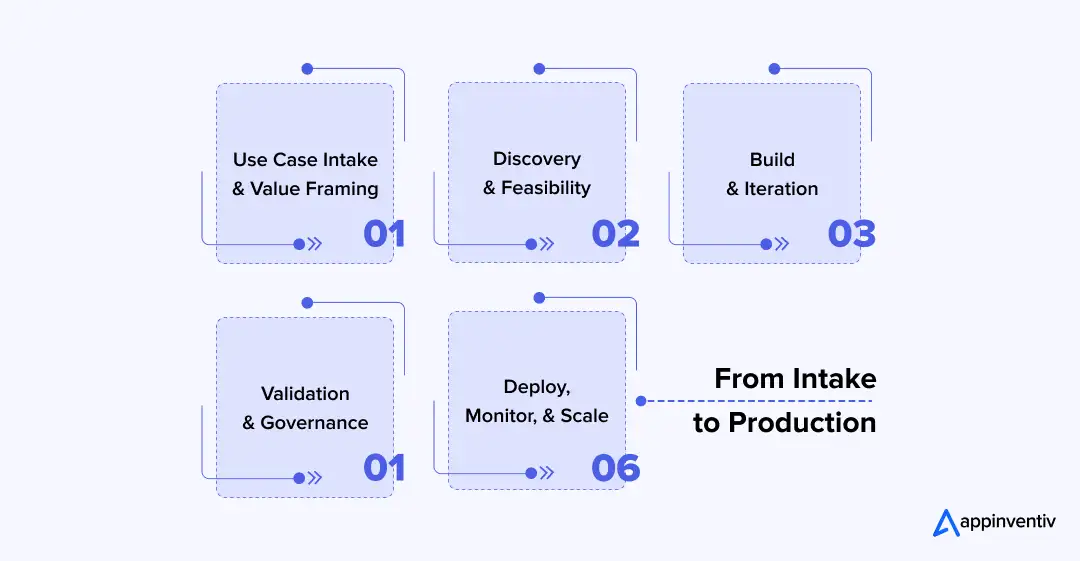
- Use case intake and value framing: Ideas typically originate from business teams, operations, or leadership. Instead of moving straight into development, they enter a shared intake process. Here, the problem statement, expected impact, data readiness, and risk considerations are discussed together. This early alignment prevents technically sound projects that fail to deliver business value.
- Discovery and feasibility: Approved ideas move into a short discovery phase. Teams assess data availability, integration dependencies, and model approach. Decisions are made early on whether a use case fits traditional machine learning, a hybrid approach, or a generative system. This stage sets realistic expectations before deeper investment begins.
- Build and iteration: Once feasibility is clear, cross-functional teams build within shared standards defined by the AI Center of Excellence operating model. Engineering, data, and governance move in parallel rather than sequentially. This reduces delays and avoids late-stage surprises.
- Validation and governance: Before deployment, models are reviewed for performance, reliability, and compliance. Governance is treated as part of delivery, not a final checkpoint. This reinforces the AI Center of Excellence governance model without slowing teams down.
- Deploy, monitor, and scale: After release, solutions are monitored for usage, accuracy, and business impact. Successful patterns are documented and reused, while underperforming initiatives are adjusted or retired. This feedback loop supports responsible growth and long-term stability.
Feedback Loops and Review Cadence
The operating model works because it relies on regular check-ins rather than one-off sign-offs. These moments create space to pause, reflect, and adjust before small issues turn into bigger ones.
- Monthly reviews focus on how things are actually running. Teams review delivery progress, early performance signals, and emerging risks.
- Quarterly portfolio discussions step back and reassess priorities. Leaders review where investment still makes sense, what should scale, and what no longer needs attention.
These rhythms help keep the AI Center of Excellence in step with the business as goals and conditions change.
Over time, this clarity reduces guesswork. Teams know how to bring ideas forward. Leaders understand how decisions are made. AI initiatives move ahead without relying on informal conversations or last-minute escalations.
That sense of familiarity is what makes scaling AI easier. New initiatives follow a known path, rather than forcing the organization to rethink the process every time.
Case Studies That Demonstrate Real Impact
See how Appinventiv helps enterprises move from AI concepts to real-world systems that improve decision-making, operational efficiency, and customer experience through measurable outcomes.
1. Flynas Airline App
The Challenge: Flynas was scaling rapidly across routes and customer touchpoints. The challenge was maintaining operational efficiency and a consistent digital experience while handling growing volumes of user interactions and operational data.
The Solution: Appinventiv strengthened Flynas’ digital platform with AI-driven capabilities focused on performance, reliability, and smarter data utilization. The solution was designed to support scale while aligning with airline operations and customer experience goals.
The Impact
- Supported millions of users across a fast-growing airline ecosystem
- Improved operational efficiency through smarter digital workflows
- Strengthened platform stability as digital demand increased
2. MyExec AI Business Consultant
The Challenge: Executives often spend too much time interpreting data before they can act on it. MyExec wanted to simplify decision-making by turning complex business data into clear, actionable insights.
The Solution: Appinventiv built an AI-powered business consulting platform that analyzes data, highlights key insights, and presents recommendations in a structured, easy-to-consume format for leadership teams.
The Impact
- Reduced time spent on manual business analysis
- Enabled faster, data-backed executive decisions
- Created a repeatable AI-driven consulting experience
3. Vyrb Social Media App
The Challenge: Vyrb set out to create a social experience that worked without screens. The goal was to help users stay connected through wearables while moving, working, or multitasking, something traditional social platforms were not designed for.
The Solution: Appinventiv developed Vyrb as a voice-first social app built specifically for Bluetooth-enabled wearables. Users can send and listen to short voice messages instantly, making interaction natural and hands-free.
The Impact
- Raised over $1M in seed funding
- Recognized as the first social platform built specifically for wearables
- Improved accessibility for users who prefer voice-led interaction
Across industries, enterprises scaling AI successfully follow a similar pattern: centralized standards, domain-level execution, and governance built into delivery cycles. The core principles behind a sustainable AI Center of Excellence.
Business Impact: How Enterprises Measure Value
Once AI is part of everyday operations, the questions change. Leaders stop asking what the models can do and start asking whether the organization is actually benefiting from them. Are decisions clearer? Are teams moving faster? Are risks showing up earlier than before?
This is where many AI programs struggle. There is plenty of activity, but not enough clarity on outcomes. A well-run artificial intelligence center of excellence helps close that gap by making impact part of the process, not something measured months later.
What Leaders Tend to Look For
In practice, enterprises track a small set of signals that already matter to the business:
- Revenue influence: Where AI supports forecasting, pricing, or personalization, leaders look for signs that it is shaping real outcomes.
- Operational efficiency: Less manual effort, shorter turnaround times, and fewer handoffs are often the first visible wins.
- Stability and risk: Fewer surprises, clearer ownership, and the ability to spot issues before they affect customers or operations.
- Decision confidence: Faster access to insights and greater trust in the outputs teams rely on every day.
These signals help leadership understand whether AI investments are building momentum or just adding complexity. As AI spreads across the enterprise, volume alone becomes a less useful signal. This is where an AI maturity assessment of CoE becomes important, helping leaders understand whether AI efforts are becoming easier to run, safer to scale, and more consistent over time.
Over time, these signals translate into measurable outcomes including reduced operational waste, faster decision cycles, and improved ROI predictability across AI investments.
How Measurement Turns into Action
What separates mature programs from stalled ones is how they use results. Within a shared AI CoE framework, outcomes are reviewed regularly, not just reported.
Some initiatives are scaled because they work. Others are adjusted or quietly retired. Patterns that prove reliable are reused across teams rather than rebuilt from scratch. Over time, this creates a rhythm where AI improves through use, not just intention.
When impact is tracked consistently, AI stops being defended project by project. It becomes part of how the enterprise thinks about performance and priorities. That shift is what allows an Enterprise AI Center of Excellence to function as a long-term asset, giving leaders confidence that AI is delivering value they can see, explain, and sustain.
Future-Proofing Your AI CoE: Looking Ahead to 2026
By 2026, most enterprises will no longer be debating AI adoption. That conversation will already be settled. The real concern will be whether the way AI is run today can still hold up as it becomes part of everyday business decisions.
The biggest risk for enterprise AI programs is not adopting new technology, it is building governance and operating models that cannot evolve as AI capabilities mature.
Future-proofing an artificial intelligence center of excellence is not about guessing what technology comes next. It is about building a setup that does not break every time priorities shift or a new capability enters the picture.
What many enterprises are starting to notice is that AI work no longer ends at deployment. Once models move into live systems, they need regular attention, adjustment, and sometimes restraint.
What is already changing on the ground:
- AI is showing up inside routine workflows, not just dashboards or experiments
- Leaders are being asked to explain AI-driven decisions more often
- Generative AI is moving closer to daily tasks, raising questions about boundaries and oversight
- Models age faster as data and business conditions change
Enterprises that are preparing for this are not chasing every new release. They are focusing on making their AI CoE flexible enough to adapt without forcing teams to reset their workflows each year.
That ability to absorb change quietly, without disruption, is what will matter most as AI becomes a permanent part of how organizations operate.
As AI becomes more embedded in daily decisions, the way it is governed and operated today will shape how well it holds up tomorrow.

How Appinventiv Supports Enterprise AI CoE Adoption
For most enterprises, building an AI Center of Excellence is not just about capability. It is about confidence. Leaders want to know that AI decisions are grounded, governed, and aligned with how the business actually runs. Appinventiv approaches this as an AI consulting company that understands both the pressure to move fast and the need to stay in control. Alongside delivery, strong governance services are built into the design and scaling of AI systems, not added later as a safeguard, drawing on experience from 300+ AI-powered solutions delivered, 150+ custom AI models trained and deployed, and 75+ enterprise AI integrations completed.
This delivery mindset is reinforced through InventivAI, Appinventiv’s AI practice focused on turning advanced AI into usable enterprise systems. Through InventivAI, teams work across data engineering, model development, MLOps, generative AI, and enterprise integration to support AI initiatives end-to-end. The emphasis stays on building solutions that hold up in real environments, across regions, users, and workflows, rather than stopping at experimentation.
What sets Appinventiv apart is its focus on outcomes over experimentation. AI initiatives are shaped with real operating environments in mind, where systems must work reliably across users, regions, and workflows. Governance services, security, and performance are treated as part of everyday delivery, helping enterprises avoid the cycle of promising pilots that never quite make it into long-term use.
An AI Center of Excellence only makes sense if it works with how the organization already runs. When ownership is clear and decisions move without friction, AI stops feeling risky and starts feeling useful. If you’re trying to figure out whether your AI CoE is set up the right way, Appinventiv can help you think it through. Sometimes the most useful step is just talking it out. Let’s talk!
FAQs
Q. How do you set up an AI Center of Excellence?
A. Most enterprises start by agreeing on ownership, not tools. Setting up an AI Center of Excellence usually begins with defining who decides priorities, how risks are handled, and how success will be measured. From there, teams put a basic AI CoE framework in place to guide use cases, delivery standards, and governance. The aim is consistency, not complexity.
Q. How do you build an AI Center of Excellence?
A. Building an Enterprise AI Center of Excellence is an incremental process. Enterprises typically start centralized, then expand as confidence grows. A clear AI Center of Excellence operating model and a realistic AI CoE implementation roadmap help teams move from early coordination to a more federated setup without losing control.
Q. What is an AI Center of Excellence, and why do enterprises need it?
A. An artificial intelligence center of excellence gives enterprises a shared way of working with AI. Without it, teams often move fast but in different directions. Over time, that leads to duplication, governance gaps, and unclear ROI. A CoE helps bring alignment so AI efforts build on each other instead of competing for attention.
Q. How should large enterprises structure an AI Center of Excellence?
A. Large organizations usually need an AI CoE structure for enterprises that balances oversight with execution. A common center-of-excellence model includes a small central team that sets standards and governance, while business units deliver within those guardrails. This fits well within a broader Enterprise AI operating model in which scale and control coexist.
Q. What roles are critical in an enterprise AI CoE?
A. An effective enterprise AI CoE depends on a few core roles being clearly owned. These usually include leadership for direction, strategy for prioritization, data and platform expertise, delivery engineering, governance, and adoption support. Together, these roles form a practical AI/ML center of excellence that keeps AI moving from build to real use.
Q. How does an AI CoE speed up adoption and ROI?
A. An AI COE reduces friction. Teams stop rebuilding the same solutions, governance becomes clearer, and decisions are made earlier. This makes scaling AI through a Center of Excellence more predictable, helping enterprises focus investment on what works and exit what doesn’t sooner.
Q. How can Appinventiv help enterprises build and run an AI CoE?
A. Appinventiv supports enterprises through an AI Center of Excellence consulting that is rooted in delivery. As an experienced AI consulting company, the team helps define the AI Center of Excellence framework, establish the AI Center of Excellence governance model, and apply practical AI Governance Services so AI systems hold up in real operating environments.
Q. What business outcomes can executives expect from an AI Center of Excellence?
A. Executives usually see clearer priorities, fewer delivery surprises, and better reuse of AI investments. A mature Enterprise AI Center of Excellence supports steadier decision-making, lower operational risk, and a stronger foundation for advanced capabilities, including a scalable generative AI center of excellence and a broader technology center of excellence strategy.

- In just 2 mins you will get a response
- Your idea is 100% protected by our Non Disclosure Agreement.

AI Voice Receptionist Development: Business Use Cases, Technology Architecture, and Cost
Key takeaways: Start with real call use cases, not tech. Define high-frequency intents, workflows, and escalation paths before building anything. Build a low-latency voice pipeline. Reliable telephony and real-time audio streaming make conversations feel natural. Set up the core AI loop. STT→LLM→TTS should handle intent, context, and responses in near real time. Ground responses with…
Key takeaways: Generative AI specialises in content synthesis and creation, while Agentic AI focuses on autonomous reasoning and multi-step task execution. Targeted benefits of generative AI and agentic AI in Australia include nearly a 35% reduction in operational bottlenecks and 70% faster workflows. Prioritise Gen AI for workforce augmentation and Agentic AI for high-stakes, autonomous…

How Much Does It Cost to Build a Conversational AI Chatbot in the UAE?
Key Takeaways AI chatbot development in the UAE typically costs AED 150,000–1,470,000 ($40K–$400K), based on complexity. Backend integration and compliance drive cost more than the chatbot interface itself. Arabic NLP, UAE hosting, and PDPL requirements increase budget and engineering effort. LLM + RAG enterprise chatbots sit at the higher end due to integration and infrastructure…