





















- Why Retail Software Decisions Fail and What Leaders Underestimate
- What Modern Retail Software Actually Means (Beyond POS and eCommerce)
- Business Benefits of Retail Software development That Leaders Actually Measure
- Real-World Retail Software Implementation Success Stories
- Retail Software Architecture That Scales With Growth
- How to Build a Retail Software: Implementation Roadmap
- Common Challenges in Retail Software Development and How Leaders Address Them
- Retail Software Development Costs and ROI for Long-Term Investment
- Where Advanced and Future Technologies Fit in Retail Software Development
- How to Choose the Right Retail Software Development Partner
- How Appinventiv Helps Retail Businesses Build Scalable Software
- Frequently Asked Questions
Key takeaways:
- Retail software development now plays a direct role in revenue growth, inventory accuracy, and long-term customer value.
- As retail operations expand across channels and regions, off-the-shelf tools often fail to keep systems, data, and teams aligned.
- Software development for retail works best when platforms are designed as connected systems, not isolated POS or eCommerce tools.
- A phased, architecture-first approach helps control risk, timelines, and retail software development cost.
Retail businesses today operate across stores, mobile apps, websites, marketplaces, and fulfillment partners. Each channel generates data, transactions, and customer interactions. When these systems do not work together, growth slows, costs rise, and decision-making becomes reactive.
Retail software development has moved far beyond basic POS or eCommerce tools. For many organizations, it now supports pricing, inventory planning, fulfillment, customer engagement, and operational reporting. As operations expand across regions and channels, software development for retail becomes a strategic investment rather than a technical upgrade.
This guide focuses on how organizations approach retail software development for business growth. It explains where standard tools fall short, when custom retail software development becomes necessary, and how modern retail system software is designed to handle scale, complexity, and long-term change.
At Appinventiv, we help enterprises plan and build retail systems aligned with this shift.
Why Retail Software Decisions Fail and What Leaders Underestimate
Retail software decisions often fail not because of weak execution, but because early assumptions go unchallenged. At scale, small compromises in system design turn into long-term constraints.
| Feature | Off-the-Shelf Retail Software | Custom Retail Software Development |
|---|---|---|
| Speed to Market | High (Days/Weeks) | Moderate (Months) |
| Scalability | Limited by provider | Elastic and architecture-driven |
| Integration Depth | Plug-ins only | Full API and legacy integration |
| Long-Term Cost | High recurring fees | Lower TCO with owned IP |
| Competitive Differentiation | None | High, proprietary workflows |
Fragmented systems hurt margins, not just experience
Many retail environments grow through disconnected tools added over time. POS, inventory, eCommerce, and analytics operate in silos. The result is delayed data, manual workarounds, and inconsistent reporting. These gaps directly affect pricing decisions, stock availability, and fulfillment costs.
“Off-the-shelf plus patches” breaks down as complexity grows
Standard platforms work well for limited use cases. Problems start when businesses extend them with custom scripts, plugins, or point integrations. Over time, these fixes increase maintenance effort, slow releases, and restrict change. What looks cost-effective early often raises the retail software development cost later.
Data issues remain hidden until decisions suffer
Slow inventory sync, duplicated customer records, and inconsistent product data do not always surface as system errors. They appear as missed sales, excess stock, and reactive pricing. Without reliable data flow, even well-funded retail system software fails to support timely decisions.
Successful retailers think in systems, not tools
They approach retail software development as a connected platform effort. Decisions are guided by long-term operating models, clear data ownership, and planned evolution. This mindset reduces rework, supports growth, and keeps software development for retail aligned with business priorities.
What Modern Retail Software Actually Means (Beyond POS and eCommerce)
Modern retail software is best understood as a connected system of capabilities that supports the entire retail value chain. Its role is not only to process transactions, but to keep data, decisions, and execution aligned across the business.
At an enterprise level, retail system software typically spans five tightly linked layers.
The Transaction Layer
This includes POS systems, checkout flows, payment processing, and returns. These systems must be fast, reliable, and consistent across locations and channels. Failures here show up immediately as lost revenue or poor customer experience.
For global retailers, transaction integrity is non-negotiable. We design transaction layers to maintain ACID compliance, ensuring that inventory is not oversold across regions when the same product is purchased simultaneously online and in-store. This becomes critical during flash sales and regional campaigns.
The Commerce and Order Layer
This layer controls how products are listed, priced, and sold across channels. It handles promotions, carts, and order flow from checkout to fulfillment. When this layer is well structured, customers see consistent pricing and availability, regardless of where they shop. As volumes increase and fulfillment options expand, this layer becomes harder to manage and more critical to keep stable.
The Supply Chain and Inventory Layer
This layer tracks where products are stored and how they move. It covers inventory updates, warehouse coordination, replenishment rules, and supplier data. Gaps here often lead to stock mismatches or manual corrections. Retail management software development often focuses heavily on stabilizing this layer.
The Customer Layer
This layer brings together customer records, loyalty activity, and service history. Its role is to keep customer information consistent across touchpoints. When this layer is fragmented, service quality drops and retention efforts lose impact.
The Intelligence and Reporting Layer
This layer turns operational data into usable insight. It includes reporting, dashboards, forecasting, and decision support. For many organizations, this is where the value of retail software development becomes visible. Poor data flow here results in delayed or unreliable decisions.
The key point is that these layers must work together. Isolated systems create blind spots. Point integrations add short-term fixes but increase long-term risk. This is why many enterprises move toward custom retail software development or platform modernization. The goal is not customization for its own sake, but control, consistency, and the ability to change without breaking core operations.
Business Benefits of Retail Software development That Leaders Actually Measure
Retail software investments are evaluated on outcomes, not intent. For enterprise leaders, the value of retail software development lies in how clearly it improves financial control, operational stability, and customer continuity across channels.
Below are the business benefits of retail software development that decision-makers consistently measure over time.
Improved Revenue Consistency Across Channels
When systems operate in silos, pricing and availability often drift out of sync. Customers may see different offers online than in stores, or find items listed but not actually available. Bringing POS, ecommerce, and order flows together helps keep information aligned and reduces revenue loss caused by these gaps.
Stronger Inventory Accuracy and Control
Inventory errors rarely appear as system failures. They surface as empty shelves, slow-moving stock, or rushed fulfillment decisions. When retail software is built with inventory visibility in mind, teams get a clearer picture of stock movement. This helps plan replenishment more accurately and cuts down manual fixes across stores and warehouses.
Faster and More Reliable Fulfillment Operations
As order volumes grow, fulfillment paths become complex. Orders may ship from stores, warehouses, or third-party partners. Custom software development for the retail industry that supports flexible order routing helps teams meet delivery commitments while controlling logistics costs. It also reduces delays caused by manual order handling.
Better Margin Protection
Pricing decisions depend on demand, stock levels, and regional performance. When these signals arrive late or remain inconsistent, margins suffer. Retail software development ensures pricing, promotions, and markdowns are guided by timely and accurate data rather than assumptions.
Operational Efficiency Across Teams
Manual reconciliation between systems increases workload for store staff, operations teams, and finance. Integrated retail system software reduces repetitive tasks and reporting gaps. Teams spend less time correcting data and more time managing exceptions that require judgment.
Clearer Visibility for Leadership Decisions
Leadership teams depend on reliable reporting to plan expansion, assess performance, and manage risk. When systems are fragmented, reports often conflict. Developing a retail software platform with shared data models improves confidence in operational and financial reporting.
Greater Adaptability to Change
Retail environments change often. New channels, fulfillment models, payment methods, or regulatory requirements appear with little notice. Custom retail software development provides greater control over change cycles. Updates can be planned without disrupting core operations or customer experience.
Many enterprises adopt MACH principles (Microservices, API-first, Cloud-native, and Headless) to stay vendor-agnostic and reduce long-term lock-in. This makes it easier to replace individual components without rewriting the entire retail platform.
Lower Long-term Cost Exposure
Initial build cost is only part of the equation. Systems that rely on heavy customization of third-party tools often become expensive to maintain. A well-structured approach to software development for retail reduces long-term dependency risks and helps control future retail software development costs.
These benefits explain why many enterprises move beyond basic tools and invest in scalable retail software development. The focus shifts from short-term fixes to building systems that support growth, stability, and informed decision-making over time.
Real-World Retail Software Implementation Success Stories
Practical examples of retail software in action clarify how strategic development delivers measurable business improvement. The following cases from Appinvenitv show our expertise in how we used structured systems to address real challenges and improve operations. Each example ties back to retail software development that supported better outcomes.
Y.K. Almoayyed & Sons – Modernizing Retail and Distribution
Client profile: A diversified enterprise with deep retail and distribution operations across automotive and lifestyle products.
Challenge: Legacy systems could not support fast data retrieval, secure storage, or scale with new business demands.
Approach: A unified retail and distribution platform was developed to centralize data workflows and strengthen infrastructure security. The architecture included automated data tiering and efficient indexing to streamline retrieval.
Impact:
- Storage cost reduced by around 32 percent.
- Data retrieval became faster, with search and access workflows simplified for internal teams.
This case illustrates how custom retail software development can solidify operational foundations in enterprises with complex data demands.
IKEA – Enhanced ERP and Experience Platform
Client profile: A global furniture and home goods retailer with high in-store and digital traffic.
Challenge: The brand needed a reliable system that provided real-time visibility into product availability and enabled better customer onboarding and engagement.
Approach: A custom ERP solution was created, incorporating real-time catalogue status and customer data capture.
Impact:
- Deployment in multiple stores increased operational consistency.
- Improved insights into customer behaviour supported broader marketing and engagement efforts.
This demonstrates how retail software development for business use can unify customer and operational signals where standard systems fall short.
Architect’s Note
In the IKEA project, the biggest hurdle wasn’t the UI; it was the real-time synchronization of 500+ global warehouses. We solved this by implementing an event-driven architecture using Kafka.
Adidas – Scalable eCommerce Platform
Client profile: A global sportswear brand with a strong online presence.
Challenge: Adidas needed a dependable eCommerce platform capable of supporting heavy traffic and regional campaigns without degrading experience.
Approach: Retail application development focused on fast performance, engaging interfaces, and tight backend integration for inventory and promotions.
Impact:
- Millions of app downloads indicate broad user adoption and platform stability.
- Improved customer engagement supported sustained online growth.
Adidas’s case shows how custom software fills gaps that standard eCommerce tools cannot when customer expectations and traffic volumes are high.
Technical Note
During high-traffic product drop events, we implemented AWS Auto Scaling Groups combined with Redis caching to handle 10× spikes in concurrent users. This ensured sub-second response times even under sustained peak load.
Edamama – Integrated eCommerce Experience
Client profile: A specialized retail brand focused on curated product experiences.
Challenge: The client needed a smoother online shopping experience with strong usability and dependable performance.
Approach: A tailored eCommerce platform was built with clear user flows, responsive interfaces, and convenient feature sets.
Impact: The resulting platform supported market expectations and boosted overall engagement.
This example reflects how retail software development can support brand differentiation through technology tailored to specific operational and customer needs.
6thStreet – Performance and Engagement Optimization
Client profile: A fashion retail brand with extensive product listings and online catalog complexity.
Challenge: Users experienced slow app performance and inconsistent navigation, which harmed engagement rates.
Approach: Core app modules were reworked to improve data handling, loading times, and search behavior. Payment gateways and push features were reinforced.
Impact:
- App launch times dropped to under three seconds.
- Millions of downloads followed, indicating stronger user retention and reach.
6thStreet’s case highlights how targeted retail software enhancements can improve performance and customer satisfaction.
These success stories show patterns enterprises frequently face: data complexity, performance limits, inconsistent integration, and the need for tailored capabilities. They also show how strategic retail software development addresses these areas, turning technical decisions into stronger business outcomes.
Explore our retail software development services built for enterprise complexity.
Retail Software Architecture That Scales With Growth
Retail software architecture defines how well systems hold up as operations expand. For enterprise environments, architecture decisions affect stability, speed of change, and long-term cost. This section explains the core architectural approaches used in retail software development and when each one makes sense.
The goal is not technical complexity. It is to create a structure that supports growth without constant rework.
Monolith vs. Microservices: Choosing the Right Core
The choice between monolithic and microservices becomes critical for many businesses. Many retail platforms start as monolithic systems. In this model, all features live inside a single codebase. When a monolith makes sense:
- Limited integrations
- Predictable traffic patterns
- Smaller product and order volumes
Monoliths are easier to build early on. They reduce coordination overhead and can speed up initial delivery. However, as channels, regions, and integrations grow, changes become slower and riskier.
Microservices architecture separates business functions into independent services. When microservices make sense:
- Multiple sales channels and fulfillment paths
- Frequent feature updates
- Independent scaling needs across systems
In retail system software, microservices are often used for inventory, pricing, orders, payments, and customer data. This approach supports flexibility but requires stronger governance and integration discipline.
Most enterprises adopt a hybrid approach. Core systems may remain centralized while high-change areas move to services over time.
When moving from monoliths to microservices, enterprises must account for the latency tax. Each internal API call adds overhead. To manage this, Appinventiv commonly uses gRPC for internal service communication to reduce east-west traffic latency and GraphQL at the API gateway to prevent over-fetching on mobile and web clients.
Headless Commerce and Composable Architecture
Headless commerce separates the frontend experience from backend logic. This allows teams to change user interfaces without affecting core systems.
In retail development, this approach supports:
- Faster updates to web and mobile experiences
- Consistent backend logic across channels
- Easier regional customization
Composable architecture builds systems from modular components rather than a single platform. Each component handles a specific role, such as search, checkout, or promotions.
This model works well in custom retail software development where flexibility and long-term change are priorities. It also reduces dependency on a single vendor.
Event-Driven Systems for Inventory and Orders
Retail operations rely on timely updates. Inventory changes, order status updates, and fulfillment actions must move quickly between systems.
Event-driven architecture meets this need by enabling systems to respond to changes as they occur.
Common examples include:
- Inventory updates triggered by sales or returns
- Order status changes shared across channels
- Fulfillment events sent to logistics partners
This approach reduces delays and avoids tight system coupling. It is widely used in retail management software development where accuracy and speed matter.
API-First Integration Strategy
Retail platforms depend on many internal and external systems. APIs act as stable contracts between them.
An API-first approach:
- Simplifies integration with POS, ERP, and third-party services
- Supports future system changes without breaking dependencies
- Improves control over data flow and access
In retail software development, APIs reduce long-term risk by keeping systems loosely connected and easier to maintain.
High-Level Architectural View
At a high level, scalable retail software architecture includes:
- Frontend layers for store, web, and mobile experiences
- Backend services for orders, inventory, pricing, and customers
- Integration layers for partners and legacy systems
- Shared data and reporting components
Each layer has a clear role. Changes in one area should not disrupt the others. This structure supports steady growth while keeping operational risk manageable.
How to Build a Retail Software: Implementation Roadmap
Retail software succeeds when execution follows a clear, structured path. For enterprise organizations, a rushed retail software development process increases risk and cost. A phased roadmap helps teams move forward with control, visibility, and accountability.
Below is a practical implementation approach used in software development for retail environments.
Discovery and System Audit
Every successful initiative begins with clarity. The discovery phase focuses on understanding how existing systems work and where they fall short.
Key activities include:
- Reviewing current POS, eCommerce, inventory, and reporting systems
- Mapping data flow between systems and identifying gaps
- Defining business goals tied to measurable outcomes
- Assessing integration dependencies and compliance requirements
This step sets the foundation for retail software development for business needs. It reduces assumptions and prevents scope changes later.
Phased Rollout Instead of a Big-Bang Launch
Enterprise retail systems rarely benefit from full-scale launches. A phased approach lowers disruption and allows teams to learn and adjust.
Typical rollout phases include:
- Core transaction and inventory stabilization
- Order management and fulfillment workflows
- Customer-facing experiences across channels
- Reporting and operational visibility
Each phase builds on the previous one. This approach supports better change control and protects daily operations while building a retail software platform.
Delivery Head’s Perspective
In enterprise retail environments, replacing legacy systems in one move is rarely practical. We often apply a Strangler Fig Pattern, where new services gradually take over specific functions while legacy systems continue running in parallel. This allows retailers to modernize critical workflows without downtime, reduce risk during peak seasons, and validate changes incrementally before full transition.
Pilot Stores and Controlled Launches
Before full deployment, pilot environments provide real-world validation. Pilot stores or regions help test performance, integrations, and user adoption.
During pilot stages:
- Teams validate system behavior under live conditions
- Store staff and operations teams provide feedback
- Issues are addressed before wider rollout
This step is critical in custom retail software development. It reduces operational risk and builds confidence across stakeholders.
Continuous Optimization After Go-Live
Implementation does not end at launch. Retail environments evolve, and systems must keep pace.
Post-launch focus areas include:
- Monitoring system performance and data accuracy
- Refining workflows based on usage patterns
- Expanding capabilities as business needs change
Ongoing optimization ensures retail system software remains aligned with growth plans and operational goals. It also helps manage retail software development cost over time by avoiding reactive fixes.
A structured roadmap brings discipline to execution. It connects strategy to outcomes and ensures retail software development delivers lasting value, not short-term fixes.
Common Challenges in Retail Software Development and How Leaders Address Them
Retail software development introduces complexity that grows with scale. Enterprise leaders often face similar obstacles, regardless of geography or retail segment. Understanding these challenges early helps reduce disruption and keeps execution aligned with business goals.
Below are the most common challenges and best practices in custom retail software development.
Legacy System Integration
Many retail environments rely on long-running systems for POS, ERP, or warehouse operations. These systems were not designed to connect easily with modern platforms.
What goes wrong
- Slow data exchange between systems
- Manual reconciliation across teams
- Limited visibility into real-time operations
How leaders address it
- Introduce integration layers instead of replacing systems at once
- Use APIs to standardize data exchange
- Modernize in phases while keeping core operations stable
This approach supports retail system software evolution without forcing risky replacements.
Data Inconsistency Across Channels
Retail data often lives in silos. Product details, inventory levels, and customer records may differ across systems.
What goes wrong
- Conflicting reports for leadership
- Inaccurate inventory availability
- Delayed pricing and promotion decisions
How leaders address it
- Define clear data ownership across systems
- Standardize product, inventory, and customer data models
- Align reporting on shared data sources
Strong data discipline improves outcomes across retail management software development initiatives.
Data Strategy Lead’s Insight
One of the most damaging issues we see is “ghost inventory”; stock that appears available but isn’t. To prevent this, we help retailers establish a Single Source of Truth using Master Data Management (MDM). By centralizing product and inventory records, especially before high-volume periods like holiday sales, teams avoid overselling, reduce last-minute substitutions, and protect customer trust.
Peak Load and Performance Issues
Sales peaks during promotions or seasonal demand place stress on systems. Performance issues often appear when traffic and transaction volumes rise.
What goes wrong
- Slow checkout flows
- Failed transactions
- Delays in order processing
How leaders address it
- Design systems to scale only where needed
- Test performance under peak conditions before major launches
- Separate high-traffic services from backend processing
This planning supports stable retail application development under pressure.
Security and Compliance Requirements
Retail platforms handle sensitive data, including payments and customer information. Security failures carry legal and reputational risk.
What goes wrong
- Inadequate access controls
- Poor handling of payment data
- Gaps in compliance monitoring
How leaders address it
- Apply strict access and role controls
- Isolate payment processing from core systems
- Build compliance checks into development workflows
Security is treated as a continuous responsibility, not a one-time task.
Adoption Resistance from Store and Operations Teams
Even well-built systems can fail if teams do not adopt them fully. Resistance often comes from workflow changes or unclear benefits.
What goes wrong
- Workarounds outside the system
- Incomplete data entry
- Reduced system trust
How leaders address it
- Involve operations teams early in design
- Introduce changes in stages
- Provide clear training tied to daily tasks
This ensures building a retail software platform that supports people, not just processes.
Model and Logic Drift in Advanced Features
Retail systems that include forecasting or automation logic can lose accuracy over time as behavior changes.
What goes wrong
- Outdated assumptions drive decisions
- Manual overrides increase
- Trust in system outputs declines
How leaders address it
- Review business rules and models regularly
- Monitor outcomes against expectations
- Adjust logic based on real usage patterns
This keeps retail software development for business aligned with current conditions.
Addressing these challenges requires planning, discipline, and experience. When risks are identified early and handled methodically, retail software development becomes a stable foundation for growth rather than a source of disruption.
Retail Software Development Costs and ROI for Long-Term Investment
Retail software development costs vary widely. The difference usually comes from scope, system complexity, and how much change the business expects over time. For enterprise leaders, the real question is not only how much it costs to build, but what it costs to own and evolve the system.
This section explains typical cost ranges and the retail software key features that influence them.
Typical Cost Range for Retail Software Development
For most organizations, retail software development costs fall into broad ranges:
Mid-scale retail platforms:
Projects focused on core commerce, inventory, and integrations usually range from $30,000 to $200,000+.
Enterprise-grade retail systems:
Platforms covering multiple channels, regions, integrations, and data workflows often range from $100,000 to $400,000 or more, depending on scope.
These figures include design, development, testing, and initial deployment. Ongoing support and enhancements are separate considerations.
What Drives the Cost
Retail software development for business growth is shaped by several cost drivers:
Scope of functionality
POS integration, inventory logic, order management, reporting, and customer systems each add effort.
Integration complexity
Connecting ERP, warehouse systems, payment providers, and third-party tools increases development time.
Customization level
Custom retail software development costs more than basic configuration, but reduces future constraints.
Data migration and cleanup
Moving and standardizing historical data is often underestimated and affects timelines.
Security and compliance requirements
Payment handling, access controls, and audit readiness add necessary effort.
Build Cost vs. Long-Term Ownership
Many organizations focus on initial build cost and overlook long-term impact.
Key ownership considerations include:
- Maintenance and updates
- Infrastructure and hosting
- Ongoing integrations
- Enhancements driven by business change
A lower upfront build can lead to higher total cost if systems require frequent workarounds. In contrast, structured custom software development for the retail industry helps control long-term spend by reducing rework and dependency risk.
Planning Cost with Confidence
Clear requirements, phased delivery, and realistic timelines help avoid budget surprises. Enterprises that treat retail software development as a long-term investment, rather than a one-time project, achieve better cost predictability and stronger outcomes.
Cost discussions become more effective when aligned with the roadmap, architecture, and business priorities rather than feature lists alone.
Also Read: How much does it cost to develop a retail app like Walmart?
Where Advanced and Future Technologies Fit in Retail Software Development
Advanced technologies play an important role in modern retail systems. However, their value depends on timing, data readiness, and clear business use cases. For enterprise leaders, the focus should be on where these technologies add stability and insight, not on adopting them too early or without purpose.
Let’s have a look at how advanced technologies fit into today’s environment and how they shape the future of retail software development.
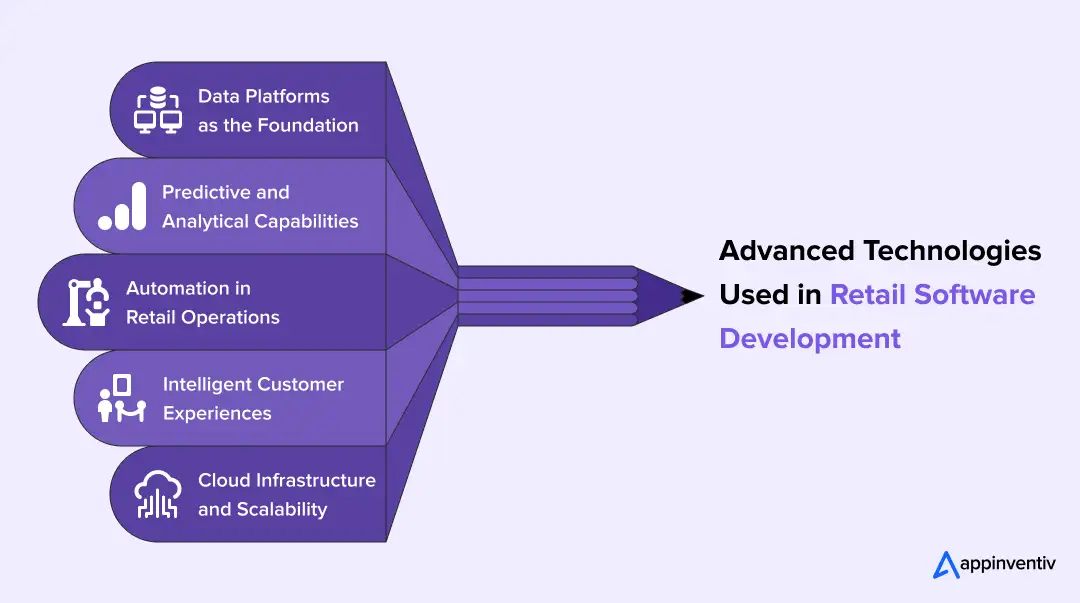
Data Platforms as the Foundation
Most advanced capabilities depend on clean and consistent data. Without this base, even well-designed systems fail to deliver results.
In retail software development for business environments, data platforms support:
- Unified product, inventory, and customer records
- Consistent reporting across channels
- Faster access to operational insights
Enterprises that invest early in data standardization find it easier to extend their retail system software later. This step is often more valuable than adding new features.
Predictive and Analytical Capabilities
Advanced analytics supports planning and operational decisions when applied carefully.
Common applications include:
- Demand forecasting for inventory planning
- Sales trend analysis across regions and channels
- Performance monitoring for promotions and pricing
These capabilities work best when built into retail management software development workflows rather than added as separate tools. Accuracy improves when data flows remain consistent and well governed.
Automation in Retail Operations
Automation helps reduce manual work in high-volume processes.
Typical areas include:
- Inventory updates triggered by sales or returns
- Order routing based on availability and location
- Alerts for stock thresholds and fulfillment delays
To build a retail software platform, automation improves reliability. It also allows teams to focus on exceptions instead of routine tasks.
Intelligent Customer Experiences
Customer-facing systems increasingly rely on structured logic rather than static rules.
Examples include:
- Product recommendations based on browsing and purchase history
- Personalized content across digital channels
- Targeted promotions aligned with customer behavior
In retail software development, these features require strong customer data management. Without it, experiences become inconsistent and difficult to maintain.
Cloud Infrastructure and Scalability
Cloud platforms support flexibility and growth when used with discipline.
Key advantages include:
- Ability to handle peak traffic during promotions
- Faster rollout across regions
- Simplified infrastructure management
Cloud adoption supports retail software development trends focused on scalability. However, cost control and governance remain essential to avoid unnecessary spend.
Emerging Retail Software Development Trends
Several trends are shaping how enterprises plan future systems:
- Greater use of modular platforms instead of single large systems
- Increased focus on real-time data processing
- Stronger emphasis on security and data privacy
- Closer alignment between operational and analytical systems
These trends influence long-term decisions in software development for retail. Enterprises that plan with these shifts in mind reduce rework and technical debt.
Taking a Practical View of Advanced Technology
Advanced tools should support clear outcomes. They should not replace strong fundamentals.
Retail leaders benefit most when:
- Advanced features are introduced after core systems stabilize
- Data ownership and governance are clearly defined
- Technology decisions align with long-term operating models
This balanced approach ensures that retail software development remains adaptable, cost-aware, and aligned with future needs rather than short-term experimentation.
How to Choose the Right Retail Software Development Partner
Choosing a development partner is a long-term decision. For enterprise retail software development, the partner you select influences system stability, cost control, and the ability to adapt as business needs change. Beyond technical skills, leaders must assess whether a partner understands retail operations and enterprise execution.
Below are the key factors enterprise buyers should evaluate before moving forward.
Proven Retail Domain Experience
Retail software development has unique challenges. These include inventory accuracy, fulfillment complexity, pricing logic, and seasonal demand shifts.
When evaluating partners:
- Look for direct experience in retail and eCommerce projects
- Ask how they handled inventory, order flows, and integrations
- Review case studies that show operational outcomes, not just interfaces
Generic development teams may deliver features. Retail-experienced teams deliver systems that work under pressure.
Architecture and Data Capability
Strong architecture decisions prevent rework and scaling issues later.
An ideal partner should:
- Design systems around long-term operating models
- Understand integration-heavy retail system software environments
- Build with data consistency and reporting in mind
Ask how the development partner approaches system design, not just how fast they code. The architecture discipline is essential in custom retail software development.
Maturity in Advanced Capabilities
Many vendors claim expertise in emerging technologies. Few apply them responsibly.
A capable partner:
- Recommends advanced features only when data readiness exists
- Explains how forecasting, personalization, or automation fits business goals
- Avoids adding complexity without clear operational value
This approach ensures retail software development for business remains practical and sustainable.
Security and Compliance Readiness
Retail platforms handle sensitive business and customer data. Security gaps create a serious risk.
Evaluate whether the partner:
- Builds secure access controls and audit trails
- Understands payment and data protection requirements
- Integrates security reviews into the development process
Security and regulatory compliance management should be built into the system, not added at the end.
Post-Launch Support and Scaling Approach
Retail systems evolve. New channels, regions, and integrations appear over time.
A reliable partner:
- Plans for ongoing maintenance and enhancements
- Supports phased rollouts and system expansion
- Helps teams adapt systems without disruption
This matters as much as initial delivery when developing a retail software platform.
Simple Vendor Evaluation Checklist
Use the checklist below to compare potential partners:
- Demonstrated experience in retail software development
- Clear approach to architecture and integration design
- Strong data handling and reporting practices
- Practical understanding of advanced capabilities
- Security and compliance awareness
- Defined post-launch support model
Partners that meet these criteria are better positioned to support enterprise-scale retail software development over the long term.
Selecting the right partner reduces risk, improves execution quality, and supports steady growth. It also ensures that technology investments remain aligned with business priorities well beyond the first release.
Start with a focused assessment of your current systems and roadmap.
How Appinventiv Helps Retail Businesses Build Scalable Software
Retail software development services that last require more than strong engineering. It requires a clear view of how retail businesses operate today and how those operations change over time. Appinventiv works with retail organizations to design and build systems that remain stable as scale, channels, and expectations increase.
Retail and Commerce Experience Backed by Real Implementations
Our teams have built and modernized platforms for established retail and ecommerce brands dealing with high traffic, large catalogs, and multi-channel operations. This work spans retail system software, ecommerce platforms, and custom retail software development designed around real operational workflows, not assumptions.
Strong Focus on Architecture and Data Readiness
Many retail programs struggle because structure is addressed too late. Appinventiv places early focus on system design, integration paths, and data consistency. This reduces downstream rework and makes it easier to expand across regions, channels, and fulfillment models without disrupting operations.
Advanced Capabilities with Practical Governance
Appinventiv has deployed 150+ AI models across different industries. In retail, these capabilities are applied only where data quality and business readiness support them. The goal is to improve forecasting, personalization, or operational insight without creating systems that teams cannot manage.
Enterprise-grade Security and Compliance Mindset
Retail platforms process sensitive business and customer information. Appinventiv follows secure development practices that align with enterprise compliance needs. Security and access controls are treated as part of system design, not add-ons introduced late in delivery.
For organizations planning to build or modernize retail platforms, Appinventiv brings practical experience, delivery scale, and execution discipline to support systems that work reliably today and adapt as the business grows.
Talk to our retail technology experts to assess your current systems and define a scalable retail software roadmap.
Frequently Asked Questions
Q. How much does it cost to develop custom retail software?
A. The cost of custom retail software development depends on scope, integrations, and system complexity. For most organizations, retail software development costs typically range from $30,000 to $200,000 for mid-scale platforms. Enterprise-grade retail system software with multiple channels, regions, and integrations can range from $100,000 to $400,000 or more. Long-term ownership costs, including maintenance and enhancements, should also be considered during planning.
Q. How long does it take to build custom retail software?
A. Timelines vary based on requirements and delivery approach. Building core retail software usually takes 4 to 6 months. Larger programs that include integrations, phased rollouts, and data migration may extend to 9 to 12 months. A phased roadmap helps reduce risk and keeps software development for retail aligned with daily operations.
Q. How to choose a reliable team for retail software development?
A. A reliable team should demonstrate experience in retail software development, not just general application delivery. Look for proven work in inventory, order management, and integrations. Evaluate their approach to architecture, data handling, security, and post-launch support. Teams with real retail case studies and clear delivery processes are better suited for custom software development for the retail industry.
Q. What future trends should businesses consider in retail software development?
A. The future of retail software development is shaped by modular platforms, stronger data foundations, and responsible use of advanced capabilities. Retail software development trends include real-time data processing, improved system integration, and secure cloud-based infrastructure. Businesses benefit most when trends are adopted after core systems are stable and data quality is reliable.
Q. What are real-life examples of businesses that used retail software?
A. Many established brands rely on custom retail software to manage complex operations. Examples include enterprise retail and distribution platforms built for organizations like YK Almoayyed, as well as eCommerce solutions developed for brands such as IKEA, Adidas, 6thStreet, The Body Shop, and edamama. These cases show how retail software development for business supports scale, consistency, and long-term growth.


- In just 2 mins you will get a response
- Your idea is 100% protected by our Non Disclosure Agreement.

Key takeaways: Every healthcare app in Australia must comply with the Privacy Act 1988, Australian Privacy Principles (APPs), and in some cases TGA (SaMD) regulations. Core integrations include My Health Record, the Healthcare Identifiers Service, Medicare/PBS systems, and pathology/imaging providers. It increases development scope but is crucial for adoption. Healthcare solutions must embed encryption, access…
When Satya Nadella took the reins at Microsoft, he famously declared that every business needed to become a software company. Nadella's statement wasn’t just tech jargon—it was a wake-up call that reflects the broader trend of digital transformation. Across industries, from retail and finance to manufacturing and logistics, companies are realizing that embracing digital transformation…

UK financial institutions operate in a market where customers demand connected, proactive financial experiences rather than isolated banking products. Open Banking successfully solved payment and account aggregation. Now, enterprises face the next structural shift. They need to bring insurance, pensions, investments, mortgages, savings, lending, and broader datasets into a single, governed view of the customer.…