
































Why Choose Managed IT Services in Dubai – Benefits, Cost, & ROI


- Dubai Compliance, Data Residency, and Local Realities That Shape IT Decisions
- What Enterprise-Grade Managed IT Services Must Deliver
- Why Businesses in Dubai Are Moving to Managed IT Services
- Managed IT Services Cost Structure in Dubai: Pricing Models, Hidden Charges, and a Buyer’s Checklist
- Quantifying ROI: How to Measure the Real Value of Managed IT Services in Dubai
- How to Choose the Right Managed IT Service Provider in Dubai: A Practical Evaluation Checklist
- A Practical Implementation Roadmap for Managed IT Services in Dubai
- Industry Use Cases: How Managed IT Services Support Key Dubai Sectors
- Addressing Common Concerns About Managed IT Services in Dubai
- Why Appinventiv Is a Strategic Partner for Managed IT Services in Dubai
- Frequently Asked Questions

Key Takeaways
- Managed IT services in Dubai replace reactive support with structured, SLA-driven IT operations, improving uptime, response times, and governance.
- The cost benefit of managed IT services is clearer when measured through TCO, helping reduce IT operational costs in the UAE without adding long-term staffing risk.
- Compliance-ready services in the UAE are essential, as PDPL and sector-specific rules make IT risk management in Dubai a business priority.
- Managed IT services enable teams to scale infrastructure and security coverage without redesigning systems or expanding internal headcount.
- Managed IT services ROI improves when outcomes are defined upfront, such as fewer incidents, faster recovery, and controlled cybersecurity exposure.
For many organizations operating in the UAE, IT is more than just a support function. It directly affects compliance, uptime, customer trust, and cost control.
In Dubai, this pressure is higher. Data protection laws such as PDPL, sector rules from DHA, and free-zone regulations have made IT governance more complex. At the same time, leadership teams are expected to keep costs predictable while systems remain available at all hours.
This is where the question shifts from whether businesses should outsource IT to why choose managed IT services in Dubai and how to do it right. The decision is rarely about basic support. It is about controlling risk, planning growth, and avoiding hidden operational gaps that appear over time.
This blog focuses on practical guidance. It looks at cost structures, compliance readiness, scalability, and measurable returns. Things that business leaders need to evaluate when considering managed IT services in Dubai, and decide when external managed IT services expertise or technical consultation makes strategic sense.
Align your IT roadmap now with Appinventiv.

Dubai Compliance, Data Residency, and Local Realities That Shape IT Decisions
In the UAE, managed IT decisions are tightly linked to regulations, data control, and where systems physically operate. Dubai is not a single-rule market; adjacent jurisdictions add complexity.
Regulatory Frameworks That Affect IT Outsourcing
- PDPL applies across the UAE, covering data access, processing, breach reporting, and third-party accountability.
- Sector-specific regulators raise the bar. DHA governs health data. Financial entities in DIFC follow their own data protection regime.
- Abu Dhabi Global Market (ADGM) operates under a separate data protection framework aligned with global standards, which directly affects cross-emirate data flows and vendor contracts.
Outsourcing does not transfer liability. This is why compliance-ready IT services in the UAE are now a board-level concern.
Data Residency and Cloud Architecture Constraints
- Some workloads require UAE-based data residency or approved regional hosting.
- Cloud, AI, and data analytics platforms must be designed with hybrid or region-specific deployments.
- Backup, disaster recovery, and failover locations are reviewed during audits.
Managed IT services in Dubai are expected to plan infrastructure with these limits in mind, not work around them later. Backup, disaster recovery, and failover locations are reviewed during audits.
The Reality of Sovereign Cloud in Dubai
In 2026, “Cloud-First” evolved into “Sovereign-First” for regulated entities. Under the National Cloud Security Policy and the CBUAE Outsourcing Regulations, certain categories of sensitive data—including government records, defense information, and “Master Systems of Record” for financial institutions—must physically reside within the UAE.
Managed service providers must now architect environments that use local nodes, such as AWS Middle East (UAE) and Microsoft Azure (UAE North), or local sovereign clouds like Etisalat or Du. This ensures that even in a multi-cloud setup, data processing and failover mechanisms remain strictly within the jurisdiction, preventing exposure to foreign laws like the US CLOUD Act.
Cybersecurity and Risk Governance Expectations
- Cybersecurity managed services are essential, especially for regulated data.
- Continuous monitoring, threat detection, and incident response must run round the clock.
- Dubai’s AI-assisted security analytics are increasingly used to reduce response times.
This directly supports stronger IT risk management in Dubai.
Local Support and Operational Accountability
- Local escalation and regional support teams improve response speed.
- Time-zone alignment matters during incidents.
- Audit rights and reporting cadence must be contractually clear.
These local realities often determine whether managed IT services deliver stability or create long-term risk.
Compliance, security, and locality are not side considerations. They define how managed IT services in Dubai should be structured, priced, and governed.
What Enterprise-Grade Managed IT Services Must Deliver
Managed IT services are often described as support. In reality, for large and growing organizations, they function as an operating layer. The difference between basic outsourcing and enterprise-grade delivery lies in structure, accountability, and technical depth.
Below are the capabilities that should be non-negotiable when evaluating managed IT services in Dubai.
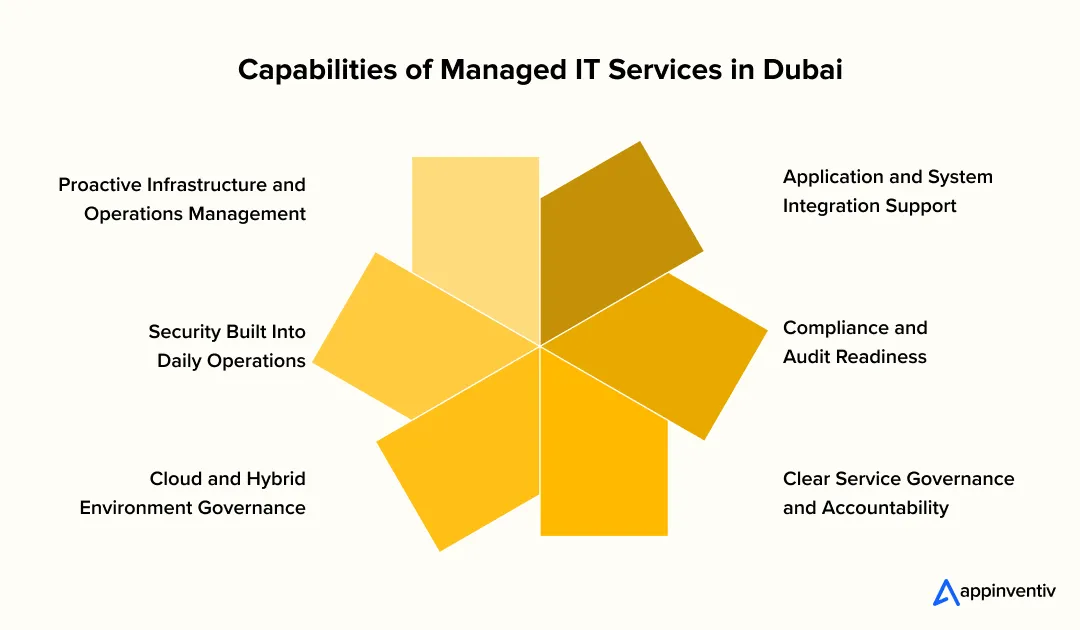
Proactive Infrastructure and Operations Management
Enterprise-grade services start with prevention, not reaction.
- Continuous monitoring of servers, networks, endpoints, and cloud workloads
- Automated patching and configuration management across environments
- Clear incident categorization with defined response and resolution timelines
- Visibility into performance trends using data analytics, not manual reporting
This level of control reduces downtime and, over time, helps reduce IT operational costs in the UAE.
Security Built Into Daily Operations
Cybersecurity managed services are no longer a separate add-on; they must be embedded into IT operations.
- 24×7 threat monitoring and log analysis
- AI-assisted anomaly detection for early risk identification
- Structured incident response plans with clear ownership
- Regular vulnerability assessments and security posture reviews
For leadership teams, this directly supports IT risk management in Dubai and lowers exposure from regulatory or reputational incidents.
Cloud and Hybrid Environment Governance
Most organizations today run mixed environments. Cloud, on-premise, and legacy systems coexist.
- Cloud workload monitoring across providers
- Cost tracking and usage controls to prevent spend overruns
- Secure integration between cloud platforms and internal systems
- Support for scalable architectures that grow with demand
Managed IT services for scalability should allow growth without constant redesign or repeated hiring.
Application and System Integration Support
IT does not operate in isolation. Applications must interact with each other reliably.
- Tools for API management and system integrations
- Support for ERP, CRM, data platforms, and industry-specific systems
- Stability testing after updates or configuration changes
In many cases, organizations benefit from consulting or development support to stabilize complex integrations as part of managed services.
Compliance and Audit Readiness
Regulatory compliance cannot be handled once a year.
- Ongoing alignment with PDPL and sector-specific requirements
- Access controls, audit trails, and data classification
- Support during internal or external audits
- Documentation that reflects real operations, not templates
This is where compliance-ready IT services in the UAE make a measurable difference.
Clear Service Governance and Accountability
Strong delivery depends on structure.
- Defined SLAs with measurable KPIs
- Regular service reviews and performance reports
- Transparent escalation paths
- Exit and knowledge transfer planning
Without this, even technically capable providers struggle to deliver consistent outcomes.
When these elements are present, managed IT services in Dubai move beyond support. They become a controlled, scalable, and measurable operating model—one that supports growth while keeping cost, risk, and compliance in balance.
Why Businesses in Dubai Are Moving to Managed IT Services
The shift toward managed IT services in Dubai is not driven by convenience, but by pressure. Pressure to control costs, stay compliant, and keep systems stable while technology stacks grow more complex.
Below are the core benefits that explain why more organizations are rethinking how IT is delivered.
Predictable Costs and Better Financial Control
Unplanned IT spend is one of the biggest concerns for leadership teams.
- Managed IT services convert variable IT expenses into a predictable operating cost.
- Staffing, tooling, upgrades, and monitoring are bundled into a defined model.
- This makes the cost of managed IT services in Dubai easier to forecast and defend during budgeting cycles.
When viewed through the lens of total cost of ownership, the cost-benefit of managed IT services often becomes clearer than maintaining large internal teams.
Reduced Operational Risk and Stronger Governance
As IT environments expand, risk increases quietly.
- Continuous monitoring reduces blind spots across infrastructure and cloud platforms.
- Cybersecurity managed services help detect threats early, before they affect operations or data.
- Defined SLAs and escalation paths improve accountability.
This structured approach strengthens IT risk management in Dubai, especially for organizations operating under PDPL or sector regulations.
Built-in Scalability Without Operational Disruption
Growth should not force a rebuild of IT systems.
- Managed IT services for scalability allow teams to expand users, workloads, and security coverage without major restructuring.
- Cloud-based infrastructure and modular service models support seasonal or rapid growth.
- AI-driven monitoring and automation reduce the need for constant manual oversight.
This flexibility is especially relevant for organizations planning regional expansion or digital transformation initiatives.
Improved Uptime and Service Reliability
Downtime is expensive. Often more than expected.
- Proactive monitoring reduces incident frequency.
- Faster response and recovery lower the impact of failures.
- Performance analytics help identify issues before users report them.
Over time, this directly contributes to managed IT services ROI through fewer outages and lower recovery costs.
Access to Specialized Skills Without Long Hiring Cycles
Modern IT environments rely on cloud, cybersecurity, data analytics, and integration expertise.
- Managed services provide access to cross-domain specialists without long recruitment timelines.
- Teams gain support for AI-enabled tools, advanced security frameworks, and complex integrations.
- Advisory and consultation support is often available when systems need redesign or optimization.
This is particularly useful when internal teams are stretched or focused on core business initiatives.
Compliance Readiness as an Operational Standard
Regulatory expectations in the UAE are evolving.
- Compliance-ready IT services in the UAE help maintain audit trails, access controls, and continuous data governance.
- Providers support alignment with PDPL, DHA, DIFC, or ADGM requirements where applicable.
- Documentation and reporting are maintained as part of daily operations.
This reduces last-minute compliance efforts and lowers long-term exposure.
Clear Signs It May Be Time to Consider Managed IT Services
Organizations often reach a tipping point.
- IT issues are addressed only after they escalate.
- Security incidents are increasing or harder to explain.
- Costs keep rising, but performance does not.
- Internal teams spend more time on maintenance than improvement.
These are common signs you need managed IT services.
Taken together, these benefits explain why choosing a managed IT service provider in Dubai has become a strategic decision. Not just for IT teams, but for business leadership focused on stability, growth, and measurable returns.
Managed IT Services Cost Structure in Dubai: Pricing Models, Hidden Charges, and a Buyer’s Checklist
Cost is often the deciding factor when choosing managed IT services in Dubai. Yet most cost overruns do not come from pricing alone. They come from unclear scope, missed assumptions, and weak procurement controls.
This section breaks down how pricing works, where hidden costs appear, and how leadership teams can evaluate proposals with confidence.
Typical Cost Range for Managed IT Services in Dubai
For mid-sized to large organizations, the cost of hiring a managed IT service provider in Dubai typically ranges from $30,000 to $400,000 per year. Exact pricing depends on infrastructure complexity. The range depends on scope, risk exposure, and service depth.
Key cost drivers include:
- Number of users, endpoints, and locations
- Infrastructure mix (on-premise, cloud, hybrid)
- Cybersecurity coverage and monitoring level
- Compliance requirements (PDPL, DHA, DIFC, ADGM)
- Support hours and response SLAs
Lower-cost engagements usually cover basic monitoring and support. Higher-cost models include cybersecurity managed services, cloud governance, compliance reporting, and advanced incident response.
Common Pricing Models You Will Encounter
Managed IT services Dubai providers typically price services in one of the following ways:
- Per-user or per-device pricing, suitable for stable environments
- Tiered service bundles, aligned to support levels and risk exposure
- Fixed annual contracts, common for regulated or multi-location setups
- Hybrid models, combining fixed fees with usage-based cloud or security services
Understanding the model helps assess the real cost vs benefit of managed IT services over time.
Hidden Charges That Impact Long-term Spend
Initial proposals often look reasonable. Costs surface later if these areas are not clarified:
- One-time onboarding and infrastructure transition fees
- Cloud migration or architecture redesign costs
- Third-party software and security licenses
- After-hours support or priority incident handling
- Integration work between applications and data platforms
- Exit and knowledge transfer charges
These items directly affect the ROI of managed IT services if not accounted for upfront.
Procurement Checklist for Informed Decision-making
Before finalizing a provider, decision-makers should confirm:
- Is the scope clearly defined and measurable?
- Are SLAs tied to response time, resolution time, and uptime?
- Does the provider support compliance-ready IT services in the UAE?
- Are cybersecurity responsibilities clearly assigned?
- Is cloud cost monitoring included or billed separately?
- Are integration, advisory, or consultation services available if systems evolve?
- Are exit terms documented and practical?
Many organizations benefit from a short technical assessment or consultation before contract signing. It helps validate assumptions and avoid costly corrections later.
When evaluated properly, managed IT services cost in Dubai becomes predictable. More importantly, it aligns with risk control, scalability, and long-term operational stability.
See how Appinventiv supports both.

Quantifying ROI: How to Measure the Real Value of Managed IT Services in Dubai
Return on investment is often discussed in broad terms. For decision-makers, it needs structure. The managed IT services ROI becomes clear only when costs, risks, and operational impact are measured side by side.
Inputs to Collect Before Calculating ROI
Start with current-state numbers. Most organizations already have these.
- Annual cost of internal IT staff (salary, benefits, attrition)
- Software, security, and infrastructure licences
- Average downtime per year and its business impact
- External consultant or emergency support spend
These inputs form the baseline for comparison.
Step-by-Step TCO Comparison
Example scenario (illustrative):
- Internal IT team: 3 full-time roles at $110,000 each
Annual staffing cost: $330,000
- Tools, licences, and infrastructure support: $60,000
- Downtime and unplanned remediation: $40,000
Total in-house IT cost: $430,000 per year
Now compare this with a managed model:
- Managed IT services Dubai contract (infrastructure, cybersecurity, cloud support): $260,000 per year
Annual cost difference: $170,000
Simple ROI calculation:
(170,000 ÷ 260,000) × 100 = 65% ROI
This is a practical way to evaluate the cost vs benefit of managed IT services without assumptions or projections.
Sensitivity Check: Why Downtime Matters
If downtime increases by even a small margin, ROI changes quickly.
- An additional 10 hours of outage at $8,000 per hour adds $80,000 in annual loss.
- Managed monitoring and faster response can materially reduce this risk.
This is one of the most overlooked contributors to managed IT services ROI.
Secondary ROI Drivers That Often Go Uncounted
- Faster project execution due to cloud-ready and AI-assisted monitoring
- Lower security incident costs through cybersecurity managed services
- Reduced dependency on short-term contractors
- Better audit readiness and fewer compliance-related delays
For many teams, a short assessment or consultation helps validate these numbers before final decisions. When measured correctly, managed services are not just about savings. They are about control, predictability, and sustained operational efficiency that helps reduce IT operational costs in the UAE.
How to Choose the Right Managed IT Service Provider in Dubai: A Practical Evaluation Checklist
Selecting a managed IT partner is not a vendor comparison exercise. It is a risky decision. The wrong choice increases cost, weakens security, and creates long-term dependency. The right one improves control, visibility, and resilience.
Below is a practical checklist that leadership and procurement teams can use during RFPs, vendor shortlisting, or proof-of-concept discussions.
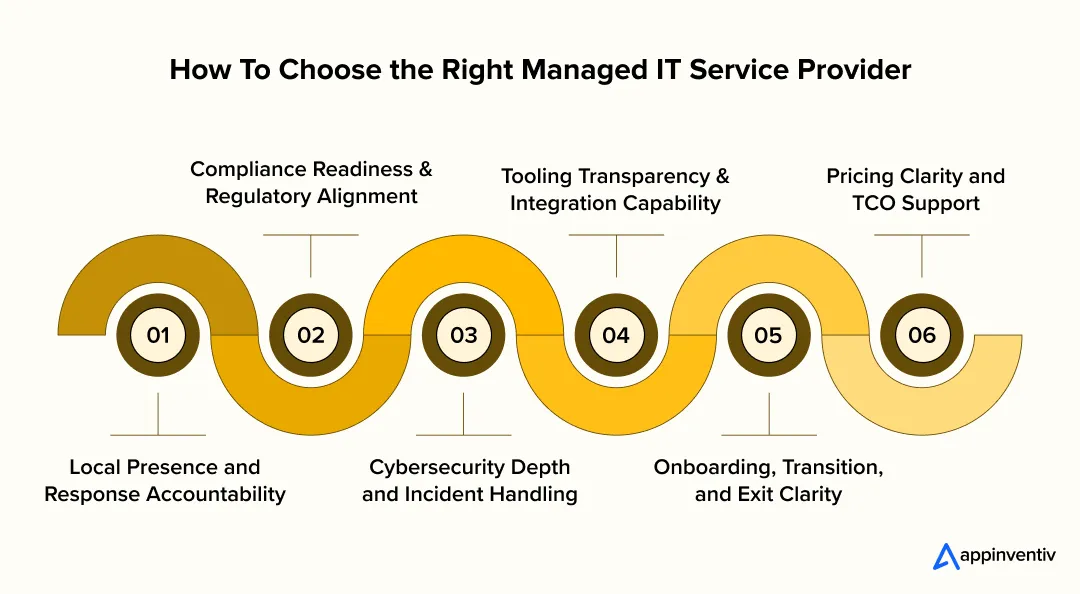 1. Local Presence and Response Accountability
- Does the provider have operational support aligned with Dubai business hours?
- Are on-site visits available when incidents cannot be resolved remotely?
- Are response and resolution SLAs clearly defined and enforceable?
Local accountability often matters more than global scale when outages occur.
2. Compliance Readiness and Regulatory Alignment
- Can the provider demonstrate PDPL-compliant data processing agreements?
- Are sector-specific controls supported for DHA, DIFC, or ADGM environments?
- Is audit support included, or treated as an exception?
Compliance-ready IT services in the UAE reduce legal and operational exposure.
3. Cybersecurity Depth and Incident Handling
- Are cybersecurity managed services included or sold separately?
- Is there continuous monitoring, threat detection, and incident response?
- Are response playbooks and escalation paths documented?
This is central to IT risk management in Dubai.
4. Tooling Transparency and Integration Capability
- What monitoring, security, and analytics tools are used?
- Can these tools integrate with existing cloud, data, or application platforms?
- Is reporting meaningful or purely operational?
Providers with strong integration and consultation capabilities adapt better as systems evolve.
5. Onboarding, Transition, and Exit Clarity
- Is there a documented onboarding and knowledge transfer plan?
- How long does stabilization typically take?
- Are exit terms clear, practical, and cost-controlled?
This directly affects long-term managed IT services ROI.
6. Pricing Clarity and TCO Support
- Is pricing fixed, tiered, or usage-based?
- Are cloud costs, licences, and after-hours support clearly separated?
- Does the provider help model the cost vs benefit of managed IT services?
When considering the benefits of choosing a managed IT service provider in Dubai, this checklist helps shift the discussion from promises to proof—and from short-term pricing to long-term value.
A Practical Implementation Roadmap for Managed IT Services in Dubai
Successful adoption of managed IT services does not happen in a single step. It requires a structured transition that protects ongoing operations while introducing stronger controls, security, and visibility. In Dubai, this process must also account for compliance and data residency from the start.
Below is a phased roadmap that many organizations follow to reduce risk and avoid disruption.
Phase 1: Readiness Assessment and Planning
This phase sets the foundation.
- Inventory of infrastructure, applications, cloud workloads, and data flows
- Review of current security posture, access controls, and incident history
- Compliance gap analysis against PDPL and sector rules
- Identification of critical systems and business dependencies
- Definition of success metrics, SLAs, and reporting cadence
At this stage, advisory or technical consultation often helps align IT priorities with business goals before contracts are finalized.
Phase 2: Onboarding and Parallel Operations
The focus shifts to controlled onboarding.
- Deployment of monitoring and security tools across environments
- Configuration of alerts, escalation paths, and response workflows
- Knowledge transfer from internal teams to the managed services team
- Parallel monitoring alongside existing support models
This overlap period reduces risk while systems stabilize.
Phase 3: Transition of Operational Responsibility
Once visibility and trust are established, responsibility expands.
- Handover of routine operations, patching, and maintenance
- Activation of cybersecurity managed services and 24×7 monitoring
- Cloud governance and cost tracking to prevent spend overruns
- Initial performance and risk reports shared with stakeholders
This phase often delivers early gains in uptime and cost control.
Phase 4: Optimization and Scalability Planning
With operations stable, attention moves to improvement.
- Performance tuning based on monitoring data and usage trends
- Review of managed IT services cost in Dubai against actual outcomes
- Planning for managed IT services for scalability as workloads grow
- Integration improvements between applications, data platforms, and cloud services
Targeted development or integration support may be introduced here to address structural gaps.
Phase 5: Ongoing Governance and Continuous Improvement
Managed services are not static.
- Monthly SLA and incident reviews
- Quarterly security and compliance assessments
- Annual TCO and managed IT services ROI evaluation
- Regular roadmap updates aligned with business change
This governance model ensures managed IT services in Dubai remain aligned with risk, cost, and growth objectives over time.
A structured implementation roadmap turns managed services into a controlled operating model rather than a disruptive change. It helps reduce IT operational costs in the UAE while maintaining compliance, stability, and long-term flexibility.
Industry Use Cases: How Managed IT Services Support Key Dubai Sectors
Different sectors in Dubai have specific demands when it comes to IT operations, compliance, and technology adoption. Below are brief snapshots that highlight how managed IT services can address those needs, along with real-world development examples where technology has strengthened outcomes.
Financial Services (DIFC and beyond)
Financial firms in zones such as the Dubai International Financial Centre operate under strict regulatory frameworks. They must handle sensitive customer data, support secure transactions, and maintain uptime for critical systems.
Managed IT services help enforce strong access controls, manage patches, and enable continuous monitoring across trading platforms, core banking systems, and data feeds.
They also support secure integration of data analytics and AI-based fraud detection tools.
Custom digital solutions, such as AI-powered banking platforms, have helped global financial firms automate processes and improve accuracy, indicating how advanced technology and governance can work together.
Healthcare and Life Sciences (DHA, DOH)
Healthcare providers in Dubai face compliance requirements from the Dubai Health Authority and federal privacy laws. Patient data needs high levels of protection, and clinical systems must remain available at all times.
Managed services in these environments often include 24×7 monitoring, secure data backups, and environment hardening to reduce risk and protect sensitive records.
Technology development, such as scalable mobile health platforms, can extend this foundation and improve patient experience. A notable example is DiabeticU, an AI-enabled diabetes management platform that uses data analytics to deliver personalized wellness insights.
Retail and Consumer Services
Retail operations, especially those with both online and physical channels, need reliable IT systems that support point-of-sale, inventory management, and customer engagement platforms.
Managed IT services help keep e-commerce systems, cloud infrastructure, and CRM platforms stable as traffic and seasonal demand fluctuate.
Emerging technologies like AI-powered visual search can improve user engagement and conversion in retail applications, though they require careful integration with existing systems.
When supported by structured monitoring and security controls, such systems can scale without straining internal teams.
Logistics and Operations
Dubai’s role as a logistics hub demands high system uptime and process visibility. Supply chain software must be reliable, secure, and integrated across partners.
Managed IT services help ensure real-time visibility and operational continuity, especially when systems span cloud and on-premise infrastructure.
Robust solutions that integrate data analytics and automation can improve responsiveness, reduce costs, and enhance forecasting. An example from a global manufacturer shows how data-driven logistics software improved visibility by 60% and reduced costs by 40%.
Across sectors, the core value of managed IT services in Dubai lies in combining continuous monitoring, security depth, and flexible architecture. Complementary development work, such as building scalable platforms or bespoke integrations, can further strengthen technology outcomes and help organizations cope with growth and regulatory change.
Addressing Common Concerns About Managed IT Services in Dubai
Decision-makers often pause before shifting to managed IT services. The concerns are valid. They can also be addressed with the right structure and safeguards.
“We will lose control over our IT environment.”
Control does not disappear. It changes form. Co-managed models, defined SLAs, and shared dashboards keep governance with internal teams while day-to-day operations are handled externally.
“Hidden costs will surface later.”
This risk is real when the scope is vague. Clear TCO models, fixed service boundaries, and documented exit clauses help manage the managed IT services cost in Dubai from day one.
“Outsourcing increases regulatory risk.”
Liability stays with the business, which is why compliance-ready IT services in the UAE matter. Providers must support PDPL alignment, audit access, and sector-specific controls.
“Our environment is too complex.”
Complex systems often benefit most from structured support and targeted technical consultation, especially across cloud, cybersecurity, and data platforms.
Addressing these concerns early helps leadership teams make informed decisions with fewer surprises later.
Let’s review your current setup.

Why Appinventiv Is a Strategic Partner for Managed IT Services in Dubai
Choosing a managed IT services company in Dubai is not only about coverage and pricing. It is about trust, execution depth, and the ability to support change over time. This is where Appinventiv brings differentiated value.
Technology-first Approach, Not Tool-first Delivery
Appinventiv approaches managed IT services as part of a broader digital ecosystem.
- Support spans cloud platforms, cybersecurity frameworks, data analytics pipelines, and AI-enabled monitoring.
- IT operations are designed to work alongside modern applications, not around them.
Enterprise-Grade Reliability: We back our operations with industry-standard certifications, including ISO 27001 (Information Security Management) and ISO 9001 (Quality Management), ensuring every process is audited and secure.
Contractual Accountability: Our delivery is governed by Tier-1 SLAs, offering up to 99.9% uptime guarantees for critical infrastructure and 24/7/365 proactive incident response.
This is especially relevant for organizations modernizing legacy environments while introducing newer technologies.
Strong Alignment With UAE Compliance and Risk Requirements
Operating in Dubai means operating under layered regulation.
- Appinventiv’s delivery models account for PDPL, sector-specific mandates, and data-residency requirements.
- Security, access control, and audit readiness are built into daily operations.
- Cybersecurity managed services support proactive risk detection and structured incident response.
This makes compliance-ready IT services in the UAE part of normal operations, not a last-minute effort.
Integrated Development, Consulting, and Managed Services
Managed IT often intersects with change.
- New applications are added.
- Systems need integration.
- Cloud architecture evolves.
Appinventiv supports these shifts through consulting, system integration, and custom development, alongside managed operations. This reduces dependency on multiple vendors and shortens response time when changes are required.
For organizations evaluating managed IT services in Dubai, Appinventiv offers more than operational support. We provide a structured, technology-aligned partnership designed to manage cost, risk, and growth with clarity. Contact Appinventiv to discuss your needs.
Frequently Asked Questions
Q. When should a business in Dubai switch to managed IT services?
A. A switch makes sense when IT issues become reactive, security incidents increase, or costs rise without clear visibility. It is also a strong option when internal teams spend more time maintaining systems than supporting growth or compliance needs.
Q. Are managed IT services cost-effective for enterprises in Dubai?
A. Yes, when assessed through the total cost of ownership. Managed IT services cost in Dubai is often lower than maintaining full in-house teams, tools, and emergency support, especially for organizations with complex or regulated environments.
Q. What is the ROI of managed IT services for UAE businesses?
A. Managed IT services ROI typically comes from reduced downtime, predictable operating costs, and fewer security incidents. Faster issue resolution and better compliance readiness also contribute to long-term financial returns.
Q. Managed IT services vs in-house IT: which is better for UAE companies?
A. In-house teams work well for core business knowledge and strategy. Managed services are better suited for 24×7 monitoring, cybersecurity, cloud operations, and compliance. Many organizations adopt a co-managed model to balance both.
Q. How do managed IT services help with scalability and growth?
A. Managed IT services for scalability allow infrastructure, security coverage, and support capacity to expand without rehiring or redesigning systems. This is especially useful during regional expansion, seasonal demand, or digital transformation initiatives.
Q. Can managed IT services support compliance and data security in the UAE?
A. Yes. Compliance-ready IT services in the UAE help maintain PDPL alignment, audit trails, access controls, and secure data handling. Cybersecurity managed services also reduce exposure to data breaches and operational risk.
Q. How do enterprises choose the right managed IT service provider in Dubai?
A. The right provider demonstrates local support capability, clear SLAs, strong security controls, and experience with UAE regulations. Many organizations also benefit from an initial technical assessment or consultation to validate fit before long-term engagement.

- In just 2 mins you will get a response
- Your idea is 100% protected by our Non Disclosure Agreement.

Capital Structuring and Tech Investments: What Enterprises Must Consider in 2026?
Key takeaways: Strategic capital structuring is essential to fund innovation without sacrificing financial stability. Each tech investment, like AI, cloud, cybersecurity, and sustainability, requires a tailored financing approach. Misalignment between capital structure and tech strategy can stall growth or strain margins. Hybrid and structured financing models help enterprises balance risk, control, and agility in 2026.…

Why Appinventiv Stands Out as the Leading Tech Consulting Provider for Digital-First Enterprises
Key takeaways: Appinventiv operates as a strategic partner, not just a service provider, focusing on business outcomes and ROI before technology. Success stories with global brands like KFC, IKEA, Adidas, etc., prove we tackle complex, enterprise-grade projects and deliver real results. Our capabilities span from AI-powered product building and cloud upgrades to custom software creation,…

Staff Augmentation vs In-House Hiring: Which Is the Better Model for Your Business?
Key takeaways: Cost Efficiency: Staff augmentation is less expensive when used in short-term projects, in contrast to in-house recruitment Scalability: Staff augmentation is swift at scaling teams, whereas in-house teams can be restricted Specialized Talent: With Augmentation, niche talent can be brought on at short notice; in-house is a long-term culture delivery mechanism. Control vs.…









