























Guide to Software Risk Management: Identifying and Mitigating Key Risks in Software Development

- What are Software Development Risks for Enterprises
- Key Risks Involved in Software Development
- Benefits of Risk Management in Software Engineering
- How to Identify and Assess These Risks
- Risk Management Strategies in Software Engineering
- Best Practices for Effective Risk Mitigation in Enterprise Software Projects
- Tools and Technologies That Strengthen Risk Management
- Cost of Implementing Software Risk Management
- Why Appinventiv Is the Right Partner for Enterprise Software Risk Management
- Frequently Asked Questions

Key takeaways:
- Risk management is no longer a peripheral activity; it is a core component of Enterprise Risk Governance (ERG) that ensures software ROI.
- Successful projects define their risk appetite—the level of risk an organization is willing to accept—before the first line of code is written.
- By integrating risk assessment into the early discovery phase, enterprises reduce residual risk and prevent technical debt compounding.
- A structured framework covers the entire lifecycle: from taxonomy identification to continuous monitoring and governance.
For enterprises, unmanaged software risk is not a technical issue; it is a business continuity risk. Software projects today face tight timelines, rising costs, and constant pressure to perform. Even one misstep can slow down an entire system. It can impact revenue or expose the business to security and compliance issues.
This is why software risk management has become a core part of modern digital planning. In fact, more than two‑thirds of enterprise decision‑makers say they are “very” or “extremely” concerned that integrating advanced technologies will negatively impact cybersecurity (68 %) and systems integration (62 %), highlighting the real and pervasive nature of these risks.
These risks rarely stem from a single failure; they arise from vulnerabilities that go unnoticed until they disrupt delivery. Software risk management brings risks into view early, allowing teams to anticipate challenges rather than react to them.
With this clarity, teams make better decisions, control costs, and maintain steady progress. This guide discusses the main types of risk management in software engineering. It explains how a structured approach can help businesses run safer, stronger, and more predictable projects.
Appinventiv helps enterprises stay on the side of predictable, well-managed delivery.
What are Software Development Risks for Enterprises
Enterprise projects carry a higher risk because they involve large teams, complex systems, strict timelines, and stringent compliance requirements. A small issue can affect many departments, slow operations, or delay revenue plans. Older systems, third-party tools, and multiple vendors add more points of failure.
This is why leaders need early, clear visibility into risk management in software projects. It helps teams act before issues grow and keeps major programs steady.
Enterprise software development risks usually fall into these groups:
- Technology gaps
- Planning and process issues
- People and communication problems
- Compliance and security needs
- Vendor and integration challenges
Unchecked risks in enterprise environments can cascade across departments, disrupting operations, delaying revenue recognition, and weakening regulatory posture.
Key Risks Involved in Software Development
Enterprise software risk is not monolithic. It requires a taxonomy of risk to categorize threats based on their origin and impact on the business logic.
Risk identification in software engineering is therefore essential. Here are the main risk areas leaders need to watch closely.
1. Technical & Architectural Integrity
Modern technical risk is rarely about “bad code”; it is about architectural fragility.
DevSecOps as a Risk Gate: Transition from periodic security audits to automated Shift-Left security. This involves integrating SAST (Static Application Security Testing) and DAST (Dynamic Testing) directly into your CI/CD pipeline. Every commit acts as a risk-validation checkpoint.
AI Code Governance: With 40%–60% of enterprise code now being AI-assisted, “Hallucinated Logic” and licensed-code leakage are critical risks. Mitigation requires automated guardrails to verify the logic and provenance of AI-generated snippets.
Without these controls, architectural fragility can trigger outages, compliance violations, and costly rollback cycles that erode customer trust.
Technical Debt & Intersystem Latency: Managing the “Legacy-to-Cloud” bridge where synchronization lags can lead to data inconsistency across distributed systems. Data inconsistency across systems can compromise reporting accuracy and regulatory audits.
For enterprises, risk management in software development becomes essential. This is because even a minor tech failure can disrupt operations or affect customers. This makes early technical review and stress testing essential.
2. Project Management Risks
The project management risks come from planning and control issues. They often lead to delays and budget problems.
They include:
- Scope creep
- Unrealistic timelines
- Incorrect effort estimates
- Slow change management
- Missing milestone reviews
Many enterprise projects fail because teams start work without clear or stable requirements. For enterprises, planning failures translate into missed market windows, budget overruns, and delayed strategic initiatives.
3. People and Stakeholder Risks
Large projects involve many decision-makers. Misalignment across the entire software supply chain can slow progress in risk management.
These risks often appear as:
- Poor communication
- Shifting priorities
- Lack of domain experts
- High turnover
- Coordination issues across locations
Misalignment at scale leads to rework cycles, delayed launches, and solutions that fail to support business priorities.
4. Sovereignty & Compliance Risk
Enterprises must follow strict laws and industry rules. Missing even one regulation can cause legal risks or financial penalties.
Common risk areas include:
- HIPAA, PCI-DSS, GDPR compliance
- Rapid market changes
- Vendor policy updates
- Shifts in cloud service terms
Compliance failures can trigger legal penalties, operational restrictions, and reputational damage that extend beyond the project lifecycle.
5. Third-Party and Integration Risks
Most enterprise systems rely on external tools, APIs, or platforms. When any of these fail, the entire solution may slow down.
These risks include:
- Unstable APIs
- Outdated vendor documentation
- Dependency failures
- Vendor lock-in
- Weak service-level agreements
In complex environments, a single integration failure can interrupt data flow across critical workflows, affecting billing, customer service, and operational decision-making.
6. Software Supply Chain & SBOM Security
In a post-Log4j world, your risk is defined by your dependencies. A typical enterprise application relies on hundreds of open-source libraries.
Software Bill of Materials (SBOM): Enterprises must maintain a dynamic SBOM, a comprehensive inventory of every third-party component, library, and tool used.
Vulnerability Remediation: It is no longer enough to “know” you have a vulnerability. You need an automated policy for patch velocity that ensures critical CVEs (Common Vulnerabilities and Exposures) are remediated within hours, not weeks.
A single vulnerable dependency can expose enterprise infrastructure to systemic cyber risk.
7. Legal and Contract Risks
Addressing “Single Point of Failure” (SPOF) in human capital and misalignment in the global software supply chain.
They include:
- Missing IP ownership terms
- Loopholes in SLAs
- Weak compliance clauses
- Risks in multi-vendor setups
Clear contracts help protect the business and reduce future disputes.
Together, these risks show why teams need clear plans, strong oversight, and early action. When risk identification in software engineering is clear and well managed, large programs remain stable, predictable, and aligned with business goals.
Benefits of Risk Management in Software Engineering
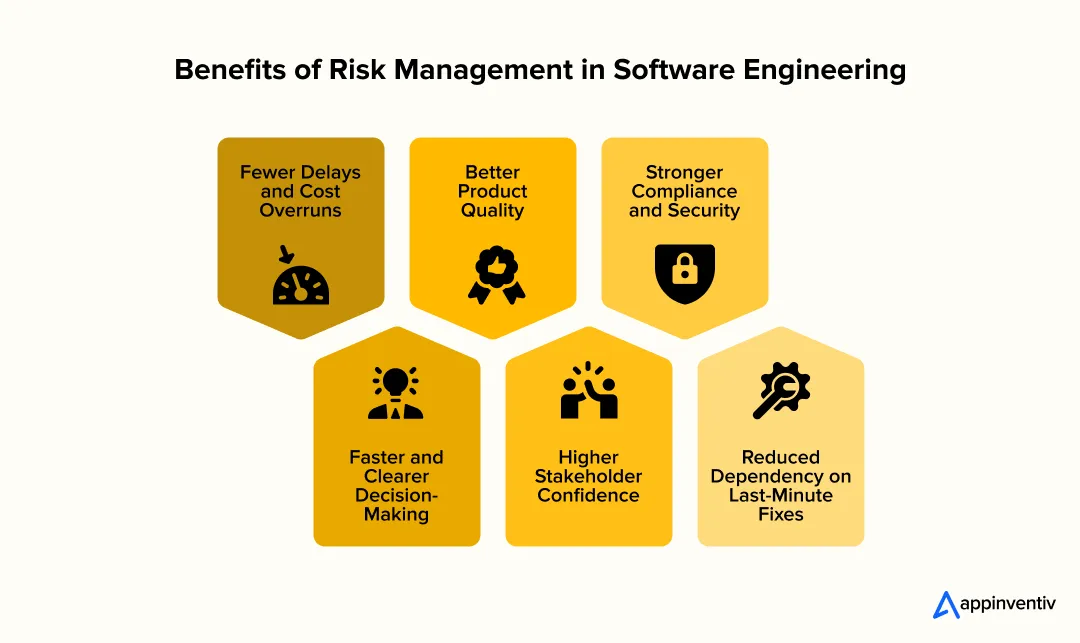
Strong risk management in software development does more than prevent problems. It helps enterprises protect timelines, budgets, and customer trust. It also creates a steady environment where teams can plan well and deliver with confidence.
The benefits below show why this process matters for every large software program.
Fewer Delays and Cost Overruns
Most overruns happen because risks are found too late. Early risk management in software project management helps teams act before a minor issue becomes a major setback. This keeps timelines predictable and helps leaders protect their budget.
Better Product Quality
Strong risk control reduces the chance of defects reaching users. Clear checks in design, code, and testing keep the product stable and safe. This lowers rework and improves customer and stakeholder trust.
Stronger Compliance and Security
Risk management ensures rules are followed from the start. This reduces the chance of legal trouble, data issues, or missed reporting needs.
For industries like healthcare, finance, and government, this is a major advantage.
Faster and Clearer Decision-Making
When risks are visible, leaders make decisions with more clarity. Teams know what must be fixed now and what can wait. This avoids confusion and keeps everyone working toward the same goal.
Higher Stakeholder Confidence
Clear software supply chain risk management processes show that the project is under control. This builds trust among business leaders, partners, and end-users. It also reduces escalations and improves cooperation across teams.
Reduced Dependency on Last-Minute Fixes
Without proper risk work, teams end up reacting instead of planning. Risk management stops this cycle. It gives teams time to prepare and reduces pressure during release stages.
These benefits make risk management a core part of enterprise software delivery. It strengthens operational resilience and improve confidence in digital transformation initiatives.
How to Identify and Assess These Risks
Effective risk management in software starts with clear visibility. Leaders need to know what can go wrong, why it matters, and how it may affect the business.
This section explains a simple, structured way to identify and assess risks in large software programs.
1. Identify Risks Early
Strong risk work begins before coding starts. Teams bring together business owners, product leaders, architects, compliance experts, and QA teams to list anything that may slow the project.
Common methods include:
- Cross-functional workshops
- Reviewing past project data
- Studying known risks in the industry
- Using checklists built for the domain (finance, healthcare, retail, etc.)
- Examining older systems or third-party tools that may cause trouble
Early identification helps teams act before the risk turns into real damage.
2. Analyze Each Risk
Once risks are finalized, the next step is to assess their severity. Teams look at two main factors:
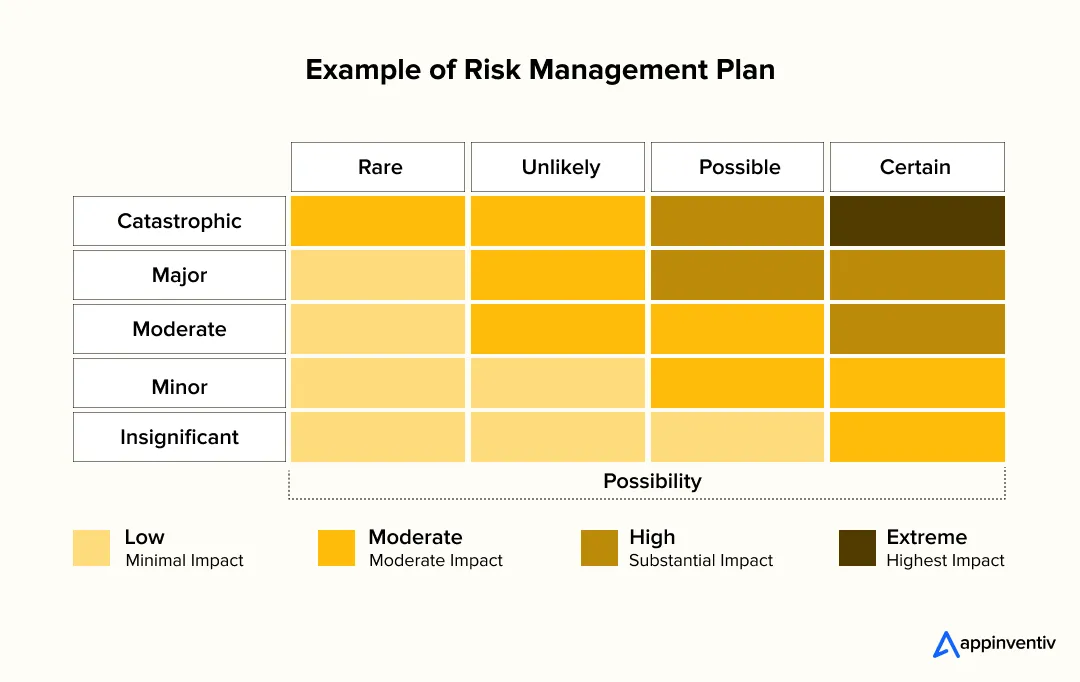
- Probability: How likely the risk is to occur
- Impact: How much harm can it cause
This helps shortlist risks into simple groups. Low, medium, high, or critical. High risks are reviewed first, while low risks are monitored over time.
Many enterprises use heat maps or scoring sheets to keep this process clear and fair across teams.
3. Prioritize What Matters Most
Not every risk deserves an equal level of effort. Some can slow an entire department, while others may cause only minor delays.
To prioritize well, teams focus on:
- Risks that impact users or customers
- Risks that threaten security or compliance
- Risks that can delay major milestones
- Risks tied to core business systems
- Risks that impact several teams at once
Prioritization ensures leadership attention is focused on risks that threaten customer experience, compliance posture, and revenue continuity.
4. Plan Responses and Set Owners
Each major risk needs a clear plan. Teams pick one of four paths:
- Avoid: Change the approach to remove the risk.
- Reduce: Add steps to lower the impact.
- Transfer: Move the risk to a vendor through contracts or SLAs.
- Accept: Agree to monitor the risk if the cost of reducing it is too high.
Every risk should have a single owner who tracks it and reports progress. This prevents confusion later.
5. Monitor and Review
Software project risk management is not a one-time activity. It continues throughout the project.
Teams track changes through:
- Sprint reviews
- Stand-ups
- QA reports
- Architecture checks
- Steering committee meetings
- Updates to the risk register
If a risk grows or fades, its score is changed. This keeps leaders informed at all times.
6. Keep Communication Clear
Large programs depend on steady communication. Leaders need regular updates to avoid surprise delays and budget jumps.
Clear reports, dashboards, and escalation steps help keep everyone aligned. This also builds trust across teams and departments.
Proactive risk management in software engineering is the key. Identifying and assessing gives enterprises a strong foundation. It brings clarity, reduces blind spots, and helps teams act before small issues grow into major failures.
Risk Management Strategies in Software Engineering
Enterprise teams often face risks that cannot be removed completely. In these cases, leaders need clear, simple strategies to decide how to act. There are four core strategies used across software development risk assessment. Each helps control impact, protect timelines, and support better decisions.
1. Avoidance (Strategic Realignment)
Removing the risk by altering the project’s scope or technology stack when the risk-to-reward ratio is unfavorable.
Examples include:
- Dropping a feature that creates high security concerns
- Replacing outdated tech with a safer option
- Changing an approach that has too many unknowns
Avoidance is used when the risk can cause major harm or when its cost is too high.
2. Mitigation (Controls Implementation)
Implementing redundant systems, automated testing, and DevSecOps to lower the probability of occurrence.
Common software engineering risk management ways to reduce this risk include:
- Adding more testing
- Improving code reviews
- Running early architecture checks
- Strengthening security controls
- Breaking complex work into smaller parts
Most enterprise risks fall into this category. It keeps progress steady without stopping the plan.
3. Transference (Contractual Offloading)
Utilizing third-party insurance or shifting liability to vendors via robust Service Level Agreements (SLAs) and Indemnification clauses.
This may include:
- Using a vendor with strong SLAs
- Outsourcing a complex module
- Moving security or hosting to a certified provider
Transfer works well when a vendor has better tools, skills, or compliance support.
4. Acceptance (Informed Retention)
A conscious decision to retain the risk when the cost of mitigation exceeds the potential loss, provided it falls within the pre-defined Risk Appetite.
Acceptance is used when:
- The impact is small
- The probability is low
- The cost of fixing the risk is higher than the risk itself
When accepted, the team keeps a close watch and prepares a backup plan.
Moving Beyond PMBOK: Strategy in Practice
These four strategies help leaders make clear choices when facing software project risk management in uncertain situations. While “Avoid, Transfer, Mitigate, and Accept” are the pillars, enterprise execution requires more nuance:
Addressing Shadow IT: Risk management must account for “unauthorized” SaaS tools integrated by localized teams. Mitigation involves Identity and Access Management (IAM) and centralized API governance.
Vendor Lock-in as a Strategic Risk: Avoid “Cloud Trap” by adopting Containerization (Docker/Kubernetes) and Multi-Cloud strategies, ensuring that a single provider’s outage or pricing shift doesn’t paralyze your operations.
The “Human Firewall”: Beyond turnover, the risk lies in Domain Knowledge Silos. We mitigate this through continuous documentation and pair programming to ensure there is no “Single Point of Failure” within the talent pool.
Strategic risk handling enables enterprises to innovate confidently without exposing core operations to unnecessary disruption.
Best Practices for Effective Risk Mitigation in Enterprise Software Projects
Large projects succeed when risks are handled with steady, disciplined steps. The best practices can help teams stay aligned, avoid delays, and protect the business from costly surprises.
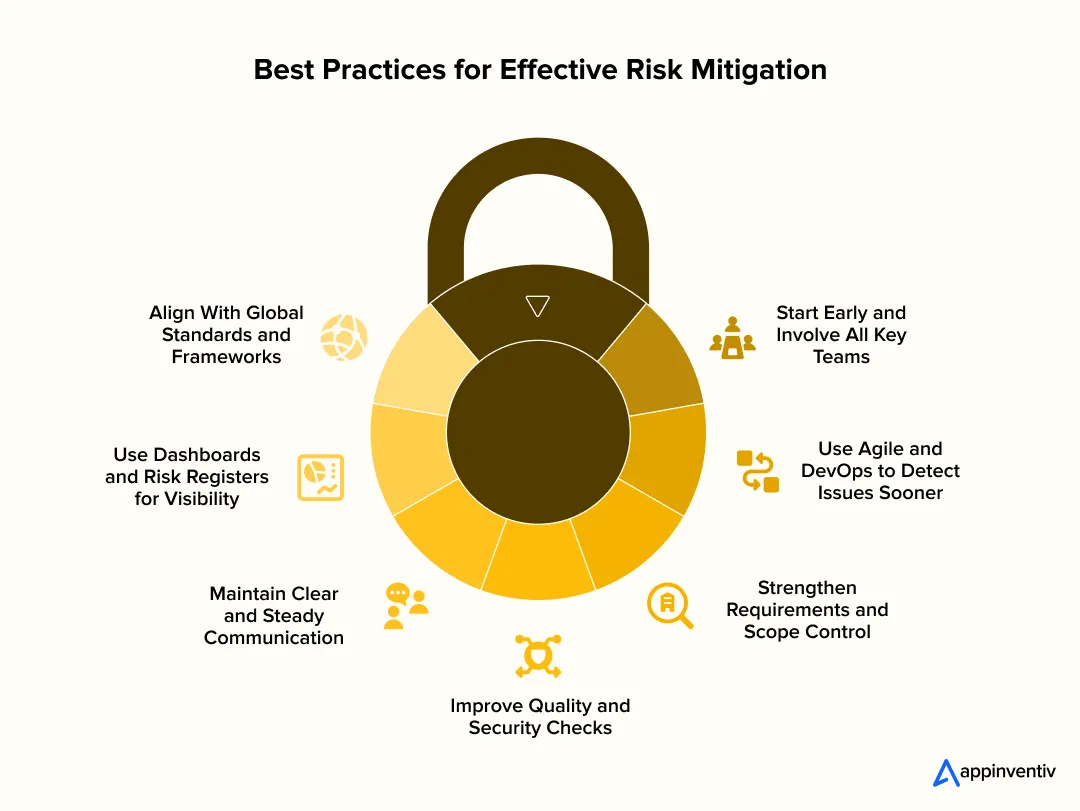
1. Start Early and Involve All Key Teams
Strong risk control begins at the start of the project. Involve leaders from business, engineering, design, security, compliance, and operations.
This early mix of voices helps teams:
- Identify blind spots
- Understand system limits
- Plan budgets better
- Prevent misaligned expectations
When everyone sees the same risk picture, the project moves with clarity.
2. Use Agile and DevOps to Detect Issues Sooner
Agile and DevOps help teams find vulnerabilities early instead of at the end. This works because the system is built and tested in small steps. Each step exposes issues before they spread.
In enterprise settings, this includes:
- Continuous integration
- Automated checks
- Early performance tests
- DevSecOps scans for security
Frequent review creates steady progress and reduces last-minute surprises.
Also Read: Why DevSecOps is Crucial for Tackling Cloud Security Challenges
3. Strengthen Requirements and Scope Control
Most enterprise delays come from unclear or shifting requirements. Clear rules at the start protect the project later.
Key steps in the software engineering risk management process include:
- Documenting what the system must do
- Setting priority levels for each need
- Approving change requests through a formal process
- Keeping all teams aligned on “what’s in” and “what’s out.”
Stable scope means stable timelines and budgets.
4. Improve Quality and Security Checks
Quality and security cannot be treated as final steps. They must be built into every phase of the project.
Strong enterprise initiatives use:
- Architecture reviews
- Code reviews
- Automated functional tests
- Performance tests at scale
- Ongoing security scans
Early testing reduces rework and reduces the risk of expensive fixes after launch.
5. Maintain Clear and Steady Communication
Communication gaps create unclear decisions, slow responses, and mixed expectations.
To avoid this, teams set:
- Clear documentation rules
- Simple reporting models
- Weekly or bi-weekly checkpoints
- Demo-based reviews to align expectations
This keeps leaders informed and gives teams a stable path forward.
6. Use Dashboards and Risk Registers for Visibility
Enterprise projects move across many teams. Without visibility, risks stay hidden until they cause real harm.
Risk management software engineering dashboards help track:
- High-priority issues
- Changes in risk score
- Delays linked to risks
- Open decisions
A shared dashboard keeps conversations honest and transparent.
7. Align With Global Standards and Frameworks
Strong enterprises follow proven global frameworks to reduce uncertainty and meet compliance needs.
Common frameworks include:
- ISO 31000 (Risk Management)
- NIST (Security and Controls)
- COSO ERM (Enterprise Risk Governance)
These frameworks bring order, clear structure, and trusted practices across complex projects.
When these software project risk management practices work together, these practices create delivery predictability and reduce operational surprises at scale.
Our cybersecurity experts help reduce system threats and keep compliance in check.
Tools and Technologies That Strengthen Risk Management
Enterprise risk management software engineering teams need strong tools to keep risks visible, controlled, and easy to act on. The tools below support planning, tracking, quality, security, and communication. Together, they create a predictable and stable project environment.
1. Risk Tracking and Governance Tools
These tools help teams record risks, assign owners, track progress, and maintain transparency.
Common options include:
- Jira and Azure DevOps for issue tracking and workflows
- Confluence for documentation and shared records
- Riskonnect, Archer, and other GRC platforms for enterprise-wide risk governance
These systems in software supply chain risk management give leaders one place to monitor high-risk items and keep teams aligned.
2. CI/CD and Automated Security Tools
Risk management in software security can be reduced with automation. It reduces mistakes and finds risks earlier in the development cycle. Common tools include:
- Static code analysis
- Dynamic testing
- Code quality checks
- Dependency scans
- Container scans
- SAST and DAST tools
Combined with CI/CD, these checks help prevent last-minute failures and protect the system from security issues.
3. QA, Testing, and Performance Tools
Testing tools help teams measure stability, speed, and reliability. They reduce the risk of defects moving into production.
Common tools used by enterprises:
- Functional testing platforms
- Load and stress testing tools
- Test automation frameworks
Early risk management in software testing helps teams avoid costly fixes later.
4. Monitoring and Incident Tools
These tools track system behavior in real time and help teams respond fast when something breaks.
Examples include:
- Application monitoring
- Log analysis
- Alerting and incident response platforms
They help teams find issues before they impact users or business operations.
5. Collaboration Tools for Distributed Teams
Large projects rely on clear communication. Collaboration tools keep conversations structured and make risk updates easy to share.
Common choices include:
- Slack
- Microsoft Teams
- Miro
- Notion
When these tools are tied to risk dashboards, decision-making becomes smoother and faster.
Integrated tooling provides leadership with real-time visibility into risk posture across complex delivery environments. Technology cannot remove risk, but with software engineering risk management, it helps teams see it early and respond with confidence.
The right mix of tracking, testing, automation, and communication tools gives enterprise leaders the clarity they need to run safer and more controlled software programs.
Cost of Implementing Software Risk Management
A structured risk management in software engineering adds clarity and control to enterprise projects. It also requires investment.
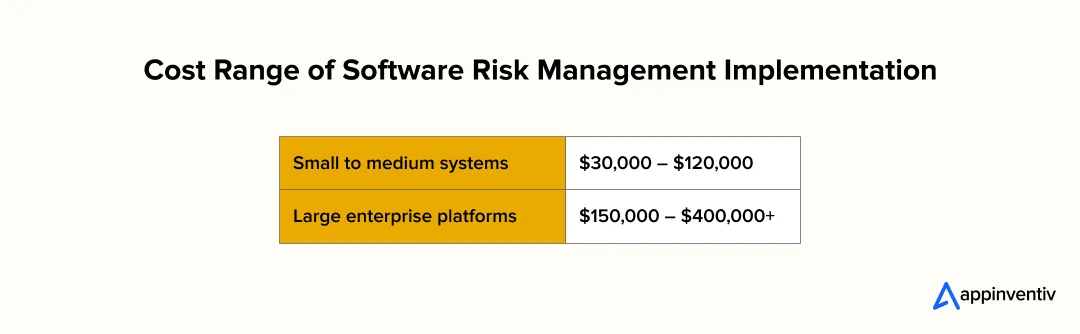
The cost depends on the project size, the number of systems involved, compliance needs, and the tools used. For most enterprise projects, the cost can range from $30,000 to $400,000 or more.
“For every $1 invested in proactive risk management, enterprises save an average of $5 to $10 in technical debt and emergency patches post-deployment.”
Below is a simple view of what shapes the cost.
1. Project Size and Complexity
Small or mid-size applications with limited integrations sit at the lower end of the range.
Large systems with deep integrations, multiple workflows, and high user traffic move toward the higher end.
2. Compliance and Security Needs
In software security risk management, compliance drives costs. Industries such as healthcare, finance, insurance, and government require greater checks and documentation. This includes:
- Security reviews
- Compliance audits
- Penetration testing
- Legal documentation
- Access and data checks
More rules mean more effort and more cost.
3. Tools and Technology Stack
Tools, security scanners, and testing systems used for risk management in software development add to the budget.
The cost depends on whether the enterprise uses:
- Existing licenses
- New paid tools
- Cloud-based platforms are billed monthly
- Enterprise-wide tools with multi-year contracts
Some tools cost only a few thousand dollars a year. Others can cross six figures.
4. Team Structure and Skill Level
Specialists drive better outcomes but increase cost. This includes:
- Solution architects
- Compliance experts
- Security teams
- Senior QA engineers
- DevOps and SRE teams
More experts mean stronger risk control, but also a higher budget. Additionally, choosing white-label risk management software can add to the final cost.
5. Length of the Project
Short projects cost less because risk checks are limited. Long projects, especially those running over 12–18 months, need ongoing audits, monitoring, and updates.
The longer the project, the higher the cost.
6. Multi-Vendor or Multi-System Environments
Enterprises often work with several vendors and tools. Managing risk across all these points requires extra governance and adds to the overall budget.
Proactive risk management reduces emergency remediation costs, downtime losses, and technical debt accumulation over time. Risk management in software engineering is an investment that protects the project from delays, cost overruns, and compliance failures.
Our experts can help you plan, build, and run projects with full risk control.
Why Appinventiv Is the Right Partner for Enterprise Software Risk Management
Enterprise software development services demand experience, discipline, and strong technical depth. Appinventiv supports enterprises that need clear planning, safe delivery, and strong control over every stage of software development.
Our approach aligns technology delivery with governance, compliance, and business continuity priorities. With a track record that spans industries and mission-critical systems, we help businesses reduce risk with cybersecurity services and move with confidence.
Proven Expertise in Large-Scale Engineering
Our ISO 27001-certified processes ensure that risk mitigation is baked into the architecture, reducing post-launch vulnerabilities by up to 40%.
From modernizing legacy platforms to building secure solutions for regulated industries, our approach is led by strong architecture, clear planning, and predictable execution.
A Reliable Partner for Complex, Multi-Year Initiatives
Enterprise programs often stretch across months or years. Our long-term partnerships show our ability to stay steady and consistent. We support:
- Multi-vendor environments
- Cloud migrations
- Core system overhauls
- Enterprise app ecosystems
- High-scale platforms with millions of users
Our teams stay involved from planning to post-launch, ensuring stability across the full lifecycle.
Appinventiv has helped enterprises reduce risk and protect their investments. We bring clarity, control, and long-term stability to every project, ensuring your software goals stay aligned with your business goals.
Contact with our experts for a risk assessment of your project.
Frequently Asked Questions
Q. How do you prioritize risks in software risk management?
A. Teams study each risk based on how likely it is and how much harm it can cause.
- High-impact and high-probability risks move to the top of the list. These usually include issues that can delay delivery, affect users, or create security or compliance threats.
- Low-impact risks are tracked but handled later. This simple order helps leaders focus on what matters most.
Q. What is the difference between Residual Risk and Secondary Risk?
A. Residual Risk is the threat that remains after all mitigation controls are applied. Secondary Risk is a new risk that arises as a direct result of implementing a mitigation strategy (e.g., adding a security tool that increases system latency). We balance both through continuous performance monitoring.
Q. How do security risks differ from operational risks in software development?
A. Security risks relate to threats that can expose data or harm the system. They could be weak passwords, unsafe code, or failed access controls.
Operational risks relate to how the system runs day-to-day, such as slow performance, downtime, or failed integrations.
Security risks threaten safety and compliance. Operational risks threaten stability and user experience. Both need strong controls, but for different reasons.
Q. What is the role of QA and testing in managing software risks?
A. QA and testing help catch issues before they reach users. They check if the system works as expected, performs well, and stays safe under stress. Early and frequent testing lowers defects, reduces rework, and keeps the product stable. This makes QA a key part of risk control.
Q. How can automation help reduce software development risks?
A. Automation reduces human error and finds problems early. Automated tests, code reviews, security scans, and build checks help teams identify defects before they grow. This creates faster feedback, safer releases, and more stable systems. For large programs, automation brings predictability and lowers long-term cost.

- In just 2 mins you will get a response
- Your idea is 100% protected by our Non Disclosure Agreement.
Maritime Insurance Claim Software Development for UAE Ports, Insurers, and Logistics Networks
Key takeaways: Manual claims management is too slow for the UAE’s high-volume ports; digital solutions streamline processes and reduce errors. Maritime insurance claim software centralizes data, automates workflows, and ensures compliance with UAE regulations and Takaful principles. Real-time integration with port and vessel systems enables faster claim registration, validation, and settlement. Advanced analytics and risk…

How to Build a Student Management System in Australia?
Key takeaways: Australia’s tightening regulatory landscape (TEQSA, ASQA, CRICOS) makes student management system development in Australia a compliance-driven necessity, not just a digital upgrade. Monetisation models such as SaaS subscriptions, institutional licensing, white-label partnerships, and hybrid pricing offer scalable commercial opportunities in Australia’s expanding EdTech market. Addressing challenges early - data privacy, legacy migration, multilingual…

Key takeaways: MVP to enterprise scaling requires planned architecture, governance, and cost controls for sustainable growth. Modular, reusable systems and automation can reduce development costs by 30–40%. Scaling should be triggered by repeatable demand and operational readiness, not just early traction. Avoid common pitfalls like premature scaling, overengineering, and lack of ownership clarity. Case studies…