

































How Much Does It Cost to Develop a Software in Australia?

 Share -


- 01How Much Does Software Development Cost In Australia? A Comprehensive View of Critical Components
- 02What Factors Affect Software Development Costs In Australia The Most?
- 03What Are the Hidden Costs in Software Development in Australia?
- 04Features Influencing Costs of Software Development
- 05How Do I Reduce Software Development Costs In Australia Without Cutting Quality?
- 06How to Make Money from Your Software Project in Australia
- 07How to Evaluate Software Development Cost Against ROI
- 08Partner with Appinventiv to Optimise Your Custom Software Development Cost in Australia
- 09FAQs:

Key takeaways:
- Software development costs in Australia for 2026 range from AUD 70,000 to AUD 700,000+, depending on several factors.
- Key factors that influence cost include the project scope, tech stack, and location of the development team.
- Choosing a development partner in Australia requires evaluating their industry experience, pricing structure, and compliance with Australian standards.
- The Australian software development market is expected to grow exponentially, driven by demand in sectors like healthcare, fintech, and e-commerce.
The Australian digital landscape has shifted. For local enterprises and scale-ups, “software development” is no longer just a digital requirement. It is a strategic investment in operational resilience. Whether you are navigating the regulatory complexities of APRA-regulated Fintech in Sydney or modernising legacy infrastructure in the healthcare or logistics sectors, understanding the local cost landscape is essential for long-term ROI.
In 2026, navigating these costs requires balancing premium domestic engineering talent with the complexities of a tightening regulatory environment. As national IT spending surpasses AUD 172 billion, the “cost” of development is increasingly defined by more than just coding hours. Key fiscal drivers now include compliance with the Privacy Act 1988’s latest transparency mandates and the Cyber Security Rules 2025.
Furthermore, strategic use of the R&D Tax Incentive, which can offer up to 43.5% in refundable offsets, remains a critical lever for offsetting capital expenditure. On average, custom software development costs in Australia typically range between AUD 70,000 and AUD 700,000 or more, depending on several key factors (details later).
At its core, the investment required for a bespoke solution can be calculated using the standard industry formula:
Total Development Hours × Developers’ Hourly Rate = Total Cost of Software Development
This article explores the elements influencing the cost to develop a software in Australia, with details of the different phases of development. It provides practical methods to enhance budgets while ensuring high-quality standards.
Whether you’re a new startup or a well-established business, this blog offers essential insights to assist you in navigating the ever-changing ecosystem of custom software development in Australia.
From Lite n’ Easy’s scalability to Rapid Teachers’ compliance, see how we’ve delivered fully compliant digital solutions for Australia’s leading brands.

How Much Does Software Development Cost In Australia? A Comprehensive View of Critical Components
Creating software is a complex process, and its expenses are influenced by numerous factors such as difficulty, phases of development, and geographic disparities.
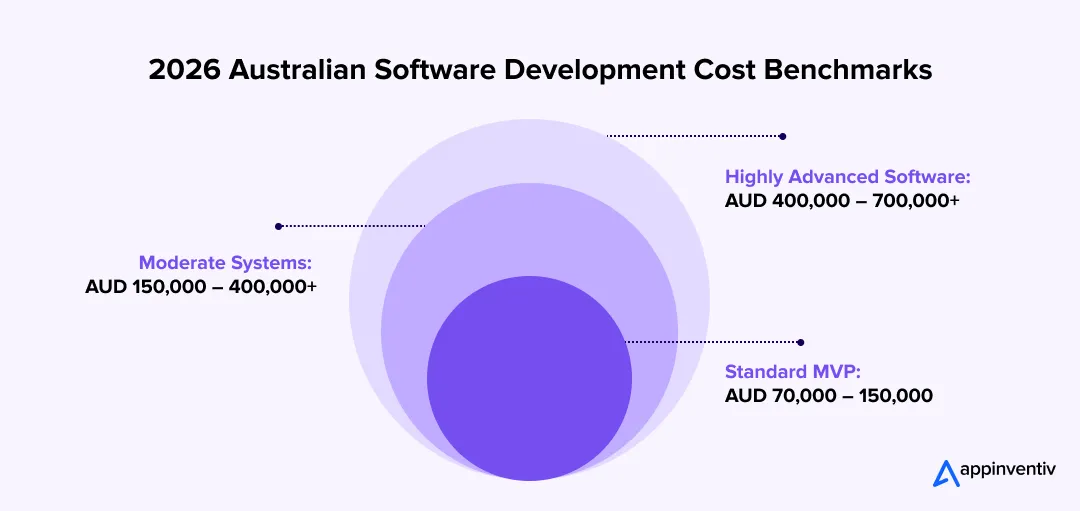
In Australia, software development costs can range from AUD 70,000 to over AUD 700,000, depending on the project’s size, scope, and intricacy.
For companies considering software development Australia, grasping these cost elements promotes improved budget planning and aligns expectations with outcomes.
- Cost Based on Complexity
- Cost Based on Development Phase
Cost Based on Complexity:
Basic Software
- Estimated Cost: AUD 70,000–150,000.
- Example: Stock control systems and fundamental customer relationship management tools.
- Characteristics: Restricted capabilities, straightforward interfaces, and few integrations.
Medium-Complexity Software
- Estimated Cost: AUD 150,000–400,000.
- Example: Online shopping sites and exercise applications featuring dashboards.
- Characteristics: Incorporation of external APIs, average user engagements, and cloud assistance.
Complex/Enterprise-Level Software
- Estimated Cost: AUD 400,000– 700,000.
- Instances: Tailored ERP software development in Australia and monetary platforms.
- Characteristics: Sophisticated capabilities such as AI, IoT, blockchain, numerous integrations, and high-level enterprise security.
The software development cost in Australia rises considerably due to the demand for advanced technology and scalable architecture.
Costs Based on the Development Phase
Each phase of the software development lifecycle contributes to the overall cost. For companies wondering about the steps to develop custom software in Australia, these stages provide a clear framework for estimating expenses:
Planning
- Estimated Cost: AUD 5,000–20,000.
- Involves: Investigation, concept development, and model creation to verify the project’s viability.
Design
- Cost Projection: AUD 10,000–50,000.
- Basic Interfaces: Reduced expense.
- Intricate UI/UX: Entails comprehensive mockups and user experience mapping.
Development
- Cost Projection: AUD 50,000–300,000.
- Frontend Development: For components that users interact with.
- Backend Development: Concerning databases, servers, and APIs.
- Integration Expenses: Incorporating external tools such as payment processors or social platforms.
Testing
- Estimated Cost: AUD 5,000–30,000.
- Manual Testing: Requires more effort and takes more time.
- Automated Testing: Upfront expenses are required, but quicker performance for extensive projects.
Deployment and Maintenance
- Cost Projection: AUD 10,000–100,000 (per year).
- Features: Cloud hosting, routine updates, bug resolutions, and scalability improvements.
Understanding these expenses will help with transparency when calculating the price of developing software. Businesses may consider outsourcing to bespoke software development Australia providers for tailored solutions at competitive rates.
Here is the table showcasing software development cost estimate at each stage:
| Stage | Estimated Cost Range in AUD | Estimated Cost Range in % | Key Considerations |
|---|---|---|---|
| Planning | 5,000–20,000 | 5-10% | Research and feasibility analysis. |
| Design | 10,000–50,000 | 10-15% | UI/UX complexity impacts costs. |
| Development | 50,000–300,000 | 40-55% | Includes coding and integrations. |
| Testing | 5,000–30,000 | 10-15% | Manual vs. automated testing costs. |
| Deployment & Maintenance | 10,000–100,000 (annual) | 5-10% | Cloud hosting, updates, and scalability. |
By analysing these elements, companies can more accurately assess the software development expenses in Australia and ensure they align with their objectives and financial plans.
What Factors Affect Software Development Costs In Australia The Most?
In Australia software development costs fluctuate significantly, influenced by a mix of technical, strategic, and market elements. Comprehending these factors influencing software development cost in Australia is essential for companies looking to utilise resources efficiently and strategise their finances.
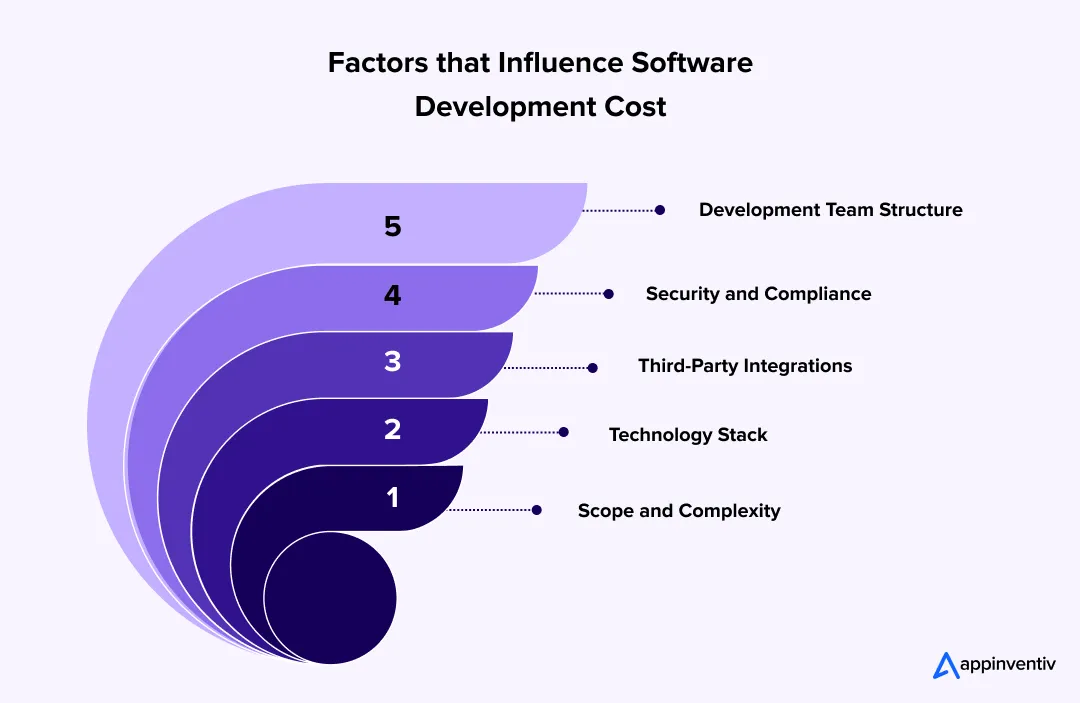
Project Scope and Complexity
The extent and intricacy of a project significantly influence the expenses associated with software development Australia. Here’s how:
- Number of Features: Additional features extend the time and effort required for development. For instance, a basic task management application is cheaper than a custom ERP software development in Australia because of its extensive features.
- Feature Depth: Enhanced features like real-time analytics, AI-based insights, and IoT connectivity increase expenses.
- Scalability Requirements: Software created for scalability at the enterprise level leads to increased expenses in both development and upkeep.
The extent and intricacy of a project significantly influence the expenses associated with software development Australia. Selecting the appropriate development methodology early in the planning phase helps optimize both timeline and budget allocation for Australian businesses.
Software Type and Platform
The type of software is one of the biggest cost drivers. A customer-facing web application, mobile app, CRM, SaaS platform and enterprise system require different levels of architecture, integrations, testing and ongoing support.
| Software type | Typical cost drivers |
|---|---|
| Web application | UX, backend, integrations, scalability |
| Mobile application | iOS/Android support, backend, device compatibility |
| CRM | Workflows, permissions, integrations, reporting |
| SaaS platform | Multi-tenancy, billing, security, scalability |
| Enterprise software | Complex integrations, security, data migration and governance |
Industry and Regulatory Requirements
The industry in which the software will operate can materially change the budget. Fintech and healthcare products, for example, may require more security, compliance, data controls and specialised integrations than a less regulated internal application.
| Industry | Indicative cost range | Common cost drivers |
|---|---|---|
| Fintech | AUD 80,000 – 700,000+ | Financial integrations, security, fraud controls and regulatory requirements |
| Healthcare | AUD 90,000 – 700,000+ | Privacy, clinical workflows, interoperability and sensitive data |
| Education | AUD 70,000 – 500,000+ | LMS integrations, user management, content delivery and analytics |
| Retail/ecommerce | AUD 75,000 – 600,000+ | Payments, inventory, ERP, CRM and fulfilment integrations |
| Mining | AUD 90,000 – 600,000+ | IoT/OT integration, remote asset monitoring, predictive maintenance, safety systems and site connectivity |
| Manufacturing | AUD 90,000 – 550,000+ | ERP/MES integration, industrial IoT, automation, production tracking, supply chain data and machine connectivity |
Software Development Cost by Location
Location can significantly affect software development rates because labour markets, salaries and operating costs differ. A current Clutch benchmark puts listed custom software development company rates at 100–149/hour in Australia, $25–49 in India and $50–99 in the US.
As per Clutch report, here is the custom software development Pricing by location
| Country | Average Cost per Hour |
|---|---|
| United States of America | $50 – $99 |
| India | $25 – $49 |
| Canada | $100 – $149 |
| Australia | $100 – $149 |
| Phillippines | $25 – $49 |
| Ukraine | $25 – $49 |
| Poland | $50 – $99 |
| Spain | $25 – $49 |
| Mexico | $25 – $49 |
Remember, a lower hourly rate does not automatically translate into a lower total project cost. Businesses should also consider project management, communication, rework, technical expertise and the delivery model when comparing locations.
Fixed-Price vs Time-and-Materials
The pricing model can affect budget predictability and how changes are handled during development. Fixed-price contracts are generally suited to clearly defined requirements, while Time-and-Materials (T&M) works better when scope is expected to evolve.
| Factor | Fixed-price | Time & Materials |
|---|---|---|
| Budget predictability | Higher | Lower |
| Scope flexibility | Lower | Higher |
| Best suited to | Defined requirements | Evolving requirements |
| Change requests | Usually separately priced | Charged according to effort |
| Discovery/MVP work | Can be restrictive | More flexible |
Technology Stack
The selection of your tech stack is a primary driver of both initial custom software development in Australia and the Total Cost of Ownership (TCO). For Aussie innovators, choosing a stack isn’t just about performance; it’s about talent availability and eligibility for federal innovation offsets.
| Tech Tier | Core Technologies | Avg. Cost Impact | Strategic Advantage in AU |
|---|---|---|---|
| Basic | Python, Node.js, React, PostgreSQL | Baseline | High local talent pool; fastest time-to-market for MVPs. |
| Cross-Platform | Flutter, React Native | -30% to -40% | Single codebase for iOS/Android; ideal for “Mobile-First” AU startups. |
| Enterprise | .NET Core, Java/Spring Boot, Angular | +20% to +35% | High security/compliance; standard for ASX 200 & Government systems. |
| Next-Gen | AI/ML (TensorFlow), Blockchain, IoT | +40% or more | High “Innovation” value; often qualifies for 43.5% R&D Tax Offsets. |
Third-Party Integrations
Contemporary software frequently depends on outside integrations to boost functionality.
- APIs: Incorporating APIs for mapping, weather information, or payment processing involves costs for licensing and development.
- Payment Processors: Secure payment systems like PayPal or Stripe require initial integration expenses and transaction charges.
- CRM Systems: Tailored integrations with platforms such as Salesforce may also increase the overall cost to build CRM software in Australia
- Integration of Social Media: Incorporating functions such as logging in through Facebook or sharing posts on Instagram necessitates extra coding and testing.
Security and Compliance
In the Australian market, robust security is a non-negotiable architectural requirement that directly scales with project complexity and influences the investment.
- Local Regulations: Software in Australia must comply with the Privacy Act 1988, APRA (CPS 234) for financial services, and the My Health Record Act for healthcare, necessitating audited security frameworks.
- Data Sovereignty: Ensuring data resides within Australian borders to meet Sovereign Cloud requirements and the Consumer Data Right (CDR) standards adds specialised engineering overhead but mitigates long-term legal risk.
- Encryption & IRAP Alignment: Implementing high-level encryption and aligning with the Information Security Registered Assessors Program (IRAP) ensures your software meets the Essential Eight maturity model, a key benchmark that increases the cost of software development in Australia.
Development Team Structure
The kind of team selected for the project has a major impact on cost differences:
- Freelancers: Typically less expensive but might not offer complete assistance.
- In-House Teams: Provides enhanced control but comes with substantial salary and infrastructure expenses.
- Outsourced Agencies: Involving experts from Australian custom software development agencies guarantees proficiency and growth, typically at competitive prices.
| Provider / team type | Typical cost range (AUD) | How cost is typically structured |
|---|---|---|
| Freelancer | 70–180/hour | Hourly or project-based |
| Outsourced agency | 70,000 – 700,000/per project | Milestone or project-based |
| Dedicated development team | 7,500–15,000+/developer/month | Monthly or hourly team cost |
| In-house team | 90,000–900,000+/developer/year | Salary + employer on-costs + tools + management |
AI and Advanced Technology Requirements
AI, machine learning, IoT, blockchain, computer vision and other advanced technologies can increase software development costs because they require specialised engineering, data infrastructure and ongoing technical support.
For AI-enabled software development, costs may include data preparation, model selection or development, API usage, model evaluation, cloud infrastructure, security, monitoring and continuous optimisation. IoT projects may require device integration, connectivity, edge computing and real-time data processing, while blockchain solutions can add smart contract development, network integration and security testing.
| Technology | Key cost drivers |
|---|---|
| AI & ML | Data preparation, model/API integration, training, evaluation and monitoring |
| Generative AI | LLM/API usage, RAG, vector databases, prompt engineering and security |
| IoT | Device integration, connectivity, edge processing and real-time data |
| Computer Vision | Image/video processing, model development, data labelling and compute |
| Blockchain | Smart contracts, network integration, wallets and security testing |
| Advanced Analytics | Data pipelines, cloud infrastructure, dashboards and predictive models |
By meticulously examining these elements, companies can more accurately assess the expenses involved in the cost to make a software in Sydney Australia, or comprehend the duration required for software development.
All these elements highlight the importance of software development in business and stress the necessity of comprehensive planning to manage expenses efficiently.
What Are the Hidden Costs in Software Development in Australia?
Alongside the initial development expenses, various concealed costs can greatly influence the total software development cost in Australia. These continual expenses need to be considered when organising a software project.
Ongoing Maintenance
When the software is operational, consistent updates, error corrections, and performance enhancements are required. Maintenance guarantees that the software remains secure, operational, and up-to-date, yet it demands ongoing allocation of time and resources.
Also Read: How Much Does it Cost to Maintain a Software?
Infrastructure Costs
Software applications frequently depend on servers, cloud storage, and networking systems. These expenses may fluctuate depending on the software’s size and application. As user demand rises, infrastructure expenses might rise to support greater traffic and data processing requirements.
Licensing and Compliance
Depending on the software sector, there could be legal obligations for licenses and adherence to standards like data protection or industry regulations. Fulfilling these requirements may incur software licenses, certifications, and evaluation costs.
Advertising and Promotion
Introducing and marketing a new software product is crucial for its success. This could cover costs such as digital marketing initiatives, public relations activities, and user acquisition plans, all contributing to the total expense of achieving market success for the software.
Understanding these hidden costs is essential, as they impact the long-term expense of developing software in Australia.
Also Read: How Much Does Accounting Practice Management Software Development Cost in Australia
Features Influencing Costs of Software Development
The characteristics included in a software project greatly influence the software development expenses in Australia, as they outline the product’s complexity and extent.
- Essential Features
- Advanced Features
- Unique Selling Points (USPs)
Essential Features:
Essential features form the core of any software, emphasising user-friendliness and functionality.
- Examples: User authentication systems, user-friendly interfaces, and safe data storage.
- Cost Estimates: The cost of creating key features can vary from AUD 15,000 to AUD 30,000, depending on the interface’s simplicity and the database structure.
These attributes guarantee that the software addresses fundamental user requirements and is a dependable foundation for upcoming improvements.
Advanced Features
For companies looking to differentiate themselves, high-end features are crucial.
- Examples: Live updates for dynamic data exchange, AI-based analysis to forecast user actions, or chatbots for automated customer assistance.
- Cost Estimates: Incorporating these may raise expenses by AUD 20,000 to AUD 50,000, depending on the technology stack and the complexity of the integrations.
These attributes improve user experience and involvement, fostering sustained value.
Unique Selling Points (USPs)
Unique, tailored features provide a competitive advantage but at a higher cost.
- Examples: Tools tailored for specific industries, such as telemedicine platforms or gamified user engagement systems.
- Cost Estimates: Creating USPs usually costs between AUD 30,000 and AUD 100,000, indicating their complexity and originality.
Focusing on the appropriate features allows companies to maximise their software development cost in Australia, aligning budget limitations with performance and market influence.
Join our list of 1000+ Australian clients in choosing a partner that understands the Australian regulatory requirements and user journey.

How Do I Reduce Software Development Costs In Australia Without Cutting Quality?
Enhancing software development cost in Australia is essential for companies aiming to create quality products while staying within budget. Here are critical tactics to attain cost-effectiveness:

Building an MVP
Creating a Minimum Viable Product (MVP) enables companies to concentrate on essential features, decreasing initial development time and expenses. An MVP allows testing the software’s idea before significantly investing in more complex features.
Prioritise Features
By focusing on key functionalities, companies can reduce their development expenses. Rather than constructing everything simultaneously, it’s important to determine which features have the greatest impact and prioritise their development. This strategy guarantees the project remains within budget while continuing to provide value to users.
Use Existing Tools and Frameworks
Utilizing current tools, libraries, and frameworks can greatly reduce development time and lower expenses. Numerous ready-made solutions exist for standard functionalities like authentication, payment processing, or notifications, which can be incorporated rather than developed from the ground up.
Outsourcing to Reliable Teams
Delegating software development to a talented team like Appinventiv is an effective approach to optimizing expenses. It is crucial to select trustworthy partners who offer digital product engineering services in Australia alongside quality development capabilities at competitive rates.
Cross-Platform Development
Cross-platform development tools enable companies to reach various platforms (iOS, Android, web) using one codebase, reducing development and maintenance expenses. This approach simplifies scaling and updating the software on multiple platforms.
How to Make Money from Your Software Project in Australia
Selecting a successful revenue model guarantees that custom software development in Australia recovers expenses and produces steady profits. Here’s a summary of typical models that companies utilise to generate revenue from their software projects:

Subscription Models
The subscription model is perfect for SaaS (Software as a Service) platforms. Clients are charged subscription fees, either monthly or yearly, for using the software. This model offers companies a consistent source of income and guarantees reliable cash flow. Subscriptions frequently feature tiered pricing that provides different access levels depending on customer requirements.
For instance, Canva basic plans might include essential features, whereas premium plans provide advanced tools or integrations. This model is ideal for companies heavily investing in cloud services, frequent updates, and assistance.
One-Time Licensing Fees
This conventional revenue model requires a one-time, upfront payment that provides users with indefinite software access. It’s frequently utilised for business solutions, desktop software, or specialized tools. Though this method generates instant revenue, the lack of ongoing income requires businesses to attract new customers consistently. Consistent updates and enhancements are essential for ensuring ongoing satisfaction and remaining competitive.
Freemium Models with In-App Purchases
The freemium model offers a free edition of the software with restricted features, encouraging users to discover its capabilities. In-app purchases or upgrades provide access to enhanced features, exclusive tools, or experiences without advertisements.
This model is especially favoured in mobile apps and gaming software, where a large user base generates income. Freemium approaches are effective for companies aiming to boost user adoption before generating revenue.
Choosing the appropriate revenue model enables companies to match their pricing strategies with market needs, ensuring they cover the cost to develop a software in Australia while enhancing profitability in the long run. Every model possesses unique advantages and should be selected according to the software’s objective, target audience, and current market trends.
How to Evaluate Software Development Cost Against ROI
Software cost should be evaluated against the business outcome it is expected to create. A lower development quote is not necessarily better if the software creates rework, security exposure or expensive technical debt. You need to consider both measurable financial returns and the ongoing cost of running and improving the software.
| ROI factor | What to assess |
|---|---|
| Revenue growth | New sales, subscriptions or channels enabled by the software |
| Cost savings | Reduced manual work, operational costs or third-party software spend |
| Productivity | Time saved for employees, customers or support teams |
| Customer value | Retention, conversion, satisfaction or reduced churn |
| Ongoing costs | Cloud, maintenance, APIs, licences, security and support |
| Payback period | How long it takes for measurable benefits to recover the initial investment |
A simple ROI calculation formula is
ROI = (Financial benefit − Software investment) ÷ Software investment × 100
For example, if a software platform requires AUD 250,000 to build and is expected to generate AUD 150,000 in annual measurable savings, the simple payback period would be about 20 months, before considering financing, tax and ongoing operating costs.
Don’t leave capital on the table. Our Australian delivery team specialises in documenting “Technical Uncertainty” to help you maximise your federal tax claim.

Partner with Appinventiv to Optimise Your Custom Software Development Cost in Australia
Assessing the cost of software development in Australia requires thoroughly examining elements such as complexity, necessary features, and continual maintenance. Although these expenses can accumulate, collaborating with a trusted provider of digital strategy consulting services in Australia guarantees that your investment achieves optimal value.
Appinventiv is recognised as a professional custom software development company in Australia. With over 3,000 digital deliveries and a team of 1,600+ tech experts, we provide the technical depth required to navigate Australia’s unique regulatory and economic landscape. We assist our AU partners in documenting technical uncertainty to maximise eligibility for the 43.5% R&D Tax Incentive.
Our Australian Footprint & Expertise
We don’t just build software; we engineer business outcomes. Our work with leading Australian brands demonstrates our ability to solve sector-specific challenges:
- Lite n’ Easy: We partnered with this iconic Australian healthy meal delivery provider to modernise their digital ecosystem, focusing on user-centric design and high-load scalability to support thousands of daily transactions across the country.
- Multinail: Supporting Australia’s construction and manufacturing backbone, our work with Multinail involved complex software engineering to drive industrial efficiency and structural precision.
- Rapid Teachers: For the education sector, we developed a sophisticated platform that streamlines teacher placements, requiring deep integration with local Australian compliance and workforce management standards.

With 10+ years of APAC delivery experience and 5+ agile delivery centres, we solve the “onshore vs. offshore” dilemma for Australian enterprises. Our model integrates an onshore strategic presence, ensuring real-time collaboration in AEST/AWST, with a high-velocity offshore engine.
This “Hybrid Delivery Model” is engineered specifically to optimise your software development cost in Australia without compromising quality or compliance.
Are you prepared to transform your idea into an impactful digital solution? Contact us for a smooth development journey that boosts growth and optimises outcomes.
FAQs:
Q. What’s the Average Cost of Software Development in Australia?
A. Software development in Australia typically costs AUD 70,000–700,000+, depending on the software type, complexity, features, integrations, security requirements and development team.
Q. How Much Does AI-Powered Software Development Cost?
A. AI-powered software can cost more than conventional applications because of data engineering, model or API integration, evaluation, security, cloud infrastructure and ongoing monitoring. Costs vary significantly depending on whether existing AI services or custom models are used.
Q. What Ongoing Costs Should I Expect After Software Is Built?
A. Ongoing costs can include cloud hosting, maintenance, security, third-party APIs, licences, monitoring and further development. A 15–25% annual maintenance budget can be used as a planning benchmark, but actual costs vary by software complexity and support requirements.
Q. How to Choose the Right Software Development Team?
A. To select the appropriate team, focus on expertise, communication skills, and the quality of their portfolio. Seek developers with expertise in your sector and review client feedback for dependability.
Q. Does Software Development Cost Vary by Industry?
A. Yes. Fintech, healthcare, mining and other regulated or technically complex industries can cost more because of security, compliance, integration, data and infrastructure requirements.


Fast 2-minute response, fully NDA-protected.

The Ultimate Guide to CRM for Insurance: Features, Cost, Top Platforms, Integration & More
Key takeaways: CRM for insurance connects sales, service, and claims into one governed system, distinct from the policy administration system. Core features span pipeline management, policy visibility, claims tracking, commission management, AI analytics, and compliance controls. Cost ranges from roughly USD 15,000 for configuration to USD 150,000 and beyond for custom development at enterprise scale.…

How to Choose a Technology Partner for Government Software Development
Key takeaways: Evaluate the partner across five layers: procurement eligibility, assurance, engineering, delivery and long-term ownership. Choose a government technology partner on evidence, governance and delivery depth, not development capability alone. Match partner evaluation criteria to the security, integration and operational risks of the programme. Treat data sovereignty, privacy, accessibility and security as architecture decisions…

Distributed Energy Resource Management System: Use Cases, Development and Implementation Costs
Key takeaways: Australian grids require robust software to manage minimum system load events effectively. DER integration software aggregates, monitors, and dispatches varied grid edge hardware securely. CSIP-Aus and AEMO compliance dictate strict architectural and cybersecurity software foundations. DERM development and implementation costs typically range from AUD 70,000 to 700,000 +. Successful DER programmes start with…