































How to Implement a Manufacturing Execution System in Australia: A Step-by-Step Process for Modern Factories


- Understanding the Core Functioning of a Manufacturing Execution System
- Why Australian Manufacturers Need an MES Now?
- How to Implement a Manufacturing Execution System in Australia: A Step-by-Step Process
- What Are the Common Challenges in MES Implementation in Australia and How to Overcome Them?
- How Much Does MES Implementation Cost in Australia?
- Key Technologies Supporting Modern MES Implementation for Future Factories
- How Appinventiv Helps Manufacturers Implement MES Solutions?

Key Takeaways
- MES implementation in Australia closes the execution gap between ERP plans and real shop-floor outcomes, enabling real-time control over throughput, quality, and delivery commitments.
- Implementing a manufacturing execution system in Australia is now a resilience strategy, helping manufacturers navigate skills shortages, compliance pressure, and multi-site complexity.
- The cost to implement the best MES software in Australia typically ranges from AUD 70,000 and AUD 700,000+.
Australian manufacturers are navigating one of the most volatile periods in recent history. The shift from manual spreadsheets to real-time shop floor intelligence is no longer an optional upgrade but a survival mandate under the national modern manufacturing strategy.
While in 2025, the sector produces $137 billion of value-added output and employs over 930,000 people, leadership teams are currently battling a documented 2.5% contraction in equipment and machinery investment. For those at the helm of MedTech, Food and Beverage, or Defence operations, relying solely on legacy ERP systems creates a critical visibility gap, a “black hole” between high-level planning and actual shop floor execution.
A manufacturing execution system (MES) serves as the digital backbone to bridge this divide. While an ERP manages business logic, the MES manufacturing execution system focuses on the “how” of production, providing the real-time intelligence needed to track every transformation of raw materials into finished goods.
In a high-cost economy like Australia, where regulatory scrutiny from bodies like the TGA or FSANZ is rigorous, the ability to monitor Overall Equipment Effectiveness (OEE) and maintain 100% digital traceability is a prerequisite for both domestic stability and global export readiness.
Moving toward a manufacturing execution system is a significant capital commitment that demands a fundamental shift in how data is governed and actioned. This blog provides a practitioner-led roadmap to answer how to implement a manufacturing execution system in Australia, covering challenges, future trends and more.
Get a clear roadmap for implementing a Manufacturing Execution System in Australia with minimal operational risk.
Understanding the Core Functioning of a Manufacturing Execution System
To implement an MES effectively, you must first comprehend its functional boundaries. While terms like SCADA, PLC and ERP in Australia are often used interchangeably in casual conversation, the distinctions between all these terms are critical for architectural integrity.
An MES manufacturing execution system operates at Level 3 of the ISA-95 model. Let’s know in detail:
- ERP (Level 4): Manages financial records, procurement, and high-level demand planning. It operates in days and weeks.
- MES (Level 3): Orchestrates the actual execution of work orders. It operates in hours and shifts, managing the “as-built” record.
- SCADA/HMI (Level 2): Provides supervisory control and data acquisition for specific lines. It monitors process values in seconds and minutes.
- PLC (Level 1): The hardware logic that physically moves the machinery in milliseconds.
The core purpose of manufacturing execution system software is to transform raw machine data into operational intelligence. Without an MES, you are essentially asking your ERP to handle granular shop-floor complexities it wasn’t built for, or relying on SCADA systems that lack the context of orders, people, and material costs.
Core Functions of MES That Drive Adoption
A mature MES deployment provides a suite of features that move a factory from reactive to proactive management. The key applications of an MES include:
- Real-Time Production Tracking: Mapping the movement of every unit through the production lifecycle to identify bottlenecks as they occur.
- Digital Traceability & Genealogy: Creating a permanent record of every component, batch number, and operator interaction.
- Quality Management & Enforcement: Automating “kill-switches” or hold-orders if a process deviates from established setpoints, preventing waste before it scales.
- Performance Monitoring (OEE): Standardising the calculation of Availability, Performance, and Quality across disparate lines to provide a single source of truth for plant performance.
By integrating these functions, MES ensures that the data generated by a machine in a regional Australian plant is immediately visible and actionable for a product lead in a metropolitan head office.
Why Australian Manufacturers Need an MES Now?
The business case for implementing a manufacturing execution system in Australia has become a dire necessity. For Aussie manufacturers, the primary reasons are no longer just about incremental efficiency. Rather, this is navigating a structural digital transformation in the Australian industrial landscape.
1. Chronic Skills Shortages and the Automation Mandate
The Australian manufacturing sector is currently facing a critical workforce deficit. According to Jobs and Skills Australia, nearly 36% of occupations in the sector are in national shortage.
So, when you cannot hire your way out of a production bottleneck, you must automate your way through it. An MES acts as a force multiplier. This allows a smaller, highly skilled team to manage complex operations by:
- Automating manual data entry and “paper-run” tasks.
- Reducing the cognitive load on operators through digital work instructions.
- Providing plant supervisors with real-time dashboards to preempt issues.
2. Rigorous Compliance and Export Competitiveness
For Australian enterprises, “compliance” is a high-stakes commercial reality. Whether it is meeting the TGA’s PICS guidelines in pharmaceuticals or adhering to the Export Control Rules 2021 for agricultural products, the “as-built” record must be flawless.
Manufacturing execution system software provides a digital thread that is inherently audit-ready. In sectors like MedTech and Defence, where Australia is positioning itself as a high-value niche producer, the ability to guarantee 100% traceability is often the deciding factor in winning international contracts.
3. Operational Visibility Across Multi-Site Plants
Many Australian manufacturers operate fragmented facilities across different states. This geographical spread often leads to data silos where “Plant A” and “Plant B” use different metrics for success. MES execution system deployment standardises these KPIs, offering a “single pane of glass” view.
Sector-Specific Applications of MES in Australia
Different Australian industries prioritise different MES capabilities based on their unique regulatory and operational pressures:
| Industry Sector | Key Aspects of MES Implementation in Australia | Operational Impact |
|---|---|---|
| Mining Equipment (METS) | Complex Assembly Tracking | Manages bespoke engineering cycles and multi-year asset lifecycles. |
| Food & Beverage | Batch Genealogy | Ensures rapid recall capability and compliance with FSANZ safety standards. |
| Pharmaceuticals | Electronic Batch Records | Replaces manual logs with 100% compliant, paperless audit trails (TGA/FDA). |
| Automotive Components | Just-in-Time (JIT) Sync | Coordinates shop-floor output with strict global supply chain delivery windows. |
How to Implement a Manufacturing Execution System in Australia: A Step-by-Step Process
Successfully implementing a manufacturing execution system in Australia requires moving away from “vendor-led” approaches toward a practitioner-led strategy. For local enterprises, the risks are often concentrated in the integration layer and the cultural shift required on the factory floor. Considering this, here is a structured, step-by-step MES implementation process. This will help you de-risk the deployment while ensuring immediate commercial ROI.
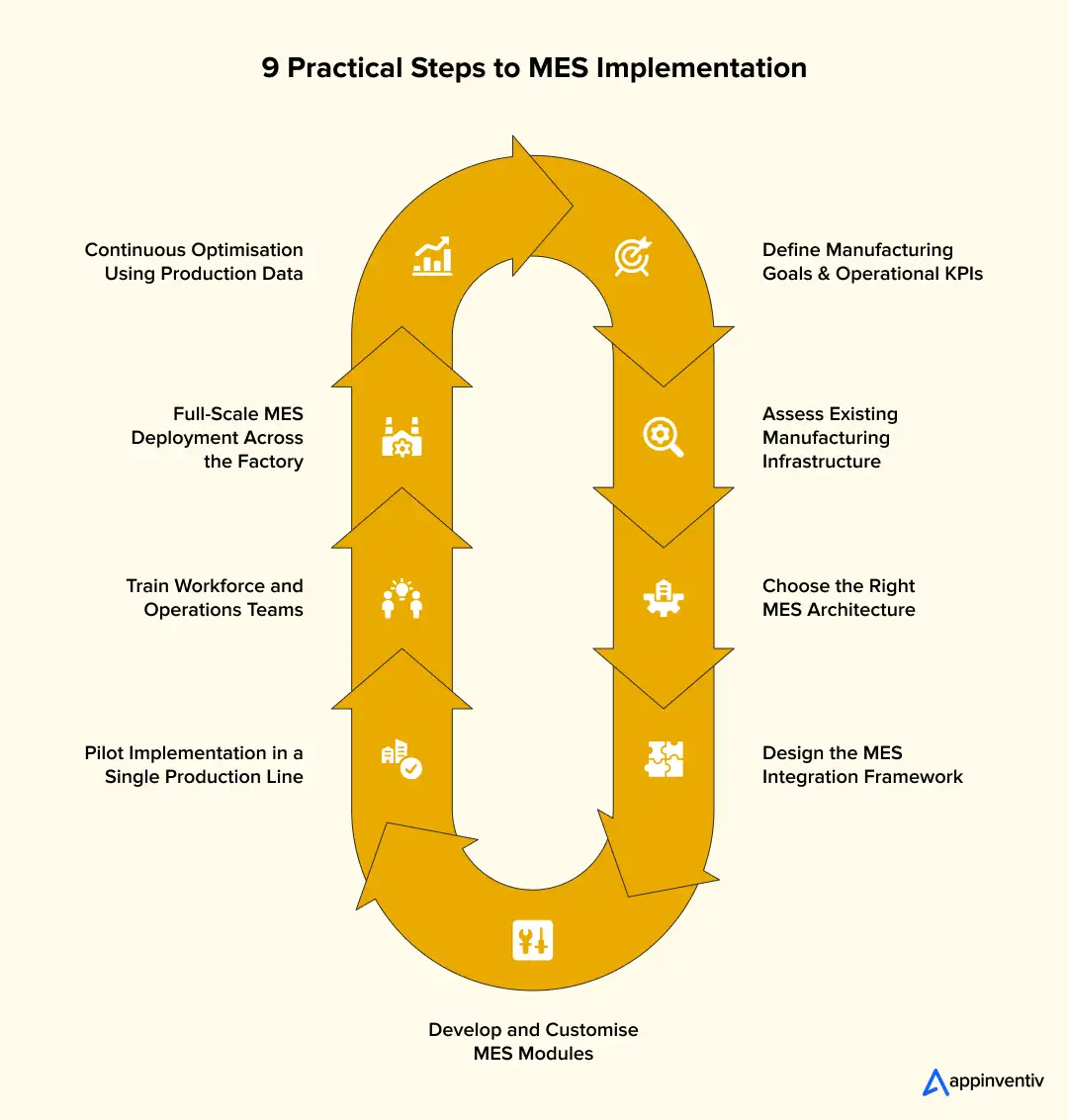
Define Manufacturing Goals and Operational KPIs
Implementation of an MES should never begin with a feature list. It must begin with a business problem. In the Australian market, where capital expenditure is heavily scrutinised, you must align the MES objective with specific executive outcomes.
- Identify Operational Pain Points: Are you losing margin due to excessive scrap or is your primary constraint a lack of real-time visibility into WIP (Work in Progress)?
- Set Measurable KPIs: Establish baseline metrics for OEE, scrap reduction, and cycle times.
- Align with Business Strategy: Ensure the MES supports broader goals, such as achieving carbon neutrality or scaling for new export markets.
Assess Existing Manufacturing Infrastructure
Before introducing a new MES, you must audit the technical debt of the current facility. Australian plants often feature a mix of advanced robotics and decades-old legacy assets.
- Evaluate ERP and SCM Connectivity: Determine how the MES will ingest orders from your ERP and push finished goods data back for financial reconciliation.
- Identify Integration Gaps: Assess if your current SCADA or PLC layers are capable of two-way communication or if they require hardware gateways.
- Determine IoT Readiness: Map out which machines are “smart” and which require external sensors to provide the necessary data for a cloud based manufacturing execution system.
Choose the Right MES Architecture
The choice of architecture is a long-term governance decision that impacts data sovereignty and total cost of ownership. So, you must take this step cautiously, considering:
- Cloud-based MES: Offers rapid scalability and lower upfront infrastructure costs. Ideal for multi-site operations where centralised data is a priority.
- On-premise MES: Preferred by high-security sectors like defence, where data must stay within the physical perimeter of the plant.
- Hybrid MES models: The most common choice for Australian factories, keeping time-critical execution data on-site while pushing analytics and reporting to the cloud.
Design the MES Integration Framework
This is where most projects gain ground or fall flat. The framework must ensure that data flows seamlessly between the top floor and the shop floor without creating new silos.
- ERP-to-MES Mapping: Define the precise data handshakes for work orders, bills of materials (BOM), and inventory updates.
- Machine Connectivity: Establish a robust Industrial IoT (IIoT) layer to capture real-time signals from the production line.
- Data Visualisation: Design the dashboard architecture to ensure that the information presented to a machine operator is fundamentally different from the insights provided to a plant manager.
Develop and Customise MES Modules
Standard manufacturing execution software often requires configuration to match your specific shop-floor logic. At this stage, we focus on translating operational workflows into digital blueprints.
- Workflow Configuration: Digitising your unique production sequences to ensure the system enforces the correct order of operations.
- Quality Control Automation: Integrating “stop-ship” triggers and automated alerts when sensors detect deviations from tolerance levels.
- Production Scheduling Optimisation: Using real-time data to dynamically adjust schedules when a machine goes offline or a rush order arrives.
Pilot Implementation in a Single Production Line
A “big bang” rollout is rarely successful in complex manufacturing. Thus, you should opt for a controlled pilot on a single, representative production line to validate the architecture under real-world conditions.
- Limited Rollout: Isolate the MES to one line to test the integration with specific PLCs and human interfaces.
- Performance Validation: Compare the digital data captured by the MES against manual logs to ensure 100% accuracy.
- Iterative Refinement: Use feedback from operators to adjust the UI/UX, ensuring the system assists rather than hinders their daily tasks.
Train Workforce and Operations Teams
The greatest barrier to MES success is often cultural, not technical. In Australia’s ageing manufacturing workforce, change management is a non-negotiable phase of the process.
- Operator Training Programs: Hands-on sessions focusing on how the system simplifies data entry and improves safety.
- Supervisor Dashboards: Training plant managers to use real-time OEE data for shift handovers and performance reviews.
- Adoption Strategy: Appointing “internal champions” on the shop floor to drive organic acceptance of the new digital tools.
Full-Scale MES Deployment Across the Factory
Once the pilot is validated and the team is trained, it is time for the staggered rollout across the remaining production lines.
- Gradual Rollout: Scaling site-by-site or line-by-line to manage the technical load and provide adequate support to each department.
- Data Validation: Ensuring that as the volume of data increases, the system remains performant.
- Production Monitoring: Closely tracking output during the transition period to quickly address any unforeseen bottlenecks.
Continuous Optimisation Using Production Data
The “final” step is actually the beginning of a continuous improvement cycle. A manufacturing execution system is most valuable when its data is used to drive long-term MES support and maintenance in Australia.
- Trend Analysis: Moving beyond real-time alerts to identify historical patterns in downtime or quality excursions.
- Predictive Maintenance: Using MES data to predict when a component is likely to fail. This allows for maintenance during scheduled downtime.
- Process Refinement: Utilising “as-built” data to refine the “as-designed” processes in your ERP, closing the loop between planning and execution.
Align your operations with Industry 4.0 through a scalable MES strategy tailored to Australian factories.
What Are the Common Challenges in MES Implementation in Australia and How to Overcome Them?
Implementing a manufacturing execution system in Australia involves navigating a unique set of geographic and structural hurdles. For a senior technology leader, these are not just technical problems but risks to be managed through strategic planning and investment.
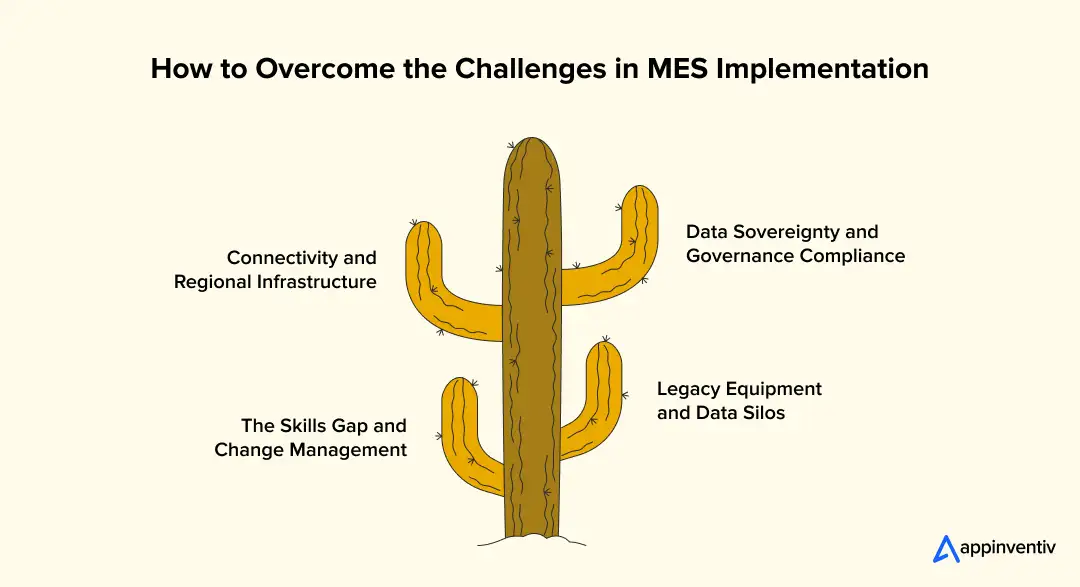
1. Connectivity and Regional Infrastructure
Australian manufacturing is often decentralised, with facilities located in regional hubs where stable, high-speed internet can be inconsistent.
- The Challenge: Real-time MES integration requires low-latency data flow. Reliance on standard NBN can lead to data packet loss or system lag in remote areas of Queensland or Western Australia.
- The Solution: There is a rapid adoption of Starlink Business for high-speed satellite backup or the deployment of Private 5G networks. These provide a secure, dedicated wireless “bubble” over the plant, ensuring that shop-floor devices remain connected even if the wider regional network fluctuates.
2. The Skills Gap and Change Management
The shift to manufacturing execution system requires a workforce that is comfortable interacting with digital interfaces rather than paper clipboards.
- The Challenge: As of 2025, over 85% of Australian hiring managers report moderate to extreme concerns regarding skills shortages in technical trades. Replacing an entire workforce is neither commercially feasible nor ethical.
- The Solution: The focus must be on upskilling. Modern MES platforms now feature low-code interfaces and AI-assisted “Co-pilots” that help existing staff navigate complex tasks. This reduces the cognitive barrier to entry and allows long-term employees to transition into “digital operators.”
3. Data Sovereignty and Governance Compliance
For Australian enterprises, the “cloud” presents a governance challenge regarding where manufacturing data physically resides.
- The Challenge: Regulatory frameworks surrounding MES implementation in Australia often mandate that sensitive production data, intellectual property (IP), and “as-built” records remain within Australian borders. Using offshore servers can trigger compliance breaches under the Privacy Act 1988 or specific Defence Industry Security Program (DISP) requirements.
- The Solution: Prioritise an MES integration strategy that utilises Australian-based data centres (e.g., AWS Sydney or Azure Melbourne regions). Implementing a hybrid architecture where execution-critical data is processed on-site while anonymised analytics are pushed to a local cloud ensures 100% data sovereignty and audit readiness for local regulators.
4. Legacy Equipment and Data Silos
Many Australian factories are “brownfield” sites with a mix of modern robotics and legacy machinery that predates the internet.
- The Challenge: Extracting data from a 20-year-old hydraulic press can be difficult, often resulting in “data silos” where older machines remain invisible to the MES.
- The Solution: The use of Edge Gateways, small hardware devices that act as translators, allows to bridge the gap. By retrofitting sensors (IIoT), you can pull signals from legacy assets and integrate them into the unified data stream of a cloud based manufacturing execution system.
Also Read: How to Modernise Legacy Systems in Australia
How Much Does MES Implementation Cost in Australia?
End-to-end manufacturing execution system cost in Australia generally falls within the range of AUD 70,000 to AUD 700,000+. The factors that influence the investments include:
- Integration with multiple legacy systems
- Extensive machine connectivity work
- Custom workflow development
- Multi-site coordination
- High cybersecurity and data sovereignty requirements
The table below provides a practical breakdown of manufacturing software development costs in Australia based on the project scope:
| Project Complexity | Typical Environment | Estimated Cost Range (AUD) |
|---|---|---|
| Basic | Single line, limited integration | 70,000 – 150,000 |
| Moderate | Single plant, ERP integration | 150,000 – 400,000 |
| Advanced | Multi-line or regulated industry | 400,000 – 700,000 |
| Enterprise | Multi-site deployment | 700K+ |
Key Technologies Supporting Modern MES Implementation for Future Factories
The shift toward Industry 4.0 in Australia is being driven by a convergence of high-bandwidth connectivity and advanced computational models. For the Aussie businesses, the objective is to move beyond simple data collection and toward a state of “autonomous orchestration” where the manufacturing execution system software does not just record history but predicts and shapes the future. Technologies supporting this industrial transformation in Australia include:
1. Industrial IoT (IIoT) and Edge Computing
IIoT is the sensory layer of the manufacturing execution system. In the coming years, the industry is poised to witness a shift where data is no longer pushed directly to the cloud for processing. Instead, edge computing handles urgent decision-making locally on the shop floor.
- Low Latency: Processing data at the “edge” (on the machine or local gateway) allows for millisecond-response times, critical for safety shut-offs or high-speed quality inspections.
- Bandwidth Efficiency: In regional Australian plants, edge computing reduces the cost of data transmission by only pushing relevant, summarised insights to the central cloud based manufacturing execution system.
2. Digital Twins and Simulation
A digital twin is a dynamic, live replica of a physical production line. Unlike static 3D models, a true digital twin in manufacturing is bi-directionally linked to the shop floor.
- Generative Simulation: According to Forrester, by the end of 2026, leaders will use digital twins combined with AI to test thousands of operational scenarios, such as reconfiguring assembly sequences without disrupting live production.
- Risk Mitigation: It allows Australian firms to simulate the impact of supply chain delays or material changes before they happen, ensuring the “as-built” reality remains profitable.
3. AI and Machine Learning for Predictive Insights
The industry is moving from descriptive analytics (what happened?) to prescriptive action (what should we do?). Thus, the manufacturing execution system features now increasingly include:
- Predictive Maintenance: AI models in Australian manufacturing analyse vibration and heat signatures from IIoT sensors to predict equipment failure before a breakdown occurs, protecting OEE.
- Computer Vision for Quality: High-speed cameras and drones powered by AI can inspect thousands of parts per minute, logging defects with a precision that exceeds human capability, essential for the stringent standards of the MedTech and Defence sectors.
- Agentic AI: 2026 is the year of “AI Agents” in Australia, where the industries can autonomously adjust process settings or re-route orders based on real-time plant conditions.
Future-Proofing MES Implementation with Industry 4.0
For Australian manufacturers, 2026 represents a definitive inflection point. The “Future Made in Australia” Act has committed $22.7 billion over the next decade to bolster sovereign capability, particularly in net-zero transformation and advanced manufacturing.
However, the differentiator is no longer access to technology, but the speed of its practical adoption. Delaying implementing a manufacturing execution system in Australia is no longer a neutral stance, it is a decision to accept a widening competitive gap.
In simple terms, future-proofing is not about a single software purchase; it is about outsourcing the reliable MES implementation services in Australia and building a scalable digital architecture that can absorb the next decade of industrial innovation.
How Appinventiv Helps Manufacturers Implement MES Solutions?
Implementing a manufacturing execution system is a high-stakes architectural shift that requires more than just technical integration; it demands a trusted tech partner who understands the unique operational tensions of the Australian factory floor.
At Appinventiv Australia, we don’t just deploy software; we engineer the digital backbone that allows local manufacturers to scale in a high-cost environment.
Case Study: Solving Supply Chain Fragmentation for a Global Manufacturer
A primary example of our impact is our work with a global manufacturer of heavy mining and construction equipment operating across Australia, North America, and Europe. The client faced severe decentralisation, with manual goods receipting and storage errors causing significant delays.
By deploying an AI-powered RPA and analytics solution to bridge the gap between their mainframe and shop-floor applications, we helped the client achieve:
- 60% Increase in Supply Chain Visibility
- 40% Reduction in Logistics Costs
- 30% Boost in Operational Efficiency
Why Australian Leaders Partner with Us
With 10+ years of APAC delivery experience, we provide next gen software development services in Australia, ensuring that every stage of your MES integration is governed by security, scalability, and commercial pragmatism.
- Practitioner-Led Execution: Our team of 1600+ tech experts brings hands-on experience in navigating the complexities of “brownfield” sites.
- Compliance and Governance: We integrate Australian regulatory expectations such as TGA and FSANZ requirements directly into the system design, ensuring your operations remain audit-ready.
- Sovereign Capability: We are committed to building the “Future Made in Australia,” providing the digital infrastructure that enables local firms to compete and win on the global stage.
Ranked consistently among the high-growth companies in the Asia-Pacific region by the Financial Times and Statista, we focus on driving measurable business impact. Our mission is to ensure that your investment in manufacturing execution system software results in a self-optimising, future-proof factory that turns operational challenges into sustainable outcomes.
Book a strategy session with us today and start your smart factory journey.
FAQs
Q. What is a manufacturing execution system (MES)?
A. A manufacturing execution system is the software layer that sits between your ERP and your factory floor machines. It tracks and documents the entire production process in real-time, providing the “as-built” record essential for quality control and compliance.
Q. How does a manufacturing execution system work?
A. The system works by ingesting work orders from an ERP and then orchestrating the shop floor tasks. It collects data directly from machines (via IIoT) and operators, validating that every step follows the defined SOPs before allowing the process to continue.
Q. How long does MES implementation take in Australia?
A. A typical timeline for MES implementation in Australia ranges between 4 and 12+ months. This includes a discovery and design phase, a controlled pilot implementation on a single line, and a staggered factory-wide deployment to manage technical and operational risk.
Q. What is the ROI of implementing an MES?
A. Most Australian businesses see significant ROI through efficiency gains, waste reduction, and the elimination of manual auditing costs. By providing a single source of truth for plant performance, an MES allows for data-driven decisions that directly impact the bottom line.
Q. How to implement a manufacturing execution system in Australia?
A. Here are the key steps for successful MES Implementation in Australia:
- Define Manufacturing Goals and Operational KPIs
- Assess Existing Manufacturing Infrastructure
- Choose the Right MES Architecture
- Design the MES Integration Framework
- Develop and Customise MES Modules
- Pilot Implementation in a Single Production Line
- Train Workforce and Operations Teams
- Full-Scale MES Deployment Across the Factory
- Continuous Optimisation Using Production Data
To gain an in-depth understanding of these nine steps, please refer to the above blog.

- In just 2 mins you will get a response
- Your idea is 100% protected by our Non Disclosure Agreement.

RPA in Manufacturing Industry: Challenges, Use Cases, ROI
Key takeaways: RPA shows the strongest impact in high-volume coordination work such as invoice-to-PO matching, ERP–WMS inventory reconciliation, and order status updates across systems. For well-scoped workflows, RPA typically shows operational impact within 8–12 weeks, driven by less rework, fewer data mismatches, and faster reconciliations. In manufacturing, RPA programs usually range from $40,000 to $600,000,…

RFID in Manufacturing: Transforming Inventory and Supply Chain Management
Key Takeaways RFID technology offers real-time tracking of materials and goods, allowing manufacturers to optimize operations, identify bottlenecks, and improve workflow efficiency. RFID's real-time data empowers manufacturers to quickly adapt to demand fluctuations, shipment delays, and other disruptions, fostering quicker decision-making and better partner/customer relationships. Real-world examples like Southeastern Container and Club Car demonstrate how…

10 Use Cases, Benefits, and Examples of How Cobots are Transforming the Manufacturing Industry
Key takeaways: Cobots work next to human workers, taking care of repetitive jobs like welding and assembly, boosting efficiency and reducing physical strain. This teamwork is changing traditional manufacturing. The cobot market is expected to hit $11.64 billion by 2030, showing the growing move toward automation and the increasing need for flexible, collaborative robots. Companies…