































How to Hire a Mobile App Developer in Dubai, UAE | Key Steps, Costs, and More

 Share -


- 01Understanding the Mobile App Development Landscape in Dubai
- 02Hiring Models Available in Dubai, UAE
- 03What Skills and Technologies Matter When Hiring a Mobile App Developer in Dubai?
- 04What Are the Steps to Hire Mobile App Developers in Dubai
- 05How Much Does It Cost to Hire a Mobile App Developer in Dubai?
- 06Key Cost Factors When Hiring Mobile App Developers in Dubai
- 07Legal and Compliance Considerations When Hiring in the UAE
- 08How AI Is Shaping Mobile App Development in Dubai (2026 and Beyond)
- 09Hiring Offshore and Remote Developers From Dubai: When Does It Make Sense?
- 10Common Mistakes Enterprises Make When Hiring a Mobile App Development Company in Dubai
- 11Why Many Businesses Prefer to Hire Custom Mobile App Developers in Dubai
- 12What Makes Appinventiv a Trusted Mobile App Development Partner in the UAE?
- 13FAQs

Key Takeaways
- Hiring mobile app developers in Dubai is about choosing a team that owns delivery, architecture, and scale, not just development tasks.
- Mobile app development costs in Dubai are driven by integrations, compliance, and long-term system responsibility rather than UI or feature count.
- UAE regulatory requirements directly influence mobile app architecture and must be addressed from the design stage, not after launch.
- Platform choice matters less than strong backend, middleware, and integration capabilities when building enterprise mobile apps.
- AI is now embedded into core mobile app architecture in Dubai, shaping workflows, data pipelines, and decision logic from day one.
In the UAE, businesses looking to hire mobile app developers in Dubai are responding to a clear market shift. Mobile apps are no longer just another digital touchpoint. For most users, they are the default way to interact with businesses. From booking services to managing finances, everyday activity has shifted decisively to smartphones.
Dubai reflects this shift more clearly than most markets in the region. Mobile-first platforms have become central to how companies operate and compete. Studies estimate that active mobile usage in Dubai contributes around AED 3.8 billion in economic impact, driven by strong adoption across retail, fintech, logistics, and on-demand services. As a result, many organizations now look to hire mobile app developers in Dubai who can build products suited to local usage patterns, not just global templates.
Consumer behavior tells a similar story. In one survey, 72% of UAE users said they prefer mobile apps for banking over other channels. That preference is no longer limited to finance. It has shaped expectations across industries. For businesses, this means the real decision is not whether to build a mobile app, but how to hire the right mobile app developer in Dubai who understands security, performance, and the practical realities of operating in the UAE market.
With 99% internet penetration, mobile apps are the primary way customers interact with businesses in the UAE.

Understanding the Mobile App Development Landscape in Dubai
Dubai’s app ecosystem has matured alongside government-led digital initiatives and strong private sector adoption. From Smart Dubai programs to app-first fintech, retail, and logistics platforms, mobile products here are built to support high transaction volumes, multilingual users, and real-time integrations. This has shaped a market where mobile app developers in UAE are accustomed to building production-grade systems rather than MVPs alone.
Local Talent, Global Engineering Standards
Most mobile app development teams in the Middle East operate in a hybrid talent environment. A typical developer in Dubai may combine regional domain knowledge with engineering experience gained from projects in Europe, the US, or APAC. This translates into stronger architecture decisions around cloud deployment, API-first design, scalable backends, and secure data handling aligned with UAE expectations.
Technical Expectations When Hiring in Dubai
Businesses looking for an app developer in Dubai often prioritize more than platform skills. Developers are expected to understand performance optimization, third-party integrations, and deployment on regional cloud infrastructure. Familiarity with enterprise apps supporting Dubai 2040 vision, app store compliance, security practices, and scalable release cycles is usually treated as a baseline, not a differentiator.
Hiring Models Available in Dubai, UAE
When companies in Dubai start looking for a mobile app developer, the decision rarely starts with budgets. It usually starts with delivery pressure. How fast the app needs to go live, how complex the backend is, and how much change is expected after launch all influence the hiring model more than cost alone.
In-House Mobile App Developers
Hiring a full-time mobile app developer in Dubai gives direct access to skills, but it also adds long-term commitments. Recruitment takes time, onboarding is rarely quick, and productivity ramps up slower than most teams expect. This model tends to work only when mobile development is already embedded into the company’s core operations.
What often becomes clear later:
- One or two developers struggle to cover architecture, performance, and maintenance together
- Scaling the team is slow and expensive
- Delivery timelines depend heavily on individual availability
Freelance and Contract Developers
Freelancers are commonly used in the UAE for short-term needs. They can help move specific features forward, especially when timelines are tight. The challenge appears once the app starts growing or integrations increase.
Teams usually run into issues such as:
- Code that lacks long-term structure
- Limited visibility once the contract ends
- Gaps in testing, deployment, and post-launch support
This approach works best for isolated tasks, not for owning a full product lifecycle.
Outsourcing to Development Teams
Outsourcing is where many Dubai-based businesses eventually land. Instead of building everything internally, they hire custom mobile app developers in Dubai, including cross platform app developers in Dubai, as part of an external team that already works together.
This model is commonly chosen when:
- Apps need to support real users at scale
- Backend systems and third-party services are involved
- Security and performance are non-negotiable
- Internal teams need predictable delivery without hiring overhead
For most growing businesses, outsourcing offers the flexibility to move faster without losing control over quality or outcomes, which is one of the key benefits of hiring mobile app developers in Dubai.
What Skills and Technologies Matter When Hiring a Mobile App Developer in Dubai?
In Dubai, mobile apps are rarely built as experiments. Most are expected to go live fast, support real users, and connect with existing systems from the start. Because of that, hiring decisions tend to focus on practical capability rather than long lists of tools.
What matters is whether a developer can deal with scale, change, and pressure once the app is in use. Below are some factors to consider while hiring a mobile app developer in the UAE
How Should You Think About iOS, Android, or Cross-Platform Development?
There is no default platform choice in the UAE market. The right decision depends on audience, usage patterns, and how the app is expected to evolve.
A capable developer should be comfortable discussing:
- iOS development for fintech, enterprise, and premium consumer apps, including real experience with Swift, Apple review processes, and ongoing OS updates, which is typically expected from a seasoned iOS app developer in Dubai.
- Android development for apps built for reach and volume, with attention to performance across devices and long-term maintainability, especially when working with an experienced android app developer Dubai.
- Cross-platform frameworks such as React Native or Flutter, often delivered by Flutter app developers in Dubai, are used mainly to reduce timelines, along with a clear understanding of where native development becomes unavoidable.
The key signal is not the framework itself, but whether the developer can explain why one option fits better than another.
What Technical Depth Should You Expect Beyond the Mobile Interface?
In most Dubai projects, the mobile app is only one layer of a larger system. Developers who focus only on screens and features often struggle once real data and traffic are involved.
Practical areas to probe include:
- Experience connecting apps to backend systems such as CRMs, ERPs, payment gateways, or logistics platforms
- APIs integration, handling authentication, managing failures, and keeping data flows predictable
- Experience integrating advanced technologies such as blockchain integration in Dubai for regulated or transactional use cases
- Understanding of cloud environments like AWS or Azure, especially how infrastructure choices affect app performance and scaling
- Awareness of mobile security basics, including secure data storage, encrypted communication, and user access control
- Experience integrating UAE PASS for secure identity verification in government, finance, real estate, and other regulated enterprise applications
In many Dubai-based enterprises, mobile apps must connect with existing systems such as SAP, Oracle, or Microsoft Dynamics. This typically requires a middleware-driven architecture that decouples the mobile layer from core enterprise platforms. When done correctly, this approach allows teams to modernize mobile experiences without disrupting legacy ERP workflows or data integrity.
Why Do Communication and Collaboration Skills Matter So Much in Dubai?
Mobile development in Dubai rarely happens in one room. Teams are often spread across regions, vendors, and time zones, which makes communication part of the technical challenge.
Developers who work well in this environment usually show:
- Clear, structured communication in professional English, with awareness of Arabic localization when required
- The ability to work with remote designers, backend engineers, and QA without constant hand-holding
- Comfort explaining technical decisions in plain terms when trade-offs affect scope, timelines, or cost
In many cases, these skills are what keep a project moving when priorities change or pressure increases.
What Are the Steps to Hire Mobile App Developers in Dubai
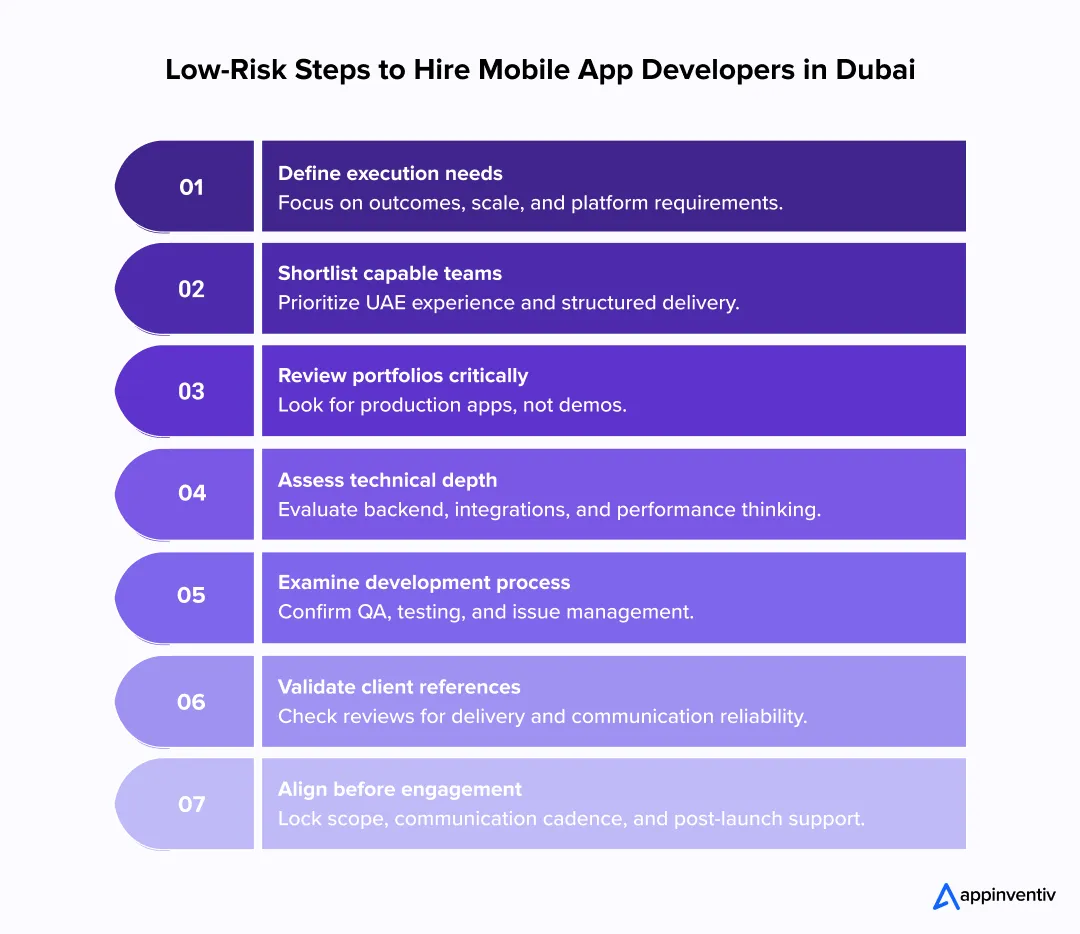
Hiring mobile app developers in Dubai is not just a recruitment exercise. For most businesses, it is an execution decision that directly affects timelines, budgets, and long-term maintainability. A structured hiring approach helps separate teams that can build functional apps from those that can deliver reliable, production-ready systems.
1. Define Project Needs Beyond Features
The hiring process should begin with clarity around what the app needs to support in the real world, not just what it needs to show on screen.
This includes:
- Core business objectives and expected outcomes
- Platform requirements and scalability expectations
- Early alignment with design guidelines, including Android Material Design and iOS Human Interface Guidelines
- An understanding of whether a prototype phase is required before full development
Clear definition at this stage reduces misalignment during estimation and delivery.
2. Research and Shortlist the Right Developers
Once requirements are clear, the next step is narrowing down candidates who are actually capable of delivering within the UAE context.
Effective shortlisting usually focuses on:
- Experience working with local developers or regional teams familiar with UAE user expectations
- Demonstrated programming skills across relevant platforms and frameworks
- Evidence of structured delivery rather than ad hoc development
This step is less about finding the cheapest option and more about reducing execution risk.
3. Evaluate Portfolios With a Practical Lens
A developer’s portfolio should reflect how they solve problems, not just how polished their interfaces look.
When reviewing portfolios, look for:
- Apps that progressed beyond demos into active use
- Clear explanations of technical decisions and trade-offs
- Signs that quality assurance was part of the process, not an afterthought
Strong portfolios usually show consistency across design, development, and testing.
4. Assess Technical and Programming Skills in Context
Assessing technical skills should go beyond language familiarity or framework lists.
Useful evaluation areas include:
- How developers approach architecture and backend integration
- Ability to explain programming skills through real project examples
- Understanding of performance, security, and maintainability concerns
- Capability of mitigating English-Arabic app development challenges
In some cases, assigning a trial project or scoped task can reveal far more than interviews alone.
5. Review Development Process and Quality Assurance Practices
How a team works often matters more than what tools they use.
Look for clarity around:
- Development workflows and handoffs
- Testing coverage and quality assurance processes
- How issues are tracked and resolved during delivery
Teams that lack a defined process often struggle once requirements evolve.
6. Verify Client Reviews and References
External validation adds an important layer of confidence.
Before finalizing a decision:
- Review independent client reviews for consistency and credibility
- Ask for references from projects similar in scope or complexity
- Pay attention to feedback on communication, reliability, and delivery discipline
This step often highlights issues that portfolios and pitches do not.
7. Confirm Alignment Before Final Engagement
Before moving forward, ensure expectations are aligned on both sides.
This includes:
- Scope boundaries and change handling
- Communication cadence and ownership
- Support expectations after launch
Alignment here prevents friction once development is underway.
Why This Approach Works
This step-by-step process emphasizes delivery readiness over speed. By focusing on real-world experience, technical depth, and proven execution habits, businesses significantly reduce the risk of rework, delays, and unexpected costs after development begins.
Build for scale, security, and long-term growth. Partner with enterprise-grade app developers.

How Much Does It Cost to Hire a Mobile App Developer in Dubai?
When cost comes up, it usually sounds like a design question. In reality, it’s an ownership question. In Dubai, pricing is shaped by what the development company is expected to stand behind after launch. Stability, integrations, security, and change over time are what move the number, not how the app looks on day one.
For enterprise work, the mobile app development cost in Dubai, by hiring the right team end up in AED 147,000 to AED 1,470,000 ($40,000 to $400,000).
One cost driver that enterprises often underestimate is technical debt. Low-cost development frequently ignores Arabic-first design and Right-to-Left (RTL) UI logic, which is critical for high-quality UAE user experiences. In enterprise applications, correcting these gaps after launch can increase total project cost by 30–40% due to redesign, revalidation, and compliance rework.
What You’re Actually Paying For at Each Level
At the lower end, the boundaries are tight by choice.
AED 147,000 to AED 275,000 ($40,000 to $75,000): These projects are deliberately simple. One platform, or a basic shared codebase. Backend logic is limited and often leans on existing services rather than custom systems. Integrations are minimal. Infrastructure is sized for steady use, not growth surprises. These apps are expected to work, not to evolve quickly.
Once the app starts touching real systems, costs shift.
AED 275,000 to AED 735,000 ($75,000 to $200,000): Here, teams are building something meant to last. There’s a proper backend layer, defined APIs, and access rules that reflect how the business actually operates. Integrations usually include internal platforms like CRMs, ERPs, or payment services. Performance starts to matter. Environments for testing and release are separated because changes are ongoing, not occasional.
The upper range is less about features and more about risk.
AED 735,000 to AED 1,470,000 ($200,000 to $400,000): These are systems the business depends on. Downtime matters. Data issues matter. Architecture is planned around failure scenarios, not just happy paths. Teams spend time on load behavior, redundancy, automated testing, and release pipelines. Security is treated as a requirement, not an add-on. Post-launch work is assumed because the app is expected to change as the business changes.
Average Hourly Cost to Hire App Developer in Dubai
Hourly rates in Dubai vary based on platform expertise, technical depth, and delivery responsibility. The ranges below reflect typical market pricing for experienced developers handling production-grade mobile and AI-enabled applications.
| Developer Type | Typical Skill Focus | Hourly Cost Range |
|---|---|---|
| Android App Developer in Dubai | Native Android, Kotlin/Java, device optimization | AED 92 – 180 ($25 – $49) |
| iOS App Developer in Dubai | Swift, Apple ecosystem, App Store compliance | AED 110 – 180 ($30 – $49) |
| Flutter App Developers in Dubai | Cross-platform builds, rapid deployment | AED 92 – 165 ($25 – $45) |
| React Native App Developers in Dubai | Shared codebase, performance tuning | AED 103 – 180 ($28 – $49) |
| Cross-Platform App Developers in Dubai | Hybrid architecture, cost optimization | AED 92 – 165 ($25 – $45) |
| AI/ML Developers in Dubai | ML integration, AI-driven features, automation | AED 128 – 330 ($35 – $90) |

Key Cost Factors When Hiring Mobile App Developers in Dubai
Mobile app development costs in Dubai are rarely fixed because they reflect responsibility, not just effort. What ultimately shapes pricing is how complex the app is to build, operate, and evolve once real users and real data are involved.
Below are the primary factors that influence cost decisions at an enterprise level.
App Complexity and Functional Scope
The biggest cost driver is app complexity, which increases as features move beyond basic workflows.
Costs rise when the app includes:
- Advanced features and functionality such as real-time updates, role-based access, or automation
- In-app purchases, subscriptions, or multi-step monetization strategies
- Logic that supports multiple user journeys instead of a single flow
A simple web interface behaves very differently from a production-grade mobile system.
Platform Choice and Development Approach
Your platform choice directly affects both build effort and long-term maintenance.
Typical options include:
- Native app development for iOS or Android, offering better performance but higher effort
- Hybrid app builds that share code across platforms
- PWA or web app approaches for lighter use cases with limited device dependency
Each development platform has trade-offs in performance, scalability, and cost.
App Development Team Size and Structure
The app development team size impacts both delivery speed and budget.
Costs vary based on:
- The number of developers required across frontend, backend, QA, and DevOps
- Whether work is handled by an onshore development team, an offshore development team, or a hybrid model
- Overall team fit, including how well team members collaborate across functions
Smaller teams move slower; larger teams cost more but reduce delivery risk.
Developer Skills and Technical Depth
Not all developers are priced equally. Developer’s skills matter most when systems grow.
Higher costs are often tied to:
- Experience with scalable architecture and integrations
- Ability to manage technical debt instead of accumulating it
- Comfort working with performance, security, and enterprise systems
Stronger technical skills often reduce long-term maintenance costs, even if upfront rates are higher.
Design, Testing, and Quality Assurance
Design and testing are often underestimated during budgeting.
Costs increase when:
- Design needs to scale across devices and platforms
- A structured testing process is required across environments
- Quality assurance is embedded throughout development rather than done at the end
Skipping these steps usually leads to rework later.
Project Timeline and Engagement Model
The project timeline and pricing model also influence cost predictability.
Common models include:
- Fixed-price packages for clearly defined scopes
- Time-based pricing tied to an hourly rate
- Hybrid models that allow flexibility as scope evolves
Shorter timelines often require larger teams, increasing cost.
Business Planning and Ongoing Ownership
Apps built without a clear business plan often cost more over time.
Factors that influence long-term cost include:
- Planned updates and feature expansion
- Ongoing maintenance and infrastructure scaling
- How well early decisions support future growth
Many enterprises use a mobile app development cost calculator for estimates, but real costs only become clear once system responsibilities are defined.
Location and Delivery Model
Finally, location affects both pricing and collaboration.
Working with:
- Local teams improves alignment and availability
- Offshore teams can reduce costs but require stronger governance
The right balance depends on delivery complexity, not just budget.
Why Cost Decisions Matter
Lower upfront costs often hide future expenses. When technical debt, scaling issues, or testing gaps surface after launch, total ownership cost rises quickly. Enterprises that budget around long-term stability rather than short-term savings tend to achieve better ROI.
To get a wider look, you can read our detailed blog on mobile app development cost in UAE.
Legal and Compliance Considerations When Hiring in the UAE
In the UAE, legal and compliance requirements are part of how work gets done, not a checkbox at the end. They affect who you can engage, how quickly teams can start, and how the app is ultimately built and operated. When these points are missed early, they tend to interrupt delivery later.
Employment Laws and Work Visa Requirements
Hiring developers directly in the UAE means entering a regulated employment relationship. There is very little flexibility here.
What enterprises usually need to factor in:
- Employment contracts must follow UAE Federal Decree-Law No. 33 of 2021, including defined roles, compensation, and notice terms
- Full-time employees require employer-sponsored residence and work visas
- Visa processing timelines can delay onboarding, regardless of technical readiness
- Legal responsibility sits with the hiring company, even if the work is project-based
For time-sensitive app initiatives, this structure often slows direct hiring more than expected.
Freelance Permits and Free Zone Arrangements
Freelancers can operate legally in the UAE, but only under approved licensing frameworks. This is closely monitored.
In practice:
- Independent developers must hold a valid freelance permit, often issued through Dubai authorities
- Others operate under free zone licenses, typically linked to technology or media zones
From an enterprise point of view, this is not optional diligence. Engaging individuals without proper permits creates exposure, even if the work is remote or short-term. Responsibility does not shift away simply because the resource is external.
This is one reason many enterprises avoid contracting individuals directly and instead work with licensed development companies.
Data Protection and Privacy Rules
Data handling is where compliance directly shapes engineering decisions. The UAE has a formal data protection framework, and mobile apps clearly fall within its scope.
Under UAE Federal Decree-Law No. 45 of 2021 on Personal Data Protection, organizations are expected to:
- Collect data only for defined, lawful purposes
- Limit data to what is operationally necessary
- Protect data through appropriate access and storage controls
- Manage cross-border data transfers carefully
These rules influence authentication design, data storage models, and system integration choices from the start.
Child Digital Safety and Age-Appropriate Design Requirements (2026)
From January 1, 2026, mobile applications accessible to or used by minors in the UAE must comply with Federal Decree-Law No. 26 of 2025 on Child Digital Safety. The regulation introduces stricter controls around how digital experiences are designed, classified, and delivered to younger users.
For enterprises, this creates clear technical requirements, including:
- Risk-based content classification based on user age
- Age-verification and age-gating logic within the app flow
- Backend enforcement rules that restrict features and content by age group
- Data-handling controls aligned with age-specific privacy expectations
Teams that do not account for these requirements early often face redesigns and compliance-driven rework late in the development cycle.
Hosting and Cloud Expectations in the UAE
While international cloud providers are widely used, enterprises in the UAE often impose additional constraints around where data lives.
Common expectations include:
- Use of regional data centers within the Middle East
- Clear documentation of data location and access paths
- Alignment with internal IT, audit, and risk controls
This level of compliance is common in government platforms such as government service apps like Metrash2.
Not just that but for mobile app projects, these requirements affect backend architecture early. When hosting decisions are deferred, teams often end up reworking core components later.
Why This Matters in Practice
In the UAE, compliance decisions tend to ripple outward. Hiring structure affects timelines. Data rules affect architecture. Hosting choices affect both cost and scalability.
Enterprises that address these points upfront usually avoid disruption once delivery is underway.
How AI Is Shaping Mobile App Development in Dubai (2026 and Beyond)
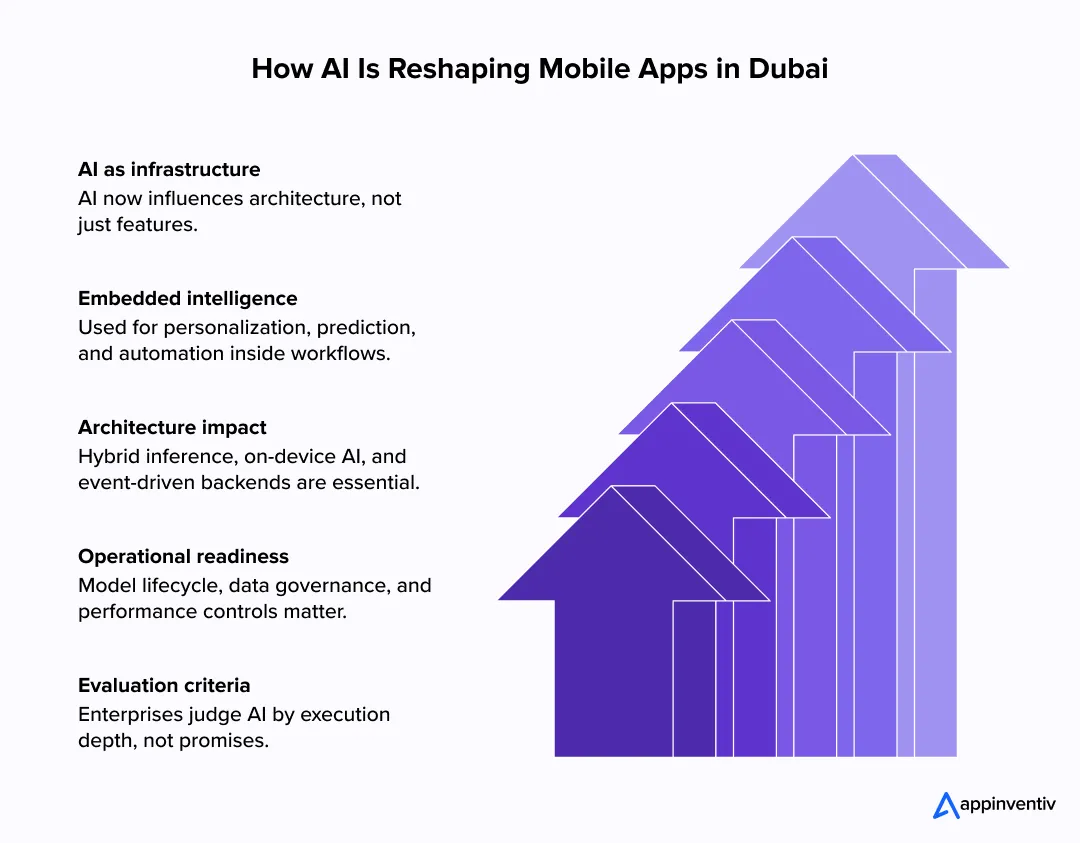
AI is no longer treated as a feature layer in serious mobile products. In Dubai, it increasingly shapes how mobile systems are engineered end to end. Enterprises expect apps to respond in real time, make decisions with incomplete data, and continue working even when connectivity drops. That expectation changes architecture, not just functionality.
Where AI Is Used in Enterprise Mobile Apps Today
In production apps, AI is usually embedded into workflows rather than exposed as a standalone feature.
Common implementations include:
- Behavior-based personalization, driven by event tracking and real-time inference rather than static rules
- Predictive analytic models for demand forecasting, fraud signals, delivery ETAs, or operational anomalies
- Decision automation, where AI outputs feed directly into routing, approvals, or prioritization logic
- Live telemetry analysis, using event streams to detect failures or performance degradation early
These use cases require AI systems to be tightly integrated with backend services, not just the mobile UI. And for that help from an expert AI development company in Dubai is a must.
How AI Changes Mobile System Architecture
AI introduces new constraints that affect how mobile apps are structured.
In practice, teams design around:
- Hybrid inference models, where lightweight models run on the device for low-latency decisions, while complex inference runs in the cloud
- On-device AI for offline scenarios, common in logistics, inspections, and field operations
- Event-driven backends, where mobile actions generate events consumed by AI services through queues or streaming pipelines
- Middleware layers that decouple mobile apps from enterprise systems like SAP, Oracle, or Microsoft Dynamics while feeding AI models clean, governed data
Without this separation, AI logic often becomes hard-coded into the app, making updates slow and risky.
AI Infrastructure Requirements Enterprises Often Miss
AI-enabled mobile apps introduce operational needs that go beyond standard development.
These typically include:
- Model lifecycle management, covering versioning, rollout, rollback, and monitoring
- Data pipelines for training and inference that respect privacy, consent, and access controls
- Performance safeguards, ensuring AI workloads do not impact app responsiveness or battery life
- Building AI guardrails, so teams can track model accuracy, drift, and real-world outcomes
When these elements are missing, AI features tend to degrade quietly until they create visible failures.
What Technical Leaders Look for When Evaluating AI Capability
For enterprises hiring mobile app developers in Dubai, AI capability is assessed through execution detail, not promises.
Strong teams can explain:
- How AI models are deployed and updated without forcing app store releases
- How inference latency is managed across devices and network conditions
- How AI outputs are validated, logged, and audited
- How systems are designed to evolve as models, data, or regulations change
When these answers are vague, AI usually becomes a source of rework later.
Teams that treat AI as core infrastructure, not an experiment, build mobile platforms that scale and adapt without constant redesign.
Hiring Offshore and Remote Developers From Dubai: When Does It Make Sense?
For many UAE businesses, offshore or remote delivery is not a compromise. It is a way to access deeper engineering capacity, speed up delivery, or cover specialized skills that are hard to scale locally. In most cases, companies do this by working with a development partner that can hire remote developers in Dubai delivery teams under a structured engagement, rather than contracting individuals directly.
That said, remote delivery works well only when the operating model is clear from the start.
When Does Offshore or Remote Delivery Make Sense for Dubai-Based Businesses?
Offshore becomes practical when the work requires scale, specialization, or long build cycles.
Common situations where it makes sense:
- You need a full delivery team fast, including backend, mobile, QA, and DevOps, without waiting for local hiring cycles
- The app roadmap is large and will evolve after launch, making a dedicated remote team model more efficient
- You need niche expertise, for example backend-heavy development where some businesses specifically look to hire offshore python developers in Dubai through a structured partner team
- You want cost control while still maintaining engineering depth, especially for long-running enterprise builds
For many Dubai projects, the strongest model is hybrid: local-facing product and governance, with remote engineering capacity behind it.
What Risks Should Enterprises Watch for When Working With Offshore Teams?
The risk is rarely technical skill. The risk is how work is managed across distance.
Typical failure points include:
- Unclear ownership of architecture and technical decisions
- Weak documentation, leading to knowledge loss when teams change
- Poor handling of integrations, especially when enterprise systems require tight coordination
- Security practices treated as “later,” not built into development workflows
Remote delivery exposes gaps faster because there is less room for informal coordination.
How Should You Set Up Communication and Governance for Remote Delivery?
Enterprises that succeed with remote teams usually build a governance layer early. This reduces misunderstandings and protects timelines.
A practical setup includes:
- A single accountable delivery owner on the vendor side, not multiple points of contact
- Weekly delivery reporting tied to outcomes: sprint goals, risks, dependencies, and blockers
- Clear escalation paths for scope changes, technical decisions, and timeline impact
- Standard working overlaps that match Dubai business hours for reviews and approvals
If the plan is to hire remote developer in Dubai delivery capacity, governance is what keeps execution predictable.
What Should You Lock in Contractually When Outsourcing Offshore?
Contracts should protect continuity and accountability, not just pricing.
Enterprises typically lock in:
- Named roles and seniority expectations for key team members
- Change management process for scope and integrations
- Security responsibilities, access controls, and data handling rules
- Clear ownership of code, documentation, and handover expectations
This is where many offshore engagements either become stable or turn into constant renegotiation.
Common Mistakes Enterprises Make When Hiring a Mobile App Development Company in Dubai
Most enterprise app failures in Dubai do not come from poor coding. They come from decisions made during vendor selection. These common mistakes when hiring app developers usually surface months later, when timelines slip, costs rise, or accountability becomes unclear.
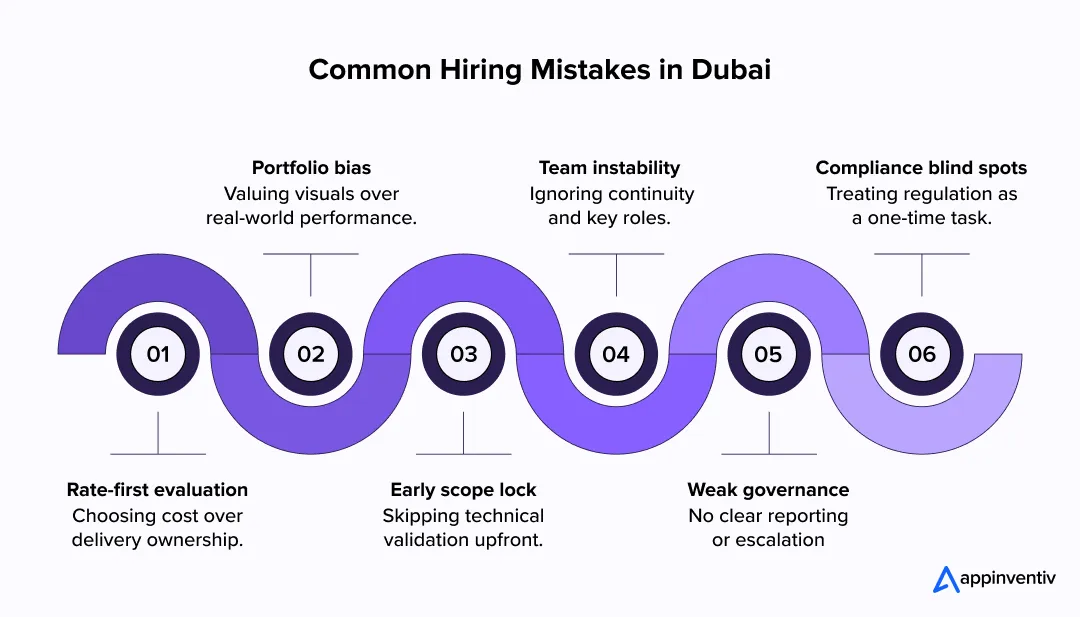
Treating Development Companies Like Staffing Vendors
One of the most common missteps is evaluating a development company the same way individual developers are assessed.
What often goes wrong:
- Focus on hourly rates instead of delivery capability
- Little scrutiny of architecture ownership or decision-making authority
- Assumption that the client will define all technical direction
Development companies are responsible for outcomes, not just effort. When that distinction is missed, projects lose structure quickly.
Overvaluing Portfolios Without Understanding Delivery Context
Portfolios can be misleading if they are not examined carefully.
Enterprises often discover too late that:
- Case studies highlight UI but not backend complexity
- Apps shown were built as prototypes, not production systems
- The team that delivered the work is no longer with the company
What matters more is how the company handled scale, integrations, performance issues, and post-launch changes.
Locking Scope Too Early Without Technical Validation
Fixed scopes feel safe from a procurement standpoint, but they can create problems if they are agreed on before technical assumptions are tested.
Typical consequences include:
- Change requests for integrations that were assumed to be simple
- Delays caused by unplanned compliance or security requirements
- Cost increases once real system dependencies emerge
Strong development companies push for early discovery and validation, even when the scope appears clear.
Ignoring Team Structure and Continuity
Enterprises sometimes assume a development company operates as a single, stable unit. That is not always the case.
Risks appear when:
- Projects rely heavily on short-term contractors
- Key architects are involved only during sales discussions
- Team continuity is not contractually defined
Over time, this leads to knowledge loss and delivery slowdowns.
Underestimating Governance and Communication Needs
In Dubai, enterprise app projects often involve multiple stakeholders across regions. Without clear governance, progress becomes difficult to track.
Common warning signs include:
- No defined escalation path
- Irregular or unclear reporting
- Technical decisions made without business alignment
Development companies should offer structured communication and decision-making frameworks, not leave this to the client to manage.
Assuming Compliance Is a One-Time Check
Compliance is often treated as a kickoff activity rather than an ongoing responsibility.
This creates issues when:
- Data handling practices change as features evolve
- Hosting decisions are revisited late
- Security controls are added reactively
Enterprises benefit most from partners who treat compliance as part of delivery, not an external requirement.
Why This Section Matters
Most of these mistakes are not obvious at the start. They appear only after development is underway, when reversing decisions becomes expensive.
Enterprises that avoid these pitfalls tend to focus less on promises and more on how a development company actually delivers, communicates, and takes ownership.
Why Many Businesses Prefer to Hire Custom Mobile App Developers in Dubai
Most businesses do not start out planning a fully custom mobile app. They start with speed. A quick launch, a ready-made framework, something that works well enough to test the idea. Over time, though, those shortcuts begin to show. Performance dips, integrations feel forced, and simple changes take longer than they should.
That is usually the point where companies decide to hire mobile app developers in Dubai who can build around the way the business actually operates. Instead of bending internal processes to fit a template, the app is shaped to match real workflows, data flows, and user behavior. In competitive and fast-moving markets, that shift makes a noticeable difference sooner than expected.
Custom development changes the conversation. It is no longer about how fast an app can be launched, but about how well it can hold up as the business grows and priorities change.
Custom Builds vs. Template-Based Solutions
Templates can be useful at the start, especially for straightforward use cases. The limitations tend to appear later, once the app becomes part of daily operations.
Custom development is often the better option when:
- The app needs to connect with ERPs, CRMs, payment systems, or internal tools
- Business workflows are specific and do not map cleanly to generic patterns
- Performance, security, or compliance expectations go beyond basic setups
- Regional requirements such as localization, role-based access, or approval layers are involved
By working with custom mobile app developers in Dubai, businesses avoid the patchwork fixes and partial rebuilds that often follow template-based launches.
Scalability as a Design Choice From the Start
In a market like Dubai, growth rarely follows a straight line. Usage can spike quickly, new features are added sooner than planned, and integrations expand as the business matures. Custom development allows teams to plan for that reality early.
This usually shows up in:
- Backend systems designed to handle increasing traffic and transaction volume
- APIs built with future integrations in mind, not just immediate needs
- Infrastructure that can scale without forcing major rework
Templates are built to move fast at the beginning. Custom builds are designed to keep working when the app becomes central to the business.
Long-Term ROI Over Short-Term Savings
While templates may reduce upfront costs, they often introduce hidden expenses later. These can include performance issues, limited customization, or the need to rebuild the app entirely as requirements change.
Businesses that hire mobile app developers in Dubai usually do so with a longer horizon in mind:
- Fewer limitations as the product evolves
- Better alignment with internal processes and systems
- Lower risk of replacement or re-platforming costs
Over time, this approach tends to deliver stronger ROI, especially for apps that become core to operations or customer engagement.
Final Checklist Before You Hire Mobile App Developers in UAE
| Area | What to Validate Before You Decide | Why It Matters |
|---|---|---|
| Business & Scope Clarity | Are business goals clearly defined beyond features? | Prevents scope creep and misaligned delivery expectations |
| Is the scope validated against integrations and future scale? | Avoids rework once real dependencies surface | |
| Are compliance and data requirements documented upfront? | Reduces late-stage legal or architectural changes | |
| Technical Capability | Can the company explain architecture decisions, not just tools? | Indicates real engineering ownership |
| Have they delivered apps with similar scale or complexity? | Lowers execution risk | |
| Are backend, cloud, security, and QA responsibilities clear? | Prevents gaps during delivery | |
| Delivery Model & Team Structure | Is there a clearly accountable delivery owner? | Ensures ownership and faster decision-making |
| Is the team stable or dependent on short-term contractors? | Impacts continuity and long-term support | |
| Are roles and seniority levels transparent? | Sets realistic delivery expectations | |
| Governance & Communication | Is there a defined reporting and review cadence? | Improves visibility and control |
| Are escalation paths clearly documented? | Avoids delays during critical decisions | |
| Will communication align with your business hours? | Reduces friction in distributed teams | |
| Legal & Compliance Readiness | Is the company licensed to operate and staff teams legally? | Avoids regulatory exposure |
| Are data protection and hosting responsibilities defined? | Ensures compliance with local regulations | |
| Do security practices align with internal IT standards? | Protects enterprise data and systems | |
| Commercials & Ownership | Are pricing, scope boundaries, and change processes clear? | Prevents cost overruns |
| Is intellectual property ownership explicitly stated? | Protects long-term business interests | |
| Are post-launch support and handover terms agreed? | Ensures continuity after launch |
Early clarity on architecture, compliance, and delivery models reduces risk and avoids costly rework later.

What Makes Appinventiv a Trusted Mobile App Development Partner in the UAE?
Enterprises that scale successfully through mobile usually do one thing differently. They work with partners who understand both regional execution and global product standards. With 1,000+ digital projects delivered in the Middle East, experience across 35+ industries, and 10+ years of operating in the region, Appinventiv has built mobile platforms that support growth rather than just launches. This depth is what businesses typically look for in a reliable mobile application development company in UAE.
That experience is reflected in consumer platforms built for global brands like Domino’s, KFC, and Pizza Hut, where mobile apps are central to ordering, fulfillment, and customer retention. These platforms were designed to handle high traffic volumes, real-time order flows, and consistent performance across devices, while remaining flexible enough to support frequent updates and regional rollouts.
Beyond food and delivery, large-scale commerce and retail brands have relied on custom mobile solutions to strengthen digital engagement. Apps developed for IKEA and Adidas focused on seamless shopping journeys, backend integrations, and performance at scale. Similarly, platforms like Edamama demonstrate how tailored mobile architecture can support complex catalogs, personalization, and secure transactions without compromising speed or usability.
For organizations planning their next mobile initiative, the choice often comes down to confidence in delivery. Partnering with a team that has built, scaled, and maintained apps for globally recognized brands reduces execution risk and shortens the path to impact. If you are evaluating options, a short conversation can help clarify whether your goals align with the right development approach.
FAQs
Q. Have Appinventiv mobile app developers worked with startups, SMEs, and large enterprises across industries?
A. Yes. Appinventiv has delivered mobile solutions for a wide range of organizations, from early-stage startups validating MVPs to large enterprises running customer-facing platforms at scale.
Typical engagement patterns include:
- MVP and growth-stage apps for startups
- Operational and customer platforms for SMEs
- Complex, integrated mobile systems for large enterprises
- Cross-industry delivery spanning retail, food, ecommerce, logistics, and consumer services
This breadth helps teams adapt delivery models to different business maturity levels.
Q. How do Appinventiv mobile app developers ensure code quality, performance, and security?
A. Code quality and performance are addressed through structured engineering practices rather than post-delivery fixes. Development teams follow defined coding standards, modular architecture, and continuous testing to catch issues early. Performance is validated through load and behavior testing, while security is handled through secure authentication flows, encrypted data handling, and controlled access to systems. These practices are applied consistently across projects, regardless of size.
Q. Why should businesses choose Appinventiv mobile app developers over freelancers?
A. Freelancers can work well for isolated tasks, but many businesses prefer structured teams when reliability matters.
Key differences include:
- Access to a dedicated team of developers for hire, not a single resource
- Clear ownership of architecture, testing, and deployment
- Continuity even if individual team members change
- Better handling of scale, integrations, and long-term maintenance
For business-critical apps, this reduces dependency risk and delivery uncertainty.
Q. What is the average delivery time when hiring mobile app developers in Dubai?
A. Delivery timelines vary based on scope and complexity, but most projects follow a predictable pattern. MVPs and focused applications can take a few months, while larger platforms with integrations, multiple user roles, and scalability requirements take longer. Factors such as platform choice, backend complexity, and compliance requirements often influence timelines more than feature count alone.
Q. What factors influence the cost of hiring mobile app developers in Dubai?
A. Cost is driven less by screens and more by system responsibility.
Common factors include:
- Platform choice and whether native or cross-platform builds are required
- Backend complexity and third-party integrations
- Performance, security, and compliance expectations
- Level of testing, deployment automation, and post-launch support
These factors shape effort and cost far more than visual design alone.
Q. Can I hire app developer in dubai for short-term or MVP projects?
A. Yes. Many teams engage developers for short-term builds, especially MVPs or proof-of-concepts. The key is defining scope clearly and selecting the right platform approach. For example, working with an experienced android app developer Dubai team often helps accelerate MVPs targeting broad user bases, while still keeping a path open for future scale.
Q. What happens if project requirements change mid-development?
A. Change is common, especially once real users or internal stakeholders start providing feedback. Well-structured teams handle this through formal change management rather than ad-hoc fixes.
This usually involves:
- Re-validating scope and impact
- Adjusting timelines or priorities transparently
- Documenting changes to avoid downstream confusion
Clear governance keeps changes from turning into disruption.
Q. Will the developer provide ongoing support and maintenance?
A. Ongoing support is typically part of enterprise-grade engagements. This includes bug fixes, OS updates, performance tuning, and incremental enhancements. For apps built by an experienced iOS app developer in Dubai or cross-platform teams, maintenance also covers adapting to platform updates and evolving security requirements, which is critical for long-term stability.
Q. What qualifications should I look for as a mobile app developer?
A. Qualifications depend on what you are building, but strong developers usually bring more than platform familiarity.
Look for:
- Proven experience delivering production apps, not just demos
- Comfort working with backend systems and APIs
- Familiarity with cross-platform setups involving looking for skilled in Flutter and React Native app developers in Dubai
- Ability to explain technical trade-offs clearly to non-technical stakeholders
These indicators usually matter more than certifications alone.


Fast 2-minute response, fully NDA-protected.

How Much Does It Cost to Develop a Remote Patient Monitoring App in the UAE?
Key takeaways: Feature scope and system integrations, not the app itself, determine your final development cost. DHA, DOH, and MOHAP compliance must be built into your architecture from day one. Wearables, EHRs, and health information exchanges are the biggest technical cost drivers. A successful RPM platform combines continuous monitoring, clinical workflows, and secure interoperability. Early…

How Much Does It Cost to Develop an App Like Herfy in 2026?
Key takeaways: Herfy-like app development costs SAR 150,000 to SAR 1,500,000 ($40,000 to $400,000). Costs rise with rider tracking, POS sync, kitchen displays, loyalty, and branch controls. Saudi apps need Arabic UX, Mada, STC Pay, VAT, and ZATCA-ready invoice flows. Peak loads during Ramadan, Eid, and weekends need strong backend and load testing. A phased…

Key takeaways: The operating model determines survival. The code does not. Compliance under PDPL in the UAE and SDAIA in Saudi Arabia must be engineered into architecture, not added before launch. A serious build costs between AED 147,000 and AED 1,470,000 (USD 40,000 to USD 400,000), depending on scope. The single largest cost most operators…