

























How Much Does It Cost to Build a Learning Management System in Australia


- How Much Does LMS Development Cost
- What Factors Drive The Cost to Build a Learning Management System in Australia?
- Cost Breakdown by LMS Development Stage
- Hidden LMS Development Costs in Australia That Most Organisations Overlook
- How to Optimise LMS Development Costs: Strategic Approaches
- Industry-Specific LMS Use Cases: Balancing Compliance and Capital
- Future of LMS Systems: Emerging Cost Drivers in 2026 and Beyond
- Questions Australian Enterprises Should Ask Before Budgeting
- How Appinventiv Helps Enterprises Build Future-Ready LMS Platforms
- FAQs

Key takeaways:
- Enterprise LMS investment in Australia typically ranges from AUD 70,000 to AUD 700,000, driven primarily by architecture, integrations, and compliance scope.
- Privacy Act 1988, APP obligations, TEQSA, ASQA, and ASD Essential Eight significantly influence LMS design decisions.
- Cloud-native, API-first, and modular platforms reduce long-term total cost of ownership and also drive sustainable outcome.
The Australian corporate landscape in 2026 is defined by a relentless pressure to upskill and a tightening web of regulatory mandates. As the “Right to Disconnect” and evolving psychosocial safety laws embed themselves into operational reality, the role of digital infrastructure has shifted.
It signals a rapid digitisation across education, government, and enterprise training sectors that is no longer about simple content hosting. It is about risk mitigation. Workforce upskilling pressure, coupled with compliance-driven training requirements from bodies like the Australian Skills Quality Authority (ASQA) and the Tertiary Education Quality and Standards Agency
(TEQSA), has accelerated LMS adoption across both academic and corporate sectors.
The Australia LMS market is currently on a high-growth trajectory, projected to reach AU$4.84 billion by 2033 as organisations move away from fragmented SaaS tools toward unified, sovereign platforms.
For an Australian enterprise, the typical investment range for a custom solution sits between AUD 70,000 and AUD 700,000+, depending on the depth of integration and regulatory complexity.
This blog provides a practitioner-led breakdown of the cost to build a learning management system in Australia, focusing on the technical and financial variables that matter to CXOs and senior technology leaders.
Align architecture, compliance, and scale before committing budget.

How Much Does LMS Development Cost
When developing an LMS system, enterprise leaders typically ask two questions first. What will this cost? And how long will it take?
The answer depends less on “LMS features” and more on architecture scope, regulatory exposure, and integration maturity.
When evaluating LMS app development cost in Australia, complexity falls into three broad tiers:
| Project Complexity | Estimated Cost | Estimated Timeline |
|---|---|---|
| Basic Corporate LMS | AUD 70,000 – 120,000 | 3–6 months |
| Mid-Level Enterprise LMS | AUD 150,000 – 350,000 | 6–9 months |
| Large-Scale Multi-Tenant Platform | AUD 400,000 – 700,000+ | 9–12+ months |
What differentiates these tiers?
The difference between these tiers lies in scope, integration complexity, and governance requirements rather than just feature count. Here are some basic elements that draw a line between these tiers:
Basic Corporate LMS
- Internal employee training
- Limited integrations
- Standard reporting
- Minimal compliance customisation
Mid-Level Enterprise LMS
- HRIS and ERP integration
- Certification tracking
- Compliance dashboards
- Advanced analytics
- Multi-role workflows
Large-Scale Multi-Tenant Platforms
- External learner monetisation
- Multi-institution support
- Sovereign hosting requirements
- Advanced AI-driven learning paths
- Complex regulatory reporting
What Factors Drive The Cost to Build a Learning Management System in Australia?
Before you plan the budget, it is critical to understand what truly influences enterprise LMS investment. In Australia, cost variation is rarely driven by basic functionality alone. Architecture choices, regulatory exposure, integration depth, and security posture collectively determine the final financial commitment. The following factors determine both capital expenditure and long-term operating cost of software development in Australia.

Architecture Decisions
The technical foundation determines 40% of the long-term learning management system software development budget. Architecture choices made early will either stabilise total cost of ownership or trigger recurring infrastructure and re-engineering expenses.
- Cloud-native vs Hybrid: While AWS (Sydney) or Azure (Melbourne) regions are standard for an enterprise learning management system in Australia deployments, some government sectors still require hybrid models to keep sensitive data on-premise.
- Multi-tenancy: If you are a Registered Training Organisation (RTO) selling courses to other businesses, building a multi-tenant architecture is essential but adds 25% to the initial build cost.
- National Scalability: Platforms must handle concurrent loads from across the country without latency, requiring sophisticated CDN and load-balancing configurations.
Compliance and Regulatory Requirements in Australia
Australian organisations face unique legal hurdles that global SaaS often ignores:
- Privacy Act 1988: Your system must adhere to Australian Privacy Principles (APPs). This involves specific data handling, “right to be forgotten” protocols, and local data residency.
- Data Sovereignty: Many Aussie enterprises mandate that no data leaves the physical borders of Australia.
- WCAG Accessibility: For government and education, WCAG 2.1 Level AA is the minimum standard, impacting learning management system development costs for Australia.
- Regulatory Reporting: Systems for RTOs must support AVETMISS data sets, while higher education must align with TEQSA standards.
Adhering to all these regulatory requirements significantly impact the cost to build a learning management system in Australia.
Feature Complexity
Feature depth increases engineering and validation cycles as well as the total cost to build an LMS system.
- SCORM/xAPI Integration: Seamless content interoperability is non-negotiable for enterprise-grade systems.
- AI-Powered Paths: Modern learning management system software development in 2026 includes adaptive learning that adjusts based on user performance.
- HRIS/Payroll Sync: Integrates with widely used Australian systems like Xero, MYOB, and QuickBooks, ensuring STP-compliant payroll and promotion eligibility alignment.
- CPD & Points Management: For regulated professions, the LMS must handle complex Continuing Professional Development (CPD) mathematics. This helps track weighted points across different categories to satisfy annual licensing audits.
- Offline Mobile Mode with Data Resync: This feature allows field workers in mining and energy sectors to complete training in “dead zones” with progress syncing automatically once back in Wi-Fi range.
These learning management system features for Australia often require custom workflows aligned with sector-specific compliance rules, which drive up the costs.
User Volume and Licensing Strategy
Building your own platform eliminates “per-user” success taxes common in SaaS. However, the architecture must be stress-tested for your specific load whether it’s 2,000 internal staff or 50,000 external learners.
Higher user volumes increase cloud infrastructure provisioning, performance testing cycles, and identity management configuration costs.
Security and Cyber Resilience
With the rise in high-profile data breaches, Australian CXOs are prioritising:
- ASD Essential Eight: Aligning the LMS with the Australian Signals Directorate’s maturity model.
- SSO/MFA: Enterprise-wide authentication via Okta or Azure AD.
- Audit Logging: Granular tracking of who accessed what data and when.
Security-first architecture reduces long-term risk exposure but requires higher upfront engineering discipline.
Cost Breakdown by LMS Development Stage
Understanding the learning management software development process in Australia allows for better capital allocation. Enterprise LMS budgeting must move beyond a single number. Capital allocation should be mapped stage by stage to avoid underfunding critical governance layers.
Below is a realistic enterprise benchmark for LMS software development cost across the different stages.
| Steps to Develop A Learning Management Software | Estimated Cost Range | Key Actions |
|---|---|---|
| Discovery & Business Analysis | AUD 10,000 – 40,000 | Define business objectives and compliance scope; map regulatory exposure (Privacy Act, APPs, TEQSA/ASQA); document system requirements; assess integration dependencies; validate risk and scalability assumptions. |
| UX/UI & Experience Design | AUD 15,000 – 60,000 | Design role-based learner journeys; ensure WCAG accessibility alignment; create wireframes and prototypes; validate usability with stakeholder groups; define experience standards for mobile and desktop. |
| Core Platform Development | AUD 80,000 – 350,000 | Build scalable backend architecture; develop user management and certification workflows; configure content delivery engines; implement reporting logic; establish secure data handling practices. |
| Integration Layer | AUD 30,000 – 120,000 | Connect LMS with HRIS, ERP, CRM, payroll, and student management systems; design API architecture; validate data synchronisation flows; implement authentication and access controls. |
| Testing & Security Hardening | AUD 20,000 – 80,000 | Conduct penetration testing; validate compliance reporting accuracy; perform load and performance testing; remediate vulnerabilities; finalise audit logging configuration. |
| Deployment & DevOps | AUD 15,000 – 50,000 | Configure cloud infrastructure in Australian regions; implement CI/CD pipelines; establish monitoring and alerting systems; validate disaster recovery processes. |
| Ongoing Maintenance | 15–25% annually | Monitor performance and security posture; implement feature enhancements; apply regulatory updates; optimise infrastructure scaling; conduct periodic compliance reviews. |
Why Staged Modelling Matters?
The most underestimated phase of EdTech app development process is discovery. Organisations often allocate 5–10% of the total budget to discovery when it should sit closer to 15–20% for regulated industries.
Appinventiv Insight
At Appinventiv, our strongest-performing projects consistently begin with a structured discovery and modelling phase. This disciplined approach is a key reason our engagements are delivered more efficiently, with fewer compliance gaps, reduced rework, and stronger delivery confidence.
When discovery is compressed:
- Compliance gaps emerge mid-build
- Integration assumptions prove incorrect
- Data structures require rework
- Security architecture must be retrofitted
Also, organisations often over-allocate to feature development and underfund compliance validation and integration testing. In regulated sectors, compliance and security layers frequently represent 25–35% of total engineering effort.
Each of these issues increases final delivery cost and timeline. In enterprise environments, disciplined upfront modelling protects capital.
Ensure Privacy Act alignment, accessibility compliance, and audit readiness from day one.

Hidden LMS Development Costs in Australia That Most Organisations Overlook
Initial development budgets rarely capture long-term operational exposure. These hidden costs are common across enterprise LMS implementations.
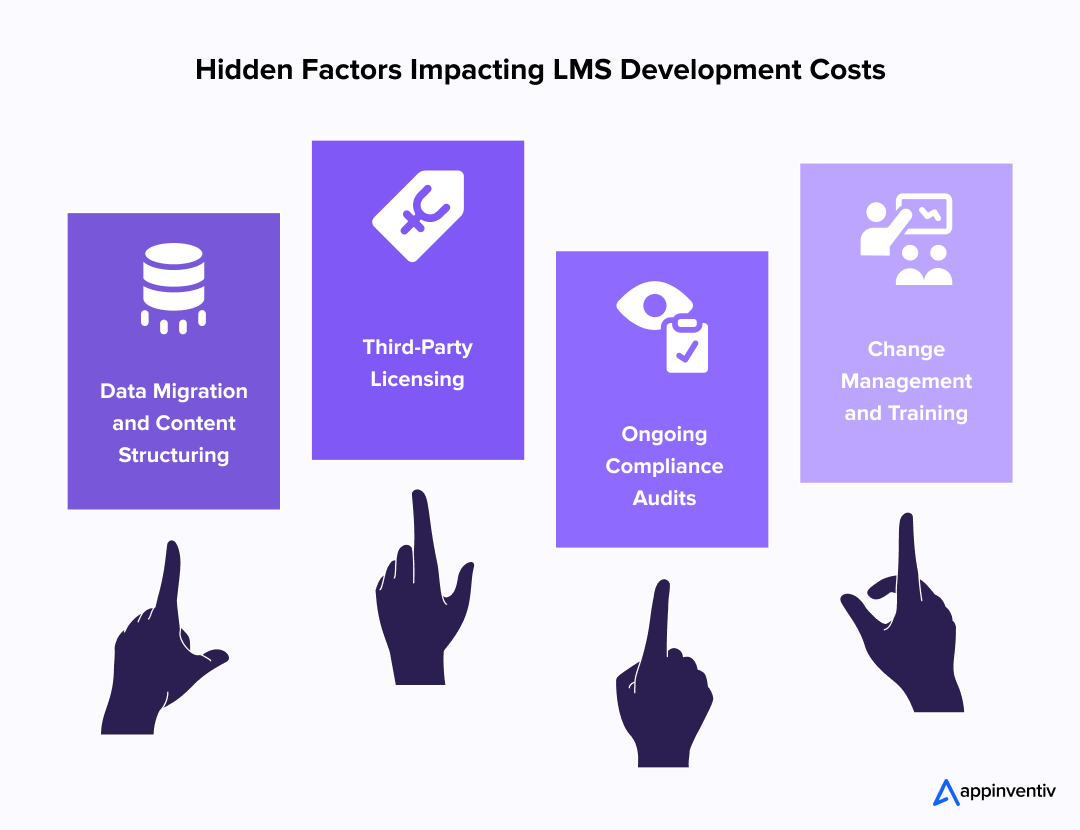
Data Migration and Content Structuring
Moving from a legacy system in Australia often uncovers “dirty data” or obsolete SCORM packages that don’t render correctly on modern mobile devices. Cleaning this content is a significant labour cost.
Third-Party Licensing
While you own the platform, you may still pay for:
- Content Libraries: LinkedIn Learning or Coursera API access.
- Infrastructure: AWS/Azure hosting fees and video streaming via Cloudflare.
Ongoing Compliance Audits
Regulatory requirements in Australia are not static. Budgeting for annual security reviews to maintain the enterprise learning management system in Australia standards is an operational necessity.
Change Management
Even the best software fails if the workforce doesn’t use it. Onboarding programmes and internal “champion” training are essential for high adoption rates.
How to Optimise LMS Development Costs: Strategic Approaches
Cost optimisation should never mean feature compromise. It should mean architectural discipline. Because to prevent budget “creep” during learning management system software development, you need an execution-led strategy:
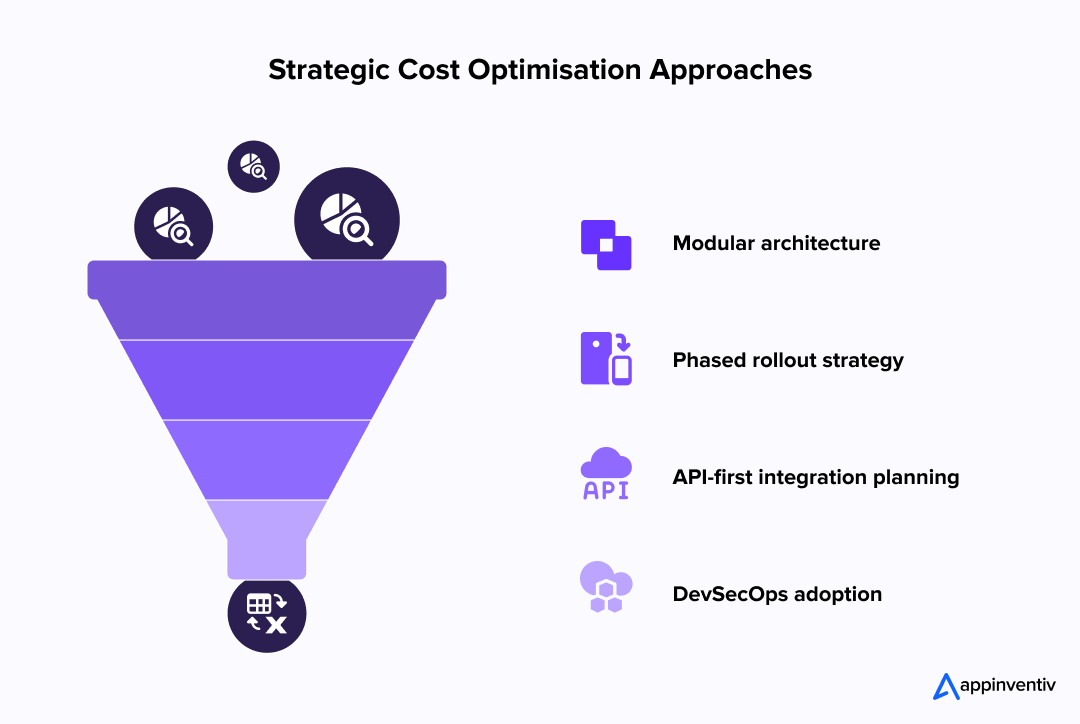
- Modular Architecture: Develop core compliance functionality first. Layer advanced analytics and AI capabilities in subsequent phases.
- Phased Rollout Strategy: Deploy internally before enabling external learners. Validate stability before scaling nationally.
- API-First Integration Planning: Avoid rigid monolithic builds. API-first design enables future integration without re-engineering.
- DevSecOps Adoption: Security validation embedded into CI/CD pipelines reduces late-stage remediation costs.
Organisations following a disciplined Learning management software development process in Australia reduce long-term total cost of ownership by maintaining architectural flexibility.
Industry-Specific LMS Use Cases: Balancing Compliance and Capital
While the core architecture of a Learning Management System remains consistent, the financial and technical “weight” of the platform shifts significantly depending on your sector’s regulatory burden. In Australia, a “one-size-fits-all” approach often leads to expensive retrofitting during audit cycles.
The following breakdown examines how sector-specific mandates, from ASQA data sets to mining safety protocols, directly influence the final development budget.
Higher Education & Registered Training Organisations (RTOs)
For RTOs, the LMS is not just a portal; it is a regulatory ledger. The primary cost driver here is the deep integration required with Student Management Systems (SMS) and the automation of high-stakes reporting.
- The Use Case: Automating the collection and submission of AVETMISS (Australian Vocational Education and Training Management Information Statistical Standard) data to the NCVER. This includes tracking “Evidence of Participation” (EoP) to secure state and federal funding.
- Tentative Cost Range: AUD 120,000 – AUD 280,000.
Healthcare, Aged Care & NDIS
In these sectors, the focus shifts to Psychosocial Safety and mandatory certification tracking under the new Aged Care Act (effective late 2025).
- The Use Case: Managing “Care Minute” compliance and clinical CPD (Continuing Professional Development). The system must trigger escalation workflows if a staff member’s mandatory “Infection Control” or “Manual Handling” certification expires, potentially restricting their ability to be rostered.
- Tentative Cost Range: AUD 90,000 – AUD 220,000.
Mining, Energy & Heavy Industry
The challenge in the resources sector is environmental and logistical: delivering high-fidelity safety training to remote sites with intermittent connectivity.
- The Use Case: High-concurrency site inductions and “Permit to Work” (PTW) validations. Before a contractor steps onto a Western Australian mine site, the LMS must verify they have completed specific safety modules and digitally signed the relevant JSA (Job Safety Analysis).
- Tentative Cost Range: AUD 150,000 – AUD 400,000.
Also Read: The Role of AI in Mining Operations in Australia
Government & Public Sector
For the AU Public Service (APS) and state bodies, data sovereignty and “Protected” level security are the non-negotiable anchors of the project.
- The Use Case: Large-scale internal upskilling and public-facing education programs that must adhere to strict accessibility and security mandates. The platform must often undergo IRAP (Information Security Registered Assessors Program) assessment.
- Tentative Cost Range: AUD 250,000 – AUD 700,000+.
Future of LMS Systems: Emerging Cost Drivers in 2026 and Beyond
As we move through 2026, the cost to build a learning management system in Australia is no longer just about content delivery; it is about the “Intelligence Layer.” Australian enterprises are shifting budgets toward AI and data lake integrations to move from reactive training to predictive skill-gap analysis.
AI-Driven Learning Personalisation
Integrating Large Language Models (LLMs) or AI in the education system to create adaptive learning pathways adds significant development depth. These systems analyse a learner’s past performance and “confidence scores” to skip known material and focus on weak points.
- Predictive Analytics: Building custom algorithms that flag employees likely to fail a mandatory compliance deadline.
- Adaptive Pathways: Dynamically restructuring course modules based on real-time assessment data.
Microlearning and Mobile-First Platforms
For the Australian field workforce, from construction sites in Perth to retail hubs in Sydney, learning must happen in the “flow of work.” Thai can be made possible by:
- Edge Computing: Ensuring high-resolution video modules load instantly in low-bandwidth regional areas.
- Push-to-Learn: Integrating with mobile notification frameworks to deliver 2-minute “safety bursts” before a shift begins.
Advanced Learning Analytics & BI Integration
Modern learning management system software development now requires the LMS to act as a data provider for the broader enterprise. This includes:
- Data Lake Integration: Exporting granular learning telemetry into Snowflake or Azure Data Lake for C-suite performance dashboards.
- Workforce Performance: Correlating training completion rates with actual safety incident reductions or sales performance.
Generative AI for Content Creation
The most significant shift in 2026 is the use of private Gen AI in the education sector to localise and generate training content. This includes:
- Policy-Driven Guardrails: Ensuring the AI only generates content based on internal, Australian-compliant policy documents.
- Governance Frameworks: Implementing human-in-the-loop (HITL) workflows to verify AI-generated assessments before they go live.
Use analytics and adaptive pathways to align training with workforce performance goals.

Benefits of LMS Investment: Measuring Business Impact
A custom enterprise learning management system in Australia should not be viewed as a cost centre, but as a risk-mitigation tool that delivers tangible outcomes through several operational levers. Here are some core benefits of a learning management system in Australia:
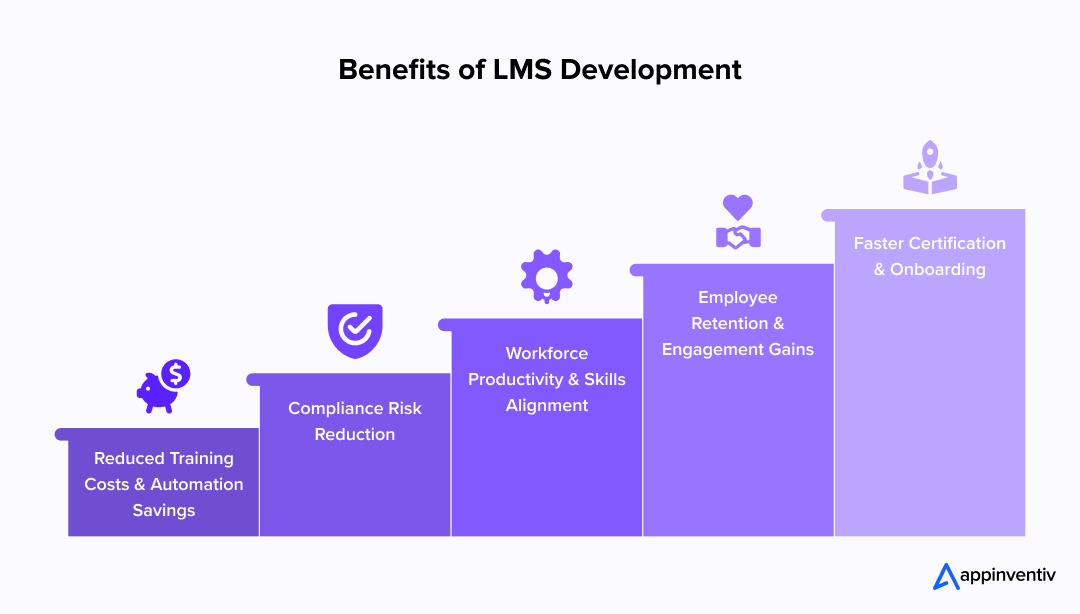
Reduced Training Costs & Automation Savings
By digitising inductions and recurring certifications, organisations eliminate the “hidden costs” of travel, venue hire, and manual grading. Automation of enrollment and reporting typically reduces L&D administrative overhead by 40%.
Compliance Risk Reduction
In a tightening regulatory environment, the cost of a “fail” during an ASQA or Audit Office review can reach hundreds of thousands in fines. A custom LMS provides a bulletproof, tamper-evident audit trail that serves as a primary legal defence.
Workforce Productivity & Skills Alignment
Custom platforms allow for “Just-in-Time” learning. Instead of day-long seminars, workers access specific modules exactly when needed, reducing downtime and ensuring skills are immediately applied to live projects.
Employee Retention & Engagement Gains
Australia’s competitive talent market values career development. Providing a high-quality, frictionless learning experience is a proven driver for reducing staff turnover, saving the significant costs of recruitment and onboarding (often 30–50% of an annual salary per role).
Faster Certification & Onboarding
Reducing the “Time to Productivity” is the ultimate ROI metric. A streamlined digital onboarding process can get a new hire site-ready or desk-ready 25% faster than traditional methods.
Questions Australian Enterprises Should Ask Before Budgeting
Before committing to an LMS development cost in Australia, Aussie innovators must pressure-test their requirements against these strategic pillars:
- What regulatory framework applies to your industry? Are you governed by the Privacy Act, ASQA, or specific APRA data standards?
- Will the LMS integrate with your HR and ERP ecosystem? Does it need to bi-directionally sync with Workday, SAP, or a bespoke payroll system?
- Is AI functionality compliant with Australian data governance laws? Does your AI vendor store data offshore, or is the model hosted within the Sydney/Melbourne cloud regions?
- What is your expected 3-year scale plan? Are you building for your current 500 employees, or for a projected 5,000-person national workforce?
How Appinventiv Helps Enterprises Build Future-Ready LMS Platforms
Appinventiv delivers high-performance software development services in Australia for over a decade. Our team of 1600+ tech experts specialises in engineering sovereign, high-stakes learning platforms that bridge the gap between complex engineering and user-centric design.
We move beyond generic SaaS limitations to build systems that reflect your specific operational DNA, as evidenced by our work on projects like Rapid Teachers.
Real-World Impact of Our Education App Development Services: The “Rapid Teachers” Case Study
We partnered with Rapid Teachers to build a high-velocity education system to streamline the connection between educators and institutions. We implemented an automated, AI-driven workflow that reduced administrative friction, allowing for real-time verification and deployment of teaching staff.

This project highlights our ability to handle high-concurrency environments where data integrity and speed are paramount.
Our Core Capabilities & Government Credentials
Our execution-led approach is backed by 10+ years of APAC delivery experience and over 3000+ digital assets deployed across Australia.
- Federal, State and Local Procurement: We are an approved ICT Supplier to the Australian Digital Transformation Agency (DTA), a member of the QLD Government ICTSS panel, and engaged through Localbuy arrangements, enabling streamlined and pre-qualified procurement across Federal, State, and Local government agencies.
- Compliance-First Architecture: Every software we build is mapped against the Privacy Act 1988 and ASD Essential Eight frameworks. We ensure data residency within Australian borders to satisfy sovereignty requirements.
- AI Personalisation: Through our experience in delivering 300+ AI solutions and training 150+ custom AI models, we implement proprietary models for predictive analytics, ensuring all our AI usage in Australia is governed and transparent.
- Scalable Platforms: As an approved ICT supplier, we design systems that meet WCAG 2.1/2.2 accessibility standards and IRAP-level security hardening for the public sector.
Want to keep the total cost to build a learning management system in Australia within your budget? Plan your LMS development with enterprise architects who understand compliance, scalability, and workforce transformation.
Schedule a Strategy Consultation today.
FAQs
Q. How much does it cost to build a learning management system australia?
A. Enterprise LMS development cost in Australia typically ranges between AUD 70,000 and AUD 700,000+.
Cost by scope:
- Basic corporate LMS: AUD 70,000 – 150,000
- Mid-level enterprise LMS: AUD 150,000 – 400,000
- Large multi-tenant or regulated platform: AUD 400,000 – 700,000+
Final cost to build a learning management system in Australia depends on compliance requirements, integrations (HRIS, ERP, payroll), AI capabilities, data sovereignty needs, and scalability expectations. Governance exposure is often the primary cost driver.
Q. How long does it take to build an LMS in Australia?
A. Delivery timelines for LMS systems range from 3 to 12+ months, depending on complexity. Timeline by scope:
- Basic internal training system: 3–6 months
- Enterprise LMS with integrations: 6–9 months
- Multi-tenant or compliance-heavy build: 9–12+ months
Discovery and regulatory validation phases significantly influence delivery duration. Compressing early planning often extends overall timelines.
Q. What is a learning management system?
A. A learning management system is a structured digital platform used to deliver, track, manage, and report on training programs across corporate, education, or government environments.
The platform typically integrates with HR and compliance systems to automate certification tracking, reporting, and workforce capability development.
Q. What ROI can organisations expect from a custom learning management system?
A. ROI is typically realised within 18–36 months in compliance-heavy or large workforce environments.
Impact areas include:
- Reduced administrative training overhead
- Automated compliance reporting
- Faster onboarding cycles
- Improved workforce productivity
- Reduced regulatory risk
Q. What tech stack is best for building a scalable learning management system software in Australia?
A. Enterprise-grade builds typically use the below listed tech stack:
- Cloud-native backend frameworks
- Containerised infrastructure
- Scalable relational or distributed databases
- API-first integration architecture
- Secure authentication layers (SSO, MFA)
- Monitoring aligned with ASD Essential Eight controls
Technology selection should prioritise scalability, compliance alignment, and integration flexibility rather than trend adoption.
Q. What data security regulations apply to LMS platforms in Australia?
A. Depending on the industry, LMS platforms must comply with:
- Privacy Act 1988
- Australian Privacy Principles (APPs)
- ASD Essential Eight cybersecurity controls
- TEQSA and ASQA compliance standards
- AVETMISS reporting requirements for RTOs
For government and regulated sectors, data sovereignty and Australian-hosted infrastructure may also be mandatory.

- In just 2 mins you will get a response
- Your idea is 100% protected by our Non Disclosure Agreement.

How to Build an EdTech App for Australia: Framework, Features, Cost Structure, & Compliance
Key takeaways: AI implementation in Australian EdTech gains ground when it is transparent, governed, and aligned with emerging regulatory expectations. Realistic EdTech app development costs range from AUD 70,000 to AUD 700,000, driven by compliance, scalability, and long-term support needs. Long-term success relies on modular development, continuous optimisation, and proactive compliance management rather than rushing…

How Smart Campuses Are Redefining the Future of Education - Benefits, Use Cases, and Technologies
Digital transformation is roaring across industries, and the education sector is no exception. The integration of cutting-edge technologies like the Internet of Things (IoT), artificial intelligence (AI), machine learning (ML), cloud computing, virtual reality, etc. is increasingly making waves in the education sector. Amidst the hum of these technology trends, the emergence of smart campus…

How Much Does it Cost to Develop a Language Learning app like Babbel
According to a report, the global language learning market is expected to be $80 billion by 2028. The immense potential of the language learning app market serves as a bright opportunity for global entrepreneurs who want a piece of this pie. Babbel is one of the more popular language-learning apps in the market today. Building…