
































Cost to Build a Taxi Booking App Like Hala Taxi: A 2026 Breakdown

 Share -


- 01Quickly Scanning the Hala Taxi App Development Cost
- 02Why Hala Taxi Works as a Reference Model
- 03The Real Cost to Build a Taxi Booking App Like Hala Ride
- 04Factors Influencing the Hala Taxi Like App Development Cost
- 05Breaking Down Features Influencing the Taxi Booking App Development Cost in the UAE
- 06UAE Compliance to Consider in the Cost Breakdown for a Taxi Booking App
- 07API Pricing: What You'll Actually Pay Every Month
- 08Tech Stack
- 09Basic to Scale: The Path to Build an App Like Hala Taxi
- 10Common Budget Killers that Can Ruin Your ROIs
- 11Appinventiv's Middle East Track Record
- 12FAQs

Key takeaways:
- Build cost runs $65K to $400K+
- UAE compliance adds 15–25% on top
- API fees compound forever, not once
- Driver app quality determines your supply
- Phase the build, skip big-bang launches
Dubai completed more than 115.32 million taxi trips in 2024, and the UAE ride-hailing market is projected to hit US $ 2,366.3 million (AED 934.3 million) by 2033, growing at a 18.7% CAGR according to Statista. Hala Taxi — the joint venture between Careem and Dubai’s Roads and Transport Authority — sits on top of this market as the reference product for anyone serious about entering the space.
Founders often worry about the same thing: what would it actually cost to build an app like Hala taxi?
The short answer nobody wants to give: anywhere between US $65,000 and US $400,000+ (roughly AED 165,000 to AED 1.47 million), depending on how far you push the product. The in-depth answer, which is what this post is, breaks that spread down so you can land on a real number for your business case.
Here’s what you’ll walk away with:
- A realistic cost to build a taxi booking app like Hala Taxi, broken down by line item
- Which features eat the budget (and which are cheap wins)
- UAE-specific compliance — RTA, PDPL, NESA/SIA, VARA-linked rules — and what each costs to get right
- Actual API pricing from Google Maps, Twilio, Stripe, Mapbox, and Network International
- Case studies from our own portfolio with numbers attached
Let’s get into it.
Lock in your build scope now — get a costed UAE launch plan in 72 hours.

Quickly Scanning the Hala Taxi App Development Cost
If you only have a minute, here it is:
| Product Stage | Cost (USD) | Cost (AED) | Timeline |
|---|---|---|---|
| Basic tier — one city, core features | $65,000 – $85,000 | AED 239K – 312K | 3 – 4 months |
| Mid-tier — multi-city, full three apps | $90,000 – $180,000 | AED 330K – 660K | 5 – 7 months |
| Enterprise — Hala-level scale, RTA integration, AI dispatch | $200,000 – $400,000+ | AED 734K – 1.47M+ | 8 – 12 months |
Conversions use the pegged rate of 1 USD ≈ 3.67 AED.
The rest of this post explains why the spread is that wide.
Why Hala Taxi Works as a Reference Model
Hala isn’t quite an Uber clone. It sits on Dubai’s existing licensed taxi fleet instead of routing around it, and that single architectural choice changes almost everything downstream. The philosophy is augmentation, not displacement — layer intelligence and demand generation on top of a licensed fleet rather than building a parallel supply base from scratch.
Hala operates on the same philosophical foundation: augment the licensed supply, don’t rebuild it.
Three things fall out of that model:
- Drivers are pre-vetted fleet operators — you inherit supply instead of building it
- Regulatory alignment is the foundation, not a retrofit
- Branded vehicles and government-tracked trips give you trust signals that a new TNC can’t fake
If your launch market is Dubai, Abu Dhabi, or any city with a strong licensed-taxi sector (Singapore, London, Tokyo all fit), the Hala model is the sharper reference than the gig-economy playbook.
That shift in framing has become obvious in our inbound over the last 18 months, Hala taxi app development cost has overtaken generic Uber-clone briefs as the top ride-hailing query we get from UAE-bound founders.
The Real Cost to Build a Taxi Booking App Like Hala Ride
We price these builds across six cost centres. Each one is a dial you can turn — platform founders turn most of them down; enterprise buyers turn most of them up.
1. Discovery and Product Strategy
US $5,000 – $15,000 (AED 18K – 55K)
Market validation, user journey maps, regulatory scoping and a technical architecture blueprint. This is the least exciting line item on the sheet and the one that saves the most money later. Skip it, and you will pay for it — we’ve seen rebuilds alone add 30-40% to a project that started with a half-baked discovery.
2. UI/UX Design
US $8,000 – $25,000 (AED 29K – 92K)
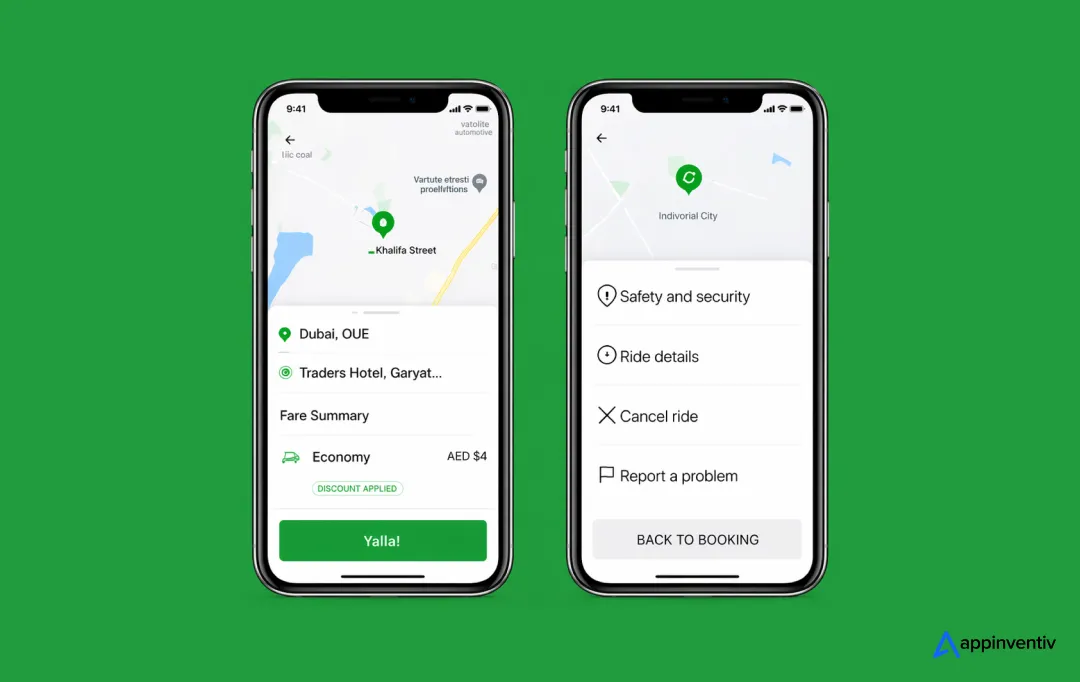
A Hala-style product means three distinct interfaces: rider, driver and admin. Each one has its own design language and information hierarchy. Lower budgets cover functional design. Higher ones buy motion work, WCAG accessibility, and proper Arabic localization — and Arabic is not a checkbox here, it’s right-to-left layouts that need to be designed, coded, and QA’d as a first-class experience.
Founders looking to stretch a limited design budget further should adapt intelligent tricks to enhance app design. For instance, small craft choices in typography, spacing, and motion often outperform larger budgets poorly spent.
3. Frontend and Backend Development
US $35,000 – $180,000 (AED 128K – 660K)
The widest line. An app with one city, cash-or-card, and basic dispatch sits near the floor. A production system with real-time matching, surge pricing, multiple payment gateways, and a fleet console sits at the top. This is where the cost breakdown for taxi booking apps really gets decided.
For cross-platform teams optimising time-to-market, the practice is often to develop Flutter apps or go for React Native. This is where, typically, app founders land — a single codebase covering iOS and Android shaves weeks off the timeline without sacrificing production quality.
On the backend, clean and well-documented API development projects are what keep the rider app, driver app, admin console, and any future regulator integration speaking the same language without a rewrite at every scale threshold
4. Third-Party Integrations
US $6,000 – $30,000 (AED 22K – 110K) for build cost. Recurring API fees are separate — we will list down popular APIs with pricing a little below in detail.
5. QA and Testing
US $5,000 – $20,000 (AED 18K – 73K)
Ride-hailing has zero tolerance for bugs. A broken payment flow doesn’t annoy a user — it strands them on a kerb at 11 pm. We budget 15–20% of development cost for QA on every mobility build, non-negotiable.
6. DevOps and Year-One Support
US $6,000 – $30,000 (AED 22K – 110K)
Cloud infra, CI/CD, monitoring, and a retainer for the first 90 days after launch, where you will find issues in real traffic surfaces.
Consolidated Cost Table
| Cost Centre | Basic | Mid-Tier | Enterprise |
|---|---|---|---|
| Discovery & Strategy | $5K / AED 18K | $8K / AED 29K | $15K / AED 55K |
| UI/UX Design | $8K / AED 29K | $15K / AED 55K | $25K / AED 92K |
| Development (all apps) | $35K–50K / AED 128K–184K | $80K–120K / AED 294K–441K | $150K–250K / AED 551K–919K |
| Integrations | $6K–10K / AED 22K–37K | $12K–20K / AED 44K–73K | $20K–30K / AED 73K–110K |
| QA & Testing | $5K–8K / AED 18K–29K | $10K–15K / AED 37K–55K | $15K–25K / AED 55K–92K |
| DevOps & Year-One Support | $6K–10K / AED 22K–37K | $15K–25K / AED 55K–92K | $25K–55K / AED 92K–202K |
| Total | $65K–91K / AED 239K–334K | $239K–203K / AED 514K–746K | $250K–400K / AED 919K–1.47M |
Also Read: Cost to Build Taxi Apps Like Uber & Careem
Factors Influencing the Hala Taxi Like App Development Cost
Two clients walk in with identical briefs and walk out with quotes that differ by 3x. We get asked why. Here are the factors influencing the Hala taxi-like app development cost that matter most in our scoping conversations.
Where your engineers sit
Region is the single biggest cost driver. Not close.
| Region | Blended Hourly Rate | Project Cost Multiplier |
|---|---|---|
| North America (US/Canada) | $120 – $200 | 2.5x – 3.5x |
| Western Europe | $90 – $150 | 2.0x – 2.8x |
| UAE / GCC (local agencies) | $80 – $130 | 1.8x – 2.5x |
| Eastern Europe | $50 – $85 | 1.2x – 1.6x |
| India (enterprise firms) | $35 – $65 | 1.0x (baseline) |
For brands exploring service providers in the UAE, finding a mobile app development company in Dubai is often a priority given its regional presence and regulatory familiarity. All this comes without North American rate cards.
Feature depth
Each feature is a compound cost: design, build, test, maintain, support. A fare estimator driven by historical trip data and a lightweight ML model costs meaningfully more than a distance-times-rate calculator. Both look like “fare estimator” in a feature list.
Platform strategy
Native iOS plus native Android plus a web admin is the gold standard and runs about 1.8x a cross-platform React Native or Flutter build. For most early-stage founders, cross-platform is the right call. Rebuild natively once you’ve validated the market — not before.
Real-time infrastructure
Ride-hailing lives and dies on latency. Matching drivers to riders in under three seconds across thousands of concurrent trips is an infrastructure problem most generic app teams have never touched. Budget $20K–$50K (AED 73K–184K) just for this, done properly.
A microservice architecture is how developers keep dispatch, pricing, payments, and notifications from blocking each other under load each service scales on its own curve, which matters the moment a surge event hits one subsystem but not the others. That same decoupling is the foundation of application scalability as you move from one city to ten.
Compliance scope
More on the UAE specifics below. Short version: RTA approvals, UAE PDPL, NESA/SIA controls, and data residency each cost real money and add real calendar time.
AI layer
Dynamic pricing, ETA prediction, demand forecasting, fraud detection — these are not toggles. Each is its own project. Expect $15K–$60K (AED 55K–220K) per module, depending on complexity. The AI app development cost can be higher than a traditional product, but it will give you better ROI.
If considered in the budget, this is where AI analytics for businesses crosses over from back-office reporting into the core product loop — demand forecasts feed the dispatcher, fraud scores feed the payments engine, and ETA models feed the rider UI.
For founders thinking further ahead, predictive analytics for mobile apps is the longer game: the same telemetry that powers today’s surge engine becomes tomorrow’s churn model and retention layer.
Breaking Down Features Influencing the Taxi Booking App Development Cost in the UAE
Each feature in the on-demand taxi booking app development adds to the cost and can increase your budget. Here’s a breakdown:
The launch-ready app
This is what you need to put something in the App Store:
| Role | Must-Have Features | Cost (USD) | Cost (AED) |
|---|---|---|---|
| Rider | OTP signup, map view, pickup/drop autocomplete, fare estimate, vehicle category, in-app payment, live driver tracking, trip history, driver rating | $18,000 – $28,000 | AED 66K – 103K |
| Driver | Document-based onboarding, online/offline toggle, job acceptance with ETA preview, turn-by-turn nav, earnings dashboard, payout requests | $12,000 – $18,000 | AED 44K – 66K |
| Admin | Driver onboarding workflow, live fleet map, manual dispatch override, pricing rules, disputes and refunds, basic reporting | $10,000 – $15,000 | AED 37K – 55K |
| Basic Layer Total | $40,000 – $61,000 | AED 147K – 224K |
The market-fit layer (post-launch, months 4–8)
Once the core product is stable, this phase focuses on scaling usage, improving retention, and adding revenue-driving features across rider, driver, and admin experiences.
| Role | Expansion Features | Cost (USD) | Cost (AED) |
|---|---|---|---|
| Rider | Scheduled and recurring rides, multi-stop trips, split fare, in-app masked calling, SOS button, corporate accounts, wallet with top-up | $25,000 – $40,000 | AED 92K – 147K |
| Driver | Performance metrics, incentive tracker, in-app training, shift planning | $8,000 – $14,000 | AED 29K – 51K |
| Admin | Heatmaps for demand, promo engine, dynamic pricing rules, financial reconciliation and BI dashboards | $15,000 – $25,000 | AED 55K – 92K |
| Market-Fit Layer Total | $48,000 – $79,000 | AED 176K – 290K |
The enterprise layer (Hala-grade)
These are the features of a taxi booking app that stop making you look like a clone:
| Category | Features | Cost (USD) | Cost (AED) |
|---|---|---|---|
| Regulatory | RTA dispatch API, Dubai Smart City data feeds, Nol card payments, airport queue management | $20,000 – $40,000 | AED 73K – 147K |
| Safety | Real-time fraud scoring, anomaly detection on trip patterns, driver certification tracking | $12,000 – $22,000 | AED 44K – 81K |
| Intelligence | Demand forecasting, AI-powered surge, predictive maintenance for fleet partners | $25,000 – $55,000 | AED 92K – 202K |
| Localization | Arabic-first UX, dialect awareness, Ramadan-aware scheduling logic | $8,000 – $15,000 | AED 29K – 55K |
| Enterprise Layer Total | $65,000 – $132,000 | AED 239K – 485K |
What each feature actually costs
A note on reconciling the numbers: the tier totals above are development-only — they cover engineering and feature build-out. The consolidated cost table earlier in this post wraps everything else around that (discovery, design, QA, DevOps, Year-One support), which is why the headline range lands at $65K–$91K. Build those supporting line items back in when you’re modelling the full project.
The per-feature view below is useful when you’re picking and choosing — say, a small team that wants to pull surge pricing forward from the enterprise tier:
| Feature | Cost Range (USD) | Cost Range (AED) |
|---|---|---|
| Real-time GPS tracking & dispatch | $12,000 – $25,000 | AED 44K – 92K |
| Multi-gateway in-app payments | $6,000 – $12,000 | AED 22K – 44K |
| Scheduled & recurring rides | $3,500 – $7,000 | AED 13K – 26K |
| In-app chat & masked calling | $4,000 – $9,000 | AED 15K – 33K |
| SOS & safety layer | $3,000 – $6,000 | AED 11K – 22K |
| Admin analytics dashboard | $8,000 – $18,000 | AED 29K – 66K |
| AI surge pricing engine | $15,000 – $35,000 | AED 55K – 128K |
| RTA / regulator integration | $10,000 – $25,000 | AED 37K – 92K |
| Loyalty/rewards module | $5,000 – $10,000 | AED 18K – 37K |
On the GPS tracking integration cost for the taxi app specifically, this is where founders most consistently underestimate. Sub-second vehicle updates across a whole city need both careful frontend engineering and a backend that can stream tens of thousands of location events per minute. The API bill alone can run several thousand dollars a month at scale.
UAE Compliance to Consider in the Cost Breakdown for a Taxi Booking App
This is where a lot of cheap quotes come apart. Operating a taxi app in the UAE means navigating at least five overlapping regulatory frameworks, and each one costs real money to get right.
1. RTA approvals and licensing (Dubai)
If your app dispatches licensed taxis or operates anywhere in Dubai’s regulated transport layer, you work with the Roads and Transport Authority. That means API certification, data-sharing agreements, and a go-to-market timeline that includes government review cycles. Similar authorities exist in other emirates — Abu Dhabi, Sharjah — and their processes are not identical.
Budget: $10,000 – $25,000 (AED 37K – 92K) for technical integration, plus 8–16 weeks of calendar time.
2. DED trade license
Before you operate anything, you need a Dubai Department of Economic Development trade license appropriate to your activity. Taxi businesses sit in a specific category and may require a local sponsor or a free zone structure, depending on your setup.
3. UAE Personal Data Protection Law (PDPL)
The PDPL — Federal Decree-Law No. 45 of 2021 — regulates how you collect, process, store, and transfer personal data. For a ride-hailing app, that includes trip histories, location data, payment info, and driver records. Non-compliance can trigger fines up to AED 5 million (~US $1.36 million), per the UAE’s Data Office.
Requirements that affect your build:
- Explicit consent flows for data collection
- Data Protection Officer appointment for most operators
- Breach notification within 72 hours
- Right-to-delete and data-portability APIs
4. NESA / SIA (now Signals Intelligence Agency) controls
The UAE’s federal cybersecurity authority maintains the Information Assurance Standards with 188 security controls — 60 management-level, 128 technical. For any app classified as critical infrastructure (and ride-hailing increasingly qualifies under transport infrastructure), these are mandatory.
5. Data residency and ISR
Dubai Government’s Information Security Regulation (ISR) expects sensitive personal data to live on UAE-based servers. AWS Bahrain, AWS UAE, and Azure UAE are all viable — and all cost more than your default us-east-1 setup. Plan for a 15–25% uplift on infrastructure.
6. Federal Decree-Law No. 34 of 2021 (Cybercrime Law)
Your platform is legally on the hook if poor security lets attackers exploit it. Encryption, multi-factor auth, and regular VAPT (vulnerability assessment and penetration testing) stop being “nice to have” and start being legal requirements.
UAE compliance cost summary
| Requirement | Typical Cost | Calendar Impact |
|---|---|---|
| RTA technical integration | $10K – $25K (AED 37K – 92K) | 8 – 16 weeks |
| DED trade license + setup | AED 15K – 50K annually | 2 – 6 weeks |
| PDPL compliance build | $8K – $20K (AED 29K – 73K) | 4 – 8 weeks |
| NESA/SIA control implementation | $15K – $40K (AED 55K – 147K) | 6 – 12 weeks |
| UAE data residency (cloud) | +15–25% on infra | Ongoing |
| Annual NESA audit | $8K – $20K (AED 29K – 73K) | 4 – 6 weeks |
This is why the taxi booking app development cost in the UAE typically runs 15–25% above what the same build would cost for a less regulated market. It’s not a bug — it’s the price of operating in a market where trust and compliance are actual moats.
API Pricing: What You’ll Actually Pay Every Month
Build costs are one-time. API costs are forever. Here are five APIs you will almost certainly integrate and what they cost at 2026 rates. These are the numbers your CFO needs before you commit to a business model.
1. Google Maps Platform
Google restructured pricing in March 2025. The universal $200 monthly credit is gone, replaced by per-SKU free usage caps.
- Dynamic Maps JavaScript API: $7 per 1,000 loads after 10,000 free/month
- Directions API: $5 per 1,000 requests
- Distance Matrix API: $5 per 1,000 elements (note: elements, not requests — a 10×10 matrix is 100 elements)
- Geocoding API: $5 per 1,000 requests
- Routes API (traffic-aware): varies by SKU, up to $10 per 1,000
Source: Google Maps Platform pricing
Practical impact: At 50,000 monthly active riders averaging three trips each, expect $3,500–$6,000/month (AED 13K–22K) on Google Maps alone. This is why caching, field masks, and session tokens matter — we routinely cut client bills by 50% through implementation hygiene.
2. Mapbox (Google Maps alternative)
Worth pricing out as an alternative. Mapbox charges per map load, per geocode, per directions request — generally 30–50% cheaper than Google at volume. Trade-offs exist in the quality of data in the UAE; run a side-by-side test before you commit.
- Maps SDK load: ~$0.50 per 1,000 after 25,000 free/month
- Directions API: ~$0.50 per 1,000 after 100,000 free/month
- Geocoding: ~$0.75 per 1,000 after 100,000 free/month
Source: Mapbox pricing
3. Twilio (SMS/OTP, voice, masked calls)
SMS OTP for login, masked calls between rider and driver. Non-optional.
- Outbound SMS (UAE): starts at ~$0.03–$0.05 per message — significantly higher than Twilio’s global baseline because UAE carriers apply aggregator fees
- Inbound SMS: from $0.0083
- Programmable Voice (UAE): varies by destination, ~$0.014/min to make, $0.0085/min to receive
- WhatsApp Business API: from $0.005 per message (often cheaper than SMS for the same use case)
Source: Twilio SMS pricing UAE.
Practical impact: OTP-heavy flows get expensive fast in the UAE. Budget $0.08–$0.15 per new user acquisition just on SMS. At scale, consider WhatsApp OTP as a fallback — it cuts this cost by 70% or more.
4. Stripe (and regional payment gateways)
Stripe operates in the UAE with these rates:
- Domestic AED cards: 2.9% + AED 1.00 per transaction
- International cards: 3.9% + 1% FX fee
- Dispute fee: $15 (refunded if you win the dispute)
Source: Stripe fees for UAE.
For local market share, you’ll want Network International or Tap Payments alongside Stripe — local card acceptance is stronger, and UAE riders expect to see local brand logos at checkout. Both charge in a similar 2.5–3.0% range plus fixed fees. Add Apple Pay, Google Pay, and Samsung Pay. In premium segments, cash still matters.
5. Firebase Cloud Messaging + push services
Basic FCM is free at reasonable volumes, which is the good news. Transactional notification services (Airship, OneSignal, Braze) start around $99/month for small deployments and scale up from there.
Monthly API cost scenarios
For a ride-hailing app at three user tiers:
| Scale | Monthly Active Riders | Estimated API Costs (USD) | Estimated API Costs (AED) |
|---|---|---|---|
| Basic | 5,000 | $800 – $1,500 | AED 2.9K – 5.5K |
| Growth | 50,000 | $5,000 – $9,000 | AED 18K – 33K |
| Scale | 500,000 | $35,000 – $70,000 | AED 128K – 257K |
These are the numbers most founders don’t model into Year 1. Build them into your unit economics before you write the first line of code.
Tech Stack
Ask any vendor for their stack. A vague answer is a red flag. Here’s what a modern production-grade Hala-style build looks like in 2026:
| Layer | Technology |
|---|---|
| Mobile (rider + driver) | Flutter or React Native (cross-platform); Swift + Kotlin (native) |
| Web admin | React / Next.js with TypeScript |
| Backend (API services) | Node.js (NestJS) or Go for dispatch; Python for ML services |
| Real-time layer | Socket.IO, Apache Kafka, Redis Pub/Sub |
| Database | PostgreSQL primary, PostGIS for geospatial, MongoDB for telemetry, Redis for cache |
| Maps & routing | Google Maps Platform, Mapbox, HERE |
| Payments | Stripe, Network International, Tap Payments and Checkout.com |
| SMS / OTP | Twilio, Unifonic (regional fallback) |
| Cloud | AWS (primary, UAE region for residency), GCP for ML workloads |
| Observability | Datadog, Sentry, Grafana, Prometheus |
| AI/ML | TensorFlow, PyTorch, AWS SageMaker |
One thing we’ll flag: you do not need Kubernetes on day one. Most platforms run fine on ECS or Cloud Run. Over-engineering the stack is one of the fastest ways to blow through a budget before you have users.
Basic to Scale: The Path to Build an App Like Hala Taxi
If you handed us a brief to build the app today, with a constrained budget, this is the sequence we’d recommend — and it’s the sequence that has worked for our clients.
Phase 1 — Simple app (months 1–4, ~$70K / AED 257K)
One city. One vehicle category. Rider, driver, and basic admin apps. Cash plus a single digital payment method. Google Maps for routing. Manual dispatch fallback for the edge cases automation doesn’t handle yet.
Goal: prove unit economics and balance supply and demand in a single geography.
Phase 2 — Market fit (months 5–8, ~$80K incremental / AED 294K)
Second city. Scheduled rides, multi-stop, split fare. AI-driven ETA and surge. Full admin analytics. Regulator integration is required for your launch city.
Goal: validate the scalability of the operating model.
Phase 3 — Scale (months 9–14, ~$120K+ incremental / AED 441K+)
Multi-country. Corporate accounts. Loyalty program. Advanced fraud and safety layer. Deep BI. Financial reporting that passes an external audit.
Goal: build defensible moats before better-funded competitors notice you exist.
This phased approach is how we’ve taken mobility startups from zero to category leaders on a fraction of what big-bang launches cost.
Bring your feature list. We’ll pressure-test it against RTA, API, and infra costs in 45 minutes.

Common Budget Killers that Can Ruin Your ROIs
Over the years, the same budget-killers keep showing up:
- Picking a vendor on price alone. The cheapest quote is almost always the most expensive outcome. We’ve inherited enough rescue projects to say this with conviction.
- Skipping discovery. You will redesign your core flows at least once. Do it on a whiteboard, not in production.
- Underestimating the driver app. Drivers are your supply. If their experience is worse than the competitor across town, your market share will tell the story within 90 days.
- Treating maps as a free resource. Google Maps Platform bills scale fast. See the pricing section above — this is not a line you can ignore.
- Forgetting offline mode. Drivers lose signal in parkades, tunnels and basements. Your app has to handle that, or drivers will stop using it.
- Shipping without ops. A 24/7 rider support function is a product requirement, not a marketing problem.
Appinventiv’s Middle East Track Record
We said up top that we’d back the advice with real numbers. Here are four relevant projects from our portfolio.
KFC Middle East — 7 apps across the Americana Group
The Americana Group came to us with a specific problem: about 90% of KFC’s orders were coming through food-delivery aggregators, which was tanking margins and hurting the brand’s direct relationship with customers. We designed and built seven KFC apps across the UAE, KSA, Kuwait, Egypt, Qatar, Bahrain, and Oman — on a 12-month target.
Results:
- 22% increase in conversion rate from users choosing direct orders over aggregators
- 4.5 average app rating on both the Play Store and App Store
- Delivered all seven apps on schedule
The relevance to Hala Taxi-style builds: multi-country deployment with localized payment, language, and fulfilment flows — same architectural problem, different vertical.
Adidas Middle East — eCommerce at scale
A mobile commerce engagement across the GCC that had to preserve Adidas’s global design system, run at performance-critical speeds, and build up a regional user base from a cold start. We delivered 2 million downloads and 500,000 new users onboarded post-launch — mostly in the UAE, KSA, and Qatar.
JobGet — from zero to MIT Innovation Award
A US-based, two-sided marketplace for blue-collar work. Architecturally identical pattern to ride-hailing: match supply with demand in real time, handle messaging and scheduling within the app, keep latency under a second. The app won the MIT Innovation Award and raised $52 million in funding — we stayed on through funding rounds and scale-up.
The recognition side
For what it’s worth on the credibility ledger:
- Deloitte Technology Fast 50 — 2023 and 2024
- Clutch Global Award — 2025
- 3,000+ digital products delivered
- 1,600+ engineers across US, UAE, and UK offices
- $950M+ in funding raised by our startup clients
When you’re ready to price out a real build, talk to our mobility team. We’ll give you a number, a timeline, and an honest view of the trade-offs.
FAQs
Q. How much does it cost to build an app similar to Hala Taxi in Dubai?
A. $65,000 to $400,000+ (AED 239K – AED 1.47M+), depending on scope. A basic single-city app runs $65K–$90K, a mid-tier multi-city build lands at $140K–$200K, and an enterprise-grade product with RTA integration and an AI layer sits at $250K–$400K+. The cost to develop a taxi app in Dubai, especially an app like Hala, reflects feature depth, compliance scope, and infrastructure choices — not vendor markup.
Q. How long does taxi app development take?
A. Basic: 3–4 months. Mid-tier: 5–7 months. Enterprise: 8–12 months. Any firm quoting 4–6 weeks for a “Hala clone” is showing you a codebase that won’t survive real traffic.
Q. Does taxi app development in Dubai require RTA integration?
A. If you touch the regulated taxi fleet or dispatch licensed drivers, yes. Even app-based private hire still coordinates with the RTA for approvals. Budget $10,000–$25,000 (AED 37K – 92K) for technical integration and 8–16 weeks of government review time on top of your development schedule.
Q. What integrations are required for taxi apps in the UAE?
A. At minimum: a map provider (Google Maps, Mapbox, or HERE), multiple payment gateways (Network International, Tap Payments, Checkout.com, Apple Pay), SMS/OTP (Twilio or Unifonic), identity verification, and cloud hosting in a UAE-compliant region. For regulated operators, add RTA APIs. PDPL-compliant consent and data-handling flows are table stakes across the board.
Q. What tech stack is used in taxi apps?
A. Flutter or React Native for mobile, Node.js or Go for backend services, PostgreSQL with PostGIS plus Redis for data and real-time workloads, Google Maps or Mapbox for routing, Stripe alongside Network International for payments, and AWS in a UAE region for hosting. AI layers typically run on Python with TensorFlow or PyTorch.
Q. How do I estimate the budget for my specific build?
A. To calculate the taxi app development cost in Dubai, or in any other region of the ME, start with the feature tier that matches your ambition (basic, mid-tier, or enterprise), add ~20% for UAE compliance, then another 15–20% for post-launch stabilization and the first year of support. Model recurring API costs separately — those compound monthly and catch most founders off-guard. Or send us the brief, and we’ll turn around a real estimate in 72 hours.


Fast 2-minute response, fully NDA-protected.

How Much Does It Cost to Develop a Remote Patient Monitoring App in the UAE?
Key takeaways: Feature scope and system integrations, not the app itself, determine your final development cost. DHA, DOH, and MOHAP compliance must be built into your architecture from day one. Wearables, EHRs, and health information exchanges are the biggest technical cost drivers. A successful RPM platform combines continuous monitoring, clinical workflows, and secure interoperability. Early…

How Much Does It Cost to Develop an App Like Herfy in 2026?
Key takeaways: Herfy-like app development costs SAR 150,000 to SAR 1,500,000 ($40,000 to $400,000). Costs rise with rider tracking, POS sync, kitchen displays, loyalty, and branch controls. Saudi apps need Arabic UX, Mada, STC Pay, VAT, and ZATCA-ready invoice flows. Peak loads during Ramadan, Eid, and weekends need strong backend and load testing. A phased…

Key takeaways: The operating model determines survival. The code does not. Compliance under PDPL in the UAE and SDAIA in Saudi Arabia must be engineered into architecture, not added before launch. A serious build costs between AED 147,000 and AED 1,470,000 (USD 40,000 to USD 400,000), depending on scope. The single largest cost most operators…