


























Healthcare 4.0: Redefining the Future of Connected Care and Clinical Intelligence

- How Does a Healthcare 4.0 Strategy Build a Foundation for Connected and Intelligent Care?
- Healthcare 4.0 vs Digital Health vs Smart Hospitals: What’s the Difference?
- What Are the Core Healthcare 4.0 Technologies and Features of Medical 4.0?
- How Is Industry 4.0 in Healthcare Transforming Modern Medicine?
- What Are the Key Applications of Healthcare 4.0 Technology?
- How Does AI-Driven Healthcare Intelligence Power Predictive and Personalized Care?
- How Does Connected Care Enable Patient-Centric Healthcare Experiences?
- What Are the Business and Clinical Benefits of Healthcare 4.0?
- What Are the Challenges in Implementing Healthcare 4.0 and How Can They Be Overcome?
- What Are the Key Industry 4.0 Trends in Healthcare and What’s Next?
- How Does Appinventiv Deliver Enterprise-Grade Healthcare 4.0 Transformation?
- Frequently Asked Questions

Key Takeaways
- Healthcare 4.0’s ecosystem is autonomous and patient-centric, integrating AI, IoT, and cloud computing.
- AI-driven clinical intelligence enhances personalized care for healthcare professionals and improves patient outcomes through predictive analytics.
- IoT and AI are being implemented in smart hospitals to improve operational efficiency, resource management, and patient care.
- Connected care enables better patient empowerment and health outcomes by using telemedicine, wearables, and real-time monitoring.
- Scalable solutions for overcoming data security, interoperability, and cost challenges lead to the successful adoption of Healthcare 4.0.
The gap between digital-first health systems and legacy providers is getting harder to ignore. As healthcare moves away from reactive treatment models and toward autonomous, data-driven care, organizations that postpone modernization are already seeing the impact on efficiency, compliance readiness, and patient experience.
Healthcare is undergoing a fundamental shift-one where AI, IoT, and real-time data don’t just support clinical decisions but drive them. It brings AI, IoT, and cloud computing together to support autonomous, patient-centric care. The outcome is practical and measurable. Better patient outcomes, faster decision-making, and more efficient healthcare delivery across daily operations.
This evolution matters more than ever now. Healthcare leaders are under pressure to deliver data-driven efficiency, personalized care, and regulatory compliance simultaneously. They must do this while maintaining operational resilience and controlling rising costs.
Healthcare industry 4.0 responds directly to these demands. It equips healthcare organizations with the tools needed to meet today’s realities and build a more connected, intelligent, and future-ready ecosystem.
Over 70% of health leaders are prioritizing digital technologies this year. Get ahead with Healthcare 4.0.

How Does a Healthcare 4.0 Strategy Build a Foundation for Connected and Intelligent Care?
For healthcare organizations competing on clinical innovation and operational efficiency, Healthcare 4.0 is no longer a roadmap item-it’s a survival strategy.
Over 70% of health system leaders across major economies identify improving efficiency and productivity as critical goals this year, with nearly 90% anticipating increased adoption of digital and virtual care technologies.
Since healthcare organizations will increasingly be expected to provide efficient, data-driven treatment and personalized care, while also meeting a range of regulatory requirements, Healthcare Industry 4.0 equips them with all they need to cope with such challenges.
Here is how you can start designing a Healthcare 4.0 strategy:
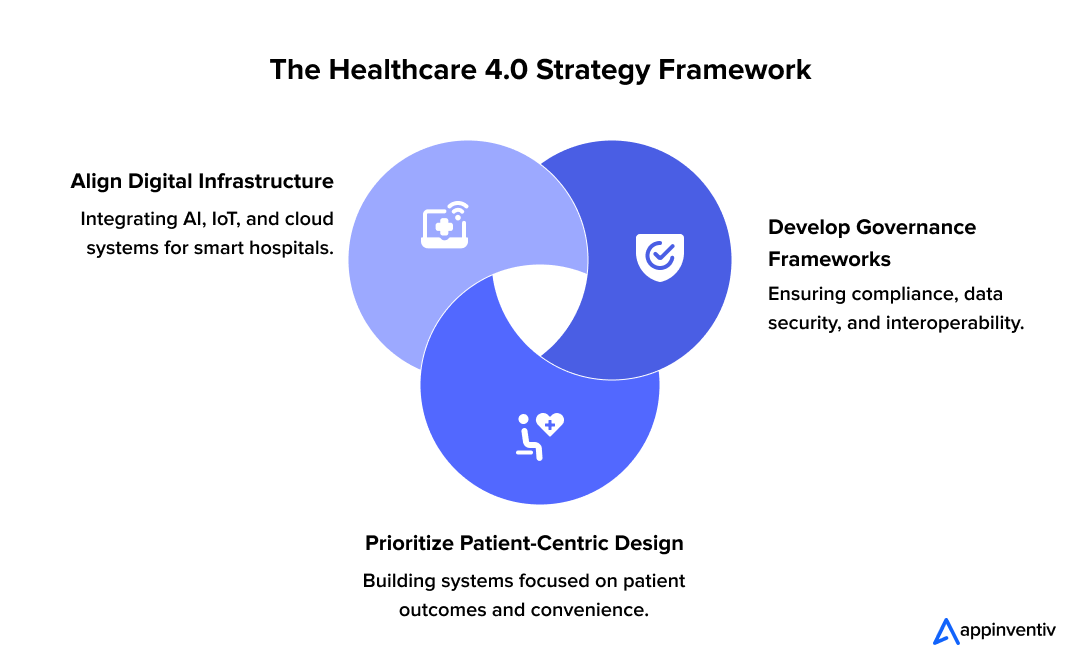
1. Align Digital Infrastructure with the Principles of Industry 4.0
The first thing that you should do is align your healthcare infrastructure with Industry 4.0 and healthcare principles. You need to integrate AI, IoT, and cloud systems for smart hospitals and connected ecosystems. This will enable free flow of data for better decision-making and smooth day-to-day operations.
2. Development of AI and Interoperability Frameworks
You will need to put in strong AI and interoperability frameworks to ensure that AI and digital technologies are correctly implemented throughout the system.
You need to establish standardized data exchange protocols using FHIR (Fast Healthcare Interoperability Resources) and HL7 standards to enable seamless communication across clinical systems and legacy infrastructure. This ensures consistent data flow, supports clinical decision-making, and prevents information silos.
Also Read: 10 Use Cases and Benefits of Conversational AI in the Healthcare Industry
3. Data Security and Governance Frameworks
You will need to implement a Zero Trust Architecture to ensure secure access across every user, device, and system layer.
This includes establishing clear policies for data security, continuous identity verification, and encrypted data exchange, while maintaining compliance with regulations such as HIPAA and GDPR. A mature governance strategy also incorporates SOC 2 Type II and HITRUST-aligned controls to reduce risk and build long-term trust in the healthcare ecosystem.
Consider adding a regional regulatory lens as well, since Healthcare 4.0 deployments increasingly require alignment with frameworks like India’s DPDP Act for health data privacy and MDR standards governing connected medical devices in regulated markets.
4. Prioritize Patient-Centric Design and Compliance
You should always put patients at the center. Doing this will result in stronger engagement, better outcomes, and overall satisfaction. You need to develop a system that will allow immediate dissemination of health information and personalized treatment.
It will also enable convenient healthcare through telemedicine and mobile health applications. Compliance will ensure that privacy, trust, and safety are protected from the very beginning.
Putting these pieces together creates one strong strategy. Healthcare organizations can build a strong foundation for the future with this strategy.
Healthcare 4.0 strategy tackles the pressing challenges of today while preparing healthcare organizations for what is next regarding growth and innovation.
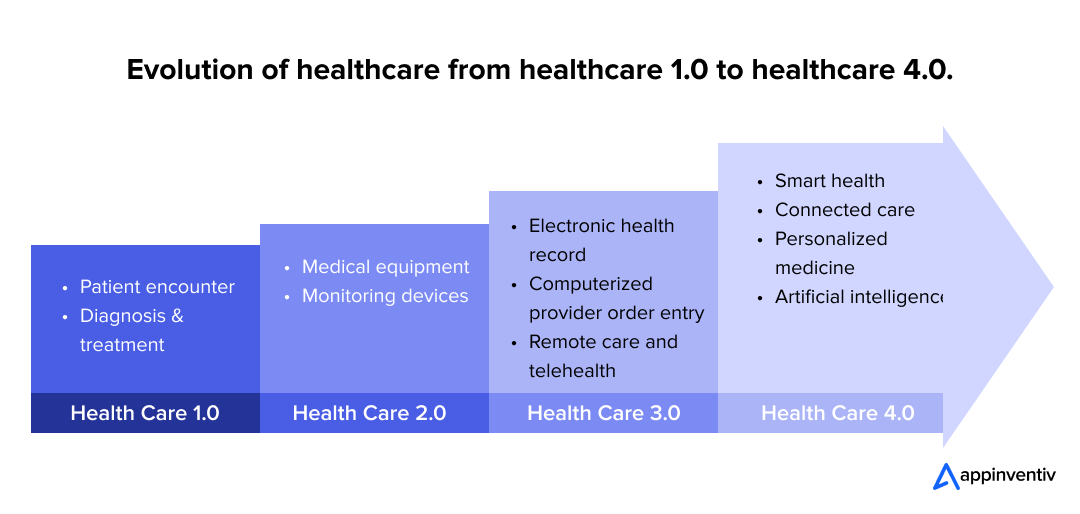
To place this shift in context, the evolution of healthcare models can be viewed clearly across four stages:
| Dimension | Healthcare 1.0 | Healthcare 2.0 | Healthcare 3.0 | Healthcare 4.0 |
|---|---|---|---|---|
| Care Model | Manual, physician-led | Digitized records | Connected systems | Autonomous, intelligent ecosystems |
| Data Usage | Paper-based | Electronic storage | Interoperable sharing | Real-time predictive intelligence |
| Patient Role | Passive recipient | Informed participant | Engaged user | Empowered decision-maker |
| Core Technology | Basic medical devices | EHR systems | IoT and telehealth | AI, IoT, Cloud, Edge |
| Decision-Making | Reactive | Data-supported | Near real-time | Predictive and automated |
Healthcare 4.0 vs Digital Health vs Smart Hospitals: What’s the Difference?
These terms are often used interchangeably, but they represent different layers of healthcare transformation. Digital health focuses on technology-enabled care delivery, smart hospitals emphasize connected infrastructure inside healthcare facilities, while Healthcare 4.0 reflects a broader shift toward autonomous, data-driven, and fully integrated healthcare ecosystems.
| Aspect | Healthcare 4.0 | Digital Health | Smart Hospitals |
|---|---|---|---|
| Scope | End-to-end ecosystem transformation | Technology-enabled care services | Digitally connected hospital infrastructure |
| Core Focus | AI-driven intelligence, automation, interoperability | Telehealth, apps, wearables, digital tools | IoT-enabled facilities and operations |
| Technology Depth | AI, IoT, cloud, edge, robotics integration | Mostly software-led solutions | Infrastructure and device connectivity |
| Objective | Predictive, autonomous healthcare systems | Improved access and engagement | Operational efficiency and patient experience |
What Are the Core Healthcare 4.0 Technologies and Features of Medical 4.0?
Medical 4.0 integrates advanced technologies to improve healthcare delivery, showcasing Industry 4.0 in healthcare in action.
Innovations like these will power predictive diagnostics, personalized care, and operational efficiency-what we consider work that underpins smarter, more connected healthcare systems.
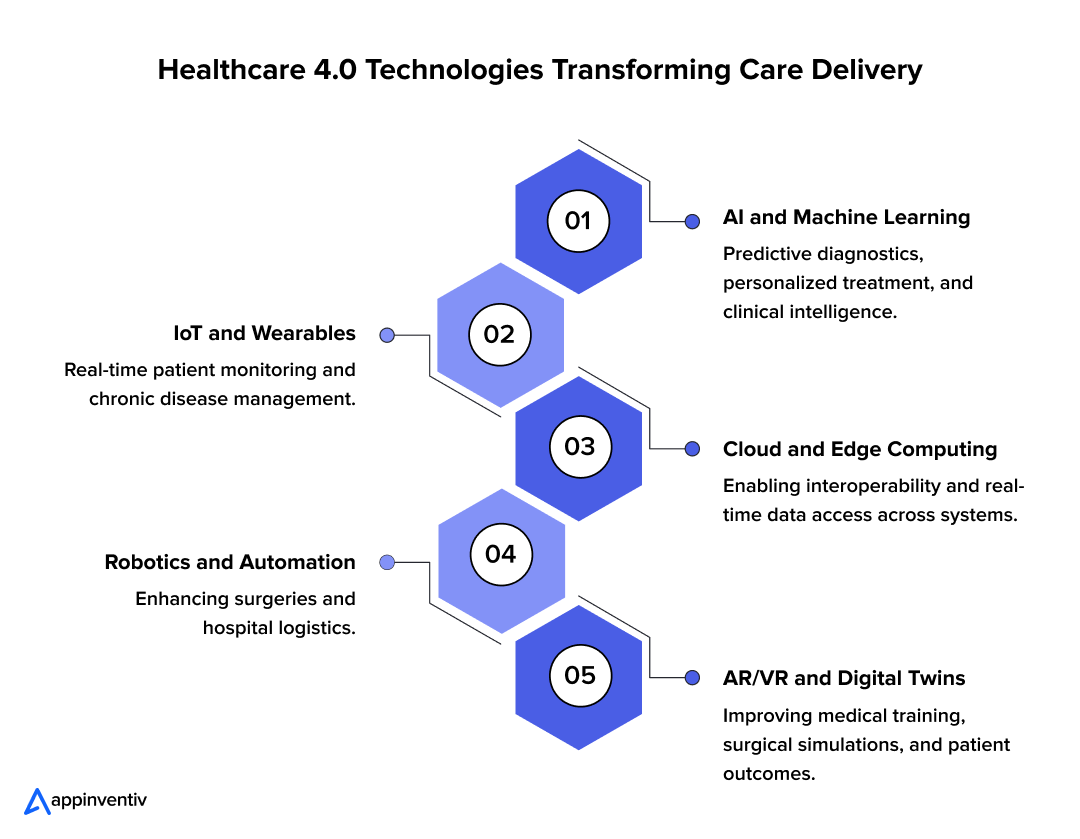
The following are core technologies for healthcare 4.0:
1. AI and Machine Learning
Predictive diagnosis, clinical intelligence, and risk stratification-all these are major Medical 4.0 technologies for healthcare concepts emanating from the very core of AI and machine learning in healthcare.
These technologies allow providers to make more informed decisions by parsing enormous volumes of data, identifying patterns, and predicting patient outcomes well before they occur.
For precision, you can utilize specialized models. High-accuracy image analysis (radiology, pathology) is handled by Convolutional Neural Networks (CNNs).
Crucially, Explainable AI (XAI) provides human-readable justifications for every prediction, solving the traditional ‘black box’ limitation of clinical AI models. More importantly, XAI acts as the bridge between advanced AI capability and real-world clinical adoption.
It enables physicians to understand, validate, and trust algorithmic recommendations, while providing legal defensibility, auditability, and accountability in AI-assisted decision-making. This is essential for regulatory acceptance and enterprise-scale deployment of AI in healthcare environments.
2. IoT and Wearables
IoT devices in healthcare and wearables, as key healthcare 4.0 technologies, further extend this paradigm in the field of real-time patient monitoring, tracking their vital signs, chronic conditions, and medication adherence.
Therefore, providers are able to monitor health from a distance and manage hospital resources in the process. This will translate into effective care delivery and reduced hospital readmissions.
Also Read: Wearables – The Emerging Future Trend for the mHealth Apps
3. Cloud and Edge Computing
Cloud computing in healthcare and edge computing, as essential Medical 4.0 technologies for healthcare, ensure a certain level of interoperability to allow secure, on-demand access to data.
Such technologies enable the healthcare system to store and share patient data across multiple departments and organizations in a way that is compliant with privacy standards.
Edge computing reduces latency, enabling real-time decision-making at the point of care.
The core technical value of Edge computing is achieving sub-50ms latency for time-sensitive use cases such as automated surgical alerts and real-time ICU monitoring.
The Edge processes raw IoMT (Internet of Medical Things) data locally, acting as a smart data gateway to aggregate and filter it before transmitting it to the central cloud.
It enables real-time data synchronization using lightweight communication protocols such as MQTT and WebSockets, ensuring continuous device connectivity and rapid data exchange.
This approach can reduce the volume of data transmitted to the cloud by up to 80%, resulting in significant bandwidth optimization and cost savings for the enterprise.
4. Robotics and Automation
Robotics process automation is one of the key Medical 4.0 technologies for healthcare. It helps automate various tasks such as surgery, hospital logistics, and supply-chain management.
Surgical robots help perform operations with precision, while automation systems manage inventory and equipment to improve efficiency and reduce human error in healthcare.
Also Read: How Agentic AI in Healthcare Is Bringing in Industry-level Transformation
5. AR/VR and Digital Twins
AR, VR, and digital twins in healthcare are Medical 4.0 technologies for healthcare, finding a new dimension of realism in medical training and surgical simulation.
These features of Medical 4.0 for healthcare create virtual models of patients or healthcare settings and allow medical professionals to perform risk reviews and treatment planning with accuracy and precision like never before.
How Is Industry 4.0 in Healthcare Transforming Modern Medicine?
Industry 4.0 and healthcare principles of automation, cyber-physical systems, and data analytics are driving innovation with the development of smarter, efficient systems to improve patient care and operational processes.
Here is the impact of industrial 4.0 in healthcare across three dimensions:
- Operational Efficiency: Smart tracking of assets, predictive maintenance, and digital supply chains all add to better resource management, reduced downtimes, and smoother logistics in the hospital.
- Clinical Excellence: Real-time visibility into personalized care, AI-assisted clinical decision-making equips caregivers with the right data to enhance diagnosis and treatment outcomes.
- Organizational Transformation: Collaboration between departments and scalability in cloud architectures make communications easier and improve data sharing, thereby helping healthcare systems grow.
What Are the Key Applications of Healthcare 4.0 Technology?
Many aspects have appeared with the inclusion of Industry 4.0 and healthcare technologies, from smart hospitals to personalized medicine.
It streamlines care delivery in a bid to deliver better patient care and operational efficiency. There are some of the most significant uses of Healthcare Industry 4.0:
1. Smart Hospitals
Smart hospitals leveraging Medical 4.0 technologies for healthcare will be capable of tracking patients, controlling equipment, and creating automated workflows with the help of IoT.
Such systems will make healthcare facilities more efficient and less susceptible to human error; thus, they will provide better care to the patients since they will monitor the patients in real-time and combine data.
2. Predictive Maintenance
Predictive maintenance for health organizations translates to one thing: the uptime of critical medical equipment. The hospitals that are fitted with AI and IoT sensors can keep track of such devices in case of any possible failure in advance to reduce the time in outage and minimize the expenses of any repairs.
3. Supply Chain Visibility
The artificial intelligence and sensor apps are rapidly becoming popular in the healthcare supply chain management. Real-time monitoring of drugs, units of blood, and other medical supplies will make sure that they are available where they are required, and hence reduce delays to improve continuity of care.
4. Personalized Medicine
AI, combined with genomic data, allows personalized medicine to become a reality whereby certain treatments are provided to the patient based on their specific genetic profile, resulting in increased efficacy of the treatment, reduced adverse effects, and better patient results.
5. Remote Diagnostics
The combination of Telehealth and AI stands for remote diagnostics and decentralized care; patients are able to meet with a doctor, get a diagnosis, and even receive a prescription for drugs in the comfort of their homes. This helps in enhancing access to health care and reducing congestion in health facilities.
Leverage healthcare custom software development to streamline operations, improve care, and integrate systems.
How Does AI-Driven Healthcare Intelligence Power Predictive and Personalized Care?
The use of AI in healthcare intelligence will revolutionize how clinical decisions are made. AI can provide much faster, more accurate decisions that support healthcare professionals in offering timely, appropriate interventions to patients, powered by ML and data analytics.
AI systems operate on extensive health data, observe patterns therein, and create insights that provide evidence for the individualized treatment plan and improve outcomes in patient care.
1. Early Detection
AI-driven healthcare intelligence algorithms comb through all the available patient data to find potential health issues early. This helps in earlier interventions, hence reducing complications and improving the chances of recovery.
2. Risk Prediction
AI can predict the occurrence of certain diseases that a patient is likely to have in the future, based on comparison with past data and extraction of risk factors. This opens doors for possible prevention and personalized health management.
3. Automation of Workflows
AI-based tools execute most of the repetitive administrative tasks, including appointment scheduling, management of patient records, and billing. This automation cuts down on human error possibilities and allows health professionals to attend to more critical areas in treating their patients.
4. Predictive Analytics and Outcome Modeling
AI-driven healthcare intelligence empowers healthcare professionals to model outcomes for certain patients based on historical data through predictive analytics.
Such outcome models assist in identifying how the patients will respond to their treatment, thus allowing for personalized, precision-based care.
Also Read: How Business Intelligence in Healthcare is Improving Patient Care
How Does Connected Care Enable Patient-Centric Healthcare Experiences?
Connected care is transforming health care delivery with efficient connections between hospital care and home care. IoT, wearables, and telemedicine converge to provide patients with ongoing, individualized care from virtually anywhere.
The following elements are driving the change in making healthcare more accessible, efficient, and patient-focused:
1. Remote Care Ecosystems
The connected care ecosystems extend care beyond the four walls of a hospital, where remote monitoring and care of patients are enabled for healthcare organizations.
By using wearables and sensor information, healthcare organizations can now monitor in real time a patient’s health condition from a distance, thus enabling continuous care with timely intervention.
2. Integration of IoT
IoT devices such as wearables and health sensors are allowing for continuous health monitoring – 24/7. These devices will be able to provide continuous collection of real-time information. It tracks vital signs, physical activity, and ongoing issues, keeping the healthcare team engaged and updated without being present in a clinical area.
3. Telemedicine and Virtual Care Models
Telemedicine and virtual care models increase access to care by moving healthcare service delivery from in-person visits to virtual consultations and follow-up care. In this way, telemedicine care can maintain continuity of care and keep the patient connected with their care team. This helps patients who live in rural areas and who are unable to travel. It also helps institutions looking to reduce patient flow.
4. Patient Empowerment
Connected care is all about empowering patients to take ownership of their health and wellness. The ability to receive real-time updates about their health, such as lab results and daily metrics via wearables, empowers them to make positive health decisions for themselves. Connected care works because it integrates ownership into the experience, which promotes positive health practices.
Appinventiv’s work on Health-e-People shows how integrating 200+ devices can create a unified, patient-centric data ecosystem driving better connected care.
What Are the Business and Clinical Benefits of Healthcare 4.0?
Healthcare 4.0 technologies present organizations, patients, and the healthcare ecosystem with huge benefits. Healthcare systems are taking advantage of advanced AI, IoT, and cloud-based technologies to be more efficient, enhance patient care, and decrease the cost of care delivery.
Let’s look at the specific benefits for each group:
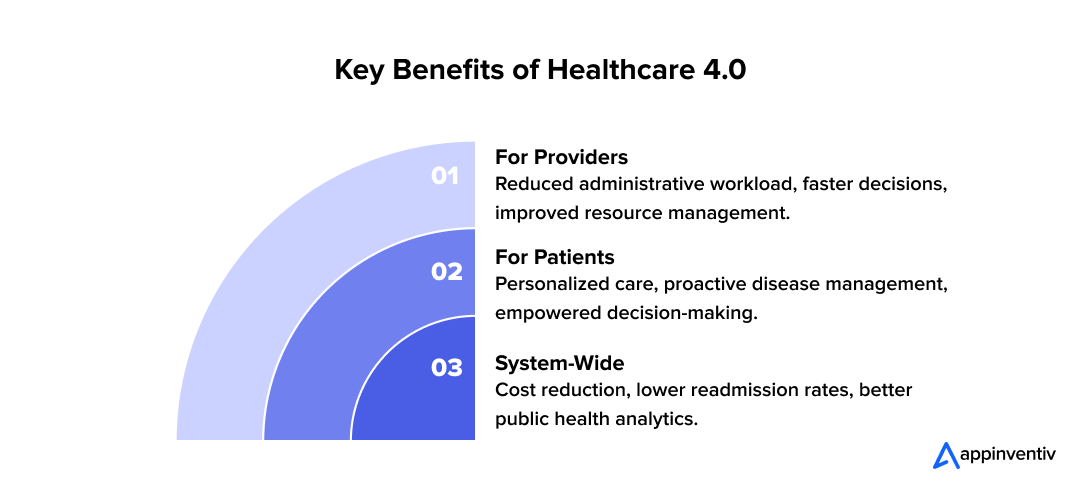
For Providers:
- Reduced time spent on administrative functions due to automation (billing, scheduling, etc.)
- Faster/More accurate decisions supported by insights from AI-automated processes
- Better communication across systems promotes interoperability, which can increase clinical and operational effectiveness.
- Real-time tracking of assets, equipment, and supplies promotes better resource management.
- Improved patient outcomes supported by predictive analytics and personalized care
For Patients:
- Care delivery is guided by their real-time data analytics derived from AI insights to support clinical judgement, which assists in the provision of the best possible care.
- Proactive monitoring for continuous health, leading to early interventions.
- More consistent management of chronic diseases through continued monitoring and individualized intervention programs.
- Increased engagement with tracking transparent access to health information, health data, and progress reports.
- Better health outcomes overall, with liberalized care through early detection of potential problems, leading to earlier intervention to mitigate outcomes.
System-Wide:
- Reduction in costs by decreasing the administrative burden, better resource management, and work efficiencies
- Decrease in hospital readmissions attributed to better care coordination, proactive monitoring, and predictive analytics
- Predictive analytics models leverage aggregated healthcare data to support evidence-based policy development, disease prevention, and more effective treatment planning.
What Are the Challenges in Implementing Healthcare 4.0 and How Can They Be Overcome?
The application of Industry 4.0 in healthcare technologies has enormous challenges, such as data security and interoperability. These challenges can be overcome to achieve the maximum potential of connected healthcare systems.
Here are a few challenges that can hinder the adoption of healthcare 4.0:
1. Data Security and Privacy
It is essential to make sure that HIPAA and GDPR are adhered to without violating the security of data. This can be solved by investing in safe cloud solutions and end-to-end encryption.
Periodic security audits and training of the staff on data protection will aid in maintaining conformity and safeguarding patient data.
For true enterprise-grade security, we move beyond perimeter defense to a Zero Trust Architecture (ZTA). This enforces strict micro-segmentation and continuous verification for every user and device access.
These technical safeguards include mandatory AES-256 encryption for data-at-rest and TLS 1.3 protocols for all data-in-transit, adhering not just to HIPAA, but to the more stringent standards of ISO 27001.
2. Interoperability
One significant problem is closing the gap between the old systems and new technologies. The integration can enhance the flow of data by adopting standardized APIs in healthcare and integration platforms.
There will be a gradual upgrade system with a data migration approach to ensure the old systems are incorporated without disturbing the operations.
Also Read: Achieving Interoperability in Healthcare IT – The Whys and Hows
3. Cultural Resistance
Resistance to new technologies by staff is not exceptional. To address this, digital literacy programs should be used to help staff adapt and understand how innovative technologies enhance care delivery and efficiency.
In parallel, a hybrid implementation model can be introduced, where AI acts as a clinical co-pilot rather than a replacement, easing adoption and reducing staff anxiety.
By making employees part of the process early on, adoption can be encouraged, and an innovation culture can be fostered.
4. Cost and Scalability
The first is initial expenditure and scaling issues, which are also major obstacles, particularly for smaller organizations. Costs and scalability can be controlled, and pilot programs can be used to test the implementation.
Hybrid cloud solutions are flexible and scalable, helping organisations expand without resource overload. Better patient outcomes and operational savings are long-term ROI.
Take the next step toward efficient, connected, and patient-centric care with Healthcare 4.0 solutions.

What Are the Key Industry 4.0 Trends in Healthcare and What’s Next?
The future of healthcare 4.0 technologies is shaped by emergent innovations that hold a promise to improve the care delivered in real-time, the outcomes, and the development of more efficient healthcare systems. These are the primary trends that influence the next stage of healthcare transformation.
1. 5G and Edge Intelligence
The real-time diagnostics and remote surgery will have less latency and can be performed through the use of 5G networks and edge computing. This is a technology that guarantees fast data transmission and hence instant communication between healthcare professionals and patients, regardless of the location.
2. Digital Twins
Digital twins are computerized models of a patient or a medical facility that are utilized to model the future. These models enable the providers to simulate treatments, anticipate outcomes, and better general care planning through real-time analysis of patient data and environmental factors.
3. Next-Gen Robotics
The next-gen robotics are autonomizing surgery and automating hospitals, simplifying complicated operations and enhancing accuracy. These technologies minimize human error, improve surgical outcomes, and increase the efficiency of operations in healthcare facilities.
4. AI Governance Automation
As AI looks to be a central component, automation of AI governance guarantees ethical decision-making and transparency of AI procedures. This tendency aims at establishing the frameworks, which will be used to control AI conduct, so that the healthcare AI systems will be responsible, just, and in line with regulations.
Also Read: Top Healthcare Trends That Will Redefine The Industry in 2025
How Does Appinventiv Deliver Enterprise-Grade Healthcare 4.0 Transformation?
With more than 10 years of experience in HealthTech, Appinventiv has delivered 500+ digital health platforms and 450+ healthcare clients. We have experience in all the major areas of healthcare, and this has equipped us with the knowledge and skills necessary to make successful transformations in Healthcare 4.0.
We focus on combining AI, IoT, robotics, and data platforms into one to create connected healthcare landscapes. Our team specializes in healthcare custom software development, helping organizations improve care delivery, streamline operations, and integrate smoothly with other systems.
We provide customized, conforming, and scalable Healthcare 4.0 that will make sure your healthcare organization is future-proofed. We aim to empower you with technologies that will enhance patient outcomes, lower operational costs, and automate workflows.
Contact Appinventiv to be the leader of your Healthcare 4.0 path. We can empower you to change the way your organization delivers care with the intelligence, security, and innovation that is desired.
Frequently Asked Questions
Q. What is Healthcare 4.0 & How Will It Change Your Practice?
A. The next stage of healthcare innovation, spanning healthcare 1.0 to 4.0, is powered by AI, IoT, and cloud computing. By making healthcare more efficient, accurate, and accessible, it will revolutionize the way patients are cared for, allowing predictive diagnostics, real-time control, and treatment plans.
Q. Healthcare 4.0 and Healthcare 5.0: What’s changing?
A. Connected systems, AI-enabled intelligence, and patient-centric care are being targeted by A. Healthcare 4.0, whereas Human-centric technologies, further improving collaborative care, emotional AI, and more advanced personalized health solutions, are likely to be incorporated in Healthcare 5.0. Healthcare 5.0 will be an expansion of the latter but with a greater focus on patient well-being on the holistic level.
Q. What Are the Best Smart Healthcare Technologies?
A. AI, IoT sensors, wearables, telemedicine systems, and robots are the most appropriate smart technologies in healthcare. The technologies can be used to monitor in real-time, conduct remote care, tailor specific treatments, and automate organizational processes, which positively influences patient results and operational efficiency.
Q. What does Healthcare 4.0 mean for hospital systems over the next decade?
A. In the decade to come, Healthcare 4.0 will become the engine of automation, enhance interoperability of systems, and allow real-time decision-making. The tendency will shift to smart hospital systems, predictive analytics, and personalized care, cost reduction, patient satisfaction, and improved clinical outcomes in hospitals.

- In just 2 mins you will get a response
- Your idea is 100% protected by our Non Disclosure Agreement.

EHR Implementation for Healthcare Providers: Process, Features, and Total Cost Analysis
Key takeaways: A clear EHR implementation guide keeps teams on track and prevents delays. The full EHR implementation process includes planning, setup, moving data, training staff, and regular updates. The right features handle clinical work, billing, reports, and compliance for large healthcare organizations. EHR implementation costs vary based on design, integrations, data migration, training hours,…
Medical Device Software Integration: A Strategic Buyer’s Guide for Healthcare Enterprises
Key takeaways: Medical device software integration is a governance decision first. Define data ownership, clinical workflows, and regulatory scope before writing a single API. Build on recognized standards from the outset. FHIR, DICOM, and IEEE 11073 reduce ambiguity and simplify long-term scaling. Expect validation and security to drive real cost. Documentation, testing, and firmware controls…

How to Build a Custom Pediatric EMR and EHR System?
Key takeaways: Clinical Precision: Custom systems accommodate pediatric-specific data points like percentile curves and weight-based longitudinal dosing. Interoperability: Seamless data exchange via HL7 FHIR ensures your practice stays connected to pharmacies, labs, and state registries. Regulatory Resilience: Built-in compliance with HIPAA, HITECH, and MACRA/MIPS reduces legal friction. Enhanced Engagement: Parent portals reduce administrative overhead by…