























13 Ways Generative AI is Transforming the Hospitality Industry

- 13 High-Value Applications of Generative AI in the Hospitality Industry
- Why Generative AI in Hospitality is Moving from Pilots to Production
- How to Implement Generative AI in Your Hospitality Business
- Challenges in Building Gen AI Powered Hospitality Platforms & How to Overcome Them
- How Much Does It Cost to Integrate Generative AI Solutions in Hospitality?
- Measuring the Impact of Generative AI on Hospitality
- The Future of Generative AI in Hospitality
- Why Appinventiv is the Right Partner for Generative AI Implementation in Hospitality
- FAQs

Key takeaways:
- The most mature applications of Generative AI for hospitality are in guest service, revenue management, marketing, and operations automation.
- Real value comes from integrating generative AI into hospitality operations and existing PMS, CRS, CRM, and POS systems, rather than using stand-alone tools.
- Successful programs treat Generative AI in hospitality as a product, incorporating data governance, change management, and iterative rollout.
- Choosing the right partner for Generative AI hotel solutions can significantly improve ROI and reduce delivery risk.
In the hospitality industry today, operators are grappling with mounting challenges: soaring operational costs, unpredictable demand spikes, rising guest expectations for personalization, and lean staffing. At the same time, legacy systems for reservations, guest services, pricing, and maintenance are struggling to keep pace, leaving hotels and resorts vulnerable to inefficiencies, lost revenue, and dissatisfied guests.
This is where generative AI in hospitality emerges as a practical solution. This technology is not just a nice-to-have innovation; it is fast becoming a strategic differentiator that helps hospitality businesses overcome exactly those pressures.
According to a recent industry survey, hotels using AI-powered tools have seen as much as a 10% increase in RevPAR (revenue per available room). Meanwhile, more than 40% of travellers now say they book hotels based on AI-generated recommendations.
By harnessing Gen‑AI, hotel leaders can deliver smarter pricing, seamless check‑ins, hyper‑personalized guest experiences, and efficient back‑office operations; all while freeing up staff to focus on what matters most: genuine hospitality.
Interested in exploring more about Gen AI capabilities in the hospitality industry? Well, in this blog, we will explain 13 powerful ways generative AI is reshaping the hospitality landscape, unlocking value both in guest satisfaction and operational excellence.
We will also uncover the real world examples of companies leveraging the advantages of Gen AI in their hospitality business, as well as help you overcome the challenges you may feasibly face during your own journey of Gen AI implementation in the hospitality sector.
Hotels using AI report up to 10% RevPAR growth. Discover how you can benefit your business with such revenue gains.

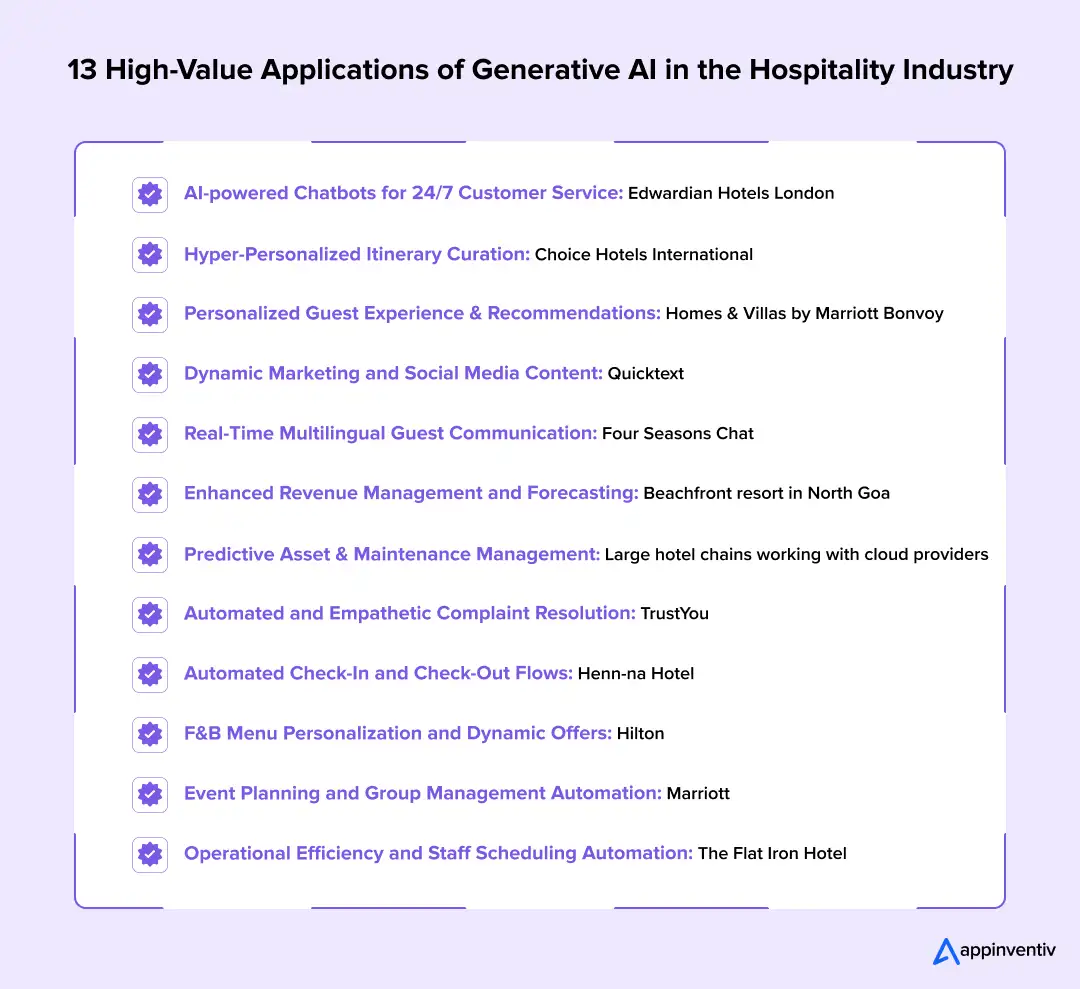
13 High-Value Applications of Generative AI in the Hospitality Industry
The applications of generative AI in the hospitality industry have evolved from proof-of-concept pilots to profit-driving operational realities that are reshaping guest expectations and operational benchmarks. Below, we focus on the 13 high value generative AI use cases in hospitality. Each use case combines text, voice, or image generation with your existing data to support a specific business process.
1. AI-powered Chatbots for 24/7 Customer Service
Modern hotel chatbots are no longer FAQ trees with canned replies. They run on large language models (LLMs) fine-tuned on your policies, property data, and guest history. These agents handle pre-stay questions, booking changes, room requests, and upsell offers across web, app, WhatsApp, and messaging platforms.
Business benefit
This is one of the most mature applications of Generative AI for hotels. You reduce call-center load, cut response times, and keep service consistent across properties. For many brands, this becomes the first visible proof of Generative AI transforming hospitality because service metrics move quickly: higher CSAT, fewer abandoned sessions, and better conversion on direct channels.
Real-world example
Edwardian Hotels London uses a chatbot, Edward, to support guests with confirmations, in-house requests, and local recommendations through messaging, reportedly handling more than 70% of guest queries and significantly reducing front-desk workload. This is exactly the kind of generative AI solution for hospitality operations that can be replicated with custom training on your own knowledge base.
Must Read: AI Agents in Customer Service: The Future of Seamless Customer Interactions
2. Hyper-Personalized Itinerary Curation
Generative models excel at constructing structured trips: day-by-day plans, activity sequences, local dining, and transfer details. When connected to your inventory, loyalty data, and external content, they can assemble itineraries that match guest profiles rather than generic templates.
Business benefit
Done well, this becomes one of the most powerful use cases of Generative AI in hospitality for driving ancillary revenue. You turn every stay into a curated micro-vacation that increases spend per guest through tours, dining, spa, and late check-out. It also strengthens loyalty because the experience feels designed rather than transactional.
Real-world example
Choice Hotels International has integrated generative AI into their mobile app to provide personalized travel recommendations and itineraries for their guests.
Also Read: Hyper Personalization in Business: A Guide for Companies
3. Personalized Guest Experience and Recommendations
Beyond itineraries, Generative artificial intelligence in the hospitality industry can design complete end-to-end experiences. It can recommend room types, pillow preferences, F&B offers, spa packages, and even suggest check-in times based on historic behavior, demographic signals, and trip purpose.
Business benefit
The benefits of Generative AI for hospitality here are twofold: higher revenue per available room (RevPAR) and better guest satisfaction. You are essentially running a recommendation engine that speaks in natural language and can justify its suggestions.
Real-world example
Homes & Villas by Marriott Bonvoy has introduced an AI-powered search that lets guests look for stays based on mood or purpose, not just check-in dates and city names. Instead of typing “Lisbon, 3 nights,” a user can search for ideas like “quiet coastal place to write” and get suggestions that feel closer to what they actually want from the trip.
Also Read: How To Build an AI Trip Planner App
4. Dynamic Marketing and Social Media Content
Every brand marketer in hospitality is under pressure to produce more copy, visuals, and offers for more channels. Here, Generative AI platforms for hospitality help you generate and test variations of emails, landing pages, loyalty campaigns, and social posts at a scale that a human team simply cannot reach.
Business benefit
You can move from a handful of monthly campaigns to thousands of micro-variants targeted by segment, season, or property. This is one of the clearest Generative AI use cases for hospitality services, where creative quality and speed improve in parallel. Testing subject lines, CTAs, and images becomes a daily habit, not a quarterly project.
Real-world example
Hotel marketing teams using tools such as Quicktext are already letting Gen AI draft email variants, landing-page copy, and offer descriptions based on guest segments and past conversations. On the F&B side, partners connected to delivery platforms like Uber Eats benefit from AI-written menu descriptions and summarised reviews, which makes their dishes easier to discover without the team writing everything manually.
Related Read: 16 Use Cases and Real Examples of AI in Social Media
5. Real-Time Multilingual Guest Communication
Guests chat, email, and call in dozens of languages. Generative models can translate, localize tone, and answer contextually, all within a single agent. In practice, this means your contact center and on-property teams can communicate effectively with global travelers without expanding headcount in every region.
Business benefit
Multilingual support becomes a built-in feature of Generative AI for hotels, instead of a separate translation workflow. You shorten response times for international guests and make sure nothing is lost in translation on high-stakes issues like cancellations, refunds, or special requests.
Real-world example
Four Seasons Chat has become a good reference point here. Guests can message the brand over WhatsApp, WeChat, or other channels in their preferred language and still receive quick, consistent support. Under the hood, hospitality-focused AI platforms now combine large language models with translation, so the hotel team can respond in one language while guests see something entirely different on their screen.
6. Enhanced Revenue Management and Forecasting
Yield management has always been data-heavy. Generative models add a new layer by interpreting complex signals in plain language and generating scenario plans, not just numbers. Generative AI for revenue managers can surface demand drivers, suggest price moves, and explain trade-offs in natural language.
Business benefit
You sharpen pricing decisions and promotion design. Instead of dashboards that only analysts understand, revenue leaders get conversational tools that answer questions like “What if we increase BAR by 8 percent next weekend on ocean-view rooms?” or “Which OTA promotions cannibalize direct bookings?”
Real-world example
A beachfront resort in North Goa deployed AI tools integrated with mycloud PMS, achieving an 18% uplift in ADR and a 30% reduction in last-minute revenue leakage from cancellations.
7. Predictive Asset and Maintenance Management
From HVAC systems to elevators and kitchen equipment, every hotel has assets that fail at inconvenient times. AI models can monitor IoT data, logs, and maintenance history to predict failures before they happen, then use generative components to schedule work orders and generate technician instructions.
Business benefit
You extend asset life, reduce guest-impacting breakdowns, and plan maintenance windows more intelligently. This is one of the more operational Generative AI use cases for hospitality services, but it has a direct line to cost savings and brand reputation.
Real-world example
Large hotel chains working with cloud providers are testing AI models that watch over HVAC units, chillers, laundry machines, and pool systems. When the data starts to look unusual, the system raises a flag before the failure hits guests.
8. Automated and Empathetic Complaint Resolution
Not every complaint needs a supervisor. With the right training, generative models can triage issues, propose compensation levels within policy, and draft empathetic responses tailored to guest history and sentiment.
Business benefit
You protect brand NPS while controlling refund and compensation leakage. Agents shift from writing every email to approving suggested resolutions. Over time, you build a feedback loop where the model learns which responses close cases fastest at acceptable cost.
Real-world example
Reputation platforms such as TrustYou now offer AI that drafts personalised responses to guest reviews. The tool reads the comment, pulls in the right tone and policy, and prepares a reply in the guest’s language. Staff still review and tweak the message, but they no longer start from a blank screen for every review, which saves hours each week while keeping the brand voice intact.
9. Automated Check-In and Check-Out Flows
Self-service check-in kiosks and mobile keys are not new, but generative models can orchestrate the entire conversation: ID verification assistance, upsell prompts, room change negotiations, and late check-out logic, all handled in natural language across app, web, or kiosk.
Business benefit
You reduce queues, free up front-desk staff for high-value interactions, and standardize policy enforcement. For many chains, this is the first place where integrating generative AI into hospitality operations delivers measurable reduction in check-in friction.
Real-world example
Japan’s Henn-na Hotel is often cited for its use of robots and automation at check-in, but the pattern is broader than one quirky concept. Hotel tech providers have begun rolling out Gen AI–driven kiosks and mobile flows that guide guests through ID checks, room selection, upgrades, and key delivery in natural language, with staff stepping in only when the conversation hits a policy or edge case.
10. F&B Menu Personalization and Dynamic Offers
Restaurants and bars inside hotels are ideal playgrounds for personalized recommendations. Generative models can interpret dietary preferences, past orders, seasonality, and event schedules to shape menus and special offers in real time.
Business benefit
This use case blends the benefits of Generative AI for hospitality with direct revenue. You reduce waste by aligning production with predicted demand and increase F&B spend per guest by suggesting the right items at the right moment, in the right channel.
Real-world example
Hilton has collaborated with Winnow to track what guests actually eat and what ends up as waste, then adjust recipes and menus accordingly. Combined with generative models, the same data can be used to push smarter, more relevant dish and pairing suggestions to guests during the stay.
11. Event Planning and Group Management Automation
MICE business involves long email threads, endless proposal iterations, and manual coordination across sales, banqueting, AV, and room blocks. Generative AI can draft proposals, summarize requirements, generate event schedules, and track changes across stakeholders.
Business benefit
For large groups and conferences, this reduces the time your teams spend on low-value paperwork. It also increases win rates by responding faster with more tailored proposals that reflect the client’s constraints and objectives.
Real-world example
Marriott is testing AI-powered tools such as PCMA’s Spark to help planners automatically build agendas, recommend sessions, and optimize event schedules based on attendee profiles and past performance data. Hotel-focused platforms also use AI to auto-assign meeting rooms, predict space utilization, and adjust layouts for different event types.
12. Operational Efficiency and Staff Scheduling Automation
Housekeeping, front desk, concierge, and F&B staffing are complex optimization problems, especially for multi-property groups. Generative models can sit on top of forecasting engines and translate demand predictions into shift plans, training tasks, and internal communications.
Business benefit
By integrating generative AI into hospitality operations for scheduling, you minimize understaffing and overstaffing while giving employees more predictable shifts and workload. This often feeds directly into lower overtime and turnover.
Real-world example
Independent properties such as The Finch in Washington and The Flat Iron Hotel in New York use HelloShift’s AI-powered operations platform to coordinate teams. Its AI housekeeping scheduler automatically assigns room cleanings based on historical patterns and live occupancy so supervisors spend less time building rotas and more time on quality checks. Hotels using this stack report smoother shift handovers and fewer missed tasks across housekeeping and front-of-house teams.
13. Automated Sustainability & ESG Reporting
Sustainability and ESG (Environmental, Social, and Governance) reporting is becoming a crucial aspect of the hospitality industry. Traditional methods are time-consuming and prone to errors. Generative AI can automate this process by collecting data on energy use, waste, water consumption, carbon emissions, and more, while aligning it with global ESG standards.
Business Benefit
By automating ESG reporting, hotels can ensure accuracy and compliance with less manual effort. This approach saves time, provides real-time updates, and boosts transparency—helping businesses stay on top of regulations and improve their sustainability image.
Real-world Example
Marriott International uses AI to automate sustainability tracking, including energy and water usage. This system pulls data from thousands of properties and generates real-time ESG reports, reducing manual work and ensuring compliance.
Snapshot: Core Generative AI use cases for hospitality services
| Use case | Primary KPI impact | Typical owners / users |
|---|---|---|
| AI-powered chatbots for 24/7 customer service | CSAT, response time, call/email deflection | Contact center, front desk, digital teams |
| Hyper-personalized itinerary curation | Ancillary revenue, direct bookings, loyalty | Product, CX, partnerships, concierge |
| Personalized guest experience & recommendations | TRevPAR, upsell rate, repeat stays | CX, loyalty, digital product, marketing |
| Dynamic marketing & social media content | Campaign ROI, open/click rates, acquisition | Brand, CRM, performance marketing |
| Real-time multilingual guest communication | CSAT, first-response time, global conversion | Contact center, front office, guest relations |
| Enhanced revenue management & forecasting | RevPAR, ADR, forecast accuracy, promo ROI | Revenue managers, commercial leadership |
| Predictive asset maintenance | Downtime, maintenance cost, guest complaints | Engineering, operations, asset management |
| Automated & empathetic complaint resolution | NPS, review scores, recovery cost, churn risk | Guest relations, customer care, quality teams |
| Automated check-ins and check-outs | Queue time, staff load, app adoption, CSAT | Front office, operations, digital product |
| F&B menu personalization | F&B revenue, avg. check value, food waste | F&B, restaurant management, revenue teams |
| Event planning & management automation | RFP win rate, sales cycle time, event NPS | MICE sales, events, banqueting, revenue |
| Operational efficiency & staff scheduling automation | Labor cost, overtime, productivity, turnover | Operations, HR, housekeeping, F&B leadership |
| Automated Sustainability & ESG Reporting | Compliance, reporting accuracy, transparency | Sustainability teams, operations, legal/compliance teams |
This is not an exhaustive list, but it covers the Generative AI use cases for hospitality services that we see most often in enterprise roadmaps today.
Sit with our hospitality and AI teams to identify quick-win pilots across guest experience, revenue, and operations.
Why Generative AI in Hospitality is Moving from Pilots to Production
We often hear a similar story in C-suite workshops: the first wave of generative AI pilots looked impressive in demos but failed to reach production. Models were powerful, but connectors, data quality, and governance were not ready.
However, this scenario is gradually vanishing and that is changing due to three core reasons:
- Maturing platforms
Cloud providers and custom Generative AI platforms for hospitality have closed many infrastructure gaps, from vector databases to observability and safety tooling. - Better patterns for integrating generative AI into hospitality operations
Teams now understand that AI agents must sit inside existing workflows rather than on separate experimental apps. - Clearer economics
As more hotels deploy at scale, benchmarks for the ROI of Generative AI in hospitality services are easier to reference, which helps finance and boards support larger rollouts.
In other words, we are moving from scattered experiments to intentional roadmaps where Generative AI in hospitality becomes part of your core digital architecture.
How to Implement Generative AI in Your Hospitality Business
The implementation of Generative AI in the hospitality industry follows a common blueprint. You are essentially building an AI layer that sits across three domains: guest experience, operations, and commercial optimization. A practical implementation roadmap often includes:
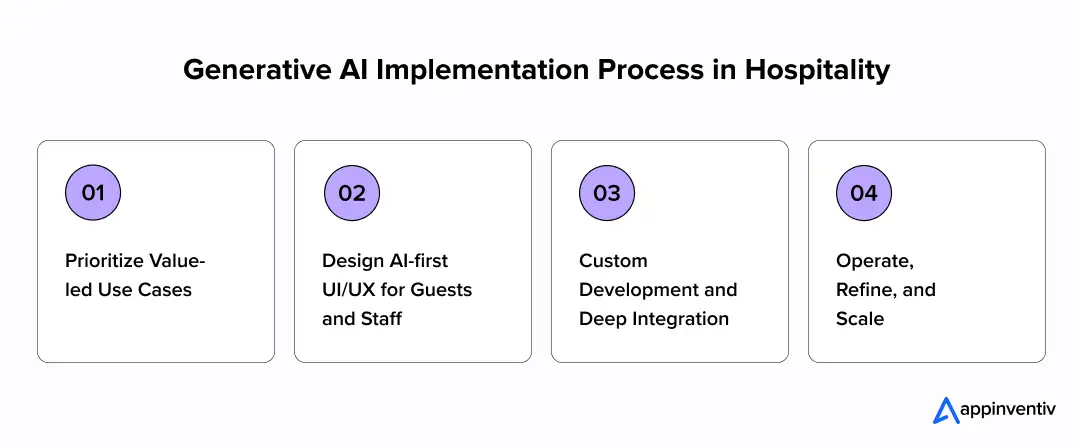
1. Prioritize Value-led Use Cases
The first step is to decide where AI should move the needle. Outline a small set of Generative AI use cases in hospitality that link directly to P&L and guest metrics: AI concierge, multilingual support, revenue co-pilots, itinerary and offer engines, or staff knowledge assistants.
Each one should have a clear owner, KPI, and integration point inside your existing digital journey. This keeps Generative AI for hotels focused on measurable outcomes rather than scattered experiments.
2. Design AI-first UI/UX for Guests and Staff
Once you know what to build, you need to decide how it should feel. Generative AI changes interfaces: guests expect natural conversation, quick clarification, and transparent options. Staff expect tools that remove clicks and screens, not add more.
Here, UX teams design flows where AI quietly handles intent detection, routing, and content generation while the interface stays simple and predictable. Good UI/UX is what turns powerful applications of Generative AI in the hospitality industry into experiences people trust and reuse.
3. Custom Development and Deep Integration
With flows defined, the heavy lifting begins. Development teams design and build tailored Gen AI solutions that connect securely to your systems, implement retrieval-augmented generation (RAG), and enforce your policies and brand tone.
This is where mature Generative AI development services matter: instead of bending your processes to fit a generic product, the software is built around your pricing rules, service playbooks, and regional constraints. Done well, this creates a reusable foundation for integrating generative AI into hospitality operations across multiple operational areas and properties.
4. Operate, Refine, and Scale
After development and integration, the focus shifts to reliability and scaling AI. Teams track usage, quality, and the real impact of Generative AI on hospitality across conversion, CSAT, handle time, and labor hours saved.
Models, prompts, and workflows are tuned with live data, then the same capabilities are rolled out to new properties and markets. Over time, your organization ends up with an advanced Gen AI platform that makes it faster and safer to add new capabilities.
At this stage, many operators choose to work with a generative AI consulting company that supports complex upgrades, feature enhancements, bug fixes and continuous maintenance.
Also Read: How to Build an AI App? Steps, Features, Costs, Trends
Challenges in Building Gen AI Powered Hospitality Platforms & How to Overcome Them
Even with a clear roadmap, integration of generative AI into the hospitality sector is not without obstacles. Common challenges and their mitigation strategies include:
1. Fragmented and Low-quality Operational Data
Challenge
Core systems like PMS, CRS, and POS often hold incomplete, duplicated, or inconsistent records. Room descriptions don’t match across channels, guest profiles are split across systems, and historical notes live in free-text fields. For any genuine Generative AI in hospitality industry use case, this makes grounding answers and recommendations unreliable.
Solution
Introduce a data layer dedicated to AI use cases: normalize key entities (guest, booking, property, rate, service), clean the most important attributes, and expose them through stable APIs. Start with a narrow, high-value slice such as one brand or region. Expand as you see impact and data quality improves, rather than trying to “fix everything” upfront.
2. Hallucinations and Brand Integrity
Challenge
If a model invents refund policies, misstates loyalty rules, or suggests benefits that do not exist, the damage goes beyond a bad reply. It hits brand trust and can create real financial exposure. This is one of the most sensitive points when deploying Generative AI hotel solutions in guest-facing channels.
Solution
Treat the model as a language engine, not a source of truth. Use retrieval-augmented generation so every answer is grounded in your approved policies, rate plans, and property content. Wrap responses in validation rules (for example, only offer discounts from an approved list) and route edge cases to human agents. For high-risk flows, keep a human-in-the-loop until performance is proven.
3. Staff Confidence and Adoption
Challenge
Front-desk, reservations, and contact-center teams may see Generative AI transforming hospitality as a threat rather than support. If they do not trust the tools, they will avoid or bypass them, and the investment stalls.
Solution
Position AI as a co-pilot that removes repetitive tasks, not a replacement. Involve staff in early design and pilots: let them review suggested replies, refine prompts, and flag gaps in knowledge. Share simple metrics showing how tools cut handle time or reduce after-call work. When people see that generative AI use cases in hospitality make their day easier, adoption follows.
4. Security, Privacy, and Regulatory Expectations
Challenge
Guest data spans multiple jurisdictions, loyalty agreements, and brand standards. Any integration of generative AI into the hospitality sector that mishandles personal data or stores prompts improperly can create compliance and reputational risk.
Solution
Design the Gen AI platform with a security first approach. Keep sensitive workloads in VPC-hosted or region-compliant environments, apply strict role-based access control, and separate identifiable guest data from model telemetry wherever possible. Log prompts, responses, and actions for audit, and align AI use with your existing privacy, PCI, and internal security policies before scaling beyond pilots.
The advantages of generative AI in hospitality will favor operators who confront these issues early rather than treating them as afterthoughts.
Also Read: The Most Profitable AI Business Ideas for 2026: Complete Guide
How Much Does It Cost to Integrate Generative AI Solutions in Hospitality?
Budgets are usually the first practical question we hear after executives see use cases of Generative AI in Hospitality that resonate with their strategy.
While exact figures vary by scope, but a structured view of cost components helps you frame internal discussions:
| Cost Component | Typical Scope | Estimated Cost (USD) |
|---|---|---|
| Discovery & design | Use case selection, UX flows, technical architecture | $10,000 – $60,000 |
| Data engineering & integrations | PMS/CRS/CRM/POS connectors, data pipelines, identity mapping | $20,000 – $150,000 |
| Model engineering & orchestration | LLM selection, RAG, prompts, evaluation tooling | $20,000 – $180,000 |
| Front-end & product development | Web/app interfaces, dashboards, staff tools | $30,000 – $120,000 |
| Security, compliance & observability | Access control, logging, monitoring, audits | $20,000 – $70,000 |
| Ongoing operations (annual) | Hosting, model usage, support, enhancements | 20% – 30% of build cost |
For a single high-value generative AI solution for hospitality operations such as a multi-property chatbot or revenue co-pilot, total initial investment often falls somewhere between $100,000 and $500,000 or more, depending on complexity and integration depth.
Also Read: How Much Does It Cost to Build an AI Agent?
Measuring the Impact of Generative AI on Hospitality
Before you implement anything or any use case, you must first define how you will measure the impact of Generative AI on hospitality across your business. In practice, that means tying each initiative to 3 kinds of KPIs:
- Revenue: RevPAR, TRevPAR, conversion rate, upsell take rate.
- Cost: labor hours saved, reduced call volume, lower maintenance spend.
- Experience: CSAT, NPS, review scores, complaint rate.
Typically, the ROI of Generative AI in hospitality services can look very different depending on the use case. A chatbot might focus on call deflection and CSAT. A revenue co-pilot will be judged on incremental RevPAR. A predictive maintenance system will be tracked on downtime and repair cost. Without this framing, it becomes difficult to justify further integration of generative AI into the hospitality sector when budgets tighten.
The Future of Generative AI in Hospitality
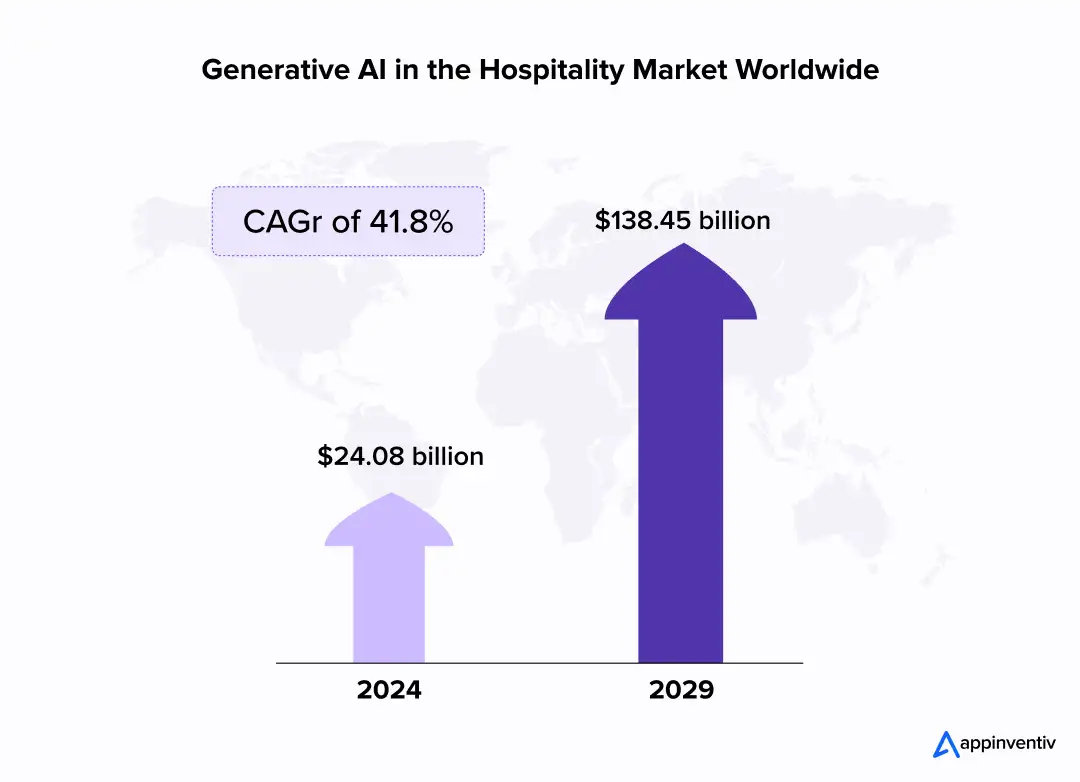
The Business Research Company estimates the Generative AI in hospitality market will grow from $24.08 billion in 2024 to $138.45 billion in 2029, a compound annual growth rate of 41.8%. Numbers like that signal a long-term structural shift, not a passing tech experiment.
In practical terms, the near future of Generative Artificial Intelligence in the hospitality Industry looks fairly grounded. More tasks guests never see will be handled quietly in the background: rewording replies, drafting proposals, preparing rate recommendations, building schedules. Front of house, guests will expect natural conversations, quick fixes, and relevant suggestions in every channel, not just on your website.
Over time, the future of generative AI in hospitality will likely be defined by orchestration rather than single use cases. The hotels that benefit most will be the ones that get three basics right: reliable data, thoughtful UX around AI-driven journeys, and a platform mindset that lets them introduce new AI capabilities without rebuilding everything each time.
Why Appinventiv is the Right Partner for Generative AI Implementation in Hospitality
When you implement Generative AI into hospitality, you are not just building a model. You are asking a partner to work inside your booking flows, PMS, CRS, loyalty stack, F&B systems, and on-property operations without breaking what already works. That combination of product engineering and domain fluency is where our AI teams are strongest.
And our AI excellence is not just theoretical, it is backed by some impressive numbers, awards and case studies. For instance:
On the AI side, we have launched 80+ Gen AI applications, with 200+ data scientists and AI engineers working across enterprise programs. To date, we have trained and deployed 75+ custom Gen AI models for clients in 35+ industries, many of them in highly regulated or operationally intensive environments.
This execution track is reflected in our external recognition as well: Appinventiv has been featured in the Deloitte Fast 50 India rankings for two consecutive years and known as the Leader in AI Product Engineering & Digital Transformation 2025” by The Economic Times.
On the hospitality side, we already understand how hotel businesses operate at a system level. A good example is our Empire project, where we built a blockchain-powered hotel booking ecosystem that removed profit-focused intermediaries, minimized double booking, and improved data reliability across guest, hotel, and payment workflows.
Our Empire project in the hospitality sector
While this solution predates Gen AI revolution, it shows how we work through complex booking logic, pricing rules, and multi-party settlement before adding a new technology layer.
Today, we bring these two threads together. As a generative AI consulting company and development partner, we help hospitality brands:
- Set the roadmap by prioritizing the generative AI use cases in hospitality that matter for your P&L and guest metrics.
- Design and build guest-facing and staff-facing products that embed Generative AI for hotels into appealing architectures and custom solutions.
- Maintain, upgrade, and scale by putting in place the tools and processes to keep Gen AI capabilities reliable, continuously improved, and rolled out across regions and brands, while your internal teams gradually take over day-to-day ownership and extension.
So, if your organization is serious about implementing Generative AI in hospitality and wants to move from pilots to production, we can help you design, build, and run that shift end to end.
FAQs
Q. How can Appinventiv implement generative AI to enhance hospitality operations?
A. We typically start by mapping your operational pain points to specific generative AI use cases in hospitality that have clear KPIs. From there, we design and build solutions such as chatbots, revenue co-pilots, predictive maintenance tools, and scheduling systems that integrate with your PMS, CRS, CRM, and POS.
Throughout, we focus on security, data governance, and the practical impact of Generative AI on Hospitality metrics that matter to your leadership team.
Q. How is generative AI used in the hospitality industry?
A. Today, generative AI in hospitality industry workloads includes 24/7 guest messaging, itinerary and experience design, marketing content creation, dynamic pricing support, staff scheduling, and maintenance documentation. When you look across these Generative AI use cases for hospitality services, a common pattern emerges: models generate language, images, or decisions that sit inside existing guest and staff workflows instead of replacing them.
Q. What are the top use cases of generative AI in hotels and resorts?
A. For most hotel groups, the highest-value generative AI use cases in hospitality include AI-powered chatbots, multilingual guest support, experience curation, F&B personalization, revenue management co-pilots, predictive maintenance, and housekeeping scheduling. Together, these use cases of Generative AI in hospitality deliver a mix of higher revenue, lower operating costs, and improved guest satisfaction.
Q. How is AI transforming guest experience in the hospitality industry?
A. Generative AI transforming hospitality is most visible in how guests interact with your brand. They can chat with intelligent agents before, during, and after the stay, receive highly personalized offers and itineraries, and experience smoother check-in, complaint handling, and on-property recommendations.
Over time, the future of generative AI in hospitality will likely involve more autonomous agents orchestrating energy, services, and personalization across rooms and public spaces.

- In just 2 mins you will get a response
- Your idea is 100% protected by our Non Disclosure Agreement.
How Much Does It Cost to Build a Conversational AI Chatbot in the UAE?
Key Takeaways AI chatbot development in the UAE typically costs AED 150,000–1,470,000 ($40K–$400K), based on complexity. Backend integration and compliance drive cost more than the chatbot interface itself. Arabic NLP, UAE hosting, and PDPL requirements increase budget and engineering effort. LLM + RAG enterprise chatbots sit at the higher end due to integration and infrastructure…
AI Inventory Management in Australia: Benefits, Use Cases, and Implementation Strategies
Key takeaways: Traditional ERP planning reacts to history; AI predicts demand shifts, reallocates stock dynamically, and prevents costly stockouts across distributed Australian networks. AI in inventory management in Australia typically reduces inventory levels 20–40% while maintaining service targets, unlocking significant working capital across multi-state operations. Enterprise implementations usually range from AUD 70,000 to AUD 700,000+,…
How to Hire RAG Architects for Enterprise AI
Key takeaways: Define your RAG architecture scope to avoid misaligned hiring decisions Identify end-to-end architectural ownership across retrieval, governance, and scaling Evaluate deep technical capabilities beyond prompt engineering and tools Validate governance and compliance readiness at the retrieval layer Test system-level thinking through real-world failure scenarios Choose the right hiring model based on scale, risk,…