






























Building a Future Ready Real Estate Platform in Qatar for Vision 2030


- Why Qatar Vision 2030 is Changing How Real Estate Platforms Are Built
- Benefits of Custom Real Estate Platforms
- How to Build a Real Estate Platform in Qatar
- Core Architecture of a Real Estate Platform
- Features of a Real Estate Management Platform in Qatar
- Data and Integration Requirements for Real Estate Platforms
- Security, Compliance, and Data Sovereignty in Qatar
- Cost to Build a Real Estate Platform in Qatar
- Key Challenges in Developing PropTech Platforms in Qatar
- Choosing the Right Development Partner in Qatar
- How Appinventiv Can Help Build a Future-Ready Real Estate Platform in Qatar

Key Takeaways
- Future-ready real estate platforms in Qatar are treated like infrastructure, not apps. They’re built to last, with strong data, clear governance, and room to adapt as policies and projects evolve.
- Off-the-shelf tools work only until complexity shows up. Once approvals, compliance, and multiple stakeholders are involved, custom platforms usually hold up far better.
- Clean data and solid integrations matter more than feature lists. Platforms succeed when the underlying architecture is trusted, not when they simply look advanced.
- Security and data sovereignty aren’t things you add later. If they’re not built in from the start, fixing them down the line is expensive and disruptive.
- The right development partner prioritises foundations over speed. That early discipline is what allows platforms to grow steadily without needing repeated rebuilds.
Real estate in Qatar is moving beyond listings and broker-led systems. As urban development scales and regulatory oversight tightens, fragmented tools are giving way to unified platforms that can handle data, governance, and long-term planning in one place. This shift is less about convenience and more about building digital infrastructure that can support smart growth.
For many organisations, the challenge is how to build a real estate platform in Qatar that stays relevant over time. A future ready real estate platform in Qatar is not defined by features alone, but by its ability to adapt to policy changes, integrate with national systems, and scale across asset types without constant rework. That reality is pushing teams toward proptech platforms in Qatar built on modular architecture, with governance designed in from the very beginning.
This guide looks at what it takes to build a real estate platform in Qatar from a practical development perspective. It walks through platform design, core features, timelines, costs, and the key execution challenges that shape real-world delivery.
Get early clarity on architecture, data strategy, and governance before development decisions lock you in.
Why Qatar Vision 2030 is Changing How Real Estate Platforms Are Built
Real estate platforms in Qatar are no longer being built just to manage properties or close transactions. They are being shaped by long-term national priorities. Qatar National Vision 2030 places strong emphasis on sustainable growth, smarter cities, and better use of data across infrastructure-heavy sectors, including real estate. That context matters when digital systems are expected to last for decades, not product cycles.
This is why real estate digital transformation in Qatar feels different from typical PropTech upgrades. Teams planning to build a proptech platform in Qatar are under pressure to think beyond features and short-term delivery. Platforms are now expected to support planning decisions, regulatory oversight, and future expansion, without needing constant rework as policies evolve.
The scale of commitment behind this shift is substantial. A widely referenced fact is that Qatar’s National Vision 2030 includes an ambitious transformation program backed by a roughly $200 billion investment budget to build a self-sustaining, diversified economy spanning infrastructure, technology, energy, and urban development. This figure is cited by official and investment-focused sources.
For anyone looking to build a smart real estate platform in Qatar, Vision 2030 effectively becomes a design reality. It sets expectations around durability, integration, and accountability that modern real estate platforms are now expected to meet from day one.
This is why development decisions made early in a real estate platform project have long-term consequences for cost, compliance, and scalability.
Also Read: How Custom Enterprise Apps Are Powering Dubai’s 2040 Vision for Smart, Sustainable Growth
Benefits of Custom Real Estate Platforms
Most teams don’t start out planning to build a custom real estate platform.
They begin with ready-made tools because they feel faster and safer. For a while, that approach works. But as projects grow, approvals multiply, and multiple teams start using the system in different ways, the cracks begin to show. That’s usually the moment people realise the real estate software isn’t helping anymore. It’s slowing things down. This is where custom real estate platform solutions in Qatar begin to feel less like a luxury and more like a necessity.
A custom platform gives you ownership, plain and simple. With an enterprise real estate platform in Qatar, you’re not stuck with fixed workflows or rigid data models. If approval rules change, you change the system. If a new authority needs access, you don’t rebuild everything around them. The platform bends with the business, instead of the other way around.
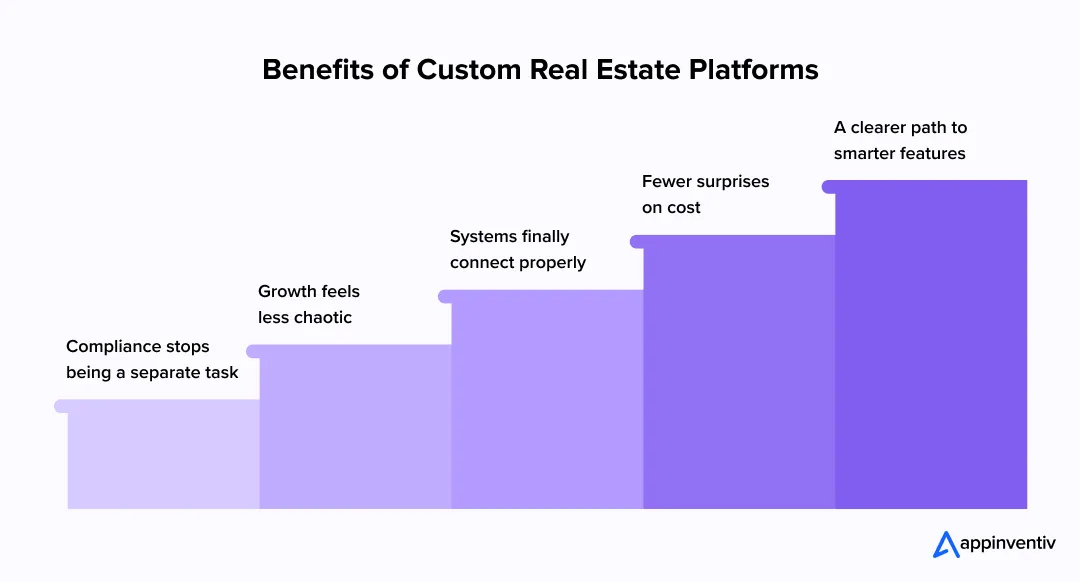
What teams notice most once a custom platform is in place:
- Compliance stops being a separate task: Approvals, records, and audit trails live inside the flow of work. That makes compliance with real estate software in Qatar something people naturally follow, not something chased at the end of the month.
- Growth feels less chaotic: New projects, new assets, even new cities can be added without breaking what already works. That kind of real estate platform scalability in Qatar matters when developments run for years, not quarters.
- Systems finally connect properly: Planning tools, utility data, finance systems, identity checks, they stop living in silos because the platform was designed to bring them together.
- Fewer surprises on cost: Yes, the upfront real estate platform development cost in Qatar is higher. But over time, teams avoid the endless license changes, add-ons, and rebuilds that come with boxed tools.
- A clearer path to smarter features: Once the data is solid, adding analytics or moving toward AI-powered real estate platform development feels like a steady step forward, not a risky leap.
In the end, the benefits of custom real estate platforms in Qatar come down to one thing: control. Control over data, workflows, and the platform’s growth over time. For organisations dealing with long timelines and high accountability, that control is often what keeps the system usable years after launch, not just on day one.
Also Read: Cost to develop a real estate app like Dubai Rest
How to Build a Real Estate Platform in Qatar
Building a real estate platform here is less about speed and more about sequencing the right decisions. Teams that rush into development usually end up rewriting large parts of the system later. The ones that succeed take time to lock fundamentals before code is written.
Below is how experienced teams approach how to build a real estate platform in Qatar, step by step.
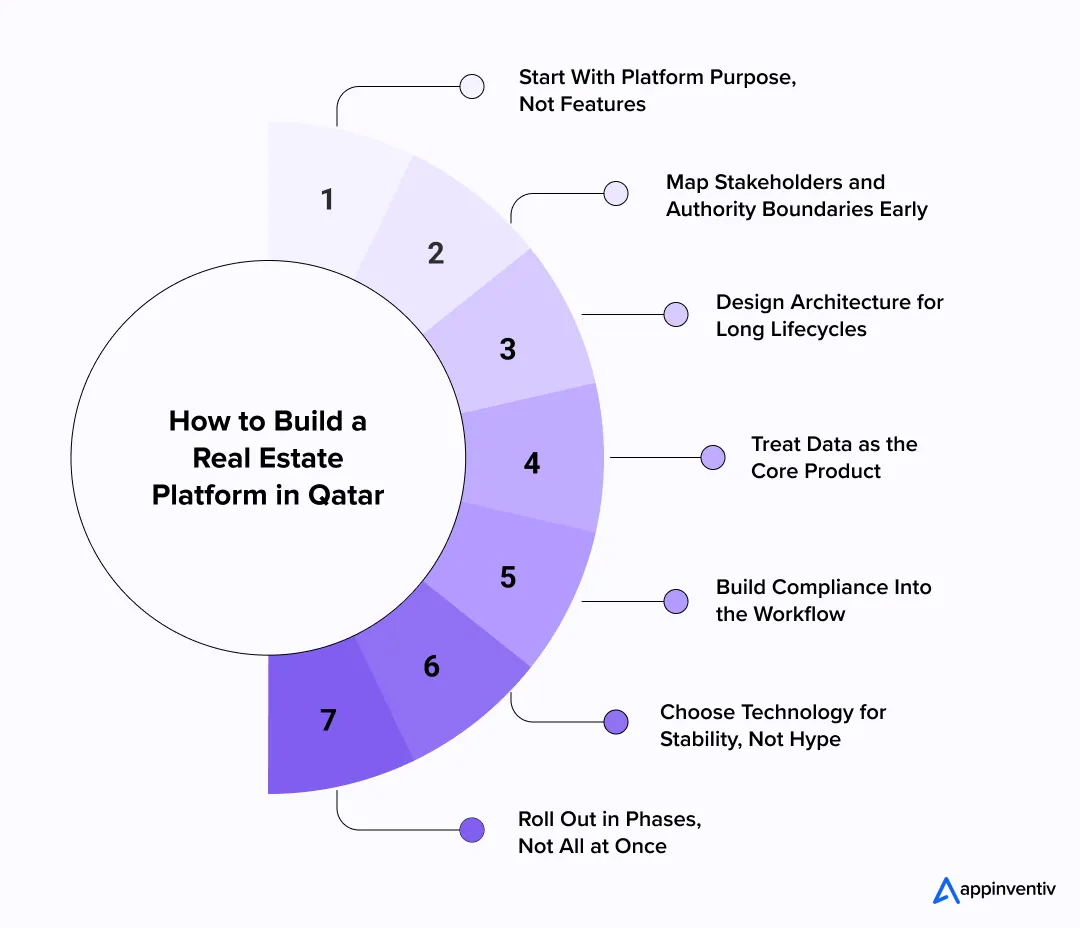
1. Start With Platform Purpose, Not Features
Before architecture or tech stacks come into play, teams need clarity on why the platform exists.
Is it meant to be:
- A system of record for assets and ownership
- An operational tool for approvals and compliance
- An investor-facing interface for visibility and reporting
- Or all three, phased over time
This distinction matters because it shapes data models, access control, and scalability. Many failed attempts to build a real estate platform in Qatar start by copying feature lists rather than defining the platform’s responsibilities.
2. Map Stakeholders and Authority Boundaries Early
Real estate platforms in this market rarely serve a single user type. They sit between authorities, developers, operators, and sometimes citizens.
At this stage, teams should clearly define:
- Who can create and update data
- Who approves, reviews, or audits it
- Who only consumes information
This step is critical for real estate system development in Qatar, because access rules and approval flows become deeply embedded into the architecture. Fixing this later is expensive.
3. Design Architecture for Long Lifecycles
Most platforms are expected to last for years, sometimes decades. That rules out tightly coupled or feature-heavy monoliths.
Strong platforms are usually built with:
- Modular services around assets, ownership, leasing, and compliance
- API-first design to support future integrations
- Clear separation between data, logic, and user interfaces
This approach supports real estate platform scalability Qatar needs as projects expand across asset types and cities.
4. Treat Data as the Core Product
In real estate platforms, features come and go but data stays. Teams should invest early in:
- Canonical data models for assets, plots, units, and ownership
- Versioning and history tracking for approvals and changes
- Validation rules to prevent inconsistent or duplicate records
This foundation is what later enables analytics, reporting, and even AI-powered real estate platform development without rebuilding the platform.
5. Build Compliance Into the Workflow
Compliance should not sit outside the system. It should live inside it.
That means:
- Approval steps are built into normal operations
- Automated audit logs instead of manual reporting
- Clear traceability for who changed what and when
Done right, compliance real estate software Qatar becomes part of daily work, not an additional burden.
6. Choose Technology for Stability, Not Hype
The technology stack should support long-term maintainability.
In practice, this usually means:
- Proven backend frameworks with strong security support
- Scalable cloud infrastructure with local data controls
- Frontend systems that can evolve independently
The goal is not novelty, but reliability for real estate technology development Qatar demands at an enterprise scale.
7. Roll Out in Phases, Not All at Once
Large platforms fail when everything launches together.
A safer approach:
- Start with a limited asset class or development zone
- Validate data quality and workflows
- Expand gradually to more users, assets, and integrations
This phased rollout also helps teams manage the timeline for building a real estate platform in Qatar that meets Qatar’s expectations without disrupting ongoing operations.
Building a real estate platform here is a long game. Teams that succeed focus less on features and more on foundations, governance, and adaptability. When those are right, the platform can grow steadily without needing to be rebuilt every few years.
Validate scope, timelines, and technical direction with a team that understands real-world delivery, not just theory.

Core Architecture of a Real Estate Platform
Architecture discussions usually start with tools and frameworks. In practice, those are the easy parts. What really matters is whether the platform can survive change. Real estate platforms live a long time. Regulations shift, projects expand, and new stakeholders come in years after launch. The architecture has to absorb all of that quietly, without turning into a constant rebuild. That’s the standard teams are working toward when they build platforms meant to last.
Here’s how teams with real delivery experience tend to think about it.
1. Keep the Structure Simple and Clearly Separated
Reliable platforms don’t bundle everything together. They draw clear lines so one change doesn’t ripple through the entire system.
Most teams separate things into:
- A data layer that holds asset records, ownership details, zoning, leases, and full history. This layer values accuracy and traceability above everything else.
- A logic layer where rules live. Approvals, validations, and compliance checks belong here, not scattered across screens.
- A user layer that people actually see. Different roles get different views, without touching the core data.
This kind of separation makes growth manageable instead of risky.
2. Build Around Real Domains, Not Feature Lists
Feature-driven builds often feel fine at first and painful later. What holds up better is organising the system around how real estate actually works. That usually means clear boundaries for things like:
- Assets and units
- Ownership and titles
- Leasing and transactions
- Compliance and approvals
- Reporting and analysis
When each area stands on its own, teams can change one part without destabilising everything else.
3. Assume the Platform Will Need to Connect to Other Systems
Real estate platforms rarely stand alone. They sit between planning teams, infrastructure data, finance systems, and reporting tools.
Designing with integrations in mind makes it easier to:
- Pull in planning and zoning information
- Connect to utilities or infrastructure data
- Share records with finance or oversight systems
Waiting to “add integrations later” usually leads to painful rework.
4. Make Data Control Part of the Design
Most platform issues don’t come from bad code. They come from unclear data ownership.
Strong platforms bake in:
- Clear access rules tied to responsibility
- Full history of changes and approvals
- Visibility into who changed what and when
Without this, trust erodes quickly, no matter how polished the interface looks.
5. Use Cloud Infrastructure Carefully
Cloud infrastructure makes scaling easier, but only if it’s set up thoughtfully.
Teams usually focus on:
- Capacity that grows with data and users
- Separate environments for testing and live use
- Controls that support audits and reviews
The goal is flexibility without losing control.
6. Plan for Change, Not Permanence
No platform stays the same forever. Vendors change, tool evolves and policies shift.
To stay adaptable, teams try to:
- Rely on open standards
- Avoid tight dependence on proprietary services
- Keep deployments portable
That flexibility often becomes invaluable a few years down the line.
In the end, good architecture doesn’t draw attention to itself. It stays out of the way. When teams invest early in clear structure, clean data boundaries, and adaptability, the platform keeps working quietly as everything around it changes.
Also Read: Cost of Real Estate App Development Like Property Finder?
Features of a Real Estate Management Platform in Qatar
A real estate management platform proves its value when people stop questioning the data and start relying on it. The goal isn’t to pack in features. It’s to create a system that teams trust during approvals, audits, and day-to-day operations.When organisations plan the features of a real estate management platform in Qatar, the focus naturally shifts toward stability and control.
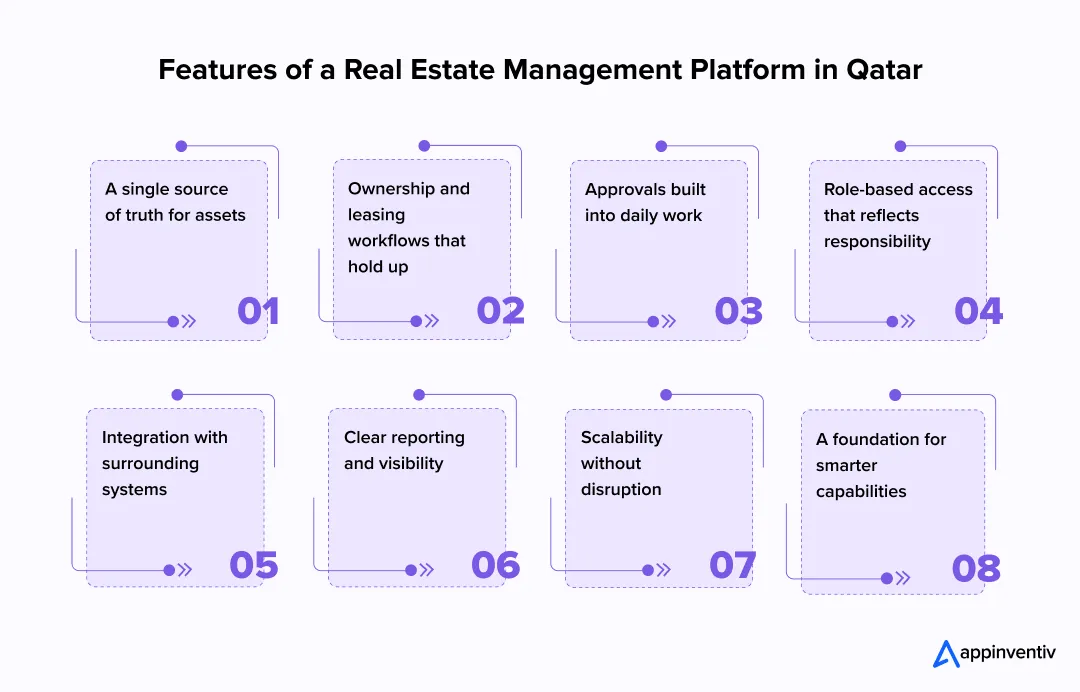
The features that consistently matter are straightforward:
- A single source of truth for assets: One clean register for plots, buildings, and units, with full change history. This becomes the backbone of any serious real estate system development.
- Ownership and leasing workflows that hold up: Clear records for ownership, leases, and amendments, so transactions remain traceable long after they’re completed.
- Approvals built into daily work: Configurable approval flows with audit logs, helping teams meet compliance real estate software expectations without relying on emails or manual follow-ups.
- Role-based access that reflects responsibility: Granular permissions so the right people can edit, review, or view data, a must for any enterprise real estate platform operating across teams.
- Integration with surrounding systems: Planning, utilities, finance, and identity platforms connect more smoothly when the system is designed for real operational use rather than isolation.
- Clear reporting and visibility: Dashboards that show asset status, approvals, and portfolio health without forcing leaders to dig through raw data.
- Scalability without disruption: As portfolios grow, the platform should grow with them, supporting the scalability demands of real estate platforms over long timelines.
- A foundation for smarter capabilities: With clean data in place, analytics and even AI-powered real estate platform development can be introduced gradually, when the organisation is ready.
In real terms, the best platforms are quiet performers. They reduce friction, support accountability, and stay dependable as complexity increases, which is exactly what teams expect when investing in long-term real estate technology.
Also Read: A Guide on Real Estate Transaction Management Software
Data and Integration Requirements for Real Estate Platforms
Most real estate platforms don’t struggle because of poor design or missing features. They struggle because the data underneath them never quite lines up. Information lives in too many places, gets updated inconsistently, or doesn’t connect cleanly with other systems. Once those problems settle in, they’re hard to fix. That’s why data and integration decisions end up being the most important part of any serious attempt to build a real estate platform that people actually trust.
In real-world use, real estate data isn’t static. Assets change hands, approvals evolve, and decisions made today are often questioned years later. A platform has to be built with that reality in mind, or confidence in the system fades quickly.
What tends to make the difference is fairly grounded.
- Clear, shared definitions from the start: Assets, plots, units, ownership, leases, approvals. Everyone needs to mean the same thing when they use these terms. Without consistent data models, reports stop matching and teams begin to rely on their own side records. Solid data modelling is the foundation of dependable real estate systems.
- A full record of how things changed, not just where they are now: Real estate decisions don’t disappear once they’re made. Platforms need to show what changed, who approved it, and when. Overwriting old data might look tidy, but it weakens accountability over time.
- Validation before data spreads: Bad data travels fast. Simple checks at the point of entry, required fields, format rules, and dependencies help prevent errors that otherwise surface much later, usually in reports or audits.
- Direct links to planning and zoning systems: Asset data loses value if it drifts away from regulatory reality. Connecting with planning approvals and zoning information helps keep records aligned with what’s actually permitted on the ground.
- Connections to utilities and infrastructure data: Knowing whether services are available, constrained, or planned adds real context to assets. It supports better decisions than looking at property data in isolation.
- Ties to financial and identity systems: Ownership changes, transactions, and approvals often depend on verified identities and financial records. Integrating these systems reduces duplication and avoids manual reconciliation.
- APIs that don’t paint the platform into a corner: Well-designed APIs allow new systems to connect later without pulling the platform apart. This flexibility is what supports long-term growth without constant rework.
This layer rarely gets much attention because users don’t see it. But in practice, it decides whether the platform becomes a reliable source of truth or just another system teams quietly work around. When data and integrations are handled properly, everything else becomes easier to trust, easier to scale, and far easier to live with over the long run.
This is why organisations planning enterprise-grade real estate platforms place as much weight on data and integration capability as they do on visible features when selecting a development partner.
Security, Compliance, and Data Sovereignty in Qatar
Security rarely gets applause when everything is working. But the moment something feels off, trust disappears fast. In real estate platforms, that trust is critical. These systems deal with ownership records, identities, financial transactions, and approvals that often carry long-term implications. If users doubt how the platform handles this information, they stop relying on it.
When organisations set out to build a real estate platform in Qatar, security and data sovereignty decisions tend to stick for years. Hosting locations, access rules, and audit mechanisms are not easy to change later. That’s why teams with experience treat security as part of the foundation, not a final checklist item.
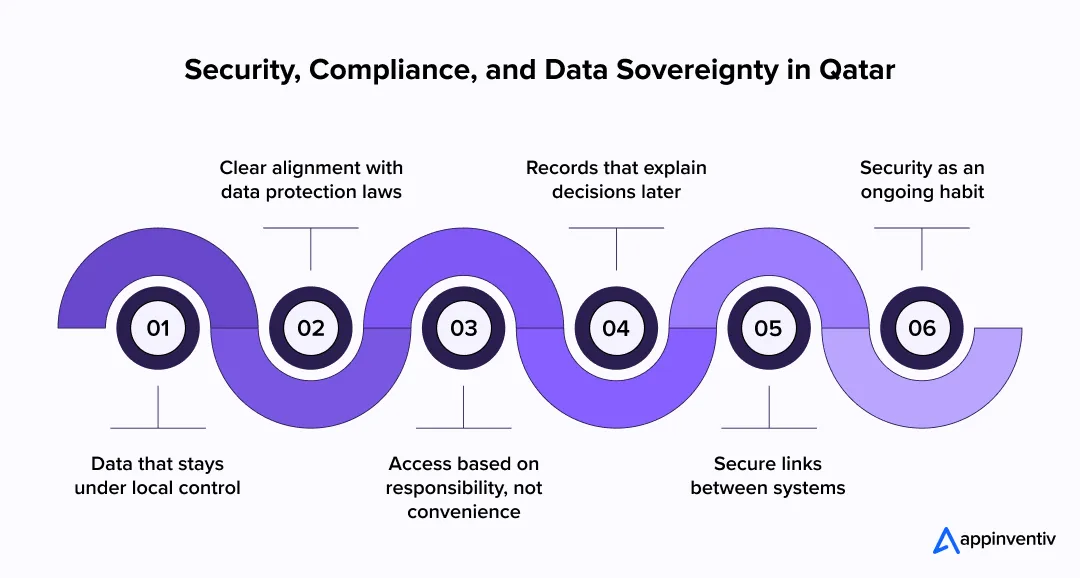
What this looks like in day-to-day delivery is fairly practical:
- Data that stays under local control: Sensitive records such as ownership and transactions are expected to remain within national boundaries. Hosting strategies usually follow guidance from the Ministry of Communications and Information Technology (MCIT), especially for enterprise platforms.
- Clear alignment with data protection laws: Platforms handling personal or commercial data must follow Law No. 13 of 2016 on Personal Data Privacy Protection (PDPL). In simple terms, this governs who can access data, how long it’s kept, and how it can move between systems. In Qatar, these expectations are especially important for platforms supporting large-scale developments and public-sector oversight.
- Access based on responsibility, not convenience: In real environments, not everyone needs the same level of access. Role-based permissions and clear separation of duties help avoid mistakes before they happen.
- Records that explain decisions later: Real estate decisions are often revisited long after they’re made. Built-in audit trails quietly capture who approved what and when, without relying on manual records. This is a core expectation for any credible compliance real estate software setup.
- Secure links between systems: Planning tools, utilities, and financial systems exchange data with the platform every day. Secure APIs, encryption, and monitoring help ensure these connections don’t turn into weak points.
- Security as an ongoing habit: Regular access reviews, monitoring, and incident planning matter just as much as initial controls. Security isn’t something you finish. It’s something you maintain.
Teams that rush through this layer usually feel the impact later through delays, redesigns, or loss of confidence from stakeholders. When security and compliance are handled properly, they fade into the background. The platform feels solid, reviews go smoothly, and teams can focus on getting work done instead of defending the system. This is why organisations planning long-term real estate platforms in Qatar often assess a partner’s security and compliance experience as carefully as their technical capabilities.
Cost to Build a Real Estate Platform in Qatar
The cost of building a real estate platform is rarely about a single feature or screen. It reflects how long the platform is expected to last, how many people will rely on it, and how deeply it needs to integrate with surrounding systems. Below is a clearer way to look at the cost to build a real estate platform in Qatar, broken down by platform maturity.
Estimated Cost Breakdown
| Platform Level | Typical Scope | Estimated Cost (AED) |
|---|---|---|
| Entry-Level Platform | Core asset records, basic user roles, limited workflows, minimal integrations | AED 147,000 – 294,000 ($40,000 – 80,000) |
| Mid-Range Platform | Approval workflows, structured data governance, reporting dashboards, and early integrations | AED 294,000 – 735,000 ($80,000 – 200,000) |
| Enterprise-Grade Platform | Multi-stakeholder access, complex data models, strong security, scalability, and analytics readiness | AED 735,000 – 1,470,000 ($200,000 – 400,000) |
Where a project lands within these ranges depends less on visual complexity and more on governance depth, integration requirements, and long-term scalability expectations. Platforms designed to support multiple authorities, long approval chains, and future analytics naturally sit at the higher end of the range.
What Drives the Cost in Practice
The cost of building a real estate platform is shaped less by design choices and more by the amount of responsibility the system is expected to carry over time.
- Platform scope and responsibility: A platform built only for internal tracking costs far less than one designed to act as a system of record across multiple teams, authorities, or partners.
- Data complexity and longevity: Clean data models, validation rules, and full change history take time to design, but they are essential when the platform needs to stand the test of time.
- Depth of system integrations: Each integration with planning, utilities, finance, or identity systems adds development effort, testing cycles, and long-term maintenance.
- Security and compliance requirements: Role-based access, audit trails, and data protection controls increase upfront cost, but they reduce the risk of expensive fixes and loss of trust later.
- Scalability planning: Platforms built to grow across projects or users require stronger architecture from the start, which impacts cost early.
- Quality of execution and testing: Thorough testing and performance checks add effort upfront but prevent costly post-launch issues and rework.
- Future readiness: Preparing the platform for analytics or AI in real estate later requires a cleaner architecture and stronger data foundations, even if those capabilities are not used immediately.
Key Challenges in Developing PropTech Platforms in Qatar
Most PropTech platforms don’t fail overnight. They fade. At first, people still log in. Then they double-check data elsewhere. Soon, approvals move back to email and spreadsheets. Eventually, the platform exists only because replacing it feels harder than tolerating it. This almost never happens because the idea was wrong. It happens because real estate, in practice, is more complex than the system was built to handle.
These are the challenges teams keep running into, and what actually helps when they face them head-on.
- Too many people pulling the platform in different directions: Planning teams want control. Project teams want speed. Leadership wants visibility. Everyone has a different idea of what “success” looks like. When all of that gets built at once, the platform becomes heavy and confusing.
What helps: Decide early what the platform must do first and who it is primarily serving. Lock down roles and access. Add complexity later, when the foundation is stable. - Messy data from the very start: Most real estate data comes from years of spreadsheets, emails, and legacy tools. If that data is rushed into a new system, trust disappears quickly.
What helps: Take the time to clean and structure data properly, even if it slows the launch. Clear validation rules and full history tracking build confidence faster than any new feature. - Rules that refuse to stand still: Approval flows and compliance requirements change. Platforms that hard-code these rules often break the moment something shifts.
What helps: Build workflows that can be adjusted without rewriting the system. Flexibility matters more than trying to predict every scenario upfront. - Integrations that look easy on paper: Connecting planning, utilities, finance, or identity systems almost always takes longer than expected. Each system behaves differently, and assumptions fall apart quickly.
What helps: Integrate in stages and test thoroughly. Avoid making the entire platform depend on a single external system. - Growth exposing weak foundations: A platform that works well for one project can struggle badly once usage increases or data volumes grow.
What helps: Design for growth early. Modular architecture makes scaling feel like a natural extension, not an emergency fix. - Security treated as something to add later: This usually leads to uncomfortable conversations, delays, and expensive rework.
What helps: Build access controls and audit trails into everyday workflows from the start. It’s quieter, cheaper, and far safer in the long run. - Rushing into advanced features too soon: There’s often pressure to add analytics or AI before the platform is stable. That usually creates noise, not value.
What helps: Get the basics right first. Once the system is trusted, adding smarter capabilities becomes far easier and far more effective.
Teams that get this right usually move slower at the beginning and much faster later. They invest early in clarity, structure, and discipline. Over time, that approach leads to platforms people rely on every day, instead of systems they quietly work around—and that difference shows up clearly in cost, confidence, and longevity.
Choosing the Right Development Partner in Qatar
The partner you choose will influence far more than the first release. They shape how decisions are made, how trade-offs are handled, and how the platform holds up once real users start relying on it. When organisations plan to build real estate platform in Qatar, this choice matters because the platform is expected to last, not just launch.
A strong partner understands that real estate platforms behave more like infrastructure than apps. Teams experienced in real estate technology development know that success depends on getting foundations right before moving fast.
What’s worth paying attention to:
- Experience beyond demos: Look for teams that have built enterprise or regulated platforms before. Delivering an enterprise real estate platform requires discipline around data, access, and accountability.
- Clear thinking, not just technical skill: Good partners can explain why they recommend certain approaches, especially around data models, integrations, and security.
- Willingness to slow down early: Partners who push back on rushed features and focus on fundamentals usually save time later.
- Ability to grow with the platform: The right team plans for change and scale, supporting real estate platform scalability as users and complexity increase.
- Honest conversations about cost and timelines: Transparent discussions around scope, risk, and real estate platform development cost are a good sign of long-term reliability.
In practice, the best partners are the ones who ask uncomfortable questions early. They help teams avoid short-term shortcuts and build platforms that stay useful long after the first version goes live.
Work with a team focused on long-term stability, compliance, and scalable real estate platforms, not quick launches.
How Appinventiv Can Help Build a Future-Ready Real Estate Platform in Qatar
Building a real estate platform isn’t a short project you tick off and move on from. It’s something teams live with for years. At Appinventiv, we’ve worked on systems where reliability mattered more than speed and where decisions had to stand up long after launch. That’s why organisations looking for a mobile app development company in Qatar often come to us when they want a partner who thinks beyond the first release.
Across the Middle East, we’ve delivered 1,000+ digital projects, many tied to enterprise and public-sector workflows. We’ve helped modernise 500+ enterprise workflows, usually by simplifying how data moves, how approvals happen, and how teams interact with core systems. A 95% client satisfaction rate comes from taking the time to understand how these systems are actually used, not just how they’re designed. This includes platforms like Slice, where we built a real estate investment platform focused on data clarity, transparency, and controlled workflows for property-driven investments.
We’ve also supported 12+ government and compliance-driven programs, where audit readiness and data protection are part of everyday work. That experience carries over directly into real estate platforms that need to be stable, transparent, and trusted.
If you’re planning a real estate platform in Qatar that needs to scale without losing control, an early conversation can help clarify scope, architecture, and risk before commitments are locked in. Appinventiv helps teams build platforms that stay stable, compliant, and usable long after launch.
FAQs
Q. What does it cost to build a real estate platform in Qatar?
A. There isn’t a single fixed number, but most real estate platforms fall between USD 40,000 and 400,000 (AED 147,000 to 1,470,000). The difference usually comes down to how much the platform is expected to handle. A simple internal system costs far less than a platform designed to manage approvals, integrations, compliance, and long-term growth.
Q. Is it better to build or buy real estate software in Qatar?
A. Buying software can work if the need is basic and short-term. The challenge starts when workflows don’t quite fit, compliance needs change, or the platform has to scale. In those cases, teams often end up working around the software. Building a custom platform makes more sense when control, flexibility, and long-term ownership matter.
Q. How does Vision 2035 support real estate technology development?
A. Vision 2035 encourages smarter cities, stronger digital infrastructure, and better use of data across sectors. For real estate, this means platforms are expected to support transparency, planning, and integration with wider systems, not just listings or transactions. It sets the direction for long-term, technology-driven development.
Q. How long does real estate software development take in Qatar?
A. A small, focused platform can be ready in about 3 to 4 months. More complete systems with approvals, reporting, and integrations usually take 5 to 8 months. Large, enterprise-grade platforms are often built in phases and can take 9 to 12 months, depending on scope and governance requirements.
Q. What features make a smart real estate platform in Qatar?
A. Smart platforms focus on fundamentals first. This includes a reliable asset registry, ownership and leasing management, approval workflows, role-based access, audit trails, and clear reporting. What makes them “smart” over time is a clean data foundation that allows analytics or AI capabilities to be added later, without needing to rebuild the system.

- In just 2 mins you will get a response
- Your idea is 100% protected by our Non Disclosure Agreement.

How to Build a Forex Currency Trading App for Multi-Currency Trading in the UAE
Key Takeaways: In the UAE, regulation comes first. Your licensing choice will shape how the entire platform is built. A forex app here needs more than charts. It needs a solid trading engine, strong liquidity connections, and reliable risk controls. AED funding, USD settlement, Islamic swap-free accounts, and Arabic support are practical requirements, not optional…
A Guide on How to Choose the Right Mobile App Development Company in Iraq
Key Takeaways Define business goals, integrations, compliance needs, and success metrics before engaging a development partner. Prioritise teams experienced in Arabic/Kurdish localisation, RTL UX, and testing on low-spec Android devices common in Iraq. Evaluate architecture maturity, security standards (SOC2/ISO), and CI/CD practices rather than focusing only on development cost. Ensure the application is designed for…

How Much Does It Cost to Build a Calorie Counting App Like Cronometer in Australia
Key takeaways: Building a calorie counting app with Cronometer-level accuracy in Australia typically costs between AUD 70,000 and AUD 700,000+, depending on data depth, compliance posture, and analytics sophistication. Underestimating compliance, data licensing, and post-launch governance is the most common cause of budget overruns for Australian nutrition platforms. The hard cost driver is not screens.…









