
































How to Build a Forex Currency Trading App for Multi-Currency Trading in the UAE


- How to Build a Forex Currency Trading App in the UAE
- Forex Trading App Development in the UAE: Market Opportunity
- Challenges in Forex Trading App Development in UAE
- Key Features to Have in Your Forex Trading App
- Advanced Capabilities in Modern Forex Trading Platforms
- Regulatory Compliance for Forex Trading Apps in the UAE
- Cost to Develop Forex Trading Platform in the UAE
- Best Practices for Building Multi-Currency Forex Trading Platforms
- Why Partner with Appinventiv for Forex Trading App Development in the UAE
- FAQs

Key Takeaways:
- In the UAE, regulation comes first. Your licensing choice will shape how the entire platform is built.
- A forex app here needs more than charts. It needs a solid trading engine, strong liquidity connections, and reliable risk controls.
- AED funding, USD settlement, Islamic swap-free accounts, and Arabic support are practical requirements, not optional features.
- Client fund segregation and AML monitoring must be built into the backend from day one.
- Real-time margin checks and leverage controls protect both the broker and the trader during volatile markets.
- Most forex platforms in the UAE cost between AED 147,000 ($40,00) and AED 1,470,000 ($400,000), depending on how advanced and compliant the system needs to be.
Building a forex trading platform in Dubai today is not just about launching an app. It means navigating DFSA or ADGM compliance, integrating liquidity providers, managing real-time risk, and delivering low-latency execution to mobile-first traders, all without regulatory missteps.
Dubai’s financial ecosystem has expanded significantly in recent years. The DIFC reported that the number of registered firms reached over 8,840 companies by the end of 2025, following nearly 40% growth in new registrations during the year, with wealth management firms, fintech startups, and trading institutions driving much of this expansion.
This surge reflects the region’s rising demand and creating an ideal environment for forex trading app development UAE.
At the same time, online trading activity across the region is accelerating. Global trading platform Capital.com reported $1.5 trillion in trading volume in the first half of 2025, with the UAE accounting for more than 71.7% of all trading activity across the MENA region. As more traders shift toward mobile and digital platforms, businesses are increasingly investing in mobile forex trading application development and multi-currency platforms capable of handling real-time market data, automated trading tools, and high-frequency transactions.
Align technology decisions with long-term compliance and scale.

How to Build a Forex Currency Trading App in the UAE
Building a trading platform in this region requires more than standard app development. How to build a forex trading app in the UAE depends on three core pillars: regulatory structure, trading engine architecture, and liquidity connectivity. The technical foundation must support ultra-low latency execution, multi-currency pricing, and compliance requirements unique to UAE financial jurisdictions.
For businesses exploring forex trading app development UAE, the development approach typically follows the structure below.
12-Step Framework to Build a Forex Trading App in the UAE
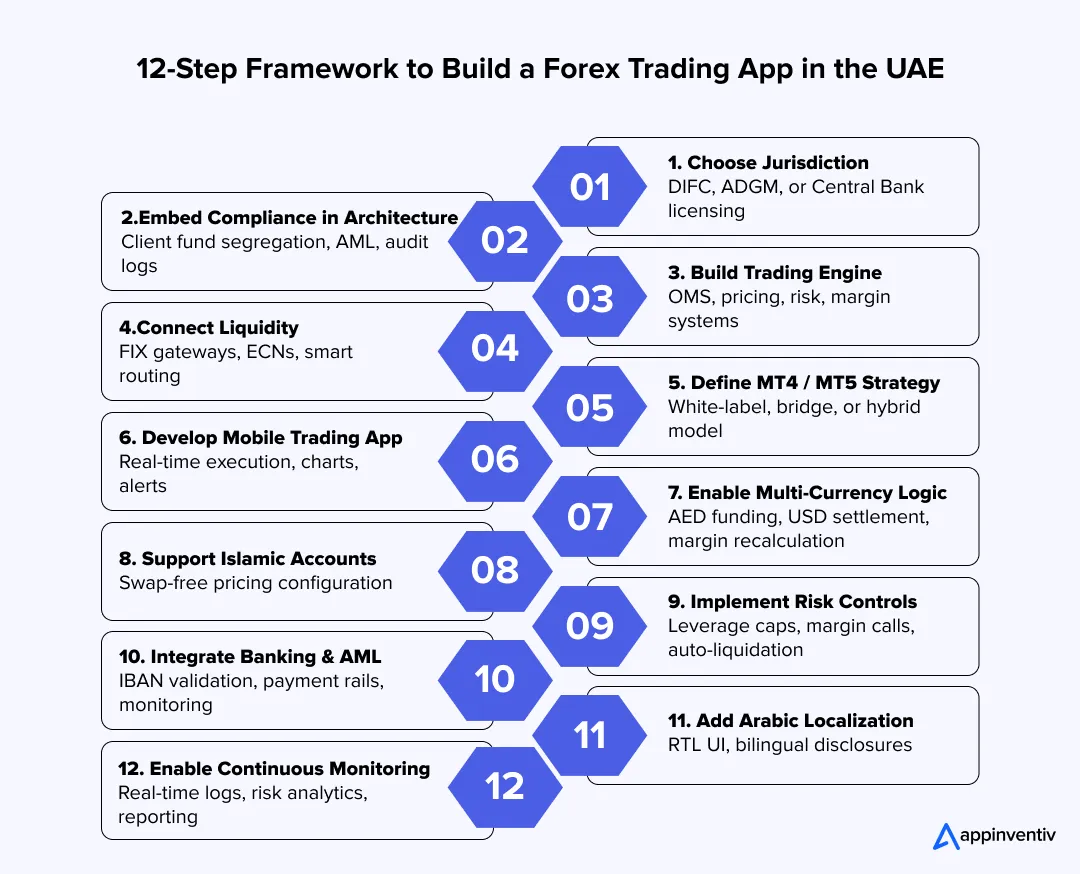
Step 1: Define the Regulatory Structure and Licensing Jurisdiction
If you get regulation wrong, the rest of your system will fail compliance review. That is the bottom line.
When planning forex trading app development UAE, the first decision is not about UI or features. It is about brokerage structure and licensing scope. In the UAE, you must determine whether you will operate under:
- DFSA within DIFC
- ADGM Financial Services Regulatory Authority
- Central Bank of UAE oversight
A DFSA regulated forex app UAE requires strict reporting standards, capital adequacy checks, client fund segregation, and automated audit logs. Your backend must support:
- Immutable trade logs
- Transaction monitoring engines
- Margin exposure reporting
- Regulatory export APIs
Compliance logic must be embedded into the architecture. Retrofitting it later increases cost and risk.
Step 2: Architect the Core Trading Engine and Order Management System
Execution speed defines credibility. Everything else is secondary.
If you are asking how to build a forex trading app in the UAE, the answer starts with the trading engine. This engine must handle:
- Thousands of concurrent orders
- Millisecond execution
- Continuous price updates
- Real-time margin recalculations
Core components include:
- Order Management System
- Matching Engine
- Pricing Engine
- AI-powered Risk Management
- Margin Engine
A robust engine typically uses:
- Event-driven microservices
- In-memory order books
- Distributed caching
- Message queues such as Kafka
- WebSocket streaming for price feeds
For multi-currency trading app development in UAE, your pricing engine must also manage:
- Cross-currency conversions
- Spread calculation
- Swap rate updates
- Leverage adjustments
This is where most platforms break under volatility.
Step 3: Integrate Liquidity Providers and Market Connectivity Infrastructure
Without liquidity, you do not have a trading platform. You have a dashboard.
To build a real online forex trading platform, you must integrate:
- Liquidity providers
- Prime brokers
- ECN networks
- FIX protocol gateways
The system must support:
- Smart order routing
- Slippage control
- Multi-source price aggregation
- Trade reconciliation
Latency between order placement and liquidity execution directly impacts trader trust. In high-volatility events, even milliseconds matter.
This layer also influences spread competitiveness, which is a major factor in the UAE market.
Also Read: How Much Does It Cost to Build a Crypto Exchange App Like BitOasis in the UAE?
Step 4: Implement MT4 and MT5 Integration Strategy
You do not always need to reinvent the trading backend.
Many brokers in Dubai and Abu Dhabi operate on MetaTrader ecosystems. That makes MT4 MT5 integration UAE a strategic shortcut in many cases.
Integration options include:
- Bridging custom mobile UI to MetaTrader servers
- White-label MT5 licensing
- API synchronization for trade execution
- Hybrid architecture with internal risk engine
This approach accelerates forex trading software development in UAE while maintaining compatibility with global broker infrastructure.
Step 5: Build the Mobile Application Layer for Real-Time Execution
Mobile trading is now the primary access channel.
That makes mobile forex trading application development a performance-driven task. The mobile app must:
- Maintain persistent WebSocket connections
- Render advanced trading charts
- Process price ticks without UI freeze
- Trigger push alerts instantly
To deliver a true real-time currency trading app, the frontend must sync with backend engines in near real time without draining battery or bandwidth.
Frontend architecture usually includes:
- Native iOS and Android builds
- Real-time charting libraries
- Secure token-based authentication
- Local caching for price history
Execution reliability matters more than visual polish.
Step 6: Design Segregated Client Fund and Compliance Ledger Architecture
Your jurisdiction decision shapes your backend architecture. That is the starting point.
In the UAE, forex brokers typically operate under:
- DIFC regulated by DFSA
- ADGM regulated by FSRA
- Onshore Central Bank framework
DIFC and ADGM both operate under English common law, but reporting structures and capital adequacy requirements differ. A broker operating inside DIFC must build systems capable of:
- Automated client money reconciliation
- Segregated client fund accounting
- Periodic regulatory reporting exports
- Risk exposure reporting at account level
If you are building a DFSA regulated forex app UAE, your backend must support strict client fund segregation. This means:
- Separate ledgers for client funds
- Reconciliation engines
- Custodian bank API integrations
- Immutable audit logs
Compliance is not a dashboard feature. It is a database design decision.
Step 7: Engineer Multi-Currency Infrastructure with AED Settlement Logic
The UAE dirham is pegged to the USD. That simplifies exchange volatility but does not eliminate settlement complexity.
In multi-currency trading app development in UAE, the backend must support:
- Dual-currency wallet logic
- Base currency vs account currency mapping
- Dynamic margin recalculation when funding currency differs from trade currency
Example:
User deposits AED.
- Trade is executed in EUR/USD.
- Liquidity provider settles in USD.
Your system must:
- Convert AED to USD at funding time
- Maintain margin in USD
- Display balances in user’s preferred currency
- Recalculate exposure if conversion rate changes
This requires:
- Currency conversion microservice
- Spread-aware conversion logic
- Precision rounding standards to avoid exposure drift
Small rounding inconsistencies in high-volume systems create reconciliation errors.
Also Read: How Much Does it Cost to Build a Digital Wallet App Like Payit in the UAE?
Step 8: Implement Islamic Swap-Free Account Pricing Logic
This is a structural change to your pricing engine.
In the UAE, brokers often offer:
- Standard accounts
- Swap-free Islamic accounts
In a swap-free account, overnight interest cannot be applied.
Instead, the engine must:
- Detect Islamic account flag
- Disable rollover interest
- Apply alternative fee logic
- Ensure compliance with internal Sharia screening policies
Your trade lifecycle service must branch based on account type.
The pricing engine must calculate:
- Overnight interest for standard accounts
- Zero swap + flat fee for Islamic accounts
Without conditional execution paths in the backend, you cannot scale Islamic trading options properly.
Step 9: Build Jurisdiction-Aware Margin and Risk Management Systems
UAE regulators expect responsible leverage policies. Your margin engine must dynamically calculate:
- Margin level per currency pair
- Aggregate exposure per client
- Jurisdiction-specific leverage caps
- Real-time liquidation triggers
A properly structured forex trading app development Dubai project includes:
- Automatic margin calls
- Forced position closures
- Real-time exposure dashboards
These are not optional controls. They protect both broker and trader.
Step 10: Integrate UAE Banking Rails and Real-Time AML Monitoring
Payment rails in the UAE have specific operational characteristics.
Your system must integrate with:
- UAE local banks
- IBAN validation systems
- AML transaction monitoring
- Cross-border remittance flows
AED settlement requires precise reconciliation logic. Deposits and withdrawals must reflect:
- Currency conversion timing
- Bank processing latency
- Transaction fee adjustments
This layer becomes even more critical when building an online forex trading platform serving cross-border traders in the GCC or having a crypto payment gateway.
Step 11: Develop Arabic Localization and Internationalization Framework
Retail adoption in the UAE requires Arabic language support.
This impacts more than text translation. The system must support:
- Right-to-left UI rendering
- Localized number formatting
- Arabic notification templates
- Compliance disclosures in Arabic
Frontend architecture should allow dynamic language switching without app restart. For mobile forex trading application development, that means building:
- Internationalization frameworks
- Localized API response handling
- Multi-language chart annotations
Localization improves trust and regulatory alignment.
Also Read: English-Arabic App Development: Key Business Challenges and How to Solve Them
Step 12: Establish Continuous Monitoring and Predictive Risk Analytics Systems
Security expectations are high in UAE financial zones.
Beyond standard encryption, the platform must support:
- Continuous transaction monitoring
- Suspicious activity flagging
- Real-time AML screening
- IP-based geo tracking
For firms pursuing forex trading app development UAE, regulatory authorities expect full traceability. That requires:
- Immutable trade logs
- Time-stamped execution records
- Export-ready audit trails
Cloud infrastructure must also respect data residency considerations where required by jurisdiction.
Final Takeaway
To truly answer How to build a forex trading app in the UAE, the architecture must integrate:
- DIFC or ADGM regulatory alignment
- Segregated client fund systems
- AED settlement logic
- Islamic swap-free account configuration
- Arabic UX support
- Local banking integrations
- Real-time risk and leverage controls
Without these, the product may function technically, but it will not operate effectively within the UAE ecosystem.
Align your compliance, trading engine, and liquidity setup from day one.

Forex Trading App Development in the UAE: Market Opportunity
If you’re an enterprise evaluating whether the UAE is the right market to launch a forex trading platform, the numbers make the case clear.
The UAE fintech market is projected to cross USD 90 billion by 2031, according to Mordor Intelligence. That growth is not theoretical. It reflects ongoing investment in digital financial services, trading infrastructure, and regulated financial ecosystems. For brokers and financial institutions, that signals a market that is expanding, not plateauing.
Another market report estimates the UAE’s smart digital financial brokerage platforms segment at around USD 1.2 billion. That figure points to active adoption of online and mobile trading platforms, not just passive interest. Digital brokerage is already a meaningful part of the financial services landscape.
For decision makers planning forex trading app development in the UAE, this creates a practical opportunity. You are entering a region with regulatory structure, capital concentration, and a digitally mature investor base. The real advantage lies in building a platform that matches that maturity from day one.
Challenges in Forex Trading App Development in UAE
Forex trading app development in the UAE looks straightforward on paper. In reality, it becomes complex the moment real users and real market volatility enter the picture. Most challenges don’t come from building features. They come from keeping the system stable under pressure.
- Regulatory alignment with DIFC or ADGM: One of the first hurdles is compliance. Licensing authorities expect clear fund segregation, transparent reporting, and traceable trade history. If these controls are added late, the platform often needs structural changes. The smarter approach is to design reporting logic, ledger separation, and reconciliation workflows into the system from the beginning.
- Execution accuracy during volatile markets: Currency markets can move sharply within seconds. If the execution engine is not tightly optimized, traders experience slippage or order rejections. To reduce this risk, platforms rely on smarter routing logic and continuous price validation before confirming trades.
- Managing continuous real-time data flow: A forex app never sleeps. Prices update constantly, and thousands of users may be connected at once. Without efficient data handling, screens freeze or delay. Systems that use stream-based processing and controlled data push models tend to perform far more reliably under load.
- Coordinating multiple liquidity providers: Each liquidity provider behaves slightly differently. Quotes may arrive at different speeds, and spreads can shift rapidly. A unified pricing layer helps smooth these inconsistencies so traders see stable pricing rather than fragmented feeds.
- Balancing speed with security requirements: Strong authentication and monitoring are necessary, but heavy checks inside the execution path slow everything down. Many platforms solve this by separating security validation from order processing so that protection runs quietly in parallel.
In the UAE, the real challenge is not just building a trading app. It is building one that holds up when markets are moving fast and regulators expect full visibility at any time.
Key Features to Have in Your Forex Trading App
Execution reliability, pricing transparency, and risk visibility determine whether traders stay or leave. The feature layer of a trading platform must support real-time performance while remaining compliant with UAE financial expectations.
When planning multi-currency trading app development in UAE, key features of a forex trading app cannot be just cosmetic. They must be infrastructure-aware and execution-driven.
| Feature Category | What It Must Deliver | Why It Matters in the UAE Context |
|---|---|---|
| Real-Time Market Data & Execution | Live bid/ask streaming, instant order execution, WebSocket-based connectivity, failover routing | Execution speed directly impacts trader trust, especially during volatility spikes |
| Multi-Currency Wallet Management | AED, USD, EUR wallet handling, real-time currency conversion, cross-currency margin calculation | UAE traders often fund in AED while trading USD or EUR pairs |
| Advanced Charting & Technical Tools | Multi-timeframe charts, technical indicators, drawing tools, high-frequency tick rendering | Professional traders expect institutional-grade analysis tools |
| Margin & Leverage Transparency | Real-time margin level, used/free margin display, automated stop-loss and liquidation triggers | Regulatory oversight in DIFC and ADGM requires precise, auditable margin logic |
| Secure Onboarding & Compliance | Digital KYC, AML screening, Arabic and English disclosures, multi-factor authentication | Compliance requirements under UAE financial jurisdictions demand strict onboarding controls |
| Payment & Withdrawal Infrastructure | AED and USD deposits, bank integrations, wallet-ledger synchronization, margin validation before withdrawal | Prevents reconciliation errors and ensures exposure stability |
| Alerts & Risk Notifications | Price alerts, margin warnings, execution confirmations, volatility notifications | Reduces trader exposure and increases platform engagement |
Advanced Capabilities in Modern Forex Trading Platforms
Modern forex platforms compete on intelligence and automation, not just execution. Advanced capabilities increase trader retention, improve decision accuracy, and position the platform for long-term growth in competitive markets like the UAE.
AI-Powered Trading Insights and Predictive Analytics
AI in fintech helps enhance trading decisions without interfering with execution speed. The primary value of predictive analytics is pattern recognition at scale.
With AI agents in finance, modern trading platforms can be trained on historical tick data, volatility cycles, liquidity depth, and price momentum behavior. These models can generate probability-weighted signals, detect unusual market movements, and provide sentiment analysis directly within the trading interface.
In high-activity environments, AI systems can also monitor abnormal trading patterns to flag risk concentration. For UAE-based platforms serving mixed retail and professional traders, predictive analytics provides structured insight while keeping final decision-making in the hands of users.
Copy Trading and Social Trading Systems
Copy trading lowers the barrier to entry for newer traders while increasing platform engagement. The system must mirror trades from a master account to multiple follower accounts in real time without execution distortion.
To function properly, the backend requires synchronized order replication logic, proportional position scaling, and real-time risk recalibration for follower accounts. Latency must remain minimal because even small delays can alter entry prices and impact performance accuracy.
For brokers expanding within the UAE, social trading features help attract retail participants who prefer guided strategies rather than independent technical analysis.
Algorithmic Trading and Automated Strategies
Automation is essential for professional and high-frequency traders. A modern platform must support API-based strategy execution and secure fintech integration with external trading scripts.
Algorithmic modules should connect directly to the trading engine through controlled execution gateways. Every automated trade must pass through pre-trade risk validation, margin verification, and exposure checks before reaching liquidity providers.
Backtesting engines should simulate historical price data at tick-level precision to prevent unrealistic strategy expectations. Reliable automation requires low-latency infrastructure and stable market data feeds to maintain consistency between simulated and live environments.
Smart Dashboards and Trading Analytics
Data visibility improves trading discipline and platform trust. A modern dashboard must convert raw trade data into actionable insight.
The backend analytics engine should process historical trades, margin utilization, win-loss ratios, drawdown periods, and exposure distribution across currency pairs. Instead of presenting isolated numbers, the system should generate contextual summaries such as risk-adjusted returns or behavioral patterns over time.
For brokers operating in regulated UAE environments, analytics dashboards also support transparency. Traders can clearly see leverage usage, realized and unrealized profit breakdown, and time-based performance tracking, which reduces disputes and improves compliance posture.
Multi-Device Synchronization
Consistency across devices is a baseline expectation. A position opened on mobile must reflect instantly on web or desktop without session conflict.
To enable this, platforms rely on centralized account state management supported by persistent real-time connections. Trade confirmations, margin updates, and balance changes must propagate across all active sessions without delay.
Cloud-based state synchronization ensures that portfolio exposure and open positions remain accurate regardless of how frequently the trader switches devices. For professional users who monitor markets continuously, this reliability directly influences platform loyalty.
Leverage enterprise-grade mobile app development tailored for regulated industry.

Regulatory Compliance for Forex Trading Apps in the UAE
Regulatory alignment in the UAE directly affects system design, capital structure, and operational workflows. Forex platforms must comply with the jurisdiction where the brokerage is licensed, typically DIFC under DFSA or ADGM under FSRA.
DIFC and DFSA Compliance
Brokers operating in DIFC must meet DFSA capital requirements that can range from several hundred thousand to multiple million US dollars depending on license category.
A DFSA regulated forex app UAE must support strict client money segregation. The system must maintain separate client and operational ledgers, enable daily reconciliation with custodian bank accounts, and generate exportable audit logs covering trades, balances, and margin exposure.
ADGM Regulatory Requirements
ADGM-regulated firms must comply with FSRA prudential standards. Platforms must support real-time margin monitoring, leverage enforcement, and capital exposure reporting.
Risk systems should generate position summaries and stress metrics aligned with approved license conditions.
AML and Client Fund Protection
All UAE forex platforms must embed AML screening at onboarding and transaction levels. Identity verification, sanctions screening, and suspicious activity logging must operate continuously.
Client funds must remain segregated in approved bank accounts, with automated reconciliation between internal wallet balances and custodial accounts.
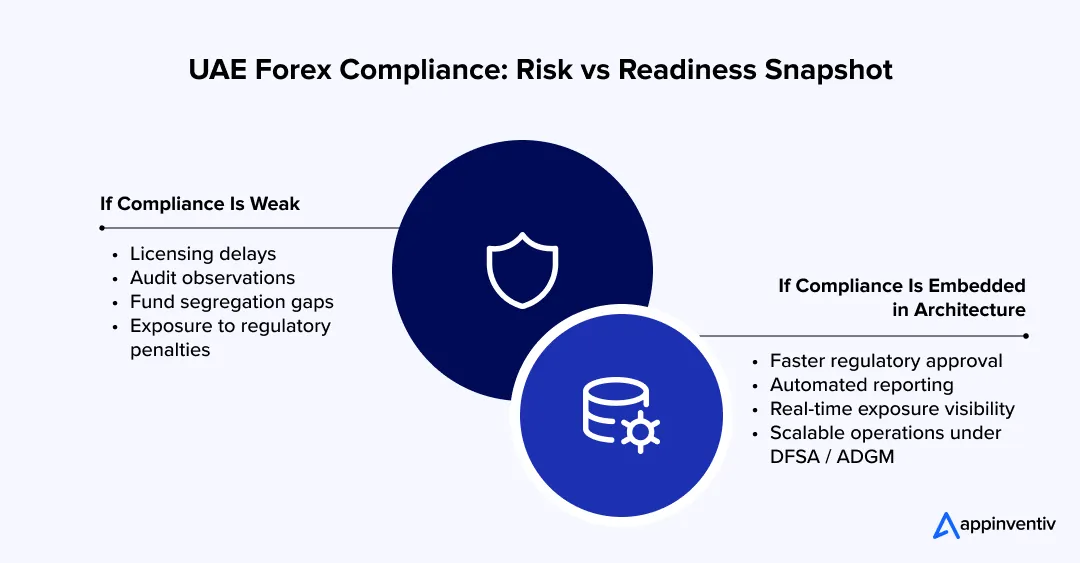
In the UAE, compliance is embedded in architecture. Ledger structure, margin logic, and reporting systems must align with regulator expectations from day one.
Cost to Develop Forex Trading Platform in the UAE
If you’re planning to build a forex trading app in the UAE, the realistic budget usually falls between AED 147,000 and AED 1,470,000 (around $40,000 to $400,000).
That’s a wide range, and honestly, it should be. A basic trading interface and a fully regulated, performance-heavy platform are two very different products. The final cost depends on how much control you want over execution, how deep your compliance requirements go, and whether you’re building core systems from scratch or integrating third-party infrastructure.
Basic Trading Platform
At the lower end, you’re typically looking at a lean setup. Standard order execution, a limited set of currency pairs, basic charting, and integration with external liquidity providers.
Many brokers at this level use white-label components to reduce development time. Customization is limited, but it’s enough to enter the market, and significantly lowers the initial cost required to build an MVP.
Estimated range: AED 147,000 to AED 294,000 ($40,000 to $80,000)
Mid-Level Platform with Advanced Features
This is where things get more serious. Multi-currency wallet logic, real-time risk calculation, Arabic localization, and tighter execution controls require deeper backend engineering.
If you’re integrating MT4 or MT5, or adding automation layers, the cost naturally increases because the system needs to be more tightly coordinated and performance-tested.
Estimated range: AED 367,000 to AED 735,000 ($100,000 to $200,000)
Enterprise-Grade Platform
At the top end, you’re building a core trading system, not just an app. Custom execution engines, liquidity aggregation, advanced risk management, segregated accounting logic, AML automation, and regulatory reporting pipelines all require dedicated engineering effort.
This level is typically aligned with DFSA or ADGM expectations and designed for long-term scale rather than short-term launch.
Estimated range: AED 882,000 to AED 1,470,000 ($240,000 to $400,000)
If you are looking for a custom development project, read our guide on how much it costs to build a mobile app in the UAE.
Cost Breakdown by Development Component
Below is how the total cost to build a forex trading app in UAE is typically distributed across technical and compliance layers.
| Component | Estimated Cost (AED) | Scope and Key Inclusions |
|---|---|---|
| Strategy, Compliance Planning, and System Architecture | AED 36,000 to AED 110,000 ($10,000 to $30,000) | Brokerage model selection, DIFC or ADGM regulatory alignment, system architecture design, client fund segregation planning, AML workflow definition |
| Trading Engine and Backend Infrastructure | AED 294,000 to AED 735,000 ($80,000 to $200,000) | Order management systems, pricing engines, liquidity routing, risk logic, multi-currency wallet architecture, custom execution engines |
| Frontend and Mobile Application Development | AED 147,000 to AED 367,000 ($40,000 to $100,000) | iOS and Android apps, charting systems, dashboards, Arabic localization, authentication workflows, real-time UI performance optimization |
| Liquidity and MT4/MT5 Integration | AED 73,000 to AED 220,000 ($20,000 to $60,000) | FIX protocol connectivity, liquidity provider onboarding, smart routing logic, MT4 MT5 integration UAE where required |
| Security, AML, and Compliance Automation | AED 55,000 to AED 147,000 ($15,000 to $40,000) | Encryption systems, AML monitoring, transaction logging, audit trails, DFSA or ADGM reporting pipelines |
| Cloud Infrastructure and Deployment | AED 36,000 to AED 110,000 ($10,000 to $30,000) | Auto-scaling cloud clusters, monitoring dashboards, failover systems, disaster recovery configuration for volatility resilience |
Best Practices for Building Multi-Currency Forex Trading Platforms
Multi-currency forex platforms must be engineered for performance, resilience, and precision. The difference between a stable platform and a failing one often lies in architectural discipline and operational foresight.
Design for Ultra-Low Latency Trading
Execution speed defines platform credibility. Even millisecond delays can impact slippage, pricing accuracy, and trader confidence.
- Minimize processing layers between order request and execution
- Use in-memory data handling for pricing and order validation
- Deploy servers closer to liquidity hubs to reduce network delay
- Continuously monitor latency at service and endpoint levels
Build Scalable Infrastructure for Market Volatility
Market events can cause sudden surges in trading volume. Infrastructure must expand without degrading performance.
- Implement horizontal auto-scaling across compute nodes
- Separate execution services from analytics workloads
- Use distributed load balancers to manage order bursts
- Conduct simulated stress tests before production release
Implement Strong Security and Compliance Controls
Security must be robust yet non-intrusive to execution flow. Protection mechanisms should not introduce bottlenecks.
- Enforce encryption technology for communication across all services
- Isolate execution engines from compliance-heavy processes
- Maintain immutable audit logs for traceability
- Automate monitoring to detect abnormal trading patterns
Optimize User Experience for Professional Traders
Professional traders demand clarity, speed, and precision. The interface must respond instantly to live market movement.
- Provide real-time exposure and margin visibility
- Enable rapid order entry with minimal interaction steps
- Ensure chart rendering remains smooth during volatility
- Allow layout customization for advanced trading setups
Design a low-latency, DFSA-ready system built for long-term growth.

Why Partner with Appinventiv for Forex Trading App Development in the UAE
Building a forex trading platform in the UAE is not just about app development. It requires regulatory foresight, liquidity engineering, and infrastructure discipline.
Our teams architect trading systems aligned with DFSA and ADGM expectations from the start. That includes structured AML layers, segregated client fund logic, margin monitoring systems, and audit-ready reporting frameworks built into the core platform.
On the execution side, we engineer low-latency environments with FIX protocol connectivity, liquidity provider aggregation, and real-time exposure tracking. Order routing, pricing feeds, and failover mechanisms are treated as mission-critical infrastructure.
Our experience extends beyond theory. For example, we have built an enterprise-grade digital wallet and compliance platform that supports secure financial transaction pipelines and regulatory-aligned reporting systems at scale.
Similarly, through our work on Slice’s real estate investment platform, we engineered fintech-grade transaction flows and scalable financial data infrastructure designed to handle growing user volumes without compromising compliance.
As a trusted mobile app development company in Dubai, with 1000+ digital projects delivered in the Middle East and 12+ government and compliance programs executed, we understand how to structure platforms that can pass regulatory scrutiny while maintaining execution speed.
If you are planning to launch a DFSA-aligned, liquidity-ready forex trading platform in the UAE, let’s evaluate your roadmap from both a technical and compliance perspective.
FAQs
Q. How long does it take to get DFSA approval for a new forex platform in the UAE?
A. DFSA approval timelines typically range between 4 to 9 months, depending on the license category, completeness of documentation, and the strength of your compliance framework. The process includes initial application review, fit and proper assessments, capital adequacy verification, AML policy evaluation, and system audits. Delays usually occur when trading infrastructure, reporting logic, or risk controls are not clearly documented. Preparing a compliance-ready architecture before applying can significantly streamline the approval cycle.
Q. Can we build a forex trading app that works under both DIFC and ADGM simultaneously?
A. Yes, but it requires careful architectural planning. While DIFC and ADGM have similar regulatory philosophies, they operate under separate legal frameworks. A unified trading platform can be built with modular compliance layers that adapt reporting, leverage rules, and governance controls based on the licensed entity. This approach allows shared core infrastructure such as trading engine, liquidity integration, and risk systems, while maintaining regulatory segregation where required. Proper legal structuring and technology design are critical to making this work efficiently.
Q. What features are required in a forex trading mobile app?
A. At the very least, a forex trading app needs stable real-time pricing, quick order placement, and clear visibility of margin and open positions. Traders also expect reliable charts and a clean trade history. In the UAE, platforms usually go a step further with Arabic language support and compliance-ready workflows built into the onboarding process.
Q. What technologies power forex trading platforms?
A. Most platforms, forex trading technology stack are built around low-latency backend systems that can handle constant price updates without slowing down. They rely on cloud infrastructure, streaming connections for live market data, and secure integration with liquidity providers. The focus is less on flashy tech and more on speed, stability, and precision.
Q. What regulations apply to forex trading apps in the UAE?
A. Forex apps in the UAE operate under regulatory authorities such as DFSA in DIFC or FSRA in ADGM. These regulators require brokers to follow strict rules around client fund segregation, capital reporting, and AML controls. So the platform itself must support proper tracking, reporting, and transaction visibility.
Q. How secure are forex trading mobile applications?
A. Security depends on how seriously it’s taken during development. Strong platforms use encrypted connections, multi-factor authentication, and detailed transaction logs. Good systems are designed so that security checks run in the background without slowing down trade execution.
Q. Is forex trading regulated in the UAE?
A. Yes, it is. Brokers must obtain licenses if they operate in regulated financial zones like DIFC or ADGM. The regulatory structure is actually one of the reasons international investors feel comfortable operating from the UAE.
Q. How much does it cost to build a forex trading app?
A. There’s no single number. In most cases, the cost ranges from AED 147,000 to AED 1,470,000 (around $40,000 to $400,000), depending on how advanced the system needs to be. A basic trading interface costs far less than a fully custom platform with its own execution engine and compliance automation.
Q. Why are forex trading apps gaining popularity in the UAE?
A. The UAE has a strong investor base, high smartphone usage, and a well-developed financial ecosystem. Traders prefer having access to global currency markets directly from their phones. As digital finance continues to expand in the region, demand for reliable trading apps naturally follows.

- In just 2 mins you will get a response
- Your idea is 100% protected by our Non Disclosure Agreement.

A Guide on How to Choose the Right Mobile App Development Company in Iraq
Key Takeaways Define business goals, integrations, compliance needs, and success metrics before engaging a development partner. Prioritise teams experienced in Arabic/Kurdish localisation, RTL UX, and testing on low-spec Android devices common in Iraq. Evaluate architecture maturity, security standards (SOC2/ISO), and CI/CD practices rather than focusing only on development cost. Ensure the application is designed for…

How Much Does It Cost to Build a Calorie Counting App Like Cronometer in Australia
Key takeaways: Building a calorie counting app with Cronometer-level accuracy in Australia typically costs between AUD 70,000 and AUD 700,000+, depending on data depth, compliance posture, and analytics sophistication. Underestimating compliance, data licensing, and post-launch governance is the most common cause of budget overruns for Australian nutrition platforms. The hard cost driver is not screens.…

MVP to Market: Realistic Cost, Timelines & Tech Stack for MVP App Development in Australia
Key takeaways: MVP development costs in Australia typically land between AUD 50,000 and AUD 200,000+, driven by integration depth, security, and delivery shape. Time-to-market can vary from 8 to 20 weeks, influenced by integrations, compliance, and feature scope. Choosing the architecture and best tech stack for building mvp app early reduces rebuild risk when traction…