




























How Digital Twins in Construction in Australia Are Transforming the Industry in 2026

- Understanding the Role of Digital Twin in Construction: How It Differs from Traditional BIM Systems
- What Is the Architecture Behind Digital Twins in Construction in Australia: How It Works?
- Why the Construction Industry Needs Digital Twins in 2026
- What Are the Key Applications of Digital Twins in Construction
- Digital Twins in Action in the Construction: Case Study of Brisbane’s Cross River Rail (CRR)
- What Are the Benefits of Digital Twins in Construction Industry in Australia?
- Which Technologies Power Digital Twins in Construction?
- What Are the Key Challenges in Implementing Digital Twins & How to Overcome Them
- How Much Does It Cost to Implement Digital Twin Solutions in Construction?
- What is the ROI of Digital Twins in Construction Projects?
- How to Implement Digital Twins in Construction Projects
- What Is the Future of Digital Twins in the Australian Construction Industry?
- How Appinventiv Can Help with Digital Twin Construction Projects in Australia?
- FAQs

Key takeaways:
- A digital twin is a live, virtual representation of a physical building or infrastructure asset. Unlike static BIM models, it uses real-time data from IoT sensors to reflect the exact current state of the construction site.
- Key digital twin use cases in Australian construction include real-time structural telemetry and “exception-based” management to bypass chronic skilled labour shortages.
- The digital twin implementation process in Australian construction follows an API-first strategy, bridging legacy ERPs with IRAP-protected onshore cloud infrastructure.
- Digital twins implementation costs range from $70,000 to $700,000, but killing just one major structural rework or a two-week critical path delay pays for the whole build.
Construction delivery across Australia is under sustained pressure. Project scopes are expanding, stakeholder ecosystems are fragmented, and cost certainty continues to erode across large infrastructure programs. Even with strong demand, margin leakage from delays, rework, and coordination gaps remains a persistent issue.
This is where digital twins in construction in Australia are moving beyond pilots into core delivery infrastructure. Instead of relying on static BIM outputs, organisations are adopting continuously updated digital environments that reflect real site conditions, asset performance, and execution risks in real time.
There is a strong momentum around smart construction using digital twins in Australia, particularly in complex, multi-contractor projects where decisions cannot depend on delayed or siloed data. The shift is not about better visualisation. It is about building a reliable operational layer that supports planning, execution, and long-term asset management.
For leadership teams evaluating a digital twin for the construction industry in Australia, the real question is practical. Can this improve cost control, reduce delivery risk, and strengthen compliance visibility?
This blog provides a structured view of how digital twin architecture in construction projects is being deployed, where it delivers measurable value, and what it takes to implement it in a way that aligns with Australian business expectations around governance, security, and long-term ownership.
Gain real-time visibility, reduce project risks, and improve cost control with a tailored digital twin solution.
Understanding the Role of Digital Twin in Construction: How It Differs from Traditional BIM Systems
While many in the industry still conflate Building Information Modelling (BIM) with digital twins, the distinction is critical for any digital transformation company in Australia advising on system upgrades.
BIM serves as a prescriptive snapshot of design intent; conversely, a digital twin functions as a descriptive, live representation of operational reality. The primary differentiator between BIM and digital twin remains the data flow. Traditional systems rely on manual updates, whereas a digital twin operates on a continuous feedback loop.
BIM vs Digital Twin: The Key Distinction
| Aspect | BIM (The Snapshot) | Digital Twin (The Heartbeat) |
|---|---|---|
| Data Nature | Static / Milestone-based | Real-time / Continuous stream |
| Primary Use | Design coordination & clash detection | Predictive maintenance & operational ROI |
| Lifecycle Stage | Pre-construction & Build | Build, Operate, & Decommission |
| Feedback Loop | Linear (Design to Site) | Bi-directional (Site to Model) |
Also Read: AI in Industrial Automation in Australia
What Is the Architecture Behind Digital Twins in Construction in Australia: How It Works?
Building a functional digital twin in 2026 isn’t about buying a single piece of software; it is about standing up a modular data environment that can survive the rigours of an Australian Tier 1 site. For a construction company, the focus is on creating a stack that is resilient enough to handle “dirty” data from the field while maintaining a clean audit trail for the board.
The architecture typically breaks down into four operational layers:
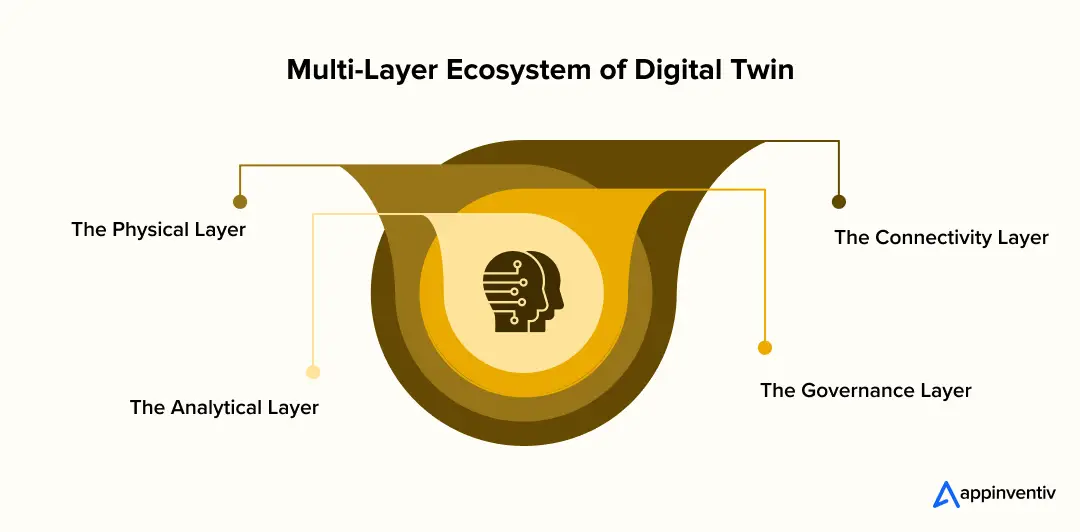
The Ingestion Layer
This is where the physical meets the digital. There is a heavy reliance on “Reality Capture”, using autonomous Boston Dynamics “Spot” units or DJI drone swarms to feed LiDAR data directly into the model. In regional Australia, this layer often incorporates LEO satellite backhaul to ensure that data from a remote mine or rail link isn’t sitting on a hard drive for a week before it hits the cloud.
The Integration (Sovereign) Layer
This is the most sensitive part of the stack. Under the Australian Privacy Principles (APPs) and Security of Critical Infrastructure (SOCI) Act, Australian project data cannot simply sit in a generic offshore bucket. This layer uses hardened APIs to pull from legacy ERPs like SAP or Jobpac, ensuring that every data point is timestamped and stored in an onshore, IRAP-protected environment.
The Analytics Layer
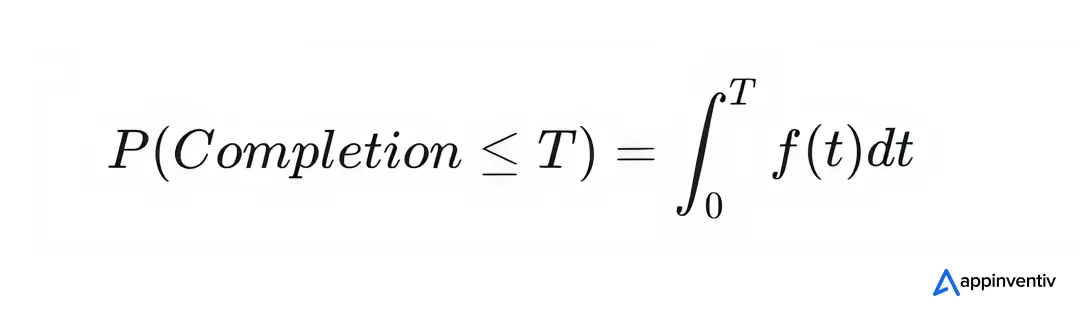
This is the engine room. It uses AI to run Monte Carlo simulations against the live schedule. If a shipment of structural steel is delayed at the Port of Melbourne, the twin doesn’t just flag it; it calculates the exact impact on the crane hire schedule three weeks down the line.
By ingesting real-time site telemetry, the twin calculates the probability of hitting a critical path milestone (T) using the following integration of the probability density function f (t):
The Visualisation Layer
Forget complex CAD interfaces that only engineers can read. The 2026 standard is a “Single Pane of Glass” dashboard. Whether it is a site manager using an iPad or a CEO in a boardroom, the interface provides a high-fidelity 3D view of the project’s financial and physical health.
| Layer | Primary Technology | Strategic Value |
|---|---|---|
| Ingestion | IoT, LiDAR, Drones, Edge Computing | Eliminates manual data entry errors |
| Integration | Secure APIs, Sovereign Cloud | Ensures “single source of truth” & compliance |
| Analytics | AI / Machine Learning | Enables predictive vs reactive management |
| Visualisation | AR/VR, Web-based 3D Dashboards | Improves field-to-office communication |
For a construction software development company, the goal is to ensure these layers are not siloed. The architecture must allow data to flow bi-directionally, ensuring that a decision made in the virtual model can be pushed back to the field as an updated work order or safety alert.
Why the Construction Industry Needs Digital Twins in 2026
The 2026 Australian construction landscape is defined by a significant disconnect between record-breaking project pipelines and eroding profit margins. For executive leadership, the shift toward digital twins in construction in Australia is no longer a pursuit of innovation for its own sake; it is a defensive strategy against systemic industry volatility.
Four specific market pressures are forcing this transition:
The Insolvency Crisis and Margin Erosion
Construction remains the highest-risk sector for business failure in Australia, accounting for 27% of all national insolvencies in the 2024–25 period. With fixed-price contracts being undermined by a 40% cumulative increase in material costs over the last five years, firms cannot afford “laggy” data. Digital twins provide the real-time financial telemetry required to identify a budget blowout before it triggers an administration event.
Mandatory Carbon Reporting and ESG Compliance
New Australian climate-related financial disclosure laws have made “greenwashing” a significant legal and director-level risk. Digital twins act as a live “carbon ledger,” tracking the embodied footprint of every cubic metre of concrete from the quarry to the pour. This granular data is now a prerequisite for securing institutional backing and state-funded tenders.
The Labour Productivity Bottleneck
While total construction work done in Australia reached $80.2 billion recently, industry productivity has dipped to seven-year lows. Residential and commercial build times have extended by up to 80% due to chronic trade shortages. By using a digital twin, site engineers manage multiple work-fronts through “exception-based” monitoring, effectively decoupling project progress from physical headcount.
The Post-Handover Value Proposition
The Australian market is moving away from the “build and bolt” mentality. Tier 1 developers are increasingly evaluated on long-term asset performance. A digital twin reduces facility management and energy costs by nearly 15–20% post-handover, turning a physical structure into a high-performance, long-term yield for the asset owner.
Modular & Supply Chain Twins
As Australia faces a 300,000-worker shortage by 2027, leadership is pivoting toward:
- Supply Chain Twins: Real-time tracking of critical inputs (like BlueScope steel) to mitigate the 50% increase in import pressure identified in the 2025 Infrastructure Market Capacity Report.
- Modular Precision: Using digital twins to ensure “factory-built” units fit onsite cores with millimetre accuracy, reducing rework by 25%.
In short, the 2026 environment does not tolerate “best guesses.” Smart construction using digital twins in Australia is the only viable mechanism to synchronise volatile site realities with the rigid fiscal demands of the boardroom.
What Are the Key Applications of Digital Twins in Construction
The applications of digital twin technology in construction are no longer speculative. Aussie innovators are leveraging these systems to solve specific high-cost inefficiencies across the asset lifecycle. Implementing digital twin applications in Australian construction projects allows for a transition from periodic oversight to continuous, automated management. Here are the key use cases of digital twin construction projects:
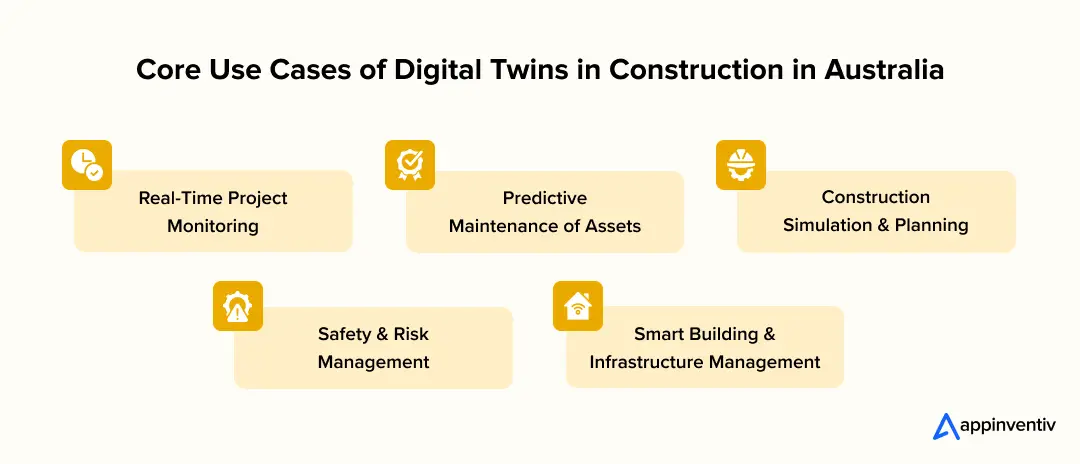
1. Real-Time Project Monitoring
Site progress is traditionally tracked through manual reporting and visual inspections, which are prone to subjective bias and delay. By integrating digital twin construction workflows, project leads use automated LiDAR scans and drone-based photogrammetry to compare the “as-built” reality against the “as-designed” model every 24 hours.
This immediate visibility allows for the identification of structural deviations before they become irreversible, multi-million-dollar remediation issues.
2. Predictive Maintenance of Assets
For Tier 1 contractors managing heavy plant and equipment, downtime is a significant margin killer. By embedding IoT sensors into critical machinery, digital twins predict mechanical failures based on vibration, heat, and usage patterns.
This moves the needle from scheduled maintenance, which often ignores actual equipment condition, to predictive intervention, ensuring maximum uptime for high-value assets on site.
3. Construction Simulation & Planning
The logistical complexity of major urban projects, such as the Brisbane Metro or Sydney’s Western Airport, requires precision timing. Digital twin use cases in Australian construction include running “4D” simulations (3D models + time) to test construction sequences.
Executives can virtually stress-test different delivery schedules to identify potential bottlenecks in material deliveries or crane movements before a single brick is laid.
4. Safety & Risk Management
Digital twins enhance site safety by creating virtual geofences. If a worker or a piece of machinery enters a high-risk zone without authorisation, the system triggers real-time alerts. Furthermore, by simulating emergency evacuations or hazardous material handling in a virtual environment, safety officers can refine protocols based on data rather than assumptions, directly addressing board-level concerns regarding Work Health and Safety (WHS) compliance.
5. Smart Building & Infrastructure Management
The value of a digital twin extends far beyond the “handover” date. Once construction is complete, the twin serves as the digital foundation for the facility management team. It tracks energy consumption, HVAC performance, and occupancy patterns.
For Australian developers, this long-term utility is a powerful value proposition, turning a one-off build into a high-performance, sustainable asset that meets the stringent requirements of the Green Building Council of Australia.
Digital Twins in Action in the Construction: Case Study of Brisbane’s Cross River Rail (CRR)
The Cross River Rail is Australia’s digital twin benchmark. Utilising the Unreal Engine, it integrated GIS, BIM, and photogrammetry into a 10.2km “live” virtual corridor to manage 5.9km of twin tunnels under the Brisbane River.
- Timeline: 2019–2026 (Operational Phase).
- Measurable Outcome: Avoided up to 4 months of potential delays and saved millions in costs by virtually testing signal visibility and station configurations.
- Strategic Value: Created a “Common Data Source” enabling non-technical stakeholders to perform “virtual walkthroughs” for design validation.
What Are the Benefits of Digital Twins in Construction Industry in Australia?
Adopting digital twins in construction in Australia is a move toward institutional resilience. In an era of high interest rates and “right-to-repair” legislation for physical assets, the digital twin serves as the primary mechanism for protecting an enterprise’s balance sheet from the volatility of field operations.
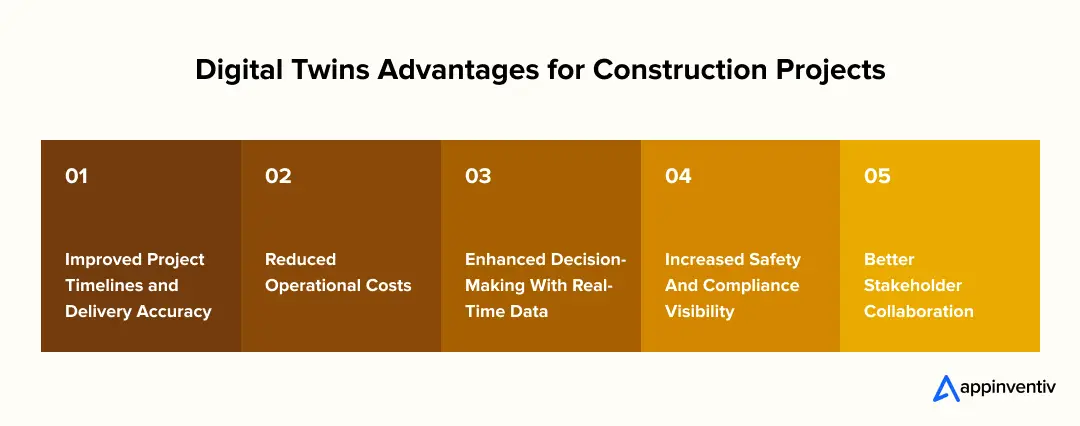
Improved Project Timelines and Delivery Accuracy
The primary friction in Australian Tier 1 projects is the disconnect between the design office and the sub-contractor on-site. Digital twins eliminate this “information lag” by providing a live, spatially accurate ground truth. This translates to a drastic reduction in unplanned RFI cycles, ensuring that the critical path remains protected from the common 5–8% margin erosion typically caused by site coordination errors.
Reduced Operational Costs
By rehearsing complex structural assemblies in a virtual environment before any steel is cut, firms are seeing a marked reduction in site-level idle time. When the digital model accurately reflects the lead times of Australian supply chains, procurement becomes a precision exercise rather than a series of educated guesses based on outdated spreadsheets.
Enhanced Decision-Making with Real-Time Data
Monthly progress claims are often “stale” by the time they reach the board. Digital twins provide a live dashboard of project health, which is essential for maintaining investor confidence and satisfying the strict audit requirements of modern infrastructure funds.
Increased Safety and Compliance Visibility
With the 2026 focus on psychosocial safety and strict WHS protocols, twins allow for virtual site inductions and real-time hazard mapping. By overlaying worker telemetry with the digital model, safety officers can identify high-risk congestion zones before incidents occur. This creates a documented, immutable trail of proactive risk management, which is essential for long-term ownership and negotiating insurance premiums.
Better Stakeholder Collaboration
On multi-billion-dollar precinct developments, the friction between developers, government bodies, and subcontractors is usually caused by data silos. A shared digital twin acts as the single source of truth, ensuring that every party is working from the same real-time data set, which significantly reduces the volume of disputes and legal overheads.
Which Technologies Power Digital Twins in Construction?
Modern digital twins move beyond static models by synchronising real-time site telemetry with high-fidelity analytics to protect project margins. This capability involves the convergence of several key technologies. Here are the emerging technologies powering digital twin Australian projects in construction:
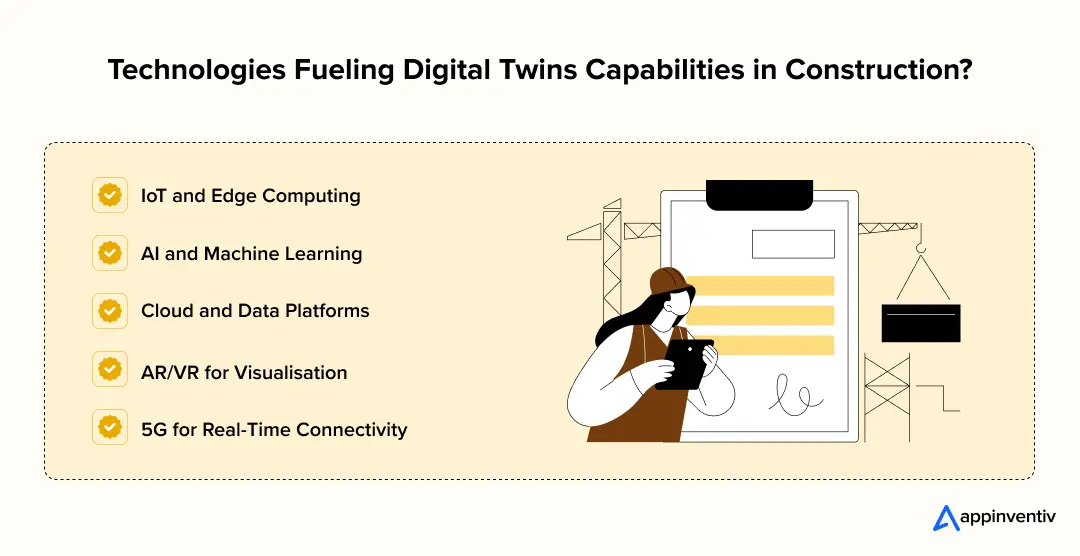
Edge Computing & Site IoT: Ruggedised sensors provide real-time structural telemetry, while edge nodes process data on-site to bypass the latency issues typical of remote Australian projects.
Predictive AI Analytics: Machine learning algorithms and artificial intelligence in Australia ingest historical site data to forecast potential schedule slippages or budget overruns weeks before they impact the critical path.
Sovereign Data Platforms: IRAP-certified, onshore cloud environments ensure all project-sensitive data remains within Australian borders, satisfying the strict requirements of the SOCI Act.
AR-Driven Field Validation: Site supervisors utilise augmented reality to overlay digital design models onto physical progress, enabling immediate, high-fidelity clash detection and rework reduction.
5G/LEO Hybrid Connectivity: The maturation of 5G and satellite constellations like Starlink ensures that digital twin architecture in construction projects remains responsive, even in regional Australia
What Are the Key Challenges in Implementing Digital Twins & How to Overcome Them
Transitioning to a digital twin-led delivery model in the Australian context is not a plug-and-play exercise. It involves navigating a complex web of legacy processes, high capital requirements, and a rigid regulatory environment. For leadership team, the goal is to identify these friction points early to prevent a strategic initiative from becoming a sunk cost.
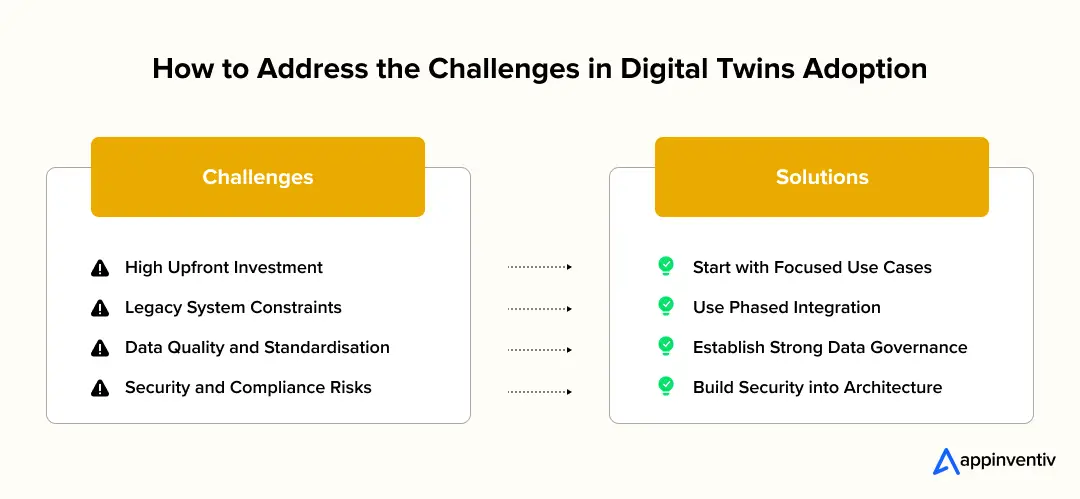
High Initial Investment
Challenge: Upfront capital for IoT and reality capture often strains project budgets before any physical construction begins.
Solution: Implement a phased “Minimum Viable Twin” focusing on high-risk zones first to prove ROI before full-scale deployment.
Integration with Legacy Systems
Challenge: Fragmented tech stacks and siloed spreadsheets prevent the seamless flow of data required for a functional digital twin.
Solution: Adopt an API-first middleware strategy using open standards like IFC to bridge the gap between legacy systems like ERPs and modern twins.
Data Accuracy and Standardisation Issues
Challenge: Inconsistent field reporting leads to “digital drift,” where the virtual model no longer reflects the actual site condition.
Solution: Establish a Common Data Environment (CDE) with automated validation protocols to ensure all incoming data meets strict quality benchmarks.
Cybersecurity and Data Privacy Risks
Challenge: Construction data is a prime target for breaches, complicated by strict Australian SOCI Act and privacy compliance mandates.
Solution: Deploy zero-trust architectures and utilise IRAP-certified, onshore cloud storage to ensure data sovereignty and board-level security assurance.
How Much Does It Cost to Implement Digital Twin Solutions in Construction?
The implementation cost of digital twin technology in Australian construction projects typically ranges from AUD 70,000 to AUD 700,000+, depending on scope, integration depth, and analytics capability. Smaller pilots focus on specific use cases, while enterprise deployments involve full-scale integration across systems and assets.
Here is a brief table outlining the digital twin project development costs in Australia for construction projects based on different project complexities:
| Project Scale | Typical Investment Range (AUD) | Primary Focus |
|---|---|---|
| Small-scale Pilot | 70,000 – 150,000 | Asset tracking or targeted safety monitoring |
| Mid-scale Project | 150,000 – 400,000 | Multi-storey residential or local infrastructure |
| Enterprise Platform | 400,000 – 700,000+ | Precinct developments or national infrastructure portfolios |
Primary Cost Drivers
- Data Infrastructure: Establishing the 5G/LEO connectivity backbone and secure cloud environments.
- Sensor Deployment: The physical cost of IoT hardware and specialised installation.
- Integration Complexity: Custom API development to sync with legacy Australian accounting and PM tools.
- AI Capabilities: Licensing fees for predictive analytics engines and automated clash detection.
Hidden Costs Drivers
Beyond the initial implementation, you must account for the “soft” costs that can erode project margins if not anticipated:
- Data Governance and Cleaning: The ongoing cost of ensuring field data remains accurate and standardised across multiple subcontractors.
- Maintenance and Digital Calibration: As the physical building evolves or undergoes maintenance, the digital model must be updated to prevent “digital drift.”
- Training and Organisational Change: The investment required to upskill site engineers to move from manual reporting to data-driven exception management.
Get a clear roadmap to implement digital twins with full cost, compliance, and integration visibility.
What is the ROI of Digital Twins in Construction Projects?
Calculating the return on investment for digital twin applications in Australian construction projects requires a shift from viewing technology as an overhead to viewing it as a risk-mitigation tool. In 2026, the ROI is measured in “days of delay avoided” and “basis points of margin protected.”
A 2025 analysis of Australian infrastructure indicated that projects utilising high-fidelity digital twins saw a 12% reduction in total lifecycle costs compared to those using traditional BIM-only workflows.
| ROI Driver | Operational Impact | Typical Commercial Outcome |
|---|---|---|
| Predictive Logistics | Reduced site congestion | 4–6% saving on plant hire and logistics |
| Virtual Commissioning | Faster system testing | 20% reduction in pre-handover defects |
| Automated Compliance | Real-time WHS auditing | Lower insurance premiums and legal risk |
| Energy Optimisation | Post-occupancy tuning | 15% reduction in annual utility expenditure |
The true ROI lies in the avoidance of “black swan” events. By simulating stress scenarios such as extreme weather events or supply chain collapses, enterprise leaders can stress-test their project’s financial and physical integrity before a crisis occurs. This level of foresight is what secures a firm’s reputation in the Australian market as a reliable delivery partner.
How to Implement Digital Twins in Construction Projects
Successfully adopting the digital twin implementation process in Australian construction requires a structured, engineering-led framework. For the Australian businesses, this process must account for local supply chain realities and specific geographical challenges.
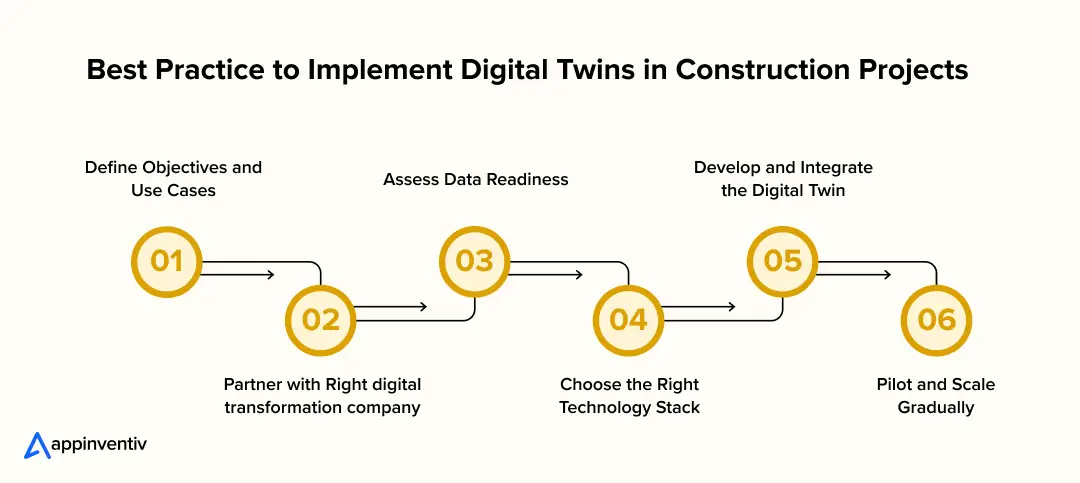
Step 1: Define Objectives and Use Cases
Identify specific commercial goals, such as risk mitigation or ESG compliance. In the 2026 Australian market, a “narrow and deep” focus on high-value pain points yields the fastest ROI.
Step 2: Partner with a Leading Digital Transformation Company
Outsource a digital transformation company in Australia with local delivery experience. The right partner bridges the gap between site reality and the high-fidelity data environment required by the board.
Step 3: Assess Data Readiness and Choose the Tech Stack
Audit existing data silos and BIM maturity. Prioritise open-standard APIs to ensure the platform handles massive “point cloud” data from LiDAR and drones without system bottlenecks.
Step 4: Develop and Integrate the Digital Twin
Embed IoT sensors into critical structural elements and establish a Common Data Environment. Integration must be bi-directional, pushing real-time “clash alerts” and schedule updates back to field teams.
Step 5: Pilot and Scale Gradually
Commence with a specific precinct or structural phase to document efficiency gains. Use these pilot results to build the internal business case for scaling across the national portfolio.
Translate your digital twin strategy into a structured rollout aligned with cost, integration, and compliance realities.
What Is the Future of Digital Twins in the Australian Construction Industry?
The trajectory of digital twins in construction in Australia is moving toward fully autonomous, carbon-aware ecosystems. For Aussie innovators, these are the shifts defining the next capital expenditure cycle.
AI-Driven Autonomous Construction Sites
Digital twins are evolving from passive monitoring to active control. In the coming years, we are poised to witness twins integrated with autonomous plant equipment, where the digital model live-updates the mission parameters for robotic excavators and 3D concrete printers.
Integration with Smart Cities and Urban Planning
Individual building twins are being federated into “Precinct Twins.” This allows Tier 1 developers to simulate how a new high-rise impacts the local Sydney or Melbourne microclimate, traffic flow, and utility grid in real-time.
Sustainability and Carbon Tracking
Driven by the Australian government’s 2030 targets, digital twins now serve as the primary ledger for “Embodied Carbon.” They track the footprint of every cubic metre of material from the source to the site, automating ESG reporting.
Convergence with Robotics and Automation
The “Human-in-the-loop” model is thinning. Digital twins are now the “brains” behind site-roving robots (like Boston Dynamics’ Spot) that perform 24/7 autonomous safety audits and thermal inspections without human intervention.
How Appinventiv Can Help with Digital Twin Construction Projects in Australia?
For many organisations, the real challenge is not understanding digital twins but executing them in live construction environments without disrupting delivery timelines. This is where selecting the right construction software development company becomes a critical decision.
Appinventiv operates as an approved ICT Supplier to the Australian Digital Transformation Agency (DTA) focuses on building custom, scalable digital twin systems aligned with enterprise and infrastructure-grade requirements. The approach prioritises integration, governance, and long-term operability.
With over a decade of experience in APAC delivery and a robust presence across five agile delivery centres in Australia, our focus remains on solving the “execution gap” that often stalls large-scale digital transformations in Australia.
The approach is grounded in the reality of the Australian market:
- Sovereign Capability: Ensuring all digital twin architecture in construction projects meets ISO and SOC2 standards with a 99.50% security compliance SLA, keeping sensitive infrastructure data onshore.
- Proven Impact: Delivering up to 35% efficiency gains for Australian enterprises by replacing manual reporting cycles with automated, real-time telemetry.
- Scalable Architecture: Moving beyond basic BIM to deploy living digital assets, a process reflected in over 250 successful digital deployments across the region.
Ranked as one of APAC’s High-Growth Companies by Statista and the Financial Times for two consecutive years, we boasts a 96% client retention rate with deep expertise in 35+ industries. This ensures that your digital twin transition is not just a technical upgrade, but a structural improvement to your project’s ROI and long-term asset value.
Is Your Project Ready for a Digital Twin? Don’t guess your digital maturity. Request a gap analysis for digital twin readiness from Appinventiv’s Australian engineering team. We’ll audit your current BIM workflows and provide a roadmap for SOCI-compliant implementation.
FAQs
Q. What are digital twins in construction?
A. A digital twin is a live, virtual replica of a physical asset (like a Sydney high-rise or a regional rail link). Unlike static 3D models, it utilises a continuous bi-directional data flow from on-site IoT sensors and reality capture to provide real-time structural telemetry, schedule forecasting, and SOCI Act-compliant data oversight.
Q. How are digital twins used in Australian construction projects?
A. Digital twins in construction in Australia are used for real-time progress monitoring, predictive maintenance of heavy machinery, and simulating complex logistical sequences to avoid costly delays in major urban precincts.
Q. How much does it cost to implement digital twins in Australian construction?
A. The cost of digital twin implementation in Australian construction projects typically ranges from AUD 70,000 to AUD 700,000+, depending on sensor density, integration complexity, and data sovereignty requirements.
Q. How long does it take to implement digital twin technology in Australian construction projects?
A. The timeline for digital twin implementation in Australia varies. A pilot phase typically takes 3–5 months, while a full-scale enterprise integration for a major infrastructure project can span 12–18 months.
Q. How does BIM integrate with digital twins on large infrastructure projects in Australia?
A. BIM provides the foundational 3D design data. The digital twin then “wraps” around this model, adding a live layer of IoT telemetry and AI analytics to turn the static design into a dynamic operational tool.

- In just 2 mins you will get a response
- Your idea is 100% protected by our Non Disclosure Agreement.

Construction CRM Integration and Implementation – Benefits, Process, Costs
Efficiency is everything when it comes to the construction sector. Factors like project cost overruns, late delivery, mismanagement of resources, or poor and confusing communication from clients may lead to derailment of the projects at a significant loss. Traditional methods have failed to meet the challenges of tighter timelines and greater complexity that modern construction…

How Much Does it Cost to Build a White Label Construction Accounting Software?
By 2050, Autodesk predicts cranking out around 13,000 new buildings every single day to keep up with a massive urban population of 10 billion people. The need for new housing, schools, and hospitals is a big part of the puzzle—but it’s just the tip of the iceberg. The real hustle? Managing finances. Tracking expenses, processing…

10 Smart Building Technologies Revolutionizing Facility Management
Managing buildings has come a long way from simply ensuring the lights work and the heating is on. Today, technology is changing how facilities are run, making operations smoother, more energy-efficient, and responsive to the needs of occupants. From systems that automatically adjust lighting and temperature to maintenance that can be predicted before issues arise,…