






























Customer Experience Automation (CXA) for Australian Enterprises


- The Australian CX Landscape: Constraints That Shape Automation Strategy
- Core CX Touchpoints Enterprises Are Automating Today
- Core Building Blocks for Customer Experience Automation for Australian Enterprises & How to Overcome Them
- Real World Applications of AI in Customer Service
- The Measurable Benefits of Customer Experience Automation
- CX Automation Failure Patterns: Why Programs Stall, Even with the Right Tools
- How Australian Enterprises Implement CX Automation Without Losing Control
- How Appinventiv Supports CX Automation for Australian Enterprises
- FAQs

Key takeaways:
- CX automation scales in Australian enterprises only when escalation, audit trails, and accountability are designed before rollout.
- Weak customer data and orchestration choices undermine CX automation faster than any platform limitation.
- AI improves CX outcomes when it supports routing and prediction, not when it replaces judgement in regulated interactions.
- CX automation succeeds when enterprises sequence implementation in controlled phases, fixing data and escalation gaps before scaling automation across channels.
Across Australian enterprises, customer experience has become a structural pressure point. Service volumes continue to rise while labour availability tightens and regulatory scrutiny increases. Boards now expect predictable service quality across digital and assisted channels without proportional cost growth.
This shift is visible in adoption patterns. Over half of Australian businesses, around 57%, now use AI in customer services. That figure reflects more than experimentation. It signals a transition away from manual, queue-based service operations toward automated, data-driven experience management.
Customer experience automation for Australian enterprises is therefore no longer about deploying isolated tools. It is about rethinking how customer journeys are designed, governed, and executed at scale.
What follows examines how enterprises are approaching CX automation as a long-term operating capability. The focus is on execution under Australian regulatory realities, security expectations, and cost discipline.
Assess where customer experience automation fits within your operating model, governance requirements, and service constraints.

The Australian CX Landscape: Constraints That Shape Automation Strategy
Automation programs do not fail in Australia because of technology. They fail because constraints are underestimated or discovered too late. Some key constraints that businesses need to pay attention to from the very start of CX automation are:
Governance Expectations
In Australia, customer-facing automation increasingly sits within enterprise governance and risk frameworks. Automated decisions are no longer treated as operational details. Boards and risk committees review them as control points.
When a customer challenges an outcome, enterprises are expected to explain how the system behaved, what data was used, and whether escalation was available. This expectation aligns closely with oversight from bodies such as the Office of the Australian Information Commissioner (OAIC) and, in regulated sectors, operational risk standards like APRA CPS 234.
Automation that cannot be explained or audited does not survive risk review.
Privacy, Consent, and Data Boundaries
Australian customers are highly sensitive to how their data moves across systems. Consent is expected to follow the customer, not the channel. Automation that ignores this principle creates friction and, in some cases, regulatory exposure under the Privacy Act 1988.
Data residency also plays a role. Many enterprises operate hybrid environments, with customer data split across onshore platforms and offshore cloud services. Customer experience automation platform development must respect these boundaries without introducing latency or fragmentation.
These considerations often shape architecture choices more than performance targets.
Accessibility Is a Structural Requirement
Automation strategies that assume a fully digital customer base tend to break down. In government, utilities, healthcare, and energy, assisted service remains critical.
Inclusive design affects how automated journeys are structured. It dictates escalation paths, channel availability, and fallback options. Accessibility is not an enhancement. It is a constraint that must be designed into CX automation from the start.
Workforce and Change Reality
Automation touches people before it touches systems. In many Australian enterprises, workforce structures are formal, regulated, or unionised. Automation initiatives framed purely around efficiency gains often encounter resistance.
Programs that succeed focus on workload reduction, service consistency, and role clarity. Training, transition planning, and clear communication matter as much as the automation logic itself.
Trust and Reputation
Australian customers are less forgiving of opaque failures. A broken automated interaction in a regulated or essential service context can escalate quickly.
As a result, automated customer experience for Australian enterprises is often introduced in stages. Reliability and recoverability are prioritised over speed. Rollback mechanisms are defined early. Monitoring is continuous, not periodic.
These constraints shape better automation. They force discipline.
Core CX Touchpoints Enterprises Are Automating Today
Australian enterprises concentrate CX automation on touchpoints where service volume, cost pressure, and risk intersect. If you want to automate your CX, staying aware of these critical touchpoints is non-negotiable to get started:
Customer Onboarding and Verification
Onboarding is one of the first areas AU organisations consider automating. Automated workflows handle identity checks, document validation, and application status updates. This reduces cycle time and limits manual rework.
In regulated environments, it also improves traceability. Every step is logged. Every decision can be reviewed.
Service Requests and Support Operations
Customer service automation solutions are most common in high-volume service environments. Automated intent recognition and routing reduce queue times and misdirected cases.
Routine enquiries are resolved without agent involvement. Complex or sensitive matters are escalated early, not after multiple handoffs. This improves resolution rates and reduces customer frustration.
Digital Engagement and Contextual Updates
Automation is applied cautiously to engagement. Here, enterprises focus on relevance rather than frequency. Customers receive updates based on status or behaviour, not blanket messaging.
This approach supports engagement without increasing privacy risk or consent complexity.
Feedback, Complaints, and Early Warning Signals
Feedback handling is increasingly automated. You can automate acknowledgement, categorisation, and prioritisation systematically to meet response obligations.
At this touchpoint, sentiment analysis is used to flag emerging issues before they become formal complaints. This allows service teams to intervene earlier and more consistently.
Core Building Blocks for Customer Experience Automation for Australian Enterprises & How to Overcome Them
Customer experience automation succeeds only when foundational components can withstand scale, governance, and operational pressure. With that said businesses in AU must focus on overcoming building blocks that enforce data integrity, decision control, and escalation clarity from day one. Some common stumbling blocks for CX automation are:
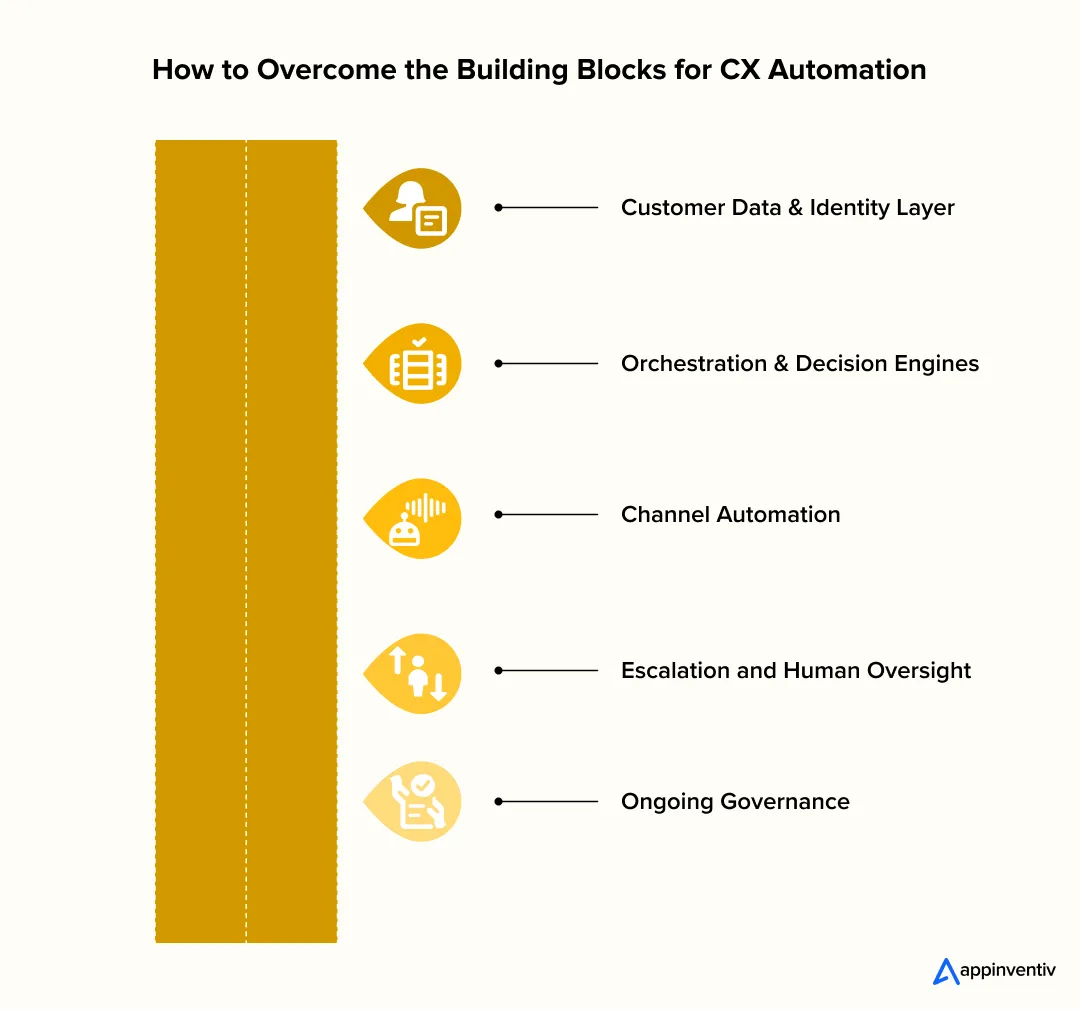
Customer Data and Identity Layer
Automation forces systems to act decisively. That only works when customer identity, consent status, and preferences are reliable at the point of interaction. Fragmented records across CRM, billing, and service platforms surface immediately once automation goes live.
How enterprises respond:
They stabilise identity resolution and consent enforcement first, rather than attempting broad data consolidation.
Orchestration and Decision Control
Orchestration defines what automation may decide and when it must stop. In regulated interactions, predictability matters more than sophistication. Programs struggle when decision logic becomes opaque or scattered across systems.
How enterprises respond:
They centralise orchestration and define clear decision boundaries that remain explainable under challenge.
Channel Enablement
CX automation rarely runs through a single channel. Problems emerge when logic sits inside channels instead of behind them, creating inconsistent outcomes.
How enterprises respond:
They keep channels lightweight and place experience logic centrally, preserving consistency as channels evolve.
Escalation and Human Oversight
Automation increases risk when it cannot pause. Complaints, vulnerability signals, and regulatory triggers require deliberate interruption, not best-effort handling.
How enterprises respond:
They design escalation paths upfront and preserve full context when handing off to human teams.
Ongoing Governance
Customer experience automation for Australian enterprises does not stabilise on its own. Rules drift, edge cases grow, and service patterns change.
How enterprises respond:
They review automation behaviour continuously and treat CX automation as an operating system, not a one-off build.
High-Impact CXA Use Cases Across Australian Industries
CX automation does not scale uniformly across industries. Value comes from aligning automation to service volumes, risk exposure, and regulatory sensitivity specific to a particular industry, rather than applying a standard model everywhere.
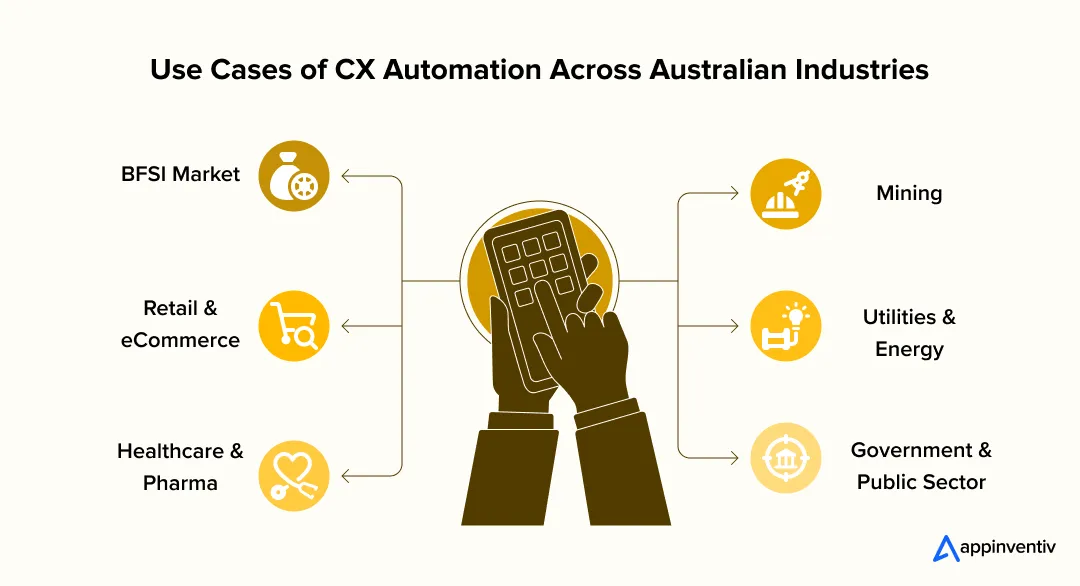
Banking, Financial Services, and Insurance
In BFSI, CX automation targets consistency and auditability first. Onboarding verification, transaction enquiries, dispute intake, and policy servicing dominate early use cases.
Where programs differentiate is escalation discipline. Interactions involving financial hardship, fraud indicators, or disputed outcomes are flagged early for human review. This protects fairness while reducing remediation and audit risk.
Mining
Mining organisations apply CX automation beyond traditional customer service. Contractor onboarding, safety incident reporting, access approvals, and service coordination across remote sites are common.
Automation here improves reliability, not volume reduction. Predictable workflows reduce administrative friction in environments where delays translate directly into operational cost.
Also Read: The Role of AI in Mining Operations in Australia
Retail and eCommerce
Retail enterprises use AI driven automation for order management, returns, delivery enquiries, and post-purchase support. Seasonal demand volatility makes manual scaling impractical.
More mature programs integrate CX automation with inventory and logistics data. This enables proactive communication rather than reactive support, reducing inbound demand during peak periods.
Utilities and Energy
Utilities rely on CX automation to manage billing enquiries, outages, meter services, and hardship support. These interactions attract both regulatory scrutiny and public attention.
Automation must be transparent. Customers expect clear reasoning behind decisions affecting billing or service continuity. Where escalation paths are visible, complaint volumes remain controlled.
Healthcare and Pharma
Healthcare organisations use AI primarily for administrative and non-clinical interactions. Common use cases include appointment scheduling, patient and provider communications, prescription status updates, trial enrolment queries, and adverse event intake workflows.
The primary benefit is operational relief. Automation reduces administrative load on clinical and pharma teams without weakening consent or data protection controls.
Government and Public Sector
Public sector CX automation prioritises accessibility and audit readiness over speed. Common use cases include eligibility verification, appointment scheduling, case status updates, and enquiry triage across digital and assisted channels.
These interactions benefit from automation because outcomes should be consistent and rule-based. Also, it allows agencies to improve access and response times without undermining transparency or public trust.
Real-World Applications of AI in Customer Service
AI adoption within CX automation continues to expand, but Australian enterprises apply it selectively. The emphasis is operational fit, reliability, and explainability rather than novelty. Some key examples of customer experience automation are:
Real World Applications of AI in Customer Service
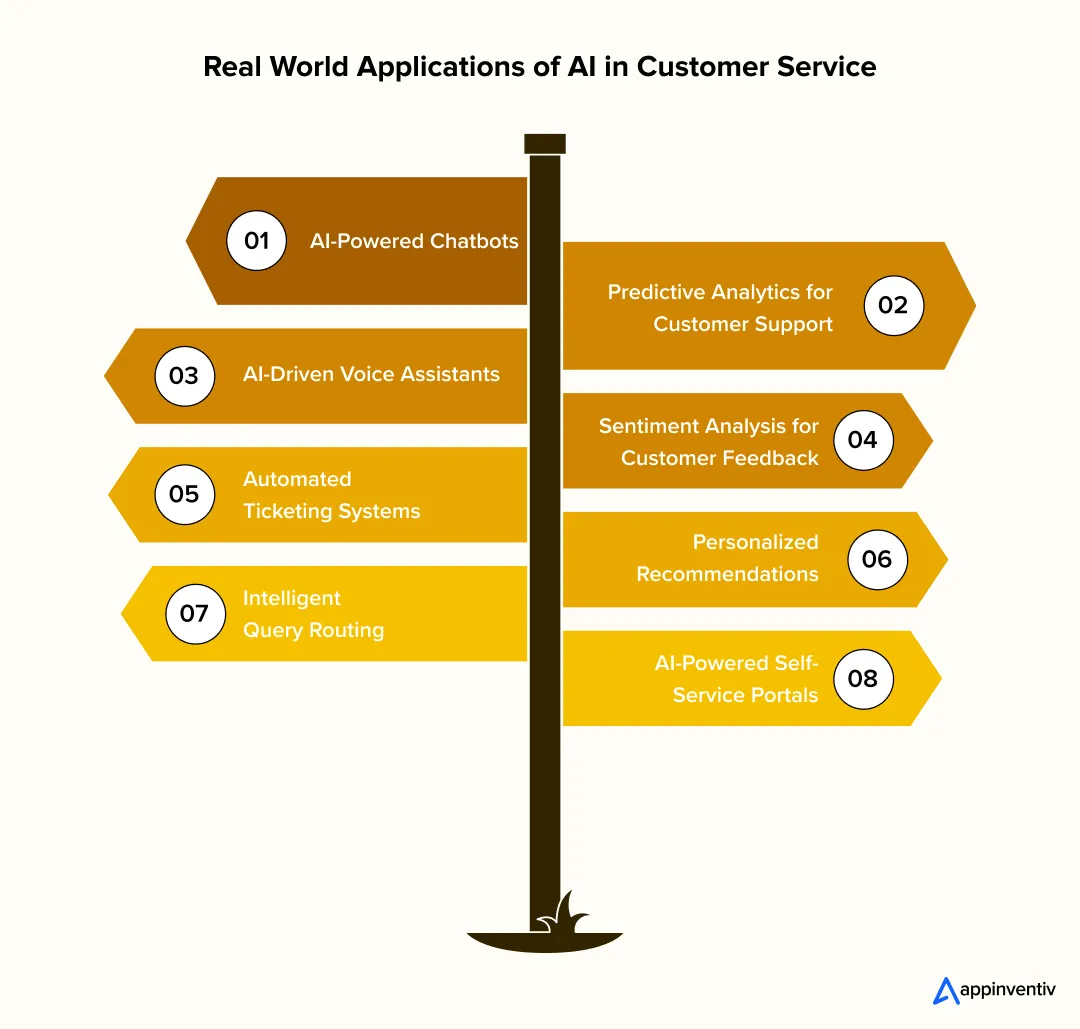
AI-Powered Chatbots
AI Chatbots in Australia are used for structured enquiries and guided workflows. Their value lies in consistency and availability, not conversational depth.
Predictive Analytics for Customer Support
Predictive models surface feasible issues before customers escalate. Utilities, telecom, and financial services use this to trigger proactive communication. The benefit is reduced inbound demand, provided predictions are transparent and actionable.
AI-Driven Voice Assistants
Voice automation for businesses supports routing, authentication, and information retrieval. It reduces handling time while preserving access for customers who prefer assisted channels.
Sentiment Analysis for Customer Feedback
AI for sentiment analysis identifies dissatisfaction patterns across channels. It is particularly effective for complaint monitoring and service quality assurance.
Automated Ticketing Systems
AI-driven classification improves routing accuracy and reduces rework. In regulated environments, consistency outweighs speed.
Personalised Recommendations
Personalisation is applied conservatively in Australia. Enterprises prioritise relevance and consent boundaries over aggressive cross-selling.
Intelligent Query Routing
Routing based on intent, complexity, and risk ensures interactions reach the appropriate teams without repeated handoffs.
AI-Powered Self-Service Portals
Self-service portals give customers control within defined workflows. Their effectiveness depends on clear boundaries and visible escalation options.
Taken together, these examples of customer experience automation show how AI-powered customer experience in Australia evolves when control and trust remain central to design decisions.
The Measurable Benefits of Customer Experience Automation
With projections indicating that 40% of customer interactions will be automated through AI and machine learning algorithms, the value of CX automation is undeniable. However, customer experience automation benefits do not show up as a single uplift metric. They emerge as second-order operational advantages once automation is embedded into core service workflows. Some measure outcomes of AI-powered customer experience in Australia are:
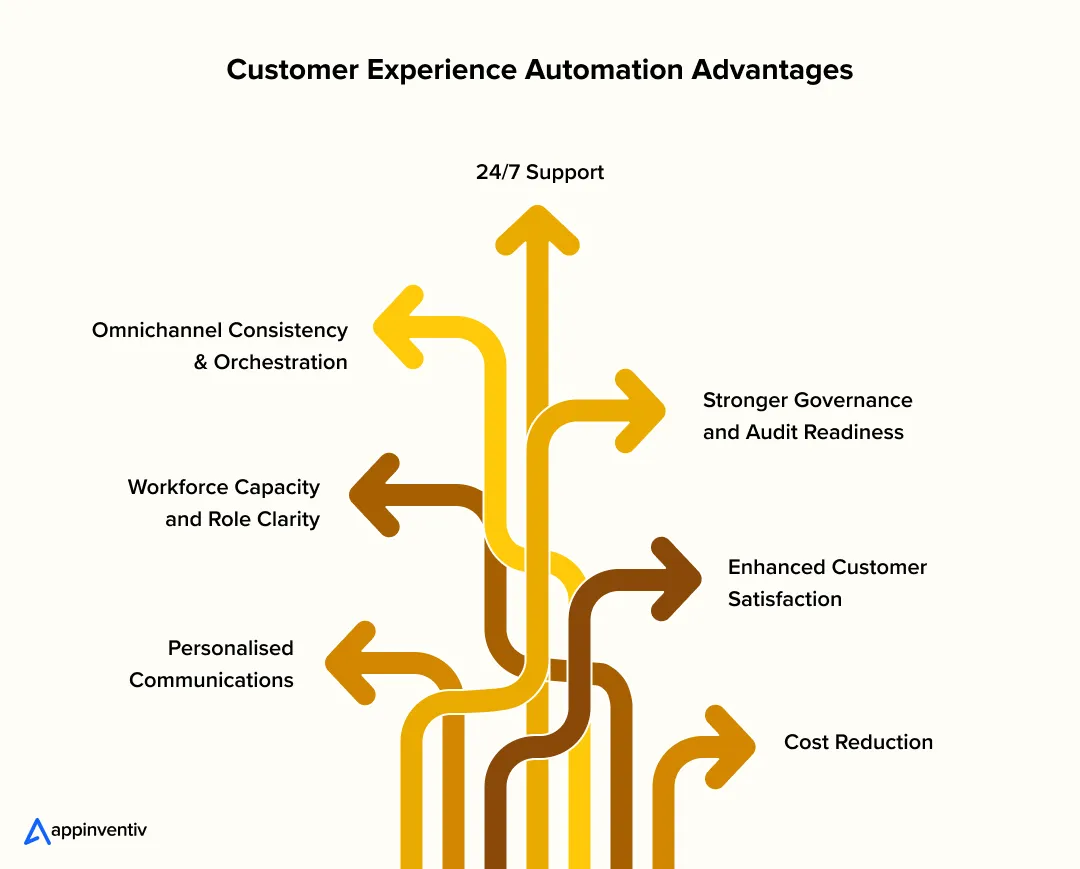
24/7 Support
CX automation enables round-the-clock handling of routine enquiries, status checks, and service requests. This ensures consistent availability without extending staffing models or increasing operational risk.
Structural Cost Control, Not Short-Term Savings
Cost reduction comes from fewer repeat interactions, lower rework rates, and improved first-contact resolution. Enterprises that chase headline cost savings through aggressive deflection often see customer satisfaction and trust decline within months.
Stronger Governance and Audit Readiness
Well-designed automation enforces policy consistently. Decision logic is applied uniformly, reducing variance caused by manual handling. Over time, this lowers remediation effort and simplifies audit response across regulated interactions.
Workforce Capacity and Role Clarity
Automation absorbs repetitive workload and allows skilled staff to focus on judgement-heavy cases. The benefit is not headcount reduction, but improved utilisation and reduced burnout in service teams.
Enhanced Customer Satisfaction
Customers respond positively to predictable, timely, and consistent outcomes. Automation improves satisfaction by reducing wait times and errors, especially in high-volume service interactions.
Personalised Communications
Automation supports context-aware updates and reminders based on customer status or behaviour. When applied conservatively, this improves relevance without breaching consent or Australia’s data privacy expectations.
Omnichannel Consistency and Orchestration
CX automation aligns decisions, context, and outcomes across digital and assisted channels. Centralised orchestration ensures customers receive consistent responses without repeated handoffs or conflicting information.
CX Automation Failure Patterns: Why Programs Stall, Even with the Right Tools
Most CX automation failures are not technical. They are design and governance failures that surface only after scale. Being aware of these patterns is the only way to steer away the failure and make your CXA successful.
Common Failure Patterns in Australian Enterprises
| Failure Pattern | What Goes Wrong in Practice | Business Impact |
|---|---|---|
| Automating Before Fixing Journeys | Automation accelerates unclear or broken processes | Higher complaint volume, lower CSAT |
| Tool-Led CX Strategy | Platforms selected before outcomes and escalation rules | Low adoption, stalled ROI |
| Weak Escalation Design | Customers trapped in automation loops | Reputational damage, regulator scrutiny |
| Opaque Decision Logic | Automated outcomes cannot be explained | Audit risk, remediation exposure |
| Ignoring Workforce Impact | Teams unclear on new roles and controls | Resistance, shadow processes |
| Overusing AI Autonomy | AI applied to judgement-heavy scenarios | Trust erosion, bias concerns |
Enterprises that avoid these patterns treat CX automation as an operating model change, not a technology deployment.
How Australian Enterprises Implement CX Automation Without Losing Control
Aussie businesses do not implement CX automation to experiment. They implement it to stabilise service delivery under regulatory, workforce, and cost pressure. That changes how execution must happen. Here is a step by step CX automation implementation process for enterprises:
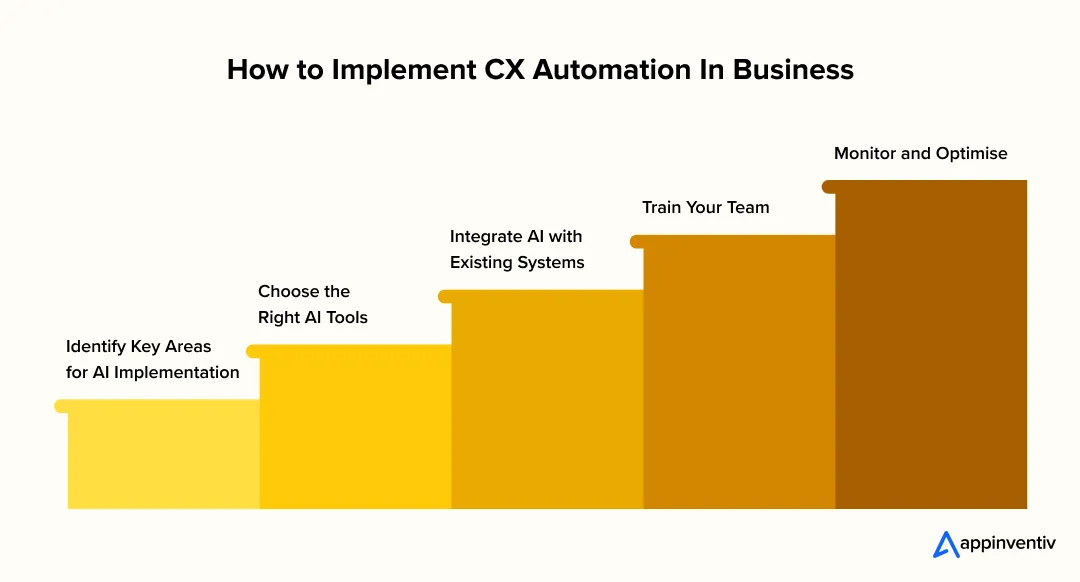
Step 1: Lock the Problem Before You Touch Technology
Effective CX programs start by isolating specific service failures. This is the initial stage where you need to figure out where inconsistency, delay, or rework is creating measurable risk. The aim here is not to automate “customer experience” broadly, but to define interaction types with clear outcomes.
When you skip this step, automation scales confusion instead of resolving it.
Step 2: Choose the Right AI Tools
Once priorities are clear, the next vital step is to select AI tools that align with your CX architecture and governance requirements. When choosing the AI technologies, your focus should remain on explainability, integration capability, and decision control rather than standalone features.
This discipline prevents later intervention from risk, legal, or compliance teams once automation is live.
Step 3: Integrate AI Into Existing Systems
Customer experience automation software development for enterprises in Australia almost always sits on top of CRM, billing, and service platforms. It means you need to integrate automation into existing workflows rather than routing around them.
This approach preserves data lineage, simplifies audit review, and avoids creating parallel systems that teams distrust.
Step 4: Train Teams to Control Automation
As automation goes live, equip teams to monitor outcomes, manage exceptions, and intervene when escalation is required. Clear role definition ensures automation strengthens service delivery rather than creating uncertainty.
Step 5: Monitor and Optimise CX Automation
Australian enterprises review automation logic continuously. They adjust rules as customer behaviour changes, regulation evolves, and service pressure shifts.
Static automation decays quickly. Controlled iteration keeps CX automation aligned with business reality.
Also Read: How to Build an AI App in Australia: A Complete Guide
Review your current CX landscape, identify automation-ready touchpoints, and assess data and governance readiness before scaling automation across the enterprise.

How Appinventiv Supports CX Automation for Australian Enterprises
As customer experience automation for Australian enterprises moves from pilot initiatives to core service infrastructure, businesses begin to look for an artificial intelligence development company in australia who can operate within real-world constraints. Governance expectations, legacy platforms, and service accountability quickly expose the limits of tool-led automation.
At Appinventiv Australia, we work with enterprises at this transition point. Our focus is on building customer experience automation that integrates into existing operating models, holds up under audit, and remains adaptable as service demands change.
We specialise in customer experience automation software development for enterprises in Australia, particularly where off-the-shelf platforms struggle to meet governance or scalability requirements. Our team of 1700+ tech experts works alongside enterprise architecture, risk, and service leaders to ensure automation decisions remain explainable and controllable.
Where enterprises typically engage us:
- Designing CX automation architectures that align with Australian compliance and data governance expectations
- Modernising legacy CX workflows without disrupting live service operations
- Implementing AI-driven automation with clear escalation, override, and audit controls
- Scaling automated customer experience across multiple channels while preserving consistency
Across Australia, we have deployed 3000+ digital assets, including 300+ custom AI solutions, supported organisations across 35+ industries, and maintained a 78% client retention rate. With 10+ years of APAC delivery experience and 5+ agile delivery centres across Australia, we combine local execution capability with enterprise delivery discipline.
Our delivery consistently meets 99.5% security compliance SLAs across ISO and SOC2-aligned environments. Once automation stabilises, Australian enterprises typically realise around 35% efficiency gains, driven by reduced rework, lower escalation volumes, and more predictable service delivery.
Discuss your project vision with us and build CX automation that holds up under real enterprise scale and governance.
FAQs
Q. What is customer experience automation for enterprises?
A. Customer experience automation for enterprises refers to the deliberate use of software, orchestration layers, and AI to manage customer interactions at scale while maintaining control, auditability, and escalation.
Enterprises use it to stabilise service delivery, reduce variability, and enforce consistent decision logic across channels. Unlike basic automation, enterprise CX automation operates within governance, security, and compliance frameworks rather than bypassing them.
Q. What is a customer experience strategy?
A. A customer experience strategy defines how an organisation designs, governs, and delivers customer interactions across the full lifecycle. At the enterprise level, it aligns service outcomes with operating models, regulatory obligations, and cost structures.
A strong CX strategy determines where automation applies, where human judgement remains essential, and how accountability is preserved as service volumes grow.
Q. How can AI improve customer experience in Australian enterprises?
A. AI improves customer experience in Australian enterprises by reducing inconsistency rather than replacing judgement. Enterprises apply AI to triage requests, predict service demand, route interactions, and surface risk signals early. When bounded correctly, AI improves response times, reduces rework, and supports service teams without undermining trust, consent, or explainability requirements.
Q. How much does it cost to implement CX automation in Australia?
A. The cost of CX automation in Australia typically ranges between AUD 70,000 and AUD 700,000, depending on scope, integration depth, and governance requirements.
- AUD 70,000–150,000 for focused automation within existing customer service platforms
- AUD 150,000–350,000 for multi-channel CX automation with orchestration and escalation controls
- AUD 350,000–700,000+ for enterprise-wide CX automation involving AI, legacy integration, and compliance-led architecture
Enterprises should assess the cost of AI development alongside long-term ownership, audit readiness, and operational resilience rather than upfront build alone.
Q. How long does it take to implement CX automation in customer service?
A. The implementation of customer experience automation for Australian enterprises typically spans 4 to 12+ months, depending on scope and complexity.
- 4–6 months for targeted automation within existing customer service workflows
- 6–9 months for multi-channel automation with orchestration and escalation controls
- 9–12+ months for enterprise-wide CX automation involving AI, governance, and legacy integration
Most organisations roll out automation in phases to reduce risk and stabilise service delivery before scaling further.
Q. What are the main challenges of automating customer experience for Australian enterprises?
A. The key challenges AU organisations face when automating customer experience are:
- Fragmented customer data and inconsistent identity records
- Unclear escalation and override rules for automated decisions
- Governance and audit requirements emerging late in delivery
- Limited transparency in AI-driven decision logic
- Workforce resistance due to poor change and role planning
- Over-automation of judgement-heavy or regulated interactions

- In just 2 mins you will get a response
- Your idea is 100% protected by our Non Disclosure Agreement.

AI Voice Receptionist Development: Business Use Cases, Technology Architecture, and Cost
Key takeaways: Start with real call use cases, not tech. Define high-frequency intents, workflows, and escalation paths before building anything. Build a low-latency voice pipeline. Reliable telephony and real-time audio streaming make conversations feel natural. Set up the core AI loop. STT→LLM→TTS should handle intent, context, and responses in near real time. Ground responses with…

Key takeaways: Generative AI specialises in content synthesis and creation, while Agentic AI focuses on autonomous reasoning and multi-step task execution. Targeted benefits of generative AI and agentic AI in Australia include nearly a 35% reduction in operational bottlenecks and 70% faster workflows. Prioritise Gen AI for workforce augmentation and Agentic AI for high-stakes, autonomous…

How Much Does It Cost to Build a Conversational AI Chatbot in the UAE?
Key Takeaways AI chatbot development in the UAE typically costs AED 150,000–1,470,000 ($40K–$400K), based on complexity. Backend integration and compliance drive cost more than the chatbot interface itself. Arabic NLP, UAE hosting, and PDPL requirements increase budget and engineering effort. LLM + RAG enterprise chatbots sit at the higher end due to integration and infrastructure…