






























CRM in Banking Industry– Benefits, Challenges, Features and Integrations


- How Modern Banks Should Approach CRM Modernization
- What Are the Different Types of CRM in Banking
- CRM by Banking Segment
- Benefits and Importance of CRM in Banking for Scaling Institutions
- How Modern Banks Structure the Technical Architecture of a Banking CRM
- How Core Features of CRM in Banking Drive Operational Efficiency
- Off-the-Shelf vs Custom CRM in Banking
- Strategic Integrations That Strengthen CRM in Banking
- How to Overcome Key Challenges of CRM in Banking
- High-Impact Banking Use Cases Across Retail and Commercial Segments
- Future Outlook: Emerging CRM Trends in Banking Intelligence
- Why Choose Appinventiv for Banking CRM Transformation
- Frequently Asked Questions

- CRM in banking transforms fragmented data into a measurable revenue intelligence infrastructure.
- AI-augmented CRM workflows are becoming the operational baseline across financial institutions.
- Architecture, integration depth, and compliance controls determine long-term scalability success.
- Early structural decisions in CRM programs compound as institutions scale.
Most banks do not realize their CRM is a limitation until growth starts slowing down. Customer data sits in separate systems. Relationship managers rely on scattered notes. Marketing runs campaigns without a complete picture of who the customer actually is. Over time, this fragmentation quietly affects revenue.
Even as broader business spending slows, Deloitte forecasts that banks’ technology and transformation investments, including CRM and data infrastructure programs, will grow by approximately 3% in 2026. This signals sustained commitment to digital modernization even in constrained economic conditions.
A modern CRM in banking is no longer just a contact database. It becomes revenue infrastructure. It connects product usage, transaction history, service interactions, and risk indicators into one unified customer view. When done right, your team can see profitability by relationship, predict churn before it happens, and identify the next best opportunity with far more precision.
Siloed systems may have worked when channels were limited. Today, with digital banking, embedded finance, and real-time customer expectations, that approach creates blind spots. You need an integrated platform that ties together engagement, compliance, analytics, and operational workflows.
In this blog, we will break down the measurable business value of CRM in banking, the technical architecture behind it, the integrations that make it effective, the regulatory considerations you cannot ignore, and a practical implementation path your team can follow.
75% of CRM-enabled organizations run AI-augmented workflows.
How Modern Banks Should Approach CRM Modernization
Banks outgrow basic CRM for banking systems the moment customer data starts spreading across too many tools.
If your organization is scaling, you have likely felt this already. The mobile app team sees one version of the customer. The lending team sees another. Support pulls up a different history altogether. Everyone is working hard, but not always from the same picture.
Industry adoption patterns show that roughly 75% of CRM-enabled organizations now operate AI-augmented workflows and agentic AI in banking. Intelligent CRM is no longer a competitive experiment. It has become an operational baseline.
At first, spreadsheets and lightweight CRM tools seem enough. Then volume increases, and you need more accounts, products, and channels. That is when gaps show up.
- Customer interactions sit in different systems, and no one owns the full timeline.
- Marketing campaigns rely on broad segments instead of behavioral signals.
- Relationship managers manually piece together insights before important calls.
- Compliance teams spend extra hours reconciling logs during audits.
An advanced CRM changes the structure underneath all this. It connects core banking data, digital touchpoints, and service records into a unified model. It supports identity resolution, so one customer is not treated as three separate profiles. It allows event-driven updates instead of overnight batch syncs.
If your bank is growing, complexity grows with it. Your CRM has to keep up, or it becomes the bottleneck instead of the backbone.
Also Read: A Guide to Legacy Banking Modernization
What Are the Different Types of CRM in Banking
The types of CRM in banking are typically organized into operational, analytical, and collaborative layers, each serving a distinct technical purpose.
| CRM Type | Technical Core | System Elements | Banking Value |
|---|---|---|---|
| Operational CRM | Process and workflow execution | Case engines, onboarding modules, SLA tracking, automation rules | Standardizes sales, servicing, and compliance workflows |
| Analytical CRM | Data modeling and predictive scoring | Data warehouse integration, ML pipelines, segmentation engines, feature stores | Enables churn prediction, cross-sell modeling, and risk analysis |
| Collaborative CRM | Cross-channel synchronization | API gateways, interaction logs, omnichannel routing layers | Ensures unified customer context across mobile, branch, and contact center |
In practice, scaling banks integrate all three and choose the right CRM to support effective customer relationship management in banking. Operational CRM drives execution, analytical CRM drives insight, and collaborative CRM keeps every channel aligned.
CRM by Banking Segment
Not every banking CRM looks the same in practice. The structure changes depending on whether you operate in investment, retail, or commercial banking.
| Segment | Operational Focus | Typical CRM Configuration | Primary Data Complexity |
|---|---|---|---|
| Investment Banking CRM | Deal and mandate management | Relationship tracking across institutions, integration with capital markets systems | Multi-entity corporate hierarchies, stakeholder mapping |
| Retail Banking CRM | High-volume customer engagement driven by advanced data analytics in banking | Omnichannel coordination, campaign automation, behavioral targeting | Large-scale customer profiles and transaction histories |
| Commercial Banking CRM | SME and mid-market relationship management | Credit facility tracking, exposure roll-ups, profitability monitoring | Linked business accounts and credit structures |
Most mid-enterprise banks use a shared CRM foundation, then configure workflows and data models differently for each segment.
Benefits and Importance of CRM in Banking for Scaling Institutions
One of the core advantages of digital transformation in banking via CRM is that it increases revenue efficiency and operational control by turning customer data into measurable financial outcomes.
For scaling banks, CRM is not a front-office upgrade. It is a lever that affects retention, product penetration, servicing cost, and regulatory exposure. The impact shows up in numbers, not dashboards.
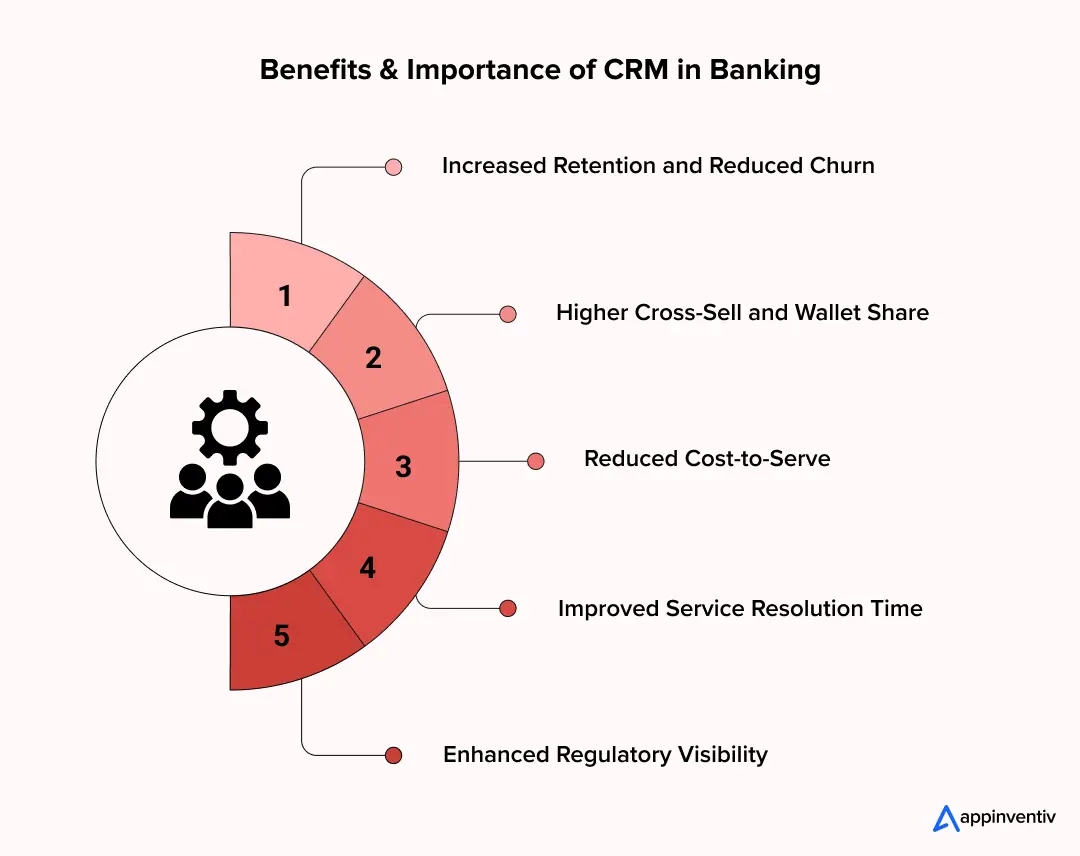
Increased Retention and Reduced Churn
When transaction behavior, service history, and engagement signals are unified, churn becomes predictable.
Instead of reacting after an account closes, your team can flag risk early using behavioral scoring models built on transaction frequency shifts, product inactivity, or complaint patterns.
Retention improvements compound over time. Even a single-digit lift can materially affect long-term customer lifetime value.
Higher Cross-Sell and Wallet Share
Disconnected data leads to generic campaigns. A unified CRM enables product affinity modeling based on income flow, borrowing history, and digital usage behavior.
This allows targeted outreach, such as identifying customers who maintain high balances but lack investment products by leveraging specialized AI in banking models. Precision increases conversion. Conversion increases wallet share.
Reduced Cost-to-Serve
Manual reconciliation, duplicate data entry, and fragmented case handling drive operational costs up.
Workflow automation and unified customer views reduce handling time per request. Relationship managers spend less time searching and more time advising.
Over time, servicing efficiency directly improves operating margins.
Improved Service Resolution Time
When every interaction is logged against a single customer profile, service teams avoid repeated questioning and misrouting. Intelligent routing based on case type and risk category shortens turnaround time.
Enhanced Regulatory Visibility
Audit-ready workflows, structured logging, and traceable customer interactions reduce compliance friction. Regulatory inquiries become easier to address because data lineage, potentially enhanced by blockchain in banking, is structured and not reconstructed.
KPI Impact Framework
These benchmarks illustrate how CRM performance translates directly into measurable financial and operational gains.
| KPI | Typical Baseline | Target Impact | CRM Enabler |
|---|---|---|---|
| Retention Rate | 80–85% | +8–15% | Predictive churn scoring |
| Cross-Sell Ratio | 1–1.5 products | +15–25% | Propensity modeling |
| Cost-to-Serve | High manual ops | -15–25% | Process orchestration |
| NPS | 30–40 | +10–20 points | Coordinated engagement |
| Service TAT | 24–72 hrs | -30–40% | Intelligent routing logic |
With reported average returns approaching 9x per dollar invested and measurable retention improvements among adopters, CRM functions as both a revenue multiplier and a revenue stabilizer for scaling institutions.
How Modern Banks Structure the Technical Architecture of a Banking CRM
A banking CRM must be engineered as a layered, event-aware system that unifies identity resolution, transactional ingestion, model scoring, and compliance enforcement within a controlled data boundary.
For a scaling financial institution, architecture is not about features. It is about how data flows, how identities are reconciled, how decisions are generated, and how every action remains auditable under regulatory scrutiny in structured CRM development services engagements.
The design has to support high write volumes from transactions, low-latency reads for servicing, and strict access control across roles.
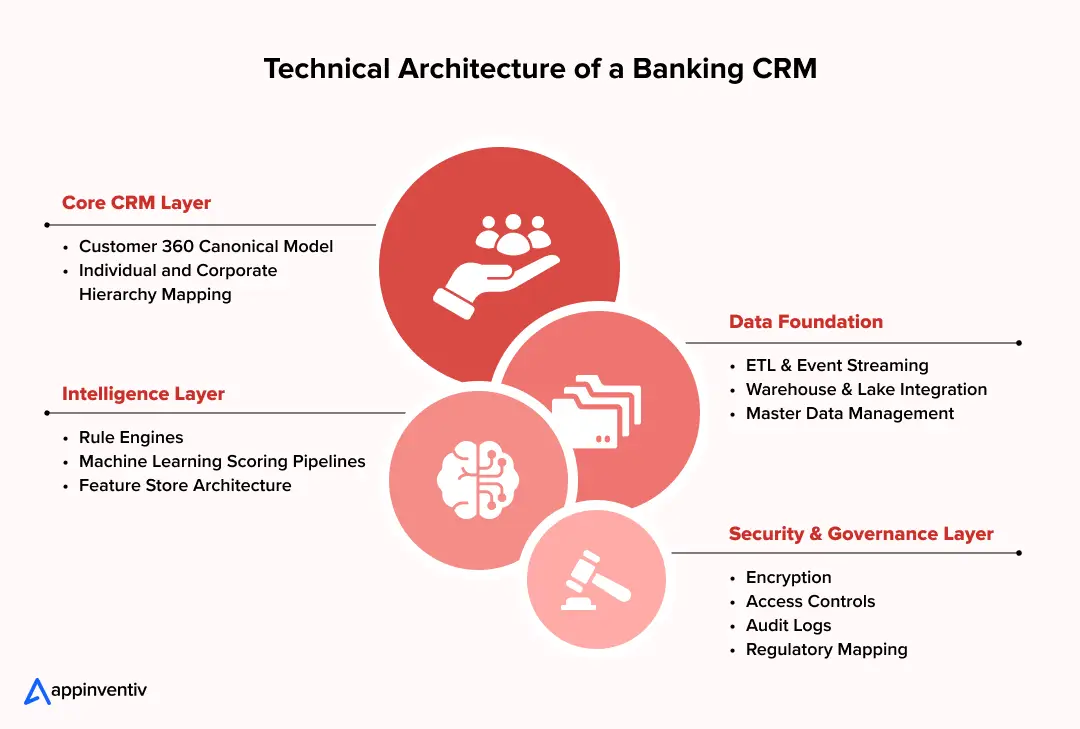
Core CRM Layer
This layer defines how customer entities exist inside the system within a modern CRM banking software architecture.
Customer 360 Canonical Model
- A normalized schema aggregates core banking data, product holdings, KYC attributes, interaction history, and risk indicators into a single logical profile.
- Identity resolution typically uses deterministic keys such as customer ID, tax ID, or CIF numbers, combined with probabilistic matching algorithms that flag duplicate or partially matching records.
Individual and Corporate Hierarchy Mapping
- Corporate structures require parent-child relationship tables or graph-based modeling.
- Exposure calculation must support roll-up queries, for example, total outstanding credit across subsidiaries.
- This often involves adjacency lists or graph databases that enable traversal queries across related entities.
- Without accurate entity modeling, analytics, and risk calculations become unreliable, especially when verifying identities through biometric technology in digital banking.
Data Foundation
This layer governs ingestion, normalization, and storage discipline.
ETL and Event Streaming
- Batch ETL pipelines handle daily reconciliation from core banking systems.
- Real-time ingestion pipelines use event brokers to capture transactional updates, service events, or IoT in banking and finance data streams as they occur.
- Change Data Capture mechanisms detect row-level updates without reprocessing entire tables.
Warehouse and Lake Integration
- Structured financial data resides in relational warehouses optimized for indexed queries.
- Semi-structured logs and clickstream payloads are stored in distributed object storage.
- The CRM queries curated and governed datasets rather than raw operational sources.
Master Data Management
- Golden records are maintained through survivorship rules.
- Attribute precedence logic determines which upstream system overrides conflicting fields.
- Data lineage tracking ensures every attribute can be traced to its origin.
This foundation prevents inconsistent reporting and duplicate identities.
Current industry data indicates that approximately 96% of CRM-using organizations now operate on cloud-based infrastructure, signaling that scalable deployment models have effectively become standard.
Also Read: Why DevOps in Banking is Critical for Scalability
Intelligence Layer
This layer operationalizes insight generation.
Rule Engines
Deterministic business rules evaluate thresholds such as transaction spikes or missed payment cycles. These rules trigger workflow states or alerts.
Machine Learning Scoring Pipelines
Supervised models to process engineered features such as rolling transaction averages, credit utilization ratios, or engagement recency metrics. Batch scoring jobs update customer risk or churn probabilities. Real-time inference APIs support low-latency decisioning during live interactions.
Feature Store Architecture
A centralized feature repository standardizes variable definitions across models. This ensures that churn scoring and cross-sell modeling use identical feature logic.
Consistency in model inputs prevents silent analytical drift.
Before examining governance controls, it is important to understand how regulatory obligations translate into architectural requirements.
Security and Governance Layer
Security mechanisms must be embedded at data, application, and access levels in any scalable CRM for the banking industry deployment.
- Data encryption uses strong symmetric algorithms at rest and secure transport protocols in transit.
- Role-based and attribute-based access controls restrict field-level visibility.
- Immutable audit logs capture read and write events with a timestamp and user identity metadata.
- Zero-trust principles enforce continuous verification and least-privilege access.
The regulatory environment shapes these controls directly.
| Regulation | Region | CRM Architectural Requirement |
|---|---|---|
| GLBA | United States | Encryption at rest and in transit, restricted access controls, formal safeguards, and policy enforcement |
| SOX | United States | Immutable audit logs, financial reporting traceability, and change management controls |
| CCPA | California, US | Consent capture, data access reporting, automated deletion workflows |
| GDPR | European Union | Explicit consent registry, data portability APIs, data minimization controls, regional data residency options |
| PSD2 | European Union | Secure API exposure, strong customer authentication support, third-party access logging |
| PCI-DSS | Global | Tokenization of card data, segmented network zones, vulnerability monitoring |
| SAMA Cybersecurity Framework | Saudi Arabia | Strict access governance, continuous monitoring, localized data control |
| UAE PDPL | United Arab Emirates | Personal data processing controls, consent tracking, breach notification capability |
| DIFC Data Protection Law | UAE Financial Free Zone | Cross-border transfer safeguards, audit trails, and lawful processing documentation |
| APRA CPS 234 | Australia | Information security capability, incident response logging, and third-party risk oversight |
| Privacy Act 1988 | Australia | Personal data protection controls, data access and correction mechanisms |
| RBI Master Directions on IT & Outsourcing | India | Data localization expectations, vendor risk monitoring, and secure system audits |
| Digital Personal Data Protection Act | India | Consent management, purpose limitation enforcement, and deletion compliance |
| AML / KYC Directives | US, EU, ME, AUS, India | Integrated identity verification linkage, suspicious activity monitoring logs |
When these layers operate together, the CRM becomes a controlled infrastructure capable of supporting real-time engagement, advanced analytics, and audit-ready compliance without fragmentation.
Weak foundations delay scale and increase long-term compliance risk.

How Core Features of CRM in Banking Drive Operational Efficiency
A modern CRM for banks should give your team one reliable customer record, one clear workflow path, and one coordinated view across every channel.
For a growth-stage or mid-enterprise bank, CRM software for the banking industry features are not about interface polish. They define how cleanly your teams operate day to day and how consistently data moves underneath.
Customer and Account Management
At the center sits a structured customer record. Not just name and contact details, but linked products, mandates, risk category, KYC status, and relationship hierarchy.
If a corporate client owns three subsidiaries and maintains multiple facilities, your CRM must reflect that structure accurately. Parent-child relationships, joint holders, guarantors, all mapped properly. Otherwise, exposure calculations and servicing context break down quickly.
Interaction Tracking
This represents a core CRM application in the banking industry, where every customer touchpoint is logged against the same profile. A phone call through your telephony system, a banking chatbot session, or an email inquiry should not live in separate histories
In practice, this means integrating metadata from communication systems into a consistent interaction log. When a customer calls twice in one week, your service agent should see that instantly, not reconstruct it manually.
Case Management and Workflow Automation
Service requests move through defined stages:
- Open
- Assigned
- Escalated
- Closed
Routing rules determine where a case goes based on type, priority, or compliance risk. That structure prevents requests from sitting idle and ensures escalation trails are traceable during audits.
Sales and Opportunity Tracking
Relationship managers need structured visibility into product conversations. Opportunity records connect potential revenue, probability, and stage progression to the underlying customer profile.
This keeps forecasting grounded in system data, not spreadsheets.
Omnichannel Orchestration
When a customer updates information in your mobile app, that state should reflect immediately in the branch and call center systems. APIs synchronize those updates so teams operate on the same version of truth.
AI-Powered Next-Best-Action
This represents advanced AI integration with CRM in banking, where recommendation engines evaluate transaction patterns, engagement recency, and product gaps. The system surfaces ranked suggestions during live interactions, supporting informed conversations instead of generic pitches.
Executive Reporting Dashboards
Leadership dashboards in the CRM in banking and financial services pull from governed data sources, not manual exports. Profitability by segment, service backlog distribution, and exposure concentration become accessible in one controlled view.
Off-the-Shelf vs Custom CRM in Banking
Your CRM banking software decision should reflect how much architectural control your bank actually needs over the next five to seven years.
Some mid-sized banks choose a configurable platform because it gets them live quickly and covers common retail workflows. That works when product lines are straightforward, and integration needs are predictable.
Others reach a point where learning how to build custom CRM software for banking becomes necessary because standard modules feel restrictive. Expanding into new lending products, entering another region, or building proprietary AI models often requires deeper system-level flexibility.
Comparison Overview
| Criteria | Off-the-Shelf | Custom |
|---|---|---|
| Deployment Speed | Faster rollout | Longer build cycle |
| Customization | Configuration-based | Fully adaptable architecture |
| Integration Depth | Vendor APIs | Direct system-level control |
| AI Capability | Pre-built modules | Proprietary model integration |
| Compliance Control | Standardized controls | Embedded into architecture |
| Competitive Differentiation | Limited | High |
If your priority is speed and operational stabilization, an off-the-shelf CRM can be practical. If your roadmap includes complex integrations, regulatory expansion, or differentiated customer intelligence, owning the architecture often gives you more room to evolve
Also Read: Enterprise CRM Use Cases and Benefits
Strategic Integrations That Strengthen CRM in Banking
A CRM for banking remains accurate only when it is continuously synchronized with the systems that generate customer and transaction data.
If your CRM in the banking industry is not properly connected, teams start working with delayed or incomplete information. Over time, trust in the system drops. That usually signals an integration gap rather than a feature issue.
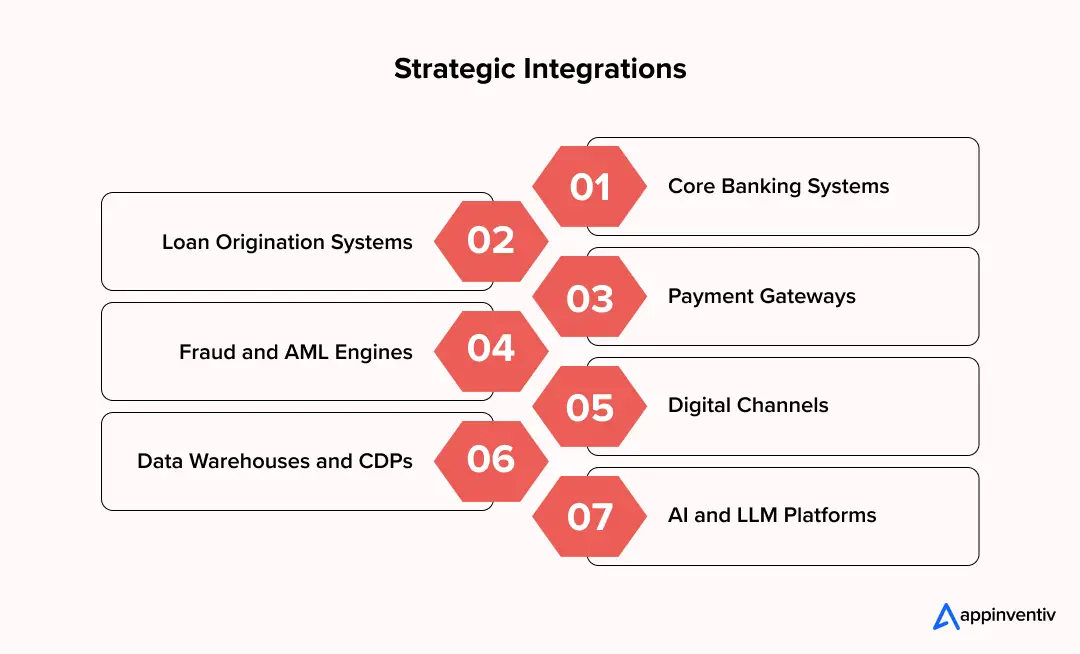
Core Banking Systems
Account balances, transaction movements, product status changes, and customer identifiers originate in the core system.
Most banks expose these via secure APIs for real-time lookups, while incremental updates are pushed via change data capture or event streams.
When a balance changes or a product is closed, that update should reflect in the CRM almost immediately.
Loan Origination Systems
Loan platforms generate application stages, underwriting decisions, and documentation flags. APIs synchronize these status changes into the CRM so relationship managers can track pipeline movement without switching systems.
Payment Gateways
Card processors and payment switches emit transaction events. Webhook notifications or streaming connectors forward authorization data and decline patterns into the CRM for contextual visibility.
Fraud and AML Engines
Fraud systems produce risk scores and alert triggers. Middleware services translate those alerts into structured case records so the investigation history is centralized.
Digital Channels
Mobile apps and web portals generate profile edits, service requests, and session activity. API gateways ensure these updates sync back into the CRM in near real time.
Data Warehouses and CDPs
Curated datasets from warehouses support segmentation and reporting within a scalable CRM for a banking environment. Reverse data pipelines can also push enriched attributes back into engagement systems.
AI and LLM Platforms
Model inference services connect via APIs to provide churn scores or recommendation outputs. Language models can summarize interaction history during live service calls.
Most integrations rely on REST APIs for direct queries, event streaming platforms for high-volume updates, and middleware layers for orchestration and protocol control.
Successful CRM implementation in the banking sector succeeds when execution is phased. compliance-aware, and tightly aligned to high-impact use cases from the start of any serious customer relationship management in banking initiative.
Rushing deployment without structural clarity usually creates rework. For scaling institutions, discipline in sequencing matters more than speed alone.
Discovery and Use-Case Prioritization
Start with specific operational gaps through professional banking technology consulting to identify if churn visibility is weak. Is churn visibility weak? Are relationship managers relying on spreadsheets? Is the audit preparation manual slow?
Map these problems to measurable use cases. Prioritize those with clear data sources and defined ownership. At this stage, data availability and integration feasibility should be validated early, not assumed.
Architecture and Compliance Validation
Before development begins, confirm that your target architecture aligns with regulatory expectations in all operating regions. Data residency rules, consent tracking, and access controls should be documented at the design level. Security teams must validate encryption standards, identity access models, and logging mechanisms upfront.
Development and Phased Integration
Build iteratively as part of a structured banking CRM software development process. Integrate core banking data first, then layer loan systems, payment feeds, and risk engines in controlled phases.
Each step in banking CRM software integration should include clear data contracts, schema validation rules, and rollback procedures. Avoid connecting every upstream system at once. Controlled sequencing reduces operational risk.
Testing and Regulatory Checks
Functional testing should include workflow state transitions, permission boundaries, and audit log verification. Regulatory validation may involve confirming deletion workflows, consent records, and traceable modification histories. Test not only features, but also data lineage and access visibility.
Rollout and Change Management
Deployment should follow a staged rollout, often beginning with one business unit or region. User training must focus on workflow discipline, not just navigation.
Continuous Monitoring and Model Retraining
Post-launch, monitor data consistency, integration latency, and user adoption metrics. If predictive models are deployed, retraining schedules and performance drift checks must be defined from day one.
Implementation is not a one-time project in CRM in the banking industry. It becomes an operational program that evolves with your institution.
How to Overcome Key Challenges of CRM in Banking
Most banking CRM programs struggle not because the platform is weak, but because real-world constraints surface once systems, data, and regulations collide.
If your bank is scaling, you have likely seen this pattern. The CRM looks solid in design sessions. Then integration starts. Data conflicts appear. Compliance teams raise concerns. Adoption slows. These issues are predictable, but only if you plan for them early.
Legacy System Integration Complexity
Many core systems were built years ago. Some still rely on batch file exchanges or tightly coupled database logic. When a CRM tries to pull real-time updates from those systems, delays and inconsistencies can surface. A balance update may not reflect instantly. A status change may appear hours later.
Mitigation
- Introduce a middleware layer that standardizes legacy outputs into modern API formats.
- Use incremental update mechanisms instead of full batch replacements
- Validate schemas before data enters the CRM environment
Data Silos and Quality Issues
Customer data rarely originates from a single source. Marketing tools, lending systems, and core platforms often format attributes differently. Over time, duplicates creep in. Addresses conflict. Contact details vary.
Mitigation
- Implement structured Master Data Management with defined precedence rules
- Automate data quality checks at ingestion
- Maintain visibility into where each attribute originated
Regulatory Exposure
As operations expand across regions, compliance obligations grow. Consent management, audit traceability, and data residency controls cannot be improvised later.
Mitigation
- Embed consent tracking directly into customer records
- Maintain immutable access and modification logs
- Review regulatory alignment at scheduled intervals
Real-Time Scalability Constraints
As digital transactions increase, synchronous calls can strain systems. Reporting queries may impact operational responsiveness if environments are not separated.
Mitigation
- Use event streaming for high-frequency updates
- Separate operational workloads from analytics processing
- Monitor latency and throughput continuously
Organizational Change Resistance
Teams may return to spreadsheets if workflows feel unfamiliar or rigid. Adoption gaps weaken data integrity.
Mitigation
- Align CRM processes with existing operational patterns
- Provide role-based training focused on real scenarios
- Monitor usage and address friction early
AI Governance and Bias
Predictive models can degrade over time. Customer behavior shifts. Data patterns evolve.
Mitigation
- Schedule periodic model performance reviews
- Document feature definitions and assumptions
- Run fairness checks against critical decision outputs
Addressing these areas early keeps your CRM stable, trusted, and usable as your institution grows.
In one recent engagement, we partnered with a leading European bank to embed AI-driven intelligence into its core customer workflows. Within 10 weeks, the institution reported a 20% improvement in customer retention, driven by predictive insights and automated decision layers. The shift was not incremental. It restructured how relationship data translated into action. Institutions that move early secure a structural advantage while others remain reactive.
Integration and governance risks compound as operations expand.

High-Impact Banking Use Cases Across Retail and Commercial Segments
Real deployments of CRM for the banking industry show how these systems move beyond data to influence everyday decisions and strategic outcomes.
Below are three verified, real-world examples of how leading banks leverage CRM or CRM-linked systems to drive customer engagement, relationship tracking, and personalized experience.
Here are a few examples of CRM in the banking industry:
Retail Personalization at Wells Fargo
Wells Fargo uses a real-time decisioning platform to tailor engagement across channels at scale. By connecting digital signals across mobile, branch, and online interactions, the bank recalculates each customer’s “next best conversation” as interactions happen. This adaptive modeling has increased engagement rates by three to ten times on some channels and improved conversion outcomes across personalized engagement touchpoints.
SME and Customer Segmentation at Axis Bank
Axis Bank’s CRM rollout focused on unifying customer insights across 2,700+ branches and 78,000+ users to support segmented relationship tracking. While specific technical details vary, this integration unified data into a consolidated CRM environment to support differentiated handling of retail, commercial, and SME customer segments.
Global Customer Segmentation at HSBC
HSBC — one of the world’s largest global banks — uses CRM-linked customer segmentation to categorize and manage relationships based on total relationship value. Internal CRM strategies organize clients into segments from “Top” to “Inactive,” allowing tailored engagement strategies and a deeper understanding of customer behavior across markets.
Future Outlook: Emerging CRM Trends in Banking Intelligence
CRM in the banking sector is moving toward systems that assist decision-making automatically that assist decision-making automatically rather than simply recording activity.
As digital volume increases, manual coordination will not scale. The next phase of CRM evolution focuses on embedded intelligence, compliance automation, and privacy-aware learning models.
AI Copilots for Relationship Managers
Instead of searching through interaction history before a client call, relationship managers will rely on AI copilots that summarize exposure, recent transactions, open cases, and recommended talking points in seconds.
- Real-time profile summaries during live interactions
- Context-aware product prompts
- Automated follow-up drafting based on meeting notes
Predictive Compliance Monitoring
Compliance will shift from reactive audits to continuous risk scanning.
- Automated detection of unusual relationship changes
- Early flagging of documentation gaps
- Policy breach alerts triggered by workflow events
Embedded Finance Integration
As banks embed services into partner ecosystems, CRM systems must synchronize customer identity and product state across external platforms.
- API-level identity mapping
- Cross-platform consent propagation
Federated Learning for Privacy
Privacy-sensitive regions are driving the adoption of federated learning models.
- Models trained locally without exporting raw data
- Aggregated parameter updates instead of centralized datasets
The direction is clear. A modern CRM for banks will become less of a tracking system and more of an operational intelligence layer supporting real-time decisions.
Even at projected expansion levels, global CRM software spending represents roughly 0.56% of total banking revenue worldwide. The gap between relationship infrastructure investment and overall industry scale suggests significant modernization headroom.
Why Choose Appinventiv for Banking CRM Transformation
If your CRM for banking program is tied to growth and regulatory resilience, partnering with an experienced banking software development company will determine whether it scales or stalls.
Many banks start with the right vision but struggle during integration, compliance validation, and performance stabilization. That is where proven banking experience matters.
Appinventiv brings measurable delivery strength:
- 300+ banking transformation projects delivered
- 97% client satisfaction in banking solutions
- 30+ countries served
- 10+ years of banking domain expertise
- 100M+ transactions processed securely
- 99.90% SLA uptime in core banking apps
- Up to 40% efficiency gains through automation
These metrics reflect real exposure to core banking integrations, AML environments, multi-region compliance, and high-availability systems.
As institutions expand products, geographies, and digital channels, CRM complexity increases quickly. Delays in architectural alignment often lead to rework and compliance friction later.
If your bank is entering a growth phase, this is the window to build CRM infrastructure correctly, before scale compounds inefficiencies.
Frequently Asked Questions
Q. What technologies are used in banking CRM development?
A. Modern banking CRM software development typically uses API-first microservices architectures, relational databases for structured customer data, and data lakes for semi-structured interaction logs. Integration relies on REST APIs, event streaming platforms such as Kafka, and Change Data Capture pipelines. Advanced environments include ML scoring services, feature stores, identity resolution engines, and role-based access control frameworks to support analytics, compliance, and secure customer lifecycle orchestration.
Q. How does CRM ensure data security in banking?
A. Banking CRM systems enforce encryption at rest using strong symmetric algorithms and secure data in transit through TLS protocols. Access control is implemented via role-based and attribute-based policies to restrict field-level visibility. Immutable audit logs capture every data access or modification event. Zero-trust principles and continuous authentication reduce insider and lateral movement risks within high-sensitivity financial environments.
Q. How to ensure regulatory compliance in CRM development for banks?
A. Compliance is embedded at the design stage through consent management schemas, data lineage tracking, and immutable logging. Regional regulations such as GLBA, GDPR, PSD2, APRA CPS 234, and RBI guidelines require structured access governance, breach notification workflows, and data residency controls. Regular compliance audits, policy validation tests, and traceable change management procedures ensure CRM systems remain audit-ready.
Q. How to integrate CRM with payment systems?
A. Payment system integration relies on secure APIs or webhook notifications from card processors and transaction switches. Event streaming connectors capture authorization events, settlement updates, and decline codes in near real time. Tokenization ensures sensitive card data is not stored directly in the CRM. Middleware services validate payload formats and map transaction metadata to corresponding customer profiles.
Q. How to integrate CRM with core banking systems?
A. CRM integration with core banking systems usually combines secure REST APIs for real-time queries and event-driven pipelines for transaction updates. Change Data Capture mechanisms detect incremental record changes without full database replication. Middleware layers normalize legacy data formats, enforce schema validation, and manage retry logic to ensure synchronization between account balances, product status, and customer identity records.

- In just 2 mins you will get a response
- Your idea is 100% protected by our Non Disclosure Agreement.

Key takeaways: Finance AI chatbots have moved past support. They now trigger payments, approve loans, and process claims inside real transaction systems. PCI compliance cannot sit outside the system. It must control how data enters, moves, and exits across every layer. Most failures happen where a finance AI chatbot meets payment systems. Poor data handling…

How to Develop an Insurance Portal That Integrates CRM, Claims, and Billing Systems
Key takeaways: Insurance portal development succeeds only when CRM, claims, billing, and policy systems are fully integrated in real time. Architecture choice and workflow orchestration determine transaction accuracy and scalability. Security, compliance, and audit traceability must be embedded across all integration layers. Testing and monitoring are essential to prevent reconciliation gaps after launch. Typical development…

How to Build a Digital Wallet App Like X Money: Cost, Features, and Technology Stack
Key Takeaways: Building a wallet like X Money requires more than payment features. It needs identity verification, fraud monitoring, payment gateways, and a secure financial infrastructure. Development costs usually range between $40,000 and $400,000. The final cost depends on features, compliance requirements, payment integrations, and platform scale. Core technologies include mobile frameworks, backend microservices, financial…









