




























How much does it cost to build a split payments app like Tamara?

 Share -


- 01Tamara App Development Cost Breakdown
- 02Factors Influencing the Cost of Building an App Like Tamara
- 03Must-Have Features for an App Like Tamara
- 04Monetization Strategies for an App Like Tamara
- 05The Process of Developing an App Like Tamara
- 06Why Choose Appinventiv for Developing an App Like Tamara in the Middle East
- 07FAQs

Key takeaways:
- Building a split payments app like Tamara typically costs between AED 150,000 and AED 1,470,000 ($40K–$400K), depending on scope and scale.
- Most teams start with an MVP (around AED 150K–AED 550K) and expand features once the product gains traction.
- Compliance, security, and third-party APIs drive a major share of the cost, not just development effort.
- Ongoing expenses such as cloud, APIs, and maintenance continue post-launch and scale with usage.
- In markets like Saudi Arabia and the UAE, regulatory readiness is just as critical as building a smooth user experience.
If you’ve been looking into fintech opportunities in the Middle East lately, you’ve probably noticed one thing. Flexible payment solutions are everywhere, and they’re growing fast. For founders and CTOs exploring this space, the question usually comes down to this: what does it really cost to build a split payment app like Tamara?
In markets like the UAE and Saudi Arabia, BNPL is no longer a nice-to-have. It’s become a core part of how people shop online. That’s why there’s a sharp rise in interest around BNPL app development in the UAE, and understanding the cost to develop a BNPL app in Saudi Arabia, especially for businesses planning to enter this space with something competitive.
That said, building an app like Tamara isn’t just about adding payment features. You’re dealing with compliance, integrations, and a seamless user experience all at once. Typically, the cost to build a split payment app like Tamara ranges between $40,000 to $400,000, depending on how complex and scalable you want the product to be. Not sure where your idea fits in this range? Appinventiv can break it down for your specific use case.
In this guide, we’ll break down what actually drives that cost and how you can plan it properly from the start.
Not sure where your idea fits within the $40K–$400K range? Get a tailored cost breakdown based on your features, market, and scale.
Tamara App Development Cost Breakdown
At this point, the big question is cost. The cost to build a split payment app like Tamara typically falls between AED 150,000 and AED 1,470,000 ($40,000 to $400,000), depending on how far you want to take the product.
Here’s a simple way to look at it:
| Stage | Estimated Cost AED | Estimated Cost (USD) | What You Get |
|---|---|---|---|
| Basic MVP | AED 150,000 – AED 220,000 | $40,000 – $60,000 | Just the essentials. Payment splitting, a clean interface, and a working backend |
| Mid-Level App | AED 220,000 – AED 550,000 | $60,000 – $150,000 | More polished. User dashboard, notifications, multiple payment options |
| Advanced App | AED 550,000 – AED 1,470,000 | $150,000 – $300,000 | Full-scale product. Integrations, strong security, and built to handle growth |
The brutal reality, whether you’re planning BNPL app development in the UAE or hiring someone for split payment app development in Dubai, costs can shift slightly depending on compliance and integrations. Both regions play along, but also a little separately.
Most founders sit somewhere between the first and second stage when they’re starting out. The tricky part is figuring out what you actually need right now, and what can wait.
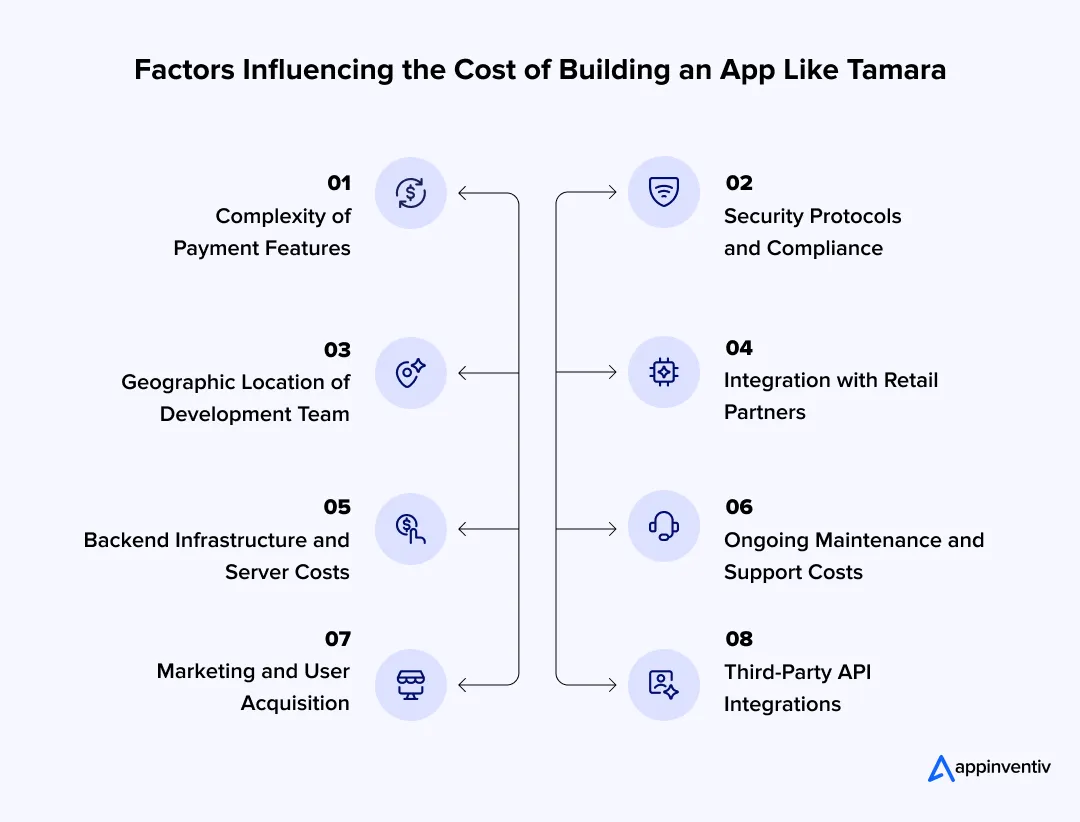
Factors Influencing the Cost of Building an App Like Tamara
In the Middle East’s dynamic FinTech market, grasping the cost of building an app like Tamara is essential for entrepreneurs and investors alike. Whether you’re evaluating split payment app development in Dubai specifically or planning a broader regional rollout, these factors directly impact your final investment.
Complexity of Payment Features
Offering a range of payment options adds layers of complexity to the app’s architecture. For instance, if a user wants to defer a payment and split another bill with a friend, the app must support this functionality.
Implementing these intricate features can significantly affect the cost to build a split payments app like Tamara. It’s crucial to decide early on what features are essential for your target market in the Middle East to manage development costs effectively.
Security Protocols and Compliance
Ensuring top-tier fintech security in your app is non-negotiable. Given that users will be sharing sensitive financial data, encryption and compliance with financial regulations are a must. For example, consider a user concerned about identity theft; strong security measures are needed to alleviate these concerns.
Adequate investment in secure protocols contributes to the overall Tamara app development cost and must be planned for from the start.
Geographic Location of Development Team
The location of your development team can also impact your budget. For example, development teams in the United States or Western Europe generally charge more compared to those in Asia or Eastern Europe.
This variation in labor costs influences the cost of building an app like Tamara and is an important consideration for Middle Eastern entrepreneurs.
Integration with Retail Partners
Users who enjoy shopping from a variety of online stores will require a versatile app. Creating an app that is compatible with different retail partners via APIs will hike up the cost to build a split payments app like Tamara.
These integrations allow for a smoother user experience but come with their own set of costs that need to be accounted for in your budget.
Backend Infrastructure and Server Costs
A stable and well-planned app backend development strategy enables a seamless user experience. And a seamless backend reduces the probability of your app being abandoned by target users. For example, imagine a user who frequently experiences app crashes or slow load times; they’re likely to abandon the app and look for alternatives, unless you have already thought of all the hiccups and taken care of them.
For instance, investing in robust servers and backend systems. This investment in high-quality infrastructure will increase the costs of developing an app like Tamara, but it’s a necessary investment for long-term stability and scalability.
Ongoing Maintenance and Support Costs
Once the app is up and running, it’s not the end of the story. Users expect regular updates, bug fixes, and new features. Suppose a user finds that a certain function isn’t working as expected.
Prompt customer support and regular maintenance are key to retaining such users. Ongoing costs for these services can sometimes be as much as the initial development costs, so factor this into the budget when you aim to create an app like Tamara.
Third-party API Integrations
When estimating the cost to build a split payments app like Tamara, third-party API integrations are often underestimated. In reality, they power most of the core functionality and add both upfront and ongoing costs, especially in fintech app development in the Middle East, where compliance and real-time transactions are critical.
Every time a user links a bank account, completes a payment, or verifies identity, an external API is at work. Each comes with its own pricing model.
Here’s a quick breakdown:
| API Type | Purpose | Estimated Cost (USD) | Estimated Cost (AED) |
|---|---|---|---|
| Payment Gateway APIs | Process transactions | 2% – 3% per transaction | ~7% – 11% AED equivalent |
| KYC/Verification APIs | Identity checks, fraud prevention | $1 – $3 per verification | AED 4 – AED 11 per check |
| Banking Integration APIs | Connect bank accounts | $0.20 – $1 per call | AED 0.7 – AED 3.7 per call |
| SMS/Notification APIs | OTPs, alerts | $0.005 – $0.05 per message | AED 0.02 – AED 0.18/message |
| Cloud Infrastructure APIs | Hosting and backend | $500 – $5,000+/month | AED 1,800 – AED 18,500+/month |
There’s another layer to consider. Some APIs, especially those used for AI features such as credit scoring or chatbots, use token-based pricing.
- You pay based on how much data is processed, not just API calls
- More user interactions mean higher token usage
- Costs scale continuously as your app grows
This is why API costs don’t stop after development. They become an ongoing operational expense and, in many cases, extend well beyond the initial build cost.
If you’re unsure which of these apply to your product, getting a quick Tamara-like app development cost breakdown early can help avoid unnecessary spending later.
Marketing, Maintenance, and App Operations Cost
Once your app goes live, the spending doesn’t really stop. There’s a second layer of costs that kicks in as soon as users start coming in. Marketing is one part of it. You’ll need SEO, paid campaigns, and app store visibility just to get noticed in a crowded market.
Alongside that, there are a few ongoing expenses to plan for:
- Maintenance and updates: Fixes, improvements, new features
- Licensing and compliance: Especially relevant in fintech app development in the Middle East
- App store fees: Publishing and platform charges
- Customer support: Handling user queries and issues
Individually, these may seem manageable. But together, they become a steady operational cost you need to account for beyond development.
Map your features and budget before you start building.
Must-Have Features for an App Like Tamara
Gaining a full understanding of the cost to build a split-payments app like Tamara requires a deep dive into key factors. From the complexity of payment features to the geographic location of your development team, each component plays a critical role in the overall expenditure.
Payment Splitting
One of the core functionalities that contributes to the Tamara app’s development cost is the payment-splitting feature. This feature allows users to divide their shopping total into smaller, manageable payments. Suppose a user wants to purchase a high-end smartphone but doesn’t want to drain the bank account in one go.
This is where payment splitting comes into play, providing the convenience of breaking down the total cost.
Payment Tracking and Notifications
Another indispensable component contributing to the cost to build a split payments app like Tamara is the payment tracking and notifications feature. This keeps users informed about upcoming payments and successful transactions.
It enhances user engagement and reduces late payments, acting as a virtual payment assistant.
Security Protocols for Data Encryption
When you develop an app like Tamara, high-level security protocols for data encryption are non-negotiable. Users will be sharing sensitive financial information, and ensuring its safety is paramount.
Therefore, integrating robust security measures is a vital part of the overall cost of building an app like Tamara.
Multiple Payment Options
Offering various payment options such as credit/debit cards, digital wallets, and direct bank transfers not only enhances user experience but also adds to the Tamara app features list. When planning to create an app like Tamara, keep in mind that the more payment options you offer, the more complex and costly the development becomes.
In some cases, businesses also explore features similar to instant loan app development in the UAE, especially when extending short-term credit beyond basic payment splitting.
Retail Partner Integration
An essential feature that significantly affects your budget when you aim to make an app like Tamara is retail partner integration. This functionality allows users to shop from a wide range of stores seamlessly through the app.
Imagine someone shopping at a popular fashion outlet; the integration would enable immediate access to split payment options right at the checkout. This elevates the user experience and is a defining trait of any split payments app like Tamara.
User-Friendly Dashboard
The dashboard is the nerve center of any split payments app development project. It offers a snapshot of the user’s transaction history, upcoming payments, and account details. A user-friendly dashboard is not just a luxury; it’s a necessity.
A well-designed dashboard allows users to navigate the app’s features effortlessly, which is vital for any app similar to Tamara.
Customer Support Chat
Customer support cannot be compromised when developing an app similar to Tamara. A real-time customer support chat can help users resolve any issues or questions about their transactions or accounts.
This feature enhances user trust and satisfaction, aspects that are paramount in the competitive landscape of split payments app development. One can also consider including a conversational AI chatbot to make the experience better for the users.
Multi-Language Support
Given that the Middle East is a linguistically diverse region, multilingual support is among the most critical features of the Tamara app. This functionality caters to users who may not be fluent in English, making it more accessible to a broader audience.
The feature could help increase user engagement rates and, in turn, potentially raise the average transaction value per user. Multi-language support not only enhances user experience but also adds to the Tamara app development cost due to the complexity of implementing multiple languages seamlessly.
Transaction History Archive
A transaction history archive is another feature to consider when developing a split payments app. It allows users to view their past transactions in chronological order, giving them better control over their financial activities.
For example, if a user wants to review how much they’ve spent on dining out last month, they can easily do so through the archive. Such a feature may not seem like a priority at first, but it adds significant value in the long run. Incorporating it into the initial development phase will factor into the Tamara app development cost and should not be overlooked when planning to develop a split payments app.
Taking into account these essential features can significantly impact the overall cost of building an app like Tamara. Being mindful of these functionalities will not only improve user experience but will also give you a realistic budget estimation for your project.
For businesses targeting Saudi Arabia, understanding the Tamara app development cost in SAR can offer a more practical view of budgeting and ROI.
Monetization Strategies for an App Like Tamara
Creating a split payments app like Tamara isn’t just about development; it’s also about generating revenue. Once you’ve understood the cost of building a split payments app like Tamara, you’ll want to plan how to recoup those costs and make a profit. Here are some effective app monetization strategies that can work well for this kind of app.
- In-App Purchases: Offering in-app purchases can be a direct way to generate revenue. For example, you could allow users to buy premium features that make their transactions more convenient or secure.
- Subscription Models: Another popular approach is to offer a subscription. For a monthly or yearly fee, users could enjoy perks such as zero transaction fees or higher transaction limits. This can be particularly appealing for business accounts or frequent users.
- Transaction Fees: Implementing a small transaction fee can be a stable way to generate revenue without significantly affecting the user experience. Given that users are making transactions through the app, even a small fee can add up to a substantial amount.
- Partnering with Retailers: Partnering with retail or online stores can provide another revenue stream. In such partnerships, you can charge retailers a commission for every purchase made through your split payments app. This is a win-win, as it also gives retailers another avenue for sales.
- Advertisements: Including advertisements within the app can generate additional revenue, though this may compromise the user experience if not executed tastefully. Therefore, it’s essential to strike the right balance.
By understanding your cost and implementing one or more of these monetization strategies, you can not only recover your investment but also create a sustainable revenue stream.
The strategies you choose should align with your overall business goals and the needs of your target audience. By doing so, you can develop a split payments app that is not only functional but also profitable.
The Process of Developing an App Like Tamara
Understanding the Tamara app development process is crucial if you’re aiming to launch a competitive product in the financial tech landscape. This involves a series of intricate steps that form the building blocks of your application.
Whether you’re planning to build a split payment app in Saudi Arabia or expand across the UAE, following a structured development process is critical.
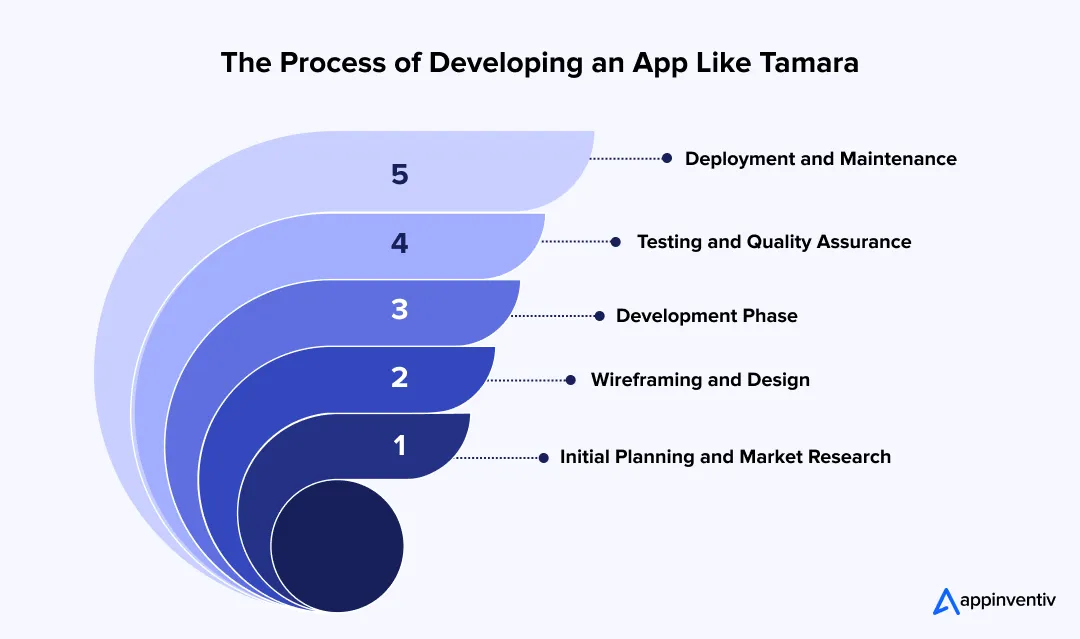
- Initial Planning and Market Research: At the very outset, in-depth market research should be conducted to identify gaps in the market and gauge the demand for a mobile app development for split payments. This phase ensures that you are not entering a saturated market and helps in shaping the app’s features.
- Wireframing and Design: After the initial planning, you move on to the wireframing stage. Here, you map out the user experience and design the interface. This is a foundational aspect of the Tamara app development process.
- Development Phase: Now comes the core development phase. This is where the app takes shape, with developers writing the code that will become its backbone. This phase often takes the most time and contributes significantly to the mobile app development for split payment costs.
- Testing and Quality Assurance: Once the app is developed, rigorous testing is essential. Quality assurance helps find bugs and security vulnerabilities and assesses the app’s overall performance.
- Deployment and Maintenance: Finally, once the app is tested thoroughly, it’s time for deployment. However, the work doesn’t end there. Maintenance is an ongoing cost that you should be prepared for.
By focusing on each of these elements, you gain a deeper insight into the steps and considerations that are integral to the Tamara app development process. This, in turn, provides a more accurate estimate of the costs and efforts involved.
Turn your plan into a working product with the right roadmap in place.
Why Choose Appinventiv for Developing an App Like Tamara in the Middle East
When you’re building something like a BNPL app, the partner you choose really shapes how the whole journey goes. In markets like Saudi Arabia, it’s not just about development. You’re dealing with compliance, integrations, and users who expect everything to just work.
That’s where experience in the region helps. At Appinventiv, we’ve worked with businesses seeking a reliable mobile app development company in Saudi Arabia, helping them move from early-stage ideas to fully functional fintech products.
A quick snapshot of our work in the Middle East:
- 1000+ digital projects delivered
- 95% client satisfaction rate
- 35+ industries served
The focus is simple. Build what matters first, avoid unnecessary complexity, and make sure the product is ready to scale. Whether you’re exploring BNPL app development in the UAE or planning something similar in Saudi Arabia, the goal is to get you to a working product faster and with fewer missteps.
With our experienced team and proven methodologies, you get a reliable partner committed to turning your vision into a scalable and robust app. Choose Appinventiv for a seamless, top-notch development experience.
FAQs
Q. How much does it cost to build an app like Tamara?
A. The Tamara app development cost can vary widely, ranging from AED 150,000 to AED 1,470,000 ($40,000 to $400,000). The exact amount depends on various factors such as features, security protocols, and third-party integrations. Please consult us for a more precise estimate.
Q. How long does it take to develop an app like Tamara?
A. To develop an app like Tamara typically takes around 4 to 9 months, including the planning, development, and testing phases. This can vary depending on the features’ complexity and the development team’s efficiency.
Q. What are the main monetization strategies for an app like Tamara?
A. The primary revenue source for BNPL apps like Tamara is merchant commission fees, where retailers pay a percentage of each successful transaction in exchange for higher conversion rates, increased customer spending, and lower cart abandonment. Additional monetization strategies may include late payment fees, premium membership plans, featured merchant placements, advertising opportunities, and strategic partnerships with financial institutions. By combining multiple revenue streams, BNPL platforms can build a sustainable business model while continuing to offer flexible, interest-free payment options to consumers.
Q. How much does it cost to build a BNPL app like Tamara in Saudi Arabia in SAR?
A. If you’re planning this in Saudi Arabia, the cost usually falls between SAR 112,000 to SAR 1,125,000. The range depends on how complex your app is and how many features you plan to include from the start.
Most founders don’t build everything at once. They begin with a simpler version and expand over time, especially when entering markets like Saudi Arabia, where compliance and integrations can add to the cost.
Q. What SAMA licence is required to launch a BNPL app in Saudi Arabia?
A. To launch a Buy Now, Pay Later (BNPL) app in Saudi Arabia, businesses must obtain authorization from the Saudi Central Bank (SAMA) to conduct BNPL activities in accordance with the Rules for Regulating Buy-Now-Pay-Later (BNPL) Companies and the Finance Companies Control Law. Applicants are required to meet SAMA’s licensing, capital, governance, risk management, and consumer protection requirements before offering BNPL services in the Kingdom.
In addition to licensing approval, BNPL providers must comply with SAMA’s cybersecurity, anti-money laundering (AML), data privacy, responsible lending, and consumer protection regulations. Many fintech startups also explore SAMA’s Regulatory Sandbox to test innovative financial products before scaling their operations in the Saudi market.
Q. How did Tamara get licensed by SAMA — and what does that process look like for a new entrant?
A. Tamara entered the Saudi market through SAMA’s Regulatory Sandbox, a framework designed to help fintech companies test innovative financial products under regulatory supervision. After demonstrating the effectiveness of its BNPL model, credit risk controls, security measures, and consumer protection processes, the company progressed toward broader regulatory approval and market expansion.
For new entrants, the process typically involves validating the business model, meeting SAMA’s licensing and governance requirements, implementing AML and cybersecurity frameworks, establishing responsible lending practices, and demonstrating operational readiness. Many fintech startups use the Sandbox as a strategic first step before pursuing full-scale authorization and commercial growth in Saudi Arabia.
Q. Does a BNPL app in Saudi Arabia need to be Sharia-compliant?
A. While SAMA’s regulations emphasize consumer protection, risk management, and responsible financing practices, Sharia compliance is generally considered essential for BNPL providers seeking long-term success in Saudi Arabia. Most BNPL platforms operating in the Kingdom structure their offerings around interest-free payment models and Sharia-aligned revenue streams to meet the expectations of consumers, merchants, and financial partners. Adopting a Sharia-compliant framework can support market acceptance, strengthen brand trust, and improve partnership opportunities within Saudi Arabia’s rapidly growing fintech ecosystem.
Q. What is the difference between building a BNPL app in Saudi Arabia versus the UAE?
A. Building a BNPL app in Saudi Arabia and the UAE involves different regulatory, operational, and market considerations. Saudi Arabia’s ecosystem is governed by SAMA and is strongly influenced by Islamic finance principles, consumer protection requirements, and local compliance standards. In contrast, the UAE offers multiple regulatory frameworks and serves a highly diverse customer base, often requiring more flexible credit assessment and payment integration strategies.
In both markets, businesses must adapt their BNPL platform to local regulations, credit scoring systems, payment infrastructure, and user expectations. This makes market-specific product design, compliance planning, and fintech integrations critical to a successful launch and long-term growth.
Q. What CBUAE licence does a split payment app need in Dubai?
A. In Dubai, the required licence depends on whether the platform functions as a payment facilitator, a BNPL provider, or a consumer financing solution. Split payment apps that extend credit to consumers generally fall under the UAE’s financial services and lending regulations and require approval from the Central Bank of the UAE (CBUAE) or another relevant regulatory authority. Businesses may also explore regulatory frameworks available through DIFC or ADGM, depending on their operating model and target market.
Beyond licensing, companies must address compliance requirements related to consumer protection, credit assessment, data privacy, cybersecurity, and transaction monitoring. Defining the business model early is essential, as it directly influences regulatory obligations, technology architecture, and market-entry strategy.
Q. How does Tamara make money — what is the revenue model?
A. Tamara’s primary revenue source is merchant commission fees, where retailers pay to offer flexible installment payments at checkout. This model benefits merchants by improving sales performance, increasing customer spending, and reducing cart abandonment rates. Beyond merchant fees, BNPL providers can monetize through subscription-based premium plans, featured merchant promotions, strategic partnerships, and transaction-related service fees. Some platforms may also charge late payment fees in accordance with local regulations and consumer protection requirements. This diversified revenue model enables BNPL companies to grow while maintaining an interest-free experience for shoppers.
Q. How does AI credit scoring work in a split payment app?
A. AI credit scoring in a split payment app uses machine learning algorithms to assess a customer’s creditworthiness in real time. The system analyzes multiple data points, including transaction history, repayment behavior, spending patterns, account activity, and available credit information, to estimate risk and determine eligibility. Unlike traditional lending models that rely heavily on historical credit scores, AI-powered scoring can evaluate a broader set of behavioral and financial signals to make faster and more accurate decisions. This enables BNPL platforms to automate approvals, personalize credit limits, improve fraud detection, and support responsible lending at scale.


Fast 2-minute response, fully NDA-protected.

How Much Does It Cost To Build a Chat App Like Arattai?
Key takeaways: Creating a chat app like Arattai will cost you anywhere from $40,000 to $400,000, depending on how complex you want it to be. The essential features you need are real-time messaging, multimedia sending, and user authentication. Layering advanced features such as voice/video calls, group messaging, AI-driven bots, and end-to-end encryption takes the app…

How Much Does It Cost to Build a Car Rental App like Hertz?
Key takeaways: The cost to build a Hertz-like app ranges roughly $40,000–$300,000+. Complexity, automation, and scale matter more than just the number of features. Real costs continue after launch: infra, maintenance, support, and compliance. Smart planning and MVP-first approach help keep budgets under control. Revenue comes from rentals, add-ons, subscriptions, partnerships, and fleet sales. You…

How Much Does It Cost to Build a Route Planning App Like Komoot
Europe doesn’t just love the outdoors- it thrives on it. From the Alps to Amsterdam’s bike lanes, cycling and hiking fuel an industry worth $53.3 billion in 2024, projected to grow at nearly 11% CAGR through 2033, as reported by GrandViewResearch. And leading this charge is Komoot, the route-planning app trusted by 40+ million users.…