



























How Much Does It Cost To Build A Construction Management Software?

 Share -


- 01Why Enterprises Are Investing in Construction Management Software
- 02What Defines Enterprise-Grade Construction Management Software
- 03Core Features of Construction Management Software
- 04Factors Affecting the Cost of Construction Management Software
- 05Construction Management Software Development Cost Breakdown
- 06Hidden and Recurring Costs Enterprises Must Plan For
- 07How Long Does It Take to Build a Procore-Like Platform
- 08Development Process for Building Construction Management Software
- 09Benefits of Developing a Construction Management Software
- 10Future Trends Affecting Construction Management Software Costs
- 11Ways to Optimize Software Development Costs
- 12Considerations Before Investing in Construction Management Software
- 13Revenue Model of Construction Software
- 14How to Develop an App Like Procore?
- 15How Appinventiv Helps Enterprises Build Construction Management Software
- 16Frequently Asked Questions

Key takeaways:
- Fragmented construction systems create hidden risk, overruns, and reduced portfolio visibility at scale.
- Enterprise-grade construction platforms unify planning, cost, compliance, and field execution operations.
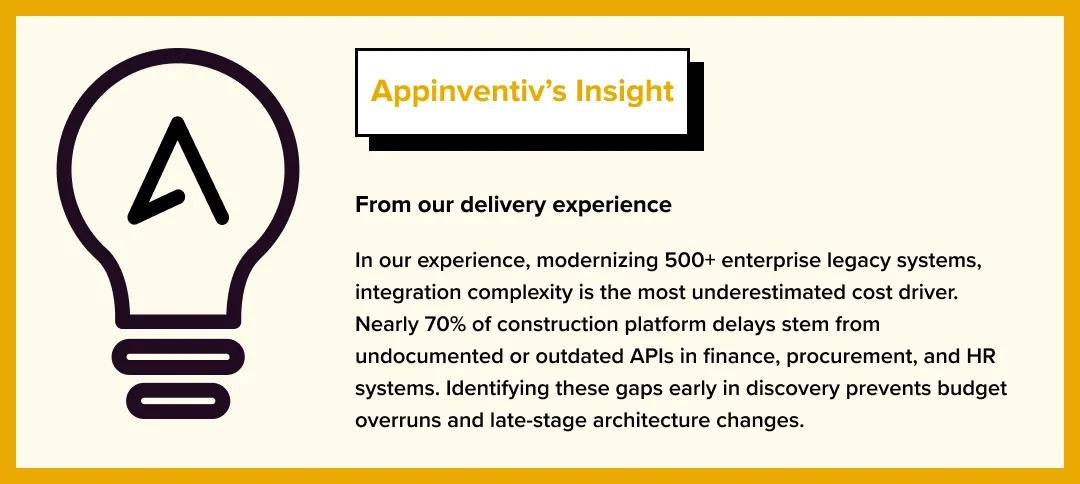
- Integration complexity and legacy APIs remain the largest drivers of software development cost.
- Custom enterprise platforms deliver stronger governance, security compliance, and long-term scalability control.
- AI, IoT, and BIM-driven intelligence are reshaping future-ready construction technology investments.
- Strategic software modernization improves margins, reduces disputes, and strengthens project delivery predictability.
Most construction enterprises reach a point where spreadsheets, email threads, and disconnected project tools start creating more risk than visibility. A project manager waits for updated drawings. A finance team struggles to reconcile budget changes. A compliance officer chases missing safety reports from field teams. None of this feels dramatic. It feels familiar. It also quietly erodes margins.
In the United States, large construction firms operate in an environment where delays trigger penalties, supply chains shift without warning, and regulatory audits are becoming routine. At the same time, clients expect transparency across every phase of delivery. When systems cannot keep up, teams fall back on manual workarounds. That is where overruns, disputes, and avoidable risk take root.
This is why conversations around enterprise-grade construction management software are changing. It is no longer viewed as a digital convenience. It is an operational control infrastructure. The ability to unify planning, procurement, cost tracking, compliance, and field execution inside one connected platform directly impacts project certainty and financial predictability.
Understanding the cost to build a construction management software platform starts here, not as a technology expense, but as a strategic investment in how your organization delivers projects at scale.
2000+ products, 95% on-time delivery across 35+ industries for global enterprises
Why Enterprises Are Investing in Construction Management Software
Most large construction firms never planned their tech stack. It grew tool by tool. Scheduling in one place. Procurement in another. Finance somewhere else. It works until projects scale and cracks appear.
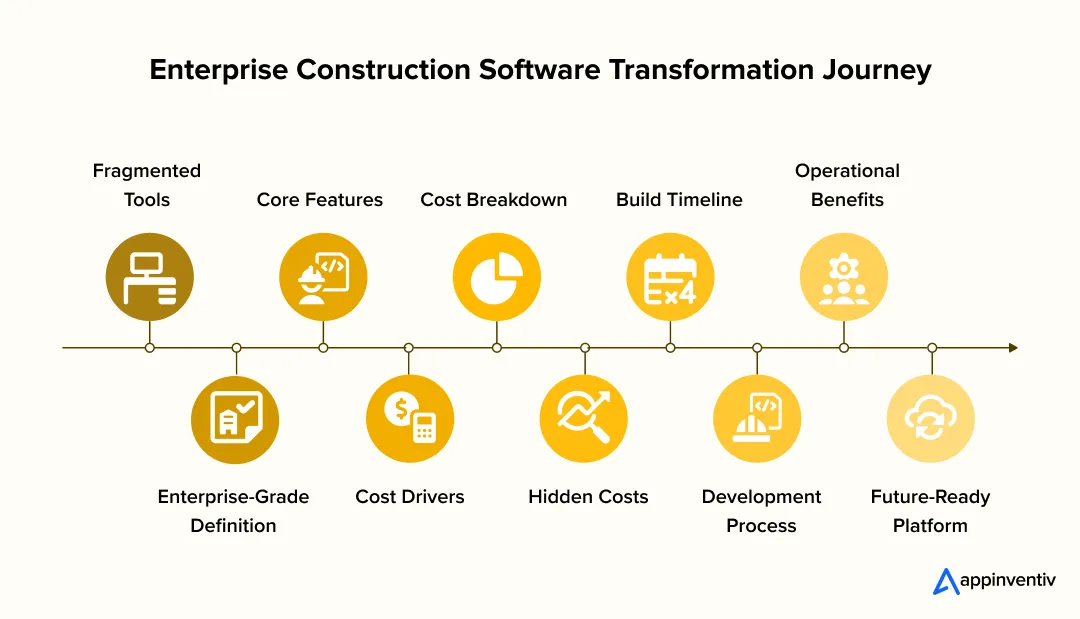
Modernising a construction software environment now focuses on replacing fragmented tools with a connected, enterprise-wide operational control system.
Common pressure points:
- Limited real-time portfolio visibility
- Site and office teams using different data
- Late discovery of cost overruns
- Manual compliance tracking
With tighter US regulations, labor shortages, and supply volatility, fragmented systems now create risk. Modernising construction software has become a strategic move to keep projects controlled, margins protected, and decisions faster.
Industry evidence supports this shift. A Dodge Construction Network study found that 76% of firms reduced project delays by five days or more after adopting construction project management platforms.
What Defines Enterprise-Grade Construction Management Software
At scale, software becomes part of the operational backbone. Enterprise-grade construction management platforms are built for heavy usage, governance, and integration. This shift is accelerating as the global construction market is projected to grow at a CAGR of 6.50% between 2026 and 2035, reaching nearly $27.12 trillion by 2035. As project volumes rise, enterprises need systems that can scale without breaking operational control.
They typically provide:
- Multi-project stability
- Real-time telemetry pipelines from distributed job sites
- Role-based secure access
- Audit-ready activity records
They also connect with ERP, finance, BIM, and procurement tools through cloud-based architectures. Off-the-shelf products focus on quick deployment. Enterprise-grade platforms focus on long-term control and resilience.
Core Features of Construction Management Software
When enterprises plan to develop a construction management software platform, features are not chosen for convenience. They are chosen because each one removes a specific operational friction. Some affect daily site execution. Others protect financial control or regulatory standing. Together, they shape both capability and construction management software development cost.
Project Planning and Scheduling
Project schedules rarely survive the first week unchanged. Weather shifts. Materials arrive late. Subcontractors reschedule crews. Enterprise platforms treat scheduling as a living system, not a static chart.
Teams typically rely on:
- Cross-project scheduling views
- Task dependency mapping
- Real-time site updates
- Integration with design, digital twin technology, and BIM timelines
Supporting live schedule recalculation and field updates requires stronger backend logic and data synchronization. That depth directly influences the cost to build a construction management software platform.
Budgeting and Cost Control
Most enterprises feel that software values first in financial visibility. Budgeting modules connect estimates, change orders, actual spend, and forecasts in one continuous flow.
Common capabilities include:
- Project and portfolio cost tracking
- Change order workflows
- Accounting and ERP integrations
- Automated variance reporting
These integrations demand secure financial data handling in construction software development and audit-safe records, increasing development effort but reducing manual reconciliation later.
Resource and Workforce Management
Labor availability can decide whether a project stays on track. Enterprise platforms help teams assign crews, track certifications, and monitor equipment use across sites.
Typical functions:
- Crew and shift scheduling
- Equipment utilization tracking
- Certification and compliance validation
- Productivity reporting from the field
This usually requires mobile interfaces and HR system integration, expanding the scope.
Procurement and Vendor Management
Procurement delays ripple across schedules. Construction software centralizes vendor records, bid requests, purchase orders, and delivery tracking.
Enterprises look for:
- Digital RFQ and bid workflows
- Purchase order management
- Controlled external partner access
Secure collaboration layers and approval flows add complexity but reduce procurement risk.
Document and Drawing Management
Every project produces thousands of files. Drawings change. Contracts get revised. Permits expire. Enterprise systems keep everything searchable and versioned.
Core needs include:
- Central document repositories
- Drawing version control
- Permission-based sharing
- Long-term archiving
This requires scalable storage and indexing, which influences infrastructure cost.
Site Mobility and Offline Access
Field teams cannot depend on perfect connectivity. Mobile apps must work on-site, capture updates, and sync when networks return.
Typical requirements:
- Mobile-first site reporting
- Offline data capture
- Photo, video, and drone survey uploads
- Task and alert notifications
Offline-first design increases engineering effort but is essential for adoption.
Compliance, Safety, and Audit Trails
Safety inspections, environmental checks, and contractual records must be traceable. Enterprise systems automate record creation instead of relying on manual logs. This becomes critical when maintaining safety and inspection records aligned with OSHA reporting requirements and contractual audit obligations in the US construction sector.
Common features:
- Digital safety checklists
- Automated safety and compliance reporting
- Time-stamped approvals
- Audit-ready activity logs
Database and security architecture must protect data integrity, shaping development cost.
Analytics and Executive Dashboards
Leadership teams need clarity across all projects. Analytics layers transform raw data into decisions.
Typical capabilities:
- Portfolio-wide dashboards
- Cost and schedule trend tracking
- Risk flagging
- Custom executive reports
AI-based predictive analytics adds technical depth, but it turns construction software from a tracking tool into a decision system. Early adopters are already seeing results, with industry data showing significant reductions in project delays and cross-team productivity gains from analytics-driven platforms.
These features are not just functional additions. They define how deeply the platform embeds into enterprise operations, and they directly influence the cost to develop construction management software that performs at scale.
Types of Construction Software Used in Enterprises
Large construction organizations rely on multiple software systems to manage different parts of project execution. Knowing these categories helps clarify where a unified construction management platform adds value.
Common types include:
- Project management tools for scheduling and progress tracking
- Cost and estimating systems for budgeting and forecasting
- Procurement platforms for vendor and material management
- BIM and digital twin tools for design coordination
- Safety and compliance systems for inspections
- Equipment platforms for telematics and maintenance
Enterprise-grade construction management software connects these functions into one controlled environment instead of leaving them in disconnected silos.
Factors Affecting the Cost of Construction Management Software
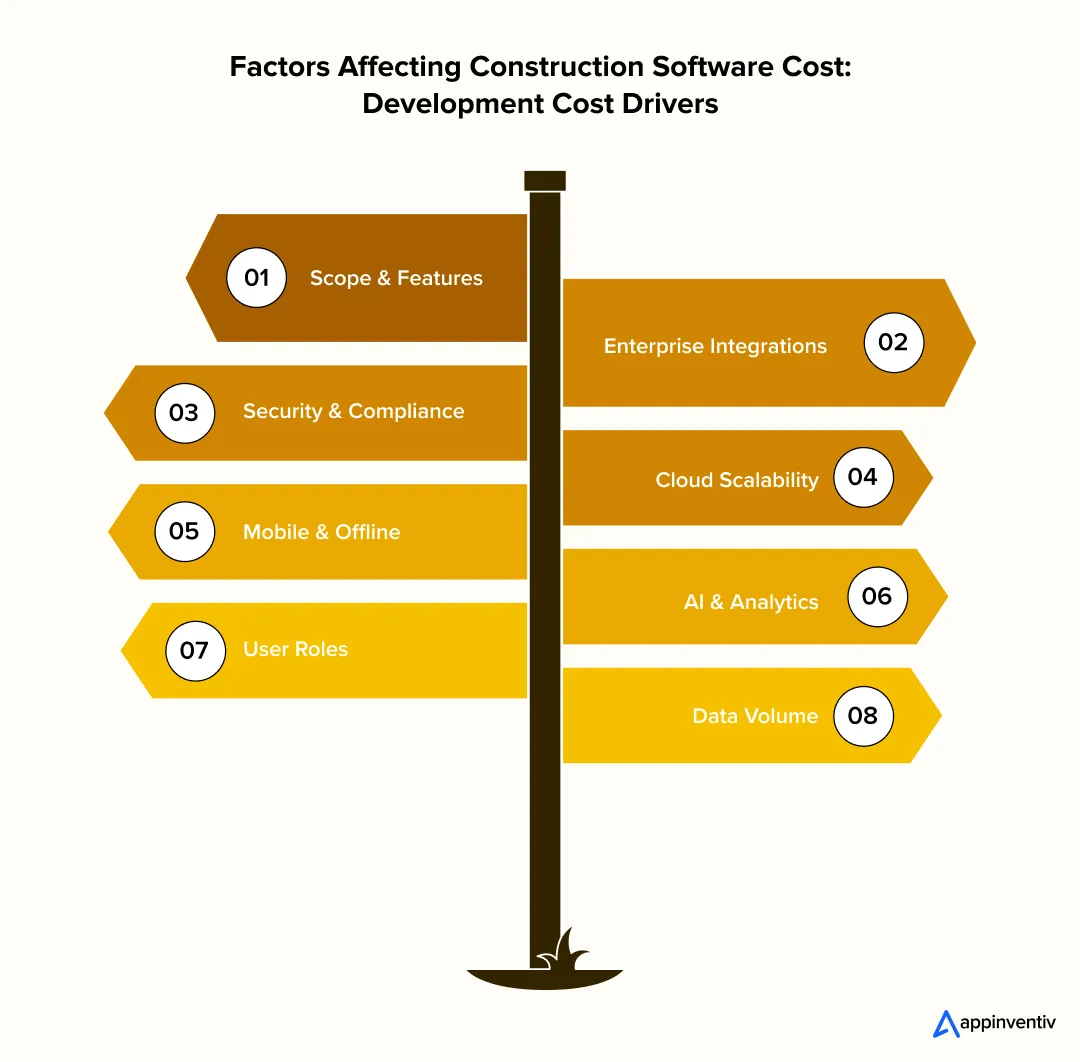
When enterprises start planning a construction management platform, cost discussions often begin with features. They should really begin with expectations. How connected should the system be to existing tools? How much automation is needed? How many people will rely on it every day? The answers to those questions shape the real construction management software development cost far more than a feature checklist.
Scope and Feature Depth
Some organizations want to replace a few disconnected tools. Others are aiming to rebuild their entire project delivery environment.
A platform that only handles scheduling and cost tracking is relatively straightforward. A platform that also manages procurement, compliance workflows, field reporting, and executive analytics needs a deeper architecture. More workflows mean more data models, more APIs, and more testing. That depth increases the cost to build a construction management software solution, but it also reduces patchwork fixes later.
Custom vs Off-the-Shelf Decisions
Off-the-shelf tools are attractive when speed matters. They work well until internal processes or compliance requirements do not fit the product’s limits. Custom construction software development becomes necessary when:
- Approval flows are unique
- Reporting structures differ across business units
- Legacy systems must stay in place
Custom work increases upfront cost, yet it avoids long-term operational friction.
Also Read: Custom AI or Off-the-Shelf AI – Which Is the Right Solution for Your Business?
Enterprise System Integrations
Most construction enterprises already run ERP, accounting, HR, BIM, and procurement platforms. A new system must talk to them cleanly. Enterprise construction platforms often integrate with SAP or Oracle NetSuite environments to synchronize finance, procurement, and project cost data in real time.
Integration effort depends on:
- How modern existing systems are
- Availability of APIs
- Need for real-time data exchange
- Sensitivity of financial and contract data
Integration complexity is one of the strongest factors affecting the cost of construction management software.
Cloud Infrastructure and Scalability
Enterprise platforms must perform reliably during peak project activity. That requires thoughtful cloud planning. Cost considerations include storage for drawings and media, global access needs, backup strategies, and disaster recovery. Cloud decisions influence both initial build cost and long-term operating spend.
Security, Compliance, and Data Governance
Construction data carries legal and financial weight. Contracts, safety records, and audit evidence must be protected. Enterprises typically require encrypted storage, controlled access, activity logs, and alignment with recognized security standards. These safeguards add cost, but they prevent larger losses later.
Enterprise platforms typically align with SOC 2 and ISO 27001 security standards, ensuring controlled access, encrypted storage, and audit-ready governance for sensitive construction data.
User Roles and Permission Complexity
Large projects involve internal teams, external contractors, vendors, and auditors. Each group needs defined access rules. Designing those permission layers takes time, yet it is essential for secure collaboration.
Mobile and Offline Requirements
Field teams often work with weak or no connectivity. Mobile apps must capture updates, photos, and inspections offline, then sync later. That offline logic adds engineering effort, but without it, adoption suffers.
AI, IoT, and Advanced Analytics Layers
Enterprises increasingly explore predictive scheduling, equipment monitoring, and automated risk alerts. These intelligence layers require data pipelines and specialized models. They raise construction software development costs, yet they turn the platform into a system that supports decisions, not just reporting.
In the end, cost is shaped less by what the software looks like and more by how deeply it is expected to run the business. This long-term value matters because firms adopting modern platforms have already seen 5%+ overhead cost reductions, strengthening the case for custom enterprise builds over short-term tool adoption.
Construction Management Software Development Cost Breakdown
When budget discussions start, most teams look for a single number. In reality, construction software costs behave more like a range of investment paths. A platform that replaces a few spreadsheets will sit at one end. A system that runs portfolio execution, compliance, and reporting across the business sits at the other end. The gap between the two is where most cost differences come from.
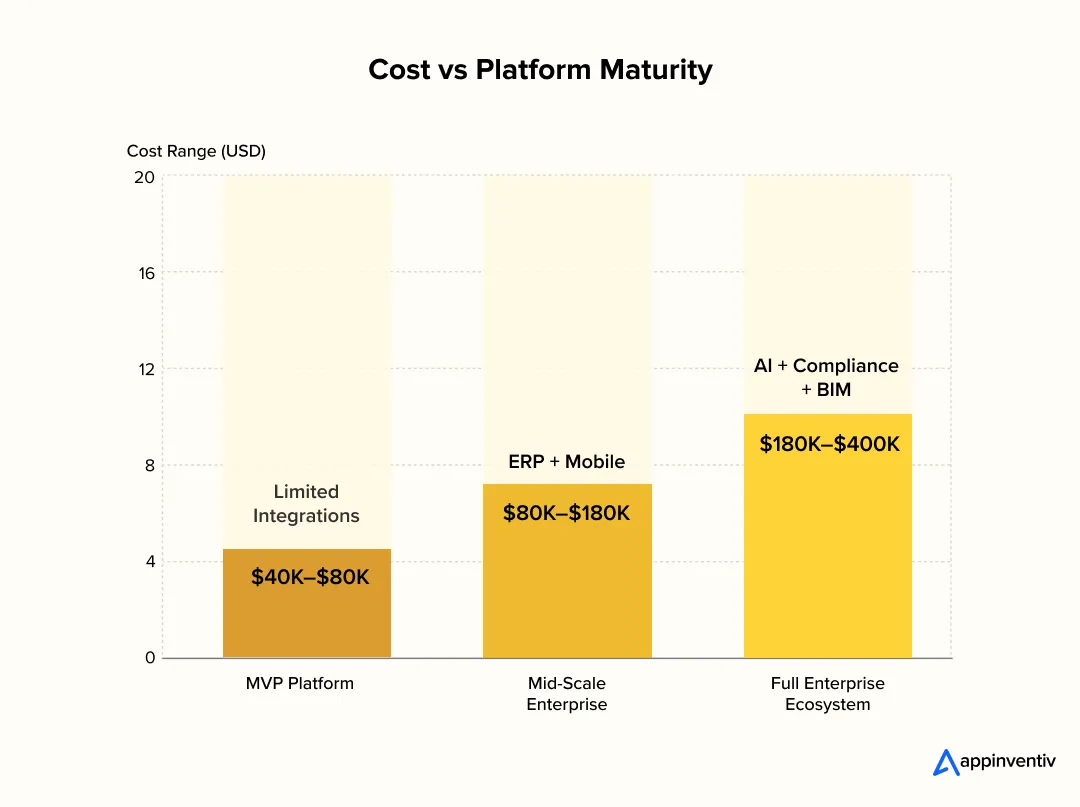
Enterprises rarely build everything at once. Many start small, test adoption, then expand. That phased thinking keeps construction management software development costs under control and avoids major disruption.
Cost by Platform Complexity
Below is a quick overview table of construction management software development as per complexity.
| Platform Type | Typical Scope | Estimated Timeline | Cost Range (USD) |
|---|---|---|---|
| MVP Platform | Scheduling, basic cost tracking, document storage, and limited integrations | 4–6 months | $40K – $80K |
| Mid-Scale Enterprise Platform | Multi-project workflows, procurement modules, mobile apps, role-based access, and finance integrations | 6–10 months | $80K – $180K |
| Full Enterprise Digital Ecosystem | Portfolio management, offline-capable mobile apps, advanced analytics, AI risk insights, ERP and BIM integrations, compliance automation | 10–16 months | $180K – $400K |
A common approach is to launch a mid-scale platform first. Once teams are comfortable and data starts flowing reliably, the system grows into a full enterprise environment.
Cost by Development Components
Behind every platform are workstreams that decide stability, security, and long-term value. Some are visible on screen. Others operate quietly but carry most of the technical weight.
| Development Area | What It Covers | Typical Cost Range (USD) |
|---|---|---|
| Product Design & UX | User flow mapping, wireframes, usability validation | $8K – $25K |
| Backend Engineering | APIs, databases, integration logic | $25K – $120K |
| Web Platform Development | Dashboards, admin tools, reporting | $15K – $60K |
| Mobile App Development | Field updates, offline sync, media uploads | $20K – $90K |
| Cloud Infrastructure | Hosting setup, storage, backups, scaling | $5K – $25K |
| DevOps & CI/CD | Deployment automation, environment setup | $5K – $20K |
| QA & Testing | Functional and performance testing | $8K – $30K |
| Security & Compliance | Penetration testing, access controls, audit prep | $10K – $40K |
How Geography Shapes Construction Software Investment?
Construction management software development costs differ across regions mainly due to engineering talent availability, enterprise compliance maturity, and operating overheads.
Rather than viewing this as a simple labor arbitrage decision, enterprises typically balance cost efficiency, domain depth, and integration capability when selecting delivery locations.
| Region | Typical Rates (USD) | Best Fit For |
|---|---|---|
| North America | $100–$200 | High-complexity enterprise builds, deep compliance and integration environments |
| Western Europe | $90–$150 | Governance-heavy platforms with strict data and security requirements |
| Eastern Europe | $30–$70 | Balanced cost-quality delivery for full-stack enterprise platforms |
| South Asia | $20–$45 | Cost-efficient large-scale development and integration programs |
| Latin America | $35–$65 | Nearshore collaboration with timezone alignment for North American firms |
Hidden and Recurring Costs Enterprises Must Plan For
The first version of the platform going live often feels like the finish line. In reality, it is the starting point. Once teams begin using the system across projects and regions, new cost layers appear. Some are obvious. Others only show up when usage grows, and expectations rise.
Enterprises that plan for these early stages stay in control of their construction management software development cost over the long run.
| Cost Area | What It Covers | Typical Annual Range (USD) |
|---|---|---|
| Cloud hosting and storage | Running the platform, storing drawings, photos, and reports | $6K – $40K |
| Scalability and performance | Handling more users, projects, and real-time activity | $3K – $15K |
| Data growth management | Archiving older projects, retrieval systems | $2K – $10K |
| Security audits | Annual penetration tests and compliance reviews | $5K – $25K |
| Support and maintenance | Fixes, monitoring, and uptime support | $8K – $30K |
| Training and onboarding | Helping new teams adopt the platform | $3K – $12K |
| Continuous upgrades | New features, workflow updates, and improvements | $10K – $50K |
The key point is simple. The cost to build a construction management software platform is a one-time investment. Keeping it reliable, secure, and useful is an ongoing commitment.
How Long Does It Take to Build a Procore-Like Platform
Timelines are one of the first things leadership teams ask about. And the answer usually starts with another question. How much of your operation do you want the platform to run from day one? A focused MVP moves fast. A full enterprise platform takes time for good reasons.
Platform Build Timelines
| Platform Stage | Typical Scope | Deployment Notes | Timeline Range |
|---|---|---|---|
| MVP Platform | Core scheduling, basic cost tracking, document storage, simple reporting | Limited integrations, web-first access, small pilot rollout | 4–6 months |
| Mid-Scale Enterprise Platform | Mobile apps, procurement workflows, role-based access, and finance system integrations | Field reporting enabled, ERP or accounting integrations, controlled team rollout | 6–10 months |
| Full Procore-Like Platform | Portfolio oversight, offline-first field apps, compliance automation, BIM integrations, executive analytics | Deep enterprise integrations, advanced security layers, and multi-region deployment | 10–16 months |
The simple truth is this. Faster builds come from a tighter scope. Enterprise-grade platforms take longer because reliability and governance cannot be rushed.
End-to-end construction platforms built for complex enterprise environments with secure cloud architecture
Development Process for Building Construction Management Software
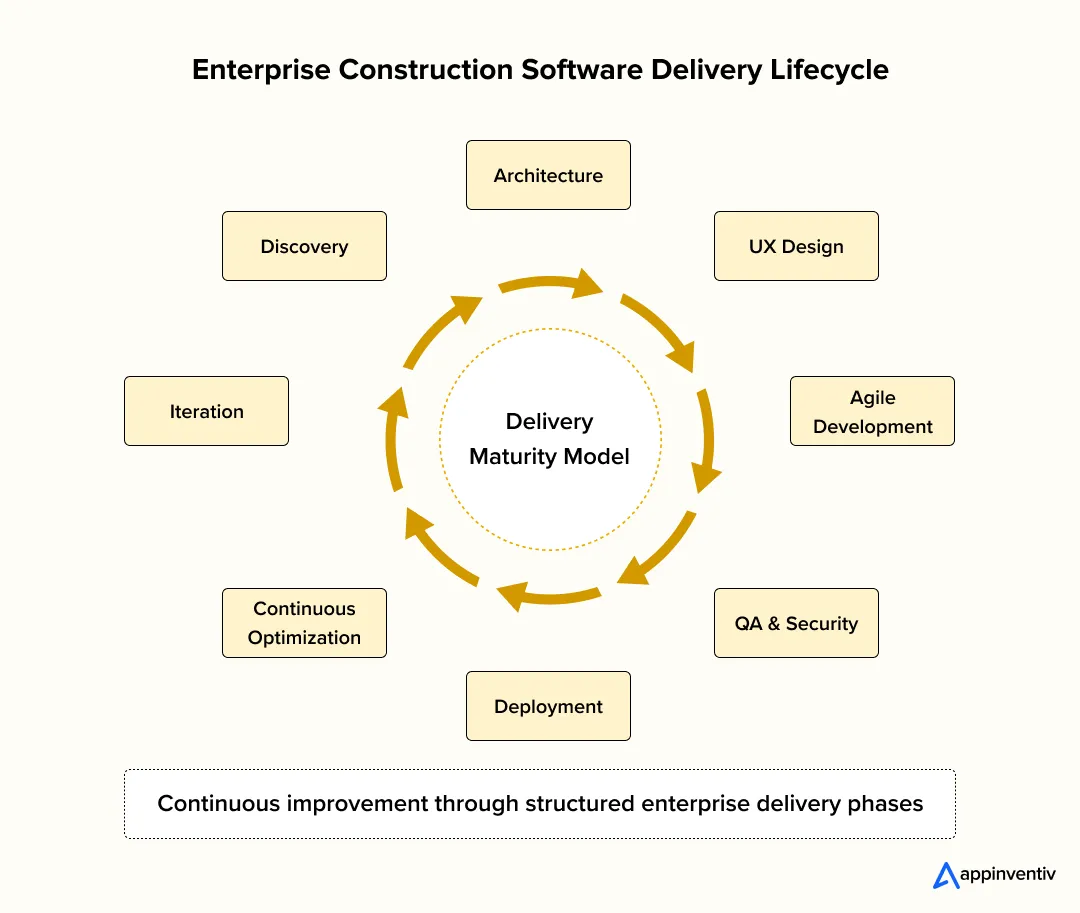
Building a construction management platform inside an enterprise rarely follows a straight line. Every organization has its own mix of legacy systems, regional processes, and project delivery habits. A structured development process helps teams move forward without losing control of scope, cost, or timelines.
Discovery and Requirements Engineering
This stage is less about technology and more about listening. Teams sit with project managers, site engineers, finance staff, compliance leads, and IT owners to understand how work moves today.
Typical outcomes include:
- Mapping real project workflows
- Identifying pain points and manual handoffs
- Listing must-have and nice-to-have capabilities
- Pinpointing systems that need to stay in place
Getting this right early avoids expensive redesign later in the build.
Architecture and Tech Stack Selection
Once requirements are clear, technical decisions follow. This is where teams decide how the platform will scale, how data will be stored, and how other systems will connect.
Focus areas include:
- Cloud or hybrid hosting models
- Database design for large drawing and document volumes
- Integration patterns for ERP, BIM, and finance tools
- Security and access control foundations
Early architecture choices quietly shape long-term stability and maintenance costs.
UX for Field and Office Teams
A platform can be technically strong and still fail if teams avoid using it. Field staff need fast mobile screens. Office teams need depth. Executives need clarity.
Design work typically covers:
- Simple site reporting flows
- Office project management views
- Role-based dashboards
- Navigation that reduces training time
Good UX directly improves data quality and adoption.
Agile Development Execution
Large platforms are built in stages. Features are released in cycles, tested with pilot teams, then expanded.
This approach allows:
- Early feedback from real job sites
- Adjustments before full rollout
- Controlled budget and scope management
It keeps construction software development practical, not theoretical.
QA, Security, and Compliance Validation
Before wider release, the platform is stress-tested. Financial data, contracts, and safety records must remain accurate and protected.
Testing usually includes:
- Functional and performance checks
- Security and penetration testing
- Verification of audit and compliance records
This step prevents operational and legal risk later.
Deployment and Integration
Rollout is usually phased. Data from legacy tools is migrated. Integrations are activated. Teams are onboarded gradually to avoid disruption.
Continuous Optimization
After launch, the work continues. New project types, regulatory updates, and user feedback drive refinements. Performance tuning, feature updates, and security patches keep the system aligned with business growth.
In practice, building construction management software is not a one-off delivery. It is a controlled, evolving program designed to strengthen operations year after year.
When complex data flows and manual processes stalled a global manufacturer’s supply chain, Appinventiv stepped in with a custom logistics and supply chain management solution that combined RPA and analytics.
The result: major automation of error-prone work, improved visibility into processes, and a 40% reduction in logistics costs while increasing operational efficiency significantly.
Benefits of Developing a Construction Management Software
Most enterprises do not invest in construction software for convenience. They invest because daily operations have reached a level of complexity where manual coordination and disconnected tools quietly drain time, money, and confidence. A well-built construction management platform changes how decisions are made and how risk is handled across every project.
Here are the advantages of investing in construction management software:
Stronger Operational ROI
When data flows cleanly between site teams, project managers, and finance, waste becomes easier to spot. Fewer manual updates. Fewer reporting delays. Fewer surprises at the end of a project.
Enterprises typically see:
- Reduced administrative effort across project teams
- Faster progress and cost reporting
- Lower rework caused by outdated drawings or miscommunication
Over time, these small gains compound into measurable margin improvement. The same study reported that 83% of construction firms reduced overhead costs by at least 5%, while 77% recorded profit margin gains, with a median increase of four percentage points.
Lower Project and Contractual Risk
Risk in construction rarely appears all at once. It builds slowly through missed inspections, undocumented changes, or delayed approvals. A centralized platform keeps records, approvals, and site activity traceable.
This leads to:
- Fewer compliance gaps
- Stronger audit readiness
- Better protection during disputes or claims
Instead of reacting to risk, teams can surface it early.
Faster Decision Cycles
Leadership teams often wait days for project updates pulled from multiple systems. Construction management software replaces that with real-time dashboards and automated reports.
The impact is simple:
- Quicker intervention when schedules slip
- Earlier visibility into budget overruns
- Better portfolio-level planning
Decisions move from reactive to informed. Productivity improvements are also measurable. 77% of leadership teams and 69% of finance and operations teams reported higher productivity after implementing unified construction management platforms.
Tighter Cost Control
Cost tracking becomes continuous rather than periodic. Estimates, actuals, change orders, and forecasts stay connected.
Teams gain:
- Real-time budget monitoring
- Early variance detection
- Clear accountability for approvals
This directly reduces unexpected overruns.
Compliance and Governance Readiness
Safety logs, inspection records, environmental reports, and contract documentation are stored with full traceability. This reduces dependence on manual record keeping and strengthens governance.
The broader benefit is confidence:
- Confidence that projects are controlled
- Confidence that audits will not disrupt operations
- Confidence that growth will not break internal processes
That is the real return on developing construction management software at enterprise scale.
Future Trends Affecting Construction Management Software Costs
Construction technology is moving fast, and software platforms are starting to look very different from even a few years ago. For enterprises planning long-term investments, it helps to understand which trends will shape future construction management software development costs.
Some changes will add new capabilities. Others will quietly raise infrastructure and integration requirements.
IoT-Enabled Job Sites
More equipment, tools, and materials are now tracked through connected sensors. This creates real-time site data that platforms must collect and process.
- Telematics integration for real-time equipment and asset monitoring
- Environmental and safety monitoring
- Continuous data ingestion pipelines
This adds new integration and data storage demands.
Digital Twins and Bim Telemetry
Digital twins are becoming common in large projects. They mirror real-world sites through BIM models linked to live field updates. Advanced implementations support BIM Level 2 and Level 3 workflows, enabling synchronized digital twins and real-time site-to-model coordination.
- Real-time synchronization with BIM tools
- Visual progress tracking
- Simulation of schedule and cost impact
Supporting this requires high-performance data and visualization layers.
Generative AI Copilots
AI assistants are starting to support project managers with automated reports, risk summaries, and procurement insights.
- Automated meeting and progress summaries
- Predictive schedule and cost alerts
- Natural-language reporting tools
AI models increase computing and data pipeline costs.
Also Read: How to Build an AI Copilot for Enterprises? Process, Costs, and Features
AR-Enabled Field Support
Field teams are beginning to use AR for overlaying plans onto physical spaces and guiding inspections.
- On-site visualization of drawings
- Guided installation and safety checks
- Remote expert assistance
These features introduce specialized mobile and device integration needs.
The takeaway is simple. Future-ready platforms cost more to build, but they prevent expensive retrofits later. Enterprises that plan for these trends early keep control of both capability and construction software development cost over time.
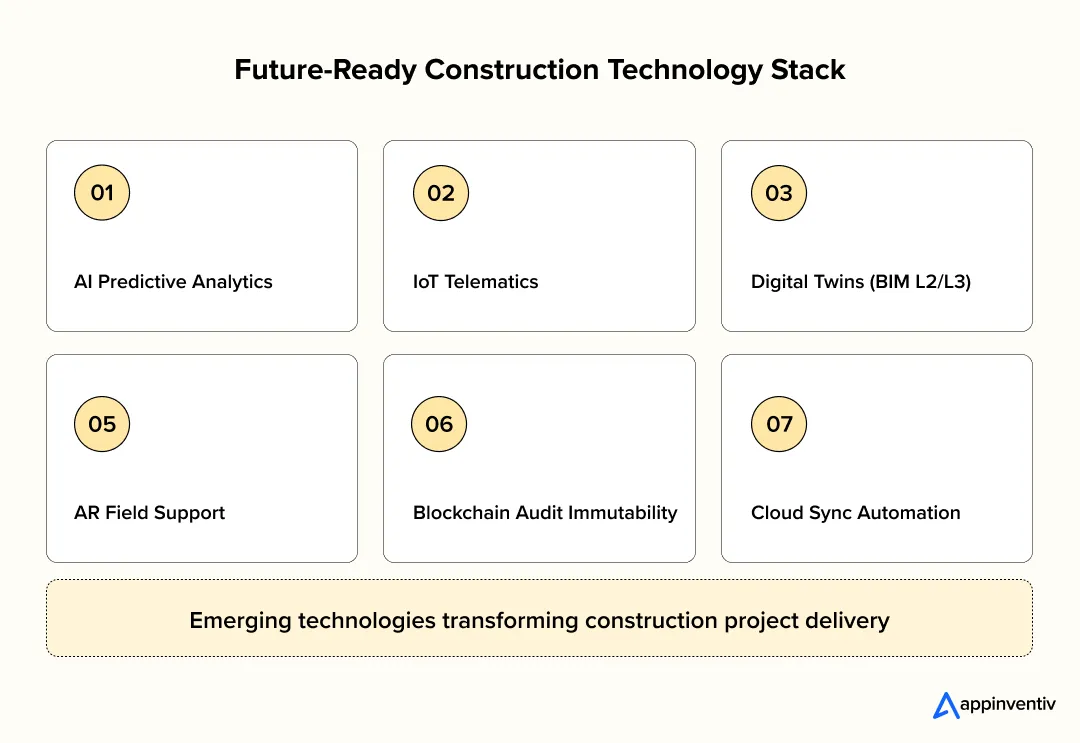
Technology Innovations Driving Next-Generation Construction Platforms
Construction management software is evolving beyond tracking and reporting. Emerging technologies are turning platforms into real-time operational intelligence systems.
- AI-based predictive analytics and machine learning help forecast delays and cost risks.
- IoT in construction telemetry pipelines enables real-time equipment monitoring and predictive maintenance insights.
- AR and VR improve site visualization and remote inspections.
- Blockchain supports automatic version control and tamper-proof records.
- Cloud sync and task automation ensure real-time reporting, automated notifications, and continuous data flow across teams.
Appinventiv helped build Ility, a scalable SaaS platform for commercial property owners that enables unified portfolio management and streamlined operations. The cloud-native architecture and integrated workflows resulted in a 40% increase in occupancy and measurable gains in landlord ROI, proving how strategic platform development transforms real estate operations.

Ways to Optimize Software Development Costs
Most enterprises don’t overspend on software because of poor planning. They overspend because the scope grows quietly while no one is looking. A feature here. An integration there. Before long, timelines stretch, and budgets follow.
Cost optimization starts with clarity. Define what must exist on day one and what can wait for later releases. Many construction platforms succeed by launching a focused core system first, then expanding once teams adopt it.
Other practical levers help control spending:
- Reuse existing systems instead of replacing everything
- Prioritize high-impact features over “nice-to-have” requests
- Test early with pilot projects to avoid late rework
- Choose scalable cloud infrastructure from the start
Another overlooked factor is choosing the right development partner. Teams that understand construction workflows make fewer false starts. Fewer false starts mean fewer wasted cycles.
In the end, cost control in software development looks a lot like cost control on a job site. You plan carefully, build in phases. You then adjust early and avoid surprises.
Considerations Before Investing in Construction Management Software
Most construction enterprises reach a point where existing tools start getting in the way. Reports take too long. Data lives in too many places. Site teams improvise their own systems. Before jumping into a new platform, it helps to slow down and make a few grounded decisions.
The first is simple. Do you build, buy, or work with a partner?
| Path | Best Fit | Watch-outs |
|---|---|---|
| Build In-House | Strong internal tech teams and long-term roadmap | Higher upfront effort, longer delivery |
| Buy a Ready-Made Product | Need quick rollout with standard workflows | Limited flexibility, vendor dependency |
| Co-Build With a Partner | Complex workflows and legacy integrations | Shared control, faster progress |
Then come the practical checks.
- Can your finance, HR, BIM, and procurement systems connect without major rework?
- Do you retain ownership of project data and documents?
- Does the technology partner understand real construction operations?
- Are the site and office teams ready to change how they work?
These points are rarely decided in boardrooms alone. They surface in workshops, pilot projects, and early rollouts.
Enterprises that take time here usually spend less later, both in budget and frustration.
Discuss your requirements and get a tailored roadmap for enterprise implementation.
Revenue Model of Construction Software
Construction software rarely succeeds on features alone. Its revenue model shapes how it grows, how it is supported, and how much value users receive over time.
Most enterprise platforms follow a subscription structure. Companies pay based on the number of projects, users, or data volume. This keeps entry costs manageable while allowing scale as adoption grows.
Other revenue streams often appear later:
- Premium analytics and AI forecasting modules
- Advanced integrations with ERP or BIM systems
- Dedicated support and uptime service agreements
- Custom workflow and reporting extensions
Some organizations also license the platform for internal-only use, especially when data control is a priority.
The key is alignment. A revenue model should match how construction teams actually use the platform. When pricing reflects real operational value, adoption becomes easier and long-term partnerships become stronger.
How to Develop an App Like Procore?
Building a Procore-like platform begins with understanding how projects run in real life, not in flowcharts. Site teams need speed. Office teams need detail. Leadership needs visibility.
Development usually starts with a core release:
- Project scheduling and cost tracking
- Document and drawing management
- Basic reporting dashboards
Once teams begin using the system, the platform expands. Mobile field reporting, procurement workflows, and finance integrations follow next.
As maturity grows, advanced layers come in:
- Offline-first mobile apps
- Compliance automation
- Portfolio analytics
- AI-driven risk insights
The most important step is sequencing. Trying to build everything at once slows progress. Building in controlled phases keeps teams engaged and budgets steady.
A Procore-like platform is not built in one leap. It is built through informed iteration, guided by real project feedback.
How Appinventiv Helps Enterprises Build Construction Management Software
Selecting a technology partner for an enterprise platform goes beyond development cost. It is about reliability, delivery discipline, and long-term support. Construction operations do not get second chances with failed rollouts or unstable systems. Enterprises evaluating the cost to build a construction management software need a partner that can deliver scale, security, and stability from day one.
Appinventiv brings enterprise software delivery experience that translates directly into large-scale platform execution through dedicated construction software development services designed for complex operational environments.
Proven delivery at scale
- 2,000+ software products delivered
- 95 percent on-time delivery record
- 500+ legacy systems modernized
- 10+ years of enterprise experience
Depth across industries and technology
- 35+ industries mastered
- 1,600+ technology specialists
- Five international offices
- 5 strategic federal partnerships
Enterprise-grade execution
- 99.5% security compliance
- 2x productivity through agile delivery
- 24/7 post-launch support
- 95% client satisfaction
- 90% repeat clientele
Recognized for sustained growth
- Deloitte Fast 50 India
- APAC High-Growth Company (Statista & FT)
Global brands such as IKEA, Domino’s, and Americana trust Appinventiv for complex digital platforms. The same enterprise rigor applies when building construction management software, from integration-heavy environments to security-first cloud deployments. Let’s connect and start your construction software development journey.
Frequently Asked Questions
Q. How does Appinventiv help enterprises build construction management software?
A. Appinventiv works with construction enterprises to design and build platforms that fit real operational workflows while providing clear guidance on the cost to build a construction management software at every stage. Teams handle discovery, architecture, integrations, security planning, and phased deployment. The focus stays on scalable cloud infrastructure, compliance readiness, and smooth adoption across field teams, office staff, and leadership stakeholders.
Q. How much does it cost to develop construction management software?
A. The cost to develop construction management software depends on the scope and depth of integration. A focused MVP typically ranges from $40K to $80K. Mid-scale enterprise platforms fall between $80K and $180K. Full enterprise ecosystems with advanced analytics, mobile offline features, and deep integrations range from $180K to $400K.
Q. What features are essential for enterprise-grade construction software?
A. Enterprise-grade construction software must support multi-project scheduling, real-time cost control, document and drawing management, mobile field reporting, role-based access, and audit trails. Integration with ERP, finance, BIM, and procurement systems is also critical, along with secure cloud infrastructure and strong data governance practices.
Q. How long does it take to build a Procore-like platform?
A. A Procore-like platform is usually developed in phases. A core MVP takes around 4 to 6 months. Mid-scale enterprise rollouts with mobile apps and finance integrations take 6 to 10 months. Full platforms with offline-first field tools, compliance automation, and deep system integrations take 10 to 16 months.
Q. How secure is custom-built construction software?
A. Custom-built construction software is designed with enterprise security standards from the start. It typically includes encrypted data storage, secure access controls, audit logging, and regular security testing. This approach provides stronger data ownership, governance, and compliance alignment than many off-the-shelf construction platforms.
Q. How does AI reduce operational risk in construction projects?
A. AI reduces operational risk by analyzing project data to detect early signs of delays, cost overruns, and compliance gaps. It can automate progress reporting, flag unusual activity, and support predictive scheduling. This allows project teams to address risks sooner, rather than reacting after problems escalate.
Q. What implementation, training, and support costs should enterprises plan for?
A. Beyond development, enterprises must budget for implementation and long-term operational support. This includes data migration from legacy systems, system integration, QA testing, and security protocol validation before launch. Training costs cover onboarding field and office teams, documentation, and change management.
After deployment, ongoing expenses include hosting, customer support resources, bug fixes, maintenance and support, compliance with data security regulations, and continuous updates. Planning these costs early ensures smooth adoption, stable performance, and sustained platform reliability.


Fast 2-minute response, fully NDA-protected.
Key takeaways: Australian construction firms are adopting project management software less as a tech upgrade and more as a survival response to margin pressure, compliance complexity, and delivery risk. 2026 adoption is being shaped by labour shortages, cost volatility, AI-enabled workflows, ESG reporting, and demand for real-time project visibility. The shift is moving beyond scheduling…
How Digital Twins in Construction in Australia Are Transforming the Industry in 2026
Key takeaways: A digital twin is a live, virtual representation of a physical building or infrastructure asset. Unlike static BIM models, it uses real-time data from IoT sensors to reflect the exact current state of the construction site. Key digital twin use cases in Australian construction include real-time structural telemetry and "exception-based" management to bypass…

Construction CRM Integration and Implementation – Benefits, Process, Costs
Efficiency is everything when it comes to the construction sector. Factors like project cost overruns, late delivery, mismanagement of resources, or poor and confusing communication from clients may lead to derailment of the projects at a significant loss. Traditional methods have failed to meet the challenges of tighter timelines and greater complexity that modern construction…