






























How Much Does It Cost to Build a Car Rental App like Hertz?


- The Strategy Behind Hertz and What Businesses Must Learn From It
- Understanding the Complete Cost to Build a Car Rental App like Hertz
- Development Stage Breakdown Based on Investment Timeline
- Factors That Influence the Cost to Build a Car Rental App Like Hertz
- Hidden Cost Drivers Businesses Often Miss When Building a Car Rental App Like Hertz
- Cost Optimization Strategies for Building a Car Rental App Like Hertz
- Crafting the Experience: Essential Features of a Car Rental App Like Hertz
- Beyond the Horizon: Strategies to Make an App Better Than Hertz
- Understanding the Monetization Strategies of the Car Rental Platform Like Hertz
- How to Develop a Car Rental App Like Hertz: The Process
- Why Choose Appinventiv for Developing an App Like Hertz
- FAQs

Key takeaways:
- The cost to build a Hertz-like app ranges roughly $40,000–$300,000+.
- Complexity, automation, and scale matter more than just the number of features.
- Real costs continue after launch: infra, maintenance, support, and compliance.
- Smart planning and MVP-first approach help keep budgets under control.
- Revenue comes from rentals, add-ons, subscriptions, partnerships, and fleet sales.
- You need a tech partner who treats it as a business system, not “just an app.”
The car rental industry has changed quietly, but completely. What used to depend on counters, paperwork, and phone calls now runs on apps and platforms. Customers expect to search, book, extend, and pay without speaking to anyone. Pricing shifts throughout the day, fleets move across cities while availability updates instantly. For most companies, technology is no longer support – it’s operations.
In this digital-first market, Hertz didn’t just adapt. It built an edge.
Over time, Hertz created a system that ties customer experience, fleet operations, and payments into one workflow. That is why many companies today aim to build an app like Hertz instead of launching simple booking tools. They want to make a platform that can scale across locations and handle demand without breaking.
That ambition raises a very real question- “What does it actually cost to build something this complex?”
To give you a brief idea, the cost to build a car rental app like Hertz usually falls in the range of $40,000 to $300,000+, depending on how deep the functionality goes and how much of the business is automated. The overall cost is influenced by system design, integrations, compliance requirements, and how prepared the platform is for growth.
This guide is here to give you clarity. We will break down where money actually goes during development, what drives cost up or down, and what teams regularly underestimate. You’ll also see how companies move from idea to deployment through a structured build process, and what features matter most early versus later.
We also touch on where the market is heading, what makes platforms stick with users, and how successful rental systems turn software into revenue. By the end, you should have a practical view of costs, decisions, and tradeoffs before you commit to building.
If you’re planning to compete with platforms, not just launch an app, this is the right place to start.
We can break down the cost before you write a single line of code.

The Strategy Behind Hertz and What Businesses Must Learn From It
The scale of the opportunity explains why platforms like Hertz matter. The global car rental market was valued at $149.87 billion in 2024 and is projected to cross $278.03 billion by 2030, growing at a CAGR of 10.5%. Travel demand is rising across both business and leisure segments, and customers increasingly expect rentals to feel as simple as booking a flight. This shift is pushing rental companies to invest in digital platforms instead of manual processes. For any team planning to build an app like Hertz, this market momentum is the real backdrop behind the investment.
Hertz did not capture this market by running campaigns. It built operational muscle through technology. The company has more than 1,000,000+ app downloads, showing that customers now engage digitally by default. But the real strength is behind the app. Hertz runs inventory, booking, payments, and fleet optimization inside one system. Businesses that want to make a car rental platform like Hertz are not copying visuals. They are trying to replicate operational control at scale.
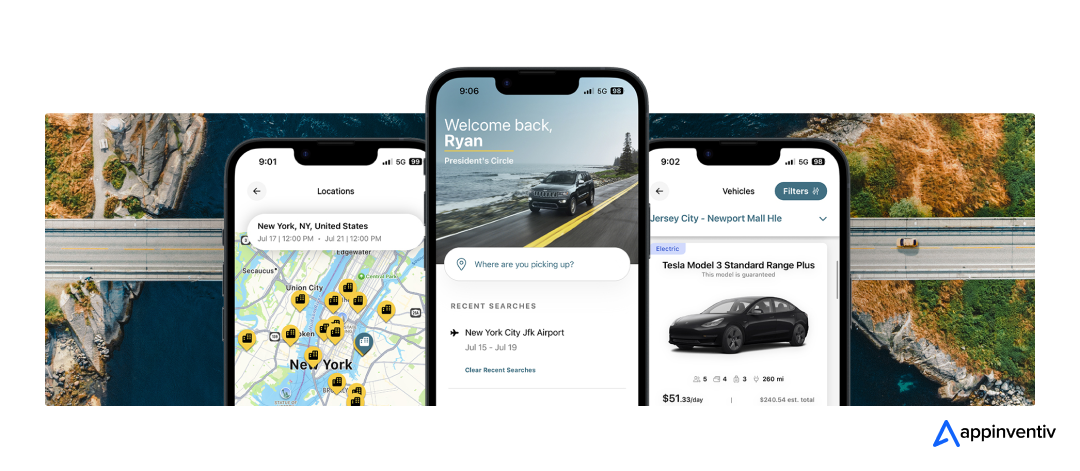
Recent performance reinforces that strategy. In Q3 2025, Hertz reported $2.5 billion in revenue, delivered $184 million in net income, and posted $0.42 in earnings per share for the first time in two years. Adjusted EBITDA reached $190 million, rising nearly $350 million year-over-year. Utilization crossed 84%, the highest level since 2018, driven by improved fleet discipline and vehicle availability. A major fleet refresh was completed, improving lifecycle economics and vehicle quality across locations. Customer experience followed the same curve, with a nearly 50% increase in Net Promoter Score across North America.
This performance is not separate from technology. It is a direct result of system design. Anyone evaluating the cost to build a car rental app like Hertz is really deciding how much control they want over pricing, inventory, and customer experience.
To say the least, the benefits of building a car rental platform like Hertz go beyond bookings. You gain predictability, utilization efficiency, and a customer relationship that scales without adding overhead. Hertz proves that in this market, software no longer supports infrastructure but supports the business itself.
Understanding the Complete Cost to Build a Car Rental App like Hertz
The budget to build a car rental platform like Hertz is not a single number. It is a range shaped by your target market, operational depth, technical ambition, and long-term product vision. A booking-only application may require a modest build, but the cost to build a car rental app like Hertz increases rapidly once you introduce fleet logic, pricing automation, compliance systems, and multi-location management. That is why serious enterprises estimate cost based on platform depth, not just feature lists.
Investment Tiers by Platform Complexity
Minimum Viable Product (MVP)
An MVP focuses on validating demand through core system flows such as vehicle discovery, reservations, basic payments, and customer accounts. At this stage, companies aim to test market response before committing to deep automation. The objective is to learn quickly, launch efficiently, and evolve based on usage patterns.
Investment Range: $40,000 – $90,000
Mid-Complexity Platform
This tier introduces operational controls such as location-based pricing, booking logic, vehicle availability tracking, and reporting. Here the app becomes a business engine, not just a listing tool. Revenue generation begins, workflows stabilize, and the system becomes integral to daily operations.
Investment Range: $90,000 – $200,000
Enterprise-Grade Platform
This level delivers automation across fleet operations, multi-location deployments, and real-time reporting. It includes system resilience, data intelligence, and workflow consistency across regions. This is where full-scale car rental app development cost reflects platform-grade engineering and operational control.
Investment Range: $200,000 – $300,000+
| Platform Stage | Complexity Level | Cost Range | Timeline | Strategic Value |
|---|---|---|---|---|
| MVP | Core platform | $40K–$90K | 2–4 months | Market validation |
| Growth | Process automation | $90K–$200K | 5–8 months | Revenue enablement |
| Enterprise | Platform maturity | $200K–$300K+ | 9–15 months | Market leadership |
Development Stage Breakdown Based on Investment Timeline
Understanding cost also requires understanding how budgets unfold over time. Companies planning the process to develop a car rental app like Hertz must treat development as a sequence of stages rather than a lump-sum expense.
Discovery and Planning
This phase translates business objectives into technical architecture. Teams define system scope, platform logic, security needs, and operational workflows. Mistakes here are expensive later and usually result in rework, delays, or feature cuts.
Estimated Cost: $5,000 – $15,000
Design Phase
UI/UX design determines usability and how easily different user types can complete their tasks. This phase covers user journeys, layout structure, interface behavior, and responsiveness across devices. A strong design reduces support load and friction after launch.
Estimated Cost: $10,000 – $30,000
Core Development
This is where the system is actually built. Backend services, APIs, role management, booking logic, pricing engines, and admin control systems are implemented. This stage carries the largest share of the car rental app development budget.
Estimated Cost: $50,000 – $160,000
Testing and Stabilization
Before launch, performance and security are validated under real-world conditions. Load tests, vulnerability scans, and user acceptance testing ensure the system behaves reliably when traffic scales.
Estimated Cost: 15–20% of development budget
Maintenance and Ongoing Support
After launch, the platform requires continuous upkeep. This includes bug fixes, feature improvements, performance tuning, infrastructure management, and compliance updates. Maintenance is not optional for production systems operating at scale.
Estimated Cost: 15–25% of total build cost annually
| Stage | Cost Range | Outcome |
|---|---|---|
| Planning | $5K–$15K | Product clarity |
| Design | $10K–$30K | Usability foundation |
| Development | $50K–$160K | Functional platform |
| Testing | 15–20% | System stability |
| Maintenance | 15–25% yearly | Platform continuity |
Factors That Influence the Cost to Build a Car Rental App Like Hertz
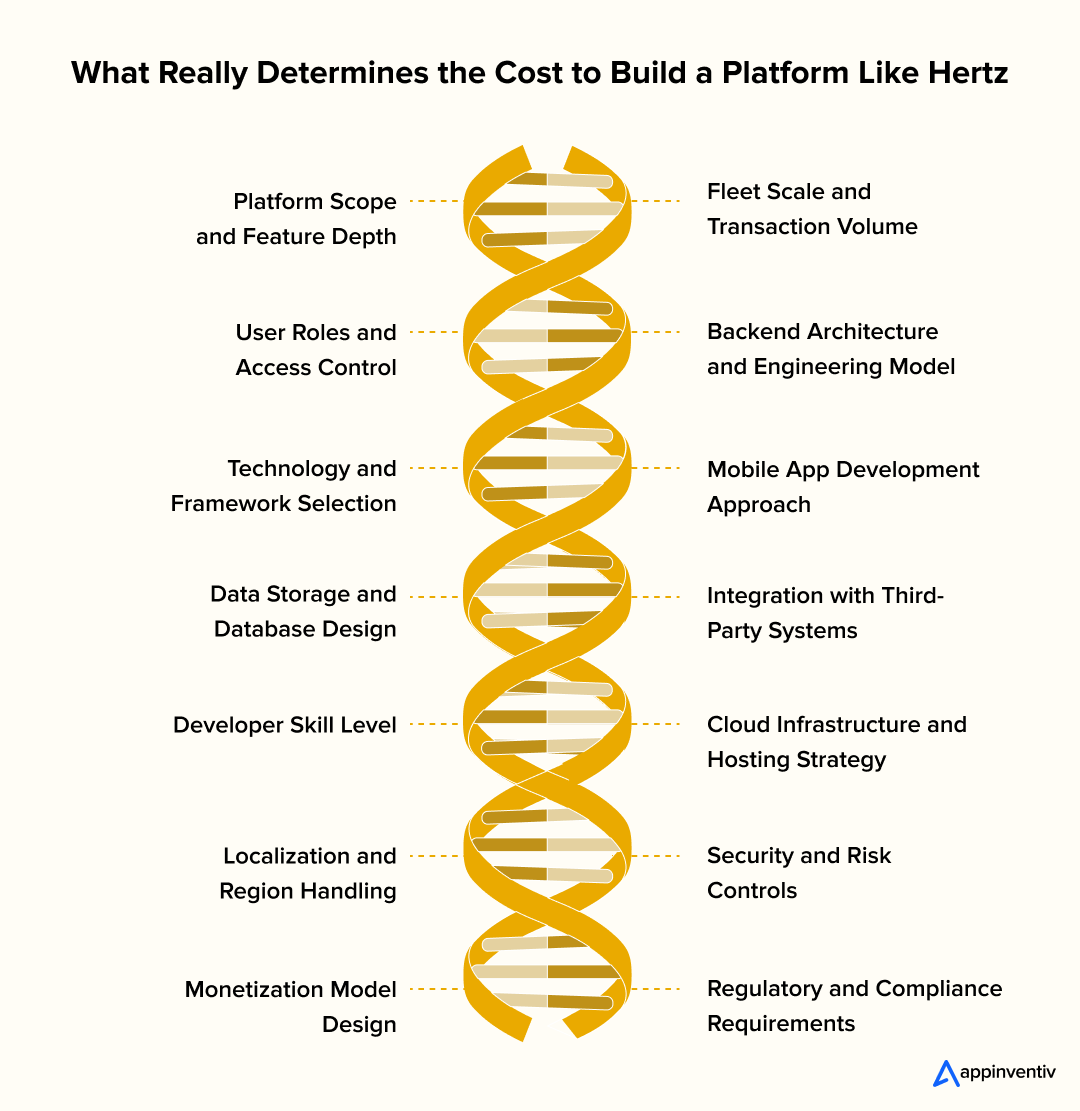
Before locking a budget, businesses need to understand one simple truth: the cost to build a car rental app like Hertz is not driven by screens alone. It is shaped by system logic, real-time operations, regulatory requirements, and how reliably the platform runs in high-traffic conditions. If you are planning to build an app like Hertz for a competitive market, these are the core forces that determine the actual investment behind car rental app development cost.
Platform Scope and Feature Depth
A basic booking app with limited vehicle availability logic does not compare to a full rental engine managing pricing, inventory, maintenance, disputes, and payments. When platforms include live vehicle status, dynamic pricing, customer identity verification, and admin control systems, the build effort increases significantly. Every additional workflow increases system complexity and directly raises the cost to build a platform like Hertz.
Fleet Scale and Transaction Handling
A platform serving a city fleet behaves very differently from one managing thousands of vehicles across locations. Load balancing, database tuning, and background processing become essential as volume grows. When estimating car rental app development cost, transaction frequency and fleet size matter as much as features. Infrastructure planning separates small builds from serious platforms.
User Roles and Access Logic
Car rental platforms operate in layers. Customers book while agents manage the reservations and finance teams handle the billing. Furthermore, operations oversee fleet health and admins control pricing and rules. Each layer increases permissions logic, validation checks, and backend coordination. Systems with complex role control structures take longer to build and cost more to maintain.
Architecture and System Engineering
Short-term builds often start fast with tightly coupled systems. Long-term systems rely on modular design and scalable infrastructure. A platform designed to survive traffic growth, payment spikes, and hardware integration costs more upfront but avoids instability later. Engineering decisions made early have the largest influence on the long-term cost to build an app like Hertz.
Technology Selection
Frameworks, databases, and hosting models change operational lifetime costs. Some stacks are faster to launch. Others cost more but deliver performance under pressure. The tech stack used in car rental app development directly affects reliability, scalability, and total ownership cost. Smart selection balances stability with flexibility.
| Component | MVP Impact (USD) | Enterprise Impact (USD) | Strategic Effect |
|---|---|---|---|
| Mobile App Approach | Cross-platform saves $30k+ | Native adds $40k–$60k | Speed vs. performance tradeoff |
| Backend Design | Simple stack lowers cost | Distributed services raise cost | Growth readiness |
| Database Architecture | Single DB cheaper | Hybrid models cost 10–20% more | Concurrent usage handling |
| Staffing Model | Generalist teams cheaper | Specialists raise budget | Quality and scale |
| Hosting Strategy | $500–$1,500/month | $10,000+/month | Reliability under load |
Regional Deployment and Localization
If you plan to launch across markets, pricing engines, tax rules, and language support must adapt by region. Platforms that ignore localization often experience poor retention. Supporting region-specific workflows raises cost but expands operational reach and reduces user churn.
Risk Protection and System Security
Car rental systems process payments, bookings, and personal data. Security is not optional. Identity control, data storage encryption, and attack protection systems increase development timelines. Cutting corners here reduces cost short term but raises business risk long term.
Revenue Engine Complexity
Subscription logic, discount engines, loyalty programs, and promotional rules all increase logic depth. Platforms that build monetization as an afterthought usually redesign later at greater cost. Businesses that plan these workflows at the start avoid rebuilding core systems.
Compliance and Legal Exposure
Payment rules, customer data handling, and contract workflows require legal alignment. Meeting the conditions for car rental app development increases engineering discipline but protects the business against regulatory disruption.
[Also Read: IT Compliance Regulations for US Industries: Navigate Compliance with Confidence]
Hidden Cost Drivers Businesses Often Miss When Building a Car Rental App Like Hertz
When teams estimate the cost to build a car rental app like Hertz, they almost always focus on features and development hours. What they miss are the expenses that appear only after customers start booking, paying, and interacting daily. These hidden costs don’t show up in the proposal but slowly inflate the real budget as the platform grows.
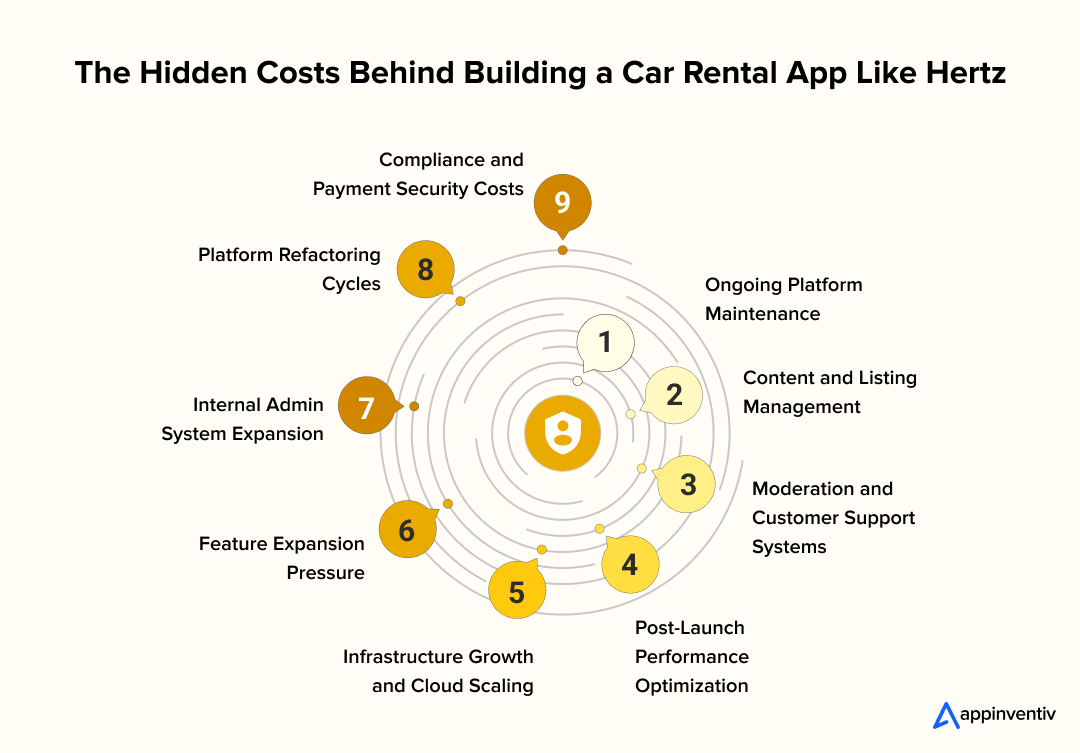
Ongoing Platform Maintenance
Once you build an app like Hertz, the work does not stop. Bug fixes, security patches, and compatibility updates become a continuous responsibility. As operating systems, APIs, and third-party services change, your platform must be updated or risk breaking core workflows. Maintenance quietly becomes one of the biggest factors affecting the cost to build app like Hertz over time.
[Also Read: What Does It Cost to Maintain an App in 2026? A Complete Enterprise Budget Guide]
Content and Listing Management
Vehicle information is not static. Prices, availability, policies, and discounts change constantly. Managing fleet content requires admin resources, automation tools, and engineering work to avoid outdated listings and booking errors. This operational layer is part of the real cost breakdown to develop a car rental platform like Hertz, but it often goes unaccounted for in early estimates.
Moderation and Customer Support Systems
Refunds, disputes, late returns, and damaged-car complaints require infrastructure. Live chat tools, ticketing software, automated refund handling, and escalation workflows all add to system complexity. As your platform scales, support becomes software-driven, not manual. This is one reason the cost to build a platform like Hertz grows after launch.
Post-Launch Performance Optimization
What works during testing can break under real traffic. Slow searches, checkout failures, and app crashes trigger emergency engineering work. Performance tuning only intensifies as the platform grows. For businesses trying to make a car rental platform like Hertz, performance engineering becomes an ongoing cost driver.
Infrastructure Growth and Cloud Scaling
Hosting, backups, data storage, and analytics systems grow with usage, not with design. As more users book and browse, infrastructure costs rise each month. This is where many businesses realize that the car rental app development cost is not fixed; it grows with success.
Feature Expansion Pressure
User behavior reshapes your roadmap. Loyalty programs, pricing automation, location-based availability, and subscription models are requested once bookings increase. Many of the features for car rental apps like Hertz are not launch requirements, but they become business necessities after traction builds.
Internal Admin System Expansion
What starts as a simple dashboard becomes an operation center. Reporting tools, fleet management workflows, audit trails, and business intelligence layers begin to grow. As operations expand, so does the software that runs behind them.
Platform Refactoring Cycles
Early shortcuts create future rebuilds. Code written for speed often needs rewriting to handle growth. Rebuilding is always more expensive than designing properly once. This is one of the most underestimated contributors to long-term cost.
Compliance and Payment Security Costs
As volume increases, compliance becomes unavoidable. Data privacy audits, payment security checks, and fraud prevention systems must be added. GDPR/PCI-DSS compliant car rental app development is not optional when processing bookings and payments. Regulations under the compliances for a car rental app like Hertz category enter long after design is complete and grow in complexity over time.
Cost Optimization Strategies for Building a Car Rental App Like Hertz
A large budget is not required to build well, but poor planning causes budget leaks. Smart decisions during architecture, feature selection, and development planning can control the long-term cost to build a car rental app like Hertz without sacrificing scale or security.
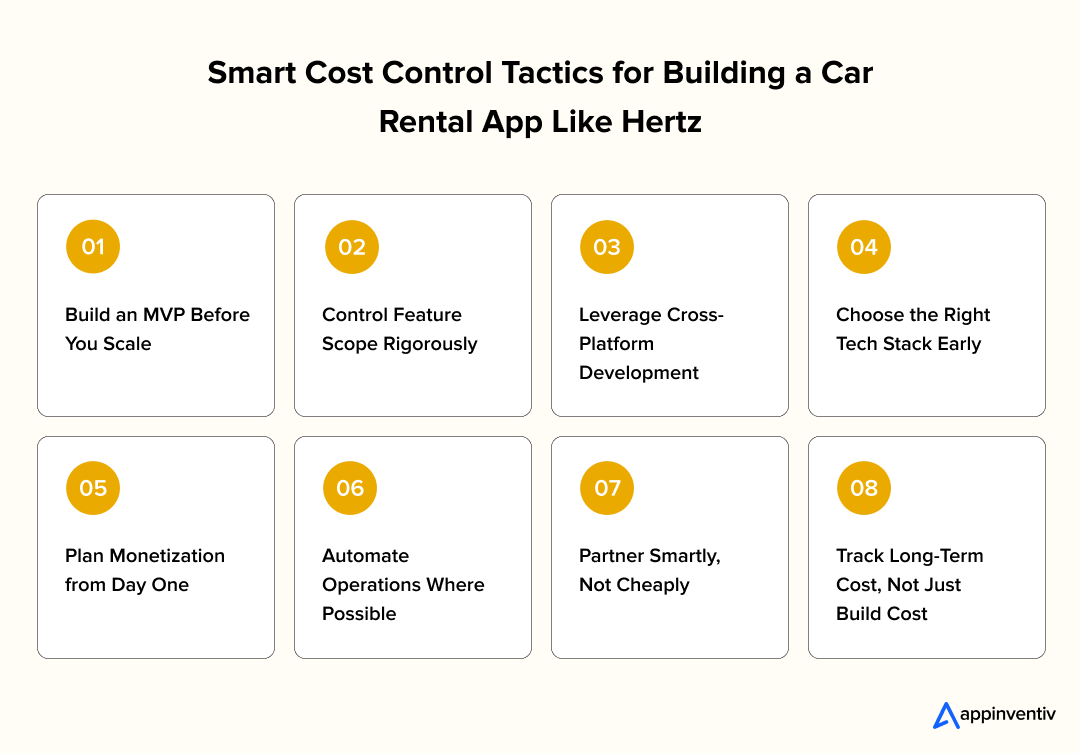
Build an MVP Before You Scale
Focus first on essential flows like bookings, search, payments, and vehicle management. Avoid launching with secondary features. An MVP reduces initial spend and validates the business before heavy investment. This is the most effective way to control the cost to build a platform like Hertz at the early stage.
Control Feature Scope Rigorously
Not every feature belongs in phase one. Roadmaps shift based on usage, not assumptions. Defining structured release phases saves money and avoids expensive rebuilds. This is especially important when deciding which features are essential versus optional.
Leverage Cross-Platform Development
Frameworks like Flutter or React Native eliminate double development effort. One codebase across platforms cuts engineering cost and time significantly. This directly lowers long-term car rental app development budget.
Choose the Right Tech Stack Early
Selecting scalable architecture from day one prevents costly refactors later. Decisions around load handling, storage, and integrations directly influence growth cost. The tech stack used in car rental app development matters far more after scale than at launch.
Plan Monetization from Day One
Revenue logic must be engineered early. Subscription options, promotions, cancellation penalties, and partnership pricing influence both income and complexity. Understanding monetization strategies of the car rental platform like Hertz early prevents revenue leaks later.
Automate Operations Where Possible
Fleet updates, pricing policies, and reporting should be system-driven, not manual. Automation saves operational cost and reduces human error. This makes the platform easier to scale without inflating expenses.
Partner Smartly, Not Cheaply
Work with teams that understand scale, compliance, and security. Cutting corners early becomes expensive later. Quality engineering lowers rebuild risk and reduces lifetime cost more than short-term savings ever will.
Track Long-Term Cost, Not Just Build Cost
Budgets should include hosting, monitoring, updates, and compliance. The factors affecting the cost to build an app like Hertz continue long after launch. Teams that model lifetime cost avoid financial surprises.
Crafting the Experience: Essential Features of a Car Rental App Like Hertz
A car rental app only works when every user type gets exactly what they need without confusion. Customers want speed and simplicity. Drivers and vehicle owners want control and clarity. Admin teams need visibility and automation. The strength of a platform lies in how well these three experiences connect and support each other in real-world use.
User-Side Features
These features decide how easy it is for customers to find a car, trust the platform, and complete a booking without frustration.
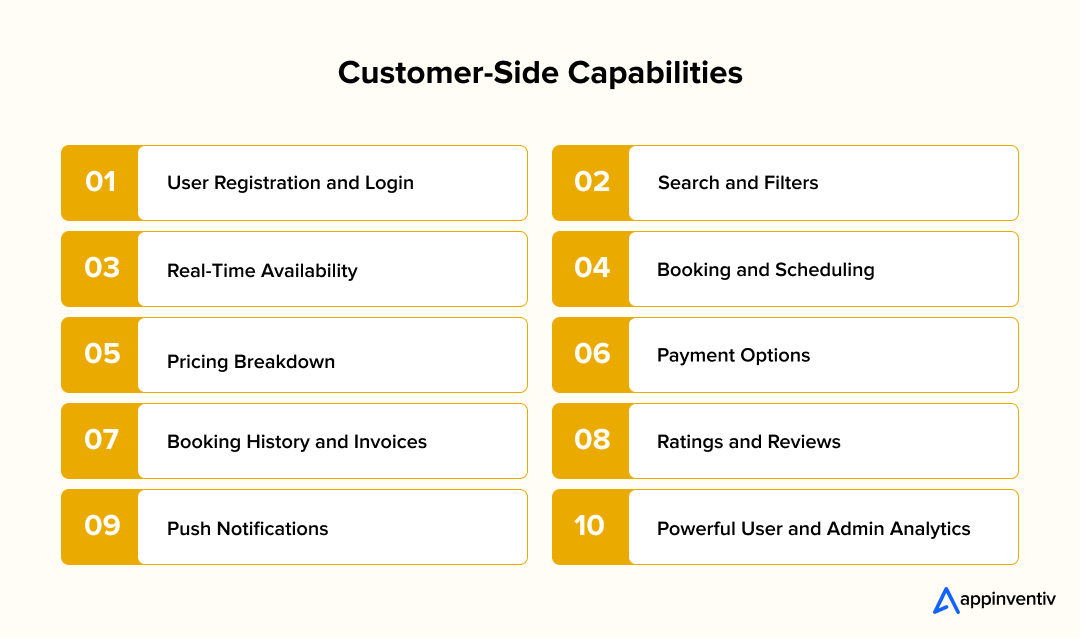
Simple Registration and Login
Users expect quick access without complicated steps. Mobile number, email, and social logins should work flawlessly so customers can start browsing without friction.
Advanced Vehicle Search and Filters
Search should feel effortless. Users must be able to filter by location, price range, vehicle type, fuel preference, and availability dates. The faster a customer finds the right car, the more likely they are to book.
Live Vehicle Availability
Real-time updates prevent double bookings and customer frustration. The system should reflect accurate availability instantly as cars are booked, returned, or blocked for maintenance.
Booking and Scheduling System
The app should make booking feel smooth and predictable. Pick-up and drop-off times, rental duration, and costs must be clearly visible before confirmation.
Pricing Transparency
Users trust platforms that show clear pricing. This includes rental charges, deposits, taxes, late fees, and any optional add-ons without hidden surprises.
Secure Payment Methods
Multiple payment options increase conversion. Users want flexibility to pay through cards, wallets, or online banking with instant confirmation.
Booking History and Invoices
Customers should always have access to past bookings, receipts, and rental details. This builds trust and simplifies record-keeping for repeat renters.
Ratings and Reviews
User feedback builds platform credibility. Reviews help new users choose confidently and push service providers to maintain standards.
In-App Notifications
Reminders, confirmations, and updates keep users informed. From booking alerts to return reminders, timely notifications reduce confusion.
Customer Support Interface
Easy access to help matters. Live chat, call support, and ticket systems ensure users can resolve issues without leaving the app.
Driver -Side Features
These functionalities control how smoothly vehicles are listed, managed, and delivered into real bookings and revenue.
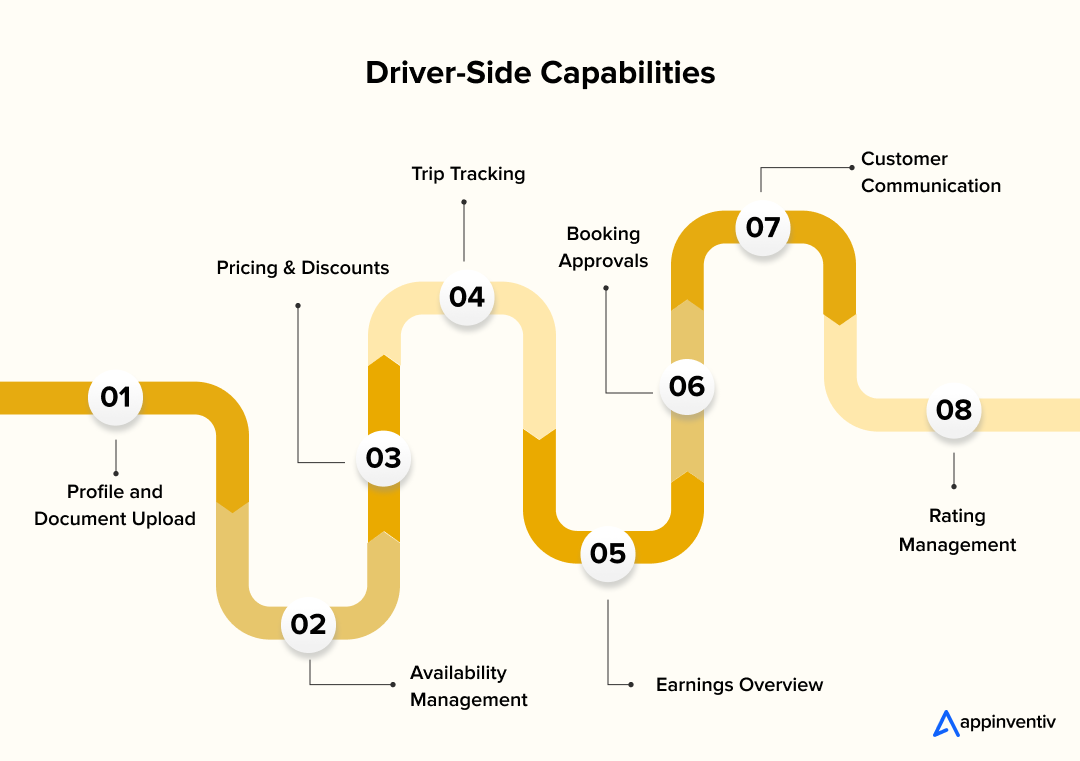
Profile and Document Management
Drivers and car owners should be able to upload licenses, ID, and vehicle documents easily. This keeps compliance simple and avoids manual verification delays.
Vehicle Availability Controls
Owners need full control over when their vehicle is rented. Blocking dates, setting working hours, and managing availability should take only seconds.
Pricing and Discount Management
Owners should be able to adjust prices based on demand, season, or vehicle usage. Smart pricing keeps earnings optimized without admin intervention.
Trip Tracking and Alerts
Drivers benefit from real-time trip updates, location tracking, and status change alerts. This keeps operations transparent and avoids disputes.
Earnings Dashboard
A simple earnings view shows income, upcoming payouts, and completed trips. Clear reporting builds confidence in the platform.
Request Approvals and Declines
Drivers must be able to accept or reject bookings quickly with clarity on timing, duration, and payout.
Customer Communication Tools
Easy messaging allows drivers and owners to confirm details and reduce misunderstandings before pickup.
Feedback Access
Ratings and reviews help drivers improve service and gain credibility on the platform.
Admin-Side Features
These features allow the admin to keep the business running quietly in the background by managing operations, control, and performance visibility.
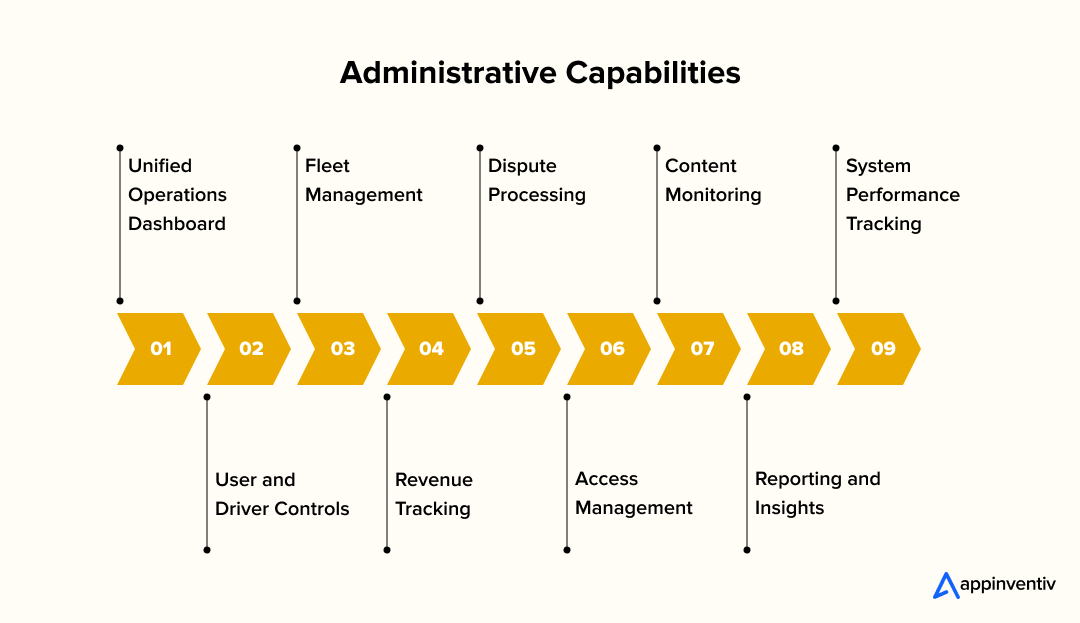
Centralized Dashboard
Admins need one view for everything. Bookings, drivers, support tickets, and revenue should be visible in real time.
User and Driver Management
Admins should control verification, suspension, and support for users and providers from a single system.
Fleet Oversight Tools
Admins must see availability, usage patterns, and vehicle performance across the entire platform.
Revenue Monitoring
Live financial tracking helps identify revenue trends, cancellations, and losses early.
Dispute and Refund Handling
Admins need tools to resolve complaints, issue refunds, and audit activity without delays.
Access Control and Permissions
Different admin roles require different system access. This prevents mistakes and secures operations.
Content Moderation
Listings, reviews, and profile activity must be monitored to maintain platform quality.
Reporting and Analytics
Usage data reveals what’s working. Reports guide feature improvements, pricing updates, and expansion decisions.
System Health Monitoring
Admins must detect downtime, slow performance, or failed payments instantly to prevent business disruption.
Beyond the Horizon: Strategies to Make an App Better Than Hertz
Hertz has built a strong digital rental model, but user expectations continue to rise faster than platforms evolve. Businesses that want to lead in mobility must create systems that feel easier, faster, and smarter than anything users have seen before. The next wave of growth will favor platforms built around experience, not just operations.
Elevated UI/UX: The Human-Centric Advantage
Businesses must understand that user interfaces directly control customer retention and booking rates. Every interaction design decision either builds loyalty or silently pushes users toward competitors.
| Heavy UI/UX Features | Description |
|---|---|
| Hyper-Personalization Driven by AI | Adapts vehicles, offers, and screens to each user’s preferences and behavior. |
| Frictionless Onboarding | Enables instant access through fast identity verification and minimal steps. |
| Inclusive Accessibility | Ensures app usability across age groups, abilities, and device types. |
| One-Tap Booking | Reduces friction by shortening the path between search and payment. |
| Visual Booking Journey | Shows trip progress clearly from reservation to return. |
| Instant Rebooking | Allows repeat users to reserve again in seconds. |
| Smart Location Suggestions | Adjusts pickup and drop points automatically based on movement. |
| Adaptive Interface | Changes layout depending on user type and usage pattern. |
| Gesture-Based Navigation | Speeds interaction using minimal taps and swipes. |
Innovative Features: Redefining Mobility Convenience
Businesses that rely only on standard app features risk becoming interchangeable.
Innovation is how a platform moves from being an option to becoming the obvious choice. Businesses must understand that the overall cost to build a car rental app like Hertz is also impacted by the integration of advanced features but is totally worth it when it comes to RoI.
| Innovative Features | Description |
|---|---|
| Contactless Experiences | Eliminates physical interactions during pickup and return. |
| Multi-Modal Mobility Hub | Combines rentals with transport, navigation, and travel services. |
| Live Damage Detection | Prevents disputes through automated image-based inspections. |
| Smart Insurance Selection | Adjusts coverage based on trip behavior and duration. |
| Subscription Rentals | Encourages retention through flexible monthly plans. |
| Auto Refund Processing | Resolves failed bookings automatically without support delay. |
| Carbon Tracking | Promotes transparency around environmental impact. |
| Driver Scoring System | Rewards responsible customer behavior. |
| Remote Vehicle Controls | Enables locking, unlocking, and alerts through the app. |
| Voice Booking | Allows hands-free search and reservations. |
| Emergency Support Button | Provides instant assistance during breakdowns or issues. |
| Offline Mode | Keeps data accessible without the internet. |
Advanced Technologies: Powering the Future of Mobility
Technology choices now determine whether an app scales or collapses under growth. Platforms built without future-ready architecture struggle when traffic and complexity increase.
| Advanced Tech | Description |
|---|---|
| Generative AI Support | Handles advanced user queries conversationally. |
| Predictive Analytics | Forecasts fleet usage and pricing shifts. |
| Smart Pricing Engine | Updates fares dynamically based on conditions. |
| Fraud Detection | Identifies suspicious activity instantly. |
| Vehicle Telematics | Streams real-time diagnostics into operations. |
| AR Inspection Tools | Simplifies damage reporting with camera overlays. |
| Blockchain Contracts | Makes agreements verifiable and tamper-proof. |
| Edge Processing | Keeps performance stable under heavy load. |
| Autonomous Readiness Systems | Prepares for future fleet automation. |
| Behavioral Alerts | Warns users before booking conflicts arise. |
Talk to us about how we can help you plan, design, and build with innovation at the core.
Understanding the Monetization Strategies of the Car Rental Platform Like Hertz
To build a truly sustainable and profitable digital platform, it’s essential to understand the diverse ways a leading entity like Hertz generates revenue. The monetization strategies are multifaceted, designed to capture value from every point in the customer journey and fleet lifecycle.
- Core Rental Fees: This remains the foundational revenue stream, encompassing the base daily, weekly, or monthly rates charged for vehicle usage.
- Comprehensive Ancillary Services: These are crucial add-ons that significantly boost average transaction value:
- Insurance & Waivers: Offering various levels of collision damage waivers, liability protection, and personal accident insurance.
- Fuel Options: Providing convenient pre-paid fuel options, or charging for refueling upon return if the tank isn’t full.
- Optional Add-ons: Renting out GPS devices, child safety seats, Wi-Fi hotspots, or offering premium roadside assistance packages.
- Vehicle Upgrades: Providing opportunities for customers to upgrade to a larger, more luxurious, or higher-performance vehicle at an additional cost at the counter or through the app.
- Late Return & Additional Mileage Fees: Imposing penalties for vehicles returned beyond the agreed-upon time or for exceeding mileage limits.
- Membership & Loyalty Programs: While designed to reward customers, higher tiers of loyalty programs can sometimes involve annual subscription fees, offering exclusive access to certain vehicle classes or accelerated rewards earning.
- Corporate Partnerships & B2B Solutions: Establishing long-term contracts with businesses to provide discounted rental rates, dedicated account management, and specialized fleet services for their employees’ travel needs. This is a highly stable and lucrative revenue stream for large players.
- Used Vehicle Sales: A significant revenue stream for companies like Hertz involves the regular rotation and sale of vehicles from their active fleet. These used vehicles are often well-maintained and sold through various channels.
- Franchising Fees: For global operations, a franchise model allows for rapid expansion and brand penetration, with recurring fees from franchisees contributing to the overall revenue.
Beyond these established methods, consider innovative monetization strategies when developing your own car rental platform:
- Subscription Models: Explore offering various subscription tiers, providing members with a certain number of rental days per month or exclusive access to specific vehicle categories for a recurring fee. This appeals to frequent local users who prefer access over ownership.
- Contextual Advertising & Partnerships: Subtly integrating non-intrusive, context-relevant advertisements for complementary services, such as local hotels, tourist attractions, or experience providers. This creates new revenue channels while enhancing user value.
- Ethical Data Monetization: Leveraging aggregated, anonymized user data and market insights (e.g., popular routes, demand hotspots) to offer valuable reports to third-party businesses like urban planners or tourism boards, strictly adhering to data privacy regulations.
- API Monetization: If your platform develops unique capabilities or becomes a central hub for car rental data, consider offering API access to other travel platforms or mobility service providers for a fee.
How to Develop a Car Rental App Like Hertz: The Process
Building a car rental platform is not a development project. It is an operational transformation that blends business logic, engineering control, and customer experience into one system. Most platforms fail not because of technology, but because execution lacks discipline once real users and revenue come into play. A structured approach is what keeps the cost, scale, and performance of a platform predictable over time.
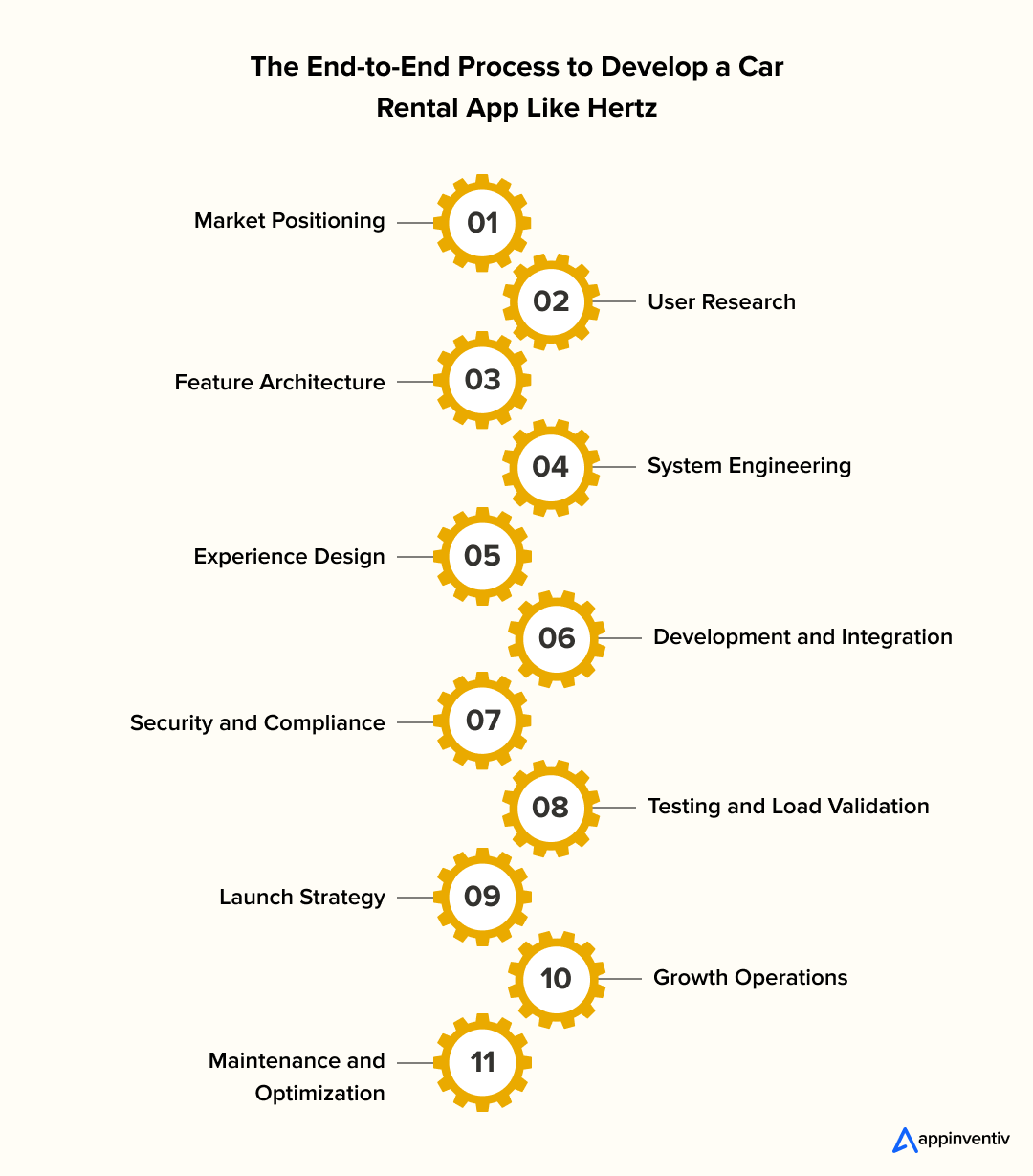
Step 1: Market Positioning and Business Definition
This step defines who the platform is built for and what problem it truly solves. Teams study existing market gaps, evaluate competitors, and shape the brand’s place in the rental ecosystem. Revenue direction, pricing logic, and user focus are clarified here to prevent strategy drift later.
Step 2: User Research and Rental Behavior Study
This phase uncovers how customers actually search, compare, and book vehicles. Research focuses on hesitation points, device usage habits, and booking drop-offs. The goal is not opinion gathering, but behavioral clarity that drives real design decisions.
Step 3: Feature Architecture and Scope Control
Features are planned as a system, not as a wish list. Teams separate launch-critical components from long-term enhancements and organize development into stages. This structure prevents feature overload and keeps delivery realistic and controlled.
Step 4: System Architecture and Engineering Design
Technical foundations are locked in here. Data handling logic, performance strategy, third-party integrations, and scalability models are designed based on expected traffic and transaction volume. Good architecture makes expansion predictable. Bad architecture makes growth expensive.
Step 5: Experience Design and Usability Engineering
Design is based on how people behave, not how they should behave. Navigation, search flow, payments, and feedback loops are optimized to reduce thinking and increase confidence. Every screen is designed to make booking feel natural and uninterrupted.
Step 6: Development and Integration
Development proceeds with structure, not speed. Core logic, interfaces, and APIs are built and tested in parallel to prevent late chaos. Integrations are staged and stabilized so the platform behaves as one system rather than disconnected tools.
Step 7: Security Framework and Compliance Setup
This step protects the platform against internal misuse and external threats. Authentication rules, data access layers, audit trails, and encryption policies are enforced. Security is treated as infrastructure, not as an add-on.
Step 8: Performance Testing and Load Conditioning
Before launch, systems are intentionally stressed. Traffic bursts, checkout pressure, and API failure situations are simulated to expose weak points early. Systems are refined until speed and reliability hold under pressure.
Step 9: Launch Planning and Controlled Rollout
Launch is introduced gradually, not aggressively. Early users provide error patterns and usability feedback. Stability is validated before large-scale promotion begins. This reduces public failures and protects early reputation.
Step 10: Growth Enablement and Operational Systems
Support operations, reporting workflows, and performance monitoring go live. Internal processes are refined so that growth does not become disorder. Governance ensures consistency as usage multiplies.
Step 11: Maintenance and Continuous Improvement
The platform enters its true operational phase. Updates, optimizations, and performance tuning become constant. This phase determines long-term success far more than initial development ever will.
Why Choose Appinventiv for Developing an App Like Hertz
We hope this blog has helped you understand the overall cost to build a car rental app like Hertz. Now, choosing a development partner is not about hiring coders. It is about trusting a team with your operations, customer experience, and growth plans. A car rental app runs at the center of your business. If it fails under load, delays payments, or frustrates users, the damage is immediate and visible.
As an on-demand app development company, we treat every platform as a business system, not just a mobile app. We design around real user behavior, booking flow pressure, and payment reliability. Our work starts with understanding how your platform will perform under stress, not just how it looks in mockups.
We prioritize stability, scalability, and speed from the first sprint. Architecture decisions are made to support growth, not restrict it. Performance tuning, security design, and integration planning are part of the build, not afterthoughts.
Most partners disappear after deployment. We do not. We remain involved through optimization, updates, and growth phases so your platform evolves with your business, not behind it. The goal is simple. Build something that works today and still works when your volume multiplies.
Partner with us to create an app that redefines mobility, enhances user experiences, and accelerates your business growth. Let’s connect today to bring your vision to life.
FAQs
Q. How Much Does It Cost to Build an App like Hertz?
A. Most apps in this space land somewhere between $40,000 and $300,000+. A smaller build with just search, booking, and payments is usually on the lower end. Once you start adding things like live location tracking, admin controls, and automated systems, the cost to build a car rental app like Hertz move up fast. Where the development team is based and whether you build one platform or two also makes a big difference. The more complex the idea, the more time and money it eats.
Q. How Long Does It Take to Develop a Car Rental Platform like Hertz?
A. There’s no fixed timeline, but most platforms take around six months to a year. If you keep things simple, you could launch in four or five months. Bigger systems with integrations, testing, and custom work tend to stretch longer. Delays usually happen when features change mid-build or when the design isn’t properly planned at the start.
Q. How to Optimize the Cost of Building a Car Rental App like Hertz?
A. The biggest money-saving move is not building everything at once. Start with the basics and grow later. Build for one platform first, not both. Use existing tools for payments and maps instead of writing your own. And plan properly. Fixing things late always costs more than getting it right early.
Q. How to Ensure the Safety and Security of Users of Car Rental Apps?
A. Keep it simple and strict. Protect data. Lock down accounts. Don’t allow weak payments. Drivers and customers should be verified properly. Location tracking helps prevent misuse, and regular security checks stop problems from piling up quietly. Most breaches happen from neglect, not complexity.
Q. What Is the ROI of Building a Car Rental App like Hertz in 2025?
A. If it’s built well, the returns are there. Demand keeps rising, especially in cities and travel-heavy areas. Some cars pay themselves off faster than people expect, while others take time. Apps that rely on one income source usually struggle. The ones that combine rentals, subscriptions, and partnerships tend to do better over time. Like any business, the tech only works when the operations underneath are solid.

- In just 2 mins you will get a response
- Your idea is 100% protected by our Non Disclosure Agreement.

How Much Does It Cost To Build a Chat App Like Arattai?
Key takeaways: Creating a chat app like Arattai will cost you anywhere from $40,000 to $400,000, depending on how complex you want it to be. The essential features you need are real-time messaging, multimedia sending, and user authentication. Layering advanced features such as voice/video calls, group messaging, AI-driven bots, and end-to-end encryption takes the app…
How Much Does It Cost to Build a Banking App like Barclays?
Key takeaways: Barclays sets the bar: Its speed, security, and money management tools show what EU users expect from modern banking apps. Costs vary a lot: A basic, compliant app can start around $40,000 (≈€30,000), while a feature-rich build can reach $400,000+ or more (≈€298,000+). Rules add real work: Meeting PSD2, GDPR, and instant payment…
How Much Does It Cost to Build a Route Planning App Like Komoot
Europe doesn’t just love the outdoors- it thrives on it. From the Alps to Amsterdam’s bike lanes, cycling and hiking fuel an industry worth $53.3 billion in 2024, projected to grow at nearly 11% CAGR through 2033, as reported by GrandViewResearch. And leading this charge is Komoot, the route-planning app trusted by 40+ million users.…









