





















Build In-House vs Hire a Development Agency: Real Cost Comparison

- Hiring an Agency Vs Building In-House: Core Differences
- What are the Pros and Cons of In-House & Agency Development?
- In-House vs Outsourcing: Cost Breakdown
- Speed-to-Market and Revenue Impact Analysis
- Key Considerations While Deciding to Build In-House or Hire Development Agency
- When to Build Vs When to Partner
- Agency vs Internal Development Team ROI- What Actually Pays Off?
- Real-World Use Cases: How Mid-Enterprises Choose Between In-House and Agency Models
- Steps to Choose the Right Software Development Model
- Why Choose Appinventiv as Your Development Partner
- FAQs

Key takeaways:
- There’s no universal winner in build in-house vs hire development agency, the right choice depends on stage, speed, and strategic priority.
- In-house development builds long-term capability but comes with higher fixed costs and slower ramp-up.
- Outsourcing offers flexibility, faster execution, and predictable project-based spend typically ranging from $40,000 to $400,000 for mid-scale initiatives.
- Speed-to-market often impacts ROI more than salary comparisons in the in house development vs outsourcing decision.
- Many mid-sized enterprises adopt a hybrid approach, keeping product ownership internal while partnering externally for scale and specialization.
At some point, almost every growing company hits this wall. Do we build in-house vs hire a development agency for support? Do we keep expanding the internal team, or bring in a partner who can move faster? It sounds like a hiring question. It rarely is. It’s usually a growth question disguised as a staffing decision.
When leaders debate hiring an Agency vs. Building In-House, what they’re really wrestling with is control versus flexibility. An internal team feels stable. You see them every day. You build shared context. But it also means fixed salaries, hiring delays, and carrying capacity even when workloads dip. On the other side, in-house development vs outsourcing isn’t just about saving money. It’s about accessing skills you may not have, scaling up without a six-month recruiting cycle, and shifting risk off your balance sheet. Neither option is perfect. Both come with trade-offs that show up later, not immediately.
The bigger picture makes this even more interesting. The global IT outsourcing market is expected to surpass $618 billion in 2026, which tells us something important. Enterprises are not outsourcing because they can’t build. They’re outsourcing because speed, specialization, and flexibility have become competitive advantages. Structure has become strategy.
In this blog, we’ll look at this decision the way a mid-sized enterprise actually experiences it. We’ll unpack real cost differences over time, where ROI quietly shifts, what risks most teams underestimate, and how to think clearly about when to build vs when to partner. The goal isn’t to push one answer. It’s to help you choose the structure that fits where your company is right now- and where it’s trying to go next.
Get a clear cost and ROI breakdown tailored to your growth stage before committing to a long-term structure.

Hiring an Agency Vs Building In-House: Core Differences
Before diving into cost models and ROI discussions, it helps to step back and understand what truly separates these two approaches. The choice between building internally and partnering externally is less about preference and more about structure, flexibility, and long-term intent.
The table below breaks down the practical differences that mid-sized enterprises typically experience when evaluating build in-house vs hire development agency options.
| Decision Area | Building In-House | Hiring a Development Agency |
|---|---|---|
| Core Objective | Build long-term internal capability | Access ready-made execution capacity |
| Cost Structure | High fixed costs (salaries, benefits, tools, retention) | Variable costs (project-based, retainer, or dedicated team) |
| Time to Start | 3–6 months hiring + ramp-up | 2–4 weeks onboarding (sometimes faster) |
| Control & Ownership | Direct oversight, deep alignment with business | Structured oversight through contracts, SLAs, and governance |
| Knowledge Retention | Stays inside the organization | Requires documentation and structured transfer |
| Scalability | Slower; depends on hiring cycles | Faster; can scale teams up or down quickly |
| Risk Exposure | Attrition risk, underutilization risk | Vendor dependency, scope creep risk |
| Best Fit For | Long-term core product development | Time-bound projects, modernization, specialized builds |
| Long-Term Impact | Strengthens internal engineering muscle | Preserves agility without expanding payroll |
When evaluating build in-house vs hire development agency, you’re deciding between strengthening permanent internal capability or buying structured, scalable delivery capacity.
In many mid-enterprises, the real tension in hiring an agency vs. building in-house isn’t cost alone. It’s whether the initiative is strategic enough to justify expanding fixed overhead, or whether flexibility and speed matter more right now.
And that’s where the broader in house development vs outsourcing conversation becomes less about preference and more about timing, risk tolerance, and internal maturity.
What are the Pros and Cons of In-House & Agency Development?
Once you move past surface-level comparisons, the real picture becomes clearer. Both models work. Both can fail. What usually makes the difference isn’t the model itself, it’s whether the structure fits the stage your company is in.
Instead of thinking in absolutes, it helps to look at the pros and cons of in-house & agency development in practical terms, how they show up in day-to-day operations.
Pros and Cons of In-House Development
Building internally is about committing to long-term capability. You’re investing in people who grow with the product and understand the business beyond just sprint tickets. That depth can become a strategic advantage, but it also entails greater structural responsibility.
Advantages of Building In-House:
An internal team stays closely aligned with business goals and customer needs. Context remains inside the company, helping decisions move faster and strengthening long-term capability.
| In-House | What That Actually Means |
|---|---|
| Direct control | Your team works inside your ecosystem. Priorities shift faster. Conversations happen without layers. |
| Deep business alignment | Engineers understand customer nuance, internal politics, and long-term vision. |
| IP and data ownership clarity | No ambiguity about where code lives or who maintains it. |
| Cultural integration | Product thinking becomes embedded in the company’s DNA. |
Limitations of Building In-House:
Fixed costs remain even when priorities shift, hiring and replacement take time, and losing key talent or needing niche expertise can quickly slow momentum.
| In-House | Where It Gets Difficult |
|---|---|
| High fixed overhead | Salaries, benefits, tools, office costs, you carry them whether the workload is high or not. |
| Hiring delays | Recruiting strong engineers takes time, often months. |
| Attrition risk | If key developers leave, momentum slows immediately. |
| Limited specialization | Hard to justify niche experts (AI, security, DevOps) full-time unless workload is constant. |
Pros and Cons of Hiring a Development Agency
Partnering with an agency is less about building permanent muscle and more about accessing structured delivery capacity. You tap into existing processes, experience, and specialized expertise without expanding payroll risk. That flexibility is often attractive to mid-sized enterprises that manage growth carefully.
Advantages of Hiring a Development Agency:
Agencies provide ready-to-deploy teams with broad expertise and scalable capacity, offering faster execution and a more flexible cost structure as priorities shift.
| Advantages of Hiring a Development Agency | Why It Appeals to Mid Enterprises |
|---|---|
| Faster execution | Teams are already assembled and experienced. No long hiring ramp-up. |
| Access to broader skill sets | Specialized talent across tech stacks, industries, and frameworks. |
| Scalable cost structure | Easier to expand or reduce capacity as priorities change. |
| Delivery maturity | Established processes, QA systems, DevOps maturity model workflows. |
Limitations of Hiring a Development Agency:
External partners require strong governance and clear scope definition, as misaligned expectations or weak knowledge transfer can lead to cost or timeline drift.
| Limitations of Agency Engagement | What You Must Manage Carefully |
|---|---|
| Vendor dependency | You rely on an external partner for continuity. |
| Context gap | Agencies need time to fully absorb your internal business nuance. |
| Scope management pressure | Poorly defined projects can lead to cost expansion. |
| Knowledge transfer planning | Without structure, learning stays outside your walls. |
In-House vs Outsourcing: Cost Breakdown
When leaders compare in house development vs outsourcing, the conversation usually starts with salaries. But the real comparison isn’t payroll versus invoice. It’s fixed structural cost versus controlled delivery spend.
Let’s look at this through a practical lens for a mid-sized enterprise building a digital product or modernizing an existing system.
In-House Cost Structure
Building internally means carrying ongoing overhead, whether roadmap velocity is high or not.
Typical cost range over 12–18 months for a mid-scale initiative:
- Small team (4–6 members): $600,000 to $1.8M+
- Includes salaries, benefits, infrastructure, recruitment, tools, and compliance setup
Even a lean internal team quickly crosses the $1M mark once you include:
- Hiring costs
- Ramp-up time (3–6 months)
- Retention risk
- DevOps, security, cloud infrastructure
- Leadership and management overhead
The longer the product lifecycle, the heavier that fixed cost becomes. That’s the trade-off when evaluating build in-house vs hire development agency models.
Outsourcing Cost Structure
Now let’s shift to outsourcing. For mid-enterprise projects such as:
- MVP launches
- Product modernization
- AI feature integration
- Platform redesign
The typical outsourcing range falls between $40,000 to $400,000, depending on scope, complexity, tech stack, and geography.
Here’s how that usually breaks down:
| Project Type | Estimated Outsourcing Range |
|---|---|
| MVP / Prototype | $40,000 – $80,000 |
| Mid-scale Product Build | $80,000 – $200,000 |
| Enterprise-Grade Platform | $200,000 – $400,000 |
What makes outsourcing financially attractive isn’t just the headline number. It’s what that number includes:
- Pre-assembled engineering team
- QA processes
- DevOps infrastructure
- Project management
- Specialized expertise (AI, cloud, security)
- Delivery maturity
Instead of building a permanent cost center, you’re funding a defined outcome.
Why Outsourcing Often Looks More Predictable
When you step back and look at the numbers calmly, outsourcing tends to feel more predictable for one simple reason: it shifts your cost structure.
In a practical in-house vs outsourced development comparison, outsourcing converts fixed overhead into variable spend. Instead of carrying salaries regardless of workload, you fund delivery against defined milestones and scope. That structural shift changes how financial risk behaves.
Here’s why that predictability stands out for mid-sized enterprises:
- You’re not paying for idle engineering capacity during roadmap slowdowns
- You’re not absorbing attrition risk if key developers leave
- You’re not committing to long-term salary overhead if strategy pivots
- You can scale resources up or down based on business needs
- Budget exposure is often tied to defined project boundaries
For mid-enterprises balancing growth with cost discipline, that flexibility matters. It allows leadership to protect cash flow while still moving initiatives forward.
That said, outsourcing isn’t automatically cheaper forever. If you’re building a deeply core product that demands continuous innovation over several years, investing internally may eventually deliver stronger long-term leverage.
But when organizations revisit the broader in house development vs outsourcing decision, the real question usually shifts. It’s not just, “Which costs less?”
It becomes, “Which model gives us financial control without slowing execution?”
Also Read: Hire Software Developers | Expert Engineers Building
Compare fixed payroll vs variable agency spend with a customized financial model built around your roadmap.

Speed-to-Market and Revenue Impact Analysis
In many boardroom discussions around build in-house vs hire development agency, speed quietly becomes the deciding factor. Not because leaders prefer one model over the other, but because delay has a measurable cost.
When you evaluate hiring an agency vs building in-house, the timeline difference is rarely small.
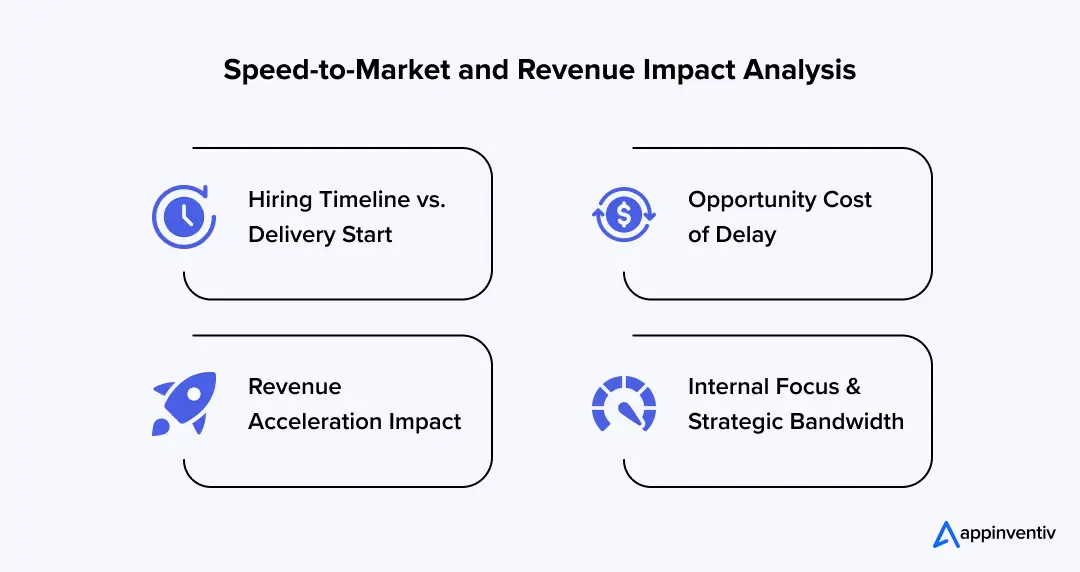
1. Hiring Timeline vs. Delivery Start
Building internally typically involves:
- 2–4 months sourcing and interviewing
- 1–2 months onboarding and ramp-up
- Additional time to stabilize delivery processes
In contrast, outsourcing partners often begin within weeks. In many in house development vs outsourcing scenarios, that acceleration can reduce launch timelines by 3–6 months.
That difference isn’t theoretical. It directly affects revenue capture.
2. Opportunity Cost of Delay
If your product is tied to:
- A seasonal market opportunity
- Competitive positioning
- Regulatory compliance deadlines
- Investor milestones
Every month of delay compounds risk. For mid-sized enterprises, speed is often tied to survival as much as growth. In an in-house vs. outsourced development comparison, even a single quarter’s delay can significantly shift projected ROI.
3. Revenue Acceleration Impact
Earlier launch means:
- Earlier revenue realization
- Faster user feedback cycles
- Quicker product iteration
- Stronger competitive positioning
When comparing outsourcing vs in house development, agencies frequently win on immediate acceleration because they bring delivery maturity and structured execution from day one.
4. Internal Focus and Strategic Bandwidth
There’s another dimension leaders often underestimate. Building internally consumes management attention. Recruiting, onboarding, mentoring, and retaining talent takes executive bandwidth.
Partnering can allow internal leadership to focus on:
- Product strategy
- Market positioning
- Customer acquisition
- Core business expansion
That indirect impact can influence overall ROI just as much as development cost.
When evaluating When to Build vs. When to Partner, speed-to-market often reshapes the equation more than raw budget numbers do.
The real question becomes:
- Can we afford the delay of building internally?
- Does faster execution translate into measurable revenue?
- Which model lets us move without compromising quality?
For mid-sized enterprises operating in competitive environments, time isn’t just a variable. It’s leverage.
Key Considerations While Deciding to Build In-House or Hire Development Agency
When leadership sits down to evaluate building in-house vs hire development agency, the discussion usually becomes practical very quickly. It’s less about preference and more about structural fit. Below are the core factors that tend to shape the final call for mid-sized enterprises.
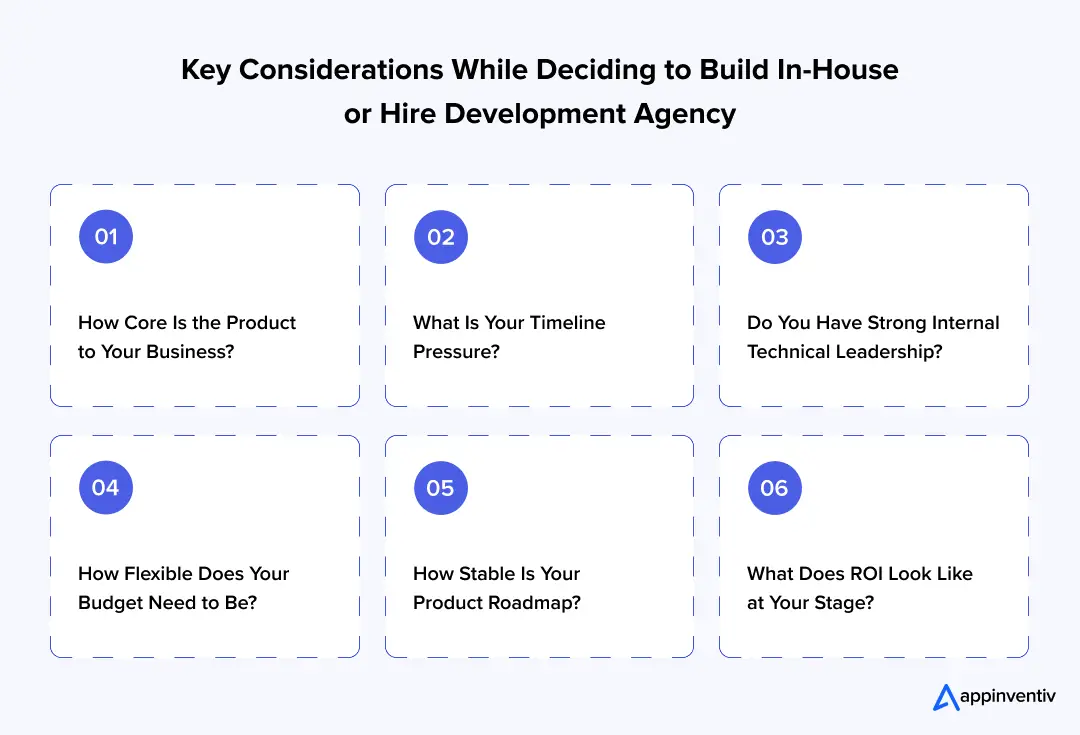
1. How Core Is the Product to Your Business?
If the software you’re building defines your market position, long-term internal ownership may be worth the investment. Deep institutional knowledge compounds over time and strengthens defensibility.
However, if the initiative supports operations, modernization, or expansion rather than defining your identity, partnering can reduce structural burden.
Ask yourself:
- Is this product central to our competitive advantage?
- Will we be continuously innovating on it for years?
- Does IP sensitivity demand internal control?
2. What Is Your Timeline Pressure?
Speed changes everything. Hiring internally can take months, and ramp-up takes longer. If your market window is tight, delay has real revenue implications.
In many in-house vs outsourced development comparison scenarios, faster onboarding through an agency directly improves ROI.
Consider:
- How much does a 3–6 month hiring delay cost us?
- Are we trying to hit a funding, compliance, or market deadline?
- Can we afford slower execution?
3. Do You Have Strong Internal Technical Leadership?
Internal teams thrive under strong architectural guidance. Without it, delivery risks increase regardless of model.
If leadership maturity is still developing, outsourcing can provide structured delivery processes and external oversight, assuming governance is clear.
Evaluate:
- Do we have senior engineering leadership in place?
- Can we manage delivery quality internally?
- Are we prepared to run engineering operations long-term?
4. How Flexible Does Your Budget Need to Be?
Internal teams create fixed overhead. Agencies typically convert that into more predictable, project-based spend.
For mid-enterprises managing cash flow carefully, this difference matters. It’s often central to the broader outsourcing vs in house development discussion.
Think about:
- Can we sustain fixed payroll during roadmap slowdowns?
- Do we need variable cost flexibility?
- Is financial predictability a priority right now?
5. How Stable Is Your Product Roadmap?
If your roadmap is clear for several years, building internally can create long-term leverage. But if priorities are still evolving, committing to permanent headcount may add rigidity.
Ask:
- Are requirements stable or still shifting?
- Is this a defined project or an evolving platform?
- Do we need elasticity more than permanence?
6. What Does ROI Look Like at Your Stage?
When assessing agency vs internal development team ROI, go beyond salary comparisons. ROI includes time-to-market, risk exposure, opportunity cost, and scalability.
Review:
- What is the revenue impact of faster delivery?
- What risks carry the highest financial consequence?
- Which model gives us execution confidence?
These key considerations, when deciding whether to build in-house or hire a development agency, rarely yield a one-size-fits-all answer. The right choice depends on where your company stands today and how much flexibility you need for tomorrow.
Also Read: Hire Mobile App Developers: Guide to Find the Best Team
When to Build Vs When to Partner
At some point, the numbers stop being theoretical, and the decision becomes practical. The real tension in when to build vs. when to partner usually shows up when leadership aligns product ambition with operational reality.
This is not about ideology. It’s about timing.
When Building In-House Makes Sense
There are situations where internal investment is the smarter long-term move. You should lean toward building internally if:
- The product is core to your long-term business strategy
- You expect continuous development over multiple years
- IP ownership and data sensitivity are critical
- You already have strong internal technical leadership
- Engineering maturity is part of your competitive advantage
In these cases, the higher cost of developing In-House becomes a strategic investment rather than overhead. You’re not just delivering features, you’re building institutional capability.
For companies with stable funding and a long roadmap horizon, this structure can create stronger alignment and deeper ownership.
When Partnering with an Agency Makes More Sense
On the other hand, partnering becomes attractive when speed, specialization, or financial flexibility take priority.
You should consider partnering if:
- You need to launch quickly
- Internal bandwidth is limited
- Specialized skills (AI, cloud, cybersecurity) are missing
- The initiative is project-based rather than perpetual
- Budget control and cost variability matter
In the broader in-house vs agency development conversation, this is where the advantages of hiring a development agency over in-house become clear. You access expertise without expanding payroll risk. You fund outcomes rather than headcount.
For many mid-sized enterprises, this is why the discussion around build in-house vs hire a development agency often ends in a hybrid decision, internal product ownership combined with external execution.
The Honest Reality
The answer to When to Build vs. When to Partner is rarely permanent. What makes sense at one stage of growth may not make sense two years later.
If your roadmap is uncertain, your capital needs protecting, or your capability gaps are slowing momentum, partnering with experienced software development services can buy time and reduce structural exposure.
If your product defines your market position and demands constant innovation, building internally may offer stronger long-term leverage.
The key isn’t picking the “right” model universally. It’s choosing the one that fits where your business is right now, and where it’s headed next.
Agency vs Internal Development Team ROI- What Actually Pays Off?
When leadership evaluates this decision seriously, the focus shifts from raw cost to return on investment. A fair agency vs internal development team ROI comparison looks beyond salary lines and contract values. It considers speed, capital exposure, delivery risk, and long-term leverage.
Here’s how mid-sized enterprises should think about ROI across both models.
1. Time-to-Market ROI
Speed directly impacts revenue and competitive positioning. Internal teams often require months of hiring and onboarding before meaningful output begins. Agencies, by contrast, usually start with ready-built teams and established processes.
Consider:
- 3–6 months hiring delay for internal teams
- 2–4 weeks onboarding for agencies
- Revenue or market opportunity lost during delays
- Competitive advantage of launching earlier
In many in-house vs agency development decisions, time-to-market becomes the single largest ROI driver.
2. Risk-Adjusted ROI
ROI is not just about growth. It’s about protection. Internal teams concentrate knowledge within a small group. If attrition hits, momentum slows. Agencies distribute execution risk across a larger talent pool.
Evaluate:
- Attrition exposure in internal teams
- Vendor dependency risk in outsourcing
- Knowledge concentration risk
- Continuity planning structures
In a real-world in-house development vs. outsourcing comparison, risk-adjusted ROI often favors the model that reduces disruption.
3. Capital Efficiency ROI
Building internally creates fixed structural overhead. That’s powerful for long-term capability but heavy on short-term capital flexibility. Outsourcing converts cost into a defined project spend.
Review:
- Fixed payroll commitments
- Variable milestone-based payments
- Budget flexibility during roadmap shifts
- Cash flow impact over 24 months
For many mid-sized enterprises deciding whether to build in-house vs hire development agency, capital efficiency becomes a deciding factor.
4. Long-Term Compounding ROI
If you plan to continuously innovate and expand the product over the years, internal capabilities can compound. Over time, engineering maturity may reduce dependency and lower incremental feature cost.
But if the initiative is project-based, modernization-focused, or transformation-driven, outsourcing often provides clearer ROI cycles.
Ask:
- Is this a long-term core product?
- Are we building permanent capability or delivering an initiative?
- Will internal knowledge compound meaningfully over time?
When analyzing outsourcing vs in house development, the real ROI question becomes practical:
- Which model accelerates measurable value?
- Which minimizes operational risk?
- Which preserves flexibility if priorities shift?
For mid-sized enterprises, ROI isn’t just financial. It’s structural. It’s about building momentum without overextending the organization.
Real-World Use Cases: How Mid-Enterprises Choose Between In-House and Agency Models
This decision rarely happens in a vacuum. It usually shows up when something changes, growth spikes, systems strain, leadership shifts, or new markets open up. The choice to build in-house vs hire development agency support tends to follow real business pressure, not theory.
Here’s how it often plays out.
1. A Manufacturing Company Modernizing Operations
A mid-sized manufacturing firm wanted real-time dashboards across its plants. The leadership team had deep operational expertise, but no appetite to build a full internal software division.
Instead of hiring five engineers and a DevOps lead, they partnered with an external team experienced in industrial systems. Internal teams handled adoption and process alignment. The tech build stayed external.
It worked because the company wasn’t trying to become a software company. They were trying to modernize. In this case, in house development vs outsourcing came down to focus.
2. An Education Platform Expanding Internationally
An EdTech company growing into new regions needed mobile upgrades, better backend scalability, and localization support. They had a strong internal product vision, but their team was already stretched thin.
They kept the product strategy in-house. Execution scale went external. The result wasn’t just faster delivery. It was reduced internal burnout. This is where in-house vs agency development becomes less about cost and more about bandwidth.
3. A Logistics Firm Exploring AI
A logistics company wanted predictive analytics to improve demand planning. They didn’t have data scientists internally. Hiring full-time specialists felt risky without proof of ROI.
So they outsourced the first phase. Models were built, tested, and validated externally. Once the numbers made sense, they hired a small internal AI team to maintain and evolve it.
That’s a very real example of When to Build vs. When to Partner. Test externally and internalize once it proves value.
4. A Financial Services Firm Handling Compliance Pressure
A mid-tier financial institution needed to upgrade its onboarding system while staying compliant with strict regulatory frameworks.
They didn’t gamble with compliance. Data governance stayed internal. But interface redesign and system performance improvements were handled by an external partner.
This wasn’t about preference. It was about risk management. In many outsourcing vs in house development situations, control and execution can be split intentionally.
5. A Subscription Platform Scaling Quickly
A growing subscription business hit a surge in users. Features needed to ship faster. Internal hiring would take months.
They temporarily expanded engineering capacity through an agency. Once growth stabilized, external support reduced naturally.
This is often what the build in-house vs hire development agency conversation really looks like. Not permanent outsourcing and no permanent hiring. Just using structure to match the stage.
Steps to Choose the Right Software Development Model
By the time you reach this stage in the discussion, the question usually isn’t theoretical anymore. It’s practical. You’re not debating philosophy, you’re trying to make a decision that won’t create regret six or twelve months down the line.
Choosing between developing in-house vs hire development agency doesn’t require a complicated framework. It requires honest answers.
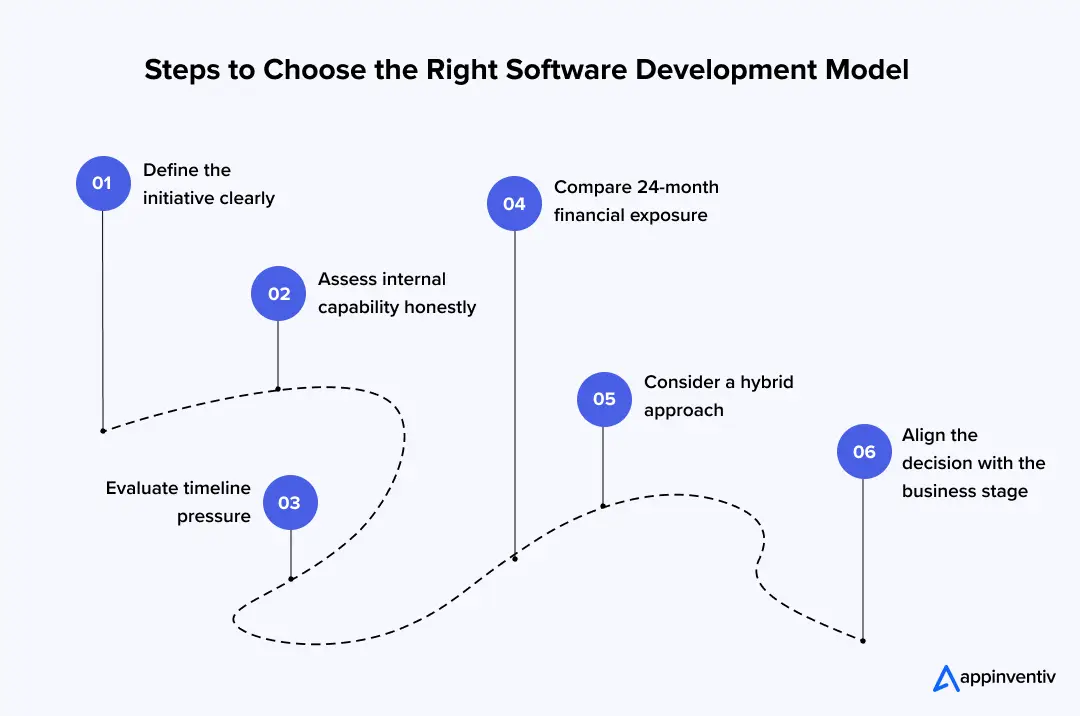
Here’s a grounded way to approach it.
- Define the initiative clearly: Is this a long-term core product or a time-bound project? Core systems may justify the higher cost of developing In-House, while defined initiatives often suit outsourcing.
- Assess internal capability honestly: Do you have strong technical leadership and hiring bandwidth? If not, the in house development vs outsourcing decision may lean toward partnering.
- Evaluate timeline pressure: If speed impacts revenue or compliance, agencies typically reduce ramp-up delays in an in-house vs outsourced development comparison.
- Compare 24-month financial exposure: Look beyond salary vs invoice. Factor fixed payroll, attrition risk, opportunity cost, and scalability when analyzing agency vs internal development team ROI.
- Consider a hybrid approach: Many mid-sized enterprises blend models, internal ownership with external execution, when deciding when to build vs. when to partner.
- Align the decision with business stage: Revisit the build in-house vs hire development agency choice based on growth phase, not preference. Structure should match strategy.
Let’s evaluate your product vision, timeline, and risk profile to define the smartest execution path forward.

Why Choose Appinventiv as Your Development Partner
When mid-sized enterprises evaluate build in-house vs hire development agency, the decision isn’t only about cost. It’s about execution confidence. As a global Mobile App Development Company, Appinventiv partners with growing enterprises to design, build, and scale digital products without adding unnecessary structural risk. Whether you’re modernizing legacy systems or launching a new platform, we align delivery models to your business stage.
With 35+ Industries Mastered, 3000+ Solutions Designed and delivered, and 500+ Legacy Processes Transformed, our experience goes beyond app builds. We understand compliance-heavy environments, high-growth scaling pressures, and enterprise-grade governance requirements. From fintech to healthcare, retail to SaaS, our teams work as structured partners, not just external vendors.
If you’re weighing in-house vs agency development and want clarity before committing to a long-term structure, let’s have a focused conversation. We’ll help you assess cost exposure, ROI impact, and delivery strategy, so your decision supports growth, not friction. Connect with our team to explore the right development model for your business stage.
FAQs
Q. Should we hire an agency or build an in-house software development team?
A. The decision to build in-house vs hire development agency support depends on your timeline, product criticality, and financial flexibility. If the product is core and long-term, internal investment may make sense. If speed, specialization, or cost variability matter more, partnering often delivers faster ROI.
Q. How do I choose between in-house developers and an agency?
A. Start by evaluating delivery urgency, internal technical maturity, and budget exposure. In a practical in house development vs outsourcing decision, consider whether you’re building permanent capability or delivering a defined initiative. Many mid-sized enterprises also explore hybrid structures before committing fully.
Q. When to Choose to Build In-House?
A. Building internally makes sense when:
- The product defines your long-term competitive advantage
- Continuous innovation is expected over several years
- Data sensitivity and compliance demand internal control
- You have strong engineering leadership already in place
In these cases, the higher cost of developing In-House becomes a strategic investment.
Q. When to Choose to Hire an Agency for Development Needs?
A. Partnering works best when:
- You need faster time-to-market
- Internal bandwidth is limited
- Specialized expertise (AI, cloud, cybersecurity) is required
- Budget flexibility is important
In many in-house vs agency development situations, agencies reduce ramp-up delays and convert fixed overhead into variable cost.
Q. Can agencies scale faster than in-house teams?
A. Yes, in most cases. Agencies typically have ready-built teams and recruitment pipelines, allowing faster scaling compared to internal hiring cycles. In an in-house vs outsourced development comparison, this elasticity often supports growth phases or short-term capacity spikes.
Q. How much does it cost to hire a development team?
A. The cost of hiring a development agency for a mid-sized project typically ranges between $40,000 to $400,000, depending on scope and complexity. By contrast, building a small internal team can exceed $600,000 to $1M+ annually when factoring in salaries, benefits, and overhead.
Q. What hidden costs come with in-house teams?
A. Beyond salary, hidden internal costs include:
- Recruitment and onboarding delays
- Attrition and replacement expenses
- Underutilization during roadmap slowdowns
- Infrastructure and tooling investments
- Management and leadership bandwidth
These factors significantly impact the broader outsourcing vs in house development evaluation and long-term ROI.
Q. How do you effectively manage in-house and outsourced development teams?
A. Managing delivery successfully, whether internal or external, comes down to structure and clarity. In both in house development vs outsourcing models, strong governance prevents drift.
Best practices include:
- Defining a clear project scope and deliverables upfront
- Using shared project management software for transparency
- Establishing consistent communication protocols and regular progress reports
- Following structured agile practices with sprint reviews and retrospectives
- Implementing strong quality and security protocols
- Encouraging a collaborative development environment, especially for remote team management
- Promoting cultural understanding and, where relevant, bilingual coordination for global teams
When comparing build in-house vs hire development agency, management maturity often determines success more than the model itself. Clear expectations, accountability frameworks, and structured reporting make collaboration sustainable, regardless of where the team sits.

- In just 2 mins you will get a response
- Your idea is 100% protected by our Non Disclosure Agreement.
Hire vs Outsource Development After Funding: What Actually Scales Faster?
Key takeaways: After funding, the real challenge is execution speed without instability, not just adding engineers. Hiring in-house takes longer to show impact than most emerging businesses expect. Outsourcing accelerates delivery by adding experienced execution capacity without long hiring cycles. Most emerging businesses scale best with a hybrid model that balances control and speed. The…

Digital Workspace: The New Normal for Software Development
From a time when only 5% of the employees in the USA were working remotely to now when millions across the world have been locked down in a remote working condition, the time and era of workspace is witnessing a drastic shift. While the freelancers and gig economy patrons are already extremely used to the…

How to Outsource Mobile App Development? A Comprehensive Guide
Key takeaways: Outsourcing boosts speed, innovation, and access to global talent without the delays and costs of building an in-house team from scratch. The process starts with defining your app’s goals, scope, and budget so you know exactly what to look for in an outsourcing partner. From there, choosing the right engagement model helps maintain…