




























AI Software Development in the UAE: From Pilots to Enterprise-Grade Systems (2026)

- Enterprise AI Adoption in the UAE in 2026
- What AI Software Development Looks Like for UAE Enterprises
- Enterprise AI Implementation Roadmap for the UAE
- Core Architecture for Enterprise AI Software in the UAE
- AI Software Development Cost in the UAE
- How to Control AI Software Development Costs in the UAE
- Benefits of AI Software Development for UAE Enterprises
- Enterprise AI Use Cases in the UAE
- Data, Security, and Compliance Requirements for AI Software in the UAE
- Integrating AI with Enterprise Systems in the UAE
- Key AI Software Development Challenges in the UAE & How to Overcome Them
- Choosing an AI Software Development Partner in the UAE
- How Appinventiv Supports Enterprise AI Software Development in the UAE
- FAQs

Key Takeaways:
- AI in the UAE is no longer about pilots. By 2026, enterprises care about systems that hold up in real operations, not experiments.
- Dubai’s AI strength comes from execution, not hype. Integration, governance, and control matter more than flashy models.
- Enterprise AI projects work best when they start small. One real problem, built carefully, scales better than broad transformations.
- AI software development in the UAE typically costs AED 146,900- AED 1,469,000 ($40,000 to $400,000). Long-term costs depend on architecture and oversight, not just on build effort.
- The UAE rewards disciplined AI delivery. Clear rules and strong infrastructure make it a practical place to build enterprise AI, not just a visionary one.
By 2026, most enterprises in the UAE will no longer be excited by AI. They’re cautious, not because AI doesn’t work, but because they’ve seen how fragile it can become once it leaves the lab. Early pilots often looked promising and even made it into leadership presentations, until real-world pressures set in, system integration issues, compliance scrutiny, and costs that became difficult to justify months later.
What makes this moment different is the scale of what’s coming next. The UAE artificial intelligence market is projected to grow at a CAGR of 45.90% between 2026 and 2034, reaching USD 221.38 billion by 2034, according to recent studies. That level of growth signals a shift from experimentation to deep, enterprise-wide deployment, where failure is no longer isolated, and mistakes compound quickly.
This is why AI software development in Dubai is being discussed differently now. The questions are no longer abstract. Leaders want to know where their data is sitting, who owns model decisions, and what happens when AI is pushed into systems that were never built for it. The Dubai AI ecosystem 2026 reflects that shift. Less noise. More focus on delivery, control, and accountability, shaped closely by the UAE AI strategy 2026.
As AI-powered software development in the UAE moves deeper into everyday operations, enterprises evaluating AI software development in the UAE are learning a hard lesson. Tools are not the problem, but execution is. The gap between a working demo and a dependable system is where most projects struggle.
This guide is written for that moment. It looks at how AI software is actually being built and deployed across the UAE today, what commonly goes wrong, and how organisations can make practical decisions around governance, cost, and scale without relying on optimism alone
Before investing further, many UAE enterprises pause to evaluate whether their AI initiatives are structurally ready for integration, governance, and long-term operation.

Enterprise AI Adoption in the UAE in 2026
By 2026, AI adoption in UAE enterprises will feel quieter than before. Not because interest has dropped, but because reality has set in. Most organisations have already tried AI innovations in some capacity. Some experiments paid off. Others became expensive lessons that never made it past internal reviews.
That experience has changed behaviour. AI is no longer rolled out just to prove innovation. It is introduced more carefully, often into systems that already matter to the business. This is what enterprise AI adoption in the UAE in 2026 looks like on the ground. Fewer big announcements. More small, deliberate decisions.
In many cases, adoption now follows a familiar pattern:
- Teams start with one operational problem that is already painful, not a broad transformation goal.
- AI is added only if it fits comfortably within existing workflows.
- Risk and compliance teams are involved earlier than before, sometimes before any code is written.
- Rollouts are staged, with the expectation that adjustments will be needed after launch.
Dubai has become a natural base for much of this work. For many organisations, AI software development in Dubai is less about location and more about access to delivery maturity. The Dubai AI ecosystem 2026 has grown quickly, shaped by real enterprise needs rather than experimentation alone. That is one reason the region is increasingly spoken about as a practical Middle East AI hub, not just an aspirational one.
There is also more hesitation now, and that is not a bad thing. Before green-lighting new ai powered software development efforts, leadership teams are asking uncomfortable questions. Will this hold up once it is audited? Can the model be explained to someone outside the project team? What happens if the output is wrong at the wrong moment?
For organisations pursuing enterprise AI software development in Dubai, this mindset marks a shift. AI is no longer something to prove. It is something that has to earn its place and keep earning it over time.
Also Read: 11 key AI adoption challenges for enterprises to resolve
What AI Software Development Looks Like for UAE Enterprises
In practice, AI software development inside UAE enterprises rarely starts with AI. It usually starts with a system that is already under strain. A reporting process that takes too long. A customer workflow that depends too heavily on manual judgment. A decision loop that breaks when volumes rise.
This is where AI software development in Dubai has taken a more pragmatic shape, with teams moving away from standalone AI products and instead embedding intelligence directly into existing enterprise software such as ERP extensions, internal dashboards, customer platforms, and risk or operations tools, making the work far less visible from the outside but significantly more demanding behind the scenes.
For most organisations, AI software development UAE now involves a few consistent realities:
- AI is built around existing data structures, not greenfield datasets. Cleaning and aligning data often takes longer than model work.
- Models are expected to explain themselves, at least internally. Black-box behaviour is tolerated far less than before.
- AI features are shipped in stages, with room to adjust once users interact with them in real conditions.
- Ownership matters and teams are being forced to decide who is responsible when AI outputs influence real decisions.
What stands out in AI-powered software development projects in Dubai is the level of coordination required. Engineering teams are no longer working in isolation. Legal, compliance, security, and operations are often involved early, sometimes slowing things down but preventing much bigger problems later. This is also where compliant AI software development in Dubai stops being a buzzword and becomes a design constraint.
Another shift is expectation management. Enterprises are far more realistic about what AI can and cannot do. Accuracy is important, but predictability and control often matter more. Systems are judged not by how impressive they look in a demo, but by how quietly they perform week after week.
For teams delivering enterprise AI software development in Dubai, success is no longer measured by launch. It is measured by how little drama the system creates once it is live.
Enterprise AI Implementation Roadmap for the UAE
Most AI initiatives don’t collapse because the model is bad. They struggle because the system around the model was never designed for it. In the UAE, where AI systems often operate in regulated, high-volume environments, implementation success depends far more on engineering discipline than on clever algorithms. This has become clear as enterprise AI adoption in the UAE 2026 moves into business-critical territory.
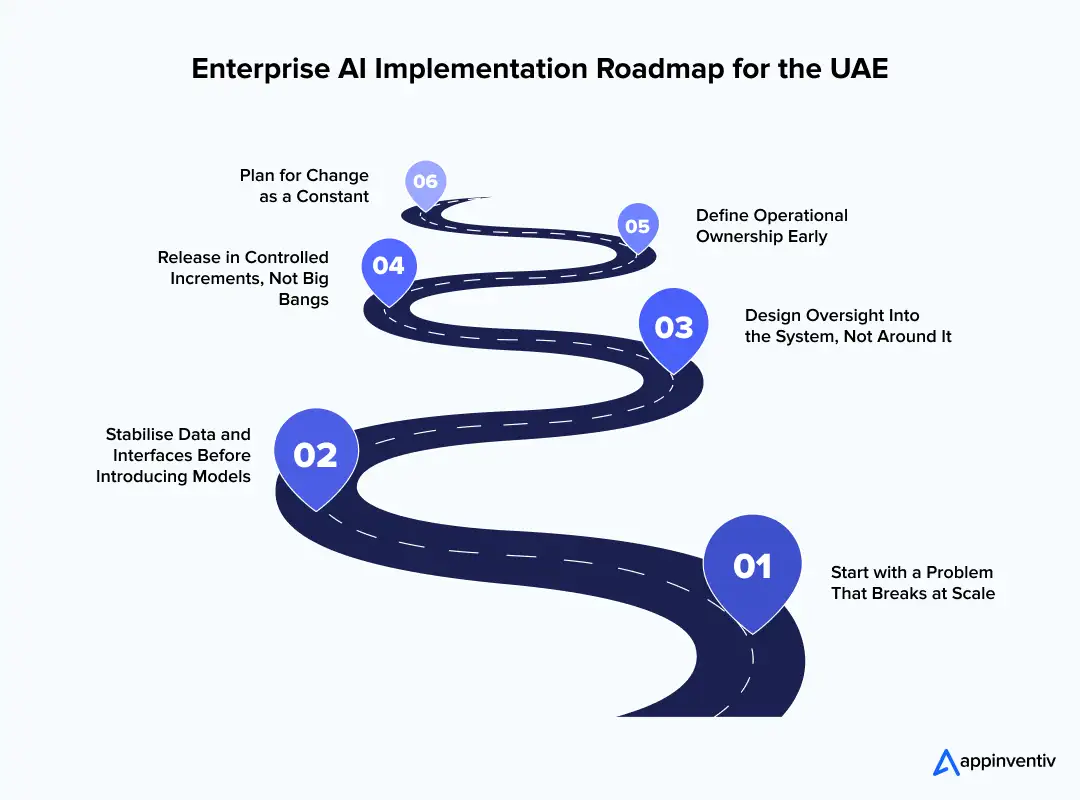
1. Start with a Problem That Already Breaks at Scale
AI is rarely justified on curiosity alone anymore. The strongest AI software development in Dubai projects begins with a problem that already shows stress under load. Manual review queues that keep growing. Forecasting logic that fails during demand spikes. Decision processes that depend too heavily on individual experience.
From a technical perspective, this step helps teams define:
- Where AI will sit in the workflow,
- Whether it operates in real time or batch mode, and
- What happens when the system cannot produce a confident output?
If those answers are unclear, the project usually drifts.
2. Stabilise Data and Interfaces Before Introducing Models
In most AI software development programs in the UAE, data readiness becomes the quiet bottleneck. Information flows through legacy databases, APIs, spreadsheets, and third-party platforms, often with inconsistent formats and access rules.
Teams that make progress typically:
- Lock down data ownership early,
- Standardise key entities across systems, and
- Expose clean interfaces for AI components rather than letting models pull data directly.
This extra effort feels slow at first, but it prevents fragile integrations that break when volumes increase or schemas change.
Also read: AI Readiness in UAE: Assessing Maturity & Scaling AI
3. Design Oversight into the System, Not Around It
As AI-powered software development in Dubai moves into core operations, oversight cannot be an afterthought. Enterprises need technical mechanisms that support review and control, not just policy documents.
In practice, this often means:
- Logging model inputs and outputs in a way auditors can trace,
- Flagging low-confidence results for human review, and
- Separating decision recommendation from decision execution.
This is where compliant AI software development in Dubai becomes a system design problem rather than a governance checklist.
4. Release in Controlled Increments, Not Big Bangs
Large AI launches rarely survive first contact with real users, which is why most teams working on enterprise AI software development in Dubai now prefer staged releases that begin with a narrow feature set, a limited group of users, and clearly defined rollback options.
From an engineering standpoint, this allows teams to:
- Monitor performance under real data conditions,
- Detect drift early, and
- Adjust prompts, thresholds, or rules without major rework.
It also reduces the risk that AI outputs will silently influence decisions in unintended ways.
5. Define Operational Ownership Early
One of the most common failure points appears after launch. The project team moves on, but the AI system stays behind. Successful implementations clearly define ownership, often splitting responsibility among engineering, operations, and risk teams.
Ownership usually includes:
- Monitoring accuracy and behaviour,
- Managing model updates or retraining, and
- Responding when outputs are questioned internally.
Without this, even well-built systems degrade quietly over time.
6. Plan for Change as a Constant
AI systems rarely remain stable over time, as data patterns shift, business rules evolve, and external conditions continue to change, which is why teams delivering long-term AI-powered software development solutions in the UAE treat implementation as the beginning of an ongoing lifecycle rather than the conclusion of a project.
Technically, this means designing for:
- Versioned models and prompts,
- Safe deployment pipelines, and
- The ability to disable or downgrade AI features without disrupting core operations.
For UAE enterprises in 2026, a realistic implementation roadmap is not about speed or ambition. It is about building AI systems that continue to behave sensibly long after the launch deck has been archived.
An early review of architecture, rollout sequencing, and ownership models can prevent costly rework once AI systems move into production environments.
Core Architecture for Enterprise AI Software in the UAE
In most UAE enterprises, AI architecture decisions are less about innovation and more about survival. AI has to fit into systems that already run the business. If it does not, the project becomes fragile very quickly. This is why architecture tends to drive outcomes in AI software development in Dubai, more than model choice or tooling.
Most teams now treat AI as a layer within existing platforms rather than a separate system. Models sit behind APIs and are called by ERP, CRM, or internal tools. This approach has become common in AI software development UAE because it gives teams control without slowing everything down.
What this architecture usually looks like in practice:
- AI services are separated from core business logic, making them easier to change or replace.
- Data access follows existing identity and permission rules rather than creating new ones.
- Sensitive data is filtered or transformed before it reaches any model.
- Outputs are logged so decisions can be reviewed later if needed.
Another shift is the decision order. In many AI-powered software development projects in Dubai, integration comes first, and model selection comes later. Teams focus on latency, cost, and auditability before worrying about accuracy benchmarks. This reduces rework once systems go live.
Security is built into the flow, not added at the end. Authentication, monitoring, and the ability to pause AI behaviour are expected, especially for compliant AI software development in Dubai.
By 2026, strong enterprise AI software development in Dubai is less about building something impressive and more about building something that blends in quietly and keeps working.
AI Software Development Cost in the UAE
When enterprises ask about AI costs in the UAE, they’re usually looking for a clean number. What they get instead is a range, and for good reason. AI projects rarely behave like traditional software development projects. The spend depends less on ambition and more on how deeply AI is woven into existing systems.
In most real-world cases, AI software development costs in the UAE range from AED 146,900 to AED 1,469,000 ($40,000 to $400,000). Where a project lands within that range depends on complexity, integration depth, and governance requirements, not just model selection.
Here’s how that range typically plays out:
| Cost Range (AED / $) | Project Scope | What This Typically Includes |
|---|---|---|
| AED 147,000–294,000 ($40,000–80,000) | Small, focused implementations | AI features are added to an existing system with limited integration and a controlled data scope. Common for internal tools, analytics support, or narrowly defined workflows. |
| AED 294,000–661,000 ($80,000–180,000) | Mid-scale enterprise builds | Deeper integration with ERP, CRM, or customer platforms. Governance, logging, and monitoring are included from the start. This range is common for early-stage AI software development in Dubai initiatives designed to scale. |
| AED 661,000–1,469,000 ($180,000–400,000) | Large, production-grade systems | AI embedded into core business processes with strict compliance and security controls. Typically involves multiple systems, higher data volumes, and ongoing model management. |
What often catches teams off guard is that build cost is only part of the picture. Infrastructure usage, monitoring, model updates, and compliance reviews all add to ongoing spend. This is especially true in AI-powered software development in Dubai, where enterprise expectations around control and auditability are high.
Organisations that manage cost well tend to do a few things differently. They scope tightly, reuse existing platforms where possible, and plan for change from the start. Instead of chasing the lowest estimate, they focus on building something that won’t need to be rebuilt six months later.
In 2026, controlling AI software development cost in the UAE is less about negotiating harder and more about making smarter architectural and governance decisions early on.
How to Control AI Software Development Costs in the UAE
AI costs usually don’t spiral out of control because someone made a bad decision. They creep up because no one stopped to question the early ones. By the time budgets feel tight, the system is already too complex to unwind. Teams that manage AI software development costs effectively in the UAE tend to be cautious before becoming ambitious.
A few habits consistently make the difference:
- Start narrower than planned: If a use case cannot stand on its own, scaling it only increases costs. Many successful AI software developments in Dubai begin with one workflow, not a roadmap.
- Assume change will happen: Models, data, and rules will shift. Architectures that expect this are cheaper to live with than those built for a single version.
- Reuse what the business already runs: Identity systems, data platforms, and monitoring tools are already in place and paid for. Ignoring them is one of the fastest ways to overspend in AI software development UAE.
- Bake governance early: Adding controls later is expensive and messy. Teams that treat compliant AI software development in Dubai as a design input rather than a checkbox usually stay closer to budget.
- Keep ownership after launch: Costs don’t stop when the system goes live. Someone needs to watch usage, performance, and spending, or it quietly drifts.
In the UAE, cost control is rarely about cutting corners. It’s about slowing down at the right moments so the project doesn’t become expensive to maintain later.
Benefits of AI Software Development for UAE Enterprises
By 2026, the value of AI within UAE enterprises will be evident in small but meaningful ways. Not in dramatic shifts, and not overnight. It shows up less often when teams stop firefighting. When decisions feel steadier. When systems don’t crack, the moment volume or complexity increases, they crack.
One of the clearest benefits is how work flows through the organisation. AI does not replace people, but it reduces drag. Information surfaces sooner. Signals that were once buried in reports or dashboards become harder to ignore. Teams spend less time assembling context and more time acting on it. This is where the real benefits of AI software development begin to feel tangible.
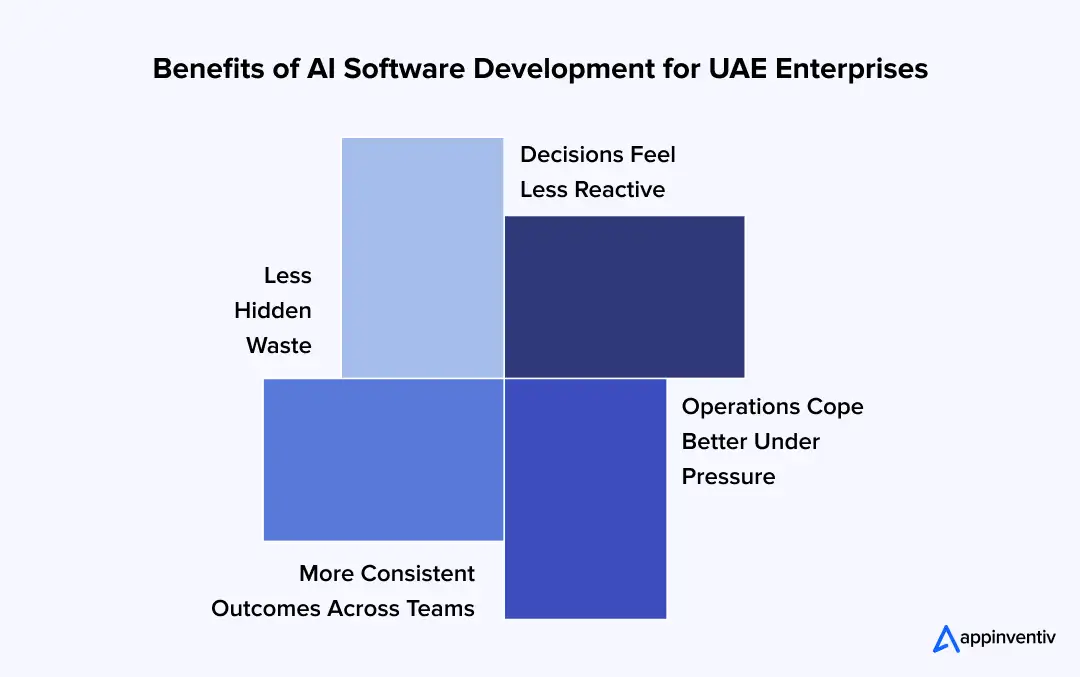
What enterprises tend to notice first:
- Decisions feel less reactive: Routine choices move faster, while unusual cases stand out instead of slipping through unnoticed.
- Operations cope better under pressure: Customer volumes, demand spikes, and operational surges are handled with fewer manual workarounds.
- More consistent outcomes across teams: Processes rely less on individual experience and more on shared logic, which matters in regulated environments.
- Less hidden waste: AI reduces rework, late fixes, and missed signals rather than cutting teams. This is common in mature AI-powered software development setups in the UAE.
Over time, another benefit becomes clear: trust. When AI is built carefully and integrated properly, teams stop second-guessing the system. Leaders gain clearer visibility. Reviews become calmer. Planning becomes easier because fewer things come as a surprise.
For organisations investing in AI software development in the UAE, the payoff is rarely loud. It’s quite stable. Systems that hold up as the business grows. Decisions that feel better informed. And operations that don’t depend on heroics to keep running.
That, more than anything, is what makes AI worth sustaining beyond the pilot stage.
Enterprise AI Use Cases in the UAE
By 2026, enterprise AI use cases in the UAE have become more selective. Organisations are no longer spreading AI thin across the business. They are placing it where complexity, volume, or risk already exists. The goal is not to experiment everywhere, but to properly stabilise a few critical areas.
Most AI software development projects in Dubai now start from operational pressure, not innovation goals. That pressure looks different by industry, but the use cases tend to cluster in familiar places.
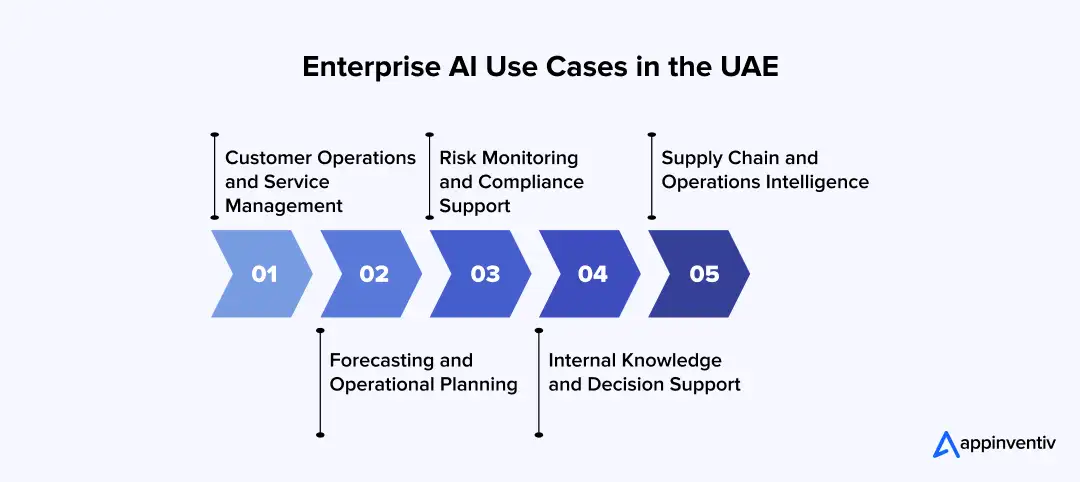
1. Customer Operations and Service Management
AI is widely used to support customer-facing teams, but rarely as a full replacement. Instead, it works in the background.
Common patterns include:
- Routing and prioritising requests based on urgency or risk
- Assisting agents with context, history, and next-best actions
- Flagging unusual behaviour or escalation signals early
AI-powered software development in Dubai, these systems are usually tightly integrated with CRM platforms rather than deployed as standalone tools.
2. Forecasting and Operational Planning
Forecasting is one of the more reliable enterprise AI use cases in the UAE. Demand planning, resource allocation, and capacity forecasting benefit from AI because they deal with patterns over time, not single decisions.
Enterprises typically use AI to:
- Reduce manual forecasting cycles
- Surface anomalies instead of replacing planners
- Adjust plans faster when conditions shift
This is a common entry point for organisations beginning enterprise AI software development in Dubai, because the risk is manageable and the value is easy to track.
Also Read: AI for Demand Forecasting: Benefits & Use Cases
3. Risk Monitoring and Compliance Support
In regulated sectors, AI is often introduced as a monitoring layer rather than a decision-maker. It watches transactions, behaviour, or processes and raises signals when something looks off.
Typical uses include:
- Transaction monitoring and anomaly detection
- Policy deviation alerts
- Audit support through structured logs and summaries
This aligns closely with compliant AI software development in Dubai, where explainability and traceability matter more than speed.
4. Internal Knowledge and Decision Support
Many UAE enterprises struggle with fragmented knowledge. AI is increasingly used to consolidate internal documents, policies, and data, enabling teams to find answers faster.
These systems usually:
- Sit behind access controls
- Work within existing document repositories
- Support decisions rather than make them
This type of AI-powered software development UAE tends to grow quietly but delivers steady value over time.
5. Supply Chain and Operations Intelligence
In logistics, retail, and manufacturing-heavy organisations, AI is applied to improve visibility rather than automate control.
Use cases often focus on:
- Identifying bottlenecks before they escalate
- Highlighting inefficiencies in movement or inventory
- Supporting planners with scenario analysis
For enterprises scaling AI software development UAE, these use cases help manage complexity without introducing unnecessary risk.
Across the UAE, enterprise AI use cases in 2026 share a common trait. They are embedded, restrained, and designed to support existing teams rather than replace them. AI is no longer used to impress. It is used where it can quietly reduce pressure and make systems easier to run.
Also Read: AI Applications in the Middle East: Enterprise Transformation
Data, Security, and Compliance Requirements for AI Software in the UAE
In the UAE, AI projects rarely stall because of weak models. They slow down when data handling, security assumptions, or compliance expectations are not thought through early enough. By 2026, enterprises treating these areas as design foundations move far faster than those trying to retrofit controls later. This is now a defining factor in AI software development in Dubai.
1. Data Control Comes First
AI systems touch more sensitive data than most teams expect. Customer records, internal documents, and operational logs all pass through models in some form. As a result, enterprises building AI software development in the UAE focus early on:
- Clear data classification and ownership
- Strict access controls aligned with existing identity systems
- Filtering or masking sensitive fields before model access
2. Security Is Built Into the Architecture
AI introduces new risk surfaces, from prompt inputs to downstream integrations. In AI-powered software development in Dubai, security is not treated as an add-on. It is embedded into how AI services are exposed and monitored.
Typical controls include:
- Authentication and authorisation at the AI service layer
- Input and output validation to prevent data leakage
- Continuous logging and behaviour monitoring
3. Compliance Shapes Design Decisions
As AI moves into regulated workflows, explainability and auditability become non-negotiable. UAE enterprises are increasingly aligning builds with an emerging AI governance framework that requires intent to be visible in system design.
For teams focused on compliant AI software development in Dubai, this usually means:
- Decision trails that can be reviewed internally
- Clear override or pause mechanisms
- Documentation that reflects how AI is actually used, not just planned
By 2026, data, security, and compliance will no longer be seen as obstacles to AI adoption. They are the guardrails that keep AI software in production without disruption.
Integrating AI with Enterprise Systems in the UAE
Most AI projects in the UAE don’t struggle because of the model. They struggle when AI meets existing systems. ERPs that have been customised for years. CRMs with uneven data. Internal tools that were never built to share context. This is where AI integration becomes the real work in software development in Dubai.
In practice, AI is rarely introduced as a replacement. It’s added as a support layer. Existing systems remain the source of truth, while AI consumes data, adds signals, and feeds results back into workflows people already use. This approach has become common in AI software development UAE because it limits disruption.
What teams usually focus on during integration:
- Keeping AI behind services or APIs rather than exposing it directly
- Aligning data across systems before relying on model outputs
- Logging when AI influences downstream actions
- Allowing human overrides where decisions carry risk
Integration also forces uncomfortable clarity. Once AI outputs affect customer, finance, or operations platforms, ownership can’t be vague. Someone has to be responsible when results are wrong or unclear. This is especially important in ai powered software development dubai, where AI often touches regulated workflows.
When integration is done well, AI stops feeling like a separate project. It becomes part of the system. Quiet. Useful. And far more likely to stay in place as enterprises continue scaling enterprise AI software development in Dubai.
Key AI Software Development Challenges in the UAE & How to Overcome Them
AI projects in the UAE rarely fail in obvious ways. More often, they slow down, lose attention, or quietly slip down the priority list. As AI software development in Dubai moves from pilots into live systems, the challenges shift away from ideas and toward execution.
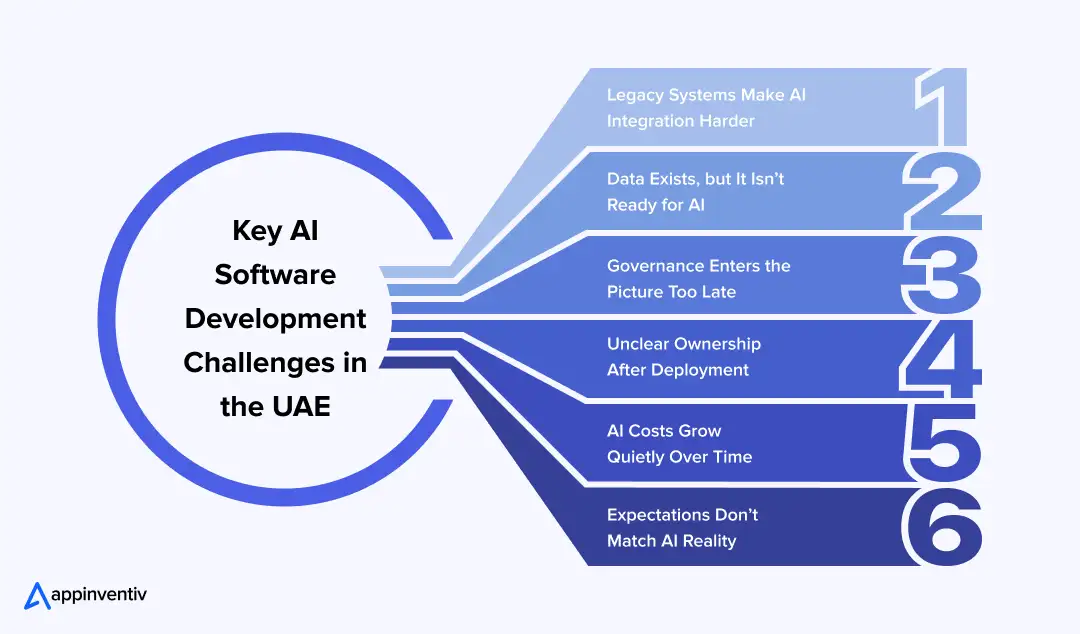
1. Legacy Systems Make Integration Harder Than Expected
Most enterprises are building AI on top of systems that have been customised for years. These platforms were never designed to support intelligent decision layers, which is why integration work often outweighs model development.
How teams handle it: Instead of forcing AI into core systems, experienced teams add it through service layers or APIs, keeping legacy platforms stable while allowing AI to evolve around them.
2. Data Exists, but It Isn’t Ready
Data volume is rarely the issue. Inconsistency and unclear ownership are. AI exposes these gaps quickly, often halfway through a project.
How teams handle it: Teams that move steadily agree early on data ownership, standardise key definitions, and tightly control what AI can access.
3. Governance Arrives Too Late
As AI-powered software development in Dubai moves into regulated workflows, governance questions often surface after systems are built.
How teams handle it: Successful teams treat governance as a design input, building logging, review paths, and human oversight into the system from the start.
4. Ownership Fades After Launch
Once AI systems go live, models drift and data changes. Many enterprise AI software development efforts lose trust because no one clearly owns the system.
How teams handle it: Clear operational ownership is defined early, usually shared across engineering, operations, and risk teams.
5. Costs Grow Quietly Over Time
AI spending doesn’t spike; it creeps. Infrastructure usage, monitoring, and updates gradually increase AI software development cost in the UAE.
How teams handle it: Cost stays predictable when teams plan beyond launch, reuse existing platforms, and monitor usage continuously.
6. Expectations Don’t Match Reality
AI produces probabilities, not certainty. When expectations are too high, trust erodes quickly.
How teams handle it: Teams set clear boundaries early, define confidence thresholds, and position AI as decision support rather than a replacement.
These challenges aren’t unique to the UAE. What makes them stand out is the speed of adoption and the level of scrutiny enterprise systems face. Teams that recognise these patterns early tend to move with fewer setbacks and far more confidence.
Also Read: How to Solve AI Development Challenges
Most AI challenges are predictable once you’ve seen them before. Addressing integration, governance, and cost discipline early reduces long-term delivery and operational risk.
Choosing an AI Software Development Partner in the UAE
By the time enterprises start looking for an AI partner, most already know what they don’t want. They don’t want another pilot that never scales. They don’t want a solution that looks good in isolation but struggles once compliance, integration, and cost reviews begin. This is why choosing the right partner has become one of the most consequential decisions in AI software development in Dubai.
In 2026, the strongest partners are not defined by how advanced their models are. They are defined by how well they understand enterprise constraints. Teams evaluating AI software development services in Dubai increasingly look for partners who have worked inside regulated environments and understand what it takes to keep systems running long after launch.
What enterprises tend to prioritise when selecting a partner:
- Enterprise integration experience: A capable partner understands ERP, CRM, and legacy systems, not just AI tooling. This matters more than raw model expertise in most AI software development UAE projects.
- Governance and compliance maturity: As AI moves into sensitive workflows, partners must demonstrate experience with logging, explainability, and review mechanisms. This is essential for compliant AI software development in Dubai, where intent must be visible in the design, not just in documentation.
- Clear ownership beyond delivery: Enterprises increasingly favour partners who stay involved after deployment. Ongoing support, monitoring, and optimisation matter more than fast handover, especially in enterprise AI software development in Dubai.
- Realistic cost and scope discipline: Strong partners talk openly about trade-offs. They help teams scope sensibly, avoid over-engineering, and manage AI software development cost in the UAE across the full lifecycle, not just the build phase.
Another factor that has gained importance is regional understanding. The UAE’s regulatory landscape, data expectations, and adoption pace are distinct. Enterprises often prefer partners who are already operating within the Dubai AI ecosystem 2026 and understand how national priorities translate into day-to-day delivery decisions.
Ultimately, the right partner does not promise certainty. They help enterprises manage uncertainty. They design systems that can adapt, explain trade-offs early, and make AI easier to govern as it becomes more deeply embedded into the business.
For organisations investing seriously in AI-powered software development in the UAE, the ability to execute steadily and responsibly often matters far more than any single technical capability.
How Appinventiv Supports Enterprise AI Software Development in the UAE
Most enterprises do not struggle with ideas. They struggle with execution. Once the decision to use intelligent systems is made, the real questions are about control, scale, and whether the platform will still make sense a year from now. As an AI software development company in Dubai, Appinventiv usually steps in at this point when teams want fewer assumptions and more certainty. Our AI consulting services in the UAE are grounded in helping organisations think through architecture, delivery pace, and long-term ownership before anything is locked in.
That practical mindset carries into delivery. Solutions like MyExec, a business-focused decision support platform, were built to assist leaders with real operational choices, not just surface-level insights. On the consumer side, the flynas airline app reflects experience with large, regulated platforms where reliability and consistency matter as much as innovation. In both cases, the work is shaped by how systems are actually used, not how they look in presentations.
This experience is backed by steady execution across the region. Appinventiv has delivered 1000+ digital projects in the Middle East, achieved a 95% client satisfaction rate, and completed 12+ government and compliance-focused programs. If you are considering where to build and scale your next intelligent platform in the UAE, an early conversation can help cut through uncertainty.
Reach out to Appinventiv to discuss how your requirements translate into a realistic, well-governed, and built-to-last delivery plan.
FAQs
Q. Why is the UAE leading AI software development in 2026?
A. Because the UAE stopped treating AI as an experiment early on. By 2026, the focus shifted to building and running real systems, not just talking about them. Investment in infrastructure, talent, and execution has made AI software development in the UAE practical and repeatable, especially at enterprise scale.
Q. Is Dubai a good place to build AI products?
A. Yes, particularly if you’re building for real business use. AI software development in Dubai works well for enterprise platforms because the ecosystem understands regulation, integration, and long-term delivery. It’s less about flashy demos and more about systems that can stay live and stable.
Q. How much does AI software development cost in the UAE?
A. For most enterprise projects, AI software development costs in the UAE usually fall between USD 40,000 and USD 400,000. Where you land in that range depends on how complex the integration is, how ready your data is, and how much governance is required after launch.
Q. What are the challenges of AI development in Dubai?
A. The hardest parts are rarely technical. AI software development challenges in Dubai usually come from working around legacy systems, fixing data issues, meeting governance expectations, and managing costs once the system is live. These are execution problems, not capability gaps.
Q. What compliance rules affect AI software in the UAE?
A. AI projects are shaped by data protection laws, industry regulations, and evolving governance standards. In practice, this means systems need to be explainable, auditable, and controllable. That’s why compliant AI software development in Dubai is now a design decision, not something handled at the end.
Q. Is the UAE good for enterprise AI projects?
A. Yes, especially for organisations that value structure and long-term stability. As enterprise AI adoption in the UAE 2026 grows, companies benefit from clearer direction, strong infrastructure, and an environment built around production-ready AI, not trial-and-error experimentation.

- In just 2 mins you will get a response
- Your idea is 100% protected by our Non Disclosure Agreement.

Key takeaways: Real-time AML systems detect and act on suspicious transactions within seconds, reducing financial risk across high-volume, cross-border environments in the UAE. Event-driven architectures with AI models improve detection accuracy while reducing false alerts, enabling faster investigations and better operational efficiency. UAE compliance demands audit-ready systems with explainable decisions, real-time reporting, and alignment across…

Maritime Insurance Claim Software Development for UAE Ports, Insurers, and Logistics Networks
Key takeaways: Manual claims management is too slow for the UAE’s high-volume ports; digital solutions streamline processes and reduce errors. Maritime insurance claim software centralizes data, automates workflows, and ensures compliance with UAE regulations and Takaful principles. Real-time integration with port and vessel systems enables faster claim registration, validation, and settlement. Advanced analytics and risk…

How to Build a Student Management System in Australia?
Key takeaways: Australia’s tightening regulatory landscape (TEQSA, ASQA, CRICOS) makes student management system development in Australia a compliance-driven necessity, not just a digital upgrade. Monetisation models such as SaaS subscriptions, institutional licensing, white-label partnerships, and hybrid pricing offer scalable commercial opportunities in Australia’s expanding EdTech market. Addressing challenges early - data privacy, legacy migration, multilingual…









