





























AI Readiness in UAE: How Can Enterprises Assess Their Maturity Before Scaling AI

- Current State of AI Readiness in UAE Enterprises
- Custom AI Readiness Assessment Framework for UAE Enterprises
- AI Readiness Checklist for UAE Enterprises
- Things to Consider When Assessing AI Readiness
- How Can Enterprises Assess Their AI Maturity Before Scaling?
- Sector-Specific Considerations for AI Readiness in the UAE
- AI Implementation Challenges and how to overcome them
- Future Trends in the UAE AI Landscape
- Why Appinventiv is the Right Partner for Your AI Readiness Journey
- FAQs

Key takeaways:
- AI readiness requires a strong foundation in strategy, data, talent, and governance before scaling across the enterprise.
- Conducting an AI maturity assessment helps businesses evaluate their current capabilities and identify gaps to ensure successful implementation.
- Before adopting AI, enterprises must ensure clean, accessible data and scalable infrastructure to support AI initiatives.
- Successful AI adoption depends on strong leadership, a clear strategy, and continuous talent development to bridge skill gaps.
- Start with small pilot projects to test AI, iterate on them based on feedback, and establish governance before scaling across the organization.
The UAE is on a mission to become one of the world’s leaders in AI innovation. You see it everywhere: finance firms testing new models, hospitals rolling out smarter diagnostics, logistics companies automating their warehouses. The government’s buzzing about AI nonstop, and honestly, that’s creating some real opportunities for businesses ready to jump in. But with all this rush and pressure comes a question nobody wants to ask: Is your business actually prepared for this, or are you just scared of falling behind?
Jumping into AI too fast can wreck your budget. If you don’t know where your company stands with AI readiness assessment in the UAE, you’ll end up misaligned with what you’re actually trying to achieve, your data will be a mess, and you won’t see the returns you hoped for. Just because something worked in a small test doesn’t mean it’s ready for your entire operation.
Checking your AI readiness assessment before you scale isn’t just smart, it’s survival. Understanding where you really are right now helps you spot the gaps, get your strategy straight, and build something that’ll actually last, not crash six months in.
Take the first step toward transforming your business with AI. Let’s assess your readiness and pave the way for scalable success.

Current State of AI Readiness in UAE Enterprises
The UAE is charging ahead with AI in businesses, but here’s what nobody wants to admit—most companies are stuck between “let’s try this” and “let’s actually use this.” According to McKinsey & Company, while 88% of organizations in the GCC are using AI in at least one business function, fewer than one-third have moved from pilot projects to full-scale implementation. This gap in AI maturity assessment in the UAE is a major challenge for many businesses.
- Trapped in Testing: A ton of companies are playing with AI in one department, showing off cool demos, but then… nothing. It stays isolated. They never actually bake it into how the business runs, so all that promise just sits there collecting dust. This is a classic example of common gaps before AI deployment in UAE enterprises.
- Pilot Overload: Most places are running these one-off AI experiments that look great in presentations but never go anywhere. It’s like they’re perpetually “exploring possibilities” without ever committing. Innovation that stays on the whiteboard doesn’t count. The AI readiness framework in the UAE isn’t being fully utilized, which means businesses struggle to take their pilots to the next level.
- Where It All Falls Apart: The moment you try scaling up, reality hits. Your data’s a disaster, and nobody wants to admit it. You can’t find enough people who actually get this stuff. Your systems weren’t built to handle AI at scale. Suddenly, that successful pilot feels like a million miles away from actual deployment.
- Here’s What People Are Missing: Sure, everyone’s “doing AI” now, but the real prize goes to whoever solves these messy problems first. Clean up your data situation. Hire people who know their stuff. Build infrastructure that can actually handle what you’re trying to do. Do that, and you’re not just experimenting, you’re actually transforming how you compete. This is key to improving enterprise AI readiness in the UAE.
UAE businesses are testing AI like it’s going out of style, but the gap between testing and actually deploying is where the winners get separated from the pretenders. AI readiness consulting can help bridge this gap and set your enterprise on the right path toward successful AI implementation.
Custom AI Readiness Assessment Framework for UAE Enterprises
Successfully scaling AI in UAE enterprises isn’t about buying the flashiest tools. It’s about fixing the cracks in your organization before you add the weight of automation. Here’s a framework for assessing enterprise AI readiness in the UAE and setting up for success:
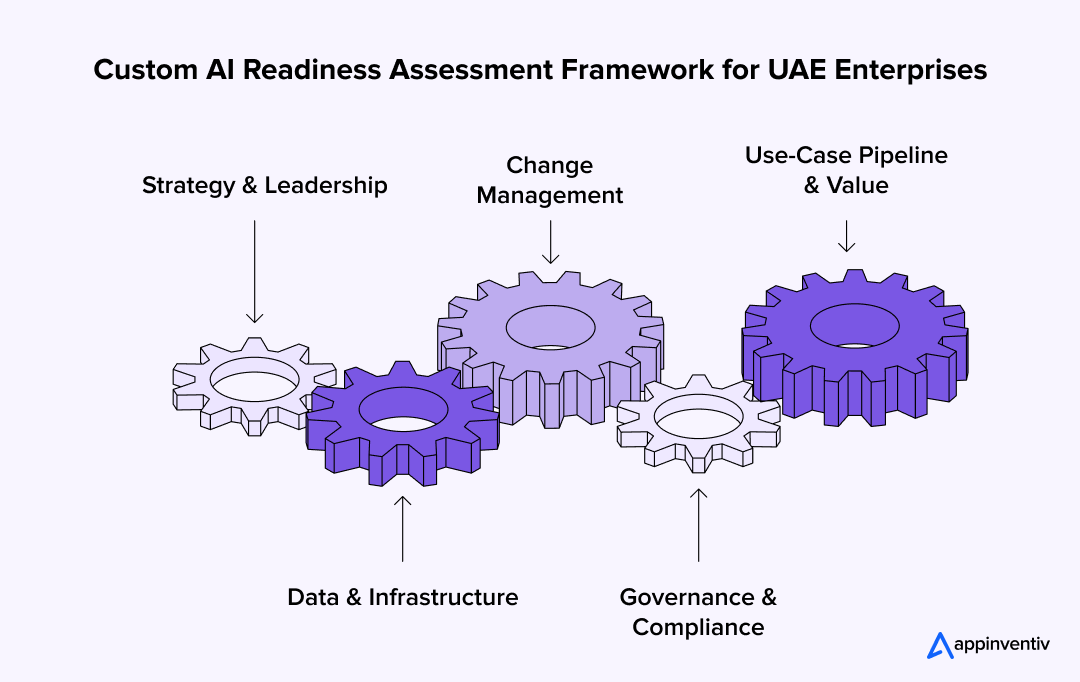
1. Strategy & Leadership
You can’t simply hand AI over to the IT department and expect it to succeed. It needs a champion at the executive level. If the leadership team treats AI like a side project, the rest of the company will ignore it.
You need a clear directive from the top that says, “This is how we operate now.” That is the only way to turn a tech experiment into a real business advantage.
2. Data & Infrastructure
AI readiness framework in the UAE starts with data. If that data is scattered, outdated, or trapped in silos, your AI is going to fail. It’s that simple. Before you worry about algorithms, worry about your infrastructure.
You need a clean, organized backbone that allows information to flow freely. Without that, you are essentially putting a Ferrari engine into a car with flat tires.
3. Governance & Compliance
AI governance in the UAE is non-negotiable. It has to exist within the lines of local laws, specifically regarding data privacy and ethics. But honest governance isn’t just about keeping regulators off your back; it’s about safety.
If you put the right security protocols in place now, you can scale your systems without constantly worrying about a data breach or a compliance nightmare down the road. It builds a layer of trust that lets you move faster.
4. Use-Case Pipeline & Value
Avoid the trap of a solution looking for a problem. You need to identify exactly where AI helps, the specific tasks that save money or speed up workflows. Prioritize the boring, high-value wins over the flashy experiments.
If you can’t draw a straight line between the AI project and a tangible business result (ROI), it shouldn’t be in your pipeline. The goal is sustainable value, not just hype.
5. Change Management
The biggest AI adoption challenge usually isn’t the technology; it’s the culture. If your team is scared that the bots are coming for their jobs, adoption will stall. You have to manage that anxiety. Effective change management is about showing your workforce that AI is there to handle the grunt work, not replace them.
When people actually understand the tool, they stop resisting it and start using it to work smarter.
AI Readiness Checklist for UAE Enterprises
This practical checklist is designed for executives for an enterprise’s AI maturity assessment. By evaluating key readiness areas, leaders can identify strengths and gaps before scaling AI initiatives.
| AI Readiness Pillar | Key Questions | Score (1-5) |
|---|---|---|
| 1. AI Strategy & Leadership | – Do you have a clear AI strategy aligned with business goals? | |
| – Is executive support in place for AI initiatives? | ||
| 2. Data & Infrastructure | – Is your data high-quality and ready for AI applications? | |
| – Is your data infrastructure scalable for AI? | ||
| 3. Talent & Skills | – Do you have sufficient in-house AI talent? | |
| – Are your teams equipped with AI skills or upskilling plans? | ||
| 4. Governance & Compliance | – Are AI systems compliant with local regulations? | |
| – Do you have a strong AI governance framework? | ||
| 5. Use-Case Pipeline & Value | – Have you identified high-impact AI use cases? | |
| – Is there a clear ROI for each AI use case? | ||
| 6. Change Management & Adoption | – Is your organization prepared for AI adoption? | |
| – Are employees ready and open to working with AI? |
Score Yourself: Rate your enterprise on each pillar (1 = low readiness, 5 = high readiness) to get a snapshot of your current AI maturity. This will help you identify areas to improve before scaling AI across your organization.
Things to Consider When Assessing AI Readiness
Implementation of AI has the potential to change business, but several barriers are challenges that most organizations in the UAE are not coping with. Taking these issues directly could be the solution.
- Why AI Projects Fail in UAE Enterprises: A significant number of AI initiatives in the UAE fail because of inadequate planning, incorrect objectives, or omissions of significant processes, such as data cleaning and employee training. Sound AI preparedness research in the UAE is beneficial in establishing definite expectations and will prevent these traps.
- Lack of Data Maturity Before AI Adoption: AI will not give results without access to clean data. The presence of data silos, old records, and bad governance usually ensures that AI is not very effective. Before getting down to AI projects, it is pivotal to fix data challenges and enhance data preparedness for AI in the UAE.
- How to Improve Enterprise AI Readiness Scores: Three areas of leadership alignment, data cleaning, and team up-skilling can help to enhance AI readiness. Periodic AI maturity measurement in the UAE will assist you in knowing your progress and where you can improve.
- Risks of Scaling AI Without Governance: The implementation of AI at scale without adequate governance may result in severe consequences, such as the loss of personal data or lawsuits. Establishing AI governance in the UAE at the baseline allows adherence and security, and it is safer to expand AI throughout the organization.
- How to Prioritize AI Use Cases with Low Readiness: Projects of AI are not all ready to launch. Begin with basic, high-impact applications that have less data and infrastructure needs. One of the things to remember as you develop your AI capabilities is to take on increasingly complex projects as you go, so you can learn expensive lessons.
How Can Enterprises Assess Their AI Maturity Before Scaling?
Scaling AI is the dream, right? But if you pull the trigger too early, you are just scaling chaos. Before you sign off on a massive enterprise rollout, you need to stop and look at what is actually happening under the hood. This isn’t about filling out a readiness survey; it’s about being honest with yourself regarding your gaps.
Here is the reality check you need before moving forward:
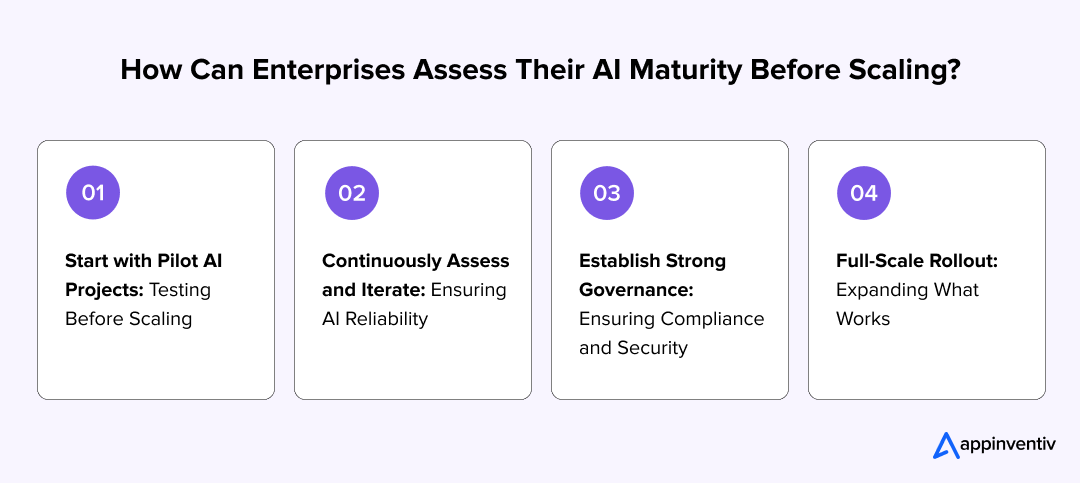
1. Start with Pilot AI Projects
Start with a pilot that solves one specific, annoying problem. Maybe it’s a chatbot for internal HR queries or a predictive model for inventory. The goal isn’t perfection; it’s proof. You want to see how the tech behaves in the wild.
If the pilot crashes and burns, great, you learned that lesson cheaply. Better to fail on a small project than a company-wide initiative. This is a key step in AI readiness assessment in the UAE.
2. Continuously Assess and Iterate
One of the biggest mistakes companies make is treating AI like standard software. You don’t just install it and walk away. Models drift. They get weird. They need constant supervision.
If you don’t have a process in place to constantly review the output and retrain the system, you aren’t ready to grow. Steps to assess AI maturity before scaling in the UAE should include consistent monitoring. You need to iterate until the system is boringly reliable.
3. Establish Strong Governance
You need governance before you need growth. In the UAE, especially, regulatory compliance isn’t optional. If your AI makes a bad decision, who is accountable? If you can’t answer that immediately, hit the brakes.
You need a framework that handles data privacy and ethical risks before you expose the system to thousands of customers. AI governance in the UAE must be solid before moving forward.
4. Full-Scale Rollout: Expand What Works
Only expand what you have proven works. Once your pilot is stable and your governance is tight, then you look at rolling it out. But be careful, scaling exposes cracks that pilots hide. A system might work fine with 100 users but choke on 10,000.
Monitor the performance obsessively as you expand. If the quality dips, pause and fix it. Don’t push a broken system just to meet a deadline. Scaling AI in UAE organizations requires careful, strategic growth.
Also Read: Harnessing AI for Enterprise: Driving Business Innovation
Don’t just adopt AI, ensure your organization is truly ready to scale. Work with experts who guide you every step of the way.

Sector-Specific Considerations for AI Readiness in the UAE
Every industry plays by different rules. What works for a bank won’t work for a warehouse. Here is what AI readiness in the UAE looks like across major sectors:
- Finance: Compliance First, Code Second
In the UAE, you can’t just build a model and hope for the best. The regulations here are strict. Readiness isn’t just about better fraud detection or risk analysis; it’s about governance. If your data infrastructure isn’t locked down to meet local compliance standards, you aren’t ready to launch.
- Logistics: It’s About Integration
This is a speed game. AI in logistics needs to predict demand and optimize routes in real-time. The real test for readiness here is compatibility: can your new AI tools talk to your legacy tracking systems? If your data is siloed and doesn’t flow across the supply chain, the algorithm is useless.
- Healthcare: Security is Non-Negotiable
The stakes are obviously higher here. Whether you are using AI for medical diagnostics or just clearing administrative backlogs, patient privacy is the bottleneck. AI readiness for government entities in the UAE is critical, and AI adoption in UAE enterprises within healthcare needs infrastructure that protects sensitive data while still being agile enough to assist doctors, not just add more admin work.
- Manufacturing: Hardware Meets Software
In UAE smart factories, AI is only as good as the data coming off the floor. Readiness here is physical. Do you have the sensors and IoT setup to actually feed the AI? If you can’t extract clean data from your machines to predict maintenance needs, you aren’t ready for automation.
- Retail: Turning Data into Sales
Customers expect you to know what they want before they do. Readiness here comes down to data utilization. Can you turn browsing history into a sale? It’s about using AI in inventory to sharpen planning and personalize the shopping journey without coming off as invasive.
AI Implementation Challenges and how to overcome them
When the AI projects are launched, everything may seem to work well, yet the truth of the matter may be that the systems are disconnected, and teams are siloed. These challenges can be addressed early, making AI adoption in UAE enterprises much smoother. However, businesses often face significant AI implementation challenges in the UAE, which need to be tackled for successful adoption.
1. Accessibility and Quality of Data.
Most companies soon understand that their data is not as clean as it should be; old data, redundancies, and inconsistencies of formats can all confuse AI models.
How to overcome: Begin with the fundamentals- clean up your data, establish a guideline on new data and make sure that all persons are given one reliable source of information. Data readiness for AI in the UAE is a must.
2. Talent and Skilled Workforce.
There is a lack of AI talent both in the UAE and generally speaking, even when companies have the desire to invest, it is difficult to find an individual who comprehends both technology and business.
How to overcome: Build from within. Train and develop your current teams, recruit specialists in complicated phases, and establish a learning culture. Gradually, your team will develop the ability to work with AI without being completely dependent on the external talent.
3. Resistance to Change
Employees will be afraid that AI is going to take their jobs, or they will lose authority over their work. This is the natural resistance even in progressive organizations.
How to overcome: Elaborate on the role of AI in the workplace, it is here to automate routine, not to take the place of employees. Give teams the opportunity to experiment, ask questions and celebrate small wins. Once individuals learn the reason why, they will accept the change.
4. Linkage to Legacy Systems
The combination of AI and existing systems may cause slowness, crashes, and unaccounted spending since older infrastructure was not designed to be used with modern AI applications.
How to overcome: Begin with a small pilot project. Prove it in one place, educate you, and then grow slowly. This does not disrupt and allows your business to restructure the technology stack.
Also Read: AI in Legacy Application Modernization – A Complete Guide
5. Moral and Regulatory Issues
Artificial intelligence can be quite unethical: Is the model fair? What are the explanations of its decisions? Will we be following the laws, particularly in a place such as the UAE?
How to overcome: Embark governance in the design process. Ensure that you record the decisions and are not against the local laws. Routine audits and openness will create credibility among the customers, partners, and your team.
6. ROI and Business Value Measures.
The advantages of AI are not necessarily apparent. Benefits such as saving time or enhanced accuracy may be intangible, and the leadership would wonder about the payback.
How to overcome: Have definite objectives and quantifiable KPIs, set them in advance. Measure the increase in efficiency, cost-saving, customer experience or the speed of decision-making. The greater these metrics increase, the more obvious the value of AI over the long term, which will ensure its continued support.
Future Trends in the UAE AI Landscape
AI in the UAE now has its own path; it is influenced by people, language, and the country’s plans for the next decade. There are already some changes that are difficult to overlook.
- Arabic Language Models: Even more AI tools are being designed, although the Arabic language is finally at the core, rather than an appendix. It is making systems to think the way people talk, their accents, and how people around them actually talk. This shift is crucial for AI readiness in the UAE, ensuring that AI systems can function seamlessly in the region’s native languages.
- UAE AI Strategy 2031: This isn’t the first time that the government has talked about AI. The government is implementing programs that are pushing AI into schools, hospitals, transport, and governmental services. That rate is compelling companies to re-evaluate their own calendar.
- The AI Within Smart Cities: As cities such as Dubai and Abu Dhabi continue their full commitment to smart infrastructure, AI is creeping into all aspects of life, such as traffic flow and energy consumption. Enterprises must understand how AI fits into these systems as enterprise digital transformation in the UAE continues to evolve. It provides access to those companies that can understand how to fit into such systems.
- Ethics and Governance: As AI adoption grows, so does the need for responsible and transparent AI practices. Companies will need to focus on AI governance in the UAE to ensure their AI systems are ethical, secure, and compliant with local laws and regulations.
The bigger picture is quite straightforward: AI is not a trend to be followed in the UAE in the future, but it is a reality. The early adapting businesses will experience the benefit the most.
Align your business with emerging AI trends in the UAE and unlock new opportunities with our team.

Why Appinventiv is the Right Partner for Your AI Readiness Journey
Becoming AI-ready goes beyond checklists; it requires a partner who can transform readiness into real-world results. As an AI consulting company in Dubai, Appinventiv brings years of experience not just in adopting AI but in embedding it into your core operations for measurable impact.
We build solutions that combine AI maturity assessment in the UAE with automation and real-time insights. Whether you’re upgrading an existing system or creating something new, we create AI platforms that work seamlessly and drive results.
Take the Americana Group; we built a real-time platform that doubled delivery efficiency and boosted accuracy. That’s the power of a solid AI readiness framework in the UAE.
For MyExec, we gave small business owners quick, AI-powered decision support, helping them make smarter choices. This is how AI adoption in UAE enterprises fuels smarter, faster decisions.
With MUDRA and Vyrb, we created user-friendly platforms that seamlessly fit into daily routines, making financial management easier or enabling hands-free communication.
So if you’re looking to turn an AI readiness assessment in the UAE into real, visible progress, Appinventiv is the partner that can take you there. Let’s build the roadmap and make your AI journey work for your business.
FAQs
Q. How can UAE enterprises measure AI readiness?
A. To assess AI readiness in the UAE, enterprises need to evaluate key areas such as leadership support, data quality, talent availability, and infrastructure. Conducting an AI readiness assessment in the UAE will help identify strengths and gaps, providing a clear picture of the organization’s maturity before scaling AI initiatives.
Q. How to know if a company is ready for AI in the UAE?
A. The best way to determine if a company is ready for AI in the UAE is by conducting an AI maturity assessment. This involves evaluating the company’s AI strategy, data infrastructure, and talent capabilities. If these areas are well-prepared, the company is likely ready for AI implementation.
Q. What do UAE companies need before adopting AI?
A. Before adopting AI, UAE companies need a solid AI readiness framework, which includes clear leadership support, high-quality data, scalable infrastructure, and the right talent. Ensuring data readiness for AI in the UAE is crucial, as is establishing a governance framework to ensure compliance with local regulations.
Q. How to audit enterprise AI capability in the UAE?
A. To audit an enterprise’s AI capability in the UAE, companies should evaluate their current AI maturity assessment in the UAE, looking at areas like data quality, talent readiness, AI governance, and infrastructure. An audit helps identify gaps and prepares the business for the next phase of scaling AI in UAE organizations.
Q. What infrastructure is needed to deploy AI at scale?
A. Deploying AI at scale requires a robust IT infrastructure that supports large-scale data management, machine learning models, and real-time analytics. Businesses must ensure they have a scalable AI data infrastructure in the UAE that can handle growing volumes of data while maintaining security and compliance.

- In just 2 mins you will get a response
- Your idea is 100% protected by our Non Disclosure Agreement.
AI Voice Receptionist Development: Business Use Cases, Technology Architecture, and Cost
Key takeaways: Start with real call use cases, not tech. Define high-frequency intents, workflows, and escalation paths before building anything. Build a low-latency voice pipeline. Reliable telephony and real-time audio streaming make conversations feel natural. Set up the core AI loop. STT→LLM→TTS should handle intent, context, and responses in near real time. Ground responses with…
Key takeaways: Generative AI specialises in content synthesis and creation, while Agentic AI focuses on autonomous reasoning and multi-step task execution. Targeted benefits of generative AI and agentic AI in Australia include nearly a 35% reduction in operational bottlenecks and 70% faster workflows. Prioritise Gen AI for workforce augmentation and Agentic AI for high-stakes, autonomous…

How Much Does It Cost to Build a Conversational AI Chatbot in the UAE?
Key Takeaways AI chatbot development in the UAE typically costs AED 150,000–1,470,000 ($40K–$400K), based on complexity. Backend integration and compliance drive cost more than the chatbot interface itself. Arabic NLP, UAE hosting, and PDPL requirements increase budget and engineering effort. LLM + RAG enterprise chatbots sit at the higher end due to integration and infrastructure…