

























AI in Travel Industry: Major Use Cases, Benefits, and Industry Transformation


- 10 AI Use Cases Transforming the Travel Industry
- Key Benefits of AI in Travel and Hospitality
- Challenges of AI Adoption in Travel
- Technologies Powering Artificial Intelligence in Travel Industry
- How to Implement Applications of AI in Travel Systems
- Cost of AI in the Travel Industry
- Future of AI in Travel and Tourism
- How Appinventiv Helps Travel Enterprises Implement AI at Scale
- Frequently Asked Questions

Key takeaways:
- 97% of travelers are open to AI-powered travel assistants
- 76% expect AI-driven personalization
- AI adoption in the travel industry can drive up to 15% higher profit margins
- AI systems detect threats 2x faster than manual processes
- AI travel market projected to reach $8.1B by 2030
Travel demand rarely stays steady for long. A concert, weather shift, or fare drop can change booking patterns within hours. Most older systems struggle to keep up with these changes. AI in the travel industry helps teams respond faster by using live booking data, search activity, and customer behavior to guide decisions as they happen.
More than 70% of travelers now use AI for travel planning or trip discovery. This shift is visible across booking platforms, where users expect faster results and relevant options without extra steps.
Artificial intelligence in travel refers to systems that learn from data and act on it in real time. Airlines adjust fares throughout the day.
Hotels change room pricing based on occupancy and local demand. Travel platforms sort results based on user behavior. Chat systems handle common queries within seconds, which reduces wait time and support effort.
For large travel companies, this moves control from manual updates to systems that react on their own. Pricing, inventory, and customer experience now depend on data that updates continuously. This blog explains the use of AI in the travel industry and how to apply these systems in real operations.
Infrastructure is already moving toward automation. Travel platforms must align with this shift to stay relevant.

10 AI Use Cases Transforming the Travel Industry
Travel platforms handle a constant stream of searches, bookings, pricing changes, and user activity. This is not a small shift. It reflects how travelers now interact with systems.
Around 97% of airline passengers say they are open to using AI assistants during their journey, which is pushing platforms to rethink how they operate.
AI systems take this flow of data and turn it into actions. Prices update as demand changes. Search results adjust based on user behavior. Systems manage inventory and respond to users without delay.
These use cases show how AI in the travel industry helps companies increase revenue, reduce manual effort, and deliver faster, more relevant experiences.
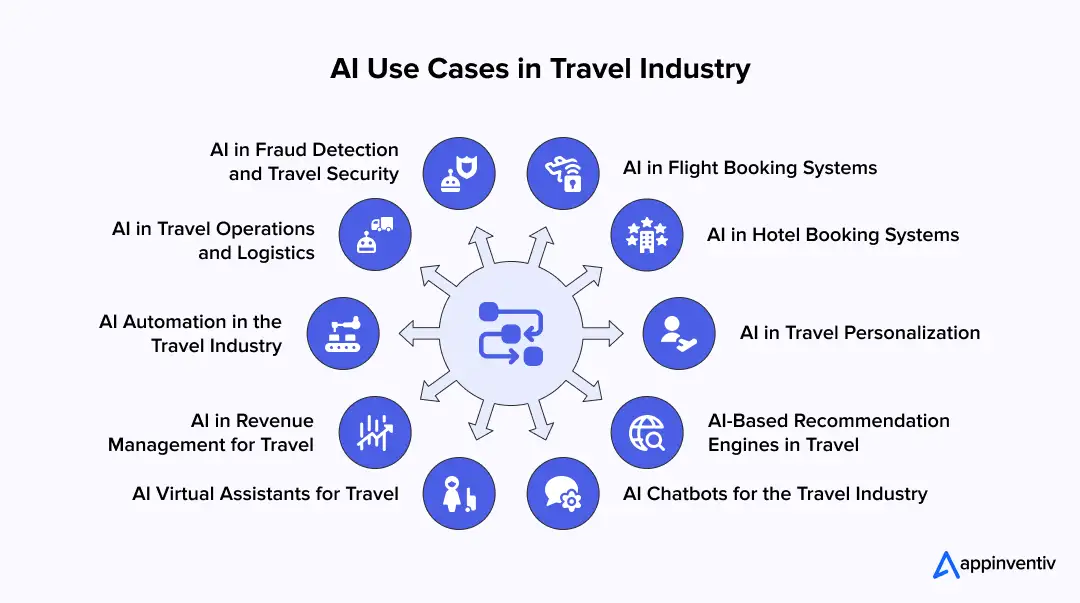
AI in Flight Booking Systems
Flight booking is no longer a static search process. Prices change fast, demand shifts without warning, and users expect relevant results within seconds. AI in travel booking systems responds to these changes using live data from searches, bookings, and pricing trends.
- Fare prediction looks at past fare movements and current demand. It estimates price changes and guides users on when to book. This helps reduce hesitation and increases completed bookings.
- Smart search and ranking reorder flight options based on user behavior. A frequent business traveler sees different results than a budget traveler. Alaska Airlines applies this through its AI-powered flight search tool, which adjusts results based on traveler intent and context.
- Route optimization evaluates routes, layovers, and timing using demand and traffic patterns. It highlights options that balance cost and travel time, which improves user decisions and booking rates.
AI in Hotel Booking Systems
Hotel bookings rarely follow a steady pattern. A sudden event in the city, a long weekend, or even a flight delay can change demand within hours. AI in hotel booking systems reads these shifts from live search and booking data, then updates pricing and availability without waiting for manual changes.
- Dynamic pricing adjusts room rates in response to changing demand. During peak periods, prices move up. When bookings slow down, rates drop to fill rooms that would otherwise stay empty.
- Inventory optimization tracks room availability across dates and categories. It helps hotels avoid double bookings and reduces the number of unsold rooms on low-demand days.
- Personalized recommendations present room options based on a guest’s previous searches or bookings. Some platforms, such as Visito, handle guest conversations across messaging apps, share room details in real time, and follow up with offers. This reduces front-desk workload and improves direct booking rates.
AI in Travel Personalization
Travel choices vary for each user. A family plans months. A business traveler books within hours. AI in travel personalization reads past searches, bookings, and on-site behavior to shape each experience in real time.
This demand is clear. 76% of travelers want AI to create personalized itineraries, and many now expect platforms to adapt in real time.
- Behavior-based experiences adjust what users see based on actions. A user who searches for luxury stays will see premium options first. A budget-focused user sees lower-priced options without extra filtering.
- Tailored itineraries build trip plans using travel history, preferred routes, and timing. Platforms suggest flights, hotels, and activities that match past behavior and current intent. Concierge by Ava, part of Navan’s travel platform, learns traveler preferences over time and simplifies booking by pre-filling and guiding search steps inside the app.
- Context-aware offers change based on location, timing, and demand. A late search may trigger last-minute deals. A repeat traveler may see offers aligned with earlier trips, which improves booking rates and retention.
AI-Based Recommendation Engines in Travel
Most travel platforms show too many choices at once. Users often scroll, compare, and leave without booking. AI-based recommendation engines cut this noise by showing a smaller set of options that match user behavior.
Discovery behavior is also changing. 65% of travelers now look for non-mainstream destinations, increasing reliance on AI-driven suggestions rather than manual search. This shift is part of a broader rise in mobile travel app demand.
- Destination suggestions rely on past trips, recent searches, and travel frequency. Someone who often books short trips may see nearby destinations first instead of long routes.
- Upsell and cross-sell appear during booking steps. Ranking systems use collaborative filtering or deep learning models. To understand how these work end to end, see how to build a recommendation system from the ground up. These additions stay relevant to the trip.
- Content personalization changes listings, offers, and guides based on user activity. TripAdvisor has tested this idea through voice-based tours on assistants like Alexa and Google Assistant, where users explore places and attractions through simple voice prompts tied to their interests.
AI-Based Chatbots for Travel Industry
Travel support requests come at all hours. A traveler may need help before booking or during a trip. AI chatbots handle these requests in real time, reducing the load on support teams.
- 24/7 support gives quick answers on bookings, cancellations, and policies. Users get what they need without waiting, which keeps them from leaving mid-process.
- Booking assistance lets users search, compare, and book within a chat. Luxury Escapes introduced a chatbot that helps users browse travel deals based on their preferences and complete bookings in a few steps. This shift increased user interaction across its platform.
- Multilingual engagement allows platforms to respond in different languages. This helps serve international users without expanding large support teams.
AI Virtual Assistants for Travel
Trips often change after booking. A delay or a missed connection can force quick decisions. AI virtual assistants help travelers handle these moments without extra effort.
- Voice-based booking lets users search for and confirm options with short voice inputs. This works well when typing is not convenient.
- Real-time updates send alerts for delays, gate changes, and schedule shifts. Travelers stay informed as events unfold.
- End-to-end assistance supports each stage of the trip. Users can check plans, ask for suggestions, or get help during travel. Trip.com introduced TripGen, which provides itinerary ideas and answers travel questions within the same app, reflecting how travel apps are reshaping the entire journey experience.
AI in Revenue Management for the Travel Industry
Travel pricing moves throughout the day. A route that looks quiet early on can sell out by evening. Many teams still depend on fixed pricing rules or delayed reports, which limits how fast they can respond.
AI in revenue management works differently. It tracks booking flow and search activity as they happen and adjusts pricing based on what is happening right now.
Some travel companies already see results from this shift. Those using AI for travel pricing and demand planning report profit improvements of up to 15 percent, mainly from better timing and fewer missed opportunities.
- Dynamic pricing changes fares and room rates based on booking speed. As seats or rooms fill up, prices increase. When demand slows, prices drop to bring bookings back.
- Demand forecasting reviews past bookings and current search patterns to estimate future demand. This helps teams plan pricing and capacity with fewer surprises.
- Yield optimization focuses on improving returns from available inventory. KAYAK uses a fare prediction feature that studies price patterns and helps users decide whether to book now or wait.
AI Automation in the Travel Industry
Travel operations involve constant updates, transactions, and service requests. Many of these tasks follow fixed steps and repeat at scale. AI automation handles this workload and reduces dependence on manual processes.
- Workflow automation manages tasks such as booking confirmations, cancellations, and notifications. Actions are triggered based on system inputs, which keeps processes running without delays.
- Back-office operations include reporting, invoicing, and data handling. AI tools process large volumes of data and reduce manual errors. Sabre applies this through its AI suite, which helps travel companies track customer activity, generate insights, and automate decision flows across operations.
- Customer service automation handles common queries, including booking status, changes, and refunds. This reduces response time and lowers support costs without increasing team size.
AI in Travel Operations and Logistics
Daily operations in travel depend on tight coordination. A delay in one place can affect multiple routes, crews, and schedules. AI in travel operations and logistics helps teams respond more quickly by leveraging real-time data.
This is already happening at scale. Over 50% of airlines are deploying AI for travel operations and predictive maintenance, while airports are investing heavily in automation across baggage and routing systems.
- Crew scheduling assigns pilots and staff based on availability, rules, and route needs. Systems adjust schedules when disruptions occur, which keeps operations running.
- Baggage handling tracks luggage across checkpoints and routes. Systems detect delays or routing issues early, which reduces lost or delayed bags.
- Capacity and route planning uses booking trends and demand data to plan routes and seat allocation. Similar methods are used in logistics. FedEx applies AI to adjust delivery routes in real time. It has reported an around 25 percent improvement in on-time delivery, demonstrating how data-driven routing can improve performance at scale.
AI in Fraud Detection and Travel Security
Travel platforms handle large volumes of payments and user data daily. This attracts fraud attempts across bookings, accounts, and listings.
AI in fraud detection and travel security tracks activity in real time and flags suspicious behavior early. For platforms exploring additional layers of security, blockchain in travel offers a complementary approach.
AI also improves response speed. Modern systems can detect threats up to 2x faster than manual processes, which reduces exposure across payments and accounts.
- Payment fraud detection checks transactions during booking. Systems look for unusual patterns such as rapid purchases, mismatched details, or high-risk locations. Risky transactions get flagged before completion.
- Identity verification confirms user identity during sign-up, booking, or check-in. This includes document checks and biometric validation, which reduces fake accounts and misuse.
- Risk monitoring reviews activity across the platform. It tracks behavior linked to phishing, fake listings, or account takeovers. Booking.com uses AI systems to detect these threats in real time, helping reduce fraud and protect users.
These use cases show how AI solutions for travel companies move from isolated features to measurable gains across operations, revenue, and customer experience.
Key Benefits of AI in Travel and Hospitality
Travel businesses deal with constant change. Prices shift, demand moves, and customer expectations keep rising. AI in the travel industry helps teams keep up without adding more manual work
This shift is measurable. AI-led travel businesses report double-digit gains in revenue and operational efficiency, particularly in pricing and personalization.
- Operational efficiency improves as systems handle routine tasks such as booking updates, pricing changes, and basic support queries. Teams spend less time on repetitive work.
- Cost reduction comes from fewer manual processes and lower support demand. Automation reduces the need for large service teams and lowers error rates.
- Enhanced personalization changes how users see options. A frequent traveler gets different results than a first-time user, which makes booking faster.
- Revenue growth comes from better pricing and targeted offers. Small pricing changes across large volumes can increase overall returns.
- Better decision-making improves as teams work with live data instead of static reports. This helps them respond faster to demand and pricing changes.
Challenges of AI Adoption in Travel
Where AI and travel systems meet, projects often slow down once real data comes into play. The issues are less about models and more about how existing platforms handle data and integration.
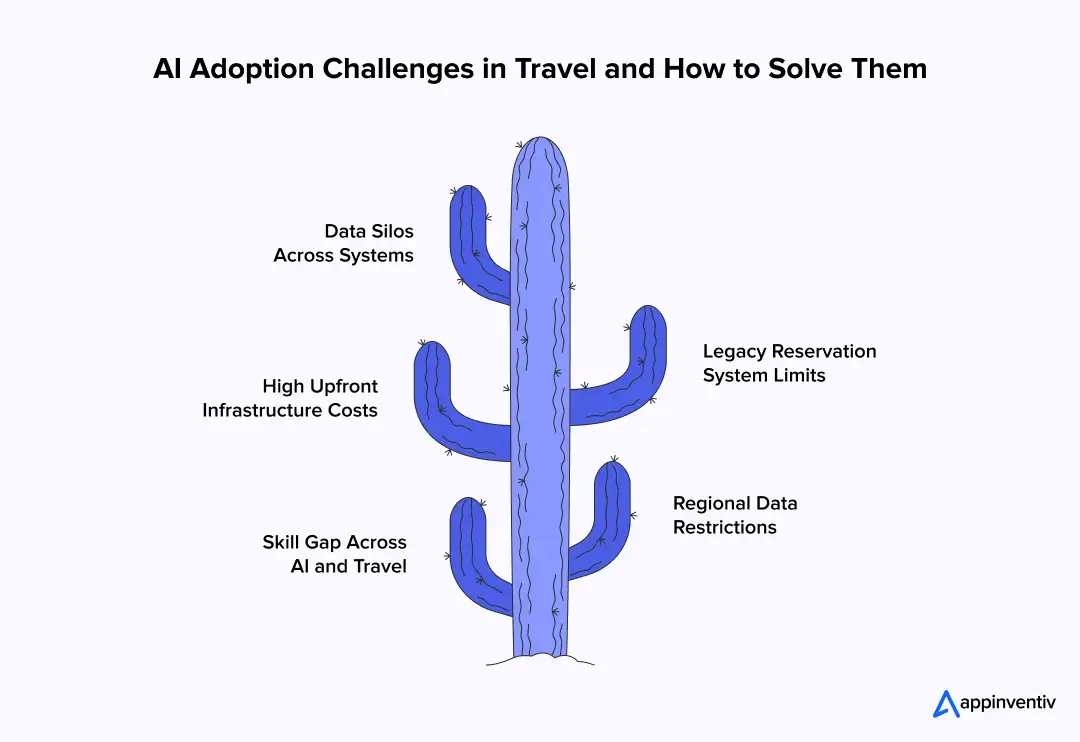
Data Silos Across Booking and Customer Systems
Booking data, customer profiles, and search activity sit in different systems. These systems do not update together, so teams work with partial data.
Solution: Bring key data streams into one layer. Sync booking, pricing, and user activity more frequently so models work with current signals.
Limited Access To Legacy Reservation Systems
Many reservation systems were built years ago and offer limited connectivity. This blocks direct access to live pricing and inventory.
Solution: Add a connection layer to connect old systems to new services. This allows data to flow without replacing the core platform.
High Upfront Spend On Data and Infrastructure
Early costs come from data setup, storage, and processing. These costs appear before visible results.
Solution: Begin with a narrow use case, like pricing or support. Expand once results are clear.
Strict Data Rules Across Regions
Travel platforms handle user data across countries with varying data protection rules. This limits how data moves and where it can be stored.
Solution: Store data within required regions and control access. Track usage through logs.
Shortage Of Teams With Both AI and Travel Expertise
Many teams lack experience in both AI and travel. This slows execution and creates gaps.
Solution: Combine internal teams with external specialists and use existing models where possible.
Implement AI-driven pricing, recommendations, and automation to improve travel operations and customer experience.

Technologies Powering Artificial Intelligence in Travel Industry
Artificial intelligence in travel relies on a mix of models and data pipelines that run in production, not just experiments. These systems connect directly with booking engines, pricing services, and customer interfaces.
Machine Learning
Pricing and demand models often rely on machine learning algorithms like gradient boosting methods, including XGBoost and LightGBM. These models handle tabular data like fare history, booking pace, and seasonality.
For time-based demand, teams use LSTM networks or Prophet to track trends across dates and routes. Feature pipelines pull data from booking systems and update models on a fixed schedule.
Natural Language Processing
Chat systems powered by natural language processing rely on transformer models such as BERT for intent detection and GPT-based models for response generation. A typical setup includes an intent classifier, entity extraction for dates and locations, and a response layer connected to booking APIs.
Computer Vision
Computer vision powers identity checks use convolutional neural networks trained on document datasets. OCR tools such as Tesseract or cloud vision APIs extract text from passports and IDs. Face-matching models compare user images at check-in against stored records.
Generative AI
Generative AI powers large language models that generate itineraries and responses using structured inputs. These systems often connect to a retrieval layer, where travel data is stored in vector databases such as FAISS or Pinecone for fast lookups.
Recommendation Systems
Ranking systems use collaborative filtering or deep learning models such as neural matrix factorization. Real-time ranking typically proceeds in two stages: candidate generation and re-ranking based on user signals such as clicks and bookings.
How to Implement Applications of AI in Travel Systems
The most effective applications of AI in travel are tied to a clear business outcome. Teams should focus on one problem at a time and build around real data and systems.
Define Business Goals
Start with a measurable target. This could be higher booking conversion, better pricing accuracy, or lower support volume. Clear goals help choose the right data and models.
Assess and Prepare Data
Collect data from booking systems, search logs, and customer platforms. Clean missing fields, align formats, and remove duplicates. Set up pipelines so that data updates on a regular schedule.
Select an AI Model and Tools
Choose models based on the problem. Use gradient boosting for pricing, time-series models for demand, and transformer models for chat or search. Pick tools that support training and deployment at scale.
Integrate with Existing Systems
Connect models to booking engines, CRM tools, and pricing systems through APIs. A middleware layer helps link older systems without full replacement.
Monitor, Improve, and Scale
Track model output against real results. Update models as new data comes in. Working with the right artificial intelligence solutions company can help expand to more use cases once the first system shows stable results.
Cost of AI in the Travel Industry
AI investment in travel depends on scope, system depth, and integration needs. A focused use case costs far less than a system that connects pricing, booking, and customer data across platforms. Most enterprise projects fall between $50,000 and $500,000, though the final figure depends on how deeply AI is embedded into your travel booking app.
| Component | What Drives the Cost | Estimated Range (USD) |
|---|---|---|
| Data infrastructure | Data storage, pipelines, and real-time processing | $10K – $100K |
| Integrations | Connecting GDS, PMS, CRM, and booking engines | $15K – $150K |
| Model development | Model selection, training, testing | $10K – $120K |
| Deployment | APIs, cloud setup, production rollout | $10K – $80K |
| Maintenance | Monitoring, updates, cloud usage | $5K – $50K annually |
Travel app development costs increase when systems require real-time data, complex integrations, or large-scale deployment across regions. Starting with a single use case helps control spend and prove value before expansion.
From dynamic pricing to AI booking assistants, deploy intelligent travel solutions that increase revenue and efficiency.

Future of AI in Travel and Tourism
Travel is starting to change before a booking is even complete. Systems no longer wait for a user to finish searching. They react early and adjust options as new signals come in.
This shift is visible across airlines, hotels, and the broader AI in the tourism industry landscape. The AI travel market is expected to reach about $8.1 billion by 2030, which shows steady growth in adoption, particularly across fast-moving regions like the GCC travel market.
The next phase will focus on removing extra steps and handling changes in the background.
- Predictive travel will rely on past trips and current activity. A frequent traveler may see saved preferences applied or receive alternate options during delays.
- Personalization will become more specific. Pricing, routes, and offers will vary for each user based on booking patterns and timing.
- Voice and chat tools will handle more of the booking process. Users will search and confirm trips through short inputs instead of long forms.
- Connected systems will link airlines, hotels, and transport. A delay in one part of the trip can trigger updates across the rest without manual effort.
How Appinventiv Helps Travel Enterprises Implement AI at Scale
AI adoption in travel breaks where systems fail to connect. Booking data sits in GDS, customer data in CRM, and pricing logic runs in separate services. Appinventiv works directly on these points.
Teams build data pipelines that pull booking and search data into one layer, add middleware to connect legacy reservation systems, and deploy models on top of real-time data without replacing core platforms.
- 300+ AI-powered solutions delivered
- 98% prediction accuracy in deployed systems
- 75+ enterprise AI integrations completed
- 10x faster time-to-market through structured delivery
- 40% reduction in operational costs
In travel, this work shows up in production systems, not prototypes.
For the Hoi Travel Companion app, the earlier setup often ran into issues as usage grew. Traffic spikes led to slowdowns, and updates required downtime. Appinventiv rebuilt the backend on AWS and set up Kubernetes with a CI/CD pipeline. This allowed regular updates without taking the system offline. The app now supports flight tracking, lounge access, and airport services in real time. It also follows SOC 2 and PCI DSS requirements.
For the Arts & Leisure travel platform, trip planning relied on spreadsheets and email exchanges. This created delays and made it hard to track updates. Appinventiv built a single system where bookings and itineraries are managed together. Travel planners and customers can view and update trips through mobile apps, which reduces back-and-forth and makes coordination simpler.
Appinventiv, a top AI development services company, focuses on systems that run inside your travel stack, not separate tools. Schedule a call and let’s build AI systems for the travel industry that connect your data, pricing, and customer experience into a single flow.
Frequently Asked Questions
Q. How is AI used in the travel industry?
A. AI in the travel industry is now part of everyday travel operations.. It helps sort search results, adjust prices throughout the day, and track demand using booking and search data. Chat systems answer common questions and guide users through bookings. Airlines and hotels use it for staff planning, fraud checks, and managing room or seat availability across locations.
Q. Is AI replacing travel agents?
A. Travel agents are still needed, but their work looks different now. Systems handle simple bookings and basic trip suggestions. Agents spend more time on detailed itineraries, group travel, and business clients. The focus shifts toward handling complex requests rather than routine tasks.
Q. How does AI improve customer experience in travel?
A. AI makes booking and travel easier to handle. Users see options that match what they usually search for. Chat systems respond right away, so there is no waiting. During a trip, updates about delays or changes come through quickly. This helps users make decisions faster and reduces confusion.
Q. How to implement AI in the travel business?
A. Begin with one clear use case, such as pricing or support. Collect data from booking systems and user activity. Clean the data so it can be used properly. Select a model that fits the task and connect it to existing systems. Track how it performs and expand once it works as expected.
Q. How much does it cost to implement AI in travel?
A. Costs vary based on how much you build. A smaller setup may start near $50,000. Larger systems that connect multiple platforms and run in real time can reach $500,000. Costs include data setup, integration work, and ongoing usage such as cloud services and maintenance.
Q. How does Appinventiv help travel businesses implement AI?
A. Appinventiv works on connecting data and systems that often sit apart. Booking data, customer data, and pricing systems do not always link well. The team brings these together and builds connections so AI models can use live data. The focus stays on systems that support real travel operations across booking, pricing, and customer interactions.

- In just 2 mins you will get a response
- Your idea is 100% protected by our Non Disclosure Agreement.

How to Find the Right AI Ethics Consultant in the Middle East for Your Digital Product
Key takeaways: Hire an AI ethics consultant before architecture and data flows are locked. The right partner turns responsible AI into product controls, not policy fluff. GCC compliance knowledge matters, especially UAE PDPL, CBUAE, SDAIA, ISO, and NIST. Bias testing must cover Arabic, dialects, names, locations, proxy data, and UX gaps. Strong AI governance needs…

AI Browser Agents Development: Steps, Costs, Challenges, and More
Key takeaways: Rely on aggressive error recovery and deterministic APIs instead of just throwing a larger model at the reliability gap. Protect your budget by defaulting to the DOM and only triggering expensive visual processing when the markup lies to you. Treat the web as hostile by structurally isolating your planning models from untrusted page…

AI Hallucinations in Enterprise Apps: Real Costs, Root Causes, and How to Fix Them
Key takeaways: AI hallucinations are no longer minor model flaws; they now create real financial, legal, and reputational exposure for enterprises. Most hallucination failures happen because AI systems are not grounded in current, verified, and access-controlled business data. RAG helps reduce hallucinations, but it only works well when paired with citation enforcement, clean retrieval, and…