































12 Use Cases and Benefits of How AI is Transforming the Smart Homes Sector


- Role of Artificial Intelligence in Smart Home Systems: Why AI Matters & How It Works
- Real-World Use Cases of AI in Smart Homes: How the Technology Is Redefining the Real Estate Sector
- Benefits of AI Smart Homes: What Homeowners and Enterprises Actually Gain
- Real-World Examples of AI-Powered Smart Home Innovation
- Appinventiv in Action: How We Help Build Intelligence into Real Estate & Smart Homes: A Short Case Study
- Challenges of Implementing AI in Smart Homes with Their Practical Solutions
- How to Integrate AI Smart Home Solutions Into Your Real Estate or Prop-Tech Business
- Cost of Building A Smart Home AI Agent
- Future Trends of AI in Smart Homes That Will Redefine the Real Estate Industry
- How Appinventiv Helps Build Intelligent, Predictive AI Smart Homes
- FAQs

Key takeaways:
- Smart homes are moving beyond “connected devices” toward systems that quietly manage themselves, opening new revenue and efficiency opportunities for builders and prop-tech teams.
- The strongest use cases today come from real, day-to-day needs: stable energy loads, fewer false alarms, healthier indoor air, faster maintenance, and better comfort without constant user input.
- Costs of AI powered smart home platforms vary depending on how deep the intelligence goes. Typically, the cost ranges between $40,000 and $400,000 or more
- The implementation process works best when companies start with high-impact zones, unify everything under one app, connect it to property tools, and run a small pilot before scaling across multiple buildings
- Appinventiv’s work in this space shows that when AI development, ML engines, and secure integrations come together, properties run smoothly, residents report higher satisfaction, and buildings deliver measurable savings fast
Walk into a newly built home in London, San Francisco or anywhere in the world today and you’ll notice something subtle: the house is watching, learning, and adjusting itself long before you hit a switch.
A thermostat nudges the temperature down minutes before peak pricing kicks in. Lights tune themselves to mimic the daylight balance you prefer. A camera recognizes your car pulling in and unlocks the door only when it’s sure it’s you, not someone walking just behind you.
This shift didn’t happen overnight. It reflects a significant pattern noted in a 2025 Parks Associates report, which unveils that 40% of US households specifically value AI-powered smart home features that notify them when an unfamiliar person approaches their home. It is a clear sign that contextual intelligence is becoming the new baseline.
This is not about gadgets anymore. Modern homes are evolving into AI-powered smart home ecosystems that understand context, learn behavior, and act autonomously.
For product heads, CTOs, and real estate innovators, this raises a more strategic question: What new opportunities, business models, and efficiencies can be unlocked when AI home automation becomes the core layer rather than an add-on? Well, this blog is the answer to all such woes.
In this blog, we will explore 15 practical applications of AI in smart homes, the business impact, the challenges leaders must solve, and how organizations can build scalable Smart Home AI Solutions that align with enterprise-grade expectations.
40% of households in the US want systems that detect unfamiliar visitors automatically. We help real estate and prop-tech teams build these capabilities into their platforms.

Role of Artificial Intelligence in Smart Home Systems: Why AI Matters & How It Works
Homes generate enormous streams of data: temperature variations, occupancy signals, power consumption, appliance cycles, air quality changes, and access patterns. On their own, these signals mean little. But once interpreted through AI, they become actionable intelligence.
Here is what AI for the smart homes sector does:
AI → unifies device outputs
AI → interprets signals
AI → predicts needs
AI → acts autonomously
In short, artificial intelligence for smart homes acts as the decision-making engine that binds these signals into coherent actions. The process typically looks like this:
| Sensors → Real-time data → AI model → Prediction → Automated execution |
The demand curve reflects this shift:
The revenue in the global artificial intelligence in smart homes technology market is projected to pass $250 billion by 2029, a significant jump from $174 billion in 2025, according to Statista.
This growth is not driven by novelty. It’s driven by buyer expectations for:
- lower operational cost
- stronger security
- personalized comfort
- sustainability
- predictive automation
This is why leaders in the real estate industry, exploring digital transformation, increasingly evaluate AI for smart homes sector solutions, either as stand-alone platforms or embedded into larger smart-living ecosystems.
Real-World Use Cases of AI in Smart Homes: How the Technology Is Redefining the Real Estate Sector
Modern homes don’t become “intelligent” because a few devices are smart; they become intelligent when software behaves like an always-present operator: reading signals, predicting needs, and coordinating dozens of micro-decisions in the background. Below are 12 real, scalable AI for smart home use cases that are reshaping residential experiences and creating new revenue opportunities for builders, OEMs, and prop-tech leaders.
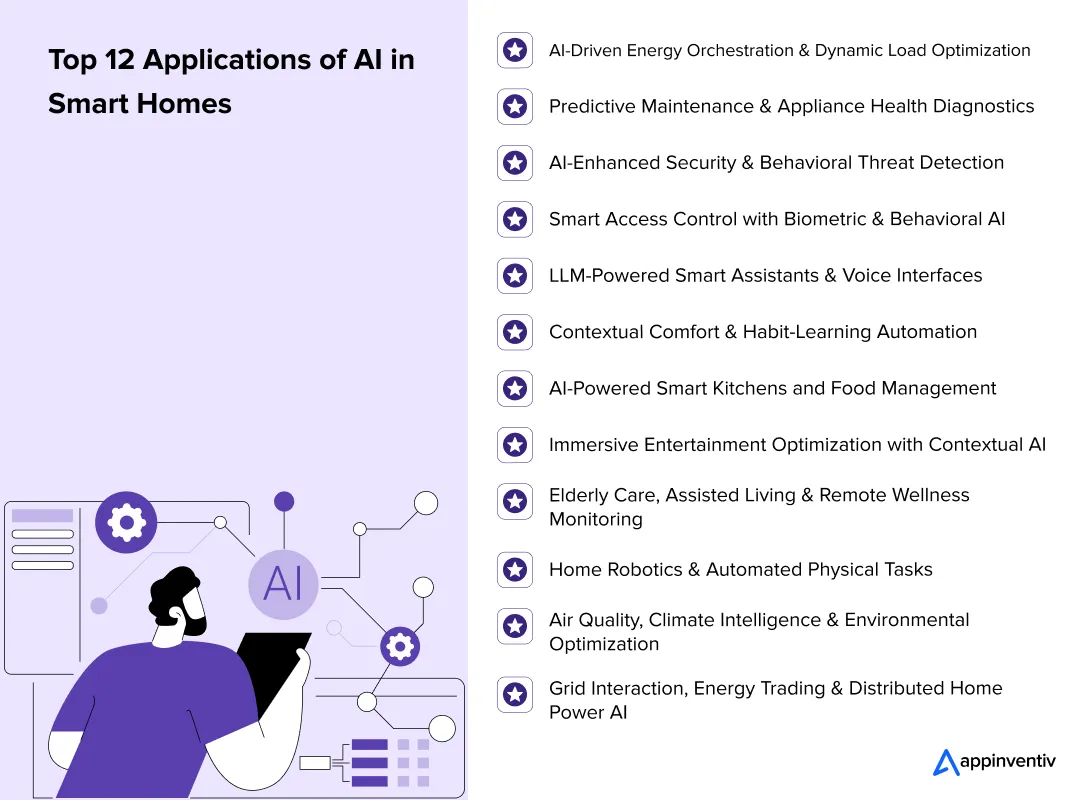
1. AI-Driven Energy Orchestration & Dynamic Load Optimization
Energy consumption inside a home looks simple at a glance, but underneath it behaves like a constantly shifting system: occupancy waves, weather fluctuations, tariff changes, inefficient cycles from aging appliances, and hidden waste.
An AI home automation engine looks at all these signals at once, the way an experienced building operator would, only with more consistency. AI forecasts demand before spikes occur, shifts loads out of expensive windows, and rebalances climate control based on thermal patterns across different rooms.
Typical capabilities of AI in real estate for smart homes include:
- Thermostats pre-adjusting ahead of tariff changes
- Adaptive lighting that blends natural daylight with minimal power usage
- Insights identifying silent energy leaks or inefficient rooms
- Automated off-peak appliance cycles for dryers, heaters, dishwashers
- Forecasting heat/cool curves based on historical usage
This level of orchestration is becoming a core differentiator for real estate companies and utility partners building AI powered smart home ecosystems, reducing operational cost while improving ESG alignment.
2. Predictive Maintenance & Appliance Health Diagnostics
Most breakdowns don’t happen suddenly. Motors vibrate irregularly. Fridges draw more power than usual. HVAC compressors cycle longer to hit the same temperature. These signals are invisible to homeowners, but a predictive AI model flags them before the failure becomes expensive.
What this intelligence layer typically delivers:
- Early warnings for failing motors or compressors
- Power-anomaly detection across appliances
- Usage-driven maintenance reminders instead of generic schedules
- Efficiency scoring that highlights devices nearing end-of-life
For prop-tech companies and building operators, this is where artificial intelligence smart home systems create a tangible impact. This can be witnessed in the form of fewer emergency calls, reduced warranty claims, lower downtime, and better experience scores across residential portfolios.
Also Read: Predictive Analytics Software Development Guide 2026
3. AI-Enhanced Security & Behavioral Threat Detection
A traditional camera reacts to motion; an AI-enabled surveillance system reacts to behavior. Instead of treating a passing cat and a suspicious linger the same way, computer vision learns posture, gait, risk cues, and contextual movement.
Common capabilities include:
- Differentiation between familiar vs. unfamiliar individuals
- Package, pet, and vehicle recognition
- “Loitering intent” detection around doors and windows
- Alerts only when the context signals potential risk
This is one of the strongest AI in smart homes examples because security is a primary buying factor in the US and UK. This is the reason that C-suite teams building smart home platforms increasingly rely on this layer to reduce false alarms and strengthen trust.
4. Smart Access Control with Biometric & Behavioral AI
The front door is evolving into a contextual access system. Instead of a simple lock-and-key, AI checks face signatures, historical entry patterns, time windows, and even anomalies in movement before granting entry.
These systems often manage:
- Biometric authentication with liveness checks
- Time-bound digital keys for guests and vendors
- Behavior-aware logic that flags unusual entry attempts
- Secure logs for auditing access patterns
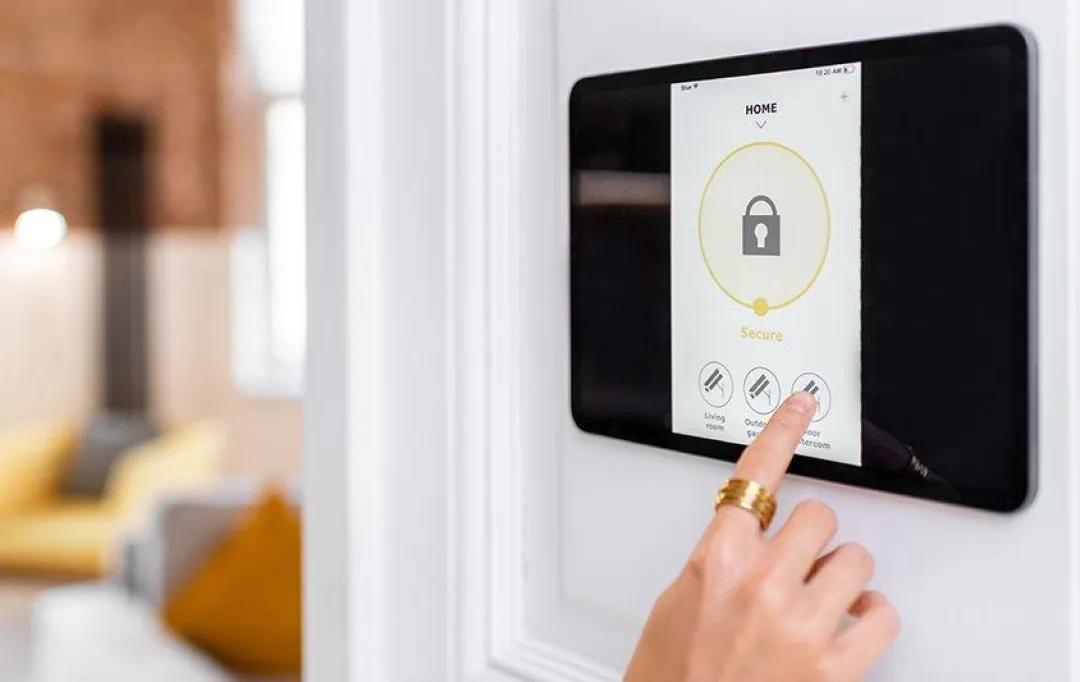
For multi-tenant housing operators, this is no longer optional. AI-driven access control reduces security overhead and helps them deploy scalable, future smart home technology without increasing staffing costs.
5. LLM-Powered Smart Assistants & Voice Interfaces
Voice assistants have entered a new stage. With LLM model development on the rise, homes now understand intent, nuance, tone, and incomplete sentences. What used to be command-and-response has turned into a conversational help system that anticipates multi-step needs.
Modern assistants typically offer:
- Natural conversations instead of rigid commands
- Multi-step automations compressed into one spoken request
- Context-aware suggestions tied to routines
- Cross-device coordination without scripting scenes
For real estate companies, this is becoming a core component of AI home automation: a unified interface that reduces friction and boosts daily engagement.
6. Contextual Comfort & Habit-Learning Automation
Residents rarely realize how predictable their routines are: lowering blinds at sunset, dimming lights before bed, adjusting HVAC at certain hours. AI picks up on these micro-patterns and quietly starts doing them first, creating an environment that feels almost intuitive.
Common adaptations include:
- Lighting temperature that imitates daily rhythms
- Temperature curves shaped around work/sleep habits
- Weekend vs. weekday environmental shifts
- Ambient adjustments based on activity (“reading,” “work,” “dinner”)
For builders and prop-tech leaders, these habit-learning engines unlock new premium tiers of artificial intelligence in smart home technology that appeal to buyers seeking comfort without complexity.
7. AI-Powered Smart Kitchens and Food Management
The kitchen is quickly becoming one of the most intelligence-driven spaces inside modern homes. What used to rely on timers, guesswork, and manual monitoring is now guided by a mix of computer vision, contextual automation, and inventory-aware systems. AI-enabled appliances can recognize ingredients, study cooking patterns, and even adjust their behavior mid-process to avoid overcooking or wasting food.
Smart ovens now identify dishes through built-in cameras and automatically fine-tune temperature, heating mode, and cooking duration. Smart fridges track inventory in real time, flag items that are about to expire, and suggest meals based on what’s available. Some setups even factor dietary restrictions or health goals into recipe recommendations, creating a more personalized kitchen experience.
Capabilities often include:
- Ingredient recognition via embedded vision modules
- Predictive expiry alerts for perishable items
- Adaptive cooking cycles that respond to food behavior in real time
- Meal suggestions based on inventory + dietary preferences
For appliance manufacturers and culinary-tech brands, these AI smart home devices reduce waste, differentiate product lines, and deepen user engagement.
Also Read: AI in Food Delivery App Development
8. Immersive Entertainment Optimization with Contextual AI
Entertainment systems now adjust themselves based on what’s happening around and on the screen. AI reads viewing behavior, ambient light, and time of day to build a more immersive experience.
Typical automation includes:
- Adaptive display brightness and color tone
- Real-time audio balancing across multiple rooms
- Lighting sequences tied to on-screen action
- Personalized content curation
For OEMs, prop-tech companies and smart TV manufacturers, this is a key differentiator in a highly commoditized category.
9. Elderly Care, Assisted Living & Remote Wellness Monitoring
For families and senior-care operators, the biggest challenge isn’t the day-to-day routine; it’s the unattended moments: a fall at night, a missed medication window, or subtle health changes no one notices until they escalate. AI-powered smart home devices are quietly becoming the safety net behind those moments.
Modern systems do far more than raise alerts. AI listens to small shifts in behavior: gait changes, reduced movement, wandering at unusual hours, or prolonged inactivity; and pairs them with insights from the environment itself.
Capabilities now include:
- Non-wearable fall detection using sensor fusion
- Medication reminders anchored to both schedule and behavior
- Sleep and heart-rate tracking through AI-enabled smart beds and mattresses
- Automatic mattress firmness adjustment based on sleep quality
For companies implementing AI applications in smart homes, this use case has fast become one of the fastest-growing commercial opportunities.
10. Home Robotics & Automated Physical Tasks
Robots inside homes have quietly moved from novelty gadgets to dependable household operators. With spatial AI, LiDAR mapping, and real-time obstacle reasoning, today’s robots navigate homes the way a trained technician would: reading room layouts, avoiding pets, and adapting when furniture or routines change.
Common robotic functions include:
- Multi-floor vacuuming with dynamic path adjustments
- Autonomous lawn care that adapts to uneven terrain and seasonal growth
- Window and façade cleaning, especially in high-rise apartments
- Early multi-task prototypes handling tidying, object sorting, or basic monitoring
Homes with intelligent robots generate richer behavioral datasets, deeper long-term engagement, and recurring service revenue, which is why enterprises building next-gen AI-powered smart home ecosystems now treat robotics as a core pillar, not an accessory.
11. Air Quality, Climate Intelligence & Environmental Optimization
Indoor air changes far more often than people realize; every door opening, every cooking cycle, every weather shift outside influences what a family breathes inside. AI-driven climate engines monitor these fluctuations continuously, tracking CO₂ levels, VOC spikes, humidity drifts, and fine pollutants long before residents sense discomfort.
As a result, instead of reacting when a room already feels stuffy or dry, the system adjusts ventilation, airflow, and purification cycles proactively. AI also identifies rooms that naturally trap more heat, absorb moisture, or accumulate pollutants, giving homeowners and facility operators actionable insights.
Capabilities include:
- Predictive ventilation cycles are triggered before air quality declines
- Real-time pollutant alerts that detect VOCs, smoke patterns, or rapid CO₂ spikes
- Occupancy-based purification, activating only when residents are present
- Seasonal humidity balancing to reduce respiratory issues and preserve materials
For HVAC brands, property developers, and wellness-tech leaders, this represents one of the clearest demonstrations of the impact of AI in smart homes. It turns environmental management into an always-on, nearly invisible layer that improves health outcomes while lowering energy waste.
Also Read: AI in Climate Change: Bridging Innovation and Sustainability
12. Grid Interaction, Energy Trading & Distributed Home Power AI
As energy infrastructure modernizes, homes are no longer passive consumers; they’re emerging as small-scale energy producers. With rooftop solar, smart meters, home batteries, and dynamic pricing, residential energy flows resemble a miniature grid of their own. AI sits at the center of this ecosystem and makes hour-by-hour decisions that maximize savings and stabilize the home’s micro-energy network.
Typical capabilities include:
- Peak-tariff avoidance, shifting heavy loads out of expensive windows
- Battery optimization rules that balance storage vs. consumption
- Surplus-to-grid scheduling to generate revenue from excess solar production
- Weather-based forecasting to predict sunny days, low-solar periods, or high-demand evenings
This shift is unlocking entirely new business models for utilities, real estate developers, energy-tech startups, and companies building AI applications in smart homes.
Benefits of AI Smart Homes: What Homeowners and Enterprises Actually Gain
AI in smart homes is far more than convenience. Once learning models begin tying together dozens of small signals from sensors and appliances, the home stops acting like a cluster of gadgets and starts behaving like a unified system. This shift brings measurable business advantages for real estate businesses, prop-tech companies, and OEMs building intelligent-living ecosystems.
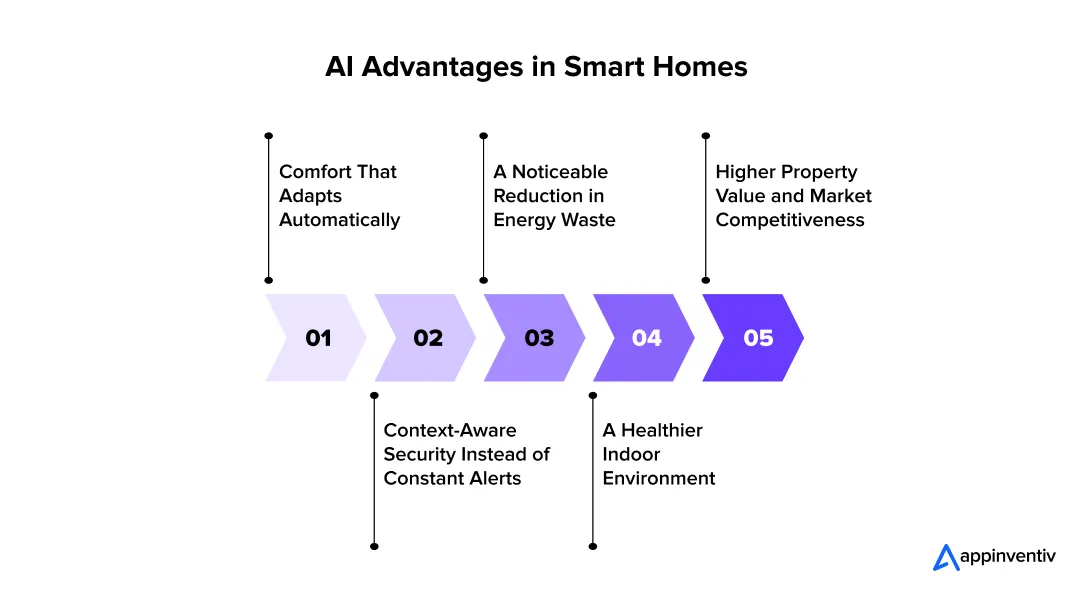
1. Comfort That Adapts Automatically
Homes begin adjusting themselves the way an attentive building operator would: aligning lighting, climate, and ambience without constant user input. Small details feel effortless: blinds adjusting ahead of a warm afternoon, lighting softening after dinner, HVAC anticipating sleep cycles.
For builders, this level of personalization becomes a premium selling point.
2. Context-Aware Security Instead of Constant Alerts
Security systems become calmer and smarter. AI reduces irrelevant alerts and focuses only on moments that require human attention, such as unknown vehicles, suspicious lingering, wrong attempts at locks, or unusual movement patterns.
For property managers, this reduces operational noise and strengthens trust.
3. A Noticeable Reduction in Energy Waste
AI-driven orchestration flattens unnecessary energy spikes before they even reach the billing cycle. Thermal curves, device patterns, and tariff structures are optimized continuously, lowering usage without residents noticing a change in comfort.
In multi-unit buildings, this contributes to lower common-area OPEX.
4. A Healthier Indoor Environment
Air quality, humidity, pollutants, and sleep-related signals all contribute to daily comfort. AI monitors them constantly and adjusts without asking for attention.
For brands selling HVAC or wellness-tech products, this feature of artificial intelligence in smart homes has become a major competitive differentiator.
5. Higher Property Value and Market Competitiveness
Intelligent-living features now sit alongside insulation, wiring quality, and smart meters as long-term property value indicators. Buyers are willing to pay for homes where the infrastructure is already designed for autonomous living.
Real-World Examples of AI-Powered Smart Home Innovation
A few companies have already shown how far intelligent home systems can go when software does the heavy lifting. These examples give a clearer picture of what smart home AI solutions look today; not as a concept, but as something people use every day.
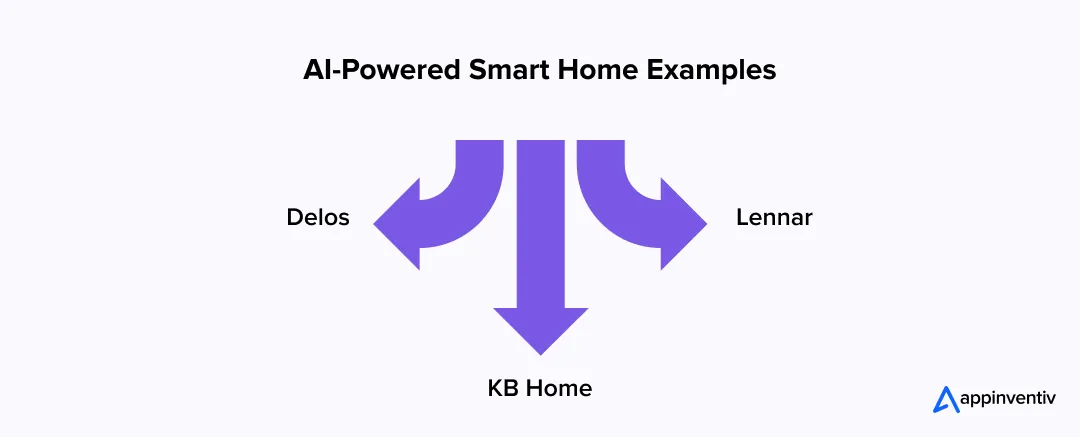
Delos
Delos has developed its “DARWIN Home Wellness Intelligence Platform,” which uses sensors and machine learning to adjust air quality, circadian lighting, and water filtration in real time. The goal is to create healthier indoor environments in residences. Their system can integrate into existing smart-home hubs and is marketed for both premium homes and wellness-focused new builds.
Delos is a strong example of how “artificial intelligence in smart homes technology” can be positioned beyond convenience, as a wellness differentiator.
Lennar
Lennar’s “Everything’s Included®” program embeds smart-home technology at the construction phase, offering Wi-Fi CERTIFIED™ home designs with fully integrated voice control, lighting, locks, and thermostats via Amazon Alexa and SmartThings.
Model homes in 15 U.S. cities showcase this turnkey technology stack, which appeals to buyers wanting move-in ready intelligence rather than retrofitted solutions.
Lennar demonstrates how AI home automation can become a baseline offering rather than a high-end add-on, improving market competitiveness and building-value perception.
KB Home
KB Home was one of the first major US builders to offer model homes fully equipped with Google-powered smart home ecosystems, including Nest thermostats, smart smoke detectors, video doorbells, and voice-controlled lighting.
The integration is designed to operate as a unified system from day one, giving buyers a turnkey intelligent-home experience without aftermarket setup.
Appinventiv in Action: How We Help Build Intelligence into Real Estate & Smart Homes: A Short Case Study
Smart home hardware only becomes useful when the software behind it knows how to interpret signals and coordinate decisions. This is the gap many real estate teams face, and it’s the exact space where our AI engineering work delivers the most impact. The project below is a simple snapshot of how we translate scattered device ecosystems into a single, intelligent experience.
Challenge: A real estate developer in the US approached us because their new smart residential tower wasn’t delivering a unified experience. The hardware was already in place, sensors, locks, energy meters, but everything operated in silos, and residents felt the building didn’t behave intelligently.
Solution: We stepped in to build the intelligence layer that the property lacked. Our team developed a central AI orchestration platform, a behavioral ML engine for energy and occupancy patterns, predictive maintenance modules, and an LLM-based resident app that tied every system into one seamless interface.
The Results?
- 38% drop in common-area energy waste
- 52% fewer resident-reported false alarms
- 72% faster resolution of internal maintenance issues
- 2.3x improvement in resident satisfaction
- Units sold 15% faster than comparable buildings
And this project isn’t an isolated win. We’ve partnered with multiple real estate players like Ility, HouseEazy, and a growing list of property-tech teams looking to modernize how their buildings think and respond.
Challenges of Implementing AI in Smart Homes with Their Practical Solutions
Adding AI to a home isn’t the same as installing a few smart devices. It requires a steady flow of data, consistent system behavior, and an intelligence layer that can make decisions without creating new friction. The hurdles below are the ones that show up most often when AI is introduced into a living space.
1. AI Needs Large, Continuous Data Streams
AI models depend on consistent data from sensors, cameras, and meters. Any gaps or noisy inputs can cause inaccurate predictions or broken routines.
Solution: Edge processing and local caching stabilize data flow. Homes can run micro-models on local hubs to ensure AI keeps working even when network conditions fluctuate.
2. Integrating AI Across Devices With Different Protocols
Most homes use a mix of brands, each with its own API or standard. AI struggles when devices don’t talk to each other cleanly.
Solution: Using Matter, Zigbee, or a unified orchestration layer gives the AI a single view of the entire home, allowing models to coordinate energy, comfort, and security decisions reliably
3. AI Behaves Unpredictably Without Explainability
Homeowners lose trust when automations fire at the wrong time or AI decisions feel opaque. Lack of transparent reasoning makes the system appear intrusive or “too controlling.”
Solution: Add simple AI explainability cues (“Adjusted cooling due to high room temperature”) and one-tap overrides for any automation. This balances intelligence with human control.
4. Trust Issues Around AI Decision-Making
People worry about AI misinterpreting behavior, acting too aggressively, or triggering automations at the wrong time. This is especially true for security or access control.
Solution: Keep humans in the loop early on. Provide transparent decision notes (“Why this action happened”), easy fallback modes, and clear privacy boundaries so people feel in control; not replaced.
How to Integrate AI Smart Home Solutions Into Your Real Estate or Prop-Tech Business
Building an intelligent home ecosystem isn’t about sprinkling in a few smart devices. What actually moves the needle is a software-led framework that unifies devices, manages data cleanly, and gives residents one simple interface to interact with. Here are some of the most valuable and practical ways to implement AI in smart homes:
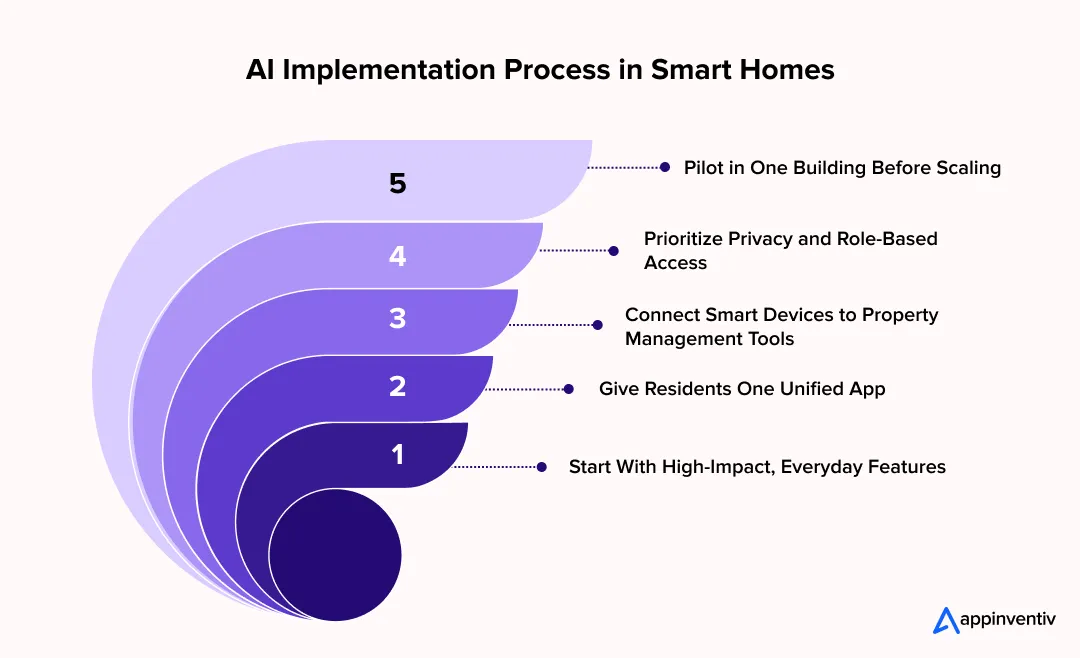
1. Start With High-Impact, Everyday Features
People respond best to features that immediately improve the way they live; lighting that follows the natural day, climate systems that pause when rooms are empty, secure entry that doesn’t require juggling fobs or codes. These are the anchors of any AI-powered smart home ecosystem. Choose devices with open APIs or Matter/Zigbee support so the system can expand without rework.
2. Give Residents One Unified App
Avoid a “many apps for many devices” experience. Build or customize a single platform that handles device controls, building communication, energy insights, and maintenance requests. Adoption rises dramatically when everything lives in one place.
3. Connect Smart Devices to Property Management Tools
This is where real operational value shows up. When your Smart Home AI Solutions talk to your property systems, routine tasks begin to run themselves.
Examples include:
- Leak detected → automatic maintenance ticket created
- Unit becomes vacant → HVAC shifts to low-consumption mode
- Abnormal energy spike → operations team alerted instantly
- Long-term inefficiency detected → predictive maintenance triggered
This turns smart homes into operational assets, not just lifestyle add-ons.
4. Prioritize Privacy and Role-Based Access
AI systems gather meaningful data: presence patterns, access logs, sleep analytics, and appliance usage. Without clear privacy enforcement, trust breaks quickly. So, your AI app development for the smart home should offer:
- Transparent data policies inside the resident app
- Edge processing when possible for high-sensitivity data
- Configurable permissions for shared homes (families, roommates, guests)
- Vendor compliance with regional standards (GDPR, CCPA, EU Data Protection Act)
- Secure audit logs for all access and automation events
For multi-unit buildings, role-based access control (RBAC) becomes essential so maintenance teams see only what they must.
5. Pilot in One Building Before Scaling
AI learns from real environments and every building behaves differently. Running a pilot in one property allows you to refine the experience before making large capital or technology commitments. A practical rollout approach:
- Deploy the AI stack in a single building or a limited set of units
- Track resident adoption, feature usage, and support tickets
- Monitor operational impact (energy, maintenance, security events)
- Adjust automations, thresholds, and model behaviors
- Expand zone-by-zone based on what residents actually embrace
Start with two or three high-impact domains (energy, access control, basic comfort routines), then scale as ROI becomes clear.
Our teams design ML engines, CV modules, LLM assistants, and full orchestration layers.

Cost of Building A Smart Home AI Agent
Unlike traditional home automation, the cost of deploying an AI powered smart home system depends less on hardware and more on the intelligence layer sitting above it: the models, orchestration logic, integration plumbing, and the resident-facing software experience.
Typically, the cost of building a smart home automation application varies based on four core factors:
- Scope of integrations (number of device categories + protocols)
- Depth of AI features (basic automation vs. predictive models vs. computer vision)
- Data infrastructure (cloud-only, edge-heavy, or hybrid architecture)
- Number of units/homes the system must support
For most projects, the cost typically falls within:
| Project Scope | Estimated Cost Range | What’s Included |
|---|---|---|
| Basic AI-Enabled Smart Home App | $40,000–$100,000 | Device integration, unified app, core automations |
| Mid-Scale Intelligent Platform | $100,000–$200,000 | ML-based personalization, predictive insights, anomaly detection |
| Advanced Smart Home Ecosystem | $200,000-$400,000+ | Computer vision models, multi-agent AI logic, LLM assistants, large-scale integrations |
Future Trends of AI in Smart Homes That Will Redefine the Real Estate Industry
The smart homes people live in today will look surprisingly simple compared to what’s coming. Most of the heavy lifting will shift from “if-this-then-that” rules to deeper, more adaptive intelligence that understands context the way a person would. A few shifts are already underway, and if the current momentum continues, the next decade of smart living is going to feel dramatically different from what we’re used to.
- Edge AI Becoming the Default Layer
More intelligence will run locally rather than in the cloud. This means quicker responses, stronger privacy, and devices that keep working even without stable internet access.
- Autonomous Home Ecosystems
Homes will shift from “rule-based automation” to autonomous behavior. The system won’t wait for commands; it will act based on its interpretation of patterns, context, and learned routines.
- Robotics Becoming Multi-Task Helpers
Today’s cleaning robots are only the beginning. Multi-function home robots, capable of handling cooking prep, organization, or health monitoring, are already in development.
- Emotion-Aware Living Environments
Using AI for sentiment analysis, voice tone detection, and environmental cues, future smart homes may adjust lighting, sound, or climate based on a resident’s mood or stress level.
- Multi-Agent AI Collaboration
Instead of single assistants doing everything, separate AI agents in real estate may manage different domains like energy, security, comfort, wellness, and coordinate with each other for holistic decisions.
How Appinventiv Helps Build Intelligent, Predictive AI Smart Homes
Modern smart homes aren’t defined by devices; they’re defined by the intelligence that connects those devices into one coherent, self-adjusting environment. That intelligence doesn’t emerge by chance. It requires disciplined engineering: clean data pipelines, real-time orchestration logic, scalable APIs, reliable edge inference, and intelligent AI model development that behaves predictably in real residential settings.
This is the layer Appinventiv’s AI development services build.
For the last 10+ years, our team of 1600+ tech experts has worked with numerous real estate companies, prop-tech innovators, IoT manufacturers, and energy-tech providers across 35+ countries to design AI ecosystems that do more than automate routines.
The AI home automation platforms we engineer learn household patterns, reduce operational overhead, improve energy outcomes, and elevate property value with future-ready infrastructure.
Here is a quick look at our capabilities of embedding AI in smart homes:
- 300+ AI-powered solutions delivered across industries
- 200+ data scientists, ML engineers & AI architects
- 150+ custom AI models trained and deployed in production
- 75+ enterprise integrations across IoT, energy, and real estate platforms
- 50+ bespoke LLMs fine-tuned for private environments
- 5+ strategic AI partnerships accelerating innovation at scale
A smart home is only as intelligent as the software connecting it.
If you’re exploring AI-driven energy orchestration, predictive maintenance engines, autonomous comfort systems, multi-agent assistants, or a cohesive smart home AI solutions platform, our real estate app development services are here to help.
Talk to our AI development experts today and bring your smart home idea to life.
FAQs
Q. How is AI used in smart homes?
A. Most homes today lean on small bits of intelligence tucked inside thermostats, cameras, appliances, and hubs. These systems observe things like movement, temperature shifts, and daily routines without asking anything from the resident.
Over time, they start adjusting lights, climate, energy use, and even security settings based on what they’ve learned.
Instead of adding more apps or steps, the home simply needs fewer touchpoints from you to run smoothly.
Q. What role does AI play inside smart home devices?
A. Each device handles its own job, but AI gives it the ability to make sense of what’s happening around it. For instance, an AI powered camera can tell the difference between a delivery person and a wandering pet. A thermostat learns how long it actually takes to make the place comfortable. AI is essentially the layer that lets devices behave with a bit of judgment rather than blind automation.
Q. Do AI-enabled smart homes really add property value?
A. Yes, in a lot of markets, especially in the US and UK, where buyers look for energy-efficient features and modern security setups.
A home that’s already wired with intelligent systems saves the next owner the trouble of upgrading later, which makes it more attractive and often easier to sell.
Q. What kinds of devices or systems can your AI platform connect with?
A. Here is a range of devices that can be connected with AI platforms:
- Smart locks, access panels, and video doorbells
- Thermostats, HVAC systems, and zoning controllers
- Lighting systems (Matter, Zigbee, Z-Wave, Wi-Fi)
- Energy meters, solar inverters, and battery storage units
- Motion sensors, occupancy sensors, and environmental monitors
- Cameras, security hubs, and anomaly-detection systems
- Smart appliances (ovens, fridges, washers) through open APIs
- Leak detectors, water meters, and irrigation systems
- Home routers, network controllers, and Wi-Fi optimization tools
Q. How does an AI-powered smart home work behind the scenes?
A. Here is how AI in smart homes works:
- Sensors send a steady stream of signals: temperature, activity, air quality, door activity, and device usage, into a central hub.
- The hub compares that data with past behavior and predicts what the home should do next, sometimes seconds before a person notices the need.
- Small adjustments follow: dimming lights, tightening access, lifting ventilation, or slowing down energy draw.
- With time, the system picks up the “rhythm” of the household and begins acting with a level of confidence that feels almost intuitive.

- In just 2 mins you will get a response
- Your idea is 100% protected by our Non Disclosure Agreement.

Simple Steps to Hire AI Governance Consultants in 2026
Key Takeaways Define AI risk tolerance and compliance goals before hiring consultants. Look for multidisciplinary teams combining governance, ML auditing, and MLOps expertise. Ensure consultants understand frameworks like the EU AI Act, NIST RMF, and ISO 42001. Prioritize experts who can operationalize governance inside ML pipelines. Embed responsible AI practices directly into CI/CD and model…

AI in Smart Homes in Australia: Use Cases, Cost & Real-World Impact
Key takeaways: The adoption of AI in Australian smart homes is primarily dictated by energy economics, insurance risk mitigation, and the evolving needs of an ageing population. AI development costs in smart homes range from AUD 70,000 to AUD 700,000+, depending on grid integrations, compliance engineering, and AI model complexity. Adherence to the Privacy Act…

Enterprise AI Integration in the Middle East: Scaling with Expert Architects
Key takeaways: Middle Eastern enterprises lead in AI adoption, driven by strong government support and investment in digital infrastructure. Successful AI integration requires robust data governance, compliance with local regulations, and tailored architectural design. Addressing talent gaps, localization needs, and legacy system challenges is crucial for scalable AI deployments. Systems integrators and big data architects…









