

























AI in Self-Driving Cars: Why Industry Giants Are Investing Billions Right Now


- Autonomous Vehicle Market Boom - Why Now is the Right Time To Capitalize On It
- AI in Self-Driving Cars: Understanding the Primary Role
- Understanding Advanced AI Algorithms in Self-Driving Cars
- Supervised Learning
- Unsupervised Learning
- Multiple Use Cases of AI in Self-Driving Cars
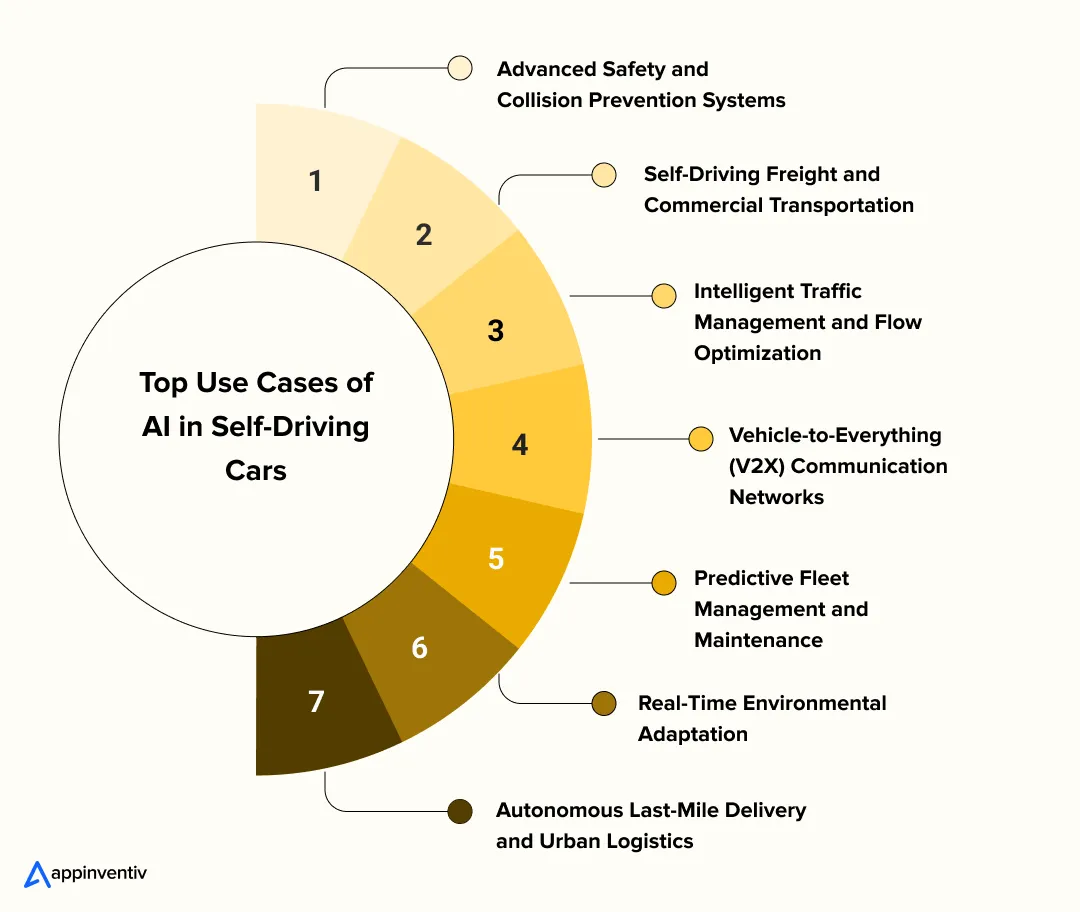
- 1. Advanced Safety and Collision Prevention Systems
- 2. Self-Driving Freight and Commercial Transportation
- 3. Intelligent Traffic Management and Flow Optimization
- 4. Vehicle-to-Everything (V2X) Communication Networks
- 5. Predictive Fleet Management and Maintenance
- 6. Real-Time Environmental Adaptation
- 7. Autonomous Last-Mile Delivery and Urban Logistics
- Benefits of Artificial Intelligence in Autonomous Vehicles
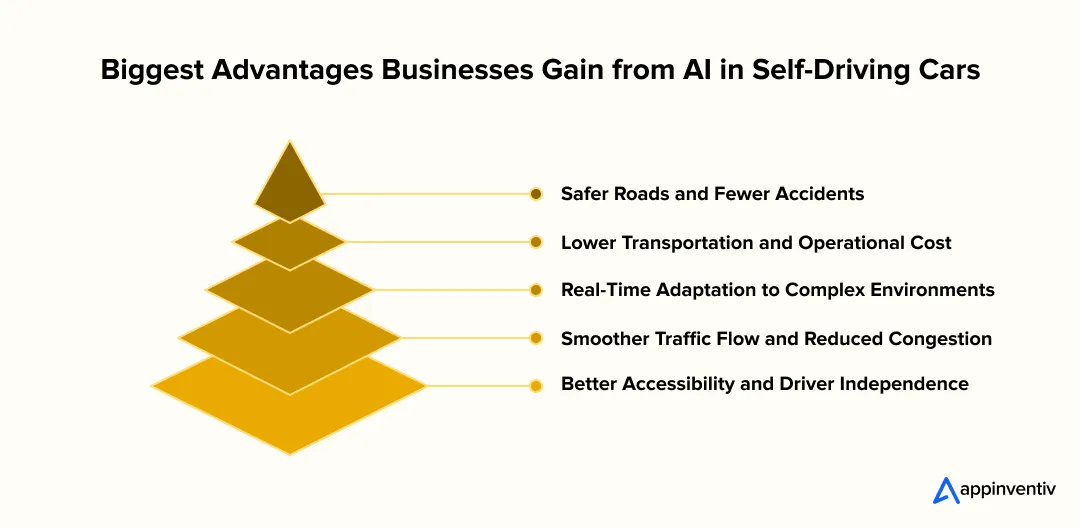
- Safer Roads and Fewer Accidents
- Lower Transportation and Operational Costs
- Real-Time Adaptation to Complex Environments
- Smoother Traffic Flow and Less Congestion
- Better Accessibility and Driver Independence
- Key Features of AI in Autonomous Cars
- Real-World Examples of AI in Autonomous Vehicles
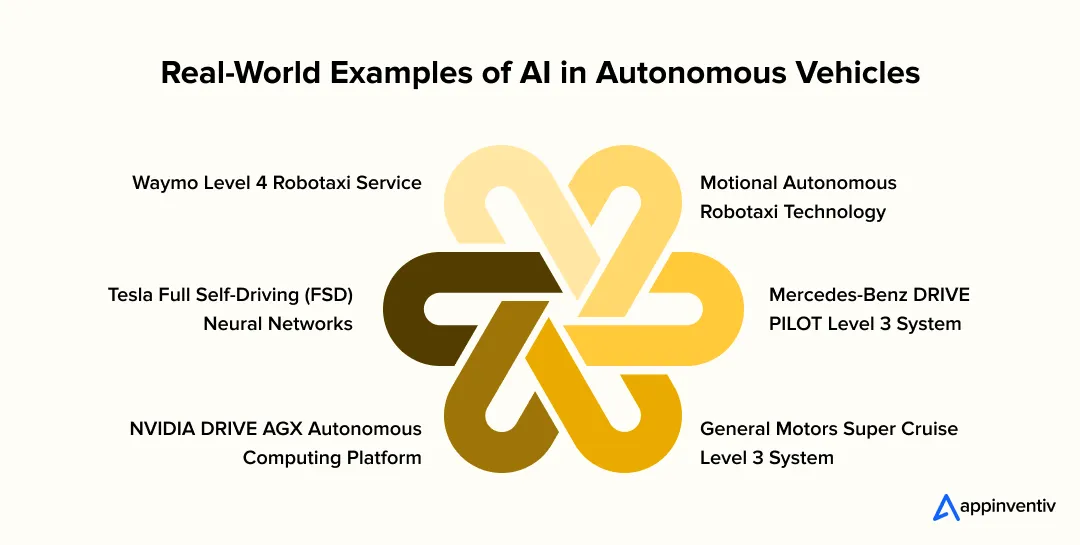
- 1. Waymo's Level 4 Robotaxi Service
- 2. Tesla's Full Self-Driving (FSD) Neural Networks
- 3. Integration of NVIDIA DRIVE AGX Platform
- 4. General Motors' Super Cruise Level 3 Technology
- 5. Mercedes-Benz DRIVE PILOT Level 3 System
- 6. Motional's Strategic Autonomous Technology Development
- Key Challenges for AI in Autonomous Vehicles and How We're Solving Them
- Challenge 1: Complex Regulatory Frameworks
- Challenge 2: Unpredictable Scenarios
- Challenge 3: Cybersecurity Related Vulnerabilities
- Future of AI in Self-Driving Cars: What Businesses Can Expect
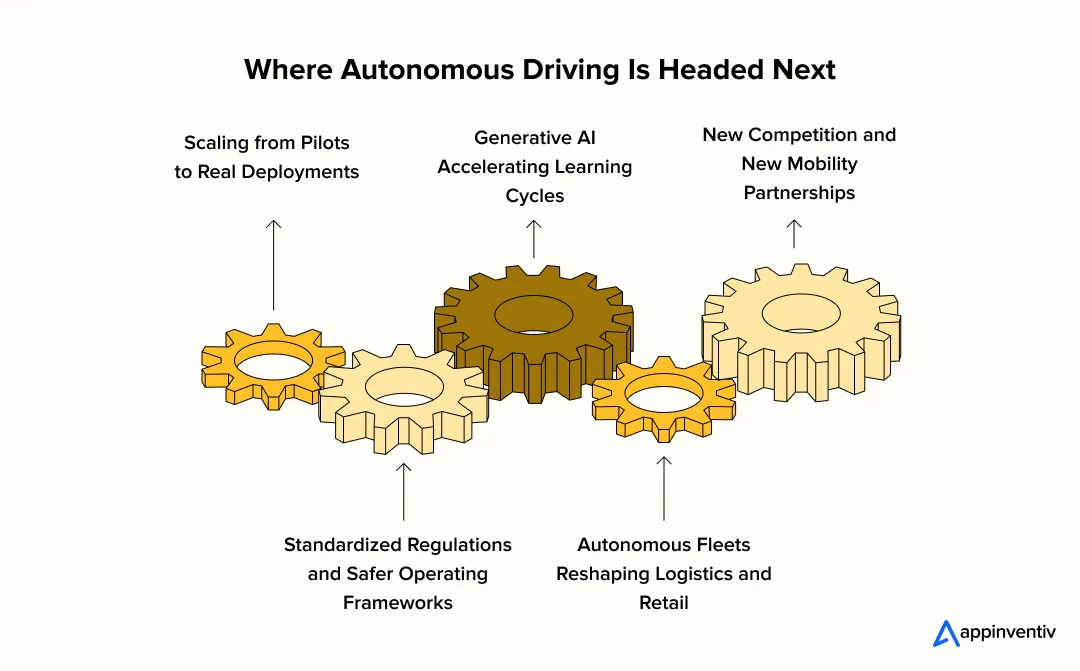
- Scaling from Pilots to Real Deployments
- Standardized Regulations and Safer Operating Frameworks
- Generative AI Will Speed Up Learning Cycles
- Autonomous Fleets Will Reshape Logistics and Retail
- New Competition and New Partnerships
- How Businesses Can Start Their Autonomous Journey
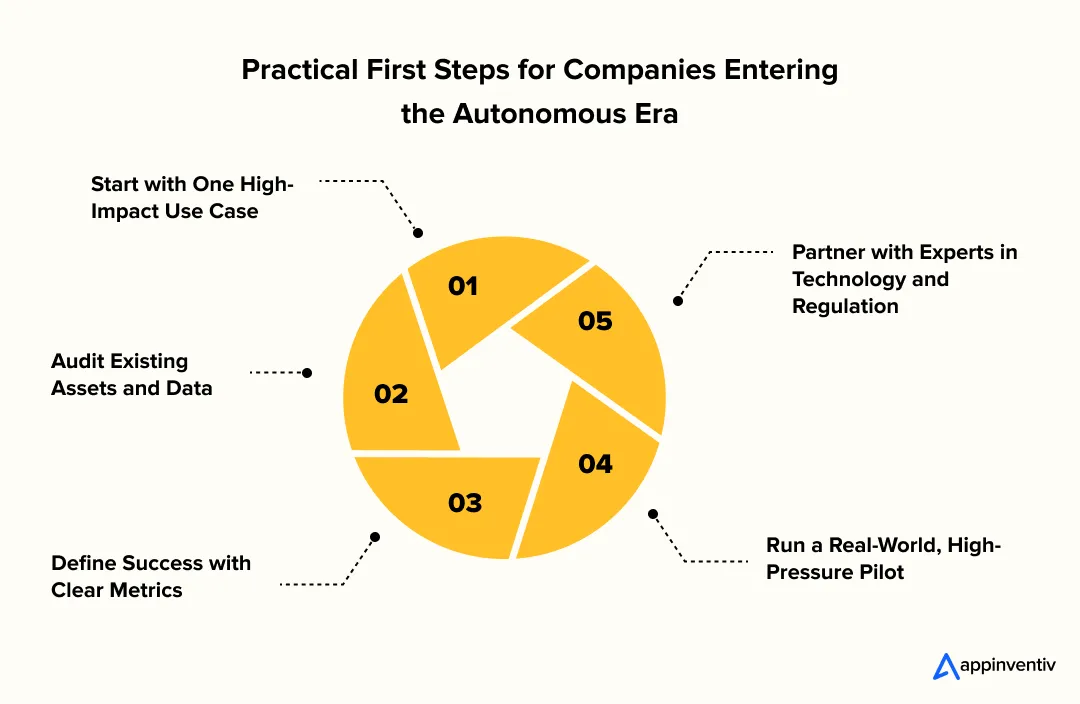
- Start With One Sharp Use Case, Not a Grand Vision
- Audit the Assets You Already Have
- Define Success in Numbers, Not Narratives
- Run a Contained Pilot With Real-World Pressure
- Bring in Partners Who Know Both Tech and Regulation
- Why Appinventiv Is the Right Partner for Your Autonomous Mobility Journey
- FAQs

Key takeaways:
- Autonomous driving is shifting from experimentation to real business opportunity.
- AI is becoming the core competitive edge in mobility, not hardware or legacy brand power.
- Companies that adopt autonomy early will build long-term data and market advantages.
- The strongest ROI comes from solving real mobility problems, not chasing hype features.
- Winning in autonomy requires the right partnerships – nobody succeeds alone in this ecosystem.
- Leadership teams that act now will shape the future of mobility, not react to it later.
If there’s one thing every CEO and CTO in mobility agrees on right now, it’s this: the old formula of “incremental tech upgrades and better fuel efficiency” isn’t enough anymore. Growth is no longer defined by hardware dominance, fleet size, or decades of brand legacy. The next market leaders will be the ones who control intelligence on the road – not just the vehicle on the road. And that shift is happening faster than most boardrooms expected.
Look at what’s unfolding globally. Automakers and tech giants aren’t chasing autonomous driving for PR headlines. They’re chasing it because traffic decisions made in milliseconds are worth billions. A car that doesn’t wait for a driver to notice danger, that reroutes itself when conditions change, that learns from millions of miles of driving data – that’s a competitive advantage too big to ignore. This is where the conversation around AI in self-driving cars stops being futuristic and starts becoming a revenue and market share story.
And here’s the part no leadership team can underestimate: every dollar invested today will build tomorrow’s data advantage. The companies who train their models sooner, who deploy at scale earlier, who capture more real-world driving scenarios first – they won’t just build safer autonomous systems, they’ll build the operating system for the future of mobility. That is why the biggest names in auto, chip manufacturing, cloud platforms, and mapping ecosystems are quietly aligning behind one shared priority: autonomy.
This blog walks through the shift in a simple, practical way – not just the excitement around autonomy, but the real foundation behind it. We’ll look at the core features that make self-driving systems work, the challenges that are slowing mass adoption, the benefits that are motivating companies to spend big, and the most promising use cases emerging across the industry. We’ll also touch on what to expect in the future if the current investment pace continues, so leadership teams can understand where the opportunity is headed instead of getting caught up in the noise.
If your ambition is to lead the autonomous era instead of reacting to it, let’s discuss what your next move should be.
Autonomous Vehicle Market Boom – Why Now is the Right Time To Capitalize On It
Autonomous vehicles are no longer a “future category” on strategy charts. They are becoming a real commercial market with defined timelines, investor confidence, and customer demand. McKinsey’s latest data shows that Level 4 robo-taxis are now expected at scale by 2030 and fully autonomous trucking between 2028 and 2031. That puts the window for strategic positioning right now. Markets like China and North America are already racing to be first with L4 highway pilots, proving that the competitive advantage is shifting to companies that invest early, train models faster, and build data moats before the rest of the industry catches up.
Customer willingness to adopt is no longer the barrier many predicted. The same survey shows that 70% of premium car owners and 55% of mid-range car owners are willing to use remote-driving services, with an average willingness to pay around $53 per hour. That level of readiness signals a new era where AI in self-driving cars isn’t just a technological discussion but a commercial one. As customer acceptance rises, the companies that are able to offer safe, reliable, and scalable autonomous features first will shape buying behavior for the next decade.
The financial case is becoming impossible to ignore. The cost per mile for autonomous fleets is projected to fall from more than $8 today to just over $1, driven by longer hardware lifespans, better operational efficiencies, and lower R&D costs over time. That shift could unlock massive business opportunities across logistics, ride-hailing, commercial fleets, and consumer mobility. We’re already seeing signs of what’s coming – DeepRoute.ai topping IDC’s Assisted Driving Capability Assessment 2025 shows how AI-powered self-driving cars are becoming a major purchase decision factor rather than a “nice-to-have innovation badge.”
Put simply, the door to this market won’t stay open forever. The next phase of growth will belong to companies that move before the economics plateau and before regulatory frameworks become fully standardized. Investing now means getting ahead of three adoption accelerators rather than reacting later:
- Rising customer demand and willingness to pay
- Regulatory clarity improving year by year
- Declining total cost of deployment for autonomous fleets
As technology matures and operating costs fall, autonomous vehicles will go from pilot projects to everyday infrastructure – and the companies that build their position today will be the ones defining tomorrow’s mobility landscape.
AI in Self-Driving Cars: Understanding the Primary Role
The reason self-driving cars look believable today is because of AI. Without it, a car would only follow preset rules and get confused the moment something unexpected happened. What changed everything is that vehicles can now learn from driving data, recognize patterns, and make judgment calls the way a human driver would. That’s the real shift – AI hasn’t just improved driving, it has started to replace the need for a driver.
Modern autonomous cars pay attention to their surroundings constantly. They look for road signs, lane markings, pedestrians, traffic signals, and even driver behavior around them. Instead of reacting blindly to obstacles, they try to understand what is happening and what might happen next. That’s why people say AI and autonomous vehicles are now inseparable – without artificial intelligence in self-driving cars, autonomy simply wouldn’t work in the real world.
Here’s where AI actively steps in:
- Perception and sensing – understanding what’s around the car using lidar, cameras, radar, and other sensors
- Predicting behavior – guessing what a pedestrian, cyclist, or nearby car might do next to avoid risk
- Making decisions in the moment – choosing whether to slow down, change lanes, brake, reroute, or keep going
- Talking and listening inside the car – using voice commands so passengers can interact naturally instead of tapping screens or buttons
As these systems get better with more real-world driving miles, self-driving cars become more confident and safer. We’re getting closer to the point where the car won’t just drive itself – it will understand the road in a way humans simply can’t match.
The role of AI in self-driving cars is pretty significant when you look at how AI and autonomous vehicles work together these days. We’re living in a digital world where cars can actually navigate roads without any human help at all. Using AI for self-driving cars and smart traffic systems has changed the automotive industry.
Understanding Advanced AI Algorithms in Self-Driving Cars
Self-driving cars don’t rely on one magic algorithm. They drive safely because different learning methods handle different responsibilities – one understands what’s around the car, another predicts what might happen next, and another decides the safest reaction. Supervised and unsupervised learning work side-by-side so the car can understand the road, interpret behavior, and make decisions in real time.

Supervised Learning
One of the important paradigms of machine learning in autonomous driving is called supervised learning. In these, a model is trained with labeled datasets to map inputs to outputs correctly. In an AI driverless cars context, supervised learning helps with object recognition, modeling, and behavior prediction. Instead of trial and error, the model learns from real driving footage and real road scenarios.
Object Recognition
With supervised learning, AI for self-driving cars systems learn to identify pedestrians, vehicles, traffic lights, and road signs from raw sensor inputs, giving the car the awareness it needs to make safe decisions.
Real-life Implementation: Tesla’s latest FSD v14 utilizes transformer-based neural networks with 4.5X more parameters than previous versions, enabling their HydraNet architecture to process camera inputs and identify objects with superhuman accuracy at over 50 FPS.
At Appinventiv, we developed an intuitive gesture-recognition application called ActiDrive, that leverages optical technology, enabling drivers to have a hassle-free drive.

In addition to enhancing the driver’s safety during the drive, the application also functions as a comprehensive trip tracker, meticulously logging user journeys, route selections, time, and the distances covered en route to their destinations.
Modeling
Supervised learning also helps create predictive models that estimate how likely certain events are – such as a pedestrian stepping into a lane or another vehicle attempting an abrupt overtake.
Real-life Implementation: Waymo’s VectorNet algorithm, deployed in their 250,000+ weekly robotaxi rides as of October 2025, uses supervised learning to predict agent behaviors by simplifying complex traffic scenes into vectors that require 200x less computational power than traditional CNNs.
Behavior Prediction
Behavior prediction enables self-driving systems to anticipate how different road users might act rather than simply reacting once they do. This proactive approach makes navigation safer and smoother.
Real-life Implementation: Waymo’s 2025 research on “Scaling Laws of Motion Forecasting” demonstrates how encoder-decoder transformer models trained on 500,000 hours of driving data can predict vehicle and pedestrian behavior up to 8 seconds into the future with remarkable accuracy.
Unsupervised Learning
Unsupervised learning helps AI technology in self-driving cars detect abnormal or unsafe situations immediately, such as sudden lane changes or unexpected road obstructions.
Anomaly Detection
AI technology in self-driving cars can recognize and act on the abnormal and unexpected events surrounding them through unsupervised learning techniques. Such systems have become very efficient by taking advantage of their sophisticated data processing and analysis capabilities. They can quickly detect and respond to unexpected occurrences like pedestrians crossing unexpectedly across the road and vehicles carrying out sudden route changes.
Real-life Implementation: GM’s enhanced Super Cruise system, serving over 500,000 vehicles as of 2025, employs unsupervised anomaly detection to identify unusual traffic patterns and road conditions across 750,000 miles of mapped highways in real-time.
Clustering
Clustering helps autonomous systems group similar conditions together – like city traffic, highways, school zones, or construction zones – and adjust driving behavior accordingly.
Real-life Implementation: Modern automotive radar systems in 2025 use advanced clustering algorithms – we’re talking K-Means, Mean Shift, and DBSCAN. These process thousands of reflection points from 76-81 GHz radar sensors. This lets autonomous vehicles accurately identify and track objects around them.
Feature Extraction
Unsupervised learning allows the system to pick out the most important details from huge volumes of sensory data, removing noise and focusing on what matters for safe navigation.
Real-life Implementation: Tesla’s RegNet-based feature extraction system, part of their HydraNet architecture, uses ConvRNN layers to automatically identify the most relevant visual features from camera data without manual labeling, enabling end-to-end learning across their entire fleet.
Now that the core algorithms are clear, the next step is to explore real-world use cases of AI for autonomous driving – where autonomous tech is creating measurable impact across businesses and mobility ecosystems.
Multiple Use Cases of AI in Self-Driving Cars
The myriad use cases of AI in self-driving cars clearly demonstrate the transformative power of AI in revolutionizing the automotive sector and elevating safety and operational efficiency. These pioneering applications of AI and autonomous vehicles include:
1. Advanced Safety and Collision Prevention Systems
AI-powered safety systems are cutting accident rates significantly through real-time threat detection and automatic emergency responses. These systems combine multiple sensors with machine learning to predict and prevent crashes with really high accuracy. Waymo self-driving technology shows this ability by cutting injury-causing crashes by 80% compared to human drivers over the same distance, with their cars logging 96 million rider-only miles through June 2025. Their system had just two bodily injury claims across 25.3 million autonomous miles, which means a 92% drop compared to cars driven by humans.
2. Self-Driving Freight and Commercial Transportation
AI is transforming the logistics industry through autonomous trucking systems that operate 24/7 without driver fatigue limitations. These systems utilize advanced perception algorithms and route optimization to enhance freight efficiency and reduce operational costs. Aurora Innovation has successfully hauled 7,000 loads over nearly 2 million miles using AI-powered autonomous trucks, while achieving 100% on-time deliveries with zero accidents between January and August 2024.
Read More: AI in Warehouse Management
3. Intelligent Traffic Management and Flow Optimization
AI systems let vehicles talk with smart infrastructure to optimize traffic patterns and reduce congestion on roads. Through machine learning that processes real-time traffic data, these systems can predict the best routes and coordinate how vehicles move across entire urban networks efficiently. A 2024 University of Michigan study showed that just 6% of connected vehicles can significantly optimize traffic signal timing and cut delays at intersections when data is shared with city infrastructure. Los Angeles worked with V2X providers to install smart traffic lights along key freight corridors, which led to up to 15% lower fuel consumption overall.
4. Vehicle-to-Everything (V2X) Communication Networks
AI-driven V2X technology creates systems where cars can talk with infrastructure, pedestrians, and other cars to make things safer and more efficient. These systems crunch huge amounts of data in real-time so they can make quick decisions and stop accidents before they happen. The global automotive V2X market sits at $7.52 billion in 2025 right now. It should hit $436.96 billion by 2037. China’s planning to have 30-40% of new cars come with C-V2X already installed by 2025.
5. Predictive Fleet Management and Maintenance
AI algorithms look at vehicle performance data to predict when maintenance is needed before things break down, which really cuts downtime and costs. These systems use machine learning to spot patterns in sensor data that point to potential parts failing or performance getting worse. Tesla’s Full Self-Driving system has racked up over 6 billion miles of supervised driving data as of October 2025. Owners collectively drove more than 14.13 million miles per day in Q3 2025. This huge dataset lets Tesla’s AI keep getting better at predicting problems and making the system more reliable.
Recommended: How to Build a Driver Assistance System like Tesla Autopilot
6. Real-Time Environmental Adaptation
AI systems in autonomous vehicles continuously adapt to changing environmental conditions such as weather, lighting, and road surface variations. Advanced computer vision and sensor fusion technologies enable vehicles to maintain safe operation in challenging conditions that traditionally required human intervention. Tesla’s Autopilot technology demonstrates this capability with one crash for every 6.69 million miles driven when Autopilot is engaged, compared to one crash every 702,000 miles for the national average. This represents approximately 10 times safer performance than human drivers, even accounting for various weather and environmental conditions.
7. Autonomous Last-Mile Delivery and Urban Logistics
AI-powered autonomous vehicles are revolutionizing urban delivery systems through optimized route planning and package handling capabilities. These systems integrate with smart city infrastructure to provide efficient, contactless delivery services while reducing traffic congestion and emissions. Gatik has partnered with major retailers like Walmart for autonomous middle-mile deliveries, with over 1,000 self-driving trucks operating globally as of early 2025, including 400+ in the United States. The light-duty autonomous truck segment shows 74% market dominance in 2025, driven by increasing demand for last-mile delivery solutions and e-commerce growth.
Related Read: How to Build a Logistics and Transportation App Like Aramex?
Explore the future of mobility by implementing AI in your bespoke automotive applications with our top-rated automotive software development services.
Benefits of Artificial Intelligence in Autonomous Vehicles
The big reason companies are pushing autonomy isn’t simply to automate driving. It’s because AI changes what driving can be. When a vehicle can notice danger faster than a human, react without hesitation, and learn from every mile on the road, it stops being just “transport” and becomes a safer and smarter way to move people and goods. That value is showing up everywhere – from ride-hailing fleets to delivery vans, logistics networks, and personal cars.
Safer Roads and Fewer Accidents
Most road accidents happen because drivers get distracted, misjudge a situation, or react too late. AI doesn’t suffer from any of that. It keeps track of pedestrians, cars, lane markings, and changing signals every second and reacts instantly when something looks risky. The earliest data from AI-powered self-driving cars already shows fewer collisions in situations that typically confuse human drivers, like sudden braking or a vehicle unexpectedly changing lanes.
Lower Transportation and Operational Costs
Autonomous vehicles don’t get tired, take breaks, or drive unpredictably. They stick to efficient routes, maintain steady speeds, and conserve fuel and battery life. For businesses running commercial fleets, AI for autonomous vehicles also helps detect mechanical issues before they turn into breakdowns, which cuts repair expenses and prevents downtime. Over time, autonomy doesn’t just improve efficiency – it becomes the cheaper way to operate.
Real-Time Adaptation to Complex Environments
Roads are unpredictable. Weather shifts, visibility drops, animals or pedestrians appear unexpectedly, and construction zones change layouts overnight. The biggest advantage of artificial intelligence in self-driving cars is that the system doesn’t panic when the environment gets messy. It constantly adjusts based on what it sees, and each mile driven makes the model smarter and safer.
Smoother Traffic Flow and Less Congestion
Self-driving cars don’t operate as isolated units. Through V2V and V2X systems, vehicles share information about traffic, hazards, and road conditions with one another and with smart city infrastructure. When multiple cars coordinate movement instead of acting individually, traffic flows more smoothly, fuel waste drops, and congestion starts to ease. Early pilots in major cities are already showing tangible results.
Better Accessibility and Driver Independence
One of the most meaningful benefits of autonomy is access. Older adults, individuals with medical conditions, and people with disabilities who cannot drive today will be able to travel independently without depending on someone else. AI-powered self-driving cars have the potential to reshape personal mobility by making transportation inclusive rather than limited to those who can sit behind a wheel.
Key Features of AI in Autonomous Cars
Self-driving cars don’t depend on one big capability. They work because many different abilities kick in together – seeing what’s around, understanding the situation, and responding quickly enough to avoid danger. If even one of these features fails, the whole driving experience becomes unreliable, which is why all of them have to operate at the same time. Let’s look at the features of AI in self-driving cars in detail below:
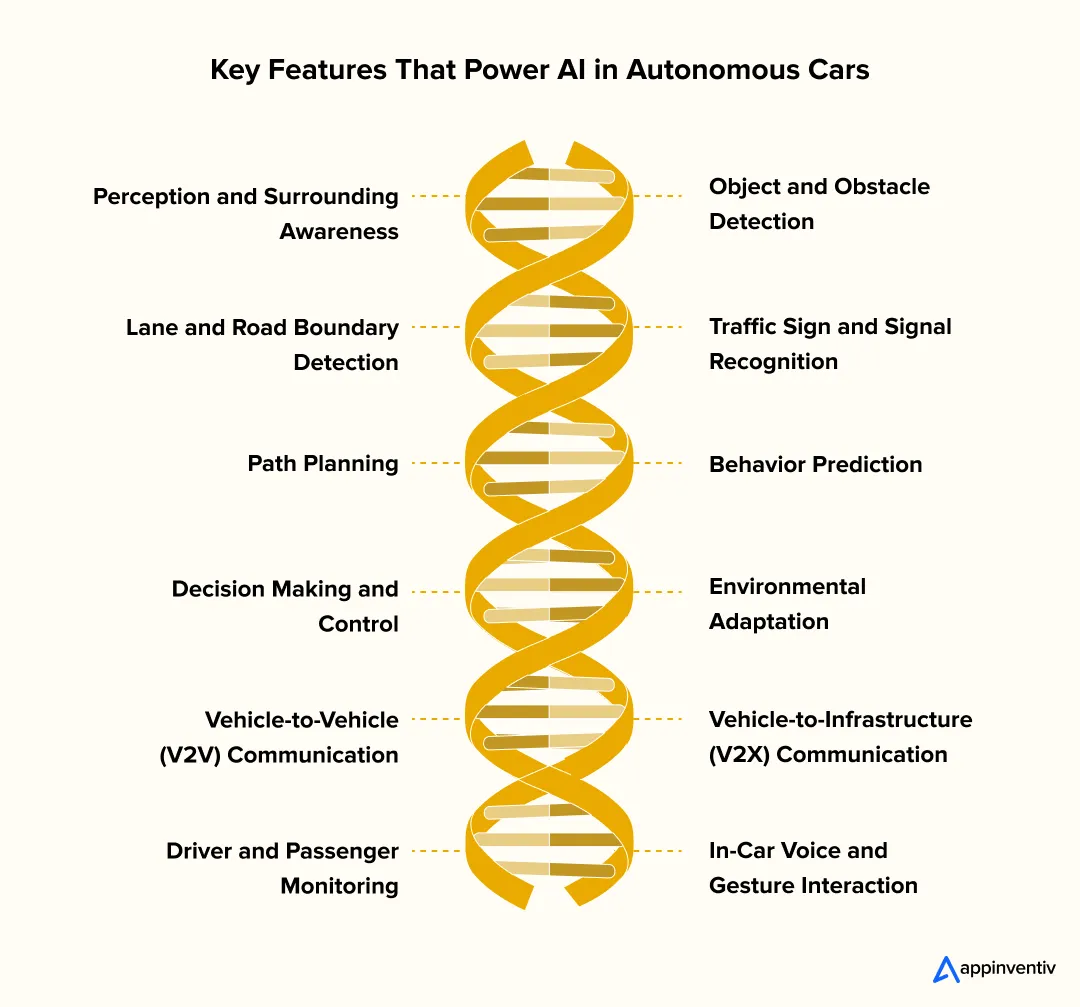
Perception and Surrounding Awareness
The vehicle keeps its “eyes open” all the time through cameras, lidar, radar, and other sensors to understand what’s happening in every direction. Because of that constant awareness, the car isn’t guessing what might be around the corner – it already knows.
Object and Obstacle Detection
When something enters the driving path – a person, a cyclist, an animal, a stalled car – the system picks it up immediately. Early detection gives the car enough space and time to avoid danger instead of reacting at the last second.
Lane and Road Boundary Detection
Even if markings are faded or visibility is poor, the car reads lane boundaries so it can stay centered and steady. This prevents unintended drifting and supports smooth lane changes without sudden movements.
Traffic Sign and Signal Recognition
The vehicle reads speed limits, traffic lights, and roadside instructions as it moves and adjusts its driving automatically. It solves the common human issue of missing a sign or misreading a signal in a busy moment.
Path Planning
The system looks at traffic flow and road conditions to decide the best way forward, updating the plan if anything unexpected comes up. The result is a calmer drive without constant stops, detours, or backtracking.
Behavior Prediction
Instead of focusing only on what is happening right now, the car tries to understand what other road users are about to do. Predicting sudden braking or a pedestrian stepping off the curb helps avoid near-miss situations.
Decision Making and Control
The car chooses when to accelerate, steer, or slow down in a way that keeps passengers safe and comfortable. It does this continuously, without hesitation, rather than waiting for the driver to take charge.
Environmental Adaptation
Snow, heavy rain, glare from the sun, uneven roads – the vehicle adjusts its driving style based on the environment instead of needing a human to take over. This keeps the ride stable even when conditions aren’t ideal.
Vehicle-to-Vehicle Communication (V2V)
Cars share information with each other about hazards and changing speeds so drivers aren’t caught off guard. When several vehicles coordinate, everyone reacts sooner and the overall traffic flow becomes safer.
Vehicle-to-Infrastructure Communication (V2X)
The car exchanges information with traffic lights, smart intersections, and other city systems to keep movement predictable. This reduces pointless stopping and makes junctions and crossings less chaotic.
Driver and Passenger Monitoring
Inside the cabin, the system notices if someone looks exhausted, unwell, or under stress and responds for safety rather than ignoring it. It adds a second layer of protection beyond what the car sees outside.
In-Car Voice and Gesture Interaction
Instead of tapping buttons or scrolling screens, passengers can speak or use simple gestures to control features. It makes interacting with the vehicle feel easy and reduces distractions while driving.
Real-World Examples of AI in Autonomous Vehicles
The following are the most current and notable examples of how leading automotive and technology companies are implementing AI in self-driving cars to revolutionize transportation and demonstrate practical autonomous driving capabilities.
1. Waymo’s Level 4 Robotaxi Service
Waymo, which is Alphabet’s self-driving subsidiary, runs what’s considered the world’s most advanced commercial robotaxi service right now. They operate in several major cities – Phoenix, Los Angeles, San Francisco, Austin, and Atlanta. As of October 2025, Waymo is doing over 250,000 paid rides per week. That’s a 25-fold jump since May 2023. Their AI system has processed over 20 billion miles worth of real-world and simulated driving data at this point. It uses advanced machine learning algorithms to make decisions in real-time while driving on the road.
The vehicles use a sophisticated sensor fusion approach that brings everything together. They combine LIDAR, cameras, and radar with AI-powered perception systems. These can identify objects around them, predict what pedestrians will do next, and navigate complex urban environments without any human intervention. The latest expansion of Waymo self-driving technology includes international testing in Tokyo, Japan right now. They’re planning services in London by 2026, Washington D.C. by 2026, and Miami through their partnership with Moove.
2. Tesla’s Full Self-Driving (FSD) Neural Networks
Tesla’s FSD system represents a camera-only approach to autonomous driving, powered by custom-built AI chips and neural networks trained on millions of miles of real-world driving data. As of October 2025, Tesla is rolling out FSD v14 to Hardware 4 vehicles, with the latest versions including v14.1.4 offering significant improvements in natural driving behavior.
The latest FSD v14 demonstrates significant improvements utilizing transformer architecture and attention mechanisms with approximately 4.5X more parameters than previous versions, enabling better understanding of spatial relationships and prediction of other road users’ behavior.
3. Integration of NVIDIA DRIVE AGX Platform
NVIDIA’s DRIVE AGX platform powers self-driving cars from several manufacturers. We’re talking Toyota, General Motors, Volvo Cars, Lucid Motors, Mercedes-Benz, and WeRide. The latest DRIVE AGX Thor system is pretty impressive – it delivers up to 2,000 TOPS (that’s trillion operations per second) of AI performance. This lets it process sensor data from cameras, LIDAR, and radar in real-time.
The 2025 partnerships show how fast things are moving. Toyota is adopting DRIVE AGX Orin for their next-gen vehicles. GM expanded their work with NVIDIA and they’re using the Blackwell architecture now. Their future vehicles can hit up to 1,000 trillion operations per second. WeRide just launched what they’re calling the world’s first mass-produced Level 4 autonomous vehicle. It’s built on NVIDIA DRIVE AGX Thor.
4. General Motors’ Super Cruise Level 3 Technology
GM’s Super Cruise has evolved into a comprehensive autonomous driving system that currently operates as a Level 2 hands-free system on over 750,000 miles of mapped highways across North America. The AI system combines GPS precision mapping, real-time sensor data, and machine learning algorithms to maintain lane position, adjust speed, and navigate traffic automatically.
Looking toward 2028, GM announced plans to upgrade Super Cruise to Level 3 ‘eyes-off’ functionality, debuting in the 2028 Cadillac Escalade IQ. This enhanced version will permit drivers to completely disengage from monitoring the road while the vehicle handles driving on eligible highways. The 2026 model year will introduce integration with Google Maps and automatic transition capabilities, while the system currently serves over 500,000 Super Cruise-enabled vehicles with more than 200,000 monthly active users as of Q2 2025.
5. Mercedes-Benz DRIVE PILOT Level 3 System
Mercedes-Benz’s DRIVE PILOT is the first Level 3 autonomous driving system that’s actually approved for public roads. Pretty significant milestone. As of early 2025, the system has been updated to work at speeds up to 95 km/h (59 mph) in Germany. That makes it the fastest certified Level 3 system you can actually buy in a production car. In the United States, it operates in California and Nevada, but the current speed limit is capped at 40 mph.
The tech combines LIDAR, stereo cameras, radar sensors, and ultra-precise GPS with advanced AI that can handle complex driving scenarios on its own. Here’s what’s interesting – the system uses more than 35 sensors working on different physical principles. This creates redundancies for precise real-time environmental detection. When DRIVE PILOT is turned on, drivers can legally do other things. We’re talking – watching TV, reading, or working. The system shows clear turquoise lighting to tell you when it’s active.
6. Motional’s Strategic Autonomous Technology Development
Motional, which is the Hyundai-Aptiv joint venture, has been a pioneer in getting autonomous vehicles on real roads. They’ve been running public robotaxi services in Las Vegas since 2018. Pretty impressive track record. The company has completed over 130,000 autonomous rides at this point, and over 95% of passengers gave five-star ratings. Their all-electric IONIQ 5 robotaxis come with advanced Level 4 autonomous capabilities built in.
Things shifted in 2025 though. Motional announced they’re focusing their resources on core driverless technology and generalization instead. They’re de-emphasizing near-term commercial deployments for now. The company secured $475M in funding from Hyundai Motor Group, which helps. They’re now using the latest breakthroughs in embodied AI and foundation models to improve their tech.
Key Challenges for AI in Autonomous Vehicles and How We’re Solving Them
While the advancement of AI for autonomous vehicles presents tremendous opportunities, several challenges of AI in autonomous vehicles must be addressed for widespread adoption. However, the industry has developed innovative solutions to overcome these obstacles.
Challenge 1: Complex Regulatory Frameworks
The main challenge with getting AI in self-driving cars deployed on the road involves dealing with different regulatory requirements across different places. Each country and state has its own unique compliance standards. This creates real barriers for manufacturers who want to penetrate global markets.
Solution: Leading companies like Tesla and Waymo are working closely with regulatory bodies to create standardized frameworks. The development of AI self-driving cars now includes adaptive compliance systems that can automatically adjust to local regulations. Industry groups are also working toward harmonized international standards at the same time.
Challenge 2: Unpredictable Scenarios
AI driverless cars run into situations they’ve never seen before – things that weren’t in their training data. We’re talking construction zones, emergency vehicles, or unusual weather. These edge cases create real safety risks for autonomous systems.
Solution: Generative AI for autonomous driving tech now lets vehicles create synthetic training scenarios. This expands what they can learn. Advanced machine learning systems use reinforcement learning to adapt to new situations in real-time. Continuous over-the-air updates also help. They make sure vehicles learn from what the whole fleet experiences.
[Also Read: How Generative AI is Powering Digital Product Development – 10 Use Cases, Benefits, and Real Examples]
Challenge 3: Cybersecurity Related Vulnerabilities
AI technology in self-driving cars opens up multiple ways for hackers to attack – from messing with sensors to breaking into networks. The fact that autonomous vehicles are all connected makes them especially vulnerable to coordinated cyber attacks.
[Also Read: Integrating AI in Cybersecurity: Automating Enterprise With AI-Powered SOC]
Solution: Modern AI for self-driving cars now includes multi-layered security protocols. We’re talking encrypted communications, blockchain-based authentication, and AI-powered threat detection. Regular security audits and penetration testing make sure AI in driverless cars stays protected against cyber threats that keep evolving.
These comprehensive solutions demonstrate how the industry addresses challenges of AI in autonomous vehicles while advancing toward safer, more reliable autonomous transportation systems.
Whatever challenge autonomy throws your way, our experts can help you navigate it and give your business an edge that competitors can’t ignore.
Future of AI in Self-Driving Cars: What Businesses Can Expect
The autonomous vehicle market isn’t moving slowly anymore – it’s accelerating. The next decade is expected to be less about “testing” and more about commercial deployment of AI in self-driving cars across logistics, consumer mobility, public transportation, and urban services. The companies that will lead this shift are the ones preparing now, rather than waiting for full maturity and stable regulations. Let’s look into several futuristic trends of AI in self-driving cars that will drive the ecosystem further:
Scaling from Pilots to Real Deployments
Up to now, most autonomous projects have operated in controlled zones or as limited pilots. That’s changing. As models get better and infrastructure improves, AI self-driving cars will start appearing on highways, industrial routes, and city networks – not as experiments, but as normal operations. The biggest change businesses can expect is consistency: predictable delivery times, steady fleet availability, and lower cost per mile over time.
Standardized Regulations and Safer Operating Frameworks
Regulations are still catching up, but the pace is improving every year. Instead of broad safety rules, governments are moving toward clear frameworks for AI in autonomous vehicles – certification criteria, liability clarity, and pilot permit paths for both consumer and commercial deployment. Safer regulatory clarity means lower risk for enterprises and easier budget approvals for autonomy adoption.
Generative AI Will Speed Up Learning Cycles
A major leap is coming from generative AI for autonomous driving. Instead of learning only from real-world miles, autonomous systems will learn from synthetic simulations that recreate dangerous or rare situations – from extreme weather to unpredictable pedestrian behavior. This will help companies train driving models faster, without waiting years for real-world exposure.
Autonomous Fleets Will Reshape Logistics and Retail
As costs fall and reliability grows, autonomy will start changing not only how goods are delivered, but how business models are designed. Last-mile delivery, ride-hailing, subscription mobility, autonomous freight, and retail logistics will move toward on-demand, error-free, and cost-predictable movement. For businesses, this isn’t just a tech shift – it’s a margin and scalability shift.
New Competition and New Partnerships
The next phase won’t be led by traditional automakers alone. Chipmakers, AI labs, cloud providers, infrastructure companies, and mapping platforms are all becoming core players. The most successful mobility companies will not be the ones building everything alone, but those who partner smartly across the AI driverless cars ecosystem – software, data, hardware, and city infrastructure.
How Businesses Can Start Their Autonomous Journey
You don’t need a full-blown “build your own robotaxi” strategy to start. The smartest moves right now are small, focused, and tied to clear business outcomes. Think of it less as jumping into full autonomy and more as taking a few deliberate steps that put you on the right side of AI in self-driving cars as it matures.
Start With One Sharp Use Case, Not a Grand Vision
Pick a single problem that hurts today: unsafe driving patterns in your fleet, high last-mile cost, inefficient routing, or lack of basic ADAS features. If the first AI initiative pays off in a visible way, it becomes much easier to expand.
Audit the Assets You Already Have
Look at the data you are sitting on, the vehicles you run, and the systems you already use for telematics, routing, or maintenance. Most companies do not need to start from zero; they need to connect what they have into something usable for AI.
Define Success in Numbers, Not Narratives
Before you run a pilot, write down what “good” looks like: fewer incidents, lower cost per mile, better on-time performance, higher vehicle uptime. If the metrics are clear, you can tell very quickly whether AI and autonomous vehicles make sense for your business or not.
Run a Contained Pilot With Real-World Pressure
Test in one city, one route, one fleet segment or one product line, but make it real enough that the results actually matter. Avoid lab-style experiments that look impressive in a deck and never survive contact with operations.
Bring in Partners Who Know Both Tech and Regulation
You want a team that understands models, data, safety cases, and compliance, not just someone who can build a demo. A custom AI development services partner will stop you from investing in features that can never see the road and help you move from prototype to something that can actually scale.
Why Appinventiv Is the Right Partner for Your Autonomous Mobility Journey
We hope this blog has given you a clear picture of how AI is reshaping self-driving technology, where the industry is heading, and why now is the right time for businesses to step in. The companies that move early will be the ones securing data advantages, market share, and long-term customer trust in the autonomous era.
At Appinventiv, we work with mobility brands that want to convert autonomy from a research topic into a real business outcome. Our team doesn’t just build software – we understand the entire ecosystem around autonomous mobility, including safety requirements, regulatory expectations, data pipelines, edge computing, cloud infrastructure, and sensor integration. That’s why businesses count on us when they want a partner who knows both the technology and the commercial side of deploying AI in mobility.
Our AI integration services are designed for automotive companies, logistics platforms, smart city operators, fleet providers, and OEMs that want to embed autonomy into their existing systems without disrupting operations. From ADAS-style pilots to full-scale autonomous fleet rollouts, we help brands test safely, scale responsibly, and adopt AI in phases that make financial and operational sense. Every project is built around measurable ROI – faster deliveries, lower operational costs, safer driving, and better user experience.
If you’re exploring automation in mobility – whether that means autonomous delivery, self-driving fleet management, in-vehicle intelligence, or AI-powered driver assistance – we can help you shape the roadmap and execute it step by step. The future of transportation is already in motion, and the brands that innovate today won’t just take part in it – they’ll lead it. Let’s build that future together.
FAQs
Q. How do self-driving cars use AI?
A. Self-driving cars use AI through sophisticated algorithms that process real-time data from cameras, lidar, and radar sensors. The AI analyzes this information to interpret the environment, navigate roads, avoid obstacles, and follow traffic rules. Machine learning enables these vehicles to make split-second decisions, predict pedestrian behavior, and continuously improve their performance through accumulated driving experience.
Q. How much does it cost to develop AI for self-driving cars?
A. Development costs usually range from $30,000 for basic Level 2 driver assistance features to $400,000 for advanced Level 4-5 autonomous systems. Several factors affect these costs. The complexity of AI algorithms matters. Sensor requirements matter. Computing power needs matter. You also have extensive testing phases and regulatory compliance to deal with. Simple lane-keeping systems cost way less than full autonomous capabilities that need sophisticated neural networks and thorough safety validation.
Q. How is AI used in self-driving cars?
A. AI serves four key functions in autonomous vehicles: sensing and perception for environmental awareness, predictive modeling to anticipate other vehicles’ and pedestrians’ behavior, real-time decision-making for navigation and safety responses, and natural language processing for passenger interaction. These capabilities work together through supervised and unsupervised learning algorithms to create fully autonomous driving experiences.
Q. What are the key trends in AI for self-driving cars?
A. Major trends for AI in self-driving cars include the explosive growth of the autonomous vehicle market, Vehicle-to-Everything (V2X) communication networks, transformer-based neural networks like Tesla’s FSD v14, and Level 3-4 automation systems. There’s also growing focus on predictive maintenance, environmental adaptation capabilities, and integration with smart city infrastructure for optimized traffic management.
Q. What are the challenges of implementing AI in autonomous vehicles?
A. Key challenges include handling complex real-world scenarios, requiring massive training datasets for accuracy, integrating multiple sensor types effectively, meeting stringent safety validation requirements, and navigating regulatory frameworks. Technical hurdles involve achieving superhuman performance levels, managing computational demands, and ensuring reliable operation across diverse weather and environmental conditions that traditionally required human intervention.
Q. How can Appinventiv assist with AI development for self-driving cars?
A. Appinventiv specializes in developing core autonomous vehicle technologies including sensor fusion systems that integrate lidar, camera, and radar data, computer vision algorithms for object detection and recognition, predictive maintenance platforms for fleet optimization, and real-time decision-making systems. They can implement end-to-end neural networks, V2X communication protocols, and custom AI solutions tailored to specific autonomous vehicle requirements and deployment scenarios.
Q. How does AI in self-driving cars improve vehicle safety?
A. AI dramatically enhances safety through real-time threat detection and collision prevention systems. Waymo’s vehicles show 80% reduction in injury-causing crashes compared to human drivers, while Tesla’s Autopilot demonstrates one crash per 6.69 million miles versus the national average of one per 702,000 miles. AI addresses the 94% of traffic accidents caused by human error.
Q. How do self-driving cars make decisions?
A. Self-driving cars make decisions through AI algorithms that process real-time sensor data and use machine learning models. When they detect situations like pedestrians crossing, the AI quickly looks at multiple factors and figures out the best response – like slowing down or stopping. This involves predictive modeling, mapping the environment, and predicting behavior to make sure decisions are safe and informed in complex traffic situations.

- In just 2 mins you will get a response
- Your idea is 100% protected by our Non Disclosure Agreement.

Hiring an AI Development Partner in the UK: A Strategic Enterprise Guide
Key takeaways: AI initiatives fail more often due to delivery, governance, and integration gaps than model limitations. Choosing the right AI partner is a business decision, not just a technical one. Production experience, data engineering maturity, and UK regulatory awareness matter more than innovation claims. Clear scope, realistic budgeting, and early governance involvement reduce rework…

How to Hire AI Developers in Australia?
Key takeaways: Australian AI developers offer world-class expertise, especially in industries like healthcare, finance, and retail, to help organizations implement AI solutions without any difficulties. Hiring AI developers in Australia offers access to seasoned professionals who have knowledge of AI integration, machine learning, and compliance with global data protection laws. The recruitment cost of AI…

How Enterprises Can Leverage Agentic AI for Smarter Data Engineering
Key takeaways: Agentic AI streamlines intricate data engineering processes, including data ingestion, transformation, and validation, allowing teams to focus on high-stakes decision-making. By automating manual tasks, Agentic AI significantly reduces operational costs, allowing companies to optimize resource allocation. Agentic AI scales with ease as the volume of data increases, without the need for additional infrastructure…









