



























How AI in Manufacturing in Australia is Transforming Factory Operations and Improving Productivity


- Why AI Adoption Is Accelerating in Australian Manufacturing?
- What Are the Key Areas Where AI Is Transforming Factory Operations?
- How AI Improves Productivity Across the Factory Value Chain
- What Are the Challenges in Implementing AI in Manufacturing & How to Overcome Them?
- Strategies for Successful AI Implementation in Manufacturing
- What is the Future of AI in Manufacturing in Australia?
- How Appinventiv Helps Australian Manufacturers Implement AI at Scale?
- FAQs

Key takeaways:
- AI in manufacturing in Australia is becoming essential to offset labour shortages, rising energy costs, and global competition pressures.
- High-impact use cases like predictive maintenance and AI quality inspection deliver measurable productivity gains within existing factory infrastructure.
- Success requires integrating modern AI with legacy factory floor hardware without disrupting active production cycles.
- Implement explainable AI and Zero Trust security to meet the 2026 Australian mandatory regulatory guardrails.
The 2026 industrial landscape in Australia marks a definitive shift from speculative interest to structural integration. For years, Australian manufacturers navigated “pilot purgatory,” where AI remained confined to small-scale tests.
Today, the sector is moving toward a backbone of autonomous systems, catalysed by the $22.7 billion federal commitment under the Future Made in Australia initiative. This investment is a strategic mandate to build sovereign capability and ensure local production survives global volatility.
This indicates a whopping market where approximately 68% of Australian firms have integrated AI into core operations to offset high labor costs and supply chain fragilities. According to Deloitte’s 2026 State of AI, this adoption is essential for the transition to a net-zero economy. For the C-suite, the priority has moved from “why” to “how” AI in manufacturing in Australia can be hardened for security, compliance, and sustained productivity.
This blog examines where AI in the manufacturing industry across Australian enterprises is delivering measurable productivity gains, what is driving adoption, and how leadership teams can implement AI responsibly at scale.
Get an expert assessment of your data maturity, infrastructure readiness, and high-ROI use cases.

Why AI Adoption Is Accelerating in Australian Manufacturing?
The transition toward AI for manufacturing in Australia is no longer a matter of tactical advantage; it is a response to structural shifts in the domestic economy. As we move ahead in 2026, several convergent pressures have forced a move away from legacy manual processes toward high-density, automated environments. For the Australian enterprise, this shift is defined by the following core drivers:
Labour Scarcity and the Skills Gap
Australia faces a persistent deficit in technical trade roles. According to Jobs and Skills Australia, the sector continues to grapple with shortages in specialised engineering and machinery roles. AI is being deployed not to replace workers, but to augment the existing workforce, allowing a leaner team to manage higher output through intelligent oversight.
Energy Arbitrage and Net-Zero Mandates
With industrial electricity prices remaining volatile, AI-driven process optimisation has become the primary tool for energy load balancing. Manufacturers are utilising machine learning to align high-energy production cycles with peak renewable generation, directly supporting the nation’s decarbonisation targets.
Sovereign Capability and Supply Resilience
The federal government’s $22.7 billion Future Made in Australia framework has placed a premium on “on-shoring” critical production. To make domestic manufacturing commercially viable against low-cost offshore competitors, Australian businesses are using AI to compress the “cost-of-goods-sold” (COGS) through hyper-efficiency.
Growing Availability of Industrial Data
Over the past decade, factories have accumulated significant operational data through IoT sensors, SCADA systems, Manufacturing Execution Systems (MES), and ERP platforms. Historically, much of this data was underutilised.
AI converts these data streams into actionable insights, detecting patterns that traditional analytics cannot identify.
The acceleration in 2026 is underpinned by a “productivity or perish” mindset. For many boards, the risk of technical debt from maintaining disconnected legacy systems now outweighs the capital expenditure required for an AI-led modernisation in Australia.
What Are the Key Areas Where AI Is Transforming Factory Operations?
The application of artificial intelligence in manufacturing in Australia has moved beyond simple data visualisation. Leading firms are now deploying “Agentic AI”, systems that do not just provide insights but take autonomous action within predefined guardrails. For the Aussie businesses, these transformations are most visible in six critical domains:
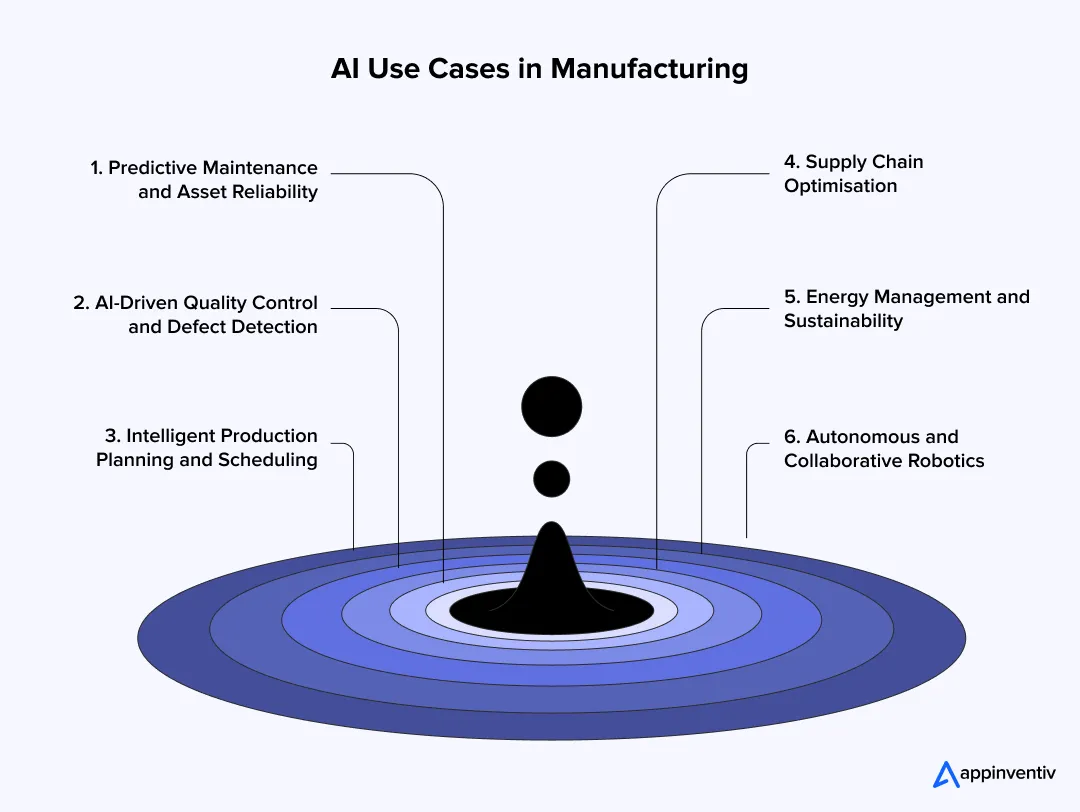
1. Predictive Maintenance and Asset Reliability
Unplanned downtime remains one of the most significant drainers of P&L in the domestic sector. There is a shift toward AI-driven maintenance that utilises real-time sensor fusion. According to PwC’s 2026 Industrial Outlook, AI-enabled predictive maintenance can reduce overall maintenance costs by up to 30% and unplanned downtime by as much as 45%.
This is particularly vital for regional Australian plants where the cost of transporting specialist technicians and parts is disproportionately high.
Business impact:
- Downtime reduction of up to 45% in asset-intensive plants
- Lower emergency repair costs by 30%
- Extended equipment lifespan
2. AI-Driven Quality Control and Defect Detection
Manual inspection is inherently limited by human fatigue and subjectivity. Australian manufacturers in high-precision sectors such as medical devices and specialised chemicals are adopting computer vision systems.
These AI applications in manufacturing for Australian manufacturers can identify microscopic anomalies at line speeds that are impossible for human eyes to track. This ensures 100% inspection rates and significantly reduces the “cost of quality” by preventing defective batches from reaching the distribution phase.
Business impact:
- Reduced scrap and rework
- Consistent compliance with strict quality standards
- Lower warranty and recall risk
3. Intelligent Production Planning and Scheduling
The volatility of the Australian market requires a dynamic approach to floor scheduling. AI agents in Australia are now replacing static ERP spreadsheets, automatically adjusting production runs based on real-time variables like energy pricing spikes, raw material delays, or urgent “priority-one” orders.
By simulating thousands of scenarios per second, these systems ensure that factory throughput is always aligned with current commercial realities.
Business impact:
- Higher asset utilisation
- Reduced idle time and bottlenecks
- Improved on-time delivery performance
4. Supply Chain Optimisation and Demand Sensing
Given Australia’s distance from global hubs, “just-in-case” inventory often creates bloated balance sheets. AI is being used to move toward “demand-sensing” models. By analysing global shipping data, port congestion, and local market signals, AI helps Australian manufacturers maintain optimal stock levels.
This resilience is a key pillar of the National AI Plan, which aims to strengthen domestic supply networks through digital innovation.
Business impact:
- Optimised inventory levels
- Reduced stockouts and overstocking
- Better working capital management
5. Energy Management and Sustainability
With Australian industrial electricity costs under constant scrutiny, AI-led energy orchestration has become an operational necessity. Factories are integrating AI with smart grids to “carbon-schedule” production, shifting high-load activities to windows where renewable penetration is highest.
This does more than lower costs; it provides the auditable data required for the Australian Public Service AI Plan and other emerging ESG compliance standards.
Business impact:
- Lower energy bills without reducing output
- Identification of inefficient machines
- Support for emissions reporting obligations
6. Autonomous and Collaborative Robotics (Physical AI)
The most visible shift on the floor is the rise of Physical AI. This involves robots with higher levels of autonomy that can navigate unstructured environments. Deloitte’s 2026 State of AI notes that 57% of Australian organisations are now utilising physical AI and this adoption is poised to exceed 80% within two years.
Unlike traditional industrial robots, these collaborative “cobots” work alongside humans to perform physically demanding or repetitive tasks, such as bundle tagging in steel mills or precise sorting in food processing, thereby improving safety and ergonomics.
Business impact:
- Increased throughput without proportional labour growth
- Improved workplace safety
- Reduced exposure to labour shortages
Also Read: How AI Overhauling Industrial Automation in Australia
If AI-driven predictive maintenance alone can reduce unplanned downtime by up to 45% and maintenance costs by around 30%, the opportunity for Australian manufacturers is too significant to ignore.

How AI Improves Productivity Across the Factory Value Chain
For the Australian executive, the metric that matters most is the “yield per unit of input.” In 2026, AI in the manufacturing industry across Australian enterprises is being evaluated not as a standalone tool, but by its ability to compress the value chain. By eliminating data silos and automating the hand-offs between departments, AI delivers a compounding effect on productivity.
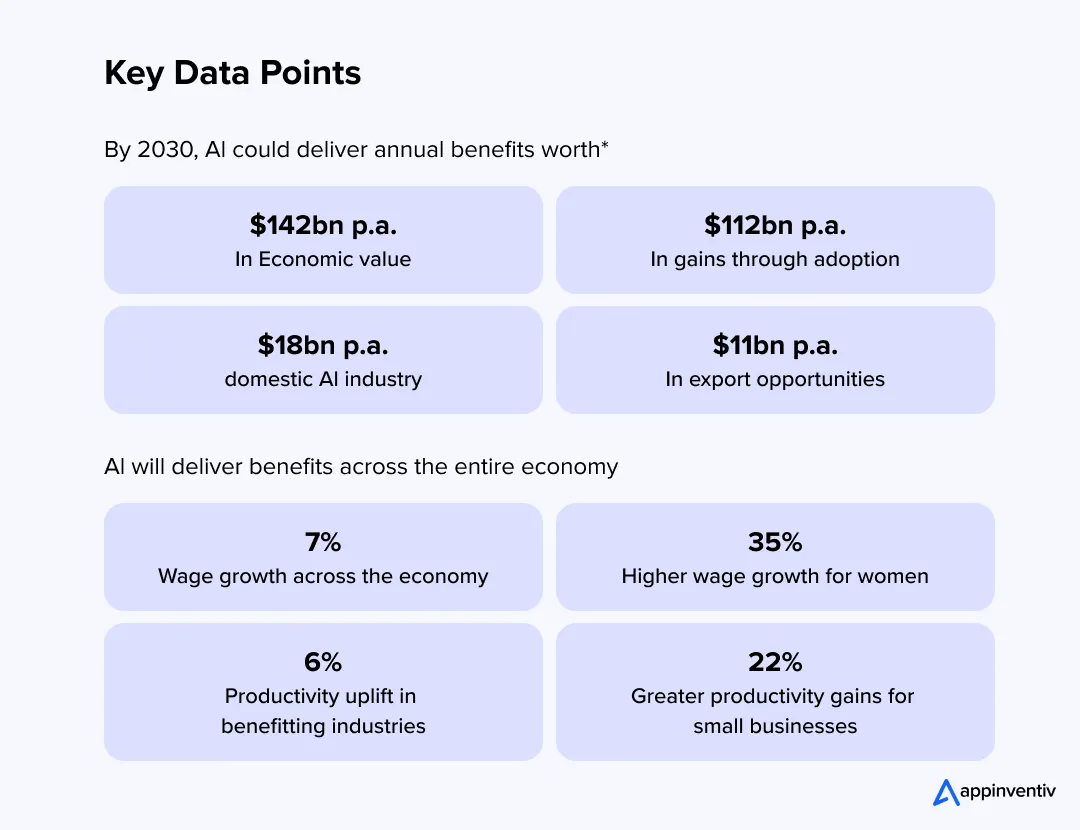
According to research from the AIIA and Google, AI adoption is projected to add up to $112 billion to the Australian economy by 2030, with manufacturing poised to be a primary beneficiary. This economic value is realised through several key performance indicators:
Increased Productivity and Operational Efficiency
By optimising machine cycles and labor allocation, factories are achieving a “doing more with less” reality. This isn’t about marginal gains; it is about systemic shifts where AI-orchestrated lines outpace traditional manual setups by double digits.
Reduced Downtime and Maintenance Costs
Shifting from “break-fix” cycles to predictive models ensures that assets remain online during critical production windows. For Australian firms, this significantly lowers the total cost of ownership (TCO) for expensive industrial plant equipment.
Faster Decision-Making through Real-Time Insights
The shift from retrospective reporting to live data allows floor managers to make “in-flight” corrections. When a supply delay occurs at a local port, the AI immediately reconfigures the production sequence, preventing an idle factory floor.
Enhanced Workplace Safety through Automation
AI-powered intelligent automation and monitoring reduces the frequency of Lost Time Injuries (LTIs). By analysing video feeds for PPE compliance or detecting equipment anomalies before they become hazardous, factories create a safer environment, which reduces insurance premiums and improves employee retention.
Data-Driven Decision Making at All Levels
Beyond the shop floor, AI provides the executive suite with a “single source of truth.” This allows for more accurate forecasting, better capital allocation, and a culture where strategic pivots are based on hard data rather than intuition
The table below summarises the typical productivity trade-offs observed when moving from manual to AI-augmented factory operations:
Productivity Impact: Manual vs. AI-Augmented Operations
| Operational Area | Manual/Legacy Approach | AI-Augmented (2026 Standard) | Estimated Productivity Delta |
|---|---|---|---|
| Maintenance | Reactive (Fix when broken) | Predictive (Fix before failure) | ~30% Cost Reduction |
| Quality | Sample-based manual check | 100% Computer Vision inspection | 99.8% Accuracy |
| Scheduling | Static weekly spreadsheets | Real-time agentic re-optimisation | 15-20% Throughput Gain |
| Energy Use | Flat-rate consumption | Dynamic “Carbon-Scheduling” | 10-15% Lower Utility Cost |
| Safety | Retrospective incident reporting | Real-time hazard detection | ~40% Incident Reduction |
Ultimately, the productivity gain is about Execution Depth. In a high-cost environment like Australia, the ability to operate a “lights-out” or highly autonomous shift during off-peak hours can be the difference between a profitable local operation and a decision to move production offshore.
What Are the Challenges in Implementing AI in Manufacturing & How to Overcome Them?
Despite the clear ROI, the path to a fully autonomous factory is rarely linear. The most significant barriers in 2026 are no longer about the technology’s capability, but rather about the execution depth and the structural readiness of the enterprise.
According to KPMG’s 2026 CEO Outlook, AI-related implementation and ethics have jumped to the number one spot on the list of business concerns, surpassing even inflationary pressures.
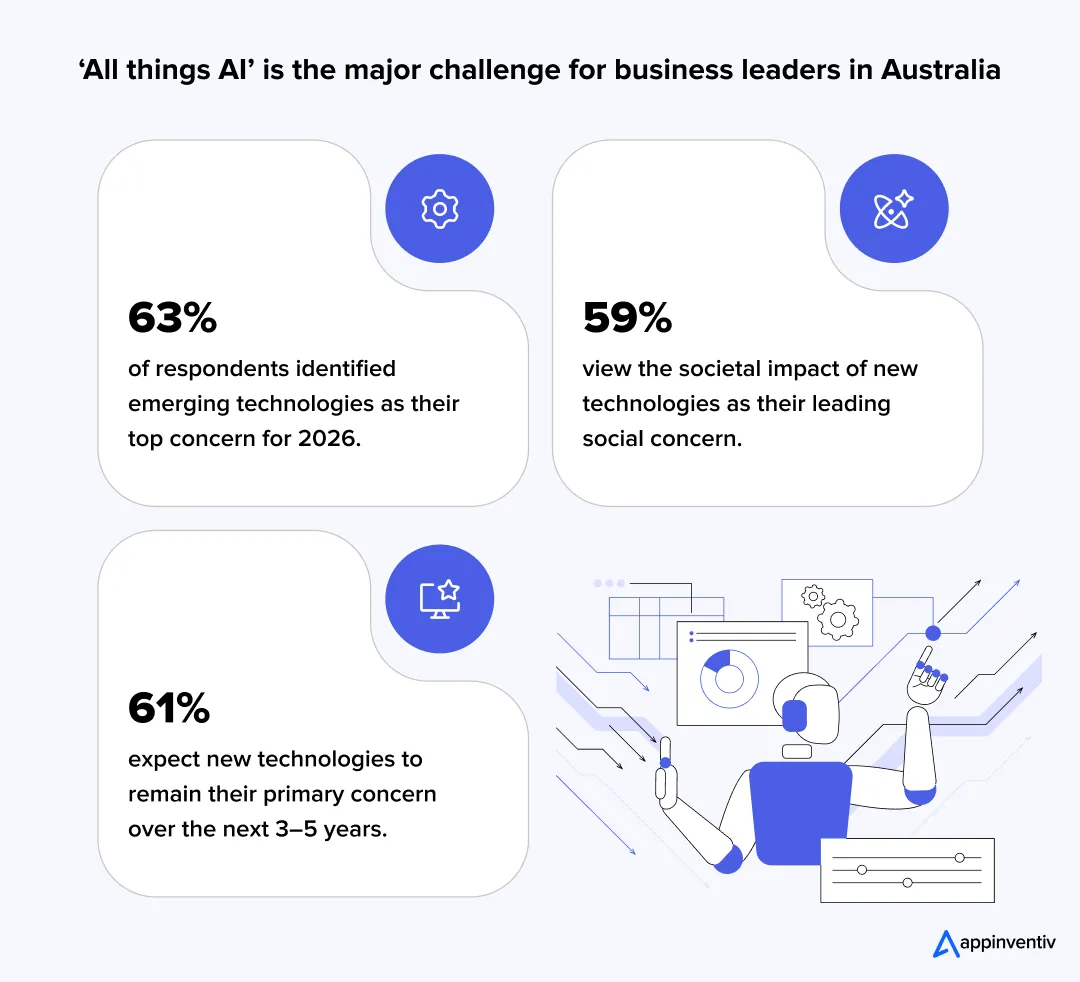
To navigate this, you need to address these hurdles through a practitioner’s lens:
Data Availability and Integration Issues
Challenge: AI is only as effective as the data it consumes. Many Australian factories operate with “fragmented data estates,” where information is trapped in proprietary OEM silos.
Solution: Successful implementation requires building a unified data layer that can normalise inputs from disparate SCADA, MES, and ERP systems into a single, real-time stream.
Skill Gaps in AI and Data Engineering
Challenge: Australia faces a deficit to “bridge” the gap of talented professionals who understand both industrial engineering and data science. As per a recent report, the demand to hire AI-literate tech workers far outstrips supply.
Solution: Companies must adopt a dual strategy: upskilling existing floor staff while partnering with artificial intelligence development services in Australia to provide the specialised heavy-lifting in data engineering.
Legacy Infrastructure and System Compatibility
Challenge: Many reliable Australian plants run on monolithic architecture that predates modern API connectivity, making real-time data extraction difficult.
Solution: Rather than a “rip and replace” approach, utilise strangler patterns. These patterns allow for the containerisation of legacy logic. For instance, if a modern AI module requires maintenance, the core PLC logic remains operational, ensuring zero downtime for the host system while the new “strangler” services eventually replace the legacy core.
Also Read: Legacy System Modernisation in Australia: A Practical Roadmap
Cybersecurity Risks in Connected Factories
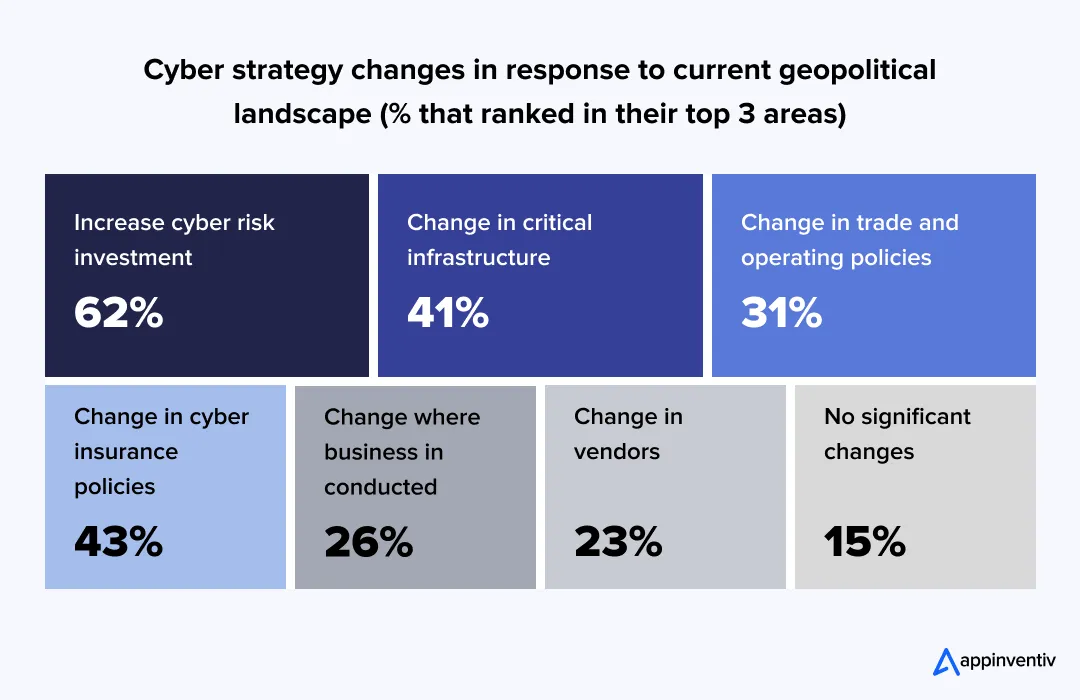
Challenge: As Operational Technology (OT) becomes hyper-connected, the attack surface expands. PwC Australia notes that cyber risk is a top-three strategic priority for 62% of Aussie leaders.
Solution: Manufacturers must implement a Zero Trust architecture and AES-256 encryption. This ensures that every sensor and PLC is authenticated and that AI models are protected from data poisoning or unauthorised access.
Regulatory and Compliance Considerations
Challenge: As of late 2025, the Australian government pivoted from mandatory AI-specific legislation to a technology-neutral regulatory framework. While the original 10 mandatory guardrails were abandoned to foster innovation, the burden of compliance has shifted to existing laws like the Privacy Act 1988 and the Consumer Law.
Solution: Bake “Explainable AI” (XAI) into the software architecture. This ensures that any autonomous decision is fully auditable and can be “decoded” by regulators, maintaining transparency without the “chilling effect” of rigid, technology-specific bans.
Ethics & Governance
Challenge: Moving from “Is it possible?” to “Is it responsible?” is now a board-level accountability to avoid unintended biases or safety lapses.
Solution: Aligning development with the Australian AI Ethics Framework ensures that AI-driven automation remains transparent and maintains the trust of the physical workforce.
Strategies for Successful AI Implementation in Manufacturing
Transitioning from a traditional factory to an AI-driven environment requires more than just technical integration. It demands a strategic shift in how the organisation manages capital, risk, and talent. For Australian businesses, the steps to implement AI in Australian manufacturing businesses must be measured and iterative to ensure long-term ownership and audit readiness.
Here is a recommended step by step execution framework:
Start with High-Impact Pilot Projects
Instead of attempting a total factory overhaul, identify a single “friction point” such as high energy costs on a specific line or high rejection rates in a particular assembly stage. By focusing on a narrow use case, you can demonstrate immediate ROI and secure board-level buy-in for broader scaling.
Scale Across Operations and Invest in Connectivity
Once a pilot proves successful, the next phase is to scale across operations by hardening the underlying data infrastructure. This involves investing in robust IoT connectivity and modernising the middleware that allows your MES to communicate with AI agents. Without this connectivity, your AI remains an “island of automation” rather than an enterprise asset.
Integrate with Existing Systems via Custom Middleware
Legacy systems are a reality for most Australian manufacturers. To avoid the high cost to implement AI in manufacturing in Australia associated with a complete “rip and replace,” build custom integration layers. These allow your new AI models to ingest data from older PLCs and SCADA systems while maintaining the integrity of your core production environment.
Build Cross-Functional Teams
The most successful implementations are led by teams that bridge the gap between “the floor” and “the cloud.” You must bring together process engineers who understand the physical machinery with data scientists who understand the algorithmic outputs. This cross-pollination ensures that the AI solutions developed are practically useful for the operators who use them daily.
Partner with Specialised AI Development Companies
The complexity of modern AI, from computer vision to large language model agents, often exceeds the capacity of in-house IT teams. To reduce delivery risk and accelerate time-to-market, many leaders choose to hire AI developers for manufacturing in Australia who specialise in industrial deployments. This provides access to specialised skill sets without the overhead of permanent, high-cost technical hires.
Align with Long-Term Business Goals
Every AI deployment should be mapped back to a commercial outcome: Is it lowering the cost of goods sold (COGS)? Is it improving safety ratings? Is it reducing energy intensity? By focusing on scalable AI solutions aligned with long-term goals, you ensure that the technology remains a value driver rather than a technical burden.
Monitor, Maintain, and Audit
In the 2026 regulatory environment, AI is not a “set and forget” asset. Continuous monitoring is required to detect “model drift,” where an AI’s performance degrades as factory conditions change. Establishing a regular audit cadence for your algorithms ensures they remain compliant with the Australian AI Ethics Framework and continue to deliver peak productivity.
Implement solutions aligned with Australian compliance, cybersecurity, and data sovereignty requirements.
What is the Future of AI in Manufacturing in Australia?
As we look toward the end of the decade, the trajectory for AI for manufacturing in Australia points toward a “lights-out” capability in specific high-value sectors. The culmination of the $22.7 billion federal investment will likely move the industry beyond simple automation into the era of hyper-autonomous manufacturing. For the Australian enterprise, this evolution will be characterised by four defining shifts:
Movement Toward Autonomous Manufacturing Systems
There is a transition from “assisted” AI, where humans act on AI insights, to fully autonomous loops. In these environments, the AI doesn’t just flag a potential bottleneck; it autonomously re-routes production, adjusts machine speeds, and places orders for raw materials through a hyper-connected supply network without requiring manual intervention for routine operational trade-offs.
Digital Twins for Simulation and Optimisation
The use of digital twins will become the standard for any factory expansion or process change. By creating a high-fidelity virtual replica of the entire factory floor, Australian manufacturers can stress-test new production lines against thousands of variables, such as energy price volatility or supply chain shocks, before committing capital. This reduces the risk of project failure and ensures that “sovereign manufacturing” remains cost-competitive.
AI-Enabled Decision Automation at the Board Level
The intelligence gathered from the factory floor will increasingly inform high-level corporate strategy. There will be a shift toward “closed-loop” business management, where AI-driven insights into production capacity and market demand allow CEOs to make real-time decisions on pricing, market entry, and capital expenditure with a level of precision previously impossible.
The Rise of “Sovereign AI” Hubs
In line with the National Reconstruction Fund, there can be regional clusters of AI excellence. These hubs will allow SMEs to access shared high-performance computing power and specialised artificial intelligence development services in Australia, ensuring that the productivity gains of AI are not restricted to Tier-1 enterprises.
The future of the Australian factory is not one of human displacement, but of human elevation. As AI takes over the cognitive load of process optimisation and the physical load of repetitive labor, the Australian workforce will shift toward high-value roles in system design, ethical oversight, and strategic management.
How Appinventiv Helps Australian Manufacturers Implement AI at Scale?
Navigating the transition from manual operations to an AI-integrated smart factory requires more than just technical deployment. It demands a trusted tech partner with a proven track record in the Australian industrial landscape.
At Appinventiv, we bridge the gap between complex data engineering and the practical realities of the factory floor. Our artificial intelligence development services in Australia are grounded in delivery excellence and a commitment to building sovereign capability for Australian enterprises.
We bring extensive experience in managing the delicate integration of Operational Technology (OT) and Information Technology (IT), ensuring that your AI initiatives are secure, scalable, and audit-ready.
Here are the core pillars of our tech excellence for the Australian organisations:
- Deep Local Expertise: With over 5+ agile delivery centers across Australia and 10+ years of experience in APAC delivery, we understand the specific regulatory and economic pressures facing local manufacturers.
- Proven Impact: Our interventions have consistently driven a 35% average efficiency gain for Australian enterprises, helping them maintain a competitive edge in a high-cost environment.
- Uncompromising Security: In an era of heightened cyber threats, we maintain a 99.50% Security Compliance SLA (ISO, SOC2), ensuring your proprietary industrial data remains protected.
- Recognised Growth Partner: Appinventiv has been ranked among APAC’s High-Growth Companies by Statista and the Financial Times for two consecutive years. These are the proven testaments to our ability to execute and scale high-impact digital transformations.
- Reliable Delivery: Our 96% client retention rate reflects our standing as a long-term strategic partner rather than a one-off vendor.
Whether you are looking to resolve legacy infrastructure bottlenecks or deploy autonomous “agentic” systems, we provide the architectural depth and end-to-end implementation support required to turn your smart factory vision into a commercial reality.
Our AI Services typically include:
- Operational assessments to identify high-ROI use cases
- Data engineering and infrastructure modernisation
- Custom AI model development and deployment
- Integration with MES, ERP, and plant systems
- Cybersecurity alignment with enterprise standards
- Continuous monitoring and performance tuning
For organisations seeking to hire developers for AI in manufacturing in Australia, our teams function as embedded delivery partners rather than external consultants, ensuring knowledge transfer and long-term sustainability.
FAQs
Q. How long does it take to implement AI in manufacturing in Australia?
A. The implementation timeline typically ranges from 4 months to 12+ months. For instance, a controlled pilot or a bespoke “Proof of Value” (PoV) focused on a single production line can often be operational within 4 – 9 months.
However, enterprise-wide deployments, which involve complex legacy system integration, data normalisation across multiple sites, and strict compliance auditing, generally require a roadmap of 9 to 12+ months to reach full operational maturity.
Q. What is the cost of AI integration for Australian manufacturers?
A. For the Australian businesses, the cost to implement AI in manufacturing generally falls between AUD 70,000 and AUD 700,000.
For small businesses or pilot deployments, AI integration can start from around AUD 70,000 to AUD 120,000, especially when focusing on limited use cases such as workflow automation or AI-powered monitoring tools.
A mid-scale bespoke system focused on predictive analytics or quality vision typically ranges from AUD 120,000 to AUD 350,000.
Comprehensive enterprise platforms that automate complex workflows and require significant infrastructure uplift often reach the AUD 700,000 threshold.
These figures reflect the local costs of high-tier engineering talent and the rigorous security standards required by the Australian market.
Q. How is generative AI used in manufacturing in Australia?
A. In 2026, generative AI has evolved into a “Worker Copilot” role. Local manufacturers use it for intelligent document processing, translating complex technical manuals into conversational troubleshooting guides for floor technicians.
Other high-value AI use cases in manufacturing in Australia include automated generation of compliance reports and “synthetic data generation” to train predictive models when physical sensor data is sparse or sensitive.
Q. What is the ROI of AI in Australian manufacturing?
A. Australian organisations are currently realising an average return of 15–20% on their business AI investments. According to Deloitte’s 2026 State of AI, over 61% of local firms report improved operational efficiency as a direct result of AI. When implemented strategically, most enterprises achieve full capital recovery within 18 to 24 months through reduced downtime and significant waste compression.

- In just 2 mins you will get a response
- Your idea is 100% protected by our Non Disclosure Agreement.

How Much Does It Cost to Build a Conversational AI Chatbot in the UAE?
Key Takeaways AI chatbot development in the UAE typically costs AED 150,000–1,470,000 ($40K–$400K), based on complexity. Backend integration and compliance drive cost more than the chatbot interface itself. Arabic NLP, UAE hosting, and PDPL requirements increase budget and engineering effort. LLM + RAG enterprise chatbots sit at the higher end due to integration and infrastructure…

AI Inventory Management in Australia: Benefits, Use Cases, and Implementation Strategies
Key takeaways: Traditional ERP planning reacts to history; AI predicts demand shifts, reallocates stock dynamically, and prevents costly stockouts across distributed Australian networks. AI in inventory management in Australia typically reduces inventory levels 20–40% while maintaining service targets, unlocking significant working capital across multi-state operations. Enterprise implementations usually range from AUD 70,000 to AUD 700,000+,…

How to Hire RAG Architects for Enterprise AI
Key takeaways: Define your RAG architecture scope to avoid misaligned hiring decisions Identify end-to-end architectural ownership across retrieval, governance, and scaling Evaluate deep technical capabilities beyond prompt engineering and tools Validate governance and compliance readiness at the retrieval layer Test system-level thinking through real-world failure scenarios Choose the right hiring model based on scale, risk,…