

























AI in Dentistry – Key Benefits, Real World Applications and Examples

 Share -


- 01Real-World Applications of AI in Dentistry Apps
- 02Benefits of AI in Dentistry: What Actually Changes in Practice
- 03The Process of Developing AI-Powered Dentistry Apps: What Actually Matters
- 04Challenges of AI in Dentistry and How They Are Addressed
- 05What is the Cost of Developing an AI-Powered Dentistry App
- 06The Future of AI in Dentistry App Development
- 07How Appinventiv Helps with AI in Dentistry App Development
- 08FAQs

Key takeaways:
- AI in dentistry app development is already creating measurable clinical and operational impact across diagnostics, patient engagement, and workflow optimization.
- The most effective AI dental apps are designed to support clinicians, improving consistency and confidence without replacing professional judgment.
- The cost to implement AI in dentistry app development typically ranges from $40,000 to $400,000 or more, depending on scope, data, and compliance needs.
- Working with an experienced AI development company like Appinventiv ensures compliant, scalable, and future-ready AI-powered dental applications.
Most discussions around dental technology tend to center on tangible advancements imaging hardware, scanning precision, or incremental improvements in clinical tools. These developments matter. But they address only part of the challenge modern dental practices face.
What is discussed far less is cognitive load.
Dentists today interpret large volumes of visual data under persistent time pressure. Radiographs are reviewed between patient appointments, alongside clinical documentation, patient communication, and operational decision-making. In this environment, variation is not a reflection of competence. It is a natural consequence of sustained human attention being applied at scale.
This is where AI in dentistry app development has begun to demonstrate practical relevance. Not as a disruptive breakthrough. Not as a substitute for clinical expertise. But as a stabilizing layer that supports consistency in high-frequency decision-making.
Artificial Intelligence in dentistry began as a narrow support mechanism, designed to assist clinicians in reviewing high-volume visual data. But over time, these systems have matured into workflow-aligned applications that surface insights at scale, quietly improving consistency without disrupting established clinical accountability.
This blog examines how artificial intelligence in dentistry app development is being applied today across diagnostics, treatment planning, patient engagement, operations and beyond. The real life application of AI for dentistry is not a future-facing concept, but an active layer shaping how dental organizations deliver care, manage scale, and improve patient understanding.
Also Read: AI Case Studies: 6 Groundbreaking Examples of Business Innovation
Our team of 200+ AI engineers and data scientists is here to help you every step of the way.

Real-World Applications of AI in Dentistry Apps
The strongest AI applications in dentistry solve problems clinicians already feel. From imaging and triage to engagement and preventive care, AI works best when it integrates into existing workflows rather than rewriting them. These real world use cases of AI in dentistry show where adoption has moved beyond experimentation.
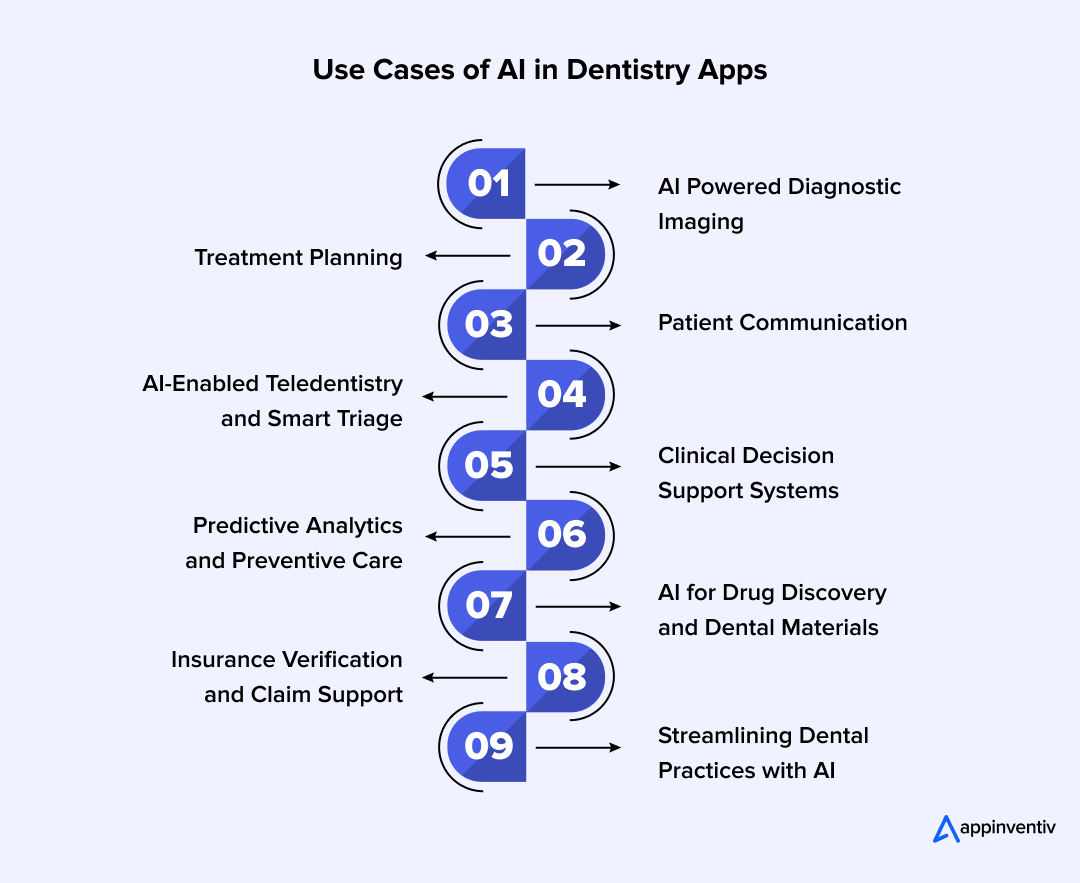
AI Powered Diagnostic Imaging
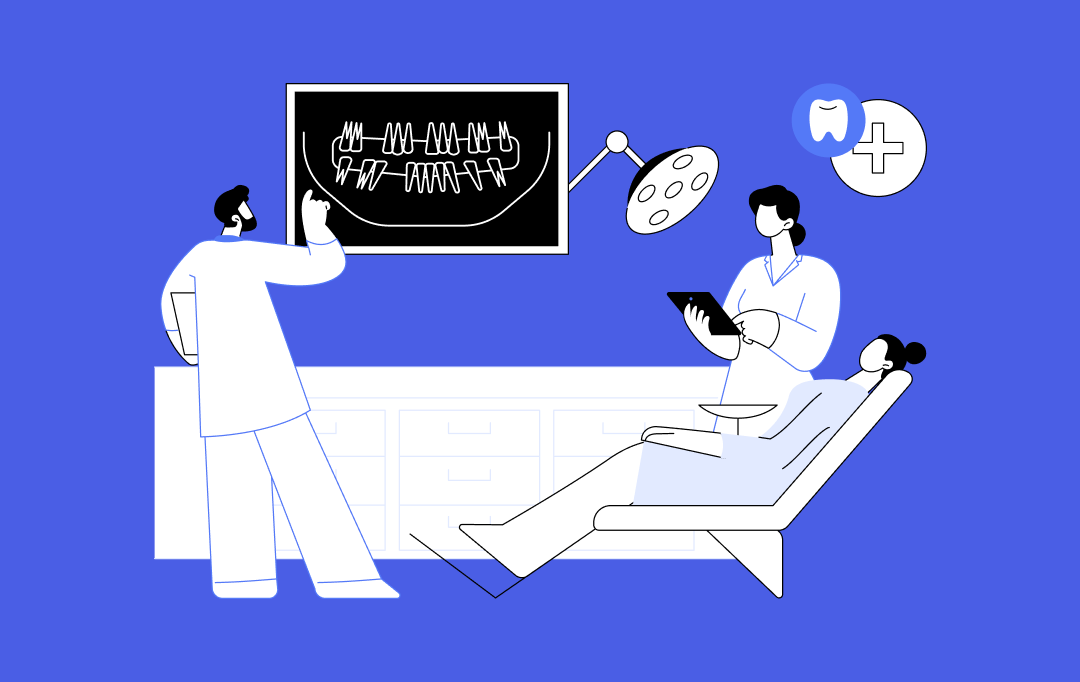
Interpreting radiographs, CT scans, and 3D images remains one of the most time-intensive tasks in dentistry. Even experienced clinicians need to review large volumes of visual data under time pressure. This increases the risk of oversight. AI-powered diagnostic apps address this challenge by analyzing dental images within seconds and highlighting areas that warrant closer review.
These systems support the role of AI in dentistry as an assistive layer. They do not replace diagnosis. They reduce variability by flagging cavities, periodontal issues, and early indicators of oral disease consistently across cases.
Real World Example: Pearl is one of the most visible examples. Its AI software analyzes dental X-rays and highlights potential problem areas for the dentist to evaluate. It does not deliver a verdict. It suggests attention. That design choice is precisely why it gained FDA clearance and widespread clinical use.
This is a clear illustration of the role of AI in dentistry being supportive rather than authoritative. Dentists decide. AI observes relentlessly.
Treatment Planning
Treatment planning has always relied on experience combined with historical outcomes. AI introduces an additional dimension: probability.
By analyzing longitudinal patient data, imaging history, and treatment outcomes, AI development in dentistry enables risk-based planning. Practices can identify patients more likely to experience complications, relapse, or delayed outcomes before those issues surface clinically.
Is it perfect? No.
Is it useful? Very.
Because it reduces reliance on approximation while still leaving final judgment with the clinician.
Real World Example: Orthodontic platforms such as SmileDirectClub use AI-driven simulations to forecast tooth movement and track treatment progress remotely. While clinicians remain responsible for final decisions, predictive modeling reduces reliance on approximation.
This capability supports more informed conversations with patients and improves long-term treatment predictability.
Patient Engagement and Communication
Ask most dental practices where they lose money, and the answer is rarely clinical error. It is missed appointments. Poor follow-ups. Inconsistent communication.
AI-powered dental apps now handle these gaps with surprising effectiveness, not by sending more messages, but by sending them at better moments.
Real World Example: Doctible uses AI-driven workflows to automate reminders, review requests, and patient outreach based on behavior patterns. Clinics using such systems often see reduced no-show rates and improved patient response without increasing staff workload.
This is a practical demonstration of AI-powered development in dentistry, solving operational problems rather than clinical ones. And that is often where adoption happens fastest.
AI-Enabled Teledentistry and Smart Triage
Teledentistry expanded access. AI improved prioritization. This powerful combination works as a double edged sword in dentistry.
Modern AI powered dental apps can now analyze patient-submitted photos and symptom descriptions before a clinician enters the conversation. Urgent cases surface earlier. Routine concerns wait appropriately.
Real World Example: Teledentix applies this model across school programs and community health initiatives, particularly in regions where in-person care is limited.
Here, the integration of AI in dentistry is less about innovation headlines and more about practical triage at scale.
Also Read: AI in Triage Systems: Transforming Emergency Care
Clinical Decision Support Systems
Decision support tools fail when they try to instruct. They succeed when they inform. AI-driven decision support platforms analyze radiographs and clinical data to present contextual insights rather than instructions. Dentists are shown comparisons, benchmarks, and visual indicators that support reasoning rather than replace it.
Real World Example: Overjet’s AI system exemplifies this approach by providing deep analysis of dental X-rays in a format designed to be interrogated, not accepted blindly.
This reflects how artificial intelligence in clinical dentistry is being accepted. Quietly. Selectively. On the clinician’s terms.
Predictive Analytics and Preventive Care
The most transformative use of AI for dentistry is still unfolding.
Predictive models now analyze long-term patient data to identify who is more likely to develop issues months or even years before symptoms appear. That shifts dentistry away from reaction and toward prevention.
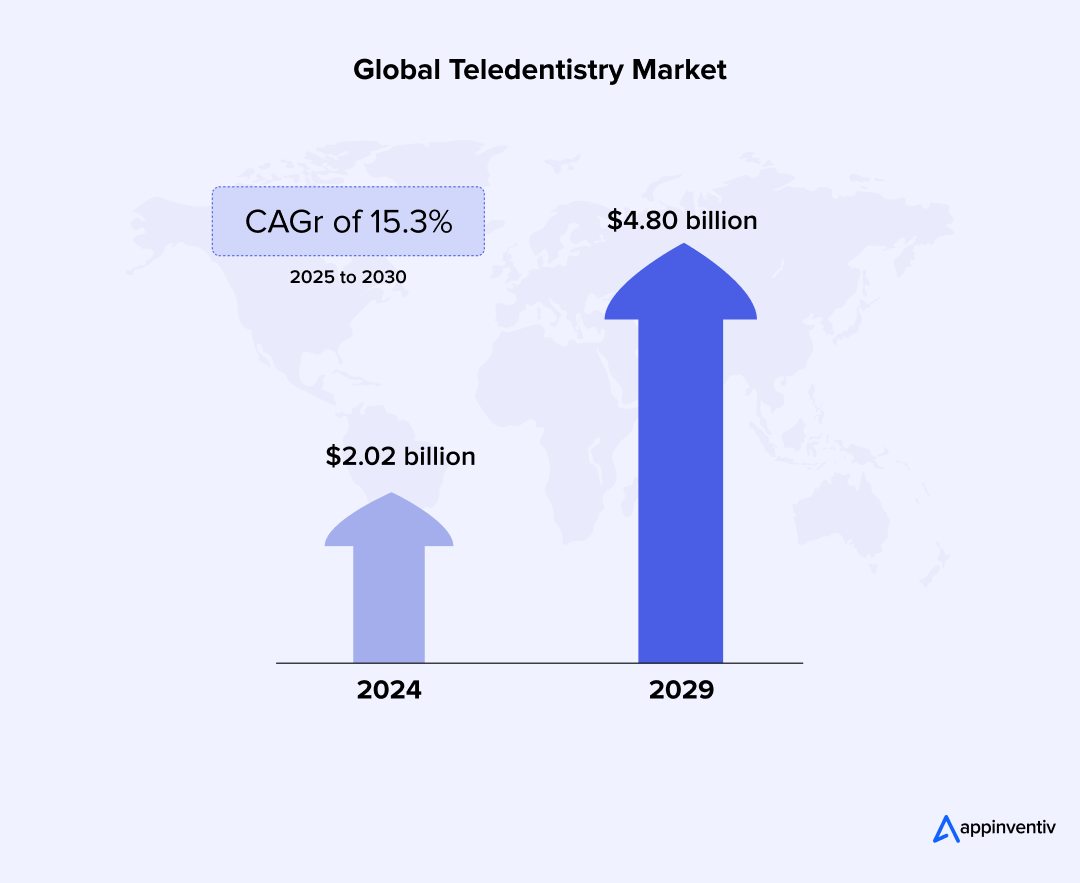
Grand View Research’s 2024 report highlights predictive analytics as one of the fastest-growing AI applications in dental healthcare, driven by its alignment with preventive care strategies. According to research, the global teledentistry market, valued at $2.02 billion in 2024, is projected to reach $4.80 billion by 2030, growing at a CAGR of 15.3% from 2025 to 2030.
Real World Example: Qventus, a company known for its predictive analytics, is being applied to dental practices to forecast patient needs and appointment schedules. By predicting potential oral health issues, dental professionals can offer proactive treatments and follow-up care, ultimately leading to better patient outcomes and more efficient use of resources.
Prevention is not dramatic. But it is sustainable. And AI supports it quietly.
AI for Drug Discovery and Dental Materials
AI is increasingly used for drug discovery in dentistry, well before clinical adoption. In research settings, it helps reduce uncertainty in developing dental drugs, biomaterials, and restorative compounds by simulating molecular behavior and material performance early in the lifecycle.
Real World Example: Atomwise is an AI platform that analyzes molecular structures to identify new drug compounds. This is a particularly exciting development for dental researchers, as AI could help accelerate the discovery of drugs for oral diseases, providing more effective treatments for conditions like oral cancer and gum disease.
Insurance Verification and Claim Support
Dental practices are often burdened with verifying insurance details, submitting claims, and handling the complexities of reimbursement. AI applications help streamline this process by automating insurance verification, assessing claim status, and managing billing. This reduces administrative overhead and speeds up the reimbursement process, allowing dental practices to focus on patient care.
Real World Example: ClearGage is an AI tool that automates insurance verification and claim submission for dental practices. It speeds up the entire process, ensuring accuracy and reducing the time dental professionals spend on insurance-related tasks. This, in turn, improves cash flow and reduces the risk of billing errors.
Streamlining Dental Practices with AI
Operational inefficiencies in dentistry often emerge gradually rather than dramatically. AI helps by analyzing scheduling patterns, chair utilization, and workflow data over time to surface inefficiencies that are difficult to detect manually.
Real World Example: AI-powered practice management platforms are used by multi-location dental groups to balance appointment loads, reduce idle chair time, and stabilize daily operations without expanding staff.
Benefits of AI in Dentistry: What Actually Changes in Practice
The conversation around the benefits of AI in dentistry often sounds abstract. Faster. Smarter. More efficient. But inside a real dental practice, the impact feels more specific and far less dramatic.
It shows up in smaller moments.
A second look that catches something subtle.
A conversation with a patient that feels clearer, calmer, more grounded in evidence.
A schedule that runs closer to plan.
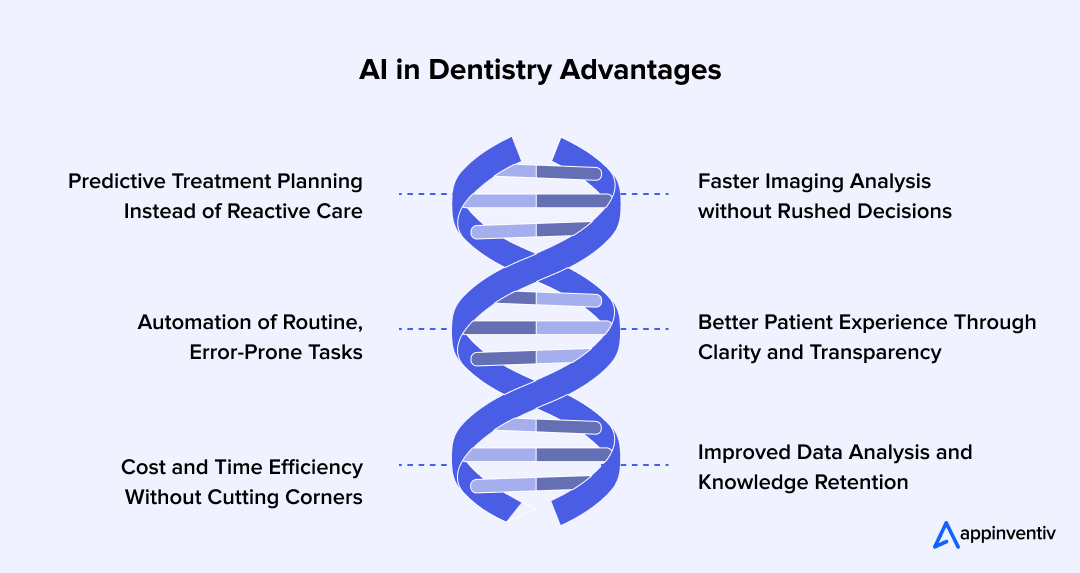
That is where AI and dentistry begin to justify each other. Let’s delve deeper to uncover some practical advantages of AI in dentistry.
Predictive Treatment Planning Instead of Reactive Care
Traditional dental care is largely reactive. A problem appears. Treatment follows. AI changes that sequence.
By analyzing longitudinal patient data, imaging history, and behavioral patterns, AI for dentistry enables predictive insights. Which patients are more likely to develop periodontal issues? Who may face implant complications? Who is at higher risk of relapse after orthodontic treatment?
This is not speculation. It is pattern recognition at scale. In practice, this means AI development in dentistry supports proactive conversations instead of reactive explanations. That alone changes how patients perceive care quality.
Faster Imaging Analysis without Rushed Decisions
Imaging workflows are time-consuming. Reviewing radiographs, panoramic scans, and CBCT images demands focus. Under pressure, speed often comes at the cost of depth.
AI does not rush. It processes. AI dental apps analyze images in seconds, flagging areas that deserve attention. The dentist still reviews, still decides but with fewer blind spots.
This is a subtle but powerful shift. Faster imaging analysis does not mean faster decisions. It means better-informed ones, delivered sooner. For patients, that often translates into same-visit clarity rather than delayed follow-ups.
This efficiency is one of the understated benefits of AI in dentistry, especially in high-volume practices.
Automation of Routine, Error-Prone Tasks
Not every improvement in dentistry needs to happen chairside. Administrative work drains time, focus, and morale. Scheduling, insurance verification, claims processing, follow-ups, etc.; these tasks are repetitive and prone to human error.
AI-powered development in dentistry has increasingly targeted these workflows. Intelligent systems now automate eligibility checks, flag claim discrepancies, and manage appointment logistics with minimal oversight.
The result is not fewer staff, but better allocation of human effort. Clinicians and coordinators spend more time on patient-facing work and less on administrative friction.
This operational lift is often the first benefit decision-makers notice when adopting an AI dental app.
Better Patient Experience Through Clarity and Transparency
Patients rarely question expertise. They question understanding. AI-assisted visual explanations have changed how dental conditions are communicated. When patients see highlighted areas on their own scans, conversations shift, doubt reduces and engagement improves.
This is not persuasion. It is clarity. The use of AI in dentistry supports informed consent by making complex findings easier to grasp. That transparency builds trust, which in turn improves treatment acceptance and long-term adherence.
In many practices, this has become one of the most valued outcomes of AI powered mobile apps for dental diagnosis.
Cost and Time Efficiency Without Cutting Corners
Efficiency in healthcare is often misunderstood. Faster does not mean better. Cheaper does not mean smarter.
The real efficiency gain from AI development in dentistry comes from reduction of rework, fewer misdiagnoses, fewer unnecessary follow-ups and fewer delayed decisions.
Over time, these small gains compound. This is where financial and clinical incentives finally align.
Improved Data Analysis and Knowledge Retention
Every dental practice generates data. Very few truly use it. AI systems analyze treatment outcomes, patient behavior, and procedural patterns over time. This turns fragmented records into actionable insight.
For growing organizations, this capability becomes strategic. It informs staffing, service expansion, preventive programs, and even location planning.
In this sense, AI technology in dentistry supports not just care delivery, but long-term business intelligence.
The Process of Developing AI-Powered Dentistry Apps: What Actually Matters
Developing an AI-powered dental app requires more than just implementing a few algorithms. It’s a comprehensive process that involves thorough planning, the right technology selection, and continuous testing. To build an AI-driven healthcare solution that integrates seamlessly into a dental practice, it’s essential to follow a structured AI dental app development process. Here’s a closer look at how this unfolds:
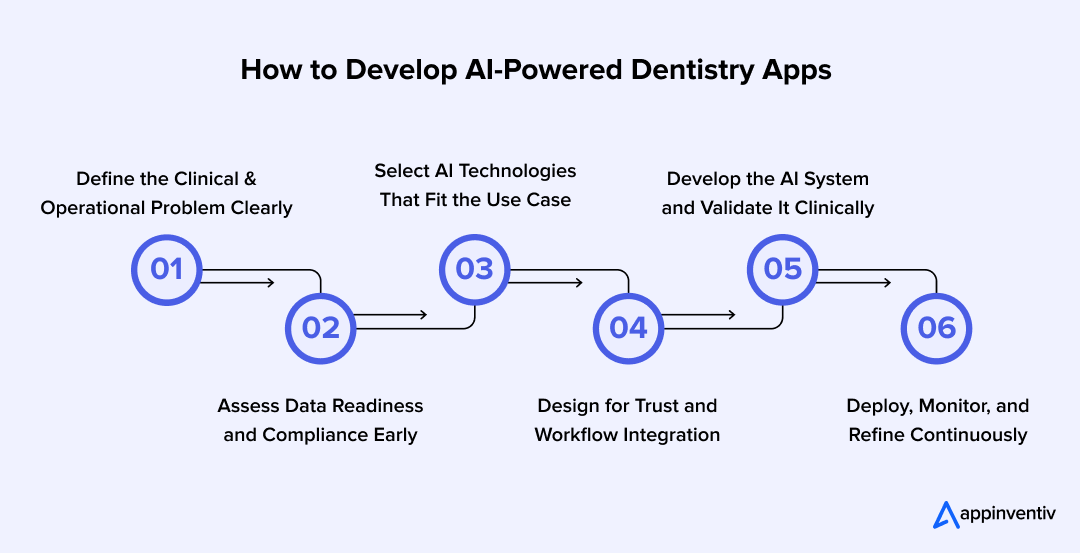
Step 1: Define the Clinical and Operational Problem Clearly
Strong AI dental apps rarely begin with technology discussions. They begin with friction. Something that slows dentists down, introduces inconsistency, or quietly drains time every day. Image reviews that vary slightly. Follow-ups that slip. Admin work that grows without notice.
In AI development in dentistry, this early framing sets the ceiling for success. When teams rush past it, they often end up with capable systems that look impressive but never quite fit into daily practice.
Step 2: Assess Data Readiness and Compliance Early
AI does not struggle because of algorithms as often as it struggles because of uneven data. Dental images, records, and historical inputs need to be reviewed honestly before any model decisions are made. Gaps surface here, and that is intentional.
At the same time, regulatory constraints are not negotiable. In AI dental health application development, requirements like HIPAA or GDPR influence architecture from the start. Treating compliance as an afterthought usually leads to rework later.
Step 3: Select AI Technologies That Fit the Use Case
Dentistry presents very different problems depending on context. Image interpretation, patient communication, and operational prediction each call for different approaches. Applying the same AI technique everywhere is rarely effective.
Well-designed AI dental app development solutions favor stability and interpretability. Generative AI in dentistry, for example, may add value in documentation or education, but is approached carefully when clinical judgment is involved.
Also read: How Agentic AI in Healthcare Is Bringing in Industry-level Transformation
| Dentistry App Use Case | AI / ML Approach | Core AI Tech Stack |
|---|---|---|
| Dental X-ray & CBCT analysis | Computer Vision, CNNs | Python, TensorFlow / PyTorch, OpenCV, DICOM standards |
| Clinical decision support | Explainable AI, Image annotation models | Python, SHAP/LIME, TensorFlow, REST APIs |
| Predictive treatment planning | Machine Learning, Predictive Analytics | Python, Scikit-learn, XGBoost, PostgreSQL |
| Preventive risk forecasting | Time-series ML models | Python, Prophet, MLflow |
| Patient communication & reminders | NLP + Rule-based automation | Python, spaCy, Twilio APIs, Firebase |
| Teledentistry triage | Computer Vision + NLP | Python, OpenCV, NLP models, WebRTC |
| Documentation & summaries | Generative AI (controlled scope) | OpenAI / Azure OpenAI, Prompt orchestration, Human review layer |
| Insurance & claims automation | AI-driven pattern recognition | Python, OCR (Tesseract), RPA tools |
| Practice workflow optimization | ML-based operational analytics | Python, Pandas, Power BI / Tableau |
Step 4: Design for Trust and Workflow Integration
In artificial intelligence in clinical dentistry, trust develops through understanding, not interface polish. Dentists want to know why something was flagged and how it relates to what they already see.
Clear visual cues, explainable logic, and minimal workflow disruption matter more than feature depth. AI earns acceptance when it blends into existing routines instead of asking clinicians to work around it.
Step 5: Develop the AI System and Validate It Clinically
This is where architecture turns into a working product. Data pipelines are built, models are trained, integrations with imaging systems or practice software are implemented, and core workflows are wired together. In AI in dentistry app development, this phase often exposes gaps between theoretical design and clinical reality.
Testing happens alongside development, not after it. Models are evaluated for accuracy, edge cases, and false alerts, while clinicians review early outputs to assess usefulness. In AI-powered development in dentistry, feedback at this stage prevents costly redesigns later.
Step 6: Deploy, Monitor, and Refine Continuously
Deployment is not a finish line. It marks the point where accountability begins. Once live, AI dental apps must be observed closely as usage patterns, patient demographics, and imaging inputs evolve.
Ongoing monitoring, retraining, and feedback loops keep systems reliable. In AI dental app development solutions, refinement is continuous. Without it, even well-designed AI models lose relevance quietly over time.
To gain an in-depth understanding of the development process and other nitty-gritties involved, please refer to our pocket guide to Healthcare Mobile App Development.
Challenges of AI in Dentistry and How They Are Addressed
The integration of AI in dentistry brings clear opportunity, but it also exposes practical constraints that surface only when systems are deployed in real clinical environments. These challenges are not technical failures; they are points of alignment that require a robust AI integration solution to ensure clinical workflows, data accuracy, and compliance work together effectively at scale.
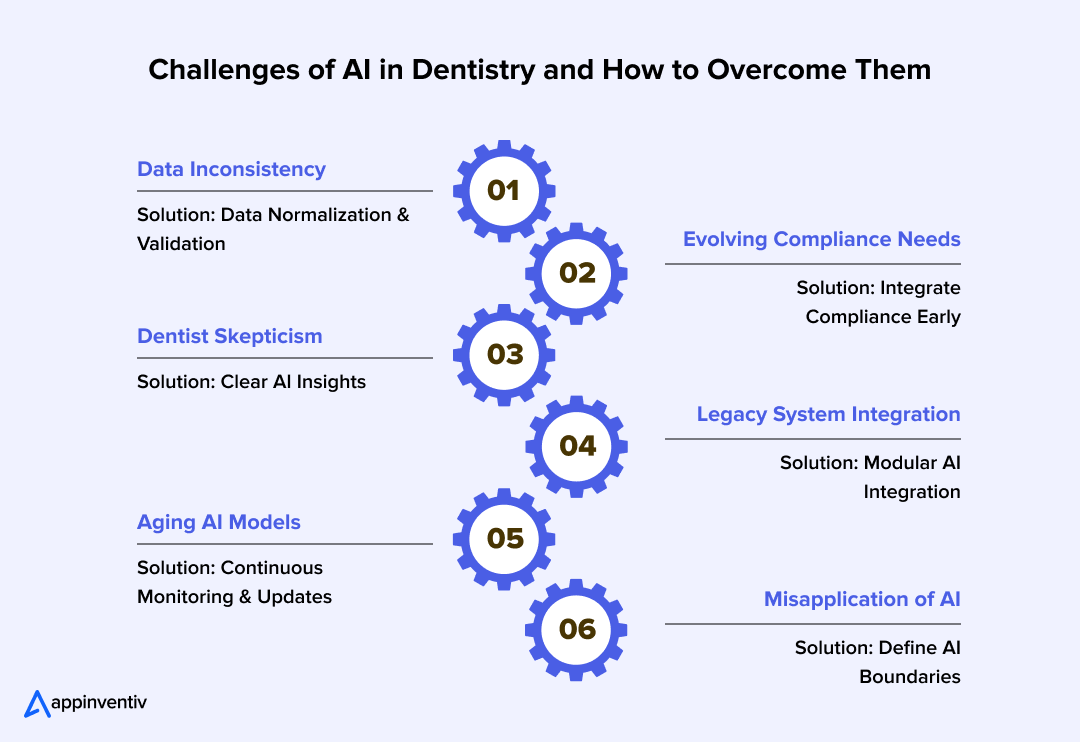
Data That Looks Complete, But Isn’t
Dental data often appears abundant at first glance. In reality, it is fragmented across devices, formats, and documentation practices. Imaging standards differ, annotations vary, and historical records are inconsistent. This unevenness can quietly distort AI outputs if left unaddressed.
What works:
An AI development company invests time upfront in data normalization, validation, and assumption testing. Cleaning and standardizing inputs early has far more impact on outcomes than model sophistication later.
Compliance That Changes the Architecture
AI dental applications do not operate in a vacuum. They exist within regulatory frameworks that differ by region and use case. What qualifies as acceptable decision support in one context may cross compliance boundaries in another.
What works:
Designing AI as assistive rather than declarative is critical. Clinicians remain accountable, while systems are documented, auditable, and aligned with regulatory expectations from the outset.
Skepticism From Dentists, Not Fear
Adoption resistance rarely stems from fear of AI itself. It emerges when systems present conclusions without context. When outputs feel disconnected from clinical reasoning, confidence erodes gradually.
What works:
Trust grows when AI explains its signals visually and allows dentists to question, verify, and override results. Transparency invites engagement rather than passive acceptance.
Old Systems That Don’t Like New Ideas
Many dental practices rely on legacy software that remains functional but inflexible. Replacing these systems outright is rarely practical, which complicates AI integration.
What works:
Upgrading legacy systems with AI-driven modules allows dental practices to enhance functionality without a full infrastructure overhaul. By integrating AI into existing systems, practices can boost efficiency while maintaining their current operations.
Models That Age Quietly
AI systems rarely fail abruptly. Instead, they degrade. Patient demographics shift. Imaging technology evolves. Yet outputs remain confident even as accuracy slowly declines.
What works:
Continuous monitoring, periodic retraining, and structured feedback loops treat AI as a living system rather than a finished product.
Knowing Where Not to Use AI
Generative AI introduces particular risk in clinical environments. Its fluency can create an illusion of certainty where control and governance are required.
What works:
Using generative systems for documentation, education, and support tasks, while keeping diagnosis and treatment logic tightly governed, preserves both safety and credibility.
What is the Cost of Developing an AI-Powered Dentistry App
The cost of building an AI-powered dentistry app rarely depends on just one factor. It shifts based on how deeply AI is woven into clinical workflows, how much historical data the system must handle, and how close the app operates to diagnosis or treatment decisions.
A scheduling assistant with light automation behaves very differently, from a cost perspective, than an AI-driven diagnostic platform reviewing radiographs in real time. Compliance scope, integration with existing dental systems, and post-launch monitoring also influence the final budget.
Before numbers make sense, most teams look at three cost-driving factors:
- Depth of AI integration (assistive vs. clinical support)
- Data readiness and volume (clean, labeled data vs. fragmented records)
- Regulatory and security requirements (HIPAA, GDPR, audit trails)
Once these variables are clear, cost ranges become easier to estimate.
On average, the cost of custom AI dental health diagnosis app development ranges between $40,000 and $400,000 or more, based on the above mentioned factors. Here is an estimated cost breakdown by app complexity.
| App Type | Cost Range | Timeline | Features Included |
|---|---|---|---|
| Simple Apps | $40,000 – $100,000 | 3–5 months | Basic AI functionality such as appointment scheduling, reminders, chatbots, and limited automation |
| Intermediate Apps | $100,000 – $200,000 | 6–9 months | AI-assisted diagnostics, personalized treatment insights, patient engagement tools, analytics dashboards |
| Advanced Apps | $200,000 – $400,000+ | 9–14 months | Real-time diagnostic support, teledentistry features, deep data integration, predictive analytics, continuous model monitoring |
These figures are indicative and reflect typical 2025–2026 healthcare app development cost. Actual costs may vary based on the development company, technology stack, compliance scope, and geographic delivery model.
Customization requirements, system integrations, and post-launch optimization can further influence the overall AI dental health app development cost.
Also read: AI Chatbot Development Cost Guide 2026: Enterprise Pricing and ROI
The Future of AI in Dentistry App Development
The future of AI in dentistry is unlikely to arrive as a dramatic leap. It will come quietly, feature by feature, until practices struggle to remember how certain decisions were ever made without it.
What changes next is not the presence of AI, but its posture. AI will stop behaving like a tool that demands attention and start behaving like infrastructure. Always on. Rarely noticed. Hard to remove once embedded.
Preventive Dentistry Becomes Data-Led, Not Intuition-Led
Preventive care has always been a goal. AI makes it measurable. As AI dental health mobile app development matures, predictive models will increasingly flag risk before symptoms surface. Not just cavities or gum disease, but likelihood trends tied to behavior, compliance, and historical outcomes.
This moves dentistry away from “watch and wait” toward “anticipate and act.” And that shift favors practices that invest early in AI development in dentistry, built around long-term data learning.
AI-Driven Monitoring Extends Beyond the Clinic
Wearables and at-home scanning tools are already entering oral care conversations. What they lack today is intelligence. That changes soon.
AI will increasingly analyze patient-generated data between visits. Subtle changes in bite pressure, oral hygiene patterns, or inflammation markers will trigger early alerts inside AI dental app ecosystems. The clinic will no longer be the only place where dental care happens.
Generative AI Finds Its Place, Carefully
Generative AI in dentistry will not dominate diagnostics but its role in education, documentation, and patient communication will expand.
Expect AI-generated summaries of treatment plans. Plain-language explanations of conditions. Automated post-visit guidance personalized to each patient’s history. Used carefully, generative systems will reduce explanation fatigue without increasing clinical risk.
Administrative Intelligence Becomes Non-Negotiable
Billing, insurance, compliance tracking, and record management will see deeper automation. These areas already strain dental operations, and AI is well-suited to reduce friction here.
For many practices, the most immediate return on AI-powered development in dentistry will come from invisible gains. Fewer claim rejections. Cleaner records. Faster audits. Efficiency will no longer be optional. It will be expected.
Standardization Across Multi-Location Practices
As dental groups scale, consistency becomes harder to maintain. AI will increasingly act as a stabilizing layer across locations, supporting uniform diagnostics, documentation, and patient communication.
This is where the role of AI in dentistry expands from clinical support to organizational intelligence. Group practices that ignore this trend may struggle to maintain quality parity.
Regulation Will Catch Up, Slowly
Regulatory clarity around artificial intelligence in dentistry will improve, but not overnight. Guidelines will emerge incrementally, shaped by how AI is already being used rather than how it is imagined.
Practices and product teams that build conservatively now will adapt more easily later. Those pushing boundaries too early may face course corrections.
In short, the future of AI in dentistry is not about replacing clinicians or accelerating treatment at all costs. It is about reducing uncertainty, fatigue, and inconsistency in a profession that demands precision. By 2026 and beyond, AI will not be something dental practices “try.” It will be something they quietly rely on.

How Appinventiv Helps with AI in Dentistry App Development
Appinventiv’s strength in AI in dentistry app development is not built on isolated experiments. It comes from repetition, scale, and delivery across regulated environments where reliability matters more than novelty.
In our 10+ years of industry experience, we have delivered 300+ AI-powered solutions, supported by a dedicated team of 200+ data scientists and AI engineers. Our experience spans 35+ industries, with 150+ custom AI model deployments, many of which operate in data-sensitive and compliance-heavy domains like healthcare.
For instance, in healthcare, we have helped some of the most reputed names like Health–e-People, Soniphi, YouComm, DiabeticU etc. to elevate and reinforce the digital transformation presence in healthcare.
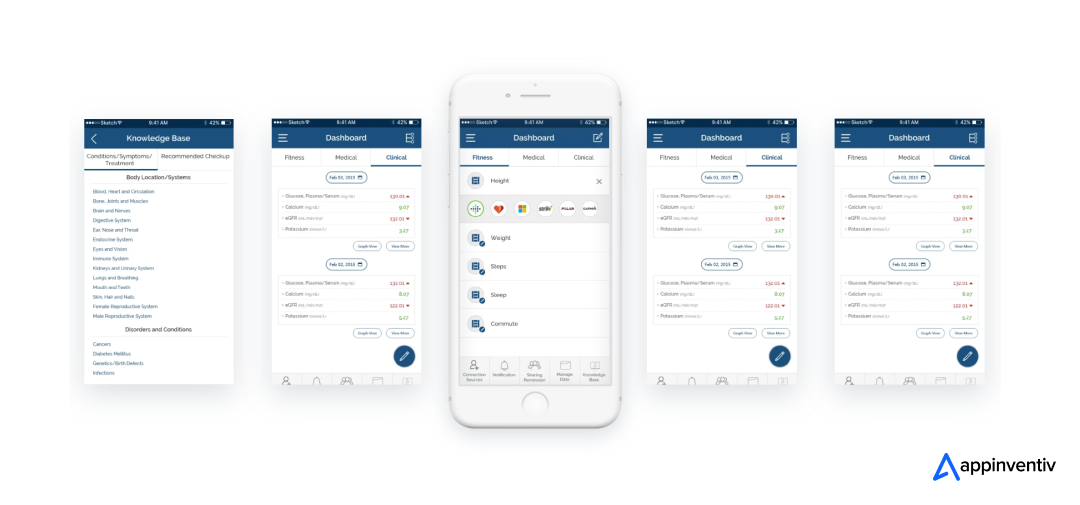
Here is how we have helped one of our US clients apply AI in a dental practice:
Objective: A mid-sized dental clinic network focused on improving diagnostic consistency, patient engagement, and operational efficiency. They wanted to support their treatment planning process with data-backed insights.
How we helped
We developed a custom AI-assisted diagnostic app to analyze dental X-rays and CT scans in near real time. Alongside this, an AI-powered patient management layer in the application handles scheduling, reminders, and personalized aftercare communication.
Measured Outcomes Within Four Months:
- 98% diagnostic accuracy, enabling earlier issue detection and stronger clinician alignment
- 40% reduction in operational costs, largely from administrative automation
- Nearly 10x faster deployment compared to traditional dental software rebuilds
The system integrated into existing workflows, minimizing disruption while improving consistency.
Our healthcare projects like this directly inform how we approach dentistry-focused AI solutions.
Why Dental Teams Continue to Choose Appinventiv
Appinventiv’s credibility is reflected in repeatable delivery, not one-off wins:
- 300+ AI solutions delivered across healthcare, enterprise, and data-driven platforms
- 75+ enterprise-grade AI integrations completed with existing clinical and operational systems
- Proven performance benchmarks, including up to 98% prediction accuracy and 40% cost savings where AI-driven automation is applied
These figures represent sustained capability, not isolated success.
What These Numbers Translate to for Dental Organizations
When dental practices and product teams work with Appinventiv’s AI team, they benefit from patterns already proven at scale:
- 98% AI prediction accuracy achieved in multiple image analysis and clinical decision-support environments, helping dentists improve diagnostic confidence without removing human judgment.
- 10x faster time-to-market enabled through reusable AI architectures, mature development pipelines, and delivery teams experienced in healthcare-grade deployments.
- 40% average operational cost reduction driven by AI-led automation across scheduling, patient communication, documentation, and internal coordination.
Our healthcare AI development services experts can help dental businesses leverage automation where it can make a measurable difference. We can further pave the way to connect AI with scheduling, patient communication, clinical documentation, and internal workflows while keeping data security and compliance in view.
Get in touch with us to develop an AI powered dental app today.
FAQs
Q. How is AI used in dentistry?
A. AI in dentistry app development is used as a support layer across clinical and operational workflows rather than as a decision-maker. In practice, it assists with image analysis, flags potential anomalies in radiographs, supports treatment planning through pattern recognition, and automates routine tasks such as scheduling, follow-ups, and insurance verification.
The most effective use of AI in dentistry focuses on reducing cognitive load and variability, allowing clinicians to work with greater consistency under time constraints.
Q. What does cost optimization look like in AI dental health app development?
A. Cost optimization in AI Dental Health App Development is achieved through scope control and phased deployment rather than cutting technical corners. Key levers include:
- Starting with narrowly defined use cases instead of full-scale platforms
- Using cloud-based infrastructure to reduce upfront investment
- Reusing pre-trained models where appropriate rather than building everything from scratch
- Designing modular systems that expand only when value is proven
Over time, operational efficiencies often offset initial development costs.
Q. How can AI tools help dentists enhance treatment quality and stay competitive?
A. AI tools improve treatment quality by increasing consistency, not by overriding expertise. Dentists benefit from more reliable image review, clearer risk identification, and data-backed planning insights.
From a competitive standpoint, AI helps practices deliver faster clarity to patients, improve engagement, and operate more efficiently. Over time, this translates into better patient trust, higher acceptance rates, and more predictable operations.
Q. Are there AI-powered case design tools available for pediatric dental practices?
A. Yes, though they are applied conservatively. In pediatric dentistry, AI is primarily used for:
- Early risk identification
- Monitoring developmental patterns over time
- Supporting preventive planning rather than definitive diagnosis
All outputs remain under clinician oversight, with a strong emphasis on safety, explainability, and prevention.
Q. Which reliable AI solutions support proactive patient care in dentistry?
A. Proactive care is supported by AI systems that analyze longitudinal data rather than single visits. These tools identify patients at higher risk of future issues and prompt early intervention.
Predictive analytics platforms and AI-enabled monitoring tools are increasingly used to shift care from reactive treatment to prevention-focused planning, especially in larger practices and dental groups.
Q. What impact has AI made on the field of dentistry?
A. AI has not fundamentally changed how dentistry is practiced overnight. Its impact has been gradual and structural.
It has reduced interpretive variability, eased administrative burden, improved patient understanding, and enabled preventive care strategies at scale. Over time, these changes reshape daily practice in subtle but lasting ways.
Q. What are the key advantages of incorporating AI into a dental practice?
A. Some of the most practical advantages of AI in dental practice are:
- More consistent diagnostic support across clinicians
- Faster imaging review and clearer patient communication
- Reduced administrative workload through automation
- Better use of historical data for planning and prevention
- Improved scalability without proportional increases in staff
The true advantage lies not in speed or automation alone, but in reducing friction and uncertainty across the practice.
Q. How long does it take to make an AI dental diagnosis mobile app?
A. A realistic timeline to build an AI dental diagnosis mobile app is 3 to 14 months or more
- 1–4 months for data preparation, model selection or training, and clinical validation planning
- 1–8 months for mobile app development, AI integration, and workflow design
- 1–2 months for testing, regulatory readiness (HIPAA/GDPR where applicable), and refinements
Contact us to get a more precise estimate for an AI-powered dental mobile app development.


Fast 2-minute response, fully NDA-protected.
How to Use AI SDR Agents to Automate Outbound Prospecting and Generate Pipeline
Key takeaways: AI SDR agents replace repetitive manual research with autonomous, signal-driven prospecting and lead qualification workflows. Start with one defined prospecting workflow before expanding AI automation across the wider sales organization. Clear ICP rules, reliable data, and decision boundaries determine whether autonomous prospecting creates useful business value. Custom AI SDR workflows work best when…
AI for Smart Cities: From Connected Infrastructure to Intelligent Urban Services
Key takeaways: AI shifts cities from monitoring infrastructure conditions to predicting disruptions and improving operational responses before failures escalate. The strongest AI use cases in smart cities combine quality data, clear ownership, workflow integration and measurable infrastructure outcomes. Digital twins create greater value when AI supports simulation, optimisation and decisions rather than visualisation alone. Responsible…
How Forward Deployed Engineers Accelerate AI From Pilot to Production
Key takeaways: IBM's 2025 CEO study revealed that only 16% of AI projects scaled across entire companies. Forward-deployed engineers integrate daily workflows, legacy applications, AI models, security rules, and server infrastructure into a single team. Live AI platforms require task checks, access permissions, system tracking, and rollback tools before full rollout. Single-team projects eliminate handoffs…