

























How to Develop an AI Chatbot for Education Platforms in UAE: Architecture, Cost, and Timeline


- Understanding the UAE Education Market and Its Unique Requirements
- How AI Chatbots Work in the Education Sector
- Core Architecture of an AI Chatbot for Education Platforms
- Key Features Of AI Chatbots For Online Learning Platforms
- How to Build An AI Chatbot For Education Platforms in the UAE
- Cost Breakdown For Developing An AI Chatbot For Education Platforms in the UAE
- Key Benefits Of AI Chatbots For Educational Institutions in the UAE
- Real World Use Cases of AI Chatbots in Education
- Rule-Based vs AI Chatbots in Education: Choosing the Right Approach
- Challenges in AI Chatbot Development for Education in the UAE and How to Overcome Them
- Data Privacy, Compliance, And Ethical AI In Education Chatbots
- Future Of AI Chatbots in UAE & Middle East Education
- How Appinventiv Can Help Develop Your AI Chatbots For Education Platforms in the UAE

Key Takeaways
- AI chatbots are helping UAE institutions handle repetitive queries, reduce response delays, and improve the availability of student support.
- Bilingual capability, PDPL compliance, and integration with LMS and student systems are essential for successful deployment.
- Costs typically range from AED 150,000 to AED 1.47M ($40K–$400K), depending on integrations, personalization, and language support.
- AI-powered learning assistants improve engagement, streamline administration, and help students stay on track academically.
- Institutions that follow a structured build approach see faster adoption, stronger student satisfaction, and long-term operational efficiency.
Admission season changes the rhythm of a university office. Phones keep buzzing, inboxes fill up, and the same questions land every few minutes: deadlines, documents, course options. Staff juggles these requests while trying to keep normal work on track. To ease that daily pressure, many institutions are turning to an AI chatbot to handle routine queries and keep information moving.
The aim isn’t to replace human support. It’s to cut waiting time and reduce confusion. A practical chatbot in education can guide applicants through admissions steps, send reminders, answer course-related questions, and respond in Arabic or English. For campuses serving students across time zones and backgrounds, round-the-clock responses bring immediate relief.
In the UAE, rolling out such systems takes careful thought. Institutions must align with PDPL privacy expectations, support bilingual communication, and serve a diverse international student base. Institutions also consider guidance from the Knowledge and Human Development Authority (KHDA), Abu Dhabi Department of Education and Knowledge (ADEK), and the Ministry of Education, UAE, to ensure digital student services meet national standards. Data residency requirements further influence deployment decisions, with many universities opting for UAE-based hosting through Amazon Web Services or Microsoft Azure regional data centers.
Leadership teams want tools that improve responsiveness without adding complexity. Institutions across Dubai, Abu Dhabi, and Sharjah are exploring AI chatbots to improve responsiveness while supporting diverse student populations. That’s why chatbot development for education is increasingly treated as an operational capability worth building properly.
This guide walks through how to build an AI chatbot for education platforms in the UAE, including architecture decisions, compliance considerations, cost expectations, and realistic timelines.
Implement an AI chatbot that delivers consistent, bilingual responses while reducing inquiry backlogs across UAE campuses.

Understanding the UAE Education Market and Its Unique Requirements
Walk into a university help desk in the UAE on a weekday morning, and the pattern is for students to confirm which documents to upload. Another is trying to locate a lecture link. A parent calls to check fee deadlines. By midday, the same questions appear again through email and student portals.
With campuses serving local learners alongside students from Asia, Europe, and Africa, clear communication has become just as important as teaching itself. This is one reason institutions are exploring conversational AI for education-sector tools to handle routine questions and make information easier to access.
Digital learning is no longer optional. Students check schedules on their phones, submit assignments online, and join virtual sessions when needed. The shift is visible in market growth, too. The UAE EdTech market was valued at about $1.2 billion in 2024 and is expected to surpass $3.3 billion by 2033, reflecting demand for more flexible and technology-supported learning.
Key Trends Shaping Adoption
Several patterns are shaping how institutions approach AI support:
- Questions don’t stop after office hours: Students often need help late at night or across time zones, making a chatbot for education platforms a practical option.
- Campuses serve a global mix of students: Language differences and varied academic backgrounds shape how support must be delivered.
- Campuses across Dubai, Abu Dhabi, and Sharjah support diverse student populations, increasing the need for multilingual and culturally aware assistance.
- Students want guidance that keeps them on track: Tools like an AI-powered learning assistant can provide reminders, navigation help, and progress cues.
- Digital experience affects enrollment choices: Families and students increasingly judge institutions by how easy it is to access information and get timely support.
How AI Chatbots Work in the Education Sector
Imagine a student trying to confirm a deadline late at night. Instead of waiting until morning or searching through multiple pages, they open the university website and type a question. Within seconds, they receive a clear answer. That is the everyday role of an educational chatbot. From major universities in Abu Dhabi to international campuses in Dubai and expanding institutions in Sharjah, students rely on quick digital guidance. It provides quick guidance when staff are unavailable and helps students find the right information without frustration.
From the user’s side, the interaction feels simple. A question goes in, and an answer comes back. Behind the scenes, the chatbot reads the message, understands the question, and pulls the relevant information from institutional systems. Whether the question is about admissions, class schedules, fees, or coursework, the goal is to make support easier to access.
Modern education chatbots are no longer limited to scripted responses. In most deployments, they combine large language models with Retrieval-Augmented Generation (RAG), institutional knowledge bases, and system integrations. This allows the chatbot to generate conversational responses while grounding answers in verified university data.
What happens when a student asks something:
- A student types a question in Arabic or English
- The AI chatbot interprets what the student needs
- It pulls the answer from the university’s systems or knowledge base
- If the request is unclear, it asks a follow-up question
- More complex issues are passed to a staff member
What makes this possible:
- Natural language processing helps the chatbot understand everyday questions
- Retrieval-Augmented Generation (RAG) pulls accurate answers from verified institutional data
- System integration ensures responses reflect current schedules, policies, and records
- Large language models generate clear, conversational replies
- Performance monitoring and controlled updates improve accuracy over time
- Multilingual chatbot support helps serve diverse student groups
When implemented thoughtfully, the AI chatbot architecture for education allows institutions to respond quickly to common questions while staff focus on situations that need a human touch.
Core Architecture of an AI Chatbot for Education Platforms
From the outside, a chatbot looks like a small chat window. Behind it sits a system that connects language processing, campus databases, and security controls so students receive accurate answers in seconds. A dependable chatbot for education works only when these layers are designed to function together without delays or data risks.
Modern deployments typically combine large language models with Retrieval-Augmented Generation (RAG), allowing the chatbot to generate conversational responses while grounding answers in verified institutional data.
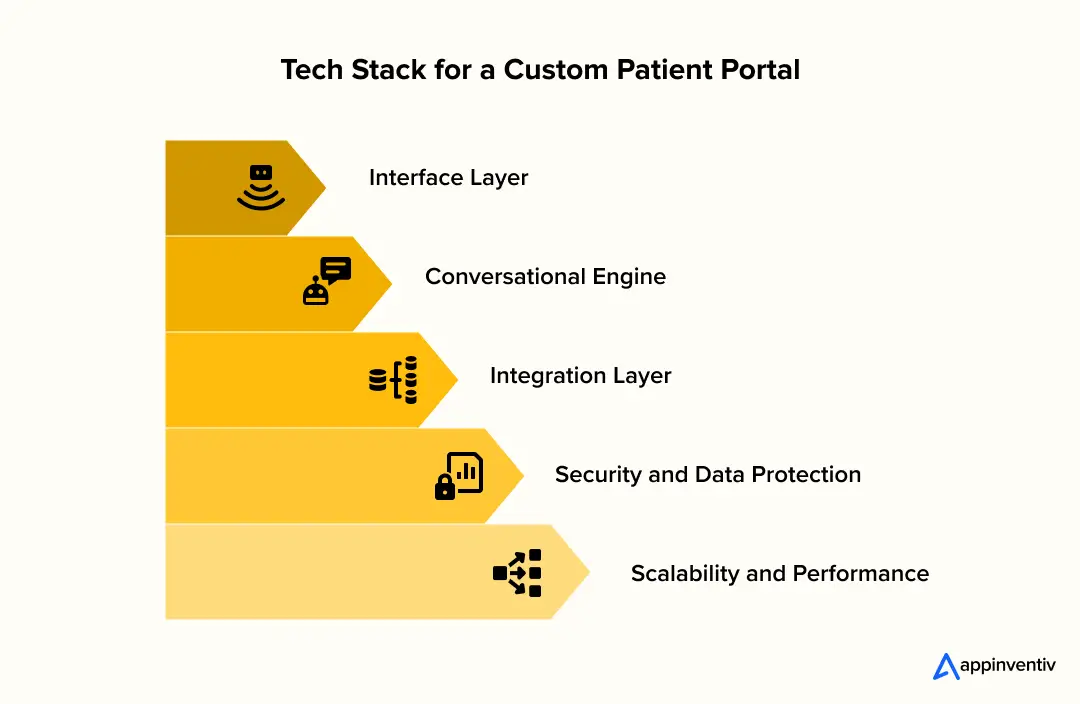
1. Interface Layer
This is what students and staff see. It needs to feel familiar and easy to use so people do not hesitate to ask questions.
- Available inside websites, student portals, and mobile apps
- Simple layout that works well on phones and low-bandwidth connections
- Quick access to common options like admissions, schedules, and fees
- Smooth switching between Arabic and English
When the interface feels natural, adoption improves.
2. Conversational Engine
Students rarely ask questions in perfect sentences. The chatbot must interpret everyday language and respond accurately.
- Language models interpret questions in Arabic and English
- Intent detection identifies whether the query relates to deadlines, fees, or coursework
- Retrieval-Augmented Generation (RAG) pulls verified information from institutional knowledge bases
- Context tracking keeps follow-up questions connected to earlier ones
- Performance monitoring and controlled model updates improve response accuracy while maintaining data privacy safeguards.
Many institutions use a mix of structured workflows and AI understanding to balance reliability with flexibility.
3. Integration Layer
A chatbot becomes useful when it connects to systems students already rely on.
- LMS access for assignments, materials, and course schedules
- Student Information Systems for enrollment and records
- Communication tools for alerts and notifications
- Policy databases for academic rules and procedures
Without integration, responses stay generic. With integration, answers become actionable.
4. Security and Data Protection
Education systems manage sensitive personal and academic records. Protection cannot be an afterthought.
- Encryption technology protects data during transfer and storage
- Role-based access control (RBAC) ensures that only authorized personnel can view sensitive information
- Data masking protects personally identifiable information in logs, dashboards, and support views
- API security controls authenticate and monitor system-to-system communication
- Audit logging records access and activity for compliance, monitoring, and incident response
- UAE data residency options, including Amazon Web Services UAE Region and Microsoft Azure UAE data centers, support local governance requirements
- Alignment with PDPL privacy expectations and institutional data policies
Trust depends on how securely student data is handled. When security controls are built into the foundation rather than added later, institutions reduce risk while maintaining compliance and operational confidence.
5. Scalability and Performance
Inquiry volumes spike during admissions, exams, and enrollment periods. Systems must remain responsive.
- Cloud infrastructure supports traffic surges
- Load balancing prevents slowdowns during peak hours
- Modular architecture allows features to expand over time
- Monitoring tools detect performance issues early
A scalable design ensures the chatbot continues to perform at peak demand. A well-structured AI chatbot architecture for education does more than answer questions. It connects students to accurate information quickly while maintaining security, reliability, and room for future growth. A well-designed architecture of an AI chatbot for e-Learning platforms ensures responses remain accurate, secure, and scalable as student needs grow.
Key Features Of AI Chatbots For Online Learning Platforms
Students don’t move through campus support in tidy steps. One minute they need a deadline, the next they’re searching for lecture notes, and later they’re trying to figure out where to upload an assignment. A chatbot for education becomes valuable when it supports these everyday moments instead of sending students across multiple portals.
For institutions, this means fewer repetitive queries and less confusion. For students, it means quick answers and less friction. The right features turn a chatbot from a simple response tool into a practical academic companion.
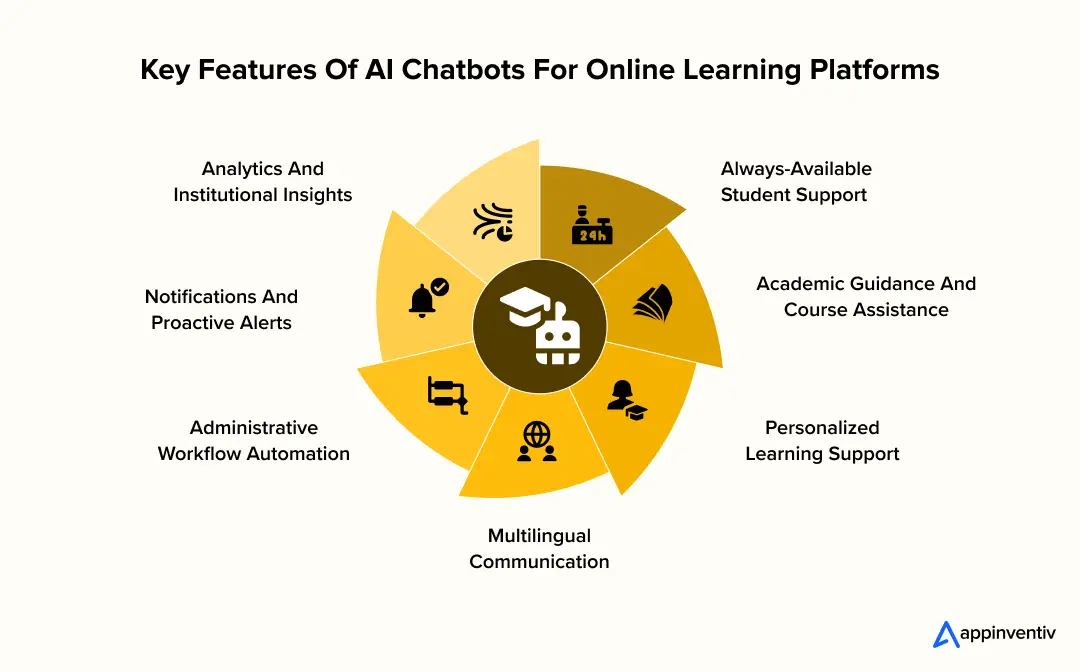
1. Always-Available Student Support
- Answers questions about admissions, schedules, fees, and exams
- Responds instantly outside office hours
- Reduces queues during peak periods
- Round-the-clock access is often the first reason institutions adopt a chatbot for education platforms.
2. Academic Guidance And Course Assistance
- Shares assignment deadlines and exam schedules
- Provides direct links to lecture materials and resources
- Guides students through LMS navigation
- Helps learners stay organized and avoid missed deadlines.
3. Personalized Learning Support
- Sends reminders aligned with course timelines, assessment schedules, and LMS activity triggers
- Suggests relevant study materials based on course enrollment, learning progress, and content access patterns
- Helps students track academic progress through milestone updates and completion indicators
- Surges proactive nudges when inactivity, missed submissions, or low engagement signals appear
- Integrates with LMS analytics and student information systems to deliver context-aware guidance
An AI-powered learning assistant provides timely nudges that help students stay organized, engaged, and academically on track.
4. Multilingual Communication
- Supports Arabic and English conversations using natural language understanding tuned to regional usage
- Allows seamless language switching within the same interaction without restarting the session
- Recognizes mixed-language queries and responds with clear, contextually appropriate phrasing
- Maintains consistency in academic terminology across languages to avoid confusion
- Improves accessibility for international students through culturally aware language handling
Clear, accurate communication strengthens engagement across diverse student communities and supports inclusive campus experiences.
Also read: Master English-Arabic App Development for MENA Market
5. Administrative Workflow Automation
- Assists with admission inquiries and document requirements
- Shares fee payment instructions and deadlines
- Guides students through enrollment steps
- Intelligent Automation reduces repetitive workload for administrative teams.
6. Notifications And Proactive Alerts
- Sends reminders for deadlines and events
- Notifies students about schedule changes
- Alerts learners about important academic updates
- Proactive updates prevent confusion and last-minute issues.
7. Analytics And Institutional Insights
- Tracks common student queries and patterns
- Highlights areas where students need more guidance
- Helps improve communication and support processes
- Insights support continuous institutional improvement
When thoughtfully implemented, AI chatbot features for online learning platforms go beyond answering questions. They simplify daily academic interactions, support student success, and ease operational pressure across the institution.
How to Build An AI Chatbot For Education Platforms in the UAE
Deciding to introduce an AI bot for education is the easy part. Making sure it actually helps students and staff takes more thought. Some institutions move too quickly, only to find the chatbot feels disconnected from real campus needs. A structured approach helps the system fit daily workflows, respect privacy obligations, and connect smoothly with existing platforms. This is why many universities work with an experienced AI development company in Dubai to guide technical decisions and ensure compliance with regulatory requirements. This structured approach supports both scalability and the long-term AI chatbot development timeline, helping institutions avoid costly redesigns later.
Projects that succeed usually move step by step rather than trying to launch everything at once.
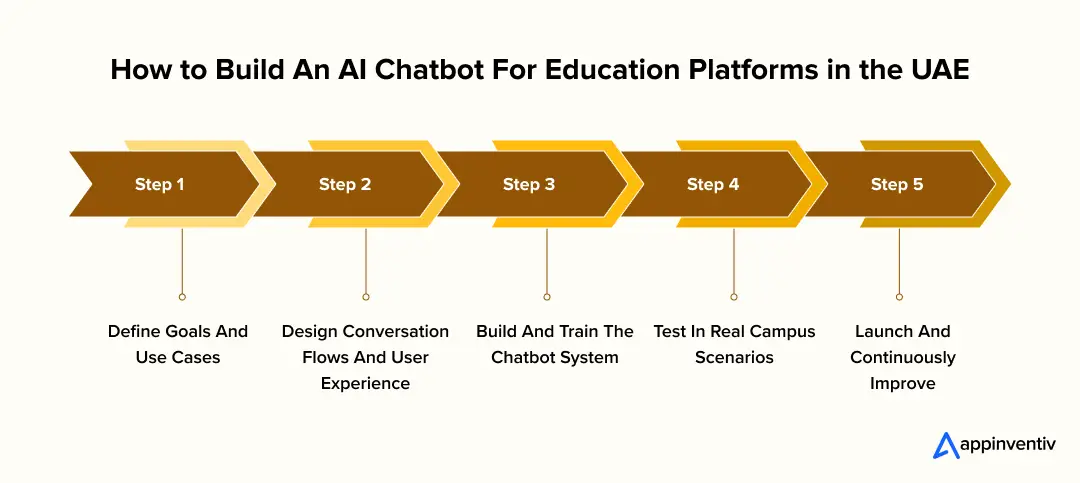
Step 1: Define Goals And Use Cases
Start with the problems students and staff face every day.
- Identify frequent questions and support gaps
- Focus on needs such as admissions help, course navigation, and reminders
- Consider language accessibility and inclusion needs
- Review privacy and compliance obligations
Clear priorities keep the effort practical and focused.
Step 2: Design Conversation Flows And User Experience
Before building anything, think about how students will interact with the chatbot.
- Map typical student questions and journeys
- Make access simple within portals and mobile apps
- Use clear, helpful, and culturally appropriate language
- Plan responses in both Arabic and English
If the experience feels natural, students are more likely to use it.
Step 3: Build And Train The Chatbot System
This phase establishes the technical foundation that determines accuracy, security, and scalability.
- Design the AI architecture using large language models with Retrieval-Augmented Generation (RAG) to ground responses in verified institutional knowledge
- Structure the knowledge base with policies, FAQs, and academic workflows to ensure accurate answers
- Train the system to understand Arabic and English queries, including mixed-language usage
- Configure intent recognition and context handling for multi-turn conversations
- Integrate LMS platforms, student information systems, and communication tools through secure APIs
- Implement role-based access controls and core security safeguards to protect sensitive data
- Establish performance monitoring and controlled updates to maintain accuracy and compliance
A solid foundation supports reliable and secure responses. At this stage, institutions often develop a custom AI chatbot for eLearning to align workflows, language requirements, and academic processes with campus needs.
Step 4: Test In Real Campus Scenarios
What works in development may behave differently when real students begin asking questions. Testing ensures the chatbot performs reliably under real campus conditions.
- Verify response accuracy and conversation flow across common student queries
- Conduct privacy, security, and access control checks
- Perform load and performance testing to ensure stability during admissions peaks and high inquiry volumes
- Run pilot testing with staff and a small student group
- Refine answers and workflows based on real interactions
- Define clear handoff points when human support should step in
Thorough testing helps prevent confusion at launch and ensures the chatbot remains responsive, secure, and reliable during peak usage periods.
Step 5: Launch And Continuously Improve
Launch marks the beginning of real usage, not the end.
- Monitor usage and performance trends
- Update responses based on actual student questions
- Expand features and integrations gradually
- Improve accuracy and usability over time
Regular refinement keeps the chatbot useful. Understanding the timeline to develop an education chatbot helps institutions plan deployments around admissions cycles and academic calendars.
Typical Build Timeline
Implementation timelines vary based on integration depth, personalization requirements, Arabic-language optimization, knowledge-retrieval design, and compliance scope.
- Basic support chatbot: about 3–4 months
Suitable for FAQ automation and admissions queries with limited integrations. The timeline remains shorter when bilingual support is minimal, and compliance requirements are straightforward. - Academic support chatbot: about 4–7 months
Includes LMS integration, structured academic guidance, and Arabic NLP tuning. Additional time is required for workflow design, multilingual accuracy, and student journey personalization. - Fully integrated AI learning assistant: about 6–9+ months
Supports deep system integrations, Retrieval-Augmented Generation (RAG) knowledge grounding, personalized learning guidance, and advanced compliance controls. Extended timelines typically reflect data governance requirements, identity integration, and institution-wide deployment readiness.
Building an AI bot for education platforms is less about deploying technology and more about fitting into everyday campus life. When institutions plan carefully and refine over time, the chatbot becomes a dependable support tool rather than something students overlook. The overall AI chatbot development timeline varies depending on integrations, language support, and the depth of personalization.
Align integrations, compliance requirements, and user experience before development to ensure long-term performance.

Cost Breakdown For Developing An AI Chatbot For Education Platforms in the UAE
When universities evaluate an AI chatbot, the first question is usually about cost and impact. Leaders want to know whether it will ease pressure on admissions teams, respond faster to students, and justify the investment.
In most UAE education projects, budgets fall between AED 150,000 and AED 1,470,000 ($40,000–$400,000). The lower end typically covers structured FAQ-style bots, while the higher range applies when the chatbot becomes part of academic and operational systems.
What shapes the investment:
- Bilingual language support: Teaching the chatbot to understand Arabic and English clearly requires linguistic tuning, testing, and alignment of terminology.
- Arabic NLP optimization: Handling mixed-language queries and regional phrasing adds training and validation effort.
- Connections to campus systems: Linking LMS platforms, student records, identity systems, and communication tools enables real-time responses but requires integration development.
- Retrieval-Augmented Generation (RAG) setup: Structuring institutional knowledge and ensuring accurate, grounded responses adds design and engineering effort.
- Student data protection requirements: Institutions must safeguard personal information and meet PDPL privacy expectations.
- UAE data residency and hosting: Deploying in-country infrastructure using UAE regions (such as Amazon Web Services or Microsoft Azure) may influence hosting and compliance costs.
- Compliance and governance requirements: Alignment with institutional policies, audit controls, and regulatory expectations adds planning and implementation time.
- Design around real student journeys: Admissions questions, course navigation, and support requests require thoughtful conversation flow design.
- Ongoing updates and governance: Policies change, deadlines shift, and academic content evolves. Regular refinement and controlled updates keep responses accurate.
Typical cost ranges by capability:
| Chatbot Type | Estimated Cost | Typical Use |
|---|---|---|
| Basic Support Bot | AED 150,000 – 300,000 ($40K – $80K) | Handles admissions queries and routine student questions |
| Academic Support Bot | AED 300,000 – 900,000 ($80K – $245K) | Provides coursework guidance and structured student support |
| AI Learning Assistant | AED 900,000 – 1,470,000 ($245K – $400K) | Integrates with academic systems and supports personalized learning journeys |
The cost to build a chatbot for education increases as integrations deepen and personalization improves. Institutions that plan for language support, compliance, and future growth from the start tend to avoid costly rebuilds later and gain more value over time.
Key Benefits Of AI Chatbots For Educational Institutions in the UAE
Ask any student what frustrates them most during the academic year, and the answer is rarely about technology. It is about delays, unclear information, and not knowing where to go for help. A chatbot for education helps close these gaps by making support easier to access and information easier to understand.
For institutions, the benefit goes beyond convenience. Chatbots help teams manage growing workloads while improving responsiveness and student satisfaction.
1. Enhanced Student Engagement
- Students receive instant answers instead of waiting for office hours
- Clear guidance reduces confusion during admissions and course registration
- Continuous support helps students stay connected to academic processes
A chatbot for education platforms ensures students always have a starting point when they need help.
2. Reduced Administrative Workload
- Handles repetitive questions about fees, schedules, and policies
- Automates admission inquiries and document guidance
- Allows staff to focus on complex student needs
Administrative teams spend less time answering routine questions.
3. Improved Learning Support
- Provides reminders for assignments and deadlines
- Guides students to relevant learning materials
- Supports self-paced study with structured assistance
An AI-powered learning assistant helps students stay organized and engaged with coursework.
4. Better Support For Diverse Student Communities
- Multilingual responses improve accessibility
- International students receive clearer guidance
- Consistent communication reduces misunderstandings
This is especially valuable in the UAE’s multicultural education environment.
5. Faster Response And 24/7 Availability
- Students receive help outside office hours
- Time zone differences no longer create barriers
- Urgent queries are resolved without delay
Continuous availability improves student confidence and satisfaction.
6. Data Insights For Better Decision-Making
- Identifies common student concerns and recurring issues
- Highlights areas where processes need improvement
- Helps institutions refine communication strategies
Insights gathered from chatbot interactions support continuous improvement. The benefits of AI chatbot in the education sector extend beyond automation. They improve responsiveness, reduce operational pressure, and create a more supportive experience for students navigating academic life.
Also Read: A Quick Guide to the Pros and Cons of Chatbot Development
Real World Use Cases of AI Chatbots in Education
Spend a morning at a university help desk in the UAE during admissions season and you will see a familiar scene. Students asking about deadlines. Parents calling about fee payments. Applicants unsure where to upload documents. Staff repeating the same answers all day.
To ease that pressure, many campuses have introduced chat-based support. Instead of waiting in line or chasing email replies, students can ask a quick question and get moving. Most don’t think about the technology behind it. They just want a clear answer and the next step.
Here are a few examples that show how conversational support is being used in real settings.
1. University of Birmingham Dubai: Staying Available Across Time Zones
At the University of Birmingham Dubai, chat support helps respond to questions from prospective and enrolled students around the clock.
What this shows: With students reaching out from different countries and time zones, automated responses help the university stay accessible without extending office hours.
2. Zayed University Library Chatbot (“Aisha”): Academic Support & Access
Zayed University Library introduced a conversational assistant to guide students and researchers to journals, services, and learning resources.
What this shows: Support is moving beyond admissions. Chat interfaces now help students find academic materials without having to navigate multiple portals.
3. National AI Investments Strengthening Student Services
The UAE continues investing in AI infrastructure and Arabic language technologies as part of its broader digital transformation efforts.
What this shows: As national AI capabilities grow, institutions gain better tools to make student services faster and easier to access.
4. Ministry of Education: Encouraging Responsible AI Use in Schools
The UAE Ministry of Education is promoting AI literacy, safe usage practices, and governance standards for AI adoption in education.
What this shows: Clear guidance helps schools and universities introduce AI-assisted support in a way that remains transparent and accountable.
Rule-Based vs AI Chatbots in Education: Choosing the Right Approach
When institutions first explore chatbots, one of the biggest questions is how “smart” the system really needs to be. Some chatbots guide users through fixed options. Others can understand how students naturally ask questions and respond in a more conversational way. The right choice depends on the type of support students need and how they interact with campus systems.
| Aspect | Rule-Based Chatbots | AI-Driven Chatbots |
|---|---|---|
| How they respond | Follow preset options and scripted replies | Understand questions written in natural language |
| Best use cases | Admission steps, policy info, fee details | Academic guidance, student support, complex queries |
| Flexibility | Limited to defined flows | Adapts to different ways students ask questions |
| User experience | Button-based or menu navigation | Conversational, more natural interaction |
| Follow-up questions | Often resets the flow | Maintains context during the conversation |
| Language handling | Keyword-based recognition | Understands Arabic and English phrasing |
| Improvement over time | Requires manual updates | Learns from interactions and improves accuracy |
| Implementation effort | Faster to deploy | Requires training and system integration |
| Cost profile | Lower upfront investment | Higher upfront cost with broader long-term value |
| Role in education | Handles routine administrative queries | Supports learning guidance and student assistance |
Why do many institutions use both:
In practice, a blended approach often works best.
- Rule-based flows manage structured processes such as admissions steps.
- AI understanding supports conversational queries and student guidance.
- Human staff step in when situations require personal attention.
For institutions planning long-term chatbot in education initiatives, combining structure with conversational intelligence creates a system that is both reliable and helpful.
Also Read: Chatbots vs. Conversational AI: Which Suits Your Business?
Challenges in AI Chatbot Development for Education in the UAE and How to Overcome Them
On paper, launching a chatbot looks straightforward. On campus, it meets real habits, mixed languages, older systems, and strict privacy expectations. If these realities are ignored, the tool meant to simplify support can create new confusion. Addressing common obstacles early helps ensure an AI bot for education actually feels useful.
1. Language And Cultural Nuances
Students often switch between Arabic and English in the same sentence, and tone matters. If the chatbot sounds unnatural or misinterprets phrasing, trust drops quickly.
Challenge: Replies feel confusing, overly literal, or culturally out of place.
What helps:
- Arabic NLP tuning to improve understanding of regional phrasing and academic terminology
- Dialect handling to interpret variations in Gulf Arabic expressions
- Code-switching detection so the chatbot can understand mixed Arabic–English queries
- RTL (right-to-left) UI compatibility to ensure Arabic conversations display correctly across devices
- Testing responses with local students to refine tone, clarity, and cultural appropriateness
When language handling reflects how students actually communicate, the chatbot feels natural and easier to trust.
2. Integration With Existing Systems
Many institutions still rely on legacy platforms, and student information often sits across multiple systems.
Challenge: Information appears outdated, inconsistent, or disconnected from real campus workflows.
What helps:
- Connect systems through secure API integrations (or middleware) so the chatbot can pull live data instead of static answers
- Use LMS APIs to fetch course schedules, assignment links, and learning resources in real time
- Integrate Student Information System (SIS) APIs for enrollment status, student profiles, and academic records where appropriate
- Use identity and access APIs (SSO) to ensure the chatbot only shows data the user is allowed to see
- Roll out integrations step by step, starting with low-risk workflows (FAQs, admissions) before expanding into academic and student-record use cases
When integrations are API-led and permissioned, the chatbot stays accurate, useful, and aligned with institutional governance.
3. Privacy And Data Protection
Student records include personal and academic details that must stay secure.
- Challenge: Delivering quick responses without exposing sensitive data
- What helps: Encrypt data, restrict access, and align storage practices with PDPL expectations
4. Accuracy And Trust
Students rely on chatbot answers for deadlines, fees, and academic procedures. If the information is wrong or outdated, trust disappears quickly.
Challenge: Inaccurate or inconsistent responses make students stop relying on the system.
What helps:
- Use Retrieval-Augmented Generation (RAG), so answers come from verified university sources, not generic AI responses
- Maintain a single, approved knowledge base for policies, schedules, and procedures
- Review and update content regularly to keep information current
- Flag uncertain responses and route them for human review
When answers are grounded in trusted sources and kept up to date, students feel confident relying on the chatbot.
5. Encouraging Adoption
Even helpful tools can be ignored if people aren’t sure when to use them.
- Challenge: Low engagement from students and staff
- What helps: Introduce the chatbot during admissions or onboarding, and keep human help easy to reach
6. Setting Clear Boundaries
A chatbot can guide students, but it cannot replace academic advising.
- Challenge: Users expect it to solve complex or sensitive issues
- What helps: Clarify what the chatbot can do and enable smooth handoff to staff when needed
Institutions that plan for these realities early tend to build systems that feel supportive rather than frustrating. A thoughtfully implemented AI chatbot for education platforms improves communication, reduces confusion, and helps students move through academic processes with greater ease.
Also Read: 11 key AI adoption challenges for enterprises to resolve
Data Privacy, Compliance, And Ethical AI In Education Chatbots
When students share their details with a university system, they don’t think about servers, databases, or security layers. They assume their information is safe. A chatbot may look like a simple chat box, but it often connects to systems that store contact details, academic records, and past conversations. Keeping that data secure isn’t only a technical responsibility. It’s part of maintaining trust.
For institutions in the UAE, introducing AI-based student support means addressing privacy, responsible use, and oversight from the outset.
1. Protecting Student Data
Education platforms handle information that students expect to remain private.
- Encrypt data during transfer and storage
- Limit access to authorized staff and systems
- Use secure hosting environments that meet compliance requirements
- Set clear rules for retention and deletion
These safeguards help reassure students that their information is handled responsibly.
2. Aligning With UAE Privacy Expectations
The UAE Personal Data Protection Law (PDPL) outlines how personal data should be handled.
- Collect only the information that is necessary
- Inform users how their data will be used
- Store and process information securely
- Ensure technology partners follow compliance obligations
How data is handled plays a direct role in institutional credibility.
3. Ethical Use Of AI In Student Interactions
Students should not feel misled when using automated support.
- Make it clear when responses are AI-generated
- Avoid presenting automated replies as human responses
- Keep answers accurate and easy to understand
- Provide a simple way to reach human support
Transparency helps build confidence in the system.
4. Preventing Bias And Ensuring Fair Support
AI systems can reflect bias if they are not monitored.
- Train systems using diverse scenarios and language patterns
- Review responses for cultural sensitivity
- Monitor outputs to detect unintended bias
- Maintain human oversight for sensitive situations
Fair responses are essential in diverse student communities.
5. Governance And Ongoing Oversight
Responsible AI requires ongoing attention.
- Establish policies for chatbot use and content review
- Monitor interactions for accuracy and compliance
- Update knowledge sources as procedures change
- Escalate sensitive or complex cases to staff
When privacy safeguards and ethical practices are built into the foundation, chatbots become a reliable support channel rather than a risk. Students feel more comfortable seeking help, and institutions maintain the credibility expected in an academic environment.
Also Read: Executive Guide to Enterprise AI Governance and Risk
Future Of AI Chatbots in UAE & Middle East Education
A few years ago, campus chatbots mostly handled basic FAQs. Today, they are becoming part of how students get through the day. They check schedules on their phones, submit assignments online, and expect help to be just as quick. As universities across the UAE continue expanding digital services, chat support is moving from a “nice extra” to something students naturally rely on. Campuses in Dubai, Abu Dhabi, and Sharjah are likely to expand this support as digital services continue to evolve.
The next phase is less about adding new features and more about removing everyday friction:
- Voice queries: Students asking quick questions instead of typing when they need fast guidance
- Smarter reminders: Notifications that reflect schedules, deadlines, and recent activity
- Early alerts: Signals when missed submissions or low engagement suggest a student may be falling behind
- Support in familiar apps: Help delivered through messaging platforms students already use
- Closer LMS connection: Academic updates surfaced directly from learning systems
As smart campus initiatives grow and digital public services raise expectations for convenience, chat support will become less visible but more dependable, a quiet layer helping students stay informed, organized, and on track.
Also Read: Shaping the Future with Bots
Deploy an AI chatbot platform that improves responsiveness, supports growth, and delivers measurable efficiency gains.

How Appinventiv Can Help Develop Your AI Chatbots For Education Platforms in the UAE
Introducing a chatbot on campus is not just a technical project. It involves understanding how students look for help, how departments share information, and how sensitive data is handled. Appinventiv builds ai chatbot for education platforms that fit into everyday academic workflows while respecting UAE privacy and compliance expectations.
Through our AI consulting services in Dubai, we help institutions plan how the chatbot will connect with existing systems, what data it should access, and how it can scale as needs grow. Taking time to get this right early helps avoid disruption later.
One example is the KODA career coaching platform, where we supported the creation of a digital guidance experience that delivers personalized recommendations and structured learning support. It shows how intelligent tools can guide users through important decisions without complicating the experience.
If your institution wants to make student support more responsive while easing staff pressure, consult our AI experts to design a secure, scalable education chatbot tailored for UAE institutions.
FAQs
Q. How does an AI-powered learning assistant support students?
A. An AI-powered learning assistant helps students manage everyday academic tasks. It can remind them about deadlines, point them to the right course materials, and answer routine questions without delay. Instead of searching through multiple portals or waiting for replies, students get clear direction when they need it.
Q. What makes an education chatbot different from a regular chatbot?
A. A standard chatbot usually answers simple customer queries. An AI chatbot for education is built for academic environments. It connects with campus systems, understands questions about schedules or coursework, and supports bilingual communication. Its purpose is to guide students through real academic processes rather than provide generic responses.
Q. What technologies are used in AI chatbot development for education?
A. AI chatbot development for education relies on several technologies working together:
- Natural language processing to understand everyday questions
- Machine learning to improve responses over time
- Integrations with LMS and student systems
- Cloud infrastructure to handle high usage
- Security and encryption to protect student data
- Retrieval-Augmented Generation (RAG) to pull accurate information from institutional knowledge bases and reduce hallucinations
- Large Language Models (LLMs) to understand and generate natural, context-aware responses
These elements enable the chatbot to deliver accurate, timely support.
Q. What is the cost to build an AI chatbot for education in the Middle East?
A. The cost to build an AI chatbot for education in the Middle East generally ranges from AED 150,000 to AED 1,470,000 ($40,000 to $400,000), depending on complexity. A basic support chatbot costs less, while a fully integrated learning assistant with multilingual support and system connections requires a larger investment.
Q. What factors affect AI chatbot development cost?
A. Several factors influence chatbot development cost:
- Arabic and English language support
- Integration with campus systems
- Security and compliance requirements
- Custom features and personalization
- Ongoing updates and maintenance
Planning for these early helps avoid unexpected expenses later.
Q. Can Arabic-language AI chatbots support education environments?
A. Yes. Arabic-language capability is essential across the region. A well-designed chatbot can understand Arabic queries, respond clearly, and switch between Arabic and English when needed. This improves accessibility and ensures students receive guidance they understand.
Q. Why is a bilingual AI chatbot for education platforms important?
A. A bilingual AI chatbot for education platforms supports both Arabic and English speakers, which is critical on diverse campuses. Students can communicate in the language they are most comfortable with, reducing confusion and improving engagement.
Q. How can universities in the UAE benefit from AI chatbots?
A. Universities benefit from an AI chatbot for education by improving response times, easing administrative workload, and offering support around the clock. Chatbots also help manage high inquiry volumes during admissions and enrollment periods.
Q. How do AI chatbots improve administrative efficiency in education?
A. Chatbots handle repetitive questions about deadlines, fees, and processes. This reduces email volume and support calls, allowing staff to focus on more complex student needs.
Q. Can AI chatbots help international students?
A. Yes. Chatbots provide multilingual guidance, explain academic procedures, and offer assistance across time zones. This makes it easier for international students to navigate unfamiliar systems and requirements.
Q. How do chatbots improve remote learning?
A. In remote or hybrid learning environments, chatbots provide quick access to schedules, materials, and support. Students receive reminders and guidance without waiting for instructor availability, helping them stay engaged and organized.
Q. Can AI chatbots integrate with ChatGPT-like models for education?
A. Yes. Modern systems can include generative AI capabilities to explain concepts, summarize materials, and guide research. When connected to institutional data sources, responses remain accurate and aligned with academic policies.
Q. What ethical concerns exist around AI chatbots in education?
A. Common concerns include data privacy, transparency, and accuracy. Students should know when they are interacting with AI, and institutions must protect personal data. Clear policies and oversight help maintain trust.
Q. How can AI chatbots ensure unbiased learning support?
A. To provide fair support, chatbots should be trained on diverse data, reviewed regularly for bias, and monitored for culturally sensitive responses. Human oversight helps ensure all students receive equitable guidance.

- In just 2 mins you will get a response
- Your idea is 100% protected by our Non Disclosure Agreement.
How Much Does It Cost to Build a Conversational AI Chatbot in the UAE?
Key Takeaways AI chatbot development in the UAE typically costs AED 150,000–1,470,000 ($40K–$400K), based on complexity. Backend integration and compliance drive cost more than the chatbot interface itself. Arabic NLP, UAE hosting, and PDPL requirements increase budget and engineering effort. LLM + RAG enterprise chatbots sit at the higher end due to integration and infrastructure…

AI Inventory Management in Australia: Benefits, Use Cases, and Implementation Strategies
Key takeaways: Traditional ERP planning reacts to history; AI predicts demand shifts, reallocates stock dynamically, and prevents costly stockouts across distributed Australian networks. AI in inventory management in Australia typically reduces inventory levels 20–40% while maintaining service targets, unlocking significant working capital across multi-state operations. Enterprise implementations usually range from AUD 70,000 to AUD 700,000+,…
How to Hire RAG Architects for Enterprise AI
Key takeaways: Define your RAG architecture scope to avoid misaligned hiring decisions Identify end-to-end architectural ownership across retrieval, governance, and scaling Evaluate deep technical capabilities beyond prompt engineering and tools Validate governance and compliance readiness at the retrieval layer Test system-level thinking through real-world failure scenarios Choose the right hiring model based on scale, risk,…









