































![70 Points Apple App Store Submissions Checklist [2019 Edition]](https://appinventiv.com/wp-content/uploads/2018/05/70-Points-Apple-App-Store-Submissions-Checklist.png)
Software Development in the Middle East – Benefits, Use Cases, Process, Costs

 Share -



- 01Why Enterprise Software Development Is Accelerating in the Middle East
- 02Benefits of Custom Software Development in the Middle East
- 03Enterprise Use Cases of Software Development in the Middle East
- 04Enterprise Software Development Roadmap in the Middle East
- 05Enterprise Software Development Costs in the Middle East
- 06Challenges and Misconceptions Around Custom Software Development in the Middle East
- 07Choosing the Right Partner for Software Engineering Services in the Middle East
- 08Future Trends: AI-Powered Software Development in the Middle East
- 09Why Enterprises Partner with Appinventiv for Software Development in the Middle East
- 10Frequently Asked Questions

- Compliance and data residency requirements shape enterprise software architecture decisions across Middle East markets.
- Custom software improves operational efficiency, scalability, and regulatory readiness for regional enterprise expansion.
- Integration complexity and legacy infrastructure often drive project timelines more than feature development itself.
- AI adoption is shifting from experimentation toward operational analytics, automation, and enterprise decision support.
- Regional delivery experience and compliance expertise matter more than pricing when selecting technology partners.
Software decisions in the Middle East are no longer routine IT upgrades. They are tied directly to growth plans, compliance exposure, and how quickly your organization can respond to market shifts.
Government-backed transformation programs are accelerating this shift. Saudi Vision 2030 initiatives, UAE digital economy policies, and national AI strategies are creating both opportunity and urgency. That momentum continues to expand software development in the Middle East across banking, healthcare, logistics, public services, and energy infrastructure.
Cloud adoption is also changing executive priorities. Regional hyperscaler data centers now allow advanced analytics and AI deployment while keeping sensitive information within national borders. For regulated industries, this data sovereignty requirement often shapes enterprise architecture decisions from the very beginning.
Because of this, enterprise software investments are shifting toward long-term resilience, operational visibility, and scalable infrastructure. What were once framed as digital transformation initiatives are now treated as core business systems with measurable impact.
In this blog, you will explore enterprise benefits, real-world use cases, development processes, and cost considerations shaping software investment across the region.
Gartner expects MENA IT spending to reach about $169 billion by 2026

Why Enterprise Software Development Is Accelerating in the Middle East
If you sit through technology budget reviews these days, one thing stands out quickly. Software investment is rarely treated as optional anymore. It usually comes up alongside expansion plans, compliance readiness, or operational visibility.
Spending trends are backing this shift
- Gartner expects MENA IT spending to reach about $169 billion by 2026.
- Enterprises are allocating more budget toward platforms that support scalability, automation, and data integration.
- Software initiatives are increasingly linked to revenue protection and operational continuity.
AI adoption is gaining real traction
- AI contribution across the region is projected to grow roughly 20 to 34 percent annually.
- The UAE currently leads adoption momentum, with Saudi Arabia following closely. The pace of Dubai’s AI landscape alone reflects how quickly enterprises are moving from pilot programs to production-grade deployments.
- Common enterprise applications include fraud monitoring, predictive maintenance, customer analytics, and workflow automation.
Policy-driven digital transformation
- Government digitization programs continue to shape enterprise technology priorities across the region.
- Saudi Vision 2030 is accelerating large-scale digital infrastructure, cloud adoption, and private-sector modernization initiatives.
- The UAE Digital Government Strategy is driving platform consolidation, AI integration, and citizen-centric digital services.
- Qatar National Vision 2030 supports knowledge-based economic growth through technology investment and smart infrastructure programs.
- Many enterprises align software and platform investments with these national strategies to strengthen compliance, competitiveness, and long-term scalability.
Infrastructure and data considerations
- Regional cloud expansion allows advanced analytics adoption while meeting local data residency expectations.
- This matters especially for finance, healthcare, and public sector organizations.
Today, enterprise software development in the Middle East is less about experimentation and more about operational readiness. These initiatives increasingly support broader transformation goals tied to scalability, resilience, and long-term business growth rather than isolated innovation projects.
Benefits of Custom Software Development in the Middle East
Most enterprises entering Middle East markets start with standard software. It works for a while. Then, regional realities show up, compliance nuances, language expectations, legacy infrastructure, and cross-border expansion plans. That is usually when leadership teams begin considering custom platforms, not for novelty, but because operational friction starts costing time and money.
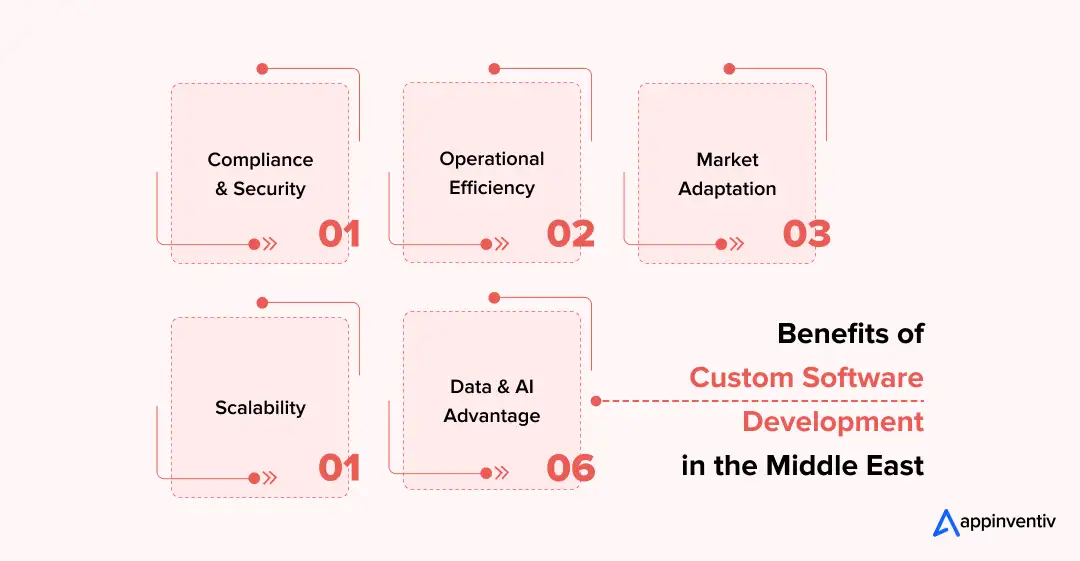
Regional Compliance Alignment
Regulation here is not a side consideration. It often shapes architecture decisions early, sometimes before development even begins.
- Data sovereignty rules can require certain datasets to stay inside national borders.
- Regulations shift periodically, especially in finance and healthcare, so adaptable platforms reduce long-term risk.
- Localization extends beyond language. Reporting formats, approval flows, and audit readiness often need regional alignment.
This is one of the more practical benefits of custom software development that Middle East enterprises lean on when compliance exposure increases.
Operational Efficiency at Enterprise Scale
Efficiency usually improves when systems finally start talking to each other properly. Many organizations discover this only after integration challenges slow operations.
- Process optimization helps departments coordinate without excessive back-and-forth.
- Legacy modernization in Dubai allows enterprises to adopt new capabilities without shutting down the operations that still depend on revenue.
- Automation reduces manual reporting, reconciliations, and repetitive operational tasks. This is especially visible in workforce management, where Dubai HRMS development has helped enterprises automate HR workflows that previously required significant manual effort.
Often, the biggest improvement comes from visibility rather than new functionality.
A practical example is IKEA’s regional digital transformation initiative, where Appinventiv developed an ERP-integrated retail solution with IoT kiosks to enhance in-store discovery, streamline onboarding, and centralize operational data. The result was better customer interaction insights alongside improved operational efficiency.

Competitive Differentiation in Regional Markets
Markets across the region differ more than they appear on paper. Customer behavior, regulatory context, and operational norms vary significantly.
- Localization supports tailored customer engagement strategies. However, localization in this region goes deeper than translation. Arabic app localization challenges introduce specific UI, font rendering, and RTL layout considerations that require dedicated technical planning.
- Arabic UX optimization can improve adoption rates, especially in consumer-facing systems.
- Faster response to market changes becomes easier when software reflects regional workflows.
These adjustments often influence customer retention and operational responsiveness.
Scalability for Regional Expansion
Expansion plans tend to expose software limitations quickly. What works in one country may struggle in another.
- Multi-country deployment readiness prevents costly rebuilds later.
- Cloud-native infrastructure helps manage varying demand across markets.
- A scalable software architecture in the Middle East that enterprises build early usually supports smoother regional growth.
AI-Driven Decision Intelligence
AI conversations in the region are becoming more practical now. Leaders expect operational value, not just innovation headlines.
- Predictive analytics helps with forecasting, maintenance planning, and risk monitoring.
- Intelligent automation reduces repetitive workloads while improving consistency.
- Data-backed insights increasingly guide executive decision-making.
Viewed together, the benefits of custom software development that Middle East enterprises pursue are rarely about customization alone. They are about operational clarity, regulatory confidence, and the ability to grow without constant technology constraints.
Enterprise Use Cases of Software Development in the Middle East
If you look at enterprise tech adoption today, most initiatives are already operational. These are not innovation pilots anymore. Banks are deploying regulated digital finance infrastructure, governments are digitizing services, healthcare providers are integrating data platforms, and large enterprises are building analytics-driven operational systems.
Fintech and Banking Transformation
Financial services transformation is closely tied to regulation and competition.
- The Central Bank’s Open Finance framework enables secure financial data sharing through standardized APIs across licensed institutions.
- Commercial Bank of Dubai has already activated Open Finance capabilities, allowing secure data exchange and transaction initiation through regulated third parties.
For enterprises, the focus usually stays on compliance integration, real-time analytics, and stronger financial risk intelligence. Beyond compliance, leading banks are also deploying AI-driven banking in the Middle East to deliver personalized experiences that improve customer retention and lifetime value.
This is often how organizations build enterprise software in the Middle East when modernizing banking infrastructure.
Healthcare Digital Ecosystems
Healthcare digitalization is accelerating through national health initiatives and enterprise investments.
- The UAE has introduced AI-enabled platforms to support data-driven health policy and clinical decision-making, a trend reflected in the growing use of Dubai’s healthcare AI platforms across both public and private hospital networks.
- Telemedicine and integrated patient data systems are expanding across GCC healthcare networks.
Priorities typically include interoperability, privacy compliance, and clinical workflow efficiency, all core digital transformation drivers.
Smart City and Government Platforms
Government platforms remain highly visible examples of regional software deployment.
- Dubai’s smart city programs integrate urban data analytics, IoT infrastructure, and digital public services. Immersive technologies are also gaining ground and are increasingly used in public-sector training, urban planning simulations, and citizen engagement programs.
- Unified licensing and digital service platforms are reducing administrative friction for enterprises operating in the region.
These initiatives depend heavily on large-scale data integration, IoT analytics, and public service optimization.
Energy, Oil, and Utilities Platforms
Energy and infrastructure companies increasingly rely on operational software.
- Predictive maintenance platforms and asset monitoring tools help reduce downtime. For asset-heavy industries, RFID tracking systems in the UAE are becoming a critical layer that connects physical operations with digital monitoring platforms.
- Smart grid IoT in the Middle East supports more efficient energy distribution and enables utilities to shift toward predictive, data-first operations.
Operational resilience, safety, and performance continuity typically drive these investments.
Retail, Logistics, and Commerce Platforms
Retail and logistics enterprises are investing heavily in data-driven customer and supply chain platforms.
- Companies like Majid Al Futtaim use advanced analytics to improve customer engagement and operational visibility.
- Omnichannel commerce platforms and logistics optimization systems continue expanding across GCC markets.
Customer experience optimization and supply chain intelligence remain the primary outcomes enterprises pursue.
For instance, Appinventiv supported Americana Restaurants with a unified last-mile delivery and operational platform designed to streamline ordering, improve logistics coordination, and provide leadership teams with real-time operational visibility across multiple markets.

Enterprise Software Development Roadmap in the Middle East
You have probably seen how these projects actually unfold. A roadmap gets approved, timelines look realistic, then someone raises a compliance question, a deployment constraint, or an integration dependency. The discussion shifts quickly. That happens often because regulatory expectations, infrastructure realities, and ongoing operational support requirements show up early.
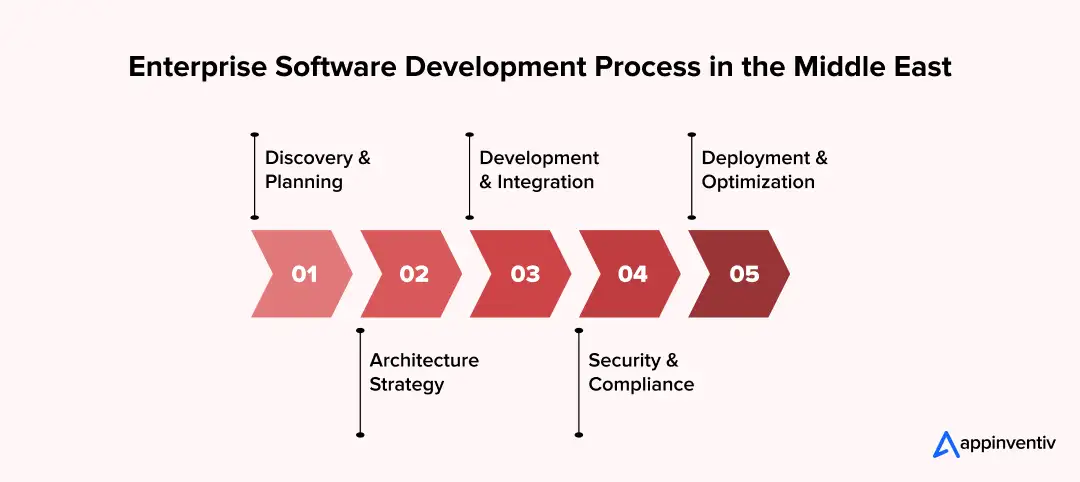
Strategic Discovery and Business Alignment
This stage often decides how smoothly everything else runs. Many enterprise teams treat it as a planning checkpoint, but it usually shapes long-term stability, compliance readiness, and scalability decisions.
Teams connect digital initiatives directly to business KPIs such as reporting speed, operational visibility, or regional expansion readiness. Requirement gathering typically covers compliance exposure, operational workflows, and future growth plans.
What typically gets addressed here:
- Regulatory compliance alignment, including UAE PDPL, Saudi PDPL, DIFC or ADGM frameworks
- Data planning, including ERP software in Dubai integrations like SAP or Oracle — a consideration that often shapes platform architecture from day one.
- Data residency clarity and infrastructure placement
- Structured planning to reduce later rework
Many project delays can be traced back to a lack of clarity at this stage.
Architecture, Design and Technology Strategy
Architecture conversations often reflect geography as much as technology. Cloud location, compliance expectations, and integration readiness usually influence decisions early.
Enterprises frequently balance innovation with regulatory constraints while designing scalable platforms.
Key architecture considerations:
- Regional cloud zones such as AWS Bahrain, Azure UAE, or Google Cloud Doha
- Hybrid environments where sensitive workloads remain local
- Microservices with Docker and Kubernetes for scalability
- API-first design supporting banking, logistics, and government integrations
- Early performance testing, security testing, and functionality validation
These decisions tend to influence operational flexibility for years.
Development, Integration, and Modernization
Execution rarely focuses only on building new features. Integration usually takes center stage, especially when legacy systems remain critical to operations.
Enterprises often prioritize stability alongside development speed.
Typical execution focus areas:
- Agile delivery frameworks supporting phased releases
- Middleware like Kafka or MuleSoft connecting legacy infrastructure
- CI/CD pipelines using Jenkins, GitLab CI, or Azure DevOps
- Continuous deployment and iterative bug fixes
- Functionality testing is integrated throughout delivery cycles
Integration complexity often drives timelines more than development itself.
Security, Governance, and Compliance
Security planning generally begins earlier in enterprise projects. Compliance exposure makes proactive governance essential.
Organizations tend to embed security into architecture rather than treat it as a final step.
Core security considerations:
- DevSecOps practices, including code scanning and container security checks
- Regulatory alignment with UAE NESA, Saudi NCA cybersecurity controls, and sector frameworks
- Identity access management and encryption standards
- Audit logging and ongoing regulatory compliance validation
- Continuous security testing across deployment cycles
This approach reduces risk and operational disruption later.
Deployment, Scaling, and Optimization
Deployment usually signals a transition, not completion. Enterprise platforms quickly move into maintenance, optimization, and scaling phases.
Operational visibility becomes a priority once systems go live.
Post-deployment focus typically includes:
- Observability using Prometheus, Grafana, or ELK stacks
- Maintenance and updates aligned with business and regulatory changes
- Performance improvements through caching, CDNs, and database scaling
- Continuous optimization and security validation
- AI monitoring for predictive analytics environments
Enterprises treating deployment as an ongoing lifecycle generally see stronger platform stability over time.
Enterprise Software Development Checklist
This reflects how many enterprise projects in the region actually progress once compliance, infrastructure, and integration realities are factored in.
- Align business objectives with regulatory exposure early
- Complete requirement gathering with compliance considerations included
- Confirm cloud region, deployment approach, and data residency strategy upfront
- Define the integration architecture clearly before development begins
- Establish a security baseline with ongoing security testing planned
- Build iteratively using agile delivery with functionality testing checkpoints
- Plan deployment, maintenance, updates, bug fixes, and ongoing releases from the outset
- Monitor performance continuously and implement performance improvements proactively
Handled thoughtfully, these steps usually reduce surprises and support smoother enterprise deployment across Middle East markets.
Ensure compliance, scalability, and integration readiness before enterprise platform development decisions

Enterprise Software Development Costs in the Middle East
Cost discussions around enterprise software here usually start simply. A rough estimate, a timeline, maybe a feature list. Then reality enters the room. Someone asks where the data will sit, whether the platform must meet PDPL requirements, or how it will connect with an existing ERP.
That is often the moment budgets get recalibrated. Regional compliance and infrastructure factors tend to shape costs more than raw development effort.
Costs can also vary by market maturity. For example, software development costs in the UAE are often slightly higher due to regulatory rigor, premium talent pools, and infrastructure standards. Similarly, the cost to build software in Dubai may reflect localization requirements, enterprise compliance expectations, and advanced cloud adoption.
Typical Software Development Cost in the Middle East
| Software Type | Typical Scope | Estimated Cost Range |
|---|---|---|
| MVP or Pilot Platform | Core functionality, limited integrations, initial compliance checks | AED 183K to 440K ($50K to $120K) |
| Mid-Level Enterprise System | Multiple integrations, stronger security layers, and regional rollout readiness | AED 440K to AED 1.1 Million ($120K to $300K) |
| Full Enterprise Platform | Scalable architecture, advanced integrations, compliance-heavy environments | AED 1.1 million to AED 1.8 million ($300K to $500K) |
These ranges reflect enterprise-grade delivery expectations. Reliability, uptime, and regulatory alignment often matter as much as feature scope.
Key Cost Drivers in Middle East Software Projects
| Cost Driver | What It Includes | Why It Matters Regionally |
|---|---|---|
| Compliance Requirements | PDPL alignment, financial or healthcare regulations | Regulatory oversight can influence architecture early |
| Integration Complexity | ERP systems, banking APIs, legacy platform connections | Many enterprises operate mixed technology stacks |
| Infrastructure Decisions | Regional cloud hosting, hybrid deployment models | Data residency requirements frequently apply |
| Localization Factors | Arabic interfaces, reporting standards, and workflow customization | Regional usability expectations affect adoption |
| Security Expectations | Identity management, encryption, and audit logging | Enterprise risk exposure drives investment here |
| Scalability Planning | Containerization, monitoring, and performance optimization | Needed for multi-country operations across GCC markets |
Most enterprises find that the cost to develop enterprise software in the Middle East becomes clearer once compliance, integration, and infrastructure choices are defined. Skipping those conversations early often leads to unexpected adjustments later.
Challenges and Misconceptions Around Custom Software Development in the Middle East
Conversations about custom software here usually start with optimism, then practical questions follow. Cost, timelines, compliance exposure, and integration realities often reshape initial assumptions. That is normal. Most enterprises go through this adjustment once real project constraints become clearer.
- Custom software will automatically cost more.
In practice, cost depends heavily on integration requirements, deployment model choices, and regulatory alignment. Some off-the-shelf solutions end up costing more once customization begins. - Deployment will take too long
Many enterprises begin with a proof of concept first. That small step often prevents larger delays later. - Standard platforms should be sufficient.
Regional compliance, bilingual interfaces, and localized operational workflows sometimes require more tailored solutions. - Integration complexity
Connecting legacy systems, third-party integrations, interactive dashboards, or machine learning tools can add technical depth. - Security and compliance expectations
Regulatory and security considerations, user authentication, and security controls often shape architecture decisions early. - Design and adoption factors
Custom UI and UX designs, localized graphics, and usability choices affect how quickly teams adopt new systems.
When enterprises acknowledge these realities early, planning usually becomes smoother, and deployment surprises tend to reduce.
Choosing the Right Partner for Software Engineering Services in the Middle East
If you have ever evaluated partners for software engineering services, you already know how similar the initial pitches can sound. Strong portfolios, regional presence, scalable delivery claims. The real differences usually show up later, often during architecture reviews or compliance discussions. That is typically when partner selection becomes clearer.
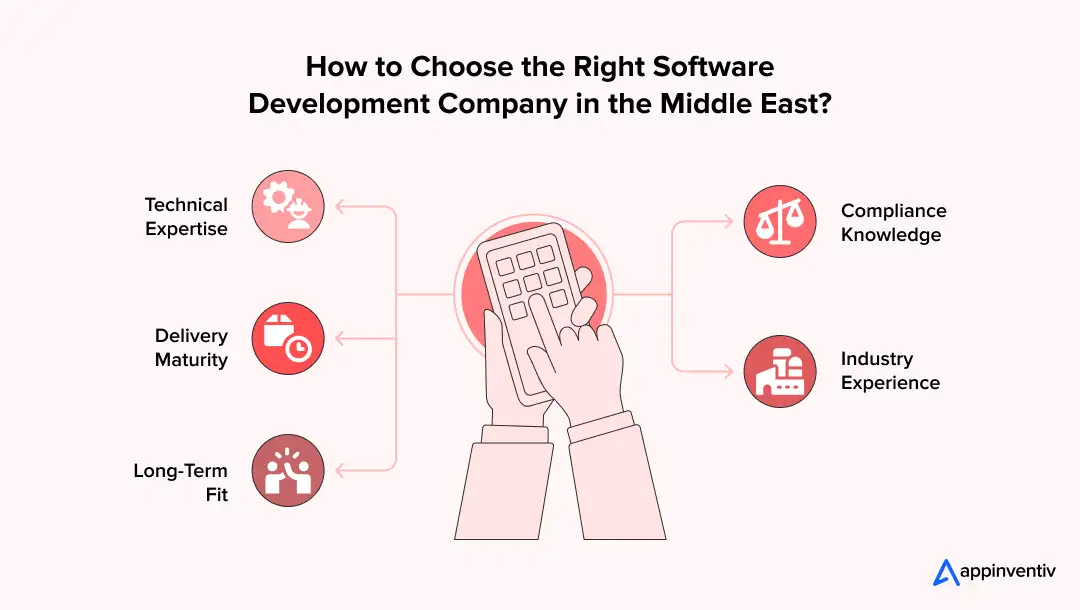
Technical Capability
This is usually the first serious filter because technical depth directly affects scalability, performance, and long-term maintainability.
- Architecture expertise matters when platforms must scale across multiple GCC markets.
- Cloud-native experience should include familiarity with regional cloud zones such as AWS Bahrain or Azure UAE regions, especially where data residency rules apply.
- AI capability becomes relevant if analytics, automation, or predictive decision tools are part of your roadmap.
Technical maturity often becomes evident once deeper technical discussions begin.
Also Read: AI Readiness in UAE: How Can Enterprises Assess Their Maturity Before Scaling AI
Compliance Expertise
Regulatory alignment is rarely optional in this region and often shapes platform design early.
- Knowledge of UAE PDPL, Saudi PDPL, DIFC or ADGM data regulations, and sector cybersecurity standards can prevent costly redesign later.
- Teams with real regional exposure usually anticipate audit documentation and governance expectations better.
This tends to reduce operational friction once systems go live.
Delivery Maturity
Execution discipline typically determines how smoothly enterprise programs progress over time.
- Enterprise Agile practices help coordinate large, distributed development teams.
- DevOps maturity, including CI/CD automation and release monitoring, supports more stable deployments.
Consistency in delivery often matters more than development speed.
Domain Experience
Industry familiarity still plays a practical role, especially where compliance and integration complexity vary by sector.
- Financial services, healthcare, logistics, energy, and public sector platforms each bring specific operational challenges.
- Vendors with sector experience often identify risks earlier and navigate them more effectively.
Appinventiv’s work with regional quick-service restaurant platforms, including digital ordering and operational integration initiatives for brands like Kudu, reflects how industry familiarity helps accelerate deployment while maintaining customer experience consistency across multiple locations.

When enterprises hire a software development company in the Middle East, sustained delivery credibility usually outweighs pricing considerations.
Assess technical depth, compliance expertise, and delivery maturity before selecting regional technology partners.

Future Trends: AI-Powered Software Development in the Middle East
If you talk to enterprise tech leaders in the region lately, AI usually comes up within the first few minutes. Not as a future idea. More as something already influencing platform decisions, budgets, and hiring priorities.
This shift is also driving investment in software development for digital transformation in the Middle East, particularly where automation, analytics, and scalable digital infrastructure are becoming operational priorities.
Where enterprises are actually using it
- Predictive analytics for demand planning, fraud monitoring, and operational forecasting.
- AI-assisted customer service is replacing rule-based support systems.
- Automation of reporting, compliance checks, and internal knowledge workflows, much of which is now being driven by AI agents in the Middle East, purpose-built to handle repetitive enterprise tasks at scale.
Infrastructure changes are happening quietly.
- Stronger preference for regional cloud hosting where data residency matters.
- Hybrid setups combining local infrastructure with AI cloud services.
- Gradual adoption of internal AI copilots for productivity and documentation.
What executives are watching closely
- Reliability over experimentation.
- Governance, security, and auditability of AI outputs.
- Integration with existing enterprise data platforms.
AI-powered software development in Middle East environments is settling into everyday operations rather than innovation headlines. Teams planning early usually avoid rushed retrofits later.
Why Enterprises Partner with Appinventiv for Software Development in the Middle East
If you have evaluated technology partners before, you know the real test is delivery, not presentations. Regional experience, compliance familiarity, and consistent execution usually matter far more than polished proposals.
Appinventiv has delivered 1000+ digital projects across the Middle East, working with enterprises, regulated industries, and public sector organizations. That experience often shapes architecture decisions early, especially around compliance alignment, cloud residency planning, and enterprise integrations.
A few indicators of regional experience:
- 95% client satisfaction rate across Middle East engagements
- 35+ industries served, including fintech, healthcare, logistics, retail, and government
- 500+ enterprise workflows modernized through digital initiatives
- 20+ strategic partnerships in the UAE and 12+ compliance-focused programs delivered
- 3 regional excellence centers supporting enterprise delivery
Operational outcomes typically drive enterprise decisions:
- 99.90% SLA uptime for mission-critical platforms
- Up to 40% cost savings reported through digital transformation programs
Enterprises often engage a software development company in the UAE when they need architecture depth, compliance awareness, and scalable software delivery that holds up under real operational demands.
Frequently Asked Questions
Q. How much does software development cost in the Middle East?
A. Costs vary widely depending on complexity, integrations, and compliance needs. Many enterprise builds fall between $50K and $500K, though advanced platforms can exceed that. Regional data residency, Arabic localization, security layers, and legacy system integration often influence pricing more than feature count alone.
Q. How to build enterprise software in the Middle East?
A. Start with business alignment and compliance clarity. Confirm data residency requirements early, especially in regulated sectors. Then define architecture, integration points, and scalability goals before development begins. Enterprises here usually prioritize stability, regulatory alignment, and operational visibility alongside functionality.
Q. Which is the best software development company in the Middle East?
A. There is no universal “best” provider. Enterprises usually evaluate technical depth, regulatory familiarity, cloud expertise, and delivery track record. Companies with regional experience, proven enterprise architecture capabilities, and a strong understanding of compliance often perform better than vendors that focus mainly on pricing.
Q. What technology and scalability factors should enterprises consider for custom software in the Middle East?
A. Enterprises typically focus on a strong technology stack with API-first architecture, modular architecture, and scalable databases such as PostgreSQL or MongoDB. Compliance checks, advanced encryption, secure data storage, and periodic security audits remain essential. Business-friendly policies and future growth plans usually shape how custom software solutions are designed for scalability.
Q. How long does it take to develop enterprise software in the Middle East?
A. Timelines usually range from three months for MVP platforms to twelve months or more for enterprise systems. Compliance approvals, integration complexity, localization requirements, and infrastructure setup often extend timelines beyond pure development effort.
Q. How do businesses choose the right software development company in the Middle East?
A. Most enterprises prioritize architecture expertise, regulatory familiarity, delivery maturity, and industry experience. Strong cloud capability, proven integration expertise, and a history of stable enterprise deployments usually matter more than vendor size or marketing visibility.
Q. Is the Middle East a good region for enterprise software development?
A. Yes, particularly due to government digital initiatives, growing cloud infrastructure, and strong enterprise demand. Data sovereignty policies and regional compliance frameworks also encourage localized development, making the region attractive for regulated industries and large-scale digital transformation programs.
Q. Why is software development growing rapidly in the Middle East?
A. Economic diversification initiatives, AI adoption, digital government programs, and cloud infrastructure expansion are major drivers. Enterprises are investing heavily to modernize legacy systems, improve customer experience, and strengthen operational resilience across industries.
Q. What types of software are enterprises building in the Middle East?
A. Common platforms include fintech systems, healthcare data platforms, logistics analytics tools, smart city infrastructure software, enterprise AI applications, and omnichannel commerce systems. Many projects focus on integration, automation, analytics, and regulatory compliance.
Q. How can Appinventiv help software development in the Middle East?
A. Appinventiv supports enterprises with architecture design, compliance-aware development, AI and cloud engineering, and scalable platform delivery. Regional experience across multiple industries helps align software initiatives with regulatory requirements, operational goals, and long-term enterprise growth strategies.


Fast 2-minute response, fully NDA-protected.

Green Software Development: A Complete Guide to Sustainable, Carbon-Aware Systems
Key takeaways: Green software treats energy and carbon as core engineering metrics, not an add-on. SCI measures carbon per unit of work, so systems can scale without being penalized. Three levers drive impact: energy efficiency, hardware efficiency, and carbon awareness. Demand shaping adjusts a service in real time based on grid carbon intensity. AI is…

How Much Does It Cost to Build ESG Reporting Software in Australia?
Key takeaways: ESG reporting software development cost in Australia ranges from roughly AUD 70,000 for a basic MVP to AUD 700,000 or more for an AI-powered enterprise platform. Regulatory timing under AASB S1 and S2 means Group 2 and Group 3 entities should architect for the full phased rollout now to avoid a costly rebuild…

Automotive Software Development in the UAE: Solutions, Costs, and Use Cases
Key takeaways: UAE smart mobility and EV initiatives are accelerating automotive software adoption across the region. The automotive software development cost typically ranges from AED 330,000 to over AED 1.8 million, depending on project scope. Telematics, EV charging, fleet management, and predictive maintenance deliver the highest business impact. AI, IoT, 5G, and cloud technologies are…