


























A Guide to Recruitment App Development in Australia


- Understanding the Importance of Recruitment App Development for Australian Enterprises
- Different Types of Recruitment Applications Enterprises Build
- Essential Features of a Recruitment App for High-Volume, Regulated Hiring
- Advanced Capabilities That Differentiate High-Impact Recruitment Apps
- Regulatory Considerations and Compliance Requirements While Developing a Recruitment App
- How to Build a Recruitment App: A Step-by-Step Process
- Cost of Recruitment App Development in Australia
- Challenges in Recruitment App Development and How to Address Them
- How Appinventiv Can Help Build AI-Powered Custom Recruitment Apps for Australia
- FAQs

Key Takeaways
- Recruitment platforms succeed when enterprises define outcomes, governance, and user journeys upfront, rather than retrofitting controls after build.
- Recruitment app development cost in Australia typically ranges from AUD 70,000 to AUD 700,000+ or more.
- Privacy, consent, auditability, and data residency must be embedded into platform architecture, not treated as post-launch checks.
- Hiring automation adds value when AI decisions remain explainable, reviewable, and governed by human oversight.
Across Australia, hiring has shifted from transactional processes to continuous workforce orchestration. Healthcare providers manage credentialed talent across states. Mining and infrastructure firms recruit at scale for remote sites. Logistics and retail deal with seasonal surges and high churn. Technology firms compete in a tight skills market where speed and experience decide outcomes.
What we see consistently across Australian enterprises is a widening gap between hiring ambition and hiring infrastructure. Legacy ATS tools, disconnected job boards, and manual approval chains struggle under the weight of remote work, skills shortages, and heightened governance expectations. The result is slower decision-making, inconsistent candidate experience, and limited visibility for leadership.
This is why recruitment app development in Australia has shifted from experimentation to necessity. Enterprises are no longer looking for another hiring tool. They are investing in AI-driven custom recruitment apps that behave like core systems. Platforms that integrate seamlessly with HR and identity frameworks, respect data sovereignty, support audit readiness, and scale with workforce demand.
For organisations choosing to develop a recruitment mobile app in Australia, the decision is less about features and more about control. Control over data, workflows, compliance, and long-term cost of ownership.
This blog reflects those priorities and speaks directly to leaders evaluating recruitment technology as a strategic asset rather than a short-term solution.
Assess whether your current hiring systems can support workforce growth, regulatory scrutiny, and AI governance without operational risk.

Understanding the Importance of Recruitment App Development for Australian Enterprises
At an enterprise level, a recruitment app is not a digital job board. It is a control layer across candidate data, recruiter workflows, employer approvals, and compliance obligations. When organisations reach the point of building a recruitment platform, it is rarely a strategic experiment. It is usually a response to repeated breakdowns in hiring speed, data visibility, or compliance confidence.
Hiring velocity no longer matches business demand. Candidate data sits across disconnected platforms. Compliance teams struggle to audit consent, access, and decision logic. Recruiters lose time to manual screening while executives lack reliable hiring intelligence.
Custom enterprise recruitment app development becomes relevant when these pressures intersect with scale, risk, or industry regulation. Generic recruitment platforms in Australia often work for small teams. They tend to fall short once organisations require deep integrations, AI-driven recruitment applications aligned to Australian expectations, or board-level reporting.
Difference between Custom-Built and Off-the-Shelf Recruitment Platforms
| Dimension | Off-the-Shelf Tools | Custom Recruitment App |
|---|---|---|
| Data ownership | Vendor-controlled | Enterprise-controlled |
| Compliance flexibility | Limited configuration | Built to Australian compliance needs |
| Integration depth | Shallow APIs | Native integration with HR, payroll, workflows |
| AI governance | Black-box models | Auditable, explainable AI logic |
| Scalability | Licence-based limits | Designed for workforce scale |
Different Types of Recruitment Applications Enterprises Build
Australian enterprises rarely build a single monolithic hiring system. Instead, they invest in platforms aligned to specific workforce realities. Together, these represent the different types of recruitment applications enterprises invest in based on operational need. Some of the most common options are:
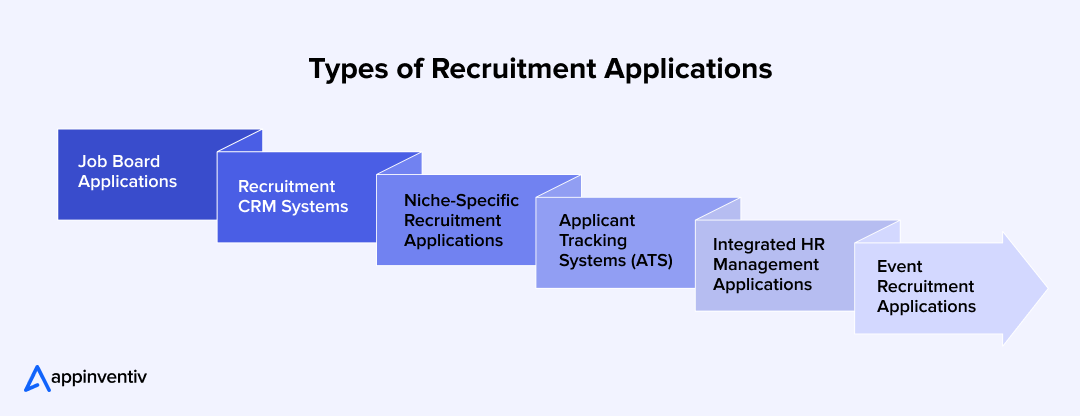
Job Board Applications
They support high-volume hiring and employer branding. They are common in retail, hospitality, and graduate recruitment programs. Public-facing usability and application velocity matter more than deep workflow control.
Integrated HR Management Applications
Here, recruitment is embedded into a broader HR ecosystem. Hiring data flows directly into onboarding, payroll, and workforce analytics. This approach suits healthcare networks and large service organisations.
Niche-Specific Recruitment Applications
Mining, aged care, and regulated industries often require credential verification, site access checks, and compliance gating before candidates even enter a pipeline. Generic platforms struggle to handle this complexity.
Recruitment CRM Systems
They are typically used by enterprise talent teams and staffing arms to manage long-term candidate relationships. Redeployment intelligence and historical engagement data drive value.
Applicant Tracking Systems (ATS)
ATS remains a foundational type, but many enterprises now rebuild ATS capabilities within custom platforms to regain flexibility and reporting control.
Event Recruitment Applications
Event recruitment applications support short-term, high-intensity hiring for career fairs, walk-in drives, campus recruitment, and large-scale workforce mobilisation. Typical event recruitment app benefits include rapid candidate intake, real-time screening, on-the-spot scheduling, and centralised data capture that prevents post-event information loss and follow-up delays.
Essential Features of a Recruitment App for High-Volume, Regulated Hiring
What enterprises often underestimate is not feature availability, but feature behaviour under load. Recruitment platforms rarely fail on day one. They fail during hiring spikes, compliance reviews, or leadership reporting cycles. The features below are structured to prevent those breakdowns.
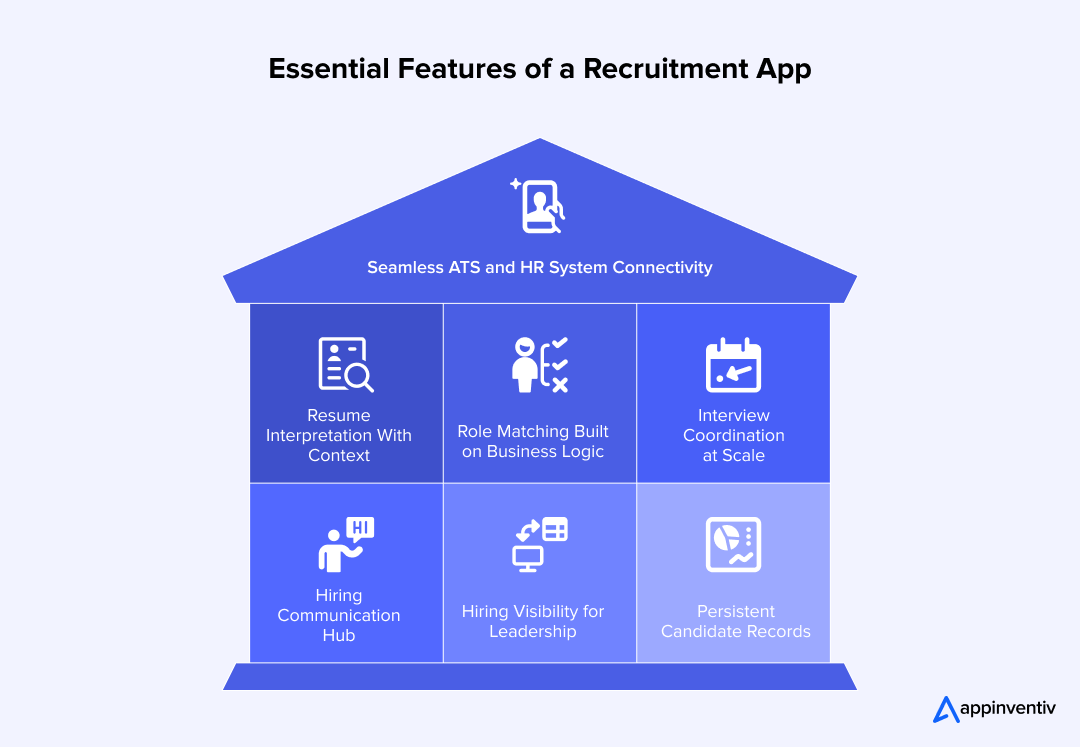
Persistent Candidate Records
Candidate information is retained in structured, reusable profiles that travel across roles, teams, and timeframes, reducing repeat data capture and fragmentation.
Resume Interpretation With Context
Parsing tools extract skills and experience while allowing recruiters to adjust or override outputs, preventing blind reliance on automation.
Role Matching Built on Business Logic
Matching engines combine skills, location, availability, and hiring urgency using transparent criteria aligned to how the organisation actually hires.
Interview Coordination at Scale
Scheduling workflows synchronise candidates, recruiters, and hiring managers, minimising delays caused by calendar conflicts or manual follow-ups.
Hiring Communication Hub
All candidate communication, updates, and documentation sit in a single channel, creating consistency and reducing compliance exposure.
Seamless ATS and HR System Connectivity
Hiring decisions flow directly into HR, onboarding, and payroll systems, eliminating re-entry errors and reconciliation effort.
Hiring Visibility for Leadership
Dashboards translate recruitment activity into operational signals, showing progress, bottlenecks, and compliance checkpoints in real time.
Advanced Capabilities That Differentiate High-Impact Recruitment Apps
Recruitment platforms that deliver sustained value are designed for foresight, not reaction. Advanced capabilities help enterprises anticipate workforce needs, defend hiring decisions, and adapt without reengineering systems mid-cycle. The advanced features of a recruitment platform include, but are not limited to:
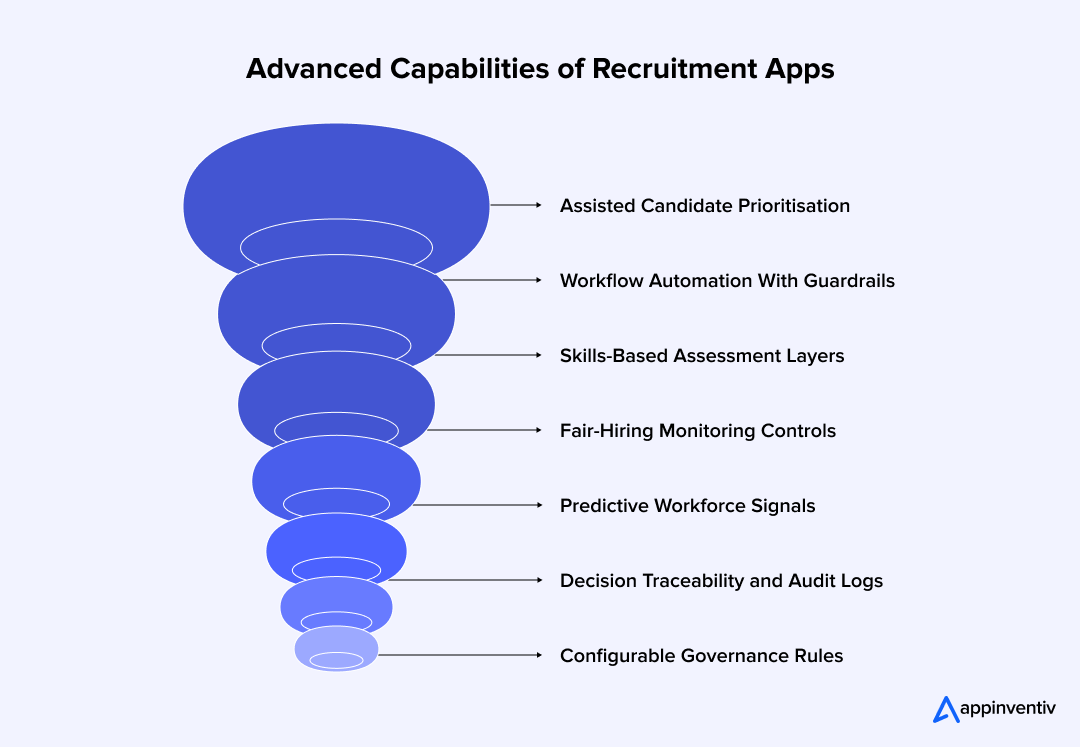
Assisted Candidate Prioritisation
AI-supported shortlisting highlights relevant profiles while keeping final decisions with recruiters, preserving accountability and trust. In enterprise environments, AI models are typically monitored through periodic outcome reviews, bias drift checks, and recruiter override analysis to ensure automation does not silently reshape hiring decisions over time.
Also Read: AI in the Workplace: Transforming Modern Business in 2026
Workflow Automation With Guardrails
Routine steps such as screening, reminders, and status updates are automated, but escalation points remain human-controlled.
Skills-Based Assessment Layers
Integrated assessments validate practical capability rather than relying solely on resumes, improving hiring quality in skills-short markets.
Fair-Hiring Monitoring Controls
Hiring outcomes are continuously reviewed to detect imbalance patterns, supporting defensible and consistent decision-making.
Predictive Workforce Signals
Historical and live data combine to forecast hiring timelines, workforce gaps, and attrition pressure before they disrupt operations. Organisations that combine AI-enabled hiring insights with strong governance tend to outperform peers in speed and quality without increasing compliance risk.
Decision Traceability and Audit Logs
Every automated action and recommendation is recorded, enabling post-hire review and regulatory scrutiny without reconstruction effort.
Configurable Governance Rules
Enterprises can adjust approval flows, screening thresholds, and data access rules as policies evolve, without platform rewrites.
Also Read: Al Adoption in Australia: Why It Matters and How Businesses Are Leading the Way
Regulatory Considerations and Compliance Requirements While Developing a Recruitment App
Recruitment applications operate at the intersection of employment decisions, personal data, and automated processing. In Australia, this places hiring platforms under heightened scrutiny, requiring compliance to be designed into systems rather than managed through policy alone.
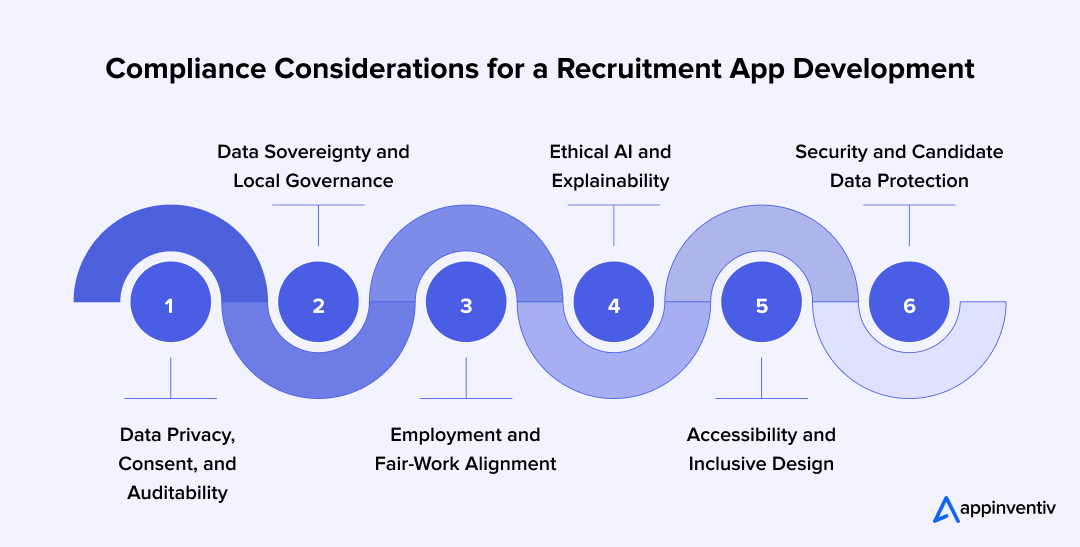
Data Privacy, Consent, and Auditability
Recruitment platforms must capture explicit, traceable consent and maintain clear audit trails for candidate access and decision-making. Enterprises require the ability to reconstruct hiring actions months or years later.
Guidance from the Office of the Australian Information Commissioner continues to influence how enterprises structure consent management and audit trails.
Data Sovereignty and Local Governance
Australian enterprises increasingly expect candidate data to remain under local jurisdiction. Hosting, backup, and disaster recovery decisions are aligned with board-approved risk and data residency expectations.
Employment and Fair-Work Alignment
Recruitment workflows intersect directly with employment obligations. Automated communications, eligibility checks, and screening logic must align with fair-work principles and internal legal policy.
Ethical AI and Explainability
AI-assisted hiring tools must remain explainable and reviewable. Enterprises require visibility into how screening and ranking decisions are made to manage bias risk and executive accountability.
Accessibility and Inclusive Design
Recruitment platforms are expected to support accessible interfaces and assessment pathways. Enterprises increasingly test platforms against accessibility standards before large-scale rollout.
Security and Candidate Data Protection
Candidate data is among the most sensitive information enterprises handle. Data encryption, role-based access, monitoring, and incident response are baseline requirements, not differentiators.
How to Build a Recruitment App: A Step-by-Step Process
Recruitment platforms that succeed in Australia follow a deliberate execution flow. Each stage builds decision clarity for the next, reducing downstream risk rather than accelerating blindly. For organisations evaluating how to build a recruitment app, here is a structured step by step recruitment app development process to follow for ultimate success.
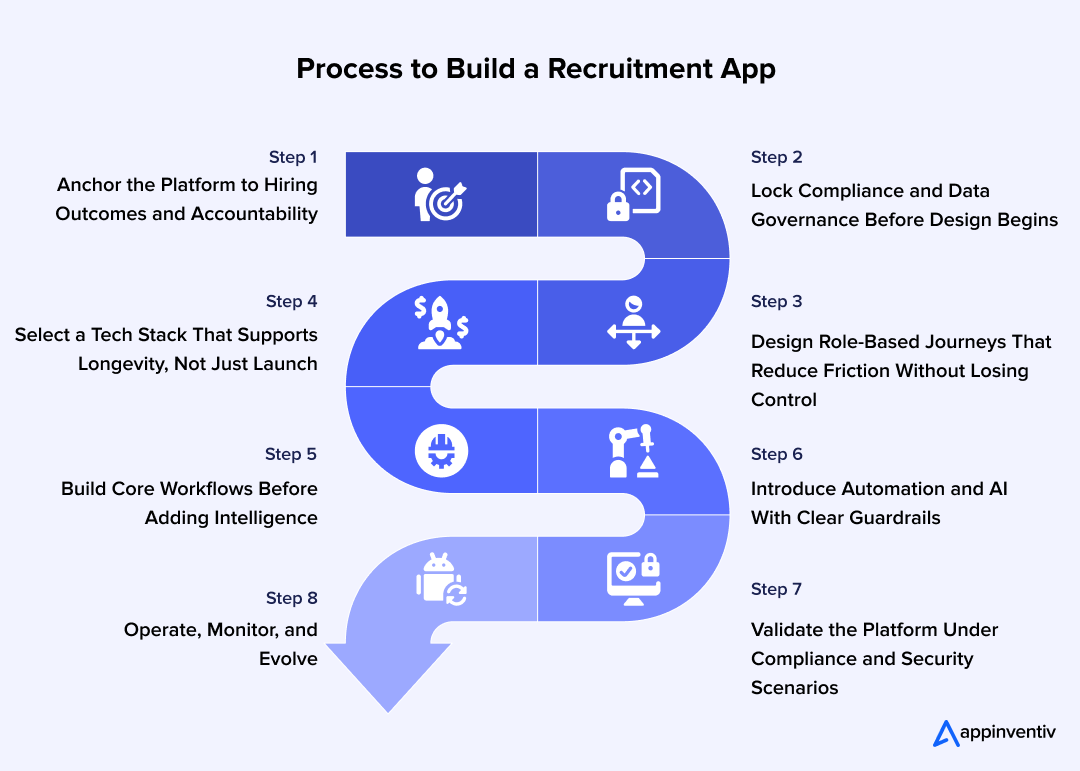
Step 1: Anchor the Platform to Hiring Outcomes and Accountability
The process starts by aligning recruitment objectives with operational pressure points. Enterprises typically define outcomes such as reduced vacancy risk in regulated roles, faster mobilisation for project-based work, or stronger audit defensibility of hiring decisions. Success metrics extend beyond time-to-hire to include recruiter throughput, compliance confidence, and data completeness across hiring cycles.
Step 2: Lock Compliance and Data Governance Before Design Begins
The next step establishes non-negotiables around data handling. Australian organisations map candidate data flows early, identifying where personal information is collected, who accesses it, and how long it must be retained. This step informs architectural boundaries, hosting decisions, and access controls long before UI discussions begin.
Key considerations often include:
- Local data residency and backup strategy
- Role-based access aligned to internal delegation of authority
- Audit reconstruction requirements for hiring decisions
Step 3: Design Role-Based Journeys That Reduce Friction Without Losing Control
With governance boundaries set, the focus shifts to experience design. Rather than a single interface, the platform supports distinct journeys that reflect how different stakeholders interact with hiring data.
| User Journey | Design Priority |
|---|---|
| Candidate | Fast application, profile reuse, transparent status updates |
| Recruiter | Clear pipeline view, structured notes, collaborative scoring |
| Employer | Controlled approvals, hiring visibility, compliance reporting |
This stage determines adoption. Over-engineered flows slow recruiters. Under-designed flows erode oversight.
Step 4: Select a Tech Stack That Supports Longevity, Not Just Launch
Once journeys are clear, technology choices follow. Enterprises prioritise stability, security, and integration readiness over novelty. The recruitment app tech stack must support frequent hiring spikes, downstream system integration, and evolving compliance expectations without replatforming.
| Layer | Enterprise-Grade Choice |
|---|---|
| Mobile | React Native or Flutter |
| Backend | Node.js, Java, or .NET |
| Data | PostgreSQL with secure object storage |
| Intelligence | Custom ML models with explainability logs |
| Cloud | AWS or Azure Australia regions |
Step 5: Build Core Workflows Before Adding Intelligence
Development progresses in layers. Teams first stabilise core workflows such as application intake, screening stages, approvals, and integrations. This approach avoids embedding automation into unstable processes, which often amplifies inefficiencies rather than resolving them.
Step 6: Introduce Automation and AI With Clear Guardrails
The next phase introduces automation where it reduces measurable friction. Scheduling, shortlist ranking, and candidate matching benefit most when automation supports human decision-making rather than replacing it. Explainability, override capability, and traceability remain essential at this stage.
Step 7: Validate the Platform Under Compliance and Security Scenarios
Testing extends beyond functional checks. Enterprises validate access controls, consent records, audit trails, and breach response readiness. Release criteria focus on confidence, not speed.
Step 8: Operate, Monitor, and Evolve
After launch, attention shifts to adoption patterns, performance stability, and regulatory alignment. Regular reviews assess whether the platform continues to support workforce strategy as hiring volumes, locations, and expectations change.
Design recruitment systems that integrate cleanly with HR, identity, and compliance frameworks while supporting long-term ownership.

Cost of Recruitment App Development in Australia
Recruitment mobile app development cost in Australia typically ranges from AUD 70,000 to AUD 700,000+, depending on scope, compliance depth, and project complexity. Basic platforms address narrow hiring use cases. Enterprise-grade systems support multi-entity hiring, audit readiness, and AI governance in the long run. The variance reflects long-term ownership decisions rather than interface sophistication.
Key Factors Affecting the Cost of Recruitment App Development Are:
- Integration with existing HR, payroll, and identity platforms
- Compliance design, audit logging, and data governance controls
- AI capability, transparency, and monitoring requirements
- Security architecture and local cloud infrastructure
- Ongoing optimisation, support, and regulatory alignment
Indicative Cost Breakdown
| Complexity Level | Typical Investment Range | Estimated Timeline |
|---|---|---|
| Basic | AUD 70,000–200,000 | 3-6 months |
| Mid-Range | AUD 200,000–400,000 | 6–9 months |
| Advanced / Enterprise Grade | AUD 400,000–700,000+ | 9-12+ months |
For Australian enterprises, the most expensive platforms are rarely the most valuable. Platforms that reduce compliance friction and agency reliance tend to deliver stronger long-term returns.
Challenges in Recruitment App Development and How to Address Them
Within Australian enterprises, recruitment platforms tend to struggle not because of missing functionality, but because execution gaps surface once systems are exposed to scale, regulation, and day-to-day hiring pressure. The challenges below reflect where recruitment app development commonly runs into friction, along with practical ways organisations respond.
Integrating with Legacy HR Systems
Challenge: Most enterprises operate layered HR, payroll, and identity systems that have accumulated over time, which makes direct integration brittle and increases operational risk once data volumes grow.
Solution: Introduce integration through modular APIs and middleware so the recruitment platform can evolve incrementally without disrupting payroll, identity, or workforce reporting systems already in use.
Also Read: AI in Legacy Application Modernization – A Complete Guide
Addressing Skills Gaps and Recruiter Enablement
Challenge: Recruitment platforms often assume a uniform level of recruiter capability, which creates friction when teams vary in experience with structured workflows, AI-assisted screening, or data-led decision-making. Skills gaps can limit platform adoption and reduce the quality of hiring outcomes.
Solution: Pair platform rollout with role-specific training, embedded guidance, and phased enablement so recruiters build confidence in using new workflows and decision-support tools without disrupting active hiring cycles.
Ensuring Data Quality and Unbiased AI Models
Challenge: Inconsistent candidate data and historical hiring bias weaken automation outcomes and quickly erode confidence in AI-driven screening.
Solution: Enforce structured data capture, keep human review loops active, and continuously monitor model outputs rather than treating AI deployment as a one-time implementation.
Driving Adoption Among Recruiters and Candidates
Challenge: Recruiters disengage when platforms introduce additional steps under hiring pressure, while candidates lose interest when workflows lack transparency.
Solution: Design workflows that clearly reduce recruiter workload and provide candidates with visible progress updates at each stage of the hiring journey.
Data Privacy and Security
Challenge: Recruitment platforms centralise highly sensitive personal data, increasing exposure during breaches, audits, or internal misuse.
Solution: Apply enterprise-grade encryption, role-based access controls, detailed audit logging, and tested incident response processes aligned with the organisation’s broader security posture.
Real-World Examples of Recruitment Software in Australia
The recruitment technology landscape in Australia is shaped by scale, compliance, and speed rather than innovation for its own sake. While well-known platforms dominate candidate attraction, enterprises typically extend or supplement these tools once hiring decisions move into screening, approvals, and governance. The following examples illustrate that pattern across industries.
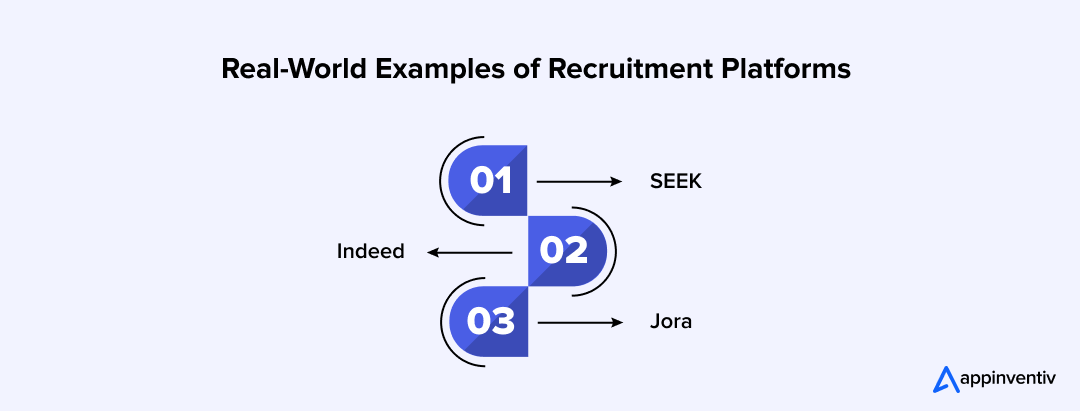
- SEEK
SEEK remains the most widely used recruitment marketplace in Australia, particularly for organisations hiring at scale across permanent and contract roles. Enterprises value its reach and brand visibility, but often rely on downstream systems when tighter workflow control or governance is required. - Indeed
Indeed operates primarily as an aggregation layer, consolidating roles from multiple sources into a single job search experience. Australian enterprises typically use it to accelerate candidate inflow, while managing screening, compliance, and approvals through internal ATS or custom platforms. - Jora
Jora sees strong adoption among small and mid-sized employers, especially in sectors with high turnover such as retail and logistics. While effective for visibility and volume, it generally sits outside enterprise hiring workflows where auditability and process governance matter.
How Appinventiv Can Help Build AI-Powered Custom Recruitment Apps for Australia
Recruitment app development in Australia takes on greater operational and regulatory responsibility; enterprise leaders are re-evaluating who they trust to build and sustain these systems. The decision is no longer about selecting a vendor for a single delivery cycle. It is about choosing a long-term technology partner that understands workforce risk, governance expectations, and the realities of operating at scale across complex hiring environments.
This is where Appinventiv comes in. We work with emerging startups and established enterprises to design recruitment software in Australia that reflects real operating conditions. Our focus is on governance, scalability, and measurable outcomes rather than feature volume.
Across Australia, we have delivered over 250 digital assets with a client retention rate of 96 percent. With more than 10 years of APAC delivery experience and five agile delivery centres, we support long-term ownership and optimisation.
Our platforms maintain a 99.50% security compliance SLA and have delivered efficiency gains of up to 35% for Australian enterprises. Recognised as one of APAC’s high-growth companies by Statista and the Financial Times, we approach recruitment platforms as strategic infrastructure rather than short-term projects.
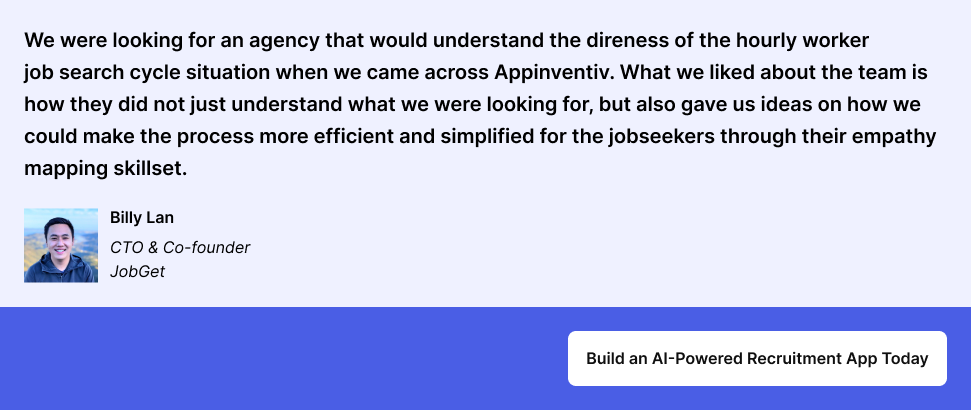
JobGet: A Recruitment App Development Case in Action
The Challenge: JobGet partnered with us with a persistent problem of blue-collar workers who faced significant hurdles in finding good jobs, and employers were struggling with high turnover and inefficient hiring.
Our Solution: Our app developers engineered a digital recruitment system equipped with instant-matching algorithms to facilitate an easy job search and onboarding for blue-collar workers.
The Result?
- 150K+ Jobseekers placed
- $52M Series B Funding
- 2 M+ App Downloads
- 50K+ Active Companies on the Platform
The scale achieved by the platform reflects its ability to handle sustained hiring volume, real-time matching, and system reliability under continuous demand rather than one-off campaign traffic.
For enterprise leaders assessing recruitment platforms, the question is rarely whether to modernise. It is whether the system will still perform when hiring decisions are reviewed months later, under scrutiny, and at scale.
If you are looking to hire recruitment app developers in Australia, discuss your project vision with us. Our role extends beyond development. We act as delivery partners accountable for outcomes, risk, and sustainability.
FAQs
Q. What is recruitment app development in Australia?
A. Recruitment app development involves building a dedicated digital platform to manage hiring activities across sourcing, screening, approvals, and onboarding. At the enterprise level, these platforms operate as systems of record, capturing how hiring decisions are made and who accesses candidate data. Organisations use them to replace fragmented tools with a single, governed workflow. The emphasis is on control, auditability, and long-term ownership rather than speed alone.
Q. Can recruitment apps include AI features?
A. Yes. Enterprise recruitment apps commonly use AI to support hiring decisions, not replace them. Typical AI features include:
- Candidate matching based on skills, location, and availability
- Shortlisting and ranking with recruiter-controlled overrides
- Resume parsing and profile enrichment
- Automated interview scheduling and follow-ups
- Hiring analytics and workforce trend insights
In enterprise environments, AI operates with explainable logic and audit trails. Recruiters retain final decision authority to manage risk and accountability. AI features without transparency or review controls are usually avoided due to compliance exposure.
Q. Who should build a recruitment app in Australia?
A. Building a recruitment app makes sense when standard platforms no longer fit organisational realities. This is common for enterprises with high hiring volumes, regulated roles, or multiple business units operating under shared governance. Industries such as healthcare, mining, infrastructure, logistics, and professional services often reach this point. The decision usually follows repeated workarounds, manual controls, or reporting gaps.
Q. Can recruitment apps integrate with existing ATS and HR systems?
A. Integration is not optional at enterprise scale. Recruitment platforms must connect with ATS, HRMS, payroll, identity, and reporting systems to avoid duplication and data loss. Most integrations are handled through APIs or middleware to minimise disruption to existing environments. Strong integration ensures hiring decisions flow cleanly into downstream workforce processes.
Q. How is candidate data protected in recruitment apps?
A. Recruitment platforms handle highly sensitive personal information, which places them under the same scrutiny as other core enterprise systems. Protection typically includes encryption, role-based access control, detailed audit logs, and clearly defined data retention rules. Organisations also design these platforms to support consent tracking and internal reviews if decisions are questioned later.
Q. How much does it cost to develop a recruitment app in Australia?
A. Costs typically range from AUD 70,000 for a narrowly scoped platform to AUD 700,000 or more for enterprise-grade systems. For instance:
- Basic platform (MVP or single use case): AUD 70,000–200,000
- Mid-range platform: AUD 200,000–400,000
- Advanced enterprise platform: AUD 400,000–700,000+
Q. How long does it take to build a recruitment app?
A. The time it takes to build a recruitment platform ranges from 3 to 12 months or more, depending on the project complexities and the expertise of the app development team.
Timelines extend when organisations require deep integration, regulated hiring workflows, or formal security and compliance validation. Enterprises often prioritise readiness and confidence over speed to market.

- In just 2 mins you will get a response
- Your idea is 100% protected by our Non Disclosure Agreement.

How to Build a Forex Currency Trading App for Multi-Currency Trading in the UAE
Key Takeaways: In the UAE, regulation comes first. Your licensing choice will shape how the entire platform is built. A forex app here needs more than charts. It needs a solid trading engine, strong liquidity connections, and reliable risk controls. AED funding, USD settlement, Islamic swap-free accounts, and Arabic support are practical requirements, not optional…

A Guide on How to Choose the Right Mobile App Development Company in Iraq
Key Takeaways Define business goals, integrations, compliance needs, and success metrics before engaging a development partner. Prioritise teams experienced in Arabic/Kurdish localisation, RTL UX, and testing on low-spec Android devices common in Iraq. Evaluate architecture maturity, security standards (SOC2/ISO), and CI/CD practices rather than focusing only on development cost. Ensure the application is designed for…

How Much Does It Cost to Build a Calorie Counting App Like Cronometer in Australia
Key takeaways: Building a calorie counting app with Cronometer-level accuracy in Australia typically costs between AUD 70,000 and AUD 700,000+, depending on data depth, compliance posture, and analytics sophistication. Underestimating compliance, data licensing, and post-launch governance is the most common cause of budget overruns for Australian nutrition platforms. The hard cost driver is not screens.…