





















Why Private AI Is the Future of Ethical and Secure AI Adoption for Enterprises?


- Why Private AI Should Be Your Enterprise's Next Strategic Investment?
- The Role of Private AI in Ensuring Data Privacy
- How Private AI Enhances Security in AI Development?
- How to Successfully Navigate Private AI Adoption Challenges?
- Future-Proof Your Business with Emerging Private AI Technologies
- Partner with Appinventiv for Your Private AI Journey
- Frequently Asked Questions

Key takeaways:
- $109.1 billion was invested in global private AI in 2024, demonstrating enterprises’ commitment to secure AI.
- Private AI keeps data within your infrastructure for complete control; public AI processes data externally on shared cloud platforms.
- Private AI enables enterprises to scale AI responsibly with complete data sovereignty, regulatory compliance, and superior long-term economics compared to public solutions.
- Adoption of private AI drives improved AI results, better security, and compliance with GDPR and CCPA.
What if the very technology meant to propel your business forward could also be its greatest vulnerability? AI has the potential to upend industries, but the greater challenge for enterprises now is how they can adopt AI without compromising on privacy, security, or ethics.
Public AI solutions operate on shared cloud platforms where data is processed externally on provider infrastructure, often alongside other users’ data. Private AI, in contrast, deploys within an organization’s controlled environment, ensuring sensitive information never leaves the company’s secure infrastructure.
Private AI for enterprise isn’t a simple trend anymore; rather, it has become an urgent need with continuous data breaches and ethical concerns headlining the news.
Private AI within an organization empowers it to take control of its data, all while driving innovation. It finally enables enterprises to harness the complete value of AI, without compromising on the aspects of trust and compliance.
With businesses increasingly dependent on AI for informed decisions, privacy, along with security, is core to businesses today.
The question isn’t whether to adopt AI; it’s how to do it responsibly. This blog explores why private AI represents the future of ethical and secure AI adoption, and how your business can start embracing it.
78% of organizations adopted AI in 2024, but the smartest ones are choosing private AI to protect their data, ensure compliance, and maintain complete control.

Why Private AI Should Be Your Enterprise’s Next Strategic Investment?
Most leadership teams can feel the shift happening inside their organizations. AI is showing up in day-to-day decisions, not just in future plans or innovation workshops. With that growth comes a practical worry: how do you protect the information these systems rely on?
Privacy AI has become the answer for many, and private artificial intelligence for enterprise is now part of serious conversations across industries.
The 2025 Stanford HAI Index noted adoption jumping from 55% to 78% in a year, which shows how quickly AI is moving from experimentation to standard practice.
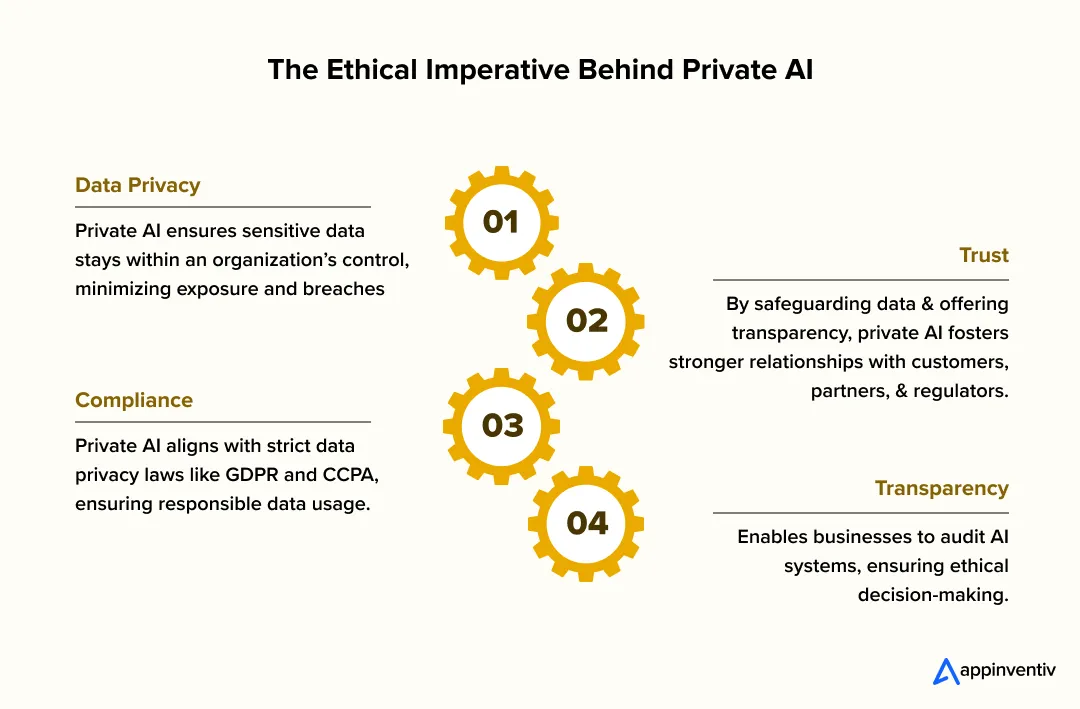
1. Complete Data Sovereignty and Control
Private AI for enterprise gives companies a way to keep their data close rather than sending it through outside services. With private AI for business, everything stays inside systems the organization already manages, so teams know exactly who can access what and under which conditions. That clarity matters when dealing with sensitive information.
Business Impact: Stronger control often means lower exposure, fewer insurance complications, and more freedom from the vendor commitments that tend to become expensive over time.
2. Seamless Regulatory Compliance
Privacy AI makes it easier to meet requirements under GDPR, CCPA, HIPAA, and the new EU AI Act because the data never leaves controlled environments. Compliance teams can verify how information is handled without chasing down third-party processes or external logs.
Business Impact: With investment in AI and generative AI for business rising nearly 18.7%, organizations have a strong incentive to adopt approaches that simplify regulatory work rather than add to it.
3. Enhanced Trust, Transparency, and Brand Resilience
Private artificial intelligence for enterprise brings needed transparency. Teams can review how models behave and address concerns before they escalate. Customers and regulators appreciate knowing there is oversight, especially when AI influences decisions that affect people directly. Privacy AI supports that expectation without slowing progress.
Business Impact: This kind of openness builds trust, steadies relationships with partners, and reduces the risk of brand damage.
4. Superior AI Outcomes Through Controlled Data Governance
With stronger AI in data and governance, privacy AI helps ensure that training data is accurate, current, and responsibly collected. Clean inputs usually translate to more dependable outputs, which helps decision-makers rely on the systems with more confidence.
Business Impact: Better predictions and more reliable automation contribute directly to stronger returns on AI programs.
5. Sustainable Competitive Advantage
Private AI for enterprise provides a solid foundation for scaling AI across the business. While competitors may be dealing with compliance setbacks or trust issues, organizations built on privacy-first principles can move forward with fewer disruptions. Private AI for business becomes a steady advantage rather than a one-off investment.
Business Impact: Privacy AI ultimately supports growth while protecting the information and relationships that matter most to an enterprise.
Also Read: 9 Reasons Your Business Needs AI Integration Consulting
With ethics and control as the drivers, the next question is: what does data privacy look like in a private AI environment?
The Role of Private AI in Ensuring Data Privacy
Among the top priorities of enterprises embracing AI today is data privacy. Secure and private AI for enterprise enables this by using critical technologies and approaches.
Here are the key technologies that enable private AI:
- Federated Learning: It trains the model on decentralized data; thus, the data stays right where it is-on the device or local system. Only model updates get shared, thus reducing exposure to sensitive information.
- Differential Privacy: The technique adds noise to the information before processing and buries it so deeply that tracking down individual data becomes very difficult. It allows businesses to draw out valuable insights without compromising user privacy.
- Flexible Deployment Architectures: Private AI for business can run on-premise, inside a Virtual Private Cloud with isolated resources, or in air-gapped environments for highly regulated sectors. Some companies choose hybrid setups to keep data sovereign while still scaling. Each option lets you align deployment with your risk profile and internal policies.
- Retrieval-Augmented Generation (RAG): RAG is one of the strongest drivers of private AI adoption. It allows your AI to draw answers from internal documents, databases, and institutional knowledge while keeping everything inside your infrastructure. Your teams get accurate, context-aware responses grounded in your own content, without exposing data to outside providers.
- Open-Source Model Deployment: Private AI relies on open-source models like Llama 3, Mistral, and Falcon instead of closed systems such as GPT-4. These models can be tuned on your proprietary data and deployed within your environment. This avoids vendor lock-in and ensures your information stays under your control from training to production.
- Data Sovereignty and Encryption-First Model Training: Private AI keeps data within your organization’s legal jurisdiction for compliance with local data laws. It ensures securing the entire AI training. It also allows for a secure AI deployment process via end-to-end encryption.
Beyond privacy, private AI also strengthens security — let’s unpack that.
How Private AI Enhances Security in AI Development?
AI brings enormous value, but it also introduces new security threats, from model theft to data exfiltration.
A secure environment is no longer optional. The above-mentioned Stanford report notes that global private AI investment reached $109.1 billion, signaling how serious enterprises are about investing in safe, controlled AI.
Private AI models for enterprises directly address many of those issues with a secure environment for development. Here is how privacy AI improves security in AI development:
- Model Theft and Poisoning Protection
Traditional AI systems expose models and algorithms that can easily be accessed or manipulated by external actors for model theft or poisoning. Private AI restricts such access to trained and open-sourced models by deploying secure, isolated environments. Consequently, only authorized users can interact with the model, reducing the chances of malicious tampering significantly.
- Data Exfiltration Protection
Data exfiltration, the unauthorized transfer of sensitive information, is a major security concern. In secure and private AI, data access is tightly controlled. Closed-loop data access ensures that sensitive data will never leave your organization’s secure environment and cannot leak or be breached during model training or model inference.
- Secured Machine Learning Pipelines
If not properly secured, this process of model development, training, and secure AI deployment can give way to vulnerabilities. Private AI ensures the securability of each step in the machine learning pipeline by using encrypted communication channels, stringent access controls, and segmented deployments.
Comparing Traditional AI Deployment vs. Private AI Deployment
Here is a quick overview table of private AI vs. public AI:
| Dimension | Traditional AI Deployment | Private AI Deployment |
|---|---|---|
| Data Ownership | Shared/outsourced or public cloud | Dedicated infrastructure, organization-controlled |
| Model Access | Broad, possibly external APIs | Controlled, internal, or trusted-partner only |
| Training Data Flow | Centralized in many cases | Federated/encrypted/partitioned |
| Regulatory Boundary | Often harder to enforce | Boundaries are simpler to define and enforce |
| Model Foundation | Proprietary models (GPT-4, Claude) with API access | Open-source models (Llama 3, Mistral, Falcon) deployed internally |
| Architecture Options | Shared cloud infrastructure | VPC, on-premise, air-gapped, or hybrid environments |
| RAG Implementation | External knowledge bases, data exposure risks | Internal RAG with proprietary data, zero external exposure |
| Cost Structure | Low upfront, high recurring API fees ($500K to $2 million + monthly at scale) | High upfront ($200K to $1 million), low ongoing costs; ROI positive in 12 to 24 months |
Privacy and security lead to one of the biggest enterprise drivers — trust (with consumers and business partners).
Private AI’s Role in Regaining Consumer and Stakeholder Trust
Private AI’s role in ethical AI adoption in business helps companies restore consumer and stakeholder trust through transparency, accountability, and security of data. Its concept of keeping data within an organization clearly states, “We own, we control, we safeguard.” This would build better relationships, reduce reputational risks, and foster long-term loyalty.
Of course, adopting private AI isn’t without challenges, which is why decision‑makers need clarity on what they’ll face.
How to Successfully Navigate Private AI Adoption Challenges?
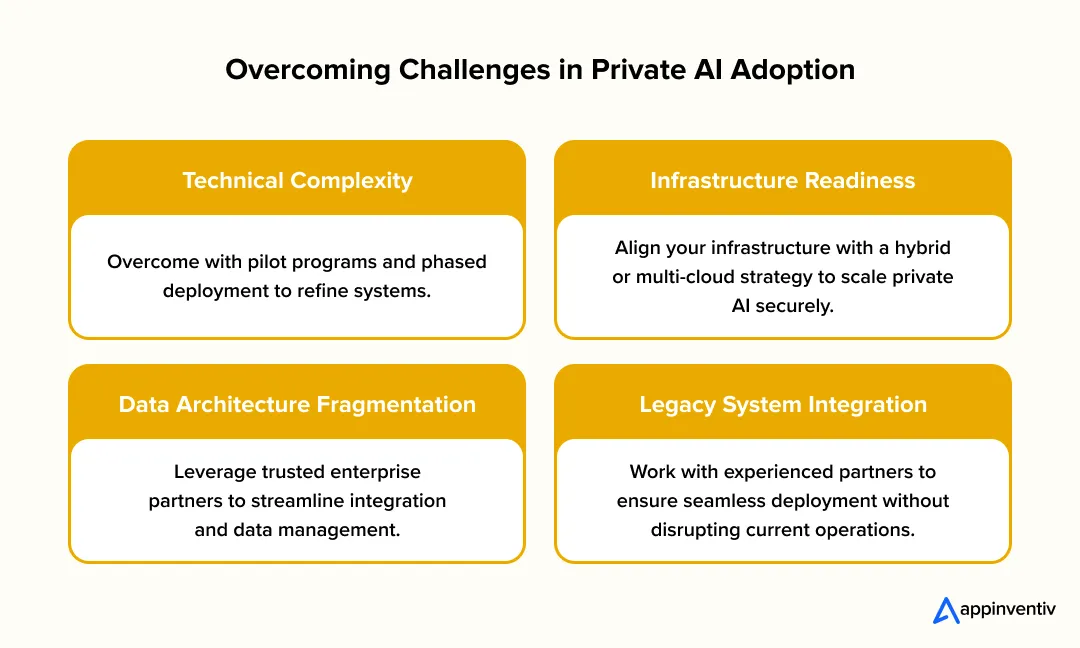
Every new technology comes with its limitations and challenges. So, of course, implementing private AI for enterprise comes with a number of challenges, but adopting the right approach can help overcome all these challenges. From infrastructure to compliance, the following are the challenges and limitations of private AI that organizations face, and how to overcome them:
- Technical Difficulty
Private or privacy AI requires substantial infrastructure and sophisticated, secure data environments. This can be a major barrier to entry for any organization lacking technical wherewithal. Pilot programs allow businesses to get their feet wet, work out the kinks, and ensure that systems meet their needs in terms of both security and operability before scaling up.
- Infrastructure and Tooling Readiness
Most organizations lack the infrastructure to accommodate the rising demands of private AI in securely storing data and the required computing power. To build a scalable system that fulfills private artificial intelligence for enterprise demands for security and compliance, align infrastructure roadmaps with a hybrid or multi-cloud strategy.
- Data Architecture Fragmentation
Data is housed within many disparate, unconnected systems that are usually challenging to integrate into one coherent private AI solution. Businesses can leverage trusted enterprise partners with deep experience in AI and integration to help bridge that gap and streamline data architecture for smooth integration and security.
- Integration with Existing IT/Cloud/Hybrid Environments
For enterprises with existing legacy systems, the integration of private AI can be a big challenge. Working with experienced partners who have a specialty in hybrid and cloud integrations makes this transition seamless and smooth for AI system deployment without disrupting present operations.
With a strategic approach and the right partners, these challenges become manageable, allowing businesses to capture the full benefits of private AI for business.
Also Read: 11 Greatest Barriers to AI Adoption and How to Beat Them: Your Implementation Roadmap
With 200+ AI engineers, 150+ custom models deployed, and a track record of secure, scalable solutions, we turn private AI challenges into measurable business outcomes.
Future-Proof Your Business with Emerging Private AI Technologies
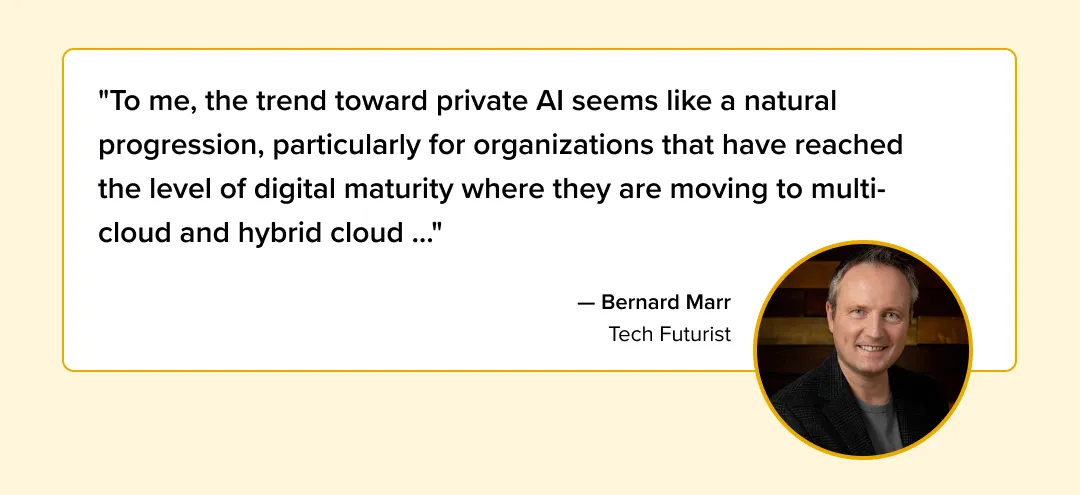
The future of private or privacy AI includes more control, security, and efficiency. With more organizations moving to hybrid and multi-cloud infrastructures, private AI will be even more integrated; technologies such as edge AI and privacy-enhancing technologies take it to the next level.
Here are some key trends to look out for in private artificial intelligence for enterprise:
- Hybrid and Multi-cloud Integration Strategy: With private AI, the integration of hybrid and multi-cloud will be smoother, thus allowing it to scale a lot faster and also be more flexible.
- Edge AI: It processes information closer to the source, reducing latency, increasing security, and keeping sensitive information within the confines of the local network.
- Governance Automation: Automation of governance will ensure that continuous compliance and protection of data are observed; thus, the AI systems become easier to manage.
- Privacy-Enhancing Technologies (PETs): With continuous evolution, technologies such as federated learning and differential privacy will only become stronger, helping companies extract insights while protecting privacy.
Private AI is not only a technological solution but also a strategic shift in how an enterprise deploys AI. If an enterprise wishes to lead in this race, it needs to put in place the necessary infrastructure and governance framework to work now.
Also Read: Top AI Trends in 2025: Transforming Businesses Across Industries
Partner with Appinventiv to deploy the hybrid architectures, edge AI capabilities, and privacy-enhancing technologies that will define the next era of AI adoption.

Partner with Appinventiv for Your Private AI Journey
Appinventiv is your trusted partner in building secure and ethical private AI for enterprise solutions. With over 300+ AI-powered solutions delivered, 200+ AI engineers, and 150+ custom AI models deployed, we have the expertise to help you navigate the complexities of AI adoption.
Here’s how we’ve made an impact:
- Banking: We helped a leading bank reduce manual processes by 35% and increase customer retention by 20% with AI. (Read Case Study)
- Social Media: For Vyrb, we built an AI voice-controlled social media app, driving 50k+ downloads and $1M in funding. (Read Case Study)
- Job Search: For JobGet, we streamlined job matching and video interviews with AI, leading to $52M in Series B funding. (Read Case Study)
With 75+ enterprise integrations, 50+ bespoke LLMs fine-tuned, and experience in 35+ industries, we’re equipped to guide your private AI transformation with our top-notch AI development services.
Let’s connect and make your business future-ready with private AI.
Frequently Asked Questions
Q. Why is private AI important for enterprises?
A. Private AI gives complete ownership to enterprises over their data for privacy, security, and compliance. It minimizes the risks associated with data breaches, helps gain stakeholder trust, and promotes ethics in AI practices for long-term business success.
Q. What is the difference between private AI and public AI?
A. Private AI is installed inside your infrastructure to operate, and, therefore, all your data remains within your control. In general, public AI uses third-party cloud services that expose data to a greater risk. Private AI revolves around concepts of the highest level of data privacy and security, whereas public AI gives more freedom with reduced control over sensitive information.
Q. How does private AI ensure compliance?
A. Private AI ensures the compliance of your data by keeping it within your infrastructure, which makes adherence to regulatory requirements such as GDPR, CCPA, and HIPAA easier. You are in control of data access, usage, and governance to meet specific compliance requirements for your industry.
Q. What industries benefit most from private AI?
A. Private AI benefits most when industries dealing in sensitive or regulated data are involved, such as banking, healthcare, insurance, and government, among others. These sectors really need high levels of data privacy, security, and compliance, of which private AI does very well.
Q. How do you measure the ROI of private AI for enterprises?
A. The return on private AI can be calculated based on various aspects: enhanced operational efficiencies, cost savings, higher customer satisfaction, better decision-making, and stronger regulatory compliance. The key to understanding your ROI is tracking improvements in AI outcomes along with reduced risks from data breaches or non-compliance.
Q. Is private AI more secure than public AI?
A. Yes, private AI is generally more secure than public AI, as it keeps sensitive data inside the organization’s infrastructure. Private AI allows you more control over data access, encryption, and governance, allowing reduced risks of external threats and breaches compared to public AI systems hosted on third-party platforms.
Q. What is Private AI?
A. Private AI means systems designed and deployed within your organizational infrastructure in order to give you full control over sensitive data. In contrast, traditional AI, which often relies on third-party cloud services, allows private AI enterprises to keep their data secure, meet regulatory compliance requirements such as the GDPR and CCPA, and mitigate risks such as data breaches or misuse. This approach will enable organizations to build and scale their AI systems while enforcing strict privacy and security standards.
Q. How does Private AI work?
A. Private AI keeps data and models within an organization’s infrastructure to ensure security and compliance by using such technologies as federated learning, where the data resides locally, and differential privacy to anonymize the information. The technology also depends on encrypted communication, secure storage, and on-premises or dedicated cloud deployments to effectively guard the data while enabling AI model development.

- In just 2 mins you will get a response
- Your idea is 100% protected by our Non Disclosure Agreement.

Simple Steps to Hire AI Governance Consultants in 2026
Key Takeaways Define AI risk tolerance and compliance goals before hiring consultants. Look for multidisciplinary teams combining governance, ML auditing, and MLOps expertise. Ensure consultants understand frameworks like the EU AI Act, NIST RMF, and ISO 42001. Prioritize experts who can operationalize governance inside ML pipelines. Embed responsible AI practices directly into CI/CD and model…
AI in Smart Homes in Australia: Use Cases, Cost & Real-World Impact
Key takeaways: The adoption of AI in Australian smart homes is primarily dictated by energy economics, insurance risk mitigation, and the evolving needs of an ageing population. AI development costs in smart homes range from AUD 70,000 to AUD 700,000+, depending on grid integrations, compliance engineering, and AI model complexity. Adherence to the Privacy Act…

Enterprise AI Integration in the Middle East: Scaling with Expert Architects
Key takeaways: Middle Eastern enterprises lead in AI adoption, driven by strong government support and investment in digital infrastructure. Successful AI integration requires robust data governance, compliance with local regulations, and tailored architectural design. Addressing talent gaps, localization needs, and legacy system challenges is crucial for scalable AI deployments. Systems integrators and big data architects…