






























Maritime Insurance Claim Software Development for UAE Ports, Insurers, and Logistics Networks


- Why Maritime Insurance Claim Software Is Replacing Manual Claims Processes
- Key Features of Maritime Insurance Claim Software
- How to Develop Maritime Insurance Claim Software in the UAE
- How Maritime Insurance Claim Software Transforms Claims Management in the UAE
- Practical Use Cases of Maritime Insurance Claim Software in the UAE
- Solving Critical Challenges in Maritime Insurance Claims with Smart Software
- Launch Your Maritime Insurance Claim Platform with Appinventiv
- FAQs

- Manual claims management is too slow for the UAE’s high-volume ports; digital solutions streamline processes and reduce errors.
- Maritime insurance claim software centralizes data, automates workflows, and ensures compliance with UAE regulations and Takaful principles.
- Real-time integration with port and vessel systems enables faster claim registration, validation, and settlement.
- Advanced analytics and risk insights help insurers and operators proactively manage risks and improve decision-making.
- Custom software development ensures scalability, security, and alignment with the unique needs of UAE maritime stakeholders.
UAE marine insurers are often settling claims that should take only hours in weeks. The reason is almost always the same: fragmented data across ports, insurers, surveyors, and logistics operators, with no single system connecting them.
What keeps global trade moving through the UAE is not just infrastructure, but coordination at scale. It is also estimated that each day, ports like Jebel Ali Port and Khalifa Port are being used by thousands of containers, pushing yearly volumes into the 20 million TEUs and billions in the national economy, with the maritime sector contributing nearly AED 135 billion in total.
However, movement at this scale is always accompanied by constant exposure to risk. Damages to cargo, route delays, weather conditions, and delays in the work process result in insurance claims that should be addressed promptly and without errors by ports, insurers, and logistics organizations.
This is the point at which the argument for developing maritime insurance claim software UAE makes sense. A bespoke solution centralizes claims on a single digital platform, where information flows in real time, verification is automatic, and all stakeholders operate on the same information. This minimizes errors, shortens settlement periods and enhances compliance.
In this blog, we explore why manual claims management no longer works for modern marine insurers. We also cover the key features of maritime insurance claim software, how it improves operations, practical use cases, the development process, and the major claim management challenges businesses face, along with effective ways to overcome them. Let’s get started.
Stay ahead with faster, smarter claim systems built for UAE insurers

Why Maritime Insurance Claim Software Is Replacing Manual Claims Processes
The UAE maritime industry is facing the issue of managing claims manually, which is no longer sustainable due to the vast increase in the scale and complexity of operations that cannot be supported by paper-based or semi-digital methods.
Since numerous parties are included in each shipment, any minor delay in the processes of documentation, verification, or approval may slow down the whole claims procedure. Human data entry, incomplete communication, and inconsistent documentation continue to increase the risk of mistakes and lengthen settlement periods.
Contemporary maritime operations require workflow automation, instant access to data, and cohesive solutions to process claims at scale and remain financially stable. These are some of the key reasons why marine insurers are now investing in insurance claim software development to manage claims more efficiently.
Key Features of Maritime Insurance Claim Software
An effective maritime insurance claim software UAE portal should mirror the business aspects of ports, insurers and logistics networks. It is not merely about digitization but about developing a system capable of managing scale, complexity, and regulatory requirements without slowing operations.
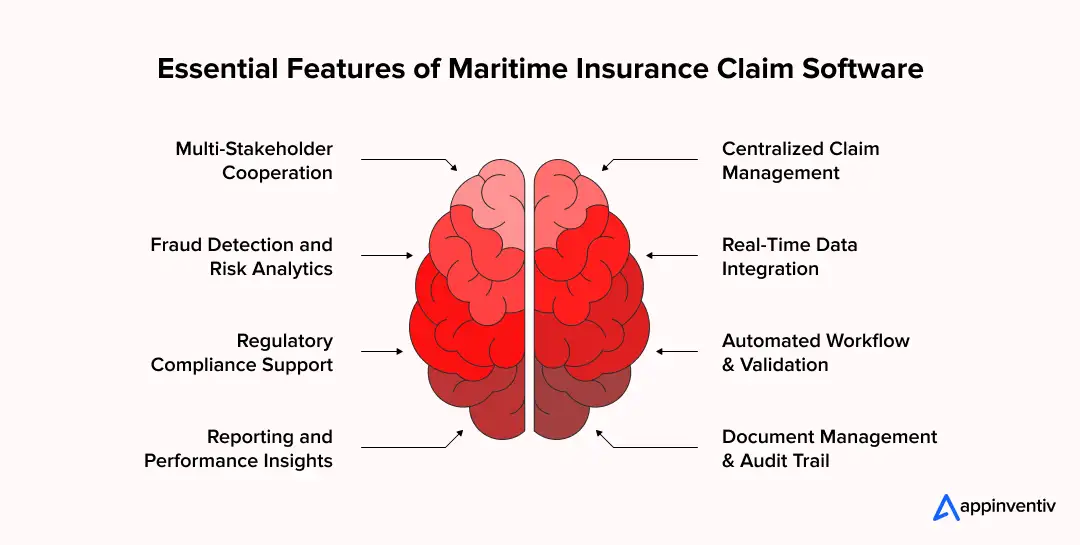
Centralized Claim Management: Single dashboard to record, follow-up and handle claims since the initial notice has been received up to the final settlement. This eliminates scattered records and ensures all involved parties operate from a single point of truth.
Real-Time Data Integration: It can integrate with port management systems, vessel tracking, and cargo platforms, enabling the incident to be recorded immediately. This enhances precision and allows for faster, more valid claims.
Automated Workflow and Validation: Policy coverage, documentation, and claim eligibility can be automatically checked using built-in rule engines. This decreases the human factor and minimizes processing schedules.
Document Management and Audit Trail: Proper storage of all documents relating to claims, and time-stamp logs on activity. This helps in transparency, makes audits easier and complies with maritime regulations.
Multi-Stakeholder Cooperation: Ports, insurers, surveyors, and logistics providers’ role-based access. Claims are able to be viewed, updated and approved by each party in a controlled environment through port insurance software in Dubai.
AI-Powered Fraud Detection and Risk Analytics: Advanced analytics combined with AI-powered fraud detection techniques are applied in a layer of cargo loss claims software to determine abnormal claim patterns, duplicates, or high-risk routes, which assists in making better financial decisions.
Regulatory Compliance Support: Pre-configured compliance checks aligned with regional and international maritime standards, often integrated with a marine policy management system to ensure policy adherence throughout the claim lifecycle.
Reporting and Performance Insights: Custom dashboards and reports that provide visibility into claim volumes, settlement times, and cost trends, enabling better operational and financial decision-making.
How to Develop Maritime Insurance Claim Software in the UAE
Developing a dedicated maritime insurance claim software UAE requires a deep understanding of local maritime operations, Islamic finance principles (Takaful), and the country’s regulatory frameworks. Let’s have a quick look at the software development process in the Middle East.
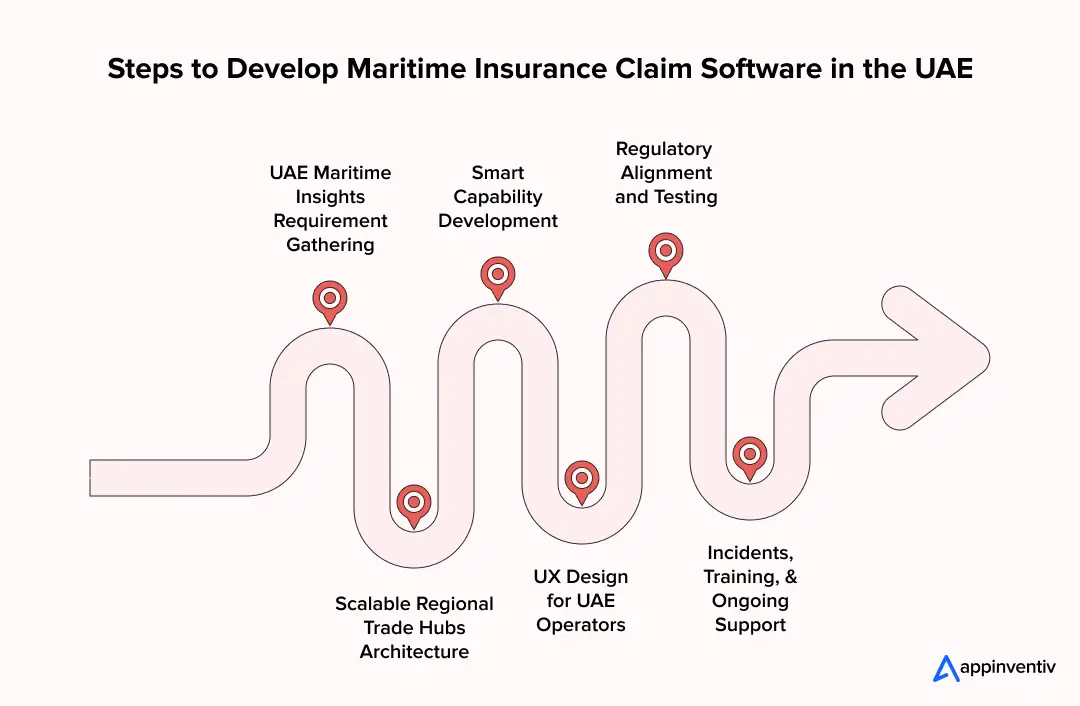
UAE Maritime Insights Requirement Gathering
Reach out to stakeholders working in ports, Takaful insurers, and logistics operators in order to map end-to-end claim workflows. Get the peculiarities of handling containers, the types of cargo, and the reporting needs of ports.
Integrate the UAE federal policies and customs policies, as well as the free zone policies, to inform the marine insurance software development in the UAE, so that the solution is compatible with the practice and legal frameworks of the country.
Scalable Regional Trade Hubs Architecture
Develop a cloud-based, scalable architecture with the capability of supporting high TEU volumes and real-time claim processing. Add multi-currency, Arabic-English interface, and vessel tracking and port management system integration.
Make it scalable to serve various UAE Free Zones and international logistics supporters, which is one of the key aspects of maritime insurance software development in Dubai.
Smart Capability Development
Develop automated verification engines, credit scoring with AI and claim management modules that operate at the centre. Provide cargo insurance software capability to facilitate Takaful-style risk sharing and facilitate cross-border claim settlements. Have high-value cargo or a suspicious pattern of claim alarms to facilitate operational control.
UX Design for UAE Operators
Design insurer, surveyor and port authority dashboards and mobile interfaces. Add interactive visualizations of the claim progress, mobile-first approvals and regional time zone and work schedule push notifications. Make sure the workflows are in line with how UAE operations are being carried out so that a decision may be made promptly and easily.
Regulatory Alignment and Testing
Conduct effective functional, integration, and security testing, considering the UAE laws and international standards in maritime. Validate maritime InsurTech in the UAE includes the following features: Sharia-compliant claim processing, an audit-ready document trail, and checks to comply with regulations to minimize disputes and regulatory risk.
Incidents, Training, and Ongoing Support
Implement the system on a step-by-step basis in ports, insurers, and logistics associates. Offer intensive user training and multi-lingual documentation. Introduce performance monitoring dashboards, feedback loops and regular updates to optimize the workflows and maintain the operations in accordance with the UAE maritime policies and insurance standards.
This approach is used to warrant an efficient, culturally responsive, legally effective, and proficient system to accommodate the region’s fast, high-volume maritime trade environment.
Let our experts help you turn your idea into a working system

How Maritime Insurance Claim Software Transforms Claims Management in the UAE
In the UAE, maritime trade is central to economic growth. With Dubai Vision 2040 accelerating enterprise system development across ports and logistics, insurance claims increasingly demand speed and coordination that modern maritime insurance claim software can support.
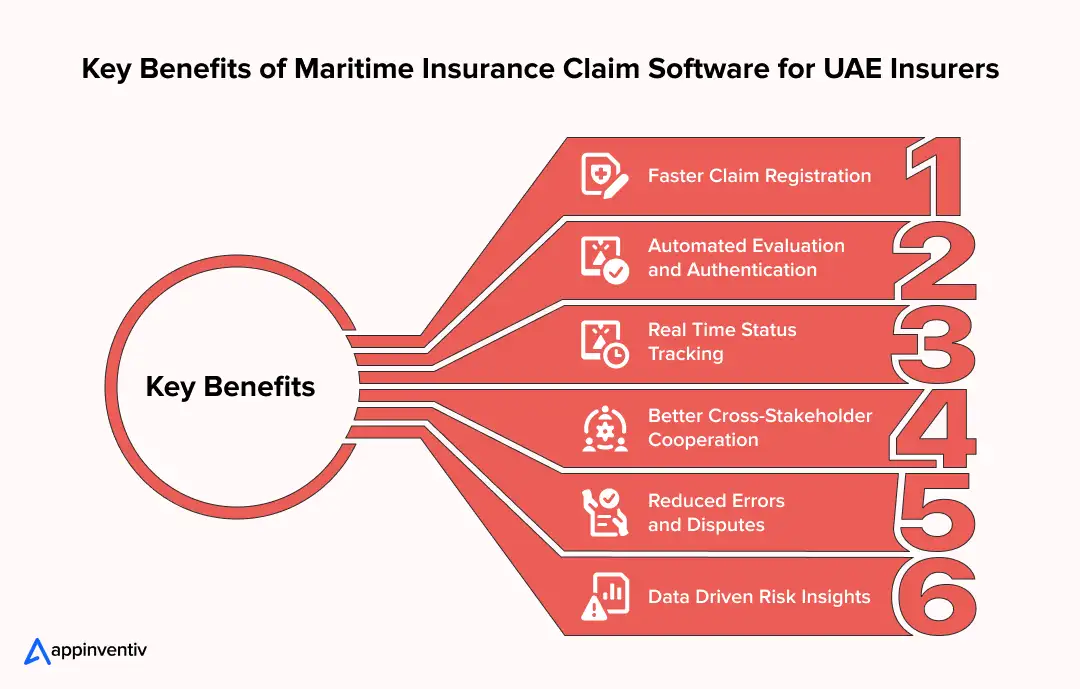
Faster Claim Registration
Incident logging may be performed in real time, including tracking of vessels, cargo records, and port activities. This will be appreciated especially in high traffic hubs like popular ports, where claims are made into the system without delays, and this assists in facilitating the regular running of Khaleeji trade networks.
Automated Evaluation and Authentication
Claims are automatically verified against policy coverage, documentation and compliance requirements through AI agents used in Middle Eastern banking operations. Using marine insurance software development in the UAE, businesses minimize manual verifications and ensure compliance with local and international maritime laws.
Real Time Status Tracking
Sharing dashboards eliminates the use of emails and phone calls by giving direct, real-time visibility of the claim progress. The updates can be tracked simultaneously by stakeholders across ports, insurers, and logistics providers, enhancing coordination in the fast-paced environment.
Better Cross-Stakeholder Cooperation
Platforms built through maritime insurance software development in Dubai enable seamless interaction among surveyors, shipping lines, and insurance teams, reflecting the UAE’s focus on integrated, high-efficiency maritime operations.
Reduced Errors and Disputes
Documentation errors and inconsistencies are minimized by structured workflows that are aided by cargo insurance software. The reduction in disputes results in quicker settlement and lower administrative costs.
Data Driven Risk Insights
Insurance data analytics determine recurring patterns of claims, high-risk cargo routes and bottlenecks. This is part of maritime InsurTech in the UAE as a wider context of informing underwriting, policy modifications, and strategic planning of risks in the Khaleeji shipping corridors.
Practical Use Cases of Maritime Insurance Claim Software in the UAE
Contemporary maritime practices in the UAE are very dynamic, and they include ports, free zones, insurance and logistic networks. The maritime insurance claim software UAE can be used to work with large volumes of claims and adhere to the local laws, Takaful principles and international standards. The following are some of the real-world applications of its effect.
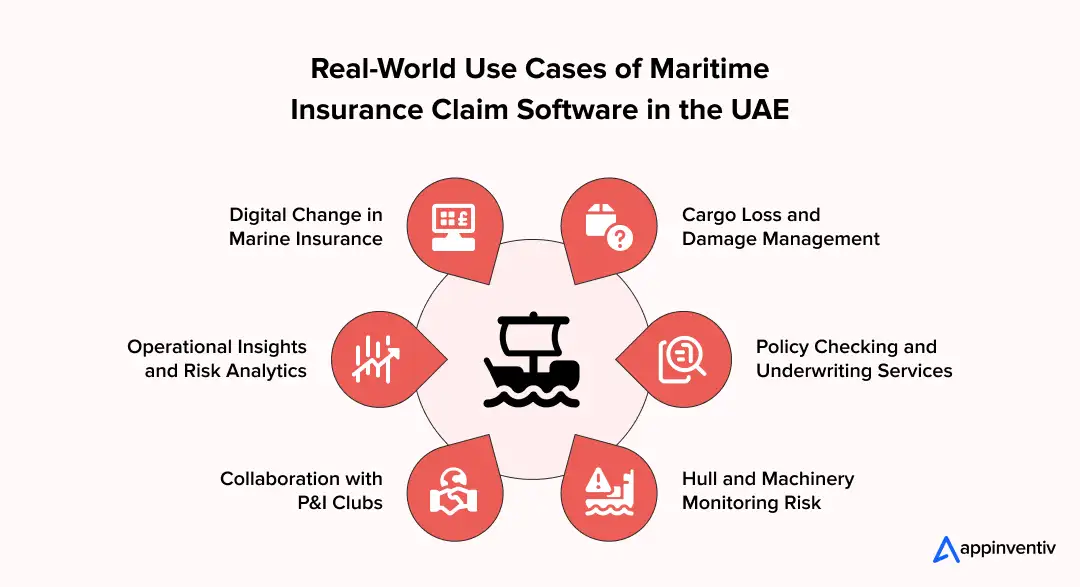
Cargo Loss and Damage Management
Container damage may be related to handling, weather, or transportation-related interruptions. The application of cargo loss claims software will allow insurers and shipping operators to capture incidents digitally, add evidence, and authenticate claims more quickly.
This minimizes delays, enhances transparency, and improves settlement accuracy, which is important in the UAE trade corridors that handle a wide variety of high-value cargo.
Policy Checking and Underwriting Services
The claims usually have to be checked in complicated marine policies. The marine underwriting software Middle East module ensures all claims are met with coverage terms and regional coverage, such as Sharia-compliant policies, and helps eliminate disputes, leaving an audit-ready trail to the regulators and insurers.
Hull and Machinery Monitoring Risk
Machinery failures or hull damage on ships can give rise to strong claims. Integrated Hull and machinery insurance software with the claims system will enable insurers to track vessel status, identify potential risks in advance, and automatically record incidents to process them more quickly.
Collaboration with P&I Clubs
Claims often have more than two parties, and one of these parties is a Protection and Indemnity club. The P&I club software integration enables real-time update, approval and correspondence between the insurers, clubs and operators, and this helps to cut short the change of the bottleneck and controversy in multi-stakeholder claim cases.
Operational Insights and Risk Analytics
Advanced dashboards and AI-driven tools within the platform support shipping risk management software, analysing high-risk routes, recurring incidents, and operational inefficiencies. These insights inform proactive risk mitigation and better decision-making for UAE maritime operations.
Digital Change in Marine Insurance
The system supports marine insurance digital transformation in the UAE by replacing paper-based processes, connecting ports, insurers, and logistics providers, and providing real-time visibility.
This will guarantee quicker claim settlements, fewer mistakes and adherence to both the federal maritime rules and international principles. With digital transformation in insurance, maritime insurers can manage large-scale claims more efficiently while improving transparency and operational control.
These applications demonstrate why UAE maritime firms and insurers can obtain faster claims processing, better risk management, fewer disputes, and more control over their operations, and simultaneously remain in line with the developing maritime ecosystem in the country.
Solving Critical Challenges in Maritime Insurance Claims with Smart Software
Maritime insurance operations in the UAE are shaped by strict regulatory frameworks, Sharia-compliant Takaful policies, and high-volume port and logistics networks, all of which influence system design and workflow. Here are some of the key challenges marine companies and insurers encounter, along with practical solutions to address them effectively.
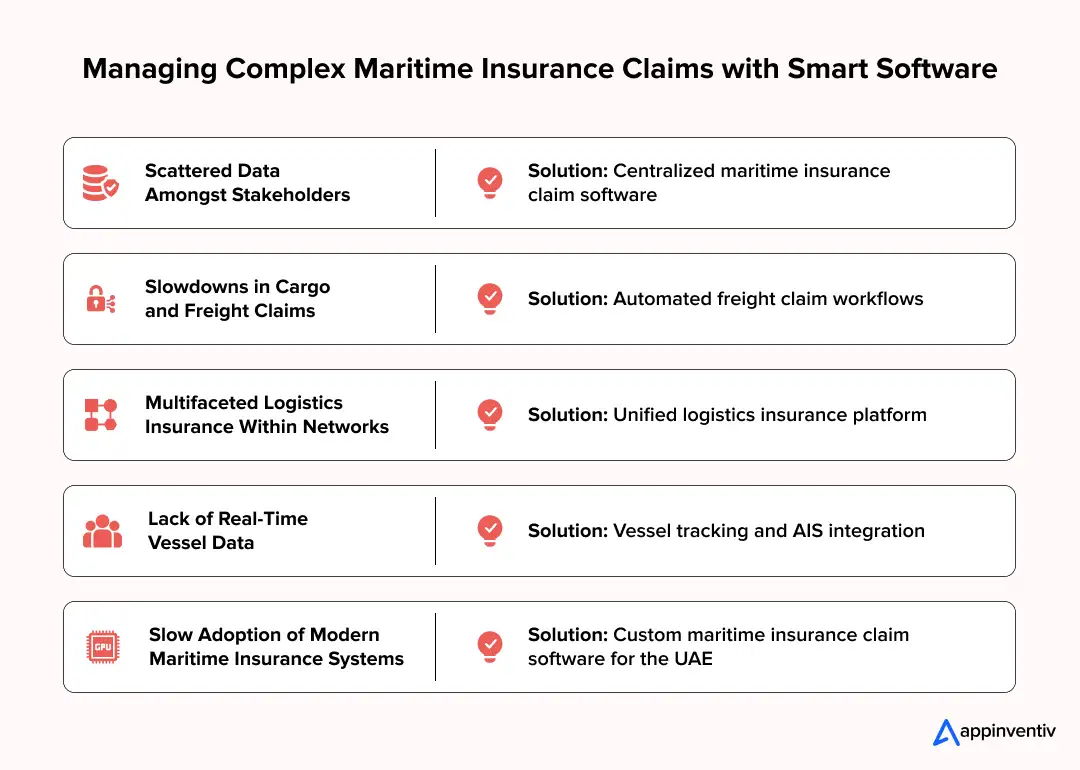
Scattered Data Amongst Stakeholders
Scattered data often leads to delays and inconsistencies in challenge information due to its spread across ports, insurers, and logistics operators.
Solution: Centralized maritime insurance claim software UAE consolidates all claimed information in one system. Live access will enable insurers, shipping lines, and port authorities to work together efficiently, resulting in faster claim registration and greater precision in maritime routes throughout the UAE.
Slowdowns in Cargo and Freight Claims
Cargo damage/loss claims can be time-consuming, which would impact settlements and cash flow.
Solution: The adoption of freight insurance software provides an automated process for incident reporting, documentation capture, and claim validation. This helps ensure that cargo loss claims proceed swiftly from initial notice to settlement, reduce disputes, and enhance the efficiency of operations for UAE marine firms.
Multifaceted Logistics Insurance Within Networks
In UAE free zones, ports, and shipping lines, logistics operations involve a number of stakeholders that create gaps in accountability.
Solution: Logistics insurance software in the UAE integrates all parties into a single workflow, providing role-based access, audit trails, and automated notifications. Claims can be tracked in real time and can improve transparency and coordination among the operators and insurers throughout the supply chain.
Lack of Real-Time Vessel Data
In most cases, there are delays or losses that cannot be easily confirmed due to a lack of timely news on the location, condition or status of the vessel.
Solution: Vessel tracking insurance integration links software with live AIS data and port management systems, providing automatic monitoring of vessel and cargo conditions and incident reports. This eliminates physical follow-ups, speeds up settlements and enhances risk management.
Slow Adoption of Modern Maritime Insurance Systems
Most UAE marine companies continue to use paper-based processes or generic, non-localized systems.
Solution: Marine insurance software development in the UAE offers tailor-made solutions that are in line with local regulations, Takaful principles, and operating realities. Custom software enhances the accuracy of claims, compliance, and cooperation, and supports the country’s maritime transformation objectives in the digital world.
Let our experts transform your processes into a seamless, reliable system
Launch Your Maritime Insurance Claim Platform with Appinventiv
The future of maritime insurance in the United Arab Emirates is shifting to faster decision-making, automated claims and more precise risk evaluation. Since the region is still establishing its status as a maritime shipping hub, insurance procedures will also have to change to keep pace with the scale and complexity of contemporary maritime activities.
Paperwork and piecemeal systems will slowly be phased out in favor of real-time data, intelligent validation, and entirely digital claim rooms. Companies that adopt modern platforms earlier will enjoy faster settlements, greater transparency, and increased trust throughout the maritime ecosystem.
Appinventiv helps UAE ports, insurers, and logistics networks to develop solutions that are specific to them. As a trusted custom software development company in Dubai, we operate in a rapidly expanding technology ecosystem, developing scalable maritime insurance claim systems that meet realistic operational requirements. From automated workflows and policy integrations to real-time vessel tracking and advanced analytics, the goal is to create systems that improve accuracy, reduce claim processing time, and support long-term growth
Now is the moment to take the next step if you are planning to modernize your claims workflow or create a safe maritime insurance platform tailored to UAE operations. A smoother system designed can minimize delays, enhance operational visibility, and assist insurers and logistics firms to better manage risk. Check our portfolio to learn more about the clients we have worked with and how we helped them digitally transform and increase user engagement.
All you need to do is speak with our team and tell them about your needs or the possibilities of a tailor-made solution to help your business. Get in touch with our experts now!
FAQs
Q. What does it cost to develop maritime insurance claim software in the UAE?
A. The cost of building maritime insurance claim software UAE is usually based on the functionality, integrations, and regulations. Simple systems with claim tracking and document management could begin at about AED 147,000 (approximately $40,000), whereas more sophisticated systems with AI verification, policy automation, and analytics can cost more than AED 1.1 million (around $300,000).
Integration with port systems, vessel tracking, and compliance frameworks also significantly influences overall development costs.
Also Read: How Much Does It Cost to Build a Software in Dubai?
Q. How do UAE marine insurers automate their claims processing workflows?
A. Here’s how the UAE marine insurers automate their claims processing workflows:
Step 1: Chart the current claims lifecycle
The first step of the insurers is to examine the flow of claims once they are reported to the point of settlement and determine the delays or manual controls.
Step 2: Build automated processes
Through maritime insurance software development in Dubai, workflows are created for claim intake, document validation, and approval routing.
Step 3: Combine policy and cargo information
The platform links insurance policy records, shipment records, and incident reports to eliminate repetitive manual entries.
Step 4: Activate real-time monitoring
Robotic dashboards enable insurers to control claims and follow up on processing schedules in real time.
Step 5: Analytics for faster settlements
Automation tools are used to detect errors, minimize fraud risk, and speed up claims processing.
Q. What is parametric marine insurance, and how is the software built?
A. Parametric marine insurance includes claims that are compensated upon designated triggers as opposed to damage valuation that is done manually. As an illustration, when a vessel tug is overdue beyond some allocated period, or a cargo shipment is over a risk limit, the claim is automatically triggered.
The application is built on data-driven guidelines, live vessel tracking, weather feeds, and automated verification engines. It will lead to saving settlement time, enhancing transparency and enabling the insurers to deal with high volume maritime risks more effectively.
Q. What should UAE insurers look for when evaluating a marine insurance software company?
A. While you decide to invest in the development of marine claims management software UAE, it is essential to choose the right partner. Here’s what you should look for:
Experience in marine insurance systems: Select those vendors who are experienced in marine insurance software development in the UAE and understand local regulatory processes.
Integration capabilities: The platform must connect to vessel tracking, port and policy databases.
Customization and scalability: Ensure the software can handle large volumes of claims and complex processes.
Security and compliance features: It should have data protection and audit-ready workflows.
Continuous support and upgrades: Support systems are reliable, guaranteeing long-term performance and flexibility.
Q. How to integrate AIS data into marine insurance underwriting software?
A. Here are the steps to integrate AIS data into marine insurance underwriting software:
Step 1: Connect to AIS data providers
Start by integrating trusted AIS data APIs into AIS data insurance software platforms.
Step 2: Build real-time vessel monitoring
The system should automatically track vessel location, speed, and route changes.
Step 3: Link data with underwriting rules
AIS data is used to assess risk levels and validate claims.
Step 4: Enable automated alerts
The software flags risky routes or unusual behaviour.
Step 5: Use analytics for risk evaluation
This improves underwriting accuracy and operational visibility.
Q. How long does it take to build a maritime insurance claims platform?
A. The production of a maritime insurance claims platform normally consumes a three or six months timeframe based on complexity. The simplest model of claim tracking and insurance workflow automation can be done in 10-12 weeks, whereas a comprehensive platform with AI analysis, policies, and real-time data links will take more time. The schedules are also based on compliance testing, stakeholder feedback and system integration requirements.
Q. What regulations govern maritime insurance software in the UAE?
A. Maritime insurance software in the UAE should be in conformity with the federal maritime regulations, insurance standards, and data protection regulations. Audit trails, safe storage of data, and policy validation should be supported by systems that comply with local legal frameworks.
International maritime standards and insurance reporting regulations are also necessary to ensure accuracy, transparency, and approval by insurers and marine operators’ regulators.

- In just 2 mins you will get a response
- Your idea is 100% protected by our Non Disclosure Agreement.

How to Build a Student Management System in Australia?
Key takeaways: Australia’s tightening regulatory landscape (TEQSA, ASQA, CRICOS) makes student management system development in Australia a compliance-driven necessity, not just a digital upgrade. Monetisation models such as SaaS subscriptions, institutional licensing, white-label partnerships, and hybrid pricing offer scalable commercial opportunities in Australia’s expanding EdTech market. Addressing challenges early - data privacy, legacy migration, multilingual…

Guide to Software Risk Management: Identifying and Mitigating Key Risks in Software Development
Key takeaways: Risk management is no longer a peripheral activity; it is a core component of Enterprise Risk Governance (ERG) that ensures software ROI. Successful projects define their risk appetite—the level of risk an organization is willing to accept—before the first line of code is written. By integrating risk assessment into the early discovery phase,…

Key takeaways: MVP to enterprise scaling requires planned architecture, governance, and cost controls for sustainable growth. Modular, reusable systems and automation can reduce development costs by 30–40%. Scaling should be triggered by repeatable demand and operational readiness, not just early traction. Avoid common pitfalls like premature scaling, overengineering, and lack of ownership clarity. Case studies…