



























IoT in Mining: Modernizing Operations for Enterprise Efficiency and Safety


- Key Components of IoT in Mining Operations
- Operational Gaps That Limit Performance in Traditional Mining Environments
- How IoT Improves Operational Efficiency in Mining
- Enhancing Safety Through IoT in Mining
- IoT and Data-Driven Decision Making in Mining
- Integration of IoT with Advanced Technologies
- Cybersecurity and Data Governance Considerations
- Real-World Use Cases of IoT in Mining Operations
- Implementation Challenges for IoT in Mining and How to Overcome Them
- Cost of Implementing IoT in Mining Operations
- Future of IoT in the Mining Industry
- How Appinventiv Helps Mining Companies Implement IoT Solutions
- Frequently Asked Questions

Key takeaways:
- The Internet of Things in mining turns scattered operational signals into live, decision-ready visibility across fleets, fixed plants, people, and the environment.
- The biggest wins usually show up first in uptime, then in safety response, and finally in energy and process stability.
- “More data” does not automatically mean better performance. Value comes when IoT telemetry changes what maintenance teams schedule, what dispatch teams adjust mid-shift, and what safety teams can act on immediately.
- Connectivity and integration are the real make-or-break factors, not the sensor catalog.
Digital maturity is no longer optional for large mining operations; it is essential for protecting margins in a volatile commodity environment. Sites are under pressure to reduce unplanned downtime, control energy intensity, strengthen safety oversight, and meet increasingly rigorous ESG expectations. At the same time, aging assets and remote operating conditions make real-time visibility more difficult.
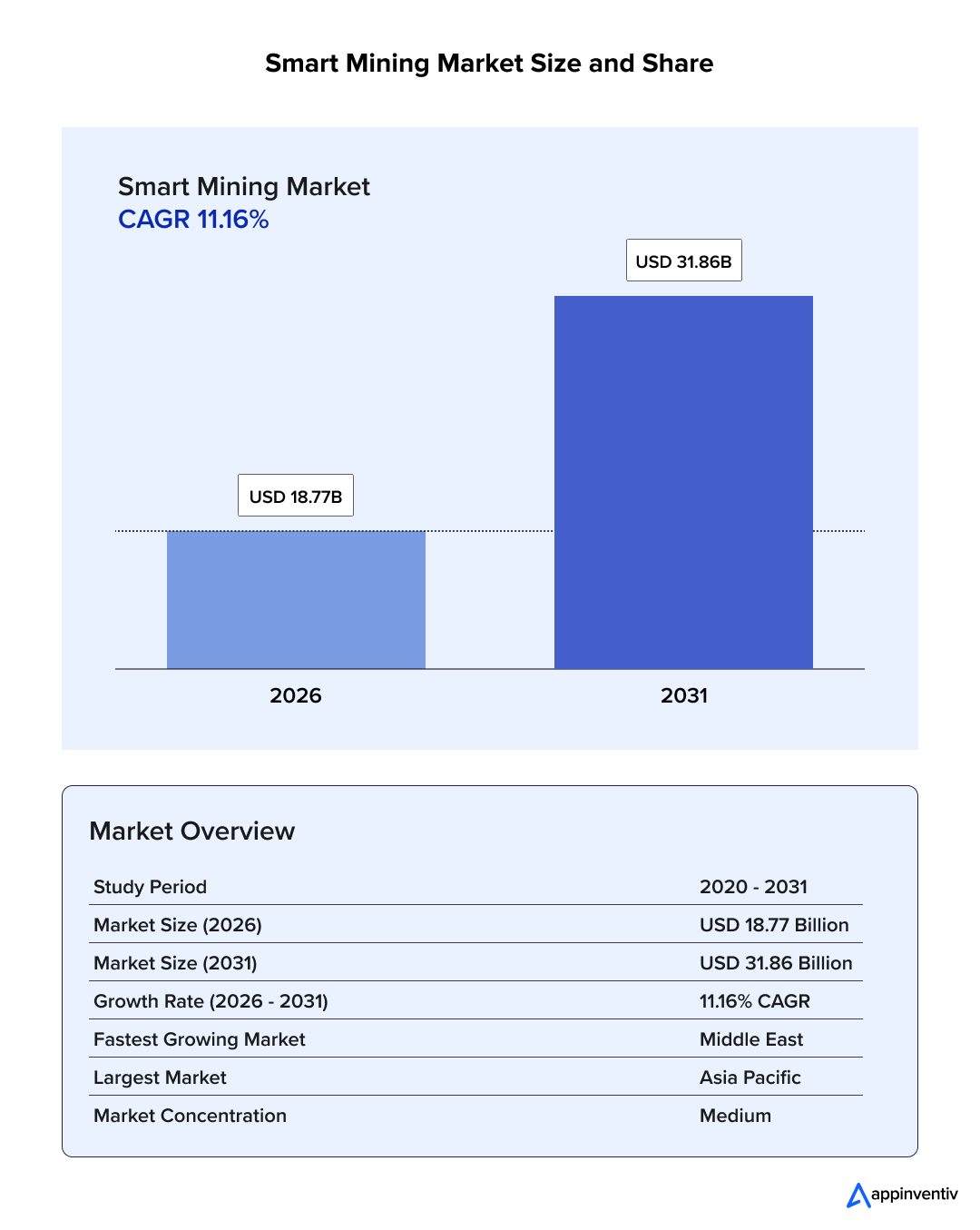
Investment trends reflect this shift. The global smart mining market is projected to grow from $18.77 billion in 2026 to $31.86 billion by 2031, signaling a clear move toward connected and automated operations. This momentum is about building operational predictability, not about experimentation.
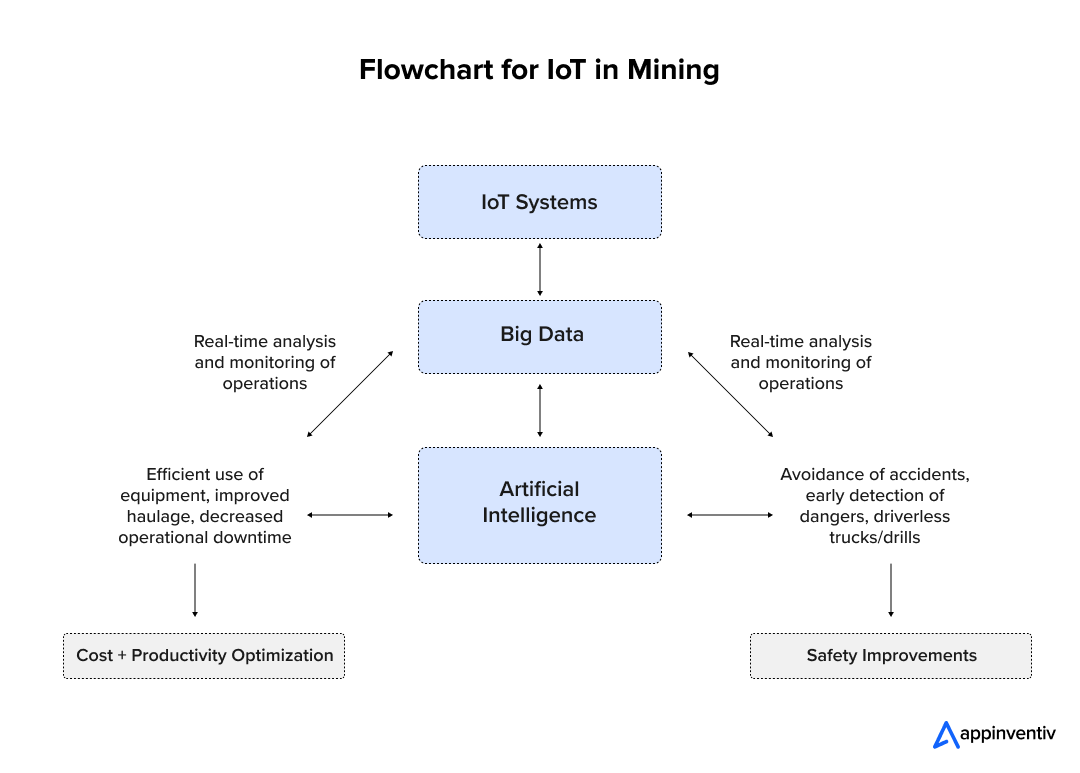
The Internet of Things in mining functions as a strategic data layer. It connects equipment, workforce, and environmental systems to provide timely, actionable insight.
This blog will examine where traditional mining operations struggle with control and visibility, and how IoT for mining addresses those gaps through measurable improvements in efficiency, safety, and governance.
Unplanned downtime costs industries $50B annually. Build smarter, connected mining systems.
Key Components of IoT in Mining Operations
Before looking at individual components, it’s important to understand that the impact of IoT in mining operations begins at the physical layer. The quality, reliability, and placement of field devices determine how accurate and actionable the entire system will be.
In harsh, high-risk environments, hardware selection is not a secondary decision; it is foundational to operational safety and performance.
1) Sensors and Edge Devices
Mining IoT devices are purpose-built for harsh environments. They need to be rugged, often intrinsically safe in certain zones, and tolerant of dust, vibration, and temperature variation.
Common sensor categories in the application of IoT in mining industry initiatives include:
- Condition monitoring: vibration, temperature, acoustic, oil quality
- Equipment performance: engine load, pressure, cycle time, utilization
- Fleet and location: GNSS, proximity, payload, route adherence
- Environmental: gas (methane, CO, H₂S), particulate matter, humidity, heat stress indicators
- Geotechnical and structural: movement, deformation, slope indicators, tailings instrumentation, where applicable
Edge devices matter because connectivity is not always stable. Underground zones and remote pits can produce a “store-and-forward” reality. The edge layer handles local buffering, filtering, and in some cases, local alerting for safety-critical signals.
2) Connectivity Networks in Remote Locations
Connectivity is a design constraint, not a checkbox.
Mining deployments typically blend multiple connectivity options:
- Private LTE / private 5G for controlled coverage and mobility
- Wi-Fi in fixed plant and site facilities
- LoRaWAN for low-power, long-range sensors
- Satellite for remote backhaul and contingency links
- Mesh networks in certain underground layouts
The right mix depends on topology, mobility needs, and risk tolerance for outages. Many IoT projects that look solid on paper fail in the field because coverage maps were optimistic.
Technical Note on Latency
For autonomous and semi-autonomous operations, connectivity is not just about “coverage”—it is about Ultra-Reliable Low-Latency Communication (URLLC). In high-speed haulage or remote drilling, a latency shift from 50ms to 200ms is the difference between a safe automated stop and a catastrophic equipment collision. We focus on Private 5G and optimized Edge processing to ensure sub-millisecond local response times.
In high-risk environments, we design for deterministic response at the edge. That means isolating safety-critical loops from cloud dependencies and validating fail-safe behavior under degraded network conditions, rather than assuming ideal connectivity.
3) Data Platforms and Analytics Systems
A mining IoT platform must handle time-series data at scale and support integration into operational workflows.
Capabilities that matter:
- Ingestion of high-frequency sensor streams
- Time-series storage and retention policies
- Real-time alerting rules and event management
- Dashboards for control rooms and asset teams
- Integration interfaces (APIs) to maintenance and fleet systems
- Audit logs for governance and security
This is where IoT for intelligent mining becomes real. Not because a dashboard exists, but because telemetry is translated into decisions.
Also Read: Key Strategies to Ensure IoT Project Success
Consumer IoT vs Industrial IoT in Mining
Consumer IoT optimizes convenience and user experience. Industrial mining IoT optimizes reliability, safety, uptime, and traceability.
A small difference captures the gap: consumer IoT can tolerate downtime. Mining IoT often cannot. A missed gas alert, delayed proximity event, or failed asset condition warning can quickly become a production or safety problem.
Operational Gaps That Limit Performance in Traditional Mining Environments
Mining operations operate under well-known pressures: safety exposure, capital-intensive assets, volatile energy costs, and strict regulatory oversight. The challenge is not awareness of these factors, but the gap between real-time field conditions and the speed at which informed decisions can be made.
Operational Reality vs. Control Limitation
The following comparison highlights where operational complexity meets control limitations in traditional mining environments. These gaps often define the starting point for IoT-driven modernization initiatives.
| Operational Area | Typical Limitation | Strategic Impact |
|---|---|---|
| Safety Monitoring | Periodic checks and fragmented reporting | Delayed hazard detection and slower response time |
| Asset Maintenance | Time-based or reactive servicing | Higher unplanned downtime and cascading failures |
| System Integration | Disconnected SCADA, fleet, and maintenance systems | Lack of unified operational visibility |
| Energy & Resources | Limited real-time usage tracking | Higher cost per tonne and avoidable waste |
| Compliance & Governance | Manual reporting and non-standardized data capture | Audit exposure and reporting inefficiencies |
This is not a question of operational competence; it is a systems issue. When data moves more slowly than field conditions change, even experienced teams operate with partial visibility.
In our experience, most modernization programs fail not because the technology is immature, but because operational ownership is unclear. The first successful step is defining who acts on which signal and within what timeframe, before adding more devices to the network.
Interoperability as a Scaling Constraint
One of the primary barriers to scaling IoT in mining industry environments is not hardware selection; it is system integration.
Legacy SCADA systems, fleet management platforms, and enterprise applications were rarely designed for horizontal interoperability. As a result, IoT initiatives stall when data cannot flow consistently across environments.
At Appinventiv, IoT scaling programs are designed around a decoupled architecture approach. By integrating legacy OT systems with cloud-native platforms using standardized industrial protocols such as OPC UA and MQTT, organizations can unify operational data without replacing existing infrastructure. This approach reduces vendor lock-in risk and supports expansion across multiple sites.
Compliance and the Audit Imperative
Regulatory expectations have evolved. In areas such as tailings governance, environmental discharge, and workforce safety, timestamped and traceable records are increasingly critical.
Standards such as the Global Industry Standard on Tailings Management (GISTM) underscore the importance of monitoring, governance, and accountability throughout a facility’s lifecycle.
In this context, IoT provides more than visibility. It provides verifiable data capture directly from source systems, reducing reliance on manual reporting and improving audit defensibility.
Strategic Framing
When viewed through this lens, the role of IoT in mining is less about “digitization” and more about control architecture. It closes operational blind spots, reduces reaction lag, and strengthens the reliability of both production and compliance reporting.
This concise framing keeps the content aligned with executive expectations while smoothly transitioning to how IoT improves efficiency and safety in measurable ways.
How IoT Improves Operational Efficiency in Mining
The benefits of IoT in mining industry initiatives are easiest to see in four areas: equipment monitoring, predictive maintenance, operational optimization, and resource management. The order matters. Most sites start with uptime, then expand.
1) Real-time Equipment Monitoring
Real-time monitoring means continuously capturing equipment health and utilization, rather than relying on operator notes, periodic checks, or after-action reporting.
What it looks like in practice
- A fleet health view that flags anomalies by severity and operational impact
- Utilization dashboards showing idle time and underused assets
- Health indicators for critical components that affect failure risk
Also Read: How Much Does it Cost to Develop a Fleet Management Software
Why it matters
Mining does not usually lose money because the equipment breaks down. It loses money because equipment breaks at the worst possible time, without warning, triggering a chain reaction.
Early detection is where IoT earns its place. A vibration trend in a critical motor is not a story until it creates a planned intervention. The moment it changes the schedule from “run to fail” to “fix during planned downtime,” the economics change.
Outcome patterns
- Lower unplanned downtime
- Longer asset life for high-cost components
- Reduced secondary damage through earlier intervention
This is a central impact of IoT in mining operations because it improves operational predictability, not just performance.
2) Predictive Maintenance and Asset Optimization
Predictive maintenance is not magic, but disciplined engineering plus good data.
A practical approach looks like this:
- Identify top failure modes for the assets that cause the most downtime.
- Instrument those failure modes, not everything.
- Build a baseline: what “normal” looks like in your operating environment.
- Tune thresholds and alerts to avoid noise.
- Connect alerts to actions in the CMMS/EAM.
The last step is where many programs stall. If an anomaly alert does not become a work order with a clear owner and target date, teams stop trusting the system.
Maintenance scheduling based on actual condition
Condition-based scheduling is a straightforward win:
- Intervene when indicators cross risk thresholds
- Align maintenance windows with production planning
- Reduce emergency repair frequency
Cost and disruption outcomes
- Fewer breakdown-related shutdowns
- Lower repair costs due to reduced escalation
- Improved parts planning and fewer urgent shipments
These are not speculative benefits. They tend to show up quickly when the instrumentation is linked to the maintenance workflow.
3) Process Automation and Operational Optimization
“Automation” in mining often starts as control improvements rather than full autonomy.
IoT contributes by feeding live operational data into control decisions:
- Drilling parameters adjusted to ground conditions
- Haul routes adjusted to congestion and road conditions
- Processing setpoints adjusted to stabilize throughput and quality
This is where smart mining with IoT goes beyond monitoring; it becomes operational tuning.
Also Read: The Role of AI in Mining Operations
A Practical Caution
Optimization fails when it is introduced as a tool rather than as a routine. If shift supervisors do not use it in planning meetings and handover, it becomes shelfware. The technology is only part of the change.
4) Energy and Resource Management
Energy is rarely “one number”. It is a pattern: across shifts, across routes, across operating modes.
IoT supports real-time monitoring of:
- Fuel usage per equipment type and per tonne moved
- Power load patterns in processing
- Water flow and pumping efficiency
- Ventilation energy and usage patterns (where applicable)
What teams often find
- Equipment idling costs more than expected
- Route choices create avoidable fuel burn
- Certain process stages run outside optimal efficiency bands
- Ventilation can be decoupled from actual occupancy without compromising safety when designed correctly
Resource monitoring can also support sustainability reporting. This is increasingly relevant as stakeholders expect evidence-based environmental performance.
From predictive maintenance to secure system integration, we design IoT solutions built for high-risk, asset-intensive environments.

Enhancing Safety Through IoT in Mining
Safety is where leadership expects clear accountability, not general statements. The Internet of Things in mining helps when it reduces exposure and improves response.
1) Worker Health and Safety Monitoring
Tags or wearables app development are trending, but it is a sensitive topic. They can improve safety, but they can also fail socially if they feel under surveillance.
Worker safety initiatives increasingly depend on real-time situational awareness rather than post-incident reporting. IoT enables structured oversight that supports prevention, faster response, and defensible safety governance.
- Dynamic risk zoning based on live conditions: Restricted zones can automatically expand or contract based on equipment movement, blasting schedules, or gas concentration thresholds rather than remaining static on maps.
- Context-aware alert prioritization: Alerts can be ranked based on combined risk factors, such as heat stress plus fatigue plus shift length, instead of single-metric triggers.
- Incident reconstruction through telemetry replay: Post-incident analysis can use time-stamped location and environmental data to reconstruct sequences accurately, improving root-cause investigations and corrective action planning.
- Role-based visibility controls: Workforce data can be segmented so supervisors see operational alerts while HR or performance teams do not access safety telemetry, preventing internal misuse.
- Integration with emergency command systems: IoT feeds can be routed directly into centralized emergency response dashboards, reducing manual coordination delays during incidents.
These capabilities move worker safety monitoring from tracking to structured risk governance. The key is to define what is measured, who sees it, how long it is retained, and how it is used. Those decisions are governance, not technology.
2) Environmental and Hazard Monitoring
This is one of the clearest examples of IoT in mining, as it replaces periodic checks with continuous sensing.
Continuous sensing shifts environmental management from periodic verification to active risk control. This is where IoT for mining directly supports both operational safety and regulatory accountability.
- Automated ventilation adjustment based on occupancy density: Ventilation systems can respond to real-time personnel distribution rather than static airflow schedules.
- Slope stability correlation models: Ground movement data can be correlated with rainfall, blasting logs, and production intensity to detect compounding risk factors.
- Regulatory-ready audit trails with tamper resistance: Telemetry systems can generate timestamped, immutable logs aligned with compliance frameworks, reducing manual reporting exposure.
- Threshold-based workflow escalation: Instead of sending generic alerts, the system can trigger predefined escalation protocols when risk crosses specific severity bands.
- Predictive hazard clustering: Data models can identify recurring patterns in near-miss events across shifts or locations, helping safety teams intervene before incidents escalate.
This positions IoT as a compliance and risk management tool, not just a sensor network.
What changes operationally
Early warnings allow supervisors to act before conditions become critical. This is also where compliance improves. Monitoring that produces traceable data trails reduces reporting gaps and improves audit readiness.
Tailings governance is a special case if your operation manages a tailings facility; monitoring and governance expectations can be shaped by standards such as GISTM, which sets a global benchmark for tailings management and includes monitoring and governance principles.
Also Read: Enterprise AI Governance, Risk, and Compliance
3) Remote Operations and Reduced Human Exposure
Reducing exposure in high-risk zones is often more effective than adding layers of supervision. Connected systems allow critical tasks to be monitored or controlled remotely while maintaining operational continuity.
- Remote isolation validation before maintenance entry: Connected systems can confirm equipment de-energization and lockout-tagout status before personnel enter hazardous zones.
- Autonomous safety override triggers: Systems can initiate automatic equipment slowdown or shutdown when proximity thresholds are breached.
- Condition-based restricted access authorization: Access to certain zones can be dynamically restricted based on real-time environmental risk levels.
- High-risk task monitoring with temporary sensor deployment: Temporary IoT instrumentation can be deployed during blasting, maintenance, or confined-space entry to monitor elevated risk windows.
- Control-room simulation drills using live telemetry feeds: Emergency response rehearsals can use real operational data to validate procedures under realistic conditions.
The point is not to “remove people.” It is “remove people from the highest-risk moments and locations.”
IoT and Data-Driven Decision Making in Mining
IoT generates data. Competitive advantage comes from how quickly that data changes decisions. Without a structured decision framework, even high-quality telemetry remains underutilized and fails to influence day-to-day operational outcomes.
For mining businesses, the real benefit is not “more dashboards.” It is a measurable improvement in uptime, safety performance, production stability, and cost predictability.
Turning Sensor Data into Actionable Insight
Raw telemetry is noisy, whereas valuable telemetry is contextual and operationally relevant.
Useful context includes:
- Equipment identity and operating state
- Location and environmental conditions
- Historical comparison to baseline behavior
- Severity classification tied to operational impact
When structured properly, IoT data supports business-critical outcomes such as:
- Reduced mean time to detect (MTTD) and mean time to respond (MTTR)
- Improved maintenance scheduling accuracy
- Lower frequency of unplanned shutdowns
- Better production forecasting reliability
Dashboards alone are insufficient. The system must answer operational questions that affect cost and safety exposure:
- What asset is at risk today, and what is the production impact?
- What action is required, and which team owns it?
- What is the cost implication if this issue is deferred?
- Is this a minor fluctuation or a developing failure pattern?
When those answers are embedded into workflows, IoT becomes a decision engine rather than a reporting layer.
Role of Analytics and Dashboards for Mine Managers
Effective control-room systems reduce cognitive overload. They do not add complexity.
High-performing mining operations rely on dashboards that are:
- Exception-driven, highlighting abnormal behavior
- Severity-ranked, aligned with production and safety impact
- Integrated with maintenance and dispatch systems
- Designed to trigger action, not just visibility
When analytics is structured in this way, leadership teams gain tangible advantages:
- Planning cycles become more accurate
- Capital allocation decisions rely on real asset performance data
- Risk exposure is identified earlier
- Compliance documentation becomes audit-ready
How Appinventiv Supports Data-to-Decision Architecture
Turning IoT telemetry into measurable business outcomes requires more than sensor deployment. It requires integration discipline and workflow alignment.
Appinventiv supports mining organizations by:
- Designing unified data architectures that connect SCADA, fleet systems, and enterprise platforms
- Building analytics layers that prioritize operational relevance over visual complexity
- Embedding alert-to-action workflows into maintenance and operations systems
- Implementing secure, scalable platforms capable of multi-site expansion
The objective is not to produce more data. It is to ensure that IoT for mining becomes a control layer that strengthens uptime, safety governance, and cost management across the organization.
Integration of IoT with Advanced Technologies
Connected infrastructure does not operate in isolation. When IoT systems are integrated with AI, digital twins, and scalable computing environments, mining operations move beyond monitoring toward predictive control and intelligent optimization.
IoT and AI for Intelligent Operations
AI is most useful when it improves detection and prioritization, especially in predictive maintenance and safety anomaly identification.
Examples:
- Anomaly detection that adapts to operational modes
- Failure probability scoring for critical assets
- Pattern detection for near-miss risks
The goal is not to replace engineers. It is to help them focus on the few signals that matter most.
Digital Twins for Mine Planning and Simulation
For businesses, digital twins technology can become practical when fed by IoT data streams.
- Production simulations reflect current equipment performance, not ideal assumptions
- Process models adjust to live variability
- Scenario planning becomes less speculative
Cloud and Edge Computing
Cloud supports cross-site analytics and long-term optimization. Edge supports local reliability and low-latency decisions.
A realistic architecture is hybrid. It respects two realities:
- Some decisions must be local and immediate
- Some insight emerges only at scale across sites and time
This is a technical area where many organizations seek specialist consultation, because the design has long-term operational implications.
Also Read: Edge Computing in IoT App Development: A Game Changer
Cybersecurity and Data Governance Considerations
Connected mines expand the attack surface, which is not fearmongering. It is the obvious consequence of adding devices, networks, and integrations.
Security Risks in Connected Mining Environments
As connectivity expands across operational technology environments, the attack surface grows accordingly. Risk management must therefore account for both cyber exposure and its potential impact on production continuity and worker safety.
- Insecure device configurations
- Weak remote access controls
- Unsegmented networks between IT and OT
- Third-party access pathways
- Unmanaged firmware and patch cycles
This is why OT security guidance is often referenced in industrial programs. NIST SP 800-82 Rev. 3 provides security guidance for operational technology systems and emphasizes the unique performance and safety requirements of OT environments.
We advise treating OT cybersecurity as operational continuity, not just IT compliance. Security controls must be validated against production tolerance because patch cycles and segmentation policies behave differently in live industrial environments.
Protecting Operational Technology and Sensitive Data
Security architecture in mining environments must balance resilience with operational continuity. Controls should strengthen protection without introducing latency or instability into production systems.
- Network segmentation between OT and IT zones
- Strict identity and access management for operators, vendors, and service accounts
- Secure remote access with monitoring and audit logging
- Device lifecycle management (inventory, firmware control, patch strategy)
- Incident response procedures aligned with operational continuity
Data Governance that Prevents Internal Trust Breakdowns
Clear governance structures determine whether IoT initiatives gain workforce acceptance or face resistance. Transparent policies around access, retention, and usage are essential for sustained adoption and regulatory defensibility.
Key governance decisions:
- Data retention for worker and safety telemetry
- Who can view identifiable workforce data
- How safety data is separated from performance management
- How audit logs are stored and reviewed
When governance is unclear, adoption slows. When governance is explicit, usage becomes routine.
Real-World Use Cases of IoT in Mining Operations
IoT deployments in mining are most effective when tied directly to measurable operational outcomes. Several global mining companies have already integrated connected technologies into core operations, not as pilots, but as production-grade systems.
The following applications of IoT in mining industry environments demonstrate how connected systems improve efficiency, safety, and process control.
Smart Haulage and Fleet Management
Fleet movement directly influences cost per tonne. Even small inefficiencies in loading, routing, or idle time accumulate quickly across large operations. Leading mining companies have addressed this through connected fleet intelligence.
For example, Rio Tinto has implemented autonomous haulage systems as part of its “Mine of the Future” program in the Pilbara region of Australia. These systems rely on connected equipment, telemetry, and centralized monitoring to improve dispatch efficiency and reduce human exposure in high-risk zones.
Similarly, Glencore, through Newtrax telemetry systems in underground operations, has used real-time equipment monitoring to track production metrics and improve utilization rates.
- Track payload variance, idle time, and cycle time by route and shift.
- Identify congestion points and adjust dispatch plans mid-shift.
- Reduce fuel waste by targeting idle patterns and route inefficiencies.
These remain some of the most visible and measurable use cases of IoT in mining sector deployments because they directly affect productivity and fuel consumption.
Underground Mine Safety Monitoring
Underground operations present complex environmental risks that demand continuous monitoring. Manual inspection cycles cannot always capture rapid changes in gas concentration or ventilation conditions.
Major mining groups such as Anglo American and BHP have invested in connected monitoring systems to improve worker visibility and environmental tracking in underground settings. Real-time data collection strengthens response time and supports safer operating conditions.
- Continuous gas monitoring tied to alerts and response workflows.
- Environmental sensing for heat and humidity conditions.
- Personnel tracking for emergency response and restricted zone enforcement.
This is one of the clearest examples of IoT in mining because the relationship between detection and prevention is immediate and measurable.
Remote Asset Management Across Large Sites
Mining infrastructure often spans extensive geographic areas. Inspecting pumps, conveyors, crushers, and auxiliary systems manually can consume significant time and resources.
At the Kansanshi mine in Zambia, operated by First Quantum Minerals, IoT-enabled environmental monitoring has been deployed to improve real-time data visibility and regulatory reporting. This approach reflects a broader trend toward connected oversight of distributed infrastructure.
- Monitor pump stations, conveyors, crushers, and auxiliary assets without frequent on-site inspections.
- Use condition trends to schedule targeted interventions rather than broad inspections.
Remote asset monitoring reduces unnecessary field checks while maintaining reliability, particularly in large, multi-site environments.
Automated Ore Processing and Quality Monitoring
Processing variability affects recovery rates and overall profitability. IoT-enabled monitoring allows operators to stabilize production through continuous feedback.
Mining companies have incorporated digital monitoring systems within their broader digital transformation efforts to improve operational transparency and workforce coordination. Connected process monitoring supports early detection of deviations and faster correction.
- Use sensors and analytics to stabilize throughput and product quality.
- Detect deviations early and adjust process parameters before losses compound.
These real-world implementations reinforce an important point: IoT value is not isolated within a single function. It connects maintenance, operations, safety, and compliance into a unified operational framework where decisions are based on live conditions rather than delayed reporting.
Implementation Challenges for IoT in Mining and How to Overcome Them
Deploying IoT mining environments involves more than installing sensors. Connectivity constraints, legacy system integration, cybersecurity requirements, and workforce adoption must be addressed deliberately to ensure long-term operational stability.
1) Connectivity Issues in Remote Locations
Connectivity design needs real field validation.
- Underground propagation can differ from models
- Weather and terrain can affect reliability
- Redundancy planning matters more than speed in many scenarios
A staged rollout helps: prove coverage and reliability in one operational area, then expand.
2) Legacy System Integration
Integration is often the most underestimated workstream.
Common integration targets:
- SCADA and historians for fixed plant
- Fleet management and dispatch systems
- CMMS/EAM for maintenance execution
- Reporting systems for production and compliance
The decision is not “integrate everything.” The decision is “integrate what changes outcomes.” Start with the integrations that turn alerts into actions.
3) Change Management and Workforce Adoption
The first failure mode of IoT is not technical; it is behavioral.
Adoption improves when:
- Alerts are reliable and low-noise
- Ownership is clear (who acts on what)
- Supervisors see that the system reduces workload rather than adds reporting
A tough truth: if an IoT program increases admin work for frontline teams, it will be bypassed.
4) Building a Scalable IoT Roadmap
A scalable roadmap usually follows a pattern:
- Start with a narrow, high-impact set of assets and risks
- Prove data quality and action loops
- Standardize device onboarding and governance
- Scale to additional sites or operational areas
This is also where many organizations consider bringing in a development or consulting partner. The value is often in the integration discipline, security-by-design, and rollout governance, not only in building dashboards.
Cost of Implementing IoT in Mining Operations
There is no fixed price for IoT mining. Investment varies based on site size, asset density, connectivity requirements, and integration scope. For leadership teams, the more relevant question is not “How much does it cost?” but “What operational risk and inefficiency are we offsetting?”
Typical Cost Ranges by Deployment Size
Deployment scale directly influences capital intensity and integration complexity. Early pilots focus on validation, while enterprise rollouts require architectural planning for multi-site scalability.
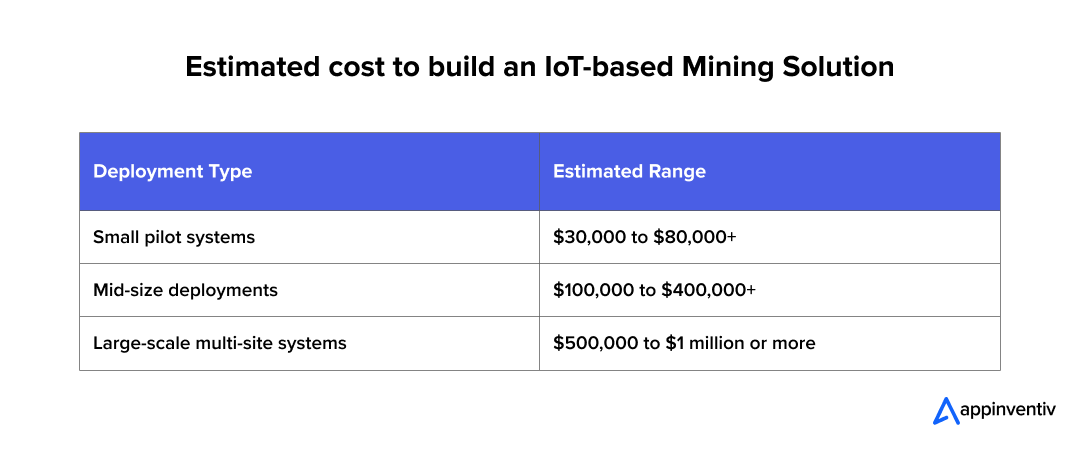
These figures vary depending on asset count, rugged hardware requirements, network design, and analytics sophistication.
Primary Cost Drivers
Cost is less about the number of sensors and more about infrastructure, interoperability, and governance requirements across operational environments.
- Sensor and device procurement (ruggedization matters)
- Network infrastructure (private LTE/5G, Wi-Fi, backhaul)
- Platform licensing or custom platform build
- Integration engineering with OT and enterprise systems
- Cybersecurity controls and monitoring
- Training and operational adoption support
- Ongoing support and managed operations
Integration and cybersecurity planning often represent a significant share of total investment, particularly in mature mining environments with legacy systems.
ROI and Total Cost of Ownership (TCO)
Return on investment is typically measured through operational stability rather than immediate revenue expansion. IoT in mining reduces variability, which directly impacts cost predictability.
ROI drivers commonly include:
- Reduced unplanned downtime
- Lower maintenance and emergency repair costs
- Improved fuel and energy efficiency
- Fewer safety incidents and faster response times
- Stronger compliance documentation
Total cost of ownership extends beyond deployment. Infrastructure lifecycle management, platform updates, cybersecurity oversight, and multi-site scaling must be considered to ensure long-term sustainability.
In board-level discussions, we typically frame IoT investments against cost-per-tonne volatility rather than pure capital expenditure. When variability reduces, planning accuracy improves, and that often justifies phased expansion.
Future of IoT in the Mining Industry
The future is not a single leap to “autonomous everything.” It is a steady progression toward tighter operational control, reduced variability, and more predictable performance across assets and sites.
Increasing Adoption of Autonomous and Semi-autonomous Systems
IoT becomes foundational as autonomy increases. Autonomous haulage, remote drilling supervision, and automated processing controls all depend on reliable telemetry and secure connectivity.
IoT in Sustainable and Green Mining Initiatives
Sustainability initiatives increasingly require evidence. Continuous monitoring of energy, emissions-related proxies, and water use supports more credible reporting and better internal control.
Long-term Impact on Productivity, Safety, and Profitability
When IoT programs mature, the major benefit is reduced volatility:
- Fewer sudden breakdowns
- Fewer unplanned shutdowns
- Fewer safety surprises
- Tighter operational forecasting
This is why many see the future of IoT in the mining sector adoption as foundational infrastructure, similar to how fleet systems and SCADA became standard over time.
The next wave of mining IoT maturity will not be defined by more sensors. It will be defined by standardized architectures that allow new sites to come online without redesigning the data foundation each time.
Let’s assess your current systems and identify high-impact IoT opportunities.
How Appinventiv Helps Mining Companies Implement IoT Solutions
Mining IoT initiatives succeed when they are engineered around operational realities: harsh environments, mixed connectivity, OT integration, and strict security requirements.
Appinventiv, as a mining software development company, supports organizations that want to move from concept to production-grade deployment through:
- IoT consulting and solution design aligned to operational objectives and measurable KPIs
- Custom IoT platform development built to handle mining-grade telemetry, alerting, and multi-site scaling
- Integration engineering across OT and enterprise systems so alerts translate into operational actions
- Security-focused design that respects OT constraints and supports governance, auditability, and controlled remote access
- Scalable delivery through phased rollouts that reduce disruption and build internal trust
For leaders evaluating IoT for mining, the most useful next step is often a structured assessment: identify the highest-impact use cases, confirm connectivity realities, map integration touchpoints, and define the governance model early. This is also the point where many teams choose to engage experienced consulting or IoT development services partners to reduce delivery risk and avoid a stalled pilot.
If your operation is already investing in automation, analytics, or sustainability reporting, IoT is usually the layer that makes those investments consistent and scalable.
Let’s discuss how connected systems can strengthen the automation and analytics investments you’ve already made.
Frequently Asked Questions
Q. What is the business value of IoT in mining?
A. When IoT is used in mining, it reduces operational variability. It integrates real-time telemetry from assets and environments into a centralized decision engine, enabling Predictive Maintenance, optimized OEE, and automated ESG compliance. For enterprises, this translates to lower cost-per-tonne and significantly improved safety margins.
Q. How does IoT help improve safety in mines?
A. Yes. IoT improves safety by continuously monitoring air quality, gas levels, heat, vibration, and worker location. Wearables and geofencing systems trigger real-time alerts when workers enter hazardous zones or unsafe conditions emerge, enabling faster intervention and reducing incident severity.
Q. How does IoT improve tailings dam safety?
A. By integrating vibrating wire piezometers and InSAR data into a real-time dashboard, it provides early warning signs of instability that manual checks might miss.
Q. How does IoT enable predictive maintenance in mining machinery?
A. IoT sensors track key indicators such as vibration, temperature, pressure, and engine load. When patterns suggest early-stage failure, maintenance teams receive alerts before breakdowns occur. This shifts maintenance from reactive repairs to condition-based planning, reducing downtime and extending equipment life.
Q. How does IoT support environmental and air-quality monitoring in mines?
A. IoT sensors continuously measure dust, gas concentration, humidity, airflow, and emissions across surface and underground operations. This real-time visibility helps mines maintain safe working conditions, comply with environmental regulations, and respond quickly to deviations before they escalate into compliance risks.
Q. How much does IoT-based monitoring cost in mining?
A. Costs vary by site size, asset count, connectivity requirements, and analytics depth. Pilot deployments typically start around $30,000, mid-size implementations range from $100,000 to $400,000, and large enterprise systems can exceed $500,000 to $1 million.
Most mining organizations evaluate these investments using a TCO and ROI framework, factoring in long-term savings from reduced downtime, energy efficiency, and improved safety outcomes.
Q. Can IoT work in underground mines with no Wi-Fi?
A. Yes. We deploy “Leaky Feeder” integrations or localized Mesh networks that allow devices to communicate even in the deepest headings.

- In just 2 mins you will get a response
- Your idea is 100% protected by our Non Disclosure Agreement.

IoT In Education for Enterprises: Financial Impact, Risks, and Roadmap
Key takeaways: Integrating IoT in education becomes an infrastructure investment as operational costs, compliance pressures, and visibility gaps intensify. Five-year ROI depends on baseline operational data, disciplined architecture, and structured financial modeling. Predictable TCO requires upfront planning across hardware, connectivity, cloud, maintenance, and governance costs. Secure IoT deployments demand zero-trust architecture, strong device identity, and…

IoT in Wearables: An Enterprise Guide to Architecture, Integration, and Scalable Deployment
Key Takeaways IoT wearables are shifting from pilot projects to enterprise infrastructure across the healthcare, industrial, and logistics sectors. Secure integration, compliance readiness, and data architecture determine wearable success more than device hardware alone. Continuous wearable data enables predictive healthcare, workforce safety optimization, and new enterprise operational intelligence capabilities. AI-driven analytics are transforming wearable data…

IoT in Banking Industry: Use Cases, Examples, ROI
Key takeaways: IoT in banking creates real value only when it is treated as a software and integration problem, not a hardware initiative. Security, governance, and audit readiness determine whether IoT programs scale or quietly stall in regulated environments. IoT implementation in banking typically ranges from $40,000 to $600,000+, with cost driven more by integration…









