




























How to Develop an Insurance Portal That Integrates CRM, Claims, and Billing Systems


- How to Develop an Insurance Portal?
- Why Insurance Portals Fail Without Deep System Integration
- Types of Insurance Portals and Their Integration Requirements
- Which Core Systems Must Work Together for an Insurance Portal to Function Properly?
- How to Design a Workflow Orchestration Layer for Insurance Portals?
- Third-Party Integrations Required in Modern Insurance Portals
- Key Challenges in Insurance Portal Integration and How to Address Them
- Cost to Develop an Integrated Insurance Portal
- Future-Ready Enhancements in Insurance Portal Development
- Why Enterprises Partner with Insurance Portal Integration Experts
- FAQs

Key takeaways:
- Insurance portal development succeeds only when CRM, claims, billing, and policy systems are fully integrated in real time.
- Architecture choice and workflow orchestration determine transaction accuracy and scalability.
- Security, compliance, and audit traceability must be embedded across all integration layers.
- Testing and monitoring are essential to prevent reconciliation gaps after launch.
- Typical development cost ranges from $40K to $400K, driven by integration complexity.
Insurance portals break down when the systems behind them don’t talk to each other properly. If CRM, claims, billing, and policy platforms run in silos, the portal only exposes the gaps. A claim gets approved but billing doesn’t update. A policy change reflects in one dashboard but not another. Teams step in to fix mismatches manually, and the promise of digital efficiency disappears.
The process of insurance portal development begins long before UI design. Insurers need to map their core systems, check how data moves between them, clean up overlapping records, and define how workflows should trigger across claims and billing. When integration, data alignment, and process coordination are handled first, the portal becomes a reliable operational layer instead of just another interface.
The urgency to modernize is visible at the executive level. According to the 2026 Global Insurance Outlook by EY, insurers are placing strategic emphasis on digital transformation and technology modernization as essential priorities to navigate disruption and grow in an increasingly volatile market.
That shift reflects recognition that fragmented infrastructure limits scalability and slows digital growth. In this blog, we will discuss how to build an insurance portal that connects CRM, claims, billing, and policy systems to improve processing speed, financial accuracy, and compliance traceability.
Modernize now and achieve up to 40% higher operational efficiency.

How to Develop an Insurance Portal?
Enterprise insurance portal development involves far more than designing a customer interface. The real complexity lies in connecting multiple operational systems that were often built independently over many years. CRM platforms manage customer relationships, claims systems process loss events, billing engines calculate premiums and payments, while policy administration systems control the lifecycle of insurance products.
If these systems remain isolated, the portal becomes only a viewing layer rather than an operational platform. Customer records fall out of sync, claims adjustments fail to update billing schedules, and agents struggle with incomplete information. Successful development of an insurance portal therefore begins with integration planning before application development.
Enterprises typically follow a structured development approach when they build an insurance portal that connects CRM, claims, and billing infrastructure.
Step 1. Map Core Insurance Systems
The first step is identifying every operational system that will participate in the portal environment.
Typical platforms include:
- CRM platforms storing customer data and interaction history
- Claims management systems handling FNOL intake and adjudication
- Billing engines responsible for premium schedules and payments
- Policy administration systems controlling policy issuance and endorsements
- Document management repositories storing contracts and claim records
Understanding how these systems interact determines the integration architecture that the portal must support.
Step 2. Evaluate API Readiness and Integration Capabilities
Insurance platforms vary widely in how they expose data. Some modern systems provide REST APIs with structured endpoints, while older platforms rely on SOAP services or database-level integrations.
At this stage architects assess:
- API availability and authentication methods
- Real-time versus batch data exchange capabilities
- Data formats used across systems
- Latency and throughput requirements
These factors influence whether the portal architecture will rely on API gateways, middleware integration layers, or event-driven messaging systems.
Step 3. Design a Unified Data Model
Insurance systems often maintain overlapping records for customers, policies, and claims. Without a consistent data structure, integrations introduce duplication and inconsistencies.
A unified data model defines how information flows across systems, including:
- customer master records shared between CRM and policy systems
- policy identifiers linked to claims records
- billing schedules associated with policy lifecycle events
- version control for policy endorsements and updates
This model becomes the foundation that keeps all integrated systems synchronized.
Step 4. Implement Workflow Orchestration
Once systems and data models are defined, the portal must coordinate workflows across them.
For example:
Claim approval → billing adjustment → CRM update → payment trigger → notification dispatch
Workflow orchestration platforms or business process engines manage these interactions while ensuring transactions remain consistent across systems.
Step 5. Build the Portal Interface on Top of the Integration Layer
Only after integration architecture and workflows are defined should development teams design the portal interface.
Depending on the business model, the portal may support:
- customer self-service features such as policy access and claim tracking
- agent portals for lead management and commission visibility
- partner portals for claims processing and document verification
- internal portals used by underwriters and administrators
Because the technology integration layer has already synchronized data across systems, the portal interface can deliver real-time information without manual reconciliation.
Why Insurance Portals Fail Without Deep System Integration
Insurance portals fail when backend systems are not synchronized at the transaction level. If CRM, claims, billing, and policy platforms operate in silos, the portal only amplifies data inconsistencies and workflow gaps. The problem is architectural, not visual.
Most breakdowns stem from weak data ownership rules, missing event propagation, and lack of transaction safety across distributed systems. When enterprises prioritize interface design before technology integration strategy, reconciliation work increases and compliance risk grows.
Below is a concise breakdown of the core failure patterns observed in large scale insurance web portal development initiatives.
Common Integration Failures in Insurance Portals
| Failure Area | Technical Root Cause | Business Impact |
|---|---|---|
| Fragmented customer and policy data | No canonical data model, conflicting system of record, inconsistent identifiers | Duplicate profiles, incorrect policy details, reporting errors |
| Claims not syncing with billing | No event-driven architecture, batch updates instead of real-time triggers | Delayed premium recalculation, manual financial reconciliation |
| Partial transaction failures | No saga orchestration, lack of idempotency and rollback logic | Claims approved but billing not updated, payout inconsistencies |
| Legacy API bottlenecks | SOAP-only services, tight coupling, no circuit breakers | Latency spikes, system timeouts under load |
| Weak observability | Missing correlation IDs, scattered logs, no distributed tracing | Audit gaps, compliance exposure |
Insurance portal development is not just UI enhancement. It is a coordination layer across policy administration, CRM, claims, underwriting, and billing engines. When insurers attempt to develop an insurance portal without redesigning integration flows, they introduce a new interface on top of unstable system foundations.
Types of Insurance Portals and Their Integration Requirements
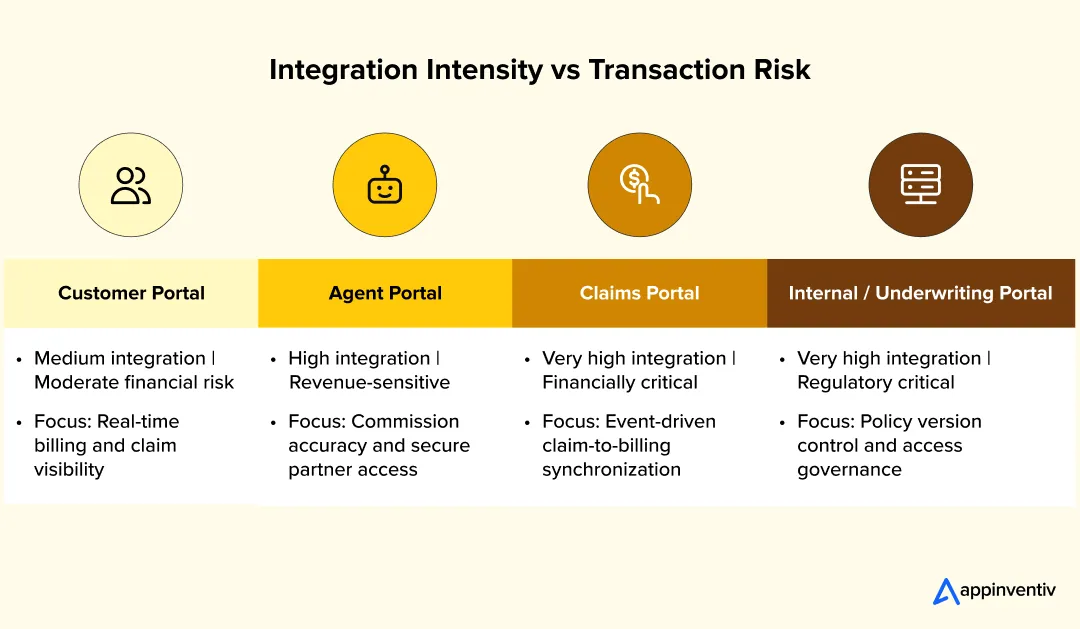
The type of portal determines the depth of integration required. In custom insurance portal software development, complexity is not defined by design elements but by how many core systems must synchronize in real time.
Whether the goal is developing an insurance customer portal or enterprise insurance portal for internal users, integration architecture defines scalability and reliability. Different portal categories demand different system alignments.
1. Customer Self-Service Portal
Insurance customer portal development focuses on policy visibility, claim tracking, premium payments, and document uploads. On the surface, this appears straightforward. In practice, it requires tight synchronization across:
- CRM for customer identity and communication history
- Claims management for real time status changes
- Billing engines for premium schedules and payment confirmations
- Policy administration systems for endorsements and renewals
If billing updates lag behind claim approvals, customers see inconsistent financial data. In insurance web portal development projects, this is one of the most common trust breakdowns.
2. Agent and Broker Portal
Insurance agent portal development supports lead management, commission tracking, and policy issuance workflows. In scenarios involving brokers, integration must also support secure partner level access and commission reconciliation.
Core integrations typically include:
- CRM opportunity pipelines
- Policy issuance services
- Billing engines for commission disbursement logic
- Document systems for regulatory compliance
Delayed commission visibility or policy version mismatches directly impact agent productivity and revenue alignment.
3. Claims-Focused Portal
Insurance claims portal development centers around FNOL intake, adjudication status tracking, and settlement coordination.
Integration depth includes:
- Claims workflow engines
- Fraud detection with AI
- Policy validation services
- Payment processing modules
Here, transaction consistency is critical. Claim status transitions must automatically propagate to billing recalculations and CRM notifications. Without event-driven integration, manual intervention becomes routine.
4. Internal Administration and Underwriting Portal
Insurance company portal development initiatives for internal teams often involve risk modeling tools, policy configuration modules, and billing overrides.
These portals integrate:
- AI-powered underwriting engines
- Policy lifecycle management systems
- CRM customer insights
- Financial controls within billing platforms
Because internal portals process high transaction volumes, enterprise insurance portal requires stronger role based access controls and throughput optimization.
Which Core Systems Must Work Together for an Insurance Portal to Function Properly?
When a customer logs in to check a claim, they assume the number they see is final. They don’t see the four different systems behind that screen. But if CRM holds one address, the claims engine references an older policy version, and billing has not recalculated the premium after an endorsement, the portal reflects confusion. Most integration failures begin here, at the data and transaction layer, not the interface.
For an insurance portal to work as an operational system rather than a display layer, four core platforms must exchange updates in a controlled, real-time manner.
- CRM System: Handles customer interactions and contact data. It should sync instantly with policy and claims events using shared customer identifiers and clear data ownership rules.
- Claims Management System: Drives status transitions from FNOL to settlement. Each state change must trigger billing adjustments and CRM updates through structured events.
- Billing and Payments Engine: Calculates premiums, installments, and refunds. Policy changes should automatically initiate recalculation and maintain auditable financial records.
- Policy Administration System: Manages coverage terms and version history. Version-aware APIs and effective-date validation ensure claims and billing reference the correct policy state.
When these systems exchange state changes predictably and in sequence, the portal becomes a reliable operational layer instead of a window into disconnected processes.
How to Design a Workflow Orchestration Layer for Insurance Portals?
Even with strong APIs and aligned systems, the insurance portal breaks down if workflows are not coordinated centrally. Claims, billing, CRM, and policy platforms operate on state changes. Without orchestration, each system reacts independently, creating timing gaps and partial updates.
A workflow orchestration layer ensures that cross system processes execute in the correct order, with transaction visibility and recovery controls.
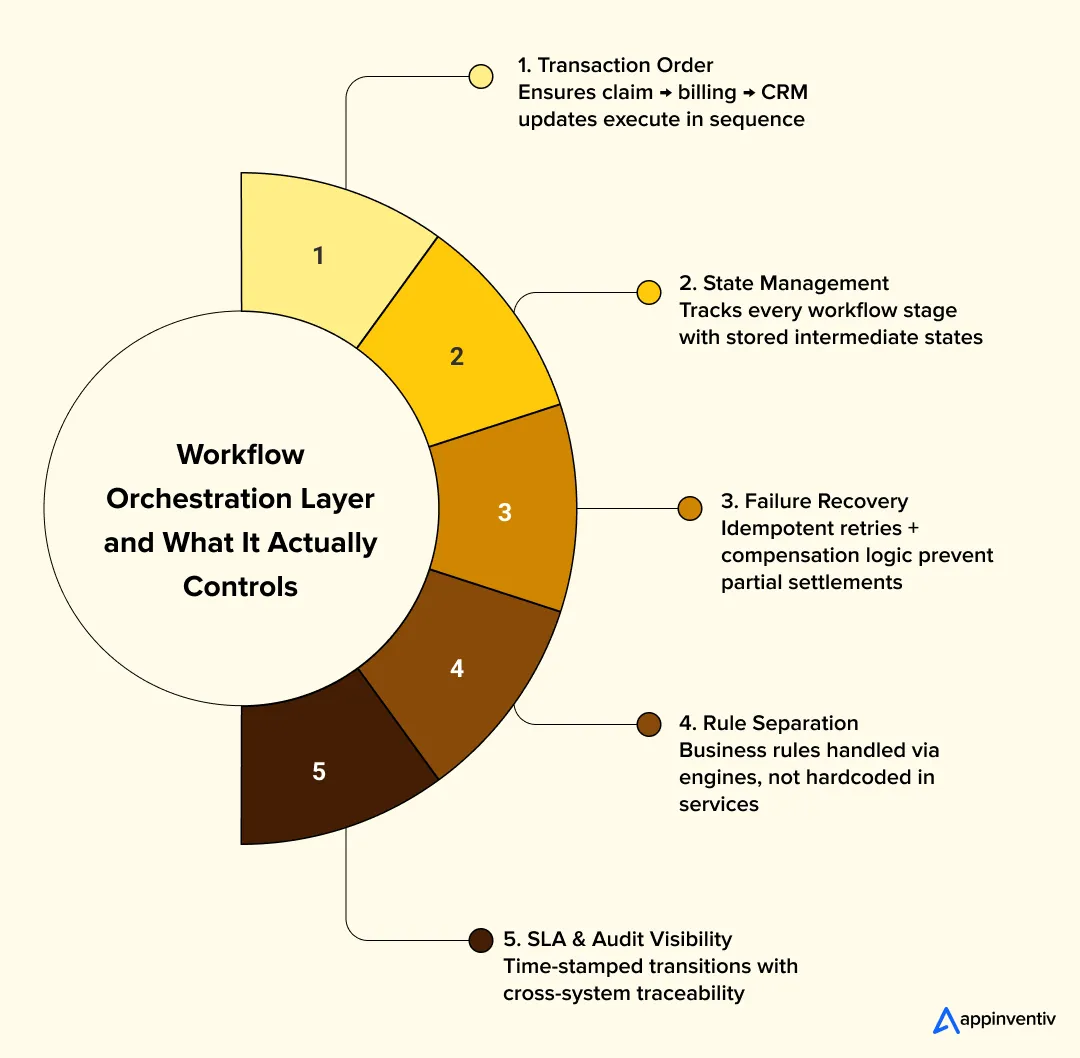
Coordinating Multi-System Insurance Transactions
Insurance workflows rarely involve a single system call.
Consider a common scenario:
Claim approved → coverage validated → premium recalculated → commission updated → customer notified
If this sequence relies only on chained API calls from the portal interface:
- A timeout in billing leaves the claim state inconsistent
- A retry may duplicate a financial transaction
- Downstream systems may update before upstream validation completes
In stable insurance web portal development, orchestration logic is moved out of the UI and into a dedicated service layer.
This layer:
- Manages process states
- Tracks execution steps
- Stores intermediate states
- Handles retries and compensation logic
Rule Engines and Business Process Management
Insurance operations are rule heavy. Eligibility checks, fraud scoring thresholds, premium adjustment rules, and commission structures vary by product and jurisdiction.
Instead of embedding these rules across multiple services, orchestration platforms often integrate:
- Business rule engines for configurable logic
- BPM tools for long running workflows
- State machines to track claim and policy lifecycle stages
This approach reduces hard coded dependencies and allows rule changes without redeploying the entire portal.
In the development of the enterprise insurance portal, separating rule evaluation from core services improves maintainability and compliance traceability.
Handling Exceptions and Transaction Recovery
Failures are inevitable in distributed systems. The difference lies in how they are handled.
An orchestration layer should support:
- Idempotent retry mechanisms
- Compensation actions to reverse partial updates
- Timeout management for long running processes
For example, if billing recalculation fails after claim approval, the system should not leave the claim permanently marked as settled. Compensation logic can revert the state or pause the workflow until financial consistency is restored.
Without this control, reconciliation becomes a manual task across departments.
SLA Tracking and Process Visibility
Operational leaders require visibility into processing timelines. Claims may have regulatory service level requirements. Payment disbursement may require tracking against internal benchmarks.
The orchestration layer can provide:
- Timestamped state transitions
- SLA breach alerts
- Centralized audit trails
- Cross system correlation identifiers
This is particularly important when organizations need to reduce payout delays and improve service transparency.
Workflow orchestration converts isolated system integrations into coordinated business processes. It is the layer that ensures policy changes, claims decisions, billing updates, and customer communication remain synchronized under load.
Insurance portals require deep system engineering, not just interface upgrades

Third-Party Integrations Required in Modern Insurance Portals
External integrations are not peripheral in custom development of insurance portals. Payment processors, identity verification services, fraud engines, and financial systems directly influence transaction accuracy and regulatory posture. Each must be integrated with controlled APIs, deterministic workflows, and observable error handling.
Below is a focused breakdown with technical specificity.
Payment Gateways and Settlement Systems
Premium payments and claim disbursements typically integrate through REST APIs combined with webhook callbacks.
A stable implementation should include:
- Tokenization of card or bank details using payment gateway issued tokens
- Webhook signature verification to prevent spoofed confirmations
- Idempotency keys on payment creation endpoints to avoid duplicate charges
- Reconciliation jobs that match gateway settlement files against internal billing ledger entries
- Dead-letter handling for failed payout events
In high-volume environments, payment confirmation latency must be decoupled from UI response using asynchronous processing.
KYC, AML, and Identity Verification Providers
Onboarding and payout workflows often depend on third-party verification APIs.
Integration design should account for:
- OAuth 2.0 client credential flows for secure API access
- Encrypted payload transmission using TLS 1.2 or higher
- Asynchronous verification callbacks for document validation
- Time-bound status flags to prevent stale approval states
- Persistent storage of verification reference IDs for audit traceability
In insurance claims portal development, claim settlement logic should block until verification status reaches a defined approval state.
Also Read: Unlocking the Power of FinTech APIs: A Pocket Guide
Fraud Detection and Risk Scoring Engines
Fraud scoring engines typically expose synchronous scoring endpoints or publish risk scores via event streams.
A controlled integration includes:
- Passing structured claim payloads with coverage and claimant attributes
- Threshold-based routing rules embedded in the orchestration layer
- Storing fraud score versions alongside claim records
- Replay capability for historical claims when scoring models are updated
Without versioned scoring logs, dispute investigations become difficult during regulatory review.
Document Management and Storage Platforms
Insurance portals manage large volumes of policy contracts and claim documents.
Technical integration should support:
- Secure object storage with encrypted-at-rest configuration
- Metadata tagging tied to policy IDs and claim IDs
- Version control to preserve endorsement history
- Pre-signed URL generation with expiration controls
- Role-based document retrieval enforced at the API layer
Improper linkage between document metadata and policy identifiers is a common source of incomplete portal views.
Core Banking and ERP Integrations
For insurers operating within financial groups, billing outputs must synchronize with accounting platforms.
Integration typically includes:
- Ledger entry creation through batch file exchange or secure APIs
- Period-end reconciliation scripts
- Currency conversion logic aligned with policy billing rules
- Exception reporting for unmatched transactions
In enterprise insurance portals, financial mismatches surface during monthly close cycles if ERP software integration lacks deterministic mapping rules.
When insurers build an insurance portal that connects to external platforms, these integrations must be treated as transactional participants, not auxiliary services. Each third-party connection should enforce authentication, idempotency, observability, and reconciliation logic to maintain operational stability.
Key Challenges in Insurance Portal Integration and How to Address Them
Building an Insurance portal becomes complex when integration extends across legacy systems, financial engines, and compliance layers.
The challenge is rarely a single broken API. It is a misalignment between systems that were never designed to operate in real time together.
The solution lies in architectural discipline and controlled execution, which is why many enterprises turn to specialized teams.
Below are the most common integration challenges and the corresponding corrective approaches.
1. Legacy Systems Without Modern APIs
Challenge: Policy and billing platforms may expose SOAP endpoints, batch file exchanges, or database connectors instead of REST APIs. Direct integration increases latency and tight coupling.
Solution:
- Introduce an abstraction layer or integration service that translates legacy protocols into RESTful endpoints
- Implement API adapters with schema normalization
- Use caching layers for read-heavy policy queries
- Gradually modernize high-traffic services first rather than attempting full system replacement
This stabilizes the development of insurance web portal development without forcing immediate core replacement.
2. Data Latency and State Drift
Challenge: Batch synchronization causes claim status, billing schedules, and CRM records to fall out of sync.
Solution:
- Implement event-driven messaging using publish-subscribe models
- Attach correlation IDs to all cross-system transactions
- Define explicit real-time vs batch synchronization rules
- Monitor drift using automated reconciliation checks
Event propagation reduces the gap between operational systems and portal visibility.
3. Billing Engine Conflicts
Challenge: Premium calculation logic may exist in multiple layers. Integration services sometimes replicate billing logic, creating discrepancies.
Solution:
- Establish the billing platform as the single source of financial truth
- Expose premium recalculation endpoints rather than duplicating formulas
- Validate tax and currency handling through centralized configuration
- Introduce financial reconciliation jobs before customer-facing updates
Clear ownership prevents financial inconsistencies during the custom insurance portal software development.
4. Policy Version Mismatch
Challenge: Claims and billing engines reference outdated policy versions after endorsements or renewals.
Solution:
- Enforce version-aware APIs with effective date validation
- Include policy version identifiers in all claim transactions
- Reject settlement processing if coverage validation fails
- Log version mappings for audit review
Version alignment is essential while developing an enterprise insurance portal, particularly where regulatory traceability is required.
5. Organizational and Vendor Dependencies
Challenge: Third-party vendors, regulatory approvals, and cross-team coordination slow integration progress.
Solution:
- Define integration contracts early with vendors
- Isolate vendor dependencies behind service interfaces
- Use phased rollout strategies for high-risk integrations
- Align compliance reviews with architecture milestones
Structured governance reduces rework and implementation delays.
When insurers build an insurance portal, technical barriers and operational constraints are inevitable. The difference lies in anticipating integration friction and designing control mechanisms before production scale exposes weaknesses.
Cost to Develop an Integrated Insurance Portal
The cost of developing an integrated insurance portal depends primarily on integration depth, legacy system readiness, and financial workflow complexity. Connecting CRM, claims, billing, and policy systems in real time requires structured API engineering, orchestration logic, data validation layers, and security controls.
For most mid-to-large insurers, a realistic investment range falls between $40,000 and $400,000, depending on scope and architectural maturity.
This estimate is grounded in patterns observed by Appinventiv across more than a decade of financial platform engineering and over 200 FinTech product implementations. In regulated environments, integration complexity consistently drives cost more than interface design.
Below are the primary factors influencing budget allocation.
1. Number of Systems Integrated
Typically accounts for $8,000 to $120,000 of the total $40,000–$400,000 project cost. Each additional system increases:
- API development and contract validation effort
- Data normalization requirements
- Orchestration complexity
- Testing scope
Insurance web portals that integrate CRM, claims, billing, policy administration, and third-party payment systems require significantly more engineering hours than a limited self-service implementation.
2. Legacy Modernization Scope
If core systems lack REST APIs or event support, Usually contributes $6,000 to $100,000 to the overall budget, cost increases due to:
- Middleware or adapter layer development
- Protocol transformation from SOAP to REST
- Batch-to-real-time conversion logic
- Additional performance tuning
In many enterprise insurance portals, the development includes modernization of the old systems.
3. Workflow and Financial Logic Complexity
Claims-driven billing recalculations, commission disbursement rules, and multi-product policy handling introduce additional development effort. Often represents $8,000 to $120,000 of the investment.
Complexity increases when:
- Premium adjustments must occur in real time
- Multi-currency handling is required
- Regulatory reporting must be automated
- Multiple distribution channels share the same portal
Insurance portal software development services become more cost-intensive when financial reconciliation logic is deeply embedded in workflows.
4. Security and Compliance Engineering
Security architecture also influences overall cost, commonly adding $4,000 to $60,000 of the total budget.
Budget considerations include:
- Token-based authentication systems
- Role-based and attribute-based access control
- Encryption key management
- Audit logging and SIEM integration
- Regulatory validation workflows
For insurers operating across jurisdictions, compliance requirements may significantly expand implementation effort.
5. Testing, Monitoring, and Ongoing Maintenance
Initial development cost is only part of the equation. Continuous monitoring, regression automation, and SLA tracking require infrastructure and operational support, generally costing $4,000 to $80,000.
Cloud hosting models, high availability configuration, and distributed tracing tools contribute to ongoing expenses beyond launch.
Organizations looking to develop an insurance portal should approach budgeting in phased increments. A controlled rollout beginning with core integrations reduces risk and spreads cost over defined milestones.
Future-Ready Enhancements in Insurance Portal Development
Once the core integration layer is stable, insurers can extend portal capabilities beyond transactional workflows.
Advanced enhancements depend on structured APIs, clean data flows, and coordinated orchestration across CRM, claims, billing, and policy systems. Without that foundation, intelligent features introduce more risk than value.
Future-ready insurance portal development often includes:
- AI-driven claims triage that scores incoming claims using historical payout patterns, fraud indicators, and coverage attributes, allowing low-risk cases to move through automated settlement paths while routing high-risk cases for manual review
- Predictive premium pricing models that analyze claims frequency, endorsement history, customer risk segments, and regional exposure trends to adjust pricing logic dynamically within defined underwriting rules
- Embedded insurance APIs that allow third-party platforms such as fintech apps or marketplaces to issue policies in real time, requiring instant premium calculation, identity verification, and secure token-based authorization
- AI-powered self-service assistants capable of retrieving policy details, validating coverage, and tracking claim status through structured backend APIs rather than static knowledge bases
- Robotic process automation for repetitive back-office tasks such as document verification, endorsement reconciliation, commission statement generation, and compliance report compilation, triggered through workflow events
- Advanced analytics integration that streams portal interaction data into centralized data platforms for customer behavior analysis, retention modeling, and cross-sell optimization
In the development of insurance web portals, these enhancements are not isolated features. They rely on consistent entity mapping, event-driven updates, and controlled access enforcement across systems. When insurers create an insurance portal with long-term scalability in mind, intelligent automation becomes a natural extension rather than a risky overlay.
AI triage, embedded APIs, and predictive pricing require strong integration foundations to scale reliably.

Why Enterprises Partner with Insurance Portal Integration Experts
Insurance portal development demands more than connecting screens to databases. It requires aligning CRM, claims, billing, and policy systems through secure APIs, transaction-safe workflows, and version-aware data handling. Without architectural rigor, reconciliation errors and workflow gaps surface quickly in production.
Many insurers rely on specialized insurance software development services when legacy constraints, financial dependencies, and regulatory requirements intersect. Structured integration frameworks, event-driven orchestration, and compliance-aware engineering reduce risk while accelerating deployment.
Appinventiv’s experience across complex financial ecosystems strengthens this execution depth. Platforms such as EDFundo, a financial literacy application, and enterprise AI implementations in banking environments demonstrate the ability to build secure, transaction-driven systems that handle sensitive financial data, regulatory controls, and high-volume user activity.
For insurers planning to build an insurance portal that operates reliably at scale, connect with our experts for a focused technical consultation. We can help you clarify integration readiness and define a structured modernization roadmap.
FAQs
Q. What technologies are used in insurance portal development?
A. Development of an Insurance portal typically uses a combination of RESTful APIs, API gateways, middleware or ESB layers, and event-driven messaging systems such as Kafka or RabbitMQ. Backend services are often built using Java, .NET, or Node.js, with relational or NoSQL databases depending on transaction patterns. Modern implementations also incorporate OAuth 2.0 for authentication, cloud infrastructure for scalability, and workflow engines for cross-system orchestration.
Q. How long does it take to develop an insurance portal?
A. Timelines depend on integration complexity rather than UI design. A limited portal connecting CRM and policy systems may take 3 to 5 months. A full-scale enterprise insurance portal integrating claims, billing, third-party payments, and compliance layers typically ranges from 6 to 12 months, especially when legacy modernization is required.
Q. How much does insurance portal development cost?
A. Costs usually range between $40,000 and $400,000, depending on system count, API maturity, financial workflow complexity, security requirements, and testing scope. Projects that require legacy modernization, real-time billing recalculation, and regulatory automation tend to fall toward the higher end of the range.
Q. How can insurance portals ensure data privacy and compliance?
A. Data privacy is enforced through token-based authentication, role-based access control, TLS encryption for data in transit, AES-256 encryption at rest, and centralized audit logging. Secure API gateways, SIEM integration, and immutable transaction logs help maintain traceability and reduce regulatory exposure.
Q. What compliance standards should insurance portals follow?
A. Compliance requirements vary by region and product type. Common standards include GDPR for data protection, HIPAA for health-related data, SOC 2 for security controls, and ISO 27001 for information security management. Insurance portals must also support regulatory reporting and audit traceability aligned with local insurance authorities.
Q. What role does automation play in insurance portal development?
A. Automation reduces manual reconciliation and accelerates processing. Event-driven workflows automate premium recalculations after endorsements, trigger claim settlement updates, and notify CRM systems in real time. Robotic process automation can further streamline document verification, commission processing, and compliance reporting, improving operational efficiency without increasing headcount.

- In just 2 mins you will get a response
- Your idea is 100% protected by our Non Disclosure Agreement.

How to Build a Digital Wallet App Like X Money: Cost, Features, and Technology Stack
Key Takeaways: Building a wallet like X Money requires more than payment features. It needs identity verification, fraud monitoring, payment gateways, and a secure financial infrastructure. Development costs usually range between $40,000 and $400,000. The final cost depends on features, compliance requirements, payment integrations, and platform scale. Core technologies include mobile frameworks, backend microservices, financial…

How Much Does Accounting Practice Management Software Development Cost in Australia 2026?
Key takeaways: Custom accounting practice management software development in Australia for mid-to-large firms generally falls between AUD 70,000 and AUD 700,000. Adherence to the Privacy Act 1988 and ATO operational frameworks is a primary cost driver, not an add-on. A modular architecture and structured development approach ensure that the platform evolves with changing laws and…

Open Banking in Australia: A Practical Guide for Businesses
Key takeaways: Open banking-driven “Smart Data” initiatives are projected to contribute up to $10 billion annually to the Australian economy. Enterprises that follow a phased rollout covering readiness assessment, compliance alignment, API integration, cybersecurity, and scaling achieve faster deployment and lower operational risk. Constant CDR updates, accreditation complexity, and modernising legacy banking systems continue to…









