





























How To Build a Farm Management Software in Australia?

- Strategic Case: Why Australian Enterprises Are Building Their Own Farm Software
- How To Build Farm Management Software in Australia: End-to-End Roadmap
- Benefits of Building a Farm Software in Australia
- Build vs Buy: When Custom Farm Management Software Makes Sense
- Core Modules: From Farm Mapping Software to Livestock Management
- Farm Management System Technology Stack for Australian Enterprises
- Farm Management Software Development Cost in Australia
- Challenges of Implementing Farm Management Software in Australia (and How to De-Risk Them)
- Extending Your Platform: From Farm Management Software to Agriculture Marketplace Apps
- Designing for Australian Realities: Connectivity, Climate, and Compliance
- Future of Farm Management Software in Australia
- How Appinventiv Helps Enterprises Build Future-Ready Farm Management Platforms?
- Frequently Asked Questions

Key takeaways:
- Strategic roadmap on how to build a farm management software in Australia that aligns with multi-site, multi-entity farm operations.
- Explains core modules like farm mapping, livestock, inventory, workforce, finance, and ESG to create one unified operational source of truth.
- Breaks down the complete development journey from vision, domain modelling, and architecture to MVP, scale-up, and product governance.
- Details the farm management system technology stack, covering geospatial data, integrations, AI analytics, DevOps, and enterprise-grade security for Australian conditions.
- Provides a realistic farm management software development cost range in Australia, from AUD 70,000 to AUD 700,000, with clear cost drivers.
- Addresses practical challenges around data quality, user adoption, connectivity, compliance, and vendor lock-in, with concrete de-risking strategies.
The boardroom and the paddock rarely appear in the same sentence, yet your balance sheet feels both every single season.
On one side, you have multi-million dollar cropping or livestock operations spread across regions. On the other hand, a patchwork of spreadsheets, siloed apps, OEM portals, and disconnected reports. When a drought warning hits, or prices swing overnight, that gap between data and decisions becomes painfully visible.
For many Australian enterprises, farm management software is no longer a “nice digitisation project.” It is the operating system that decides how quickly you can react, how confidently you can invest, and how transparently you can report to boards, lenders, and global buyers. Generic tools help for a while, then hit a ceiling as scale, complexity, and compliance demands grow.
This guide is written for leaders who are past the experimentation stage and are now asking a different question: how do we build or develop a farm management software in Australia that matches our footprint, our supply chains, and our ESG commitments? We will walk through the strategy, architecture, cost, and execution details you need before you commit serious capital to your next-generation farm platform.
See how Australian enterprises structure farm platform investments to deliver returns within 12–24 months.
Strategic Case: Why Australian Enterprises Are Building Their Own Farm Software
Australian agriculture is not a side business. As per a report by the Department of Agriculture (Australia), it uses about 55% of the nation’s land, roughly 426 million hectares, and almost 74% of its water. At that scale, small improvements in planning, inputs, or labour quickly turn into multi-million dollar swings.
Most large farming groups still sit on fragmented stacks. OEM portals, point solutions, custom spreadsheets, and manual reports all tell different stories. When climate, prices, or policy shift, leaders see delays and blind spots instead of a live, trusted picture.
That is why more Australian enterprises are treating farm management software as a strategic platform, not a “farm app.” The goal is simple: build a system that reflects your actual footprint, supply chains, and governance needs, rather than trying to stretch a generic tool beyond its limits.
Who This Guide Is For
This guide is aimed at:
- Broadacre cropping enterprises manage thousands of hectares across regions
- Livestock-heavy businesses that need serious cattle and flock management, not hobby tools
- Mixed farming operations juggling rotations, pasture, and animals on the same hectares
- Integrated agribusinesses that connect farming with inputs, processing, logistics, or exports
If you recognise your organisation in this list, you are the one making the call on whether to keep stitching tools together or to build a coherent farm management platform.
How To Build Farm Management Software in Australia: End-to-End Roadmap
Australian agriculture is deeply tied to both people and trade. About 5.9% of rural employment, and 2.2% of national employment, sits in this sector. Around 70% of total agricultural, fisheries, and forestry production is exported over a three-year average.
So when you make farming software for a large farming business, you are not just buying software. You are touching jobs, export reliability, lender confidence, and ESG commitments. That demands a disciplined, technical roadmap to develop a farm management software in Australia rather than a quick “app build.
Below is a stepwise approach on how to build a farm management software in Australia that matches enterprise expectations on robustness, security, and long-term value.
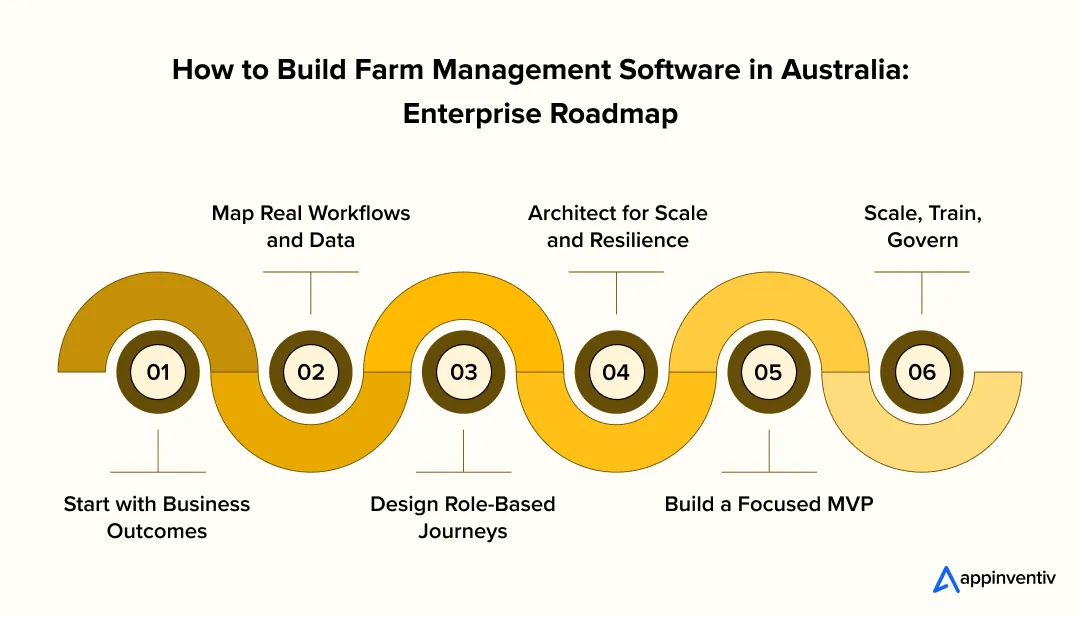
Phase 1: Strategy, Outcomes, and Scope
Start with strategy, not screens.
Define what must change in the next three to five years. Be specific. For example:
- Reduce cost per hectare by a set percentage across defined regions
- Cut cycle time for planning and reforecasting from weeks to days
- Improve reporting accuracy for export programme audits and ESG disclosures
Then define the scope:
- Which commodities and regions are in play for phase one
- Which business entities sit inside the same data model
- Which external stakeholders depend on data from this system
This becomes the guardrail for all later decisions. If a feature, integration, or report does not support these goals, it moves down the list.
Phase 2: Map Workflows and Data Across Properties
Next, as you make a farming software, you need a clear view of how work and data actually flow today. This is more than a process map in a presentation.
For each major domain, map end-to-end flows:
- Land and cropping: planning, tasks, inputs, harvest, and storage
- Livestock: breeding, purchasing, movements, treatments, and sales
- Inputs and assets: procurement, storage, usage, maintenance, and disposal
- People: workforce scheduling, contractors, safety checks, and incidents
- Finance and ESG: budgeting, actuals, variance, compliance, and reporting
For each flow, document:
- Actors involved and their responsibilities
- Systems, documents, and communication channels were touched
- Data produced, consumed, and reconciled
This often exposes duplicated effort, missing data, and late reporting. It also reveals where a farm management platform must integrate with existing systems instead of replacing them.
From a technical standpoint, when learning how to build a farm management software in Australia, these maps become inputs into your domain model. They show which entities are core, which are derived, and where boundaries between services should sit.
Phase 3: Design the Features of Custom Farm Management Software
Now translate workflows into concrete capabilities. The goal is to support complete user journeys, not create isolated screens.
Start by defining primary user roles:
- Enterprise farm managers and regional managers
- Livestock and cropping leads
- Operational teams on each property
- Finance, risk, and ESG teams
- Executive leadership that consumes summary views
For each role, design journeys such as:
- Plan a season across multiple regions, with shared constraints and local variations
- Adjust grazing plans based on pasture conditions and water availability
- Approve capital and operating budgets using live production assumptions
- Prepare evidence packs for audits, lenders, and supply chain partners
Turn those journeys into feature groups:
- Planning modules for land, crops, and livestock
- Execution tools for tasks, work orders, and field recording
- Monitoring dashboards and alerts for operations and risk
- Reporting and export modules for finance and ESG
Here, you also decide where mobile, web, and tablet experiences differ. A manager might need scenario planning and multi-farm views. Field staff might need fast, offline-capable task flows with minimal data entry.
Phase 4: Choose Architecture, Deployment Model, and Data Strategy
With clear journeys and features as you develop a farm management software in Australia, you can now address architecture with rigour. Key decisions include:
- Deployment Model
- Fully cloud, or hybrid, where some sites require local components
- Regions for hosting to satisfy data residency requirements in Australia
- Domain Architecture
- Use domain-driven design concepts to separate land, livestock, inventory, finance, and compliance.ce
- Decide whether you need microservices from day one, or a modular monolith that can be split over time.
- Data Strategy
- One authoritative operational store for transactions
- Dedicated stores for time-series sensor data and geospatial layers
- A governed pipeline into analytics and reporting, so BI tools are reading from curated datasets
Non-functional requirements should be explicit: target response times, uptime, RPO/RTO for disasters, and security posture. These will shape your choices on load balancing, clustering, backup, and failover.
Phase 5: Build the MVP and Prove Value
The MVP or minimum viable product in agricultural software development is not a toy version. It is a focused slice through the architecture that proves both business and technical assumptions.
Design the MVP to include:
- At least one complete planning-to-reporting loop in cropping or livestock
- A minimal but real integration set, such as accounting, weather, and one external data source
- A working implementation of your identity model and permission structure
Agree on KPIs before development starts. Typical examples:
- Reduction in manual data handling for selected teams
- Timeliness and completeness of operational records
- Time to produce management reports that previously required manual compilation
On the technical side, the MVP should exercise your CI/CD pipeline, logging, monitoring, and alerting. It is a live test of your engineering practices, not just your code.
Run the MVP long enough to capture at least one cycle of planning, execution, and review. Use that period to observe system behaviour under real load and operating conditions, including offline scenarios.
Phase 6: Scale, Change Management, and Continuous Improvement
Once the MVP proves its value, the challenge shifts from “can we build this?” to “can the organisation absorb it?”
Scale needs a structured plan:
- A rollout sequence by region or business unit, aligned with seasonal windows
- Training programmes tailored to roles, with repeatable content and local champions
- A clear communication rhythm that explains what changes when, and why
From a technical perspective, scaling means:
- Hardening for increased data volumes and users
- Extending integration coverage while keeping interfaces stable
- Tightening observability so issues can be spotted before they interrupt operations
Treat the platform as a product. That means a backlog, public roadmap, and regular release cadence. Teams must see continuous improvement, not a one-off deployment.
Product Governance and Operating Model
A farm management system that spans multiple properties and entities needs a clear operating model. Without it, even well-built software becomes fragmented again.
Core elements of governance include:
- Product Ownership
- A named product owner or agricultural software development lead with authority to prioritise work
- Alignment with both technology leadership and operations leadership
- Cross-functional Steering
- A forum where IT, farming operations, finance, risk, and ESG can review priorities
- Regular decisions on trade-offs, such as new features versus technical debt reduction
- Support and Service Management
- Defined support tiers, response times, and escalation paths for critical issues
- Clear ownership for data quality and access control
Over time, you can formalise metrics for the platform itself. Examples include adoption rates, the number of processes digitised, and the share of key decisions made using system data rather than ad-hoc methods.
When strategy, design, architecture, delivery, and governance all line up, you are not just making farming software. You are establishing a long-lived digital asset that underpins Australia-scale operations, export reliability, and workforce productivity.
Benefits of Building a Farm Software in Australia
Australian agriculture is not just big on land and water. It also drives the trade book. It accounts for about 10.8% of goods and services exports, roughly AUD 71.5 billion in 2023–24, and around 2.4% of national GDP. When a sector sits that high in the economy, the way you run data, decisions, and compliance is not an IT detail. It is a competitiveness question.
Here are the key benefits of building farm software in Australia for large enterprises:
- Sharper Profitability at Scale
Instead of chasing numbers across multiple systems, you work from one production and cost view. Farm managers and finance teams see the same paddock, mob, and enterprise-level margins. It becomes easier to trim unproductive spend and back the most profitable rotations, regions, or lines.
- Faster, Clearer Decisions Under Volatility
Weather, prices, and policy can move quickly. A custom platform gives you live operational signals, not delayed summaries. Leaders see how a change in season, water allocation, or input price flows through to yield, stock, and cash. Decisions move from reactive to proactive.
- Compliance and ESG Without Constant Firefighting
Export markets and financiers are tightening their expectations on traceability and sustainability. A well-designed farm management system keeps chemical use, livestock movements, water, and safety records in one data model. You can respond to audits and ESG requests with evidence, not scrambling.
- Control of Your Data and Digital Moat
Generic tools are built for the average farm, not your specific footprint and supply chain automation. Owning your own platform means you control your data model, integrations, and roadmap. Over time, that becomes part of your competitive edge, not just a back-office system.
Build vs Buy: When Custom Farm Management Software Makes Sense
Most teams start with off-the-shelf tools. It is quick, low-risk, and good enough for a single enterprise or a small group of farms. For many years, that has been the story of farm management software in Australia.
The cracks appear when your footprint and complexity grow. You add more properties, more enterprises, more partners, and more compliance programmes. Suddenly, you are running three “best farm management software Australia” products, two OEMs, and a dozen spreadsheets just to close the month.
Buying makes sense when:
- Your operations are relatively standard and single-entity
- You can live with the vendor’s data model and roadmap
- Integration needs are light and mostly one-way
Understanding how to build a farm management software in Australia starts to make sense when:
- You operate across multiple entities, regions, and commodities
- You need deep integrations with ERP, logistics, and specialist ag systems
- Your data model is part of your competitive advantage
- You want firm control over data residency, privacy, and ESG reporting
The decision is not “custom software development versus SaaS” in a vacuum. It is a question of whether your farm platform is a utility or a long-term digital asset that shapes how you run, grow, and finance the business. For many large Australian agribusinesses, that answer is slowly tilting towards owning the core platform and using off-the-shelf tools as satellites, not the centre.
Core Modules: From Farm Mapping Software to Livestock Management
Once you develop a farm management software in Australia, the next question is simple: what should the platform actually do on day one?
Think of your farm software in Australia as a set of focused modules that all speak the same language. Each module solves a real operational problem but still feeds into one shared data model. That is how you avoid building another collection of disconnected tools.
Below are the core areas most Australian enterprises end up prioritising.
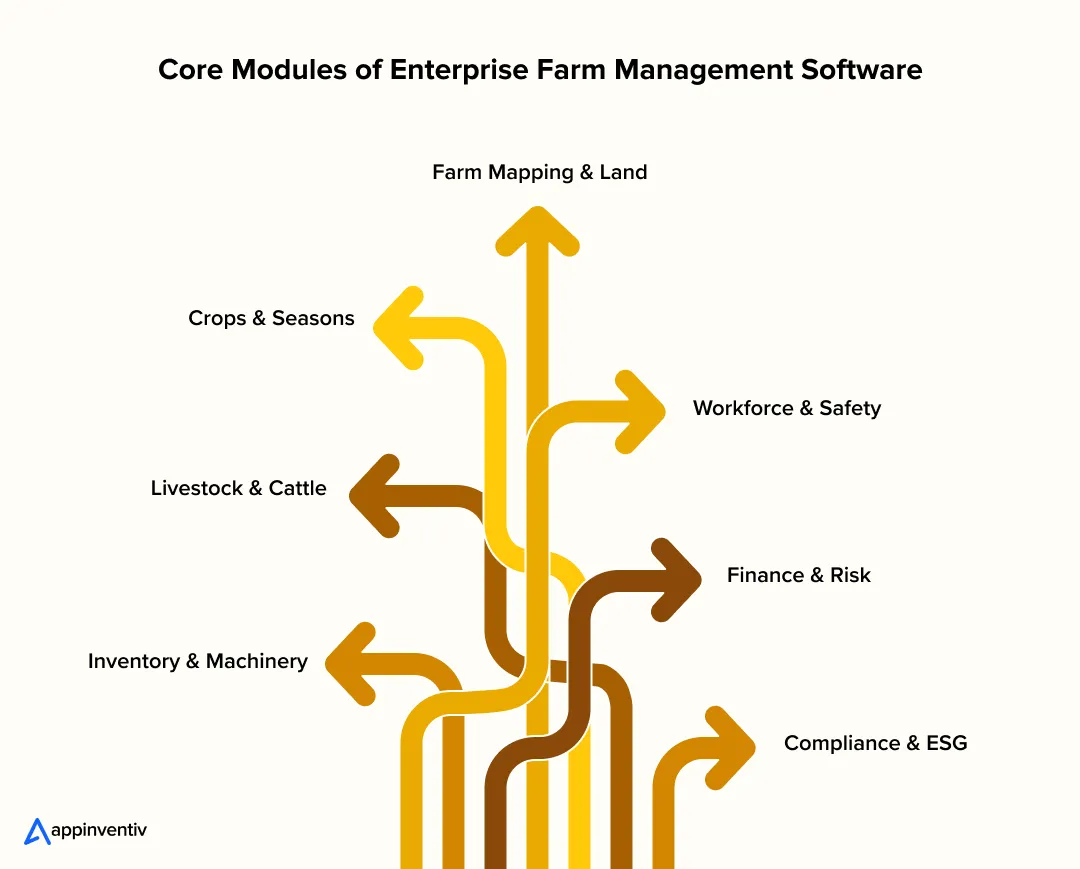
- Farm Mapping Software and Land Management
A robust mapping layer is usually the backbone of the system. Your platform should allow teams to:
- Maintain accurate boundaries for farms, paddocks, zones, and exclusion areas
- Overlay soil types, elevation, and infrastructure such as fences, troughs, and bores
- View satellite, biomass, and historical yield layers against the same map
For remote areas, offline map access is non-negotiable. Field teams should still see paddock layouts and record activities even when the signal is weak.
- Crop Planning and Operations
This module handles how you plan and execute seasons across different regions. Key capabilities include:
- Crop rotations and constraints at the paddock and farm level
- Seed, fertiliser, and chemical plans aligned with agronomy advice
- Work orders for seeding, spraying, spreading, irrigation, and harvesting
- Simple recording flows for field teams to log what was done and when
The aim is to move from static plans in documents to living plans that update as the season evolves.
- Livestock and Cattle Management Software in Australia
For livestock-heavy enterprises, this is a core pillar, not an add-on. Your livestock management software in Australia should support:
- Herd and flock structures, mobs, age classes, and locations
- Weight and performance data from yards, weigh systems, or manual entry
- Grazing plans linked to paddocks and available pasture
- Animal health events, treatments, and withholding periods
For cattle management software in Australia, traceability is critical. The platform should make it easy to maintain movement histories and records needed for market access programmes. IoT in agriculture enables real-time monitoring of livestock through sensors and connected devices.
- Inventory, Inputs, and Machinery
This module connects planning with what you have on hand. Common elements are:
- Inventory of chemicals, fertilisers, seed, feed, and fuel by site
- Batch and expiry tracking where regulations require it
- Simple inbound and outbound flows so stock levels stay accurate
- Registers for machinery, service schedules, and downtime logs
When this module is wired into planning and operations, you can see early when inputs will become a constraint rather than discovering it on the day.
- Workforce, Contractors, and Safety
People do the work. The platform should make their day easier, not harder. Typical features include:
- Task assignment and checklists for staff and contractors
- Mobile workflows for starting, pausing, and completing jobs in the field
- Timesheets linked to jobs, properties, or cost centres
- Safety checks, inductions, and incident reporting forms
The goal is to capture the reality of work without asking teams to become data entry clerks.
- Finance, Profitability, and Risk
This is where operational data turns into board-level insight. Your finance and risk layer should help you:
- Link paddock and mob activity to costs and revenues
- See gross margins by region, enterprise, and season
- Run “what if” scenarios on price, yield, or stocking changes
- Provide structured data to risk and insurance discussions
When this works well, finance teams stop chasing numbers and start shaping decisions.
- Compliance, Traceability, and Sustainability
Finally, you need a place where compliance is a by-product of good operations, not a separate project. A strong module in this area will:
- Capture records needed for chemicals, water, livestock, and WHS
- Generate evidence packages for audits and certifications from live data
- Track emissions, water, and soil metrics alongside production data
This is also the layer that underpins ESG reporting. It gives you a defensible story when lenders, investors, or supply chain partners ask how the farm is performing beyond yield alone.
Farm Management System Technology Stack for Australian Enterprises
At this point, you know what the platform must do. The next question is how to build it so it stays reliable, adaptable, and secure over the next decade, not just the next season. Think of the stack as layers that can evolve independently but still work together cleanly.
- Reference Architecture for Farm Management Software Australia
A typical farm management software in Australia with enterprise-grade architecture will include:
- Client Layer: Web portal for managers and analysts, mobile apps for field teams
- API Gateway / BFF: Backend-for-frontend services tuned for each client type
- Domain Services: Independent services for land, crops, livestock, inventory, finance, and compliance
- Event Backbone: Streams or queues for handling telemetry and business events
- Data and Analytics Layer: A lake or warehouse feeding BI tools and data science work
You do not have to start with hundreds of microservices. The key is clear domain boundaries and a design that can be split as scale grows.
- Data and Geospatial Layer
Three data patterns show up in almost every serious farm management system:
- A relational store for operational transactions and master data
- A time-series store for sensor readings, machine data, and other high-frequency signals
- A geospatial store for paddock boundaries, infrastructure, and spatial analytics
On top of these, you will need pipelines that curate data into analytics-ready models. That lets you build dashboards and run models without hammering production systems.
- Integrations with Devices, Platforms, and Enterprise Systems
The real power of the platform comes from how it connects with the rest of your stack and physical assets. Typical integration families include:
- Field hardware: sensors, meters, weigh systems, ID tags, pump controllers
- External data: weather, satellite imagery, market feeds, agronomy datasets
- ERP Systems Integration: ERP, accounting, procurement, CRM, logistics, document management
Design integrations as APIs or event interfaces, not one-off point links. Understanding API development’s best practices makes it easier to change providers or add new data sources later.
- AI, Analytics, and Decision Support Engines
“Analytics should not be an afterthought bolted to the side. Leveraging AI in agriculture enables predictive models for yield forecasting, pasture growth analysis, and animal performance tracking.”
- Descriptive Analytics: Operational dashboards and KPI views for managers
- Predictive Analytics Models: Yield, pasture growth, animal performance, disease or pest risk
- Prescriptive Engines: Recommendations for grazing moves, irrigation timing, input rates, or harvest priorities
These models can live as separate services with their own lifecycle. That allows data teams to experiment without destabilising core operations.
- Security, Privacy, and Data Governance for Australia
Enterprise farm platforms carry sensitive operational, financial, and personal information. Security cannot be added at the end. Strong cybersecurity measures for businesses should be added from day one. Key elements include:
- Strong identity and access management with role-based permissions
- MFA and SSO for internal and external users where appropriate
- Data residency in Australian regions, with encryption at rest and in transit
- Clear governance around data ownership, sharing rules, and retention policies
- Comprehensive audit logging for access, changes, and key business events
This is what gives boards, lenders, and partners confidence that the platform is an asset, not a risk.
- DevOps, Testing, and Reliability
Finally, the stack must be operable at scale. That is where DevOps and reliability engineering come in. You will want:
- CI/CD pipelines so changes can move from development to production safely
- Infrastructure as Code for repeatable, versioned environments
- Automated tests at multiple levels, including performance and integration tests
- Monitoring, logging, and alerts wired into operations, with clear runbooks
When this is in place, your farm management software development in Australia stops being a series of projects. Adopting Agile and DevOps methodologies transforms it into a stable, evolving product that can support the business for years.
Also Read: How Technology in Agriculture Continues to Empower Farmers
Farm Management Software Development Cost in Australia
When you plan a new farm management platform, it sits beside real performance numbers. Cropping farms have seen strong seasons, with the three-year average cash income to 2023–24 sitting about 55% higher than the previous decade’s average. Dairy farms have done even better. Their three-year average to 2023–24 is roughly 130% higher than the prior 10-year average.
Those numbers make one thing clear. A well-run farm business has room to invest in better systems, but the spending has to be defensible. For most enterprises, farm management software development in Australia costs typically falls between AUD 70,000 and AUD 700,000, depending on scope, complexity, and non-functional requirements. The rest of this section explains why that band is wide and where your project is likely to sit.
1. Key Cost Drivers
Four groups of decisions shape where you land within that AUD 70,000 to AUD 700,000 range.
The first is functional scope. A focused cropping-only MVP with core planning, recording, and reporting is very different from a mixed farming platform that also handles livestock, inputs, machinery, workforce, and compliance in a single build.
The second is depth of analytics and geospatial capability. Simple dashboards and basic maps are one level of effort. High-frequency sensor ingestion, advanced models for pasture and yield, and rich spatial layers require more engineering and data work.
The third is the integration effort. Connecting to one accounting platform is modest work. Connecting to multiple ERPs, procurement tools, logistics partners, identity providers, and specialist ag systems pushes you up the band.
The fourth is the non-functional bar. Targets for uptime, performance, security, data residency, and disaster recovery all add engineering and testing. Enterprise-grade expectations naturally move you toward the higher end but also make the platform robust enough for board and auditor scrutiny.
2. Cost to Create a Farm Management Software: Typical Ranges
Every organisation will have its own numbers, but the table below gives a realistic starting point. It links the indicative cost to the scope, not to a one-size-fits-all figure.
| Scenario / Scope | What you typically get | Indicative build cost (AUD) |
|---|---|---|
| Targeted MVP for one enterprise line | Core land or livestock module, basic mapping, simple dashboards, 1–2 key integrations | AUD 70,000 – AUD 200,000 |
| Multi-site pilot across a few regions | Land + livestock or land + inventory, richer mapping, reporting, 3–5 integrations | AUD 200,000 – AUD 450,000 |
| Enterprise platform for multi-entity operations | Full module set, advanced analytics, geospatial stack, 5+ integrations, high security | AUD 450,000 – AUD 700,000+ |
These figures usually cover discovery, solution design, architecture, implementation, initial integrations, and taking the platform into production. They do not normally include large hardware deployments, dedicated internal change teams, or long-running data science programmes, which are often budgeted separately.
Also Read: How Much Does it Cost to Build a Web App in Australia?
3. Optimising Farm Management Software Development Cost in Australia
The goal is not to hit the lowest possible number. It is to invest where it changes business outcomes, and defer what can safely wait.
A phased delivery model helps. Start with an MVP that delivers one or two complete workflows for a meaningful part of the business. Prove value, validate technical choices, and then extend into new modules and regions. Reuse patterns, components, and integration frameworks aggressively so later phases build on a stable core rather than starting again.
You also control cost through scope discipline. If a feature does not support the outcomes agreed in phase one, it moves to a later release. That keeps the initial build tight, testable, and easier to roll out.
4. Measuring ROI and Time-to-Value
Cost on its own does not justify a platform. Leaders need to see when and how it pays back.
On the operational side, track time spent on planning, recording, and reporting before and after rollout. Watch data completeness and latency for core metrics. On the financial side, follow cost per hectare, gross margins, and labour productivity in pilot regions.
ESG impact matters as well. If the system makes it easier to evidence emissions, water use, safety, and animal welfare, that value shows up in lender conversations, buyer negotiations, and risk assessments.
Most enterprises that start with a sharp MVP, measure the right indicators, and keep the product evolving see clear benefits within 12 to 24 months. The long-term return depends on how consistently the platform is treated as a strategic asset rather than a finished project.
Challenges of Implementing Farm Management Software in Australia (and How to De-Risk Them)
Even when the business case is clear, getting a farm management platform live across Australian operations is rarely smooth. The risks in agricultural software development are not only technical. They sit in data quality, habits, infrastructure, and long-term ownership. Naming these early gives you a chance to design around them instead of discovering them mid-rollout.
- Data Fragmentation and Quality
Most enterprises discover that their biggest problem is not a lack of data, but too much of it in inconsistent formats. Historical paddock, livestock, and cost records often clash. Without a plan for cleaning, standardising, and governing data, your new platform will inherit old problems. A short, focused data remediation phase before migration pays off quickly.
- User Adoption and Change Fatigue
If the system feels like extra admin, frontline teams will ignore it, no matter how good the dashboards look. Simple, role-based workflows and fast mobile experiences matter more than long feature lists. Involving farm managers and supervisors in design and giving them visible ownership of the rollout makes adoption much easier.
- Connectivity and Infrastructure Constraints
Some sites will never have perfect connectivity. If that reality is not baked into design and testing, you will see timeouts, lost records, and frustration. Offline-first flows, deliberate testing in low-signal areas, and clear guidance to users on how sync works make a big difference.
- Cybersecurity and Data Ownership
Enterprise platforms hold sensitive operational and financial data. Weak identity controls or unclear ownership rules can slow sign-offs from boards and risk teams. Defining who owns what data, who can access it, and how it is protected should be part of the foundation, not an afterthought.
- Vendor Lock-In and Future Flexibility
Agriculture, regulation, and technology will all change over the life of this platform. If everything depends on one vendor’s proprietary stack, future changes become painful and expensive. API-first design, clear exit options, and internal capability building help keep you in control of the roadmap rather than locked into someone else’s.
Co-design architecture, modules, and rollout with a team experienced in large-scale agtech delivery.
Extending Your Platform: From Farm Management Software to Agriculture Marketplace Apps
Once your farm management platform is stable, a natural question appears: can this infrastructure also support new revenue models? For some Australian enterprises, the answer is yes. The same data foundation that powers planning and reporting can also underpin digital marketplaces for inputs, produce, or services.
When you develop an agriculture marketplace app, the conversation shifts from “how do we run better?” to “how do we trade smarter?”
- When an Agriculture Marketplace Makes Strategic Sense
A marketplace layer makes sense when you have scale, trusted relationships, and a clear value gap. That could be input buying for a group of growers, selling produce under a shared brand, or coordinating services such as spraying or freight.
If your farm management system already knows what is planted, what is in storage, and what capacity exists on the ground, you are halfway to a live view of supply and demand. Building on that is usually more effective than standing up a marketplace in isolation.
- Architecture and Feature Considerations
To develop an agriculture marketplace app on top of your platform, you need a few extra building blocks: product catalogues, pricing logic, ordering flows, payment rails, and integration with logistics. All of these must speak to the same data model as your core system.
That means orders tie back to real inventory, planned production, or service capacity. Buyers and sellers see accurate availability, not estimates maintained in separate tools.
- Trust, Governance, and Compliance
Marketplaces live or die on trust. Identity verification, clear terms, dispute handling, and compliant payment flows matter as much as code. You also need to be precise about who owns the data generated by trades and how it can be used.
Handled well, the marketplace becomes a natural extension of the platform: farms, suppliers, and buyers all work off shared facts, not disconnected records.
Designing for Australian Realities: Connectivity, Climate, and Compliance
Australian farms operate far from city infrastructure. Coverage drops, weather turns fast, and compliance rules are strict. A farm management platform that ignores this will look good in workshops and fail in the paddock. The system has to feel reliable to people on the ground and credible to people signing off at the board level.
A. Working Around Patchy Connectivity
On many properties, coverage can vanish between the house, the yards, and the back paddocks. If the software stalls every time the signal flickers, teams will walk away from it. An offline-first design, with local data storage and quiet background sync, lets people keep working and trust that their records will appear centrally when the network cooperates.
B. Climate Volatility, Drought, and Water Management
Australian planning lives under drought risk and shifting rainfall patterns. Leaders need more than historical reports. They need to see climate outlooks, water allocations, and production plans together. When your platform ties paddocks, mobs, and budgets to those signals, it becomes a planning tool, not just a logbook.
C. Regulatory, Safety, and ESG Context
Chemicals, livestock movements, water, workplace safety, and biosecurity all bring their own reporting rules. At the same time, banks and buyers are asking harder questions on ESG. If the system captures treatments, movements, applications, and incidents as part of everyday work, audits and disclosures become a query on structured data, not a scramble through files.
Future of Farm Management Software in Australia
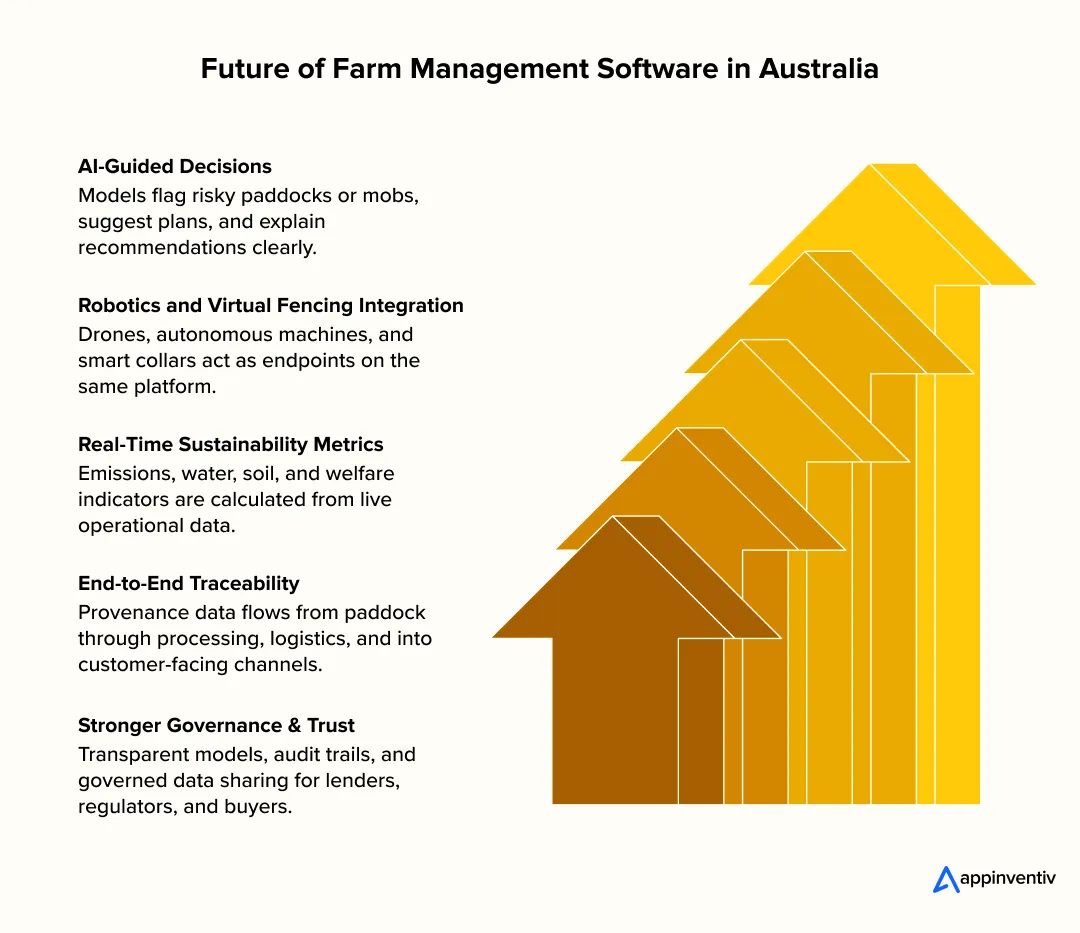
The next decade in Australian agriculture will be shaped by three forces: smarter decisions, more automation, and tougher expectations on proof. Farm management software will sit at the centre of all three. It will shift from a record-keeping tool to the orchestration layer for how data, machines, and people work together.
- AI-Driven Decisions, Not Just Dashboards
Today, most platforms show what happened. The next wave will quietly suggest what should happen next. Models will flag outlier paddocks or mobs, highlight emerging risks, and propose plans under different price or climate scenarios.
For executives, the real question will not be “can we use AI?” but “how do we govern it?” That means explainable models, clear override rules, and full traceability of how a recommendation was generated.
- Deeper Integration with Robotics, Sensors, and Virtual Fencing
Autonomous machinery, drones, collars, and sensors are already on many properties. Right now, they often come with their own portals and reports. Over time, those devices will be treated as endpoints on your main platform, not separate systems.
Your farm management software will decide where machines go, how virtual fences move, and how device data feeds planning, maintenance, and compliance. That reduces noise and gives one operational picture instead of many.
- Sustainability and Traceability by Design
Banks, regulators, and global buyers are asking harder questions about emissions, water, and land use. They also want credible proof of origin and handling. Future-ready platforms will treat these needs as core workloads, not reporting add-ons.
That means emissions, water, soil, and welfare metrics calculated from real operational data, and clean interfaces to share that evidence through the supply chain. Done well, the same system that runs your farms also protects export access and supports premium positioning.
Run a discovery workshop to map priorities, risks, and a phased roadmap for your farm platform.
How Appinventiv Helps Enterprises Build Future-Ready Farm Management Platforms?
Alright, let’s talk real-world for a moment. You’re sitting in a planning meeting, juggling budget approvals, system risks, and board expectations. That’s usually when the question lands: how to build a farm management software in Australia that is reliable enough for enterprise scale.
At Appinventiv, we deliver agriculture software development services that go beyond coding. This is long-term product engineering designed to handle harsh field conditions, complex data flows, and enterprise governance. It is not a short dev sprint. It is a platform decision.
From our team of software developers in Melbourne and 5+ agile delivery centres serving Australian clients, we have deployed 250+ digital assets locally, achieved a 96% client retention rate, and delivered transformation across 35+ industries with over 10 years of APAC experience. That balance of strategy, architecture, and execution is what enterprise farm software Australia projects need.
A practical example is MAAN, an agriculture and nutrition platform we built for IFOAM. It was designed for regions with weak connectivity and non-English users. Offline-first access, multilingual UX, and a clean domain model helped it grow into a thriving digital community with thousands of active users.
Those same principles guide enterprises looking to develop a farm management software in Australia or evaluate the best farm management software Australia options. What matters most is choosing a partner who understands Australian operating conditions and enterprise delivery realities. Let’s connect to plan your farm platform roadmap.
Frequently Asked Questions
Q. What is farm management software Australia?
A. Farm management software in Australia is a computerized system that integrates land, crops, livestock, inputs, workforce, finance, and compliance into a single system. Rather than operating with operations on different tools, it provides leaders with one, close real-time perspective of farm and region performance.
Q. How does FMS support agricultural compliance in Australia?
A. An effective FMS records the chemical consumption, animal movement, water consumption, WHS operations, and any other activities during everyday work. That information can subsequently be converted into audit-ready reports to regulators, industry schemes and ESG reports without having to construct them manually.
Q. How to build a farm management software in Australia?
A. Begin with business results and extent, then add additional maps of actual workflows and information streams between properties. Then, start with design role-based tours, select an architecture and data plan, develop a targeted MVP, and scale out in stages with definite governance and change management processes.
Q. How much does it cost to build a custom farm management software in Australia?
A. Enterprise projects are, in most cases, within the AUD 70,000 to AUD 700,000 spectrum with scope, depth of integration, analytics requirements, and non-functional requirements such as security and uptime. At the bottom end is a targeted MVP, and at the top end is a multi-entity,analytics-rich platform.
Q. How long does it take to develop farm management software?
A. The time scales depend on the scope, but a realistic scope is 4-9 months to develop an MVP that would cover a selected few regions and core modules. The implementation of the platform in all entities and the introduction of advanced analytics typically turn into a multi-step project that will last 12-24 months.
Q. How can farm management software improve Australian farm operations?
A. The farm management software enhances its visibility, accelerates planning and reforecasting and decreases the number of times it is recorded and reported. In the long term, it contributes to the increase of margins, climate/market risk management on a proactive basis, and data that is credible to the lenders, buyers, and ESG stakeholders.

- In just 2 mins you will get a response
- Your idea is 100% protected by our Non Disclosure Agreement.
How AI-Powered Agriculture Apps in Australia Are Boosting Farm Gate Returns
Key takeaways: AI-powered agriculture apps in Australia are no longer productivity tools alone. When built around farm gate economics, they become decision infrastructure that directly influences cost control, quality consistency, and pricing outcomes. Traditional yield growth is insufficient under rising input costs and market volatility. AI-led agriculture platforms create value by improving timing, quality thresholds,…

Drones in Agriculture in Australia: Use Cases, Benefits & ROI Insights
Key takeaways: Drones are becoming a labour-offset tool for Australian growers, helping large farms operate efficiently with fewer onsite workers. The biggest impact comes when drone data is paired with software, AI, and automated workflows, not when drones are used only for visual monitoring. Precision spraying, livestock monitoring, vineyard heat-stress mapping, and broadacre yield forecasting…

How Technology in Agriculture Continues to Empower Farmers
The agriculture industry has seen multiple revolutions over the last 50 years. The advancements in agriculture, specially in machinery has, over time, expanded the speed, scale, and farm equipment productivity - leading to better land cultivation. Today, in the 21st century, agriculture has found itself in the center of yet another revolution. An agricultural technology…