































How To Build A Custom Behavioral Health Software? Costs, Features & Compliances


- Why Build Custom Behavioral Health Software Systems
- How to Build Behavioral Health Software: Step-by-Step Roadmap
- Behavioral Health vs Mental Health EHR: Scoping the Build
- Key Features for Behavioral Health Software Development You Should Include
- Behavioral Health Software Development Cost and Timeline Estimates
- Security and Compliance of Behavioural Health Software: You Must Plan For
- What Are The Challenges of Custom Behavioral Health Software Development and How to Address Them
- Future Trends That Shape Behavioral Health Platform Development
- Strategic Considerations for Enterprise Buyers
- Why Appinventiv for Custom Behavioral Health Software Development
- Frequently Asked Questions

Key Takeaways
- Custom behavioral health software development supports the unique needs of therapy work that many general EHR tools do not cover well.
- Start with the foundational modules. Clinical notes, scheduling, billing, and security should be the first modules you build.
- Treatment plans and consent controls are important for safe and organized care, so they should be part of the early build.
- Using standards like FHIR or HL7 helps your system connect easily with other healthcare tools as your organisation grows.
- A phased plan keeps the project safe, simple, and easier for teams to adopt. That is MVP, pilot, and then full scale.
Behavioral health needs are rising across hospitals, clinics, and care networks. More patients now need long-term therapy support, remote sessions, and coordinated care across multiple teams. This shift has made older systems slow, rigid, and difficult to scale. Many organisations now see that general EHR tools cannot support therapy-driven workflows, strict privacy needs, and growing compliance demands.
This is why more healthcare leaders are exploring custom solutions. A custom behavioral health platform development can match the way your teams work. It can support detailed clinical notes, group sessions, treatment plans, and secure data exchange across departments.
In this guide, we explain how to build behavioral health software that fits your organisation’s needs. We explain the features your system should have, the rules you need to follow, the cost you should plan for, and the steps to build the platform. The aim is to help you make clear decisions and avoid problems as you plan your digital project.
Scope a custom behavioral health platform tailored to your enterprise needs.
Why Build Custom Behavioral Health Software Systems
Behavioral health workflows are structurally different from general medical care. Longer therapy sessions, repeat visits, evolving treatment plans, group therapy, and stricter confidentiality requirements often stretch traditional EHR systems beyond their design limits. When platforms are built for high-volume clinical throughput rather than longitudinal therapy care, teams compensate with workarounds, external tools, and manual processes that slow operations and increase compliance risk.
A custom behavioral health platform aligns technology with how your organization actually delivers care. It supports value-based models, strengthens privacy controls, and provides long-term architectural flexibility without locking you into rigid vendor roadmaps.
A custom build makes strategic sense when:
- Therapy-driven workflows require structured long-term progress tracking and detailed documentation
- Multi-site operations need standardized yet adaptable workflows
- 42 CFR Part 2, HIPAA, or regional privacy regulations demand granular access controls
- Leadership plans expansion, service diversification, or deeper system integrations
- Off-the-shelf tools create adoption friction and operational inefficiencies
- Licensing costs and vendor limitations restrict long-term scalability
For organizations managing complex behavioral health ecosystems, customization is less about preference and more about operational control, compliance resilience, and sustainable growth.
How to Build Behavioral Health Software: Step-by-Step Roadmap
Building the best behavioral health software needs a structured process. It needs clear planning, deep domain understanding, and strong coordination across clinical, administrative, and technical teams.
A step-by-step roadmap helps large organisations move forward with less risk and more clarity. The process below is common across enterprise-grade builds.
1. Needs Assessment and Stakeholder Alignment
The process begins with understanding your current workflow. Clinical, admin, billing, and compliance teams often work in different ways. Each group must share its pain points and expectations.
Key activities include:
- listing workflow gaps and current system issues,
- identifying user groups like therapists, admin staff, billing teams, and managers,
- defining project goals such as faster documentation, fewer errors, stronger privacy, or easier reporting.
This step creates a shared view of what the software must solve.
2. Scope Definition and Feature Prioritization
Once the needs are clear, the next step is deciding what to build first. Not every feature is needed at the start.
Most organisations begin with:
- clinical notes,
- scheduling,
- billing,
- basic compliance and security.
Advanced features like analytics, telehealth, and behavioral health patient portal development can be implemented later. This keeps the project practical and reduces early complexity.
3. Architecture and Tech Planning
This step sets the foundation. It decides on the enterprise behavioral health software architecture. This includes how the system will run and scale.
Key decisions include:
- cloud, on-premise, or hybrid deployment,
- data structure and storage,
- support for healthcare interoperability standards like FHIR or HL7,
- security layers for protecting sensitive therapy data,
- API planning for future integrations.
A strong enterprise behavioral health software architecture helps your system grow without performance issues.
Expert Suggestion:
Use healthcare-native cloud services like AWS HealthLake or Google Cloud Healthcare API to manage petabyte-scale FHIR data. This ensures your architecture isn’t just a database, but a managed ecosystem that supports sub-millisecond latency for real-time clinical decision support and AI-ready data pipelines.
4. UX/UI Design and Prototyping
A custom behavioral health software development platform must have frictionless UX. Clinicians spend long hours in the system. Slow or confusing screens can affect care.
Design teams create:
- clean dashboards,
- simple note-taking screens,
- clear scheduling views,
- easy paths for submitting claims and reports.
Prototypes help your teams give feedback before development begins.
5. Legacy Data Migration and Integrity
For established hospitals and networks, the biggest hurdle isn’t building the new system—it’s moving the history. A failure in data migration can lead to clinical errors and compliance breaches.
The migration protocol includes:
- Data Mapping: Aligning legacy SQL or proprietary database fields with modern FHIR (Fast Healthcare Interoperability Resources) resources.
- ETL Strategy (Extract, Transform, Load): Cleaning “dirty data” from old systems to ensure that when a clinician opens a patient file in the new system, the history is structured and searchable.
- Validation Hashing: Use cryptographic checksums to verify that 100% of the records moved are identical to the source, ensuring data integrity for future audits.
- Continuity of Care: Plan for “shadow periods” where systems run in parallel to ensure zero downtime during the cutover.
6. Development and Testing
The build usually starts with an MVP. It includes the core features needed for daily operations. Development happens in small phases so the team can test and improve as they go.
During development, prioritize API-First Design. This allows the behavioral health platform to act as a ‘headless’ data source, enabling you to launch mobile apps for patients or integrate third-party AI scribes in the future without rebuilding the core backend.
Testing covers:
- security checks,
- compliance checks,
- performance tests,
- usability tests with real users.
This ensures the best behavioral health software development is safe, fast, and easy to use.
7. Deployment and Staff Training
A controlled rollout helps reduce disruption. Many organisations start with a pilot team or a single facility. This allows users to learn the system and helps your team catch issues early.
Training includes:
- documentation standards,
- privacy routines,
- new scheduling steps,
- billing workflows.
Once the pilot succeeds, the system expands to the rest of the organisation.
8. Maintenance, Updates, and Scaling
Healthcare needs change often. Regulations shift. New services get added. Software must keep up.
This phase includes:
- feature updates,
- security patches,
- compliance improvements,
- performance upgrades,
- scaling to new sites or departments.
Long-term support keeps your behavioral health software solutions stable and ready for future needs.
These are the main steps to develop behavioral EHR software. This structured process helps your organisation move from idea to a working system with fewer risks and smoother adoption. With the right partner and a clear plan, each stage supports a stable, secure, and scalable behavioral health platform that grows with your needs.
The CTO’s Perspective: Architectural Realism
At the enterprise level, we prioritize Zero-Trust architecture and SMART on FHIR authentication. By utilizing OAuth 2.0 with PKCE (Proof Key for Code Exchange), we secure patient-facing APIs against modern interception attacks. We also design for Data Liquidity, ensuring that your custom platform doesn’t become another data silo but acts as a hub for internal and external interoperability.
Behavioral Health vs Mental Health EHR: Scoping the Build
Now that the build process is clear, the next decision is scope. Mental health EHR software typically focuses on therapy, psychiatry, and counseling workflows. Behavioral health platforms often extend further into substance use programs, integrated care coordination, and outcomes reporting across services.
For enterprise organisations, the priority is usually consolidation. Modern behavioural mental health EHR software should support therapy-driven documentation, strict confidentiality controls, and interoperability with wider hospital systems, without splitting workflows across multiple tools.
Defining this scope early prevents rework later, especially when designing access policies, consent rules, and FHIR-based integrations.
Our healthcare engineering team can help you design a stable and scalable platform.

Key Features for Behavioral Health Software Development You Should Include
Behavioral health software solutions have unique needs that general EHR systems often do not support. Teams handle long sessions, group therapy, repeat visits, and sensitive notes that demand stronger privacy controls.
A custom enterprise behavioral health software architecture helps address these needs with a clear, structured feature set. Below is a list to help leaders assess what matters most for their organisation.
Clinical Documentation and Treatment Management
Behavioral health care relies on detailed, evolving clinical records. The platform should support structured therapy notes, SOAP templates, treatment plans, progress tracking, and group-session documentation while maintaining strict separation of individual patient records.
Enterprise Scheduling and Care Coordination
Scheduling must support recurring therapy sessions, group care logic, and multi-provider coordination. Enterprise environments also benefit from workflows that connect appointments directly with documentation and billing to maintain continuity across teams.
Billing and Revenue Cycle Management
A complete billing module or revenue cycle management helps teams handle claims, insurance submissions, payments, and financial reports. For many organisations, this reduces billing errors and speeds up reimbursements.
Interoperability and Data Exchange (FHIR, HL7, APIs)
Enterprise behavioral health systems cannot operate in isolation. Seamless interoperability allows data exchange with hospitals, labs, pharmacies, external EHRs, and internal platforms, enabling coordinated care and reducing manual data handling.
Telehealth and Hybrid Care Support
Virtual care is now a core requirement rather than an add-on. Built-in telehealth capabilities should support secure video sessions, remote documentation, virtual follow-ups, and integrated billing workflows.
Advanced Access Controls, Consent, and Audit Trails
Behavioral health data demands stronger privacy safeguards than standard healthcare records. Role-based permissions, consent management workflows, and detailed audit logs are essential for regulatory compliance and risk reduction.
Analytics and Reporting
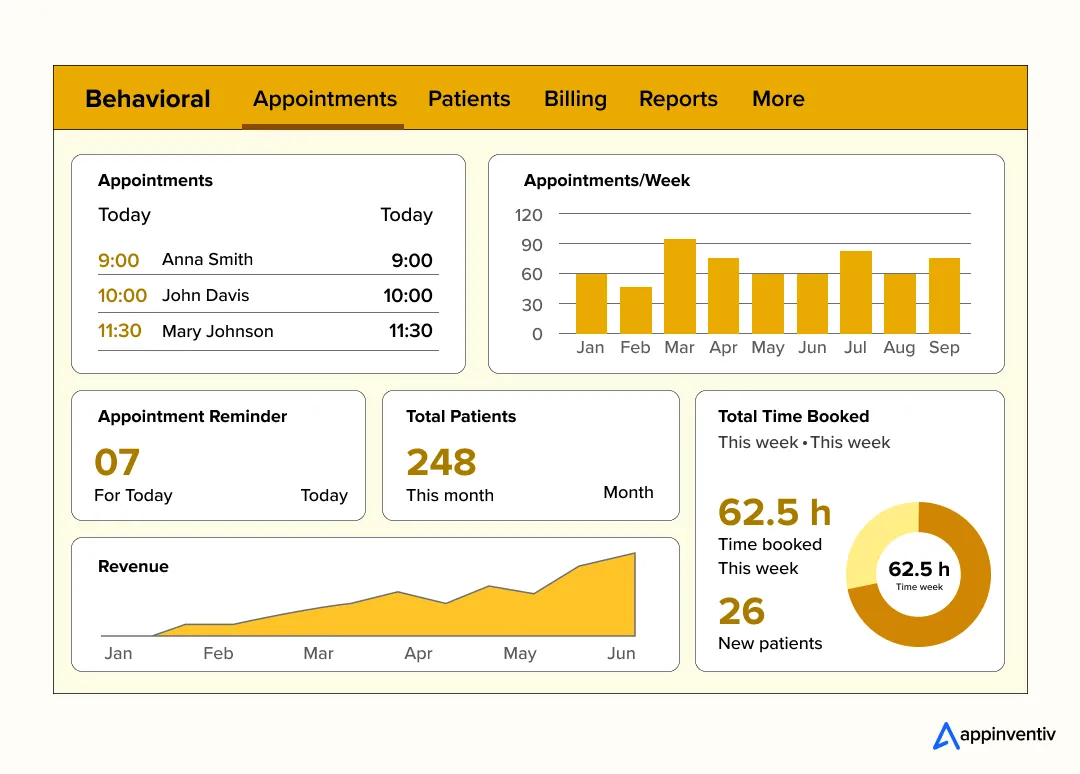
Dashboards provide deep insights into Population Health Management, allowing leaders to segment patient data by risk factors, demographics, and clinical outcomes. This is critical for identifying high-risk groups within a network and allocating resources where they are most needed.
For example:
Modular Architecture for Scalability
Large organisations require flexibility as services evolve. A modular platform allows new workflows, departments, or care programs to be added without disrupting existing operations, ensuring long-term adaptability.
A strong enterprise feature set creates a stable foundation for clinical excellence, operational efficiency, and regulatory readiness. As behavioural health services expand, a modular and interoperable platform ensures your system can scale without forcing teams to change how they deliver care.
Behavioral Health Software Development Cost and Timeline Estimates
The cost of behavioral health software development depends on the size of your organisation, the depth of features, and the number of systems you plan to connect. Large hospitals, multi-location clinics, and behavioral health networks usually fall into higher ranges because they need stronger security, detailed workflows, and full interoperability. Smaller practices often start with a lighter scope and expand later.
A clear understanding of cost helps leadership plan budgets, set expectations, and evaluate long-term return. Below is a simple table summarising typical cost bands by project size.
Estimated Behavioral Health Software Development Cost
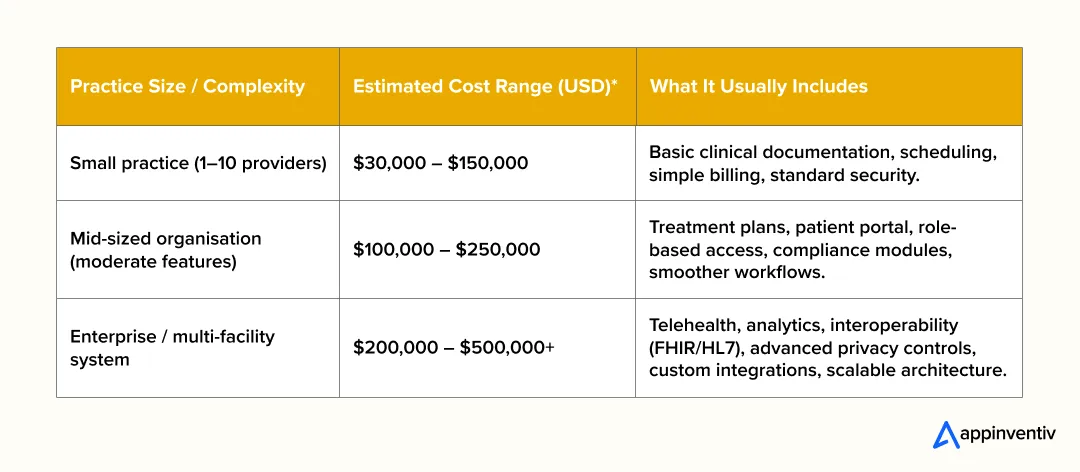
*Costs vary by region, compliance needs, infrastructure, and development timeline.
Beyond Development Costs: The Strategic ROI of Customization
While the upfront investment for a custom platform is higher than a SaaS subscription, the Total Cost of Ownership (TCO) over 5 years is significantly lower for large-scale organizations.
- Reduction in Clinician Burnout: Standard EHRs are often cited as a primary driver of therapist burnout due to “click fatigue.” A custom UX designed for behavioral workflows can reduce documentation time by up to 30%.
- Lower Turnover Costs: In an industry where clinician turnover can cost an organization 1.5x to 2x a staff member’s annual salary, improving the daily digital experience directly impacts your bottom line.
- Elimination of “Seat” Licenses: For a network with 500+ providers, per-user licensing fees become a massive annual liability. A custom build moves that expense from an ongoing OPEX drain to a one-time CAPEX asset.
- Revenue Integrity: By automating the “Golden Thread” (linking the diagnosis to the treatment plan and the progress note), you reduce the risk of denied claims and audit-related clawbacks.
What Drives the Final Cost
Several factors influence the final budget:
- number of user roles (therapists, admin, billing, leadership),
- depth of privacy and compliance controls,
- integrations with labs, billing systems, or legacy software,
- custom note formats and advanced reporting,
- telehealth and mobile capabilities,
- performance and scaling needs for multi-site operations.
The more complex your workflows, the higher the development effort.
Typical Timelines
Most behavioral health practice management software projects take 9 to 18 months from planning to full rollout. A shorter timeline usually means a lighter feature set or a focused MVP.
A rough timeline view:
| Stages | Typical Timeline |
|---|---|
| Planning, scope, and design | 4-8 months |
| Development and testing | 6–12 months |
| Pilot rollout, training, and full deployment | 9–18 months |
The safest approach is a phased rollout. It reduces risk, supports better staff adoption, and gives your team time to adjust.
A clear behavioral health software development cost and timeline plan helps leaders understand the full scope of the project before starting. When matched with a strong roadmap, it ensures smooth delivery and a system that supports care, compliance, and long-term growth.
Get a practical cost and architecture assessment tailored to your workflows, compliance needs, and growth roadmap.
Security and Compliance of Behavioural Health Software: You Must Plan For
The data from your behavioral health software systems is among the most sensitive categories. It includes therapy notes, emotional history, private conversations, and details of long-term treatment. Any system that stores this information must follow strict rules. It must also keep data safe from misuse, unauthorised access, and operational errors. For healthcare leaders, this is not only a legal need but also a matter of patient trust.
Below is a clear view of the key compliance and security requirements your custom behavioral health platform development must support.
Core Compliance Rules
Different regions follow different laws, but the goal is the same: keep patient data safe and private.
HIPAA (United States)
HIPAA-compliant behavioral health software sets rules for data privacy, access control, secure storage, and breach reporting.
GDPR (European Union)
GDPR compliance focuses on consent, data rights, and strict rules for the storage and sharing of patient information.
42 CFR Part 2 (Substance Use Disorders)
For organizations handling substance use disorder (SUD) data, HIPAA alone is insufficient. Implementing granular data segmentation and ‘consent-to-redisclose’ workflows required by 42 CFR Part 2. This prevents SUD records from being shared with a patient’s primary care team without explicit, separate consent—a major audit risk for integrated care networks.
Local healthcare laws (India, Middle East, APAC, and others)
Many regions now have privacy laws that apply to hospitals and clinics. Your system must follow these rules based on where you operate.
These laws require strong controls over who can see patient data, how long data is stored, and how it is shared with other systems.
Security Practices That Must Be Built In
A behavioral health practice management software should follow a security-first design. This protects patients, reduces risk, and keeps your organisation audit-ready at all times.
Encryption
All data must be encrypted during storage and during transfer. This keeps sensitive details safe even if a breach occurs.
Role-Based Access Control
Only the right people should see the right data. For example, a billing staff member should not see therapy notes.
Audit Trails
Every action inside the system should be recorded. It could be login, edits, downloads, and file access. This supports investigations and compliance checks.
Regular Security Audits and Monitoring
Continuous checks of custom behavioral health software development help identify risks early and keep the system updated as threats evolve.
Consent, Privacy, and Confidentiality
Therapy details demand higher privacy controls than general medical notes. Your system must support:
- digital consent forms,
- fine-grained privacy settings,
- rules for data-sharing approvals,
- data retention and deletion policies.
This ensures that clinicians follow a clear and consistent process when handling sensitive patient details.
Compliance Reporting and Audit Support
Large organisations often face internal or external audits. Your behavioral health case management software should allow easy access to:
- data access logs,
- activity reports,
- compliance summaries,
- security incident reports.\
This reduces the time your team spends preparing for audits and keeps operations smooth during inspections.
A strong compliance and security foundation is the base of any behavioral health software solution. It protects your organisation from legal risk and builds confidence among patients and clinicians. When planned early, it also saves time and cost during development and future upgrades.
What Are The Challenges of Custom Behavioral Health Software Development and How to Address Them
There are many benefits of behavioral health software development. It brings clear long-term value, but it also has challenges that leaders should plan for early.
Understanding these challenges helps organisations avoid delays, control costs, and reduce operational risk. The goal is not to slow down the project, but to move forward with clarity and a solid plan.
High Upfront Cost and Longer Development Time
Custom software for behavioral health systems requires more time and investment than off-the-shelf tools. They involve detailed workflows, strict privacy rules, and deeper testing.
How to address it:
Start with an MVP. Focus on the core features your teams need right now. Roll out in phases so teams can adopt the system smoothly while you control cost.
Heavy Compliance and Privacy Work
Behavioral health data requires stronger privacy controls than general medical records. Building these rules from scratch can be complex.
How to address it:
Plan compliance from day one. Set clear privacy rules, access levels, audit trails, and encryption standards before development begins.
Workflow Disruption and Staff Adoption
Shifting from paper or older systems to a new platform can feel overwhelming for teams. This can slow down care if not managed well.
How to address it:
Train teams early. Run a pilot. Gather feedback. Make small improvements before scaling. This reduces stress and improves user confidence.
Integration Complexity
Hospitals and clinics often rely on several systems like billing, labs, pharmacy, scheduling, and more. Connecting all of them takes planning.
How to address it:
Use standard protocols for behavioral health billing software like FHIR and HL7. Build a modular system that connects smoothly with internal and external tools.
Strong Data Security Needs
Therapy notes and behavioral health records require extra care. Any breach can cause serious harm to patients and damage organisational trust.
How to address it:
Put strict access controls, encryption, and activity logs in place. Monitor the system often and update security policies as needed.
Planning for these challenges early helps organisations move forward with fewer surprises. With the right preparation and the right and best behavioral health software partner, each challenge becomes manageable, and the system becomes more reliable and future-ready.
Future Trends That Shape Behavioral Health Platform Development
Custom behavioral health platform development is moving toward smarter, faster, and more secure digital systems. New technologies are helping organizations improve patient care, reduce manual work, and maintain strong privacy controls. Understanding these trends helps leaders plan platforms that stay relevant as clinical and operational needs change.
AI and Machine Learning for Clinical and Operational Support
AI and ML tools in healthcare are becoming common. In behavioral health systems, they help teams work faster and make better decisions.
These tools support:
- simple risk assessments based on patient patterns,
- session-note suggestions that save clinician time,
- early alerts for missed follow-ups or therapy gaps,
- workload predictions for staff planning.
These features do not replace clinical judgment. They simply help teams work with more clarity and less manual strain.
Cloud-Based Infrastructure for Scalability
More healthcare organisations are moving to cloud platforms because they are easier to scale and maintain.
Cloud systems help with:
- multi-site access,
- quick updates,
- secure data storage,
- reduced hardware costs.
For custom behavioral health EHR software development networks planning to grow, the cloud provides a stable base without heavy IT overhead.
Blockchain for Sensitive Data Protection
Behavioral health data needs a high level of trust. Blockchain interoperability for businesses helps create a tamper-proof record of access and changes.
This supports:
- secure patient consent forms,
- protected therapy notes,
- clear audit trails for compliance teams.
Blockchain is not required for every organisation, but it offers strong value for large networks or high-risk data environments.
Advanced Analytics for Better Outcomes
Data analytics is now a core part of software for behavioral health operations. It helps leaders understand care progress, patient trends, and service performance.
Analytics tools offer:
- outcome tracking,
- session utilisation insights,
- wait-time and drop-off patterns,
- population-level reports for planning programs.
These insights are the foundation of Value-Based Care (VBC) readiness. As the industry shifts toward quality-of-care metrics, having a system that can prove clinical efficacy through data becomes a competitive necessity for large-scale healthcare networks.
Virtual and Hybrid Care Support
Telemental health for providers and patients continues to grow in the behavioral health field. Patients want easy access, and clinicians need tools that support secure online care.
Future-ready systems include:
- video sessions,
- online follow-ups,
- remote assessments,
- digital treatment plans.
This helps organisations reach more patients without adding heavy infrastructure.
Interoperability with Hospital and External Systems
Healthcare systems are becoming more connected. Behavioral health platforms must exchange data safely with EHRs, labs, pharmacies, and behavioral health billing software tools.
Standards like FHIR and HL7 will shape future integrations, reducing manual work and improving care coordination.
These trends show a clear shift toward intelligent, scalable, and secure behavioral health platforms. Organisations that plan for these technologies early can reduce future costs, better support clinical teams, and stay prepared for new care models.
Strategic Considerations for Enterprise Buyers
Building a custom behavioral health case management software is a major decision. It affects clinical workflows, patient experience, readiness for compliance, and long-term operational costs. Senior leaders must plan with a clear view of both present needs and future direction. The goal is to choose an approach that supports clinical teams today and keeps the organisation ready for tomorrow.
Below are the key considerations that help enterprise buyers make informed decisions.
Assess the Complexity of Your Organisation
Custom behavioral health software development services often involve multiple teams, long-term treatment plans, and strict privacy controls.
Ask yourself:
- Do your clinicians follow different workflows across departments or locations?
- Do you manage large volumes of therapy notes or group sessions?
If the answer is yes, a custom solution may offer better stability and control.
Confirm Privacy, Security, and Compliance Needs
Behavioral health comes with higher privacy expectations, GDPR or HIPAA-compliant behavioral health software, and tighter regulations.
Consider:
- the sensitivity of your data,
- the number of users who need controlled access,
- the need for detailed audit logs,
- the risk of non-compliance.
If compliance pressure is growing, a tailored system can protect your organisation far more effectively than a general tool.
Define Your Long-Term Goals
Leaders should plan for the future, not just current needs. Think about: planned expansion to new sites, the integration of SDoH protocols to improve health equity, and how your data architecture supports a Population Health Management strategy across your entire geographic footprint.
A custom platform supports these goals without forcing major system changes later.
Plan for Change Management
Even the best system fails without proper adoption.
Ask:
- How will teams be trained?
- Will there be a pilot phase?
- How will data be moved from old systems?
Clear planning ensures that the transition is smooth and that staff feel supported.
Choose the Right Development Partner
An enterprise behavioral health platform requires strong technical skills and deep domain knowledge.
Your partner should bring:
- proven healthcare experience,
- understanding of compliance rules,
- strong design and engineering teams,
- the ability to scale your system over time.
This reduces risk and ensures long-term support.
When these considerations are addressed early, your organisation is better prepared to build a system that supports clinical care, protects patient data, and grows with your business.
Our healthcare specialists can provide a technical gap analysis to help you plan a compliant, scalable platform.
Why Appinventiv for Custom Behavioral Health Software Development
Custom behavioral healthcare software development services demand deep technical strength, strong domain understanding, and strict compliance readiness. Appinventiv brings all three together.
Our teams work closely with healthcare leaders to design systems that support therapy-focused workflows, protect sensitive data, and scale across clinics and locations. The goal is simple: build software that supports care, reduces operational strain, and aligns with your organisation’s long-term goals.
Enterprise Healthcare Expertise
We design and build platforms that include clinical documentation, consent controls, treatment plans, telehealth, analytics, and compliant data exchange. Our teams understand behavioral health workflows and tailor the system to each organisation’s needs.
Strong Technical Foundation
Our engineering teams build modular, secure, and scalable systems. We support interoperability standards like FHIR and HL7. We design privacy-forward architectures with role-based access, audit trails, and secure storage.
Advanced Capabilities When Needed
Over 150 AI models deployed across projects to support automation, predictions, and insights. Cloud-native builds that support multi-site operations and fast scaling.
Appinventiv acts as a long-term partner for healthcare organisations that want a stable, compliant, and future-ready custom behavioral health EHR software development. Our focus is on building software that improves care, supports clinicians, and helps leadership make confident decisions.
Need behavioral or mental health app development service? If you are exploring what a tailored behavioral health system could offer, we can walk through options and understand what matters most for your environment.
Frequently Asked Questions
Q. What is behavioral health EHR software?
A. Behavioral health EHR software is a specialized electronic health record system designed for therapy, psychiatry, counseling, and long-term mental health care workflows. It supports features like therapy notes, treatment plans, consent tracking, and stricter privacy controls that general medical EHR systems often do not provide.
Q. What are the benefits of using EHR software in behavioral health practices?
A. Behavioral health EHR software improves documentation accuracy, strengthens privacy compliance, simplifies scheduling and billing, and supports long-term treatment tracking. It reduces administrative workload for clinicians and provides leadership with better visibility into outcomes, operations, and compliance readiness.
Q. What is HL7 FHIR integration for behavioral health?
A. HL7 FHIR integration allows a behavioral health system to exchange data safely with other healthcare platforms. It helps clinicians access lab reports, medication details, and patient records without manual work. This improves coordination and keeps information consistent across all care teams.
Q. How does EHR in primary care differ from mental health EHR software?
A. Primary care EHR systems are built for short, diagnosis-driven medical visits, while mental health EHR software focuses on long-term therapeutic relationships. Behavioral health platforms support detailed session notes, progress tracking, group therapy workflows, and stronger confidentiality controls required for sensitive patient data.
Q. How long does it take to build a HIPAA-compliant behavioral health EHR?
A. A HIPAA-compliant behavioral health EHR usually takes 9 to 18 months to build. The timeline depends on the number of features, privacy rules, integrations, and the size of the organisation. Projects with advanced modules or multi-site needs may take longer.
Q. Why invest in behavioral health software development?
A. Behavioral health software supports better care and smoother operations. It helps clinicians manage long sessions, protect sensitive notes, and follow strict privacy rules. It also reduces manual work for staff and improves reporting for leadership. For growing organisations, it becomes a long-term asset that improves both care and efficiency.
Q. How to develop custom behavioral health EHR software?
A. Developing a custom behavioral health EHR starts with understanding your workflows. The process includes planning, design, development, testing, pilot rollout, and scaling. Most organisations begin with an MVP that covers core features like notes, scheduling, billing, and compliance controls. Advanced modules can be added later as needs grow.
Q. How to upgrade your behavioral health software?
A. Upgrading your system starts with reviewing current gaps. Common upgrades include better privacy controls, telehealth support, FHIR-based integrations, analytics dashboards, and a cleaner user interface. A phased upgrade plan helps teams adjust smoothly without affecting daily care.
If you need support with custom development or upgrades, Appinventiv can guide you through each step.

- In just 2 mins you will get a response
- Your idea is 100% protected by our Non Disclosure Agreement.

EHR Implementation for Healthcare Providers: Process, Features, and Total Cost Analysis
Key takeaways: A clear EHR implementation guide keeps teams on track and prevents delays. The full EHR implementation process includes planning, setup, moving data, training staff, and regular updates. The right features handle clinical work, billing, reports, and compliance for large healthcare organizations. EHR implementation costs vary based on design, integrations, data migration, training hours,…
Medical Device Software Integration: A Strategic Buyer’s Guide for Healthcare Enterprises
Key takeaways: Medical device software integration is a governance decision first. Define data ownership, clinical workflows, and regulatory scope before writing a single API. Build on recognized standards from the outset. FHIR, DICOM, and IEEE 11073 reduce ambiguity and simplify long-term scaling. Expect validation and security to drive real cost. Documentation, testing, and firmware controls…

How to Build a Custom Pediatric EMR and EHR System?
Key takeaways: Clinical Precision: Custom systems accommodate pediatric-specific data points like percentile curves and weight-based longitudinal dosing. Interoperability: Seamless data exchange via HL7 FHIR ensures your practice stays connected to pharmacies, labs, and state registries. Regulatory Resilience: Built-in compliance with HIPAA, HITECH, and MACRA/MIPS reduces legal friction. Enhanced Engagement: Parent portals reduce administrative overhead by…