





























How Much Does It Cost to Build an AI App in Dubai?


- The State of AI in Dubai and Why Businesses Are Investing Now
- Understanding the Complete Cost to Build an AI App in Dubai
- Development Stage Breakdown (Cumulative Investment Approach)
- Factors That Influence the Cost of Building an AI Application in Dubai
- Hidden Cost Drivers Businesses Often Miss in AI Projects in Dubai
- Optimize Your Budget: Proven Tips for Building Your AI Application Efficiently in Dubai
- What Makes an AI Application Enterprise-Ready in Dubai
- How to Develop Your AI App in Dubai: The Right Approach
- Monetizing Innovation: Revenue Models for AI Apps in Dubai
- What are the challenges in developing Ai powered app in Dubai?
- Future Trends in AI Applications Businesses Can Expect in Dubai
- Why Appinventiv is Dubai's Go-To Choice for Custom AI App Development in Dubai
- FAQs

Key takeaways:
- AI app costs in Dubai typically range from AED 80,000 for simple builds to AED 800,000+ for enterprise systems.
- Dubai is past AI experimentation, and not investing now means catching up later at higher cost.
- The real budget is driven by data, integrations, architecture, and compliance, not just app features.
- Hidden costs like data prep, cloud usage, APIs, and model updates add significantly over time.
- Most AI apps take around 3.5 to 6 months from planning to launch, with ongoing yearly maintenance.
- A specialist partner like Appinventiv helps control cost, de-risk delivery, and turn AI into measurable ROI.
Everyone understands what artificial intelligence can do for business today. It speeds things up, removes repetitive work, improves decision-making, and helps teams operate with more clarity. In Dubai, the shift toward AI is no longer happening quietly in the background. With government-backed initiatives, smart city programs, and Dubai Vision 2030 shaping how industries evolve, businesses are now expected to adopt intelligent systems as part of normal operations.
For business leaders, this creates real pressure. The market here moves quickly. Customers expect faster service. Teams want better tools. Competitors are already investing in automation and data-driven systems. You may not feel the impact immediately, but over time, organisations that do not adopt AI tend to lose ground whether that is in operational efficiency, customer experience, or internal scalability.
The moment a business decides to move forward, the conversation naturally shifts to cost. Leaders want to understand the cost to build an AI app in Dubai before putting budgets in motion. The reality is there is no flat pricing model. The scope of the product, the data involved, the intelligence expected from the system, and how deeply it integrates into business workflows all influence the final number.
As a general reference point, the average cost of custom AI app development in Dubai typically starts around AED 80,000 to 150,000 for simpler implementations. More advanced systems often fall into the AED 200,000 to 500,000 range. Enterprise platforms, particularly those involving custom models, automation, and integrations, can push the costs beyond AED 800,000 and higher. This is why your AI mobile app development budget in the UAE matters just as much as the technology itself.
This blog will break down the AI app development cost in the UAE in 2026, how to structure a sensible AI app development budget for businesses in UAE, challenges in developing Ai powered app, and what drives enterprise AI app ROI over time. You will also get clarity on what impacts NLP/ML app development cost in Dubai, so you can move forward with realistic expectations rather than assumptions.
Talk to our Dubai team and get a practical build-path that aligns with your budget and growth goals.

The State of AI in Dubai and Why Businesses Are Investing Now
AI in Dubai is no longer experimental. It is becoming part of how the economy itself is being rebuilt. Government strategy, sector-wide adoption, and private investment are all moving in the same direction. This is not enthusiasm. This is long-term policy meeting real business execution.
PwC estimates that artificial intelligence could add $320 billion to the Middle East economy by 2030, with the UAE expected to see the strongest impact in the region.
To put that into perspective:
- The UAE could see AI contribute close to 14% of national GDP by 2030
- The region’s AI contribution is forecasted to grow 20–34% every year
What is happening within the UAE market itself shows the same momentum. Grand View Research values the UAE AI market at $3.47 billion in 2023, growing at a projected 43.9% CAGR through 2030 and reaching $46.33 billion. That level of growth is not driven by experimentation alone. It reflects enterprise adoption, state investment, and real-world deployment across multiple sectors.
Industry adoption is already broad. McKinsey reports that AI is being actively used across:
- Energy, manufacturing, and infrastructure
- Financial services and professional services
- Technology, telecom, media
- Healthcare, education, and social services
AI is no longer isolated to innovation teams. It is becoming standard business infrastructure.
Another major shift underway is the adoption of agent-based systems. These do not just respond to prompts. They execute tasks, run workflows, and act inside business systems. Roughly 60% of organizations surveyed report already using AI agents in some form. These systems are now reducing operational load, improving speed, and cutting internal costs which makes them attractive not as technology, but as business tools.
This is why timing matters. In Dubai’s case, AI is no longer about being early. It is about not being late. Businesses that invest now build systems while the market is growing. Those that wait will eventually be forced to adopt under pressure, at higher cost, and with less control. In an economy shaped by national AI initiatives and private investment at this scale, standing still quietly becomes the biggest risk of all.
Also Read: Benefits of AI strategy consulting for Enterprises
Understanding the Complete Cost to Build an AI App in Dubai
The budget for an AI application in Dubai is not a fixed number but a range that changes based on complexity, intelligence level, and long-term goals. Building an AI system is very different from developing a regular app. Some projects focus only on automation or prediction, while others become core systems that support entire operations. To understand how much you are really investing, you need to look at both complexity tiers and how costs build across development stages.
Investment Tiers by Application Complexity
Minimum Viable Product (MVP):
Build a focused AI capability that solves one business problem. Launch quickly to test real-world results. Improve based on usage data. This stage helps you validate whether AI delivers value before expanding.
Investment Range: AED 90,000 – AED 180,000
Mid-Complexity AI Platform:
Introduce multiple models, dashboards, and automated workflows. Add system integrations and improve reliability. Transform your AI system into a working business tool rather than an experiment.
Investment Range: up to AED 500,000
Enterprise-Grade AI System:
Develop intelligent platforms that support automation, decision-making, and continuous learning. Integrate external services and enterprise systems. Build solutions that perform under scale and complexity.
Investment Range: AED 800,000+
| Platform Type | Key Capabilities | Investment Range (AED) | Timeline | Strategic Advantage |
|---|---|---|---|---|
| Minimum Viable AI System | Basic automation, simple models, reporting | 90,000–180,000 | 3–4 months | Early learning |
| Business AI Platform | Custom models, dashboards, automation | 200,000–500,000 | 6–8 months | Operational gains |
| Enterprise AI System | Decision engines, large data workflows | 800,000+ | 12–18 months | Competitive advantage |
Development Stage Breakdown (Cumulative Investment Approach)
When people talk about the cost to build an AI app in Dubai, most assume the money goes straight into coding. That is rarely true. The budget builds step by step, and each stage shapes how smooth the next one will be.
Everything usually starts with planning. This is where the loose idea turns into something practical. Teams sit down to define what problem the AI should solve, what data will be used, and how the system should be built to avoid rework later. In Dubai, this early phase typically costs between AED 15,000 and AED 35,000, depending on how complex the product is going to be.
After that, design takes centre stage. This is not about colours and buttons alone. It is about how users interact with the system and how information flows from one screen to another. If this part is rushed, even the best technology built later will feel clumsy. Design usually adds another AED 25,000 to AED 50,000. By this point, most projects have already crossed AED 40,000 and often reach up to AED 85,000 before development even begins.
Then comes the actual build. This is where engineering teams create the system that runs everything behind the scenes. Data pipelines, logic engines, dashboards, and integrations are put in place here. For smaller applications, this phase generally costs between AED 100,000 and AED 200,000. For anything more advanced, the number moves up quickly. By the time a basic version of the product is ready, the total investment often sits somewhere between AED 140,000 and AED 285,000.
Testing is not something that happens at the end. It runs throughout development. Teams continuously check whether things break, slow down, or behave in unexpected ways. Security testing is especially important in Dubai, where data handling standards are strict. This stage usually adds another 15 to 20 percent on top of development spend.
Once the app goes live, spending does not stop. AI systems need regular attention. Data changes, behaviour shifts, and performance needs tuning. Most businesses plan for ongoing support that costs around 10 to 15 percent of the build value every year. This covers fixes, improvements, and keeping the system stable as usage grows.
Development Cost Overview with Timeline
| Stage | Team Size | Timeline | Cost Range (AED) | What Happens |
|---|---|---|---|---|
| Discovery & Planning | 2–3 specialists | 2–4 weeks | 15,000 – 35,000 | Business goals are translated into technical direction, data readiness is reviewed, and the system architecture is defined |
| UI/UX Design | 2–4 designers | 3–5 weeks | 25,000 – 50,000 | User flows are designed, interfaces are created, and usability testing begins |
| Development | 4–8 engineers | 8–16 weeks | 100,000 – 200,000 | Core system is built including models, backend services, and application logic |
| Testing | QA team | 3–4 weeks (overlapping) | 15–20% of development | Performance is validated, issues are resolved, and reliability is strengthened |
| Maintenance | Ongoing | Continuous | 10–15% yearly | System performance is monitored, models are refined, and infrastructure is kept stable |
Factors That Influence the Cost of Building an AI Application in Dubai
Before locking a budget, businesses in Dubai need to understand one simple truth. The cost of an AI application is not driven by design alone. It is shaped by architectural choices, scaling needs, and how much responsibility the system carries in daily operations. A small automation tool does not cost the same as a platform that supports decision-making, customer experience, or operational workflows. In Dubai’s high-expectation market, these factors directly decide your final spend.
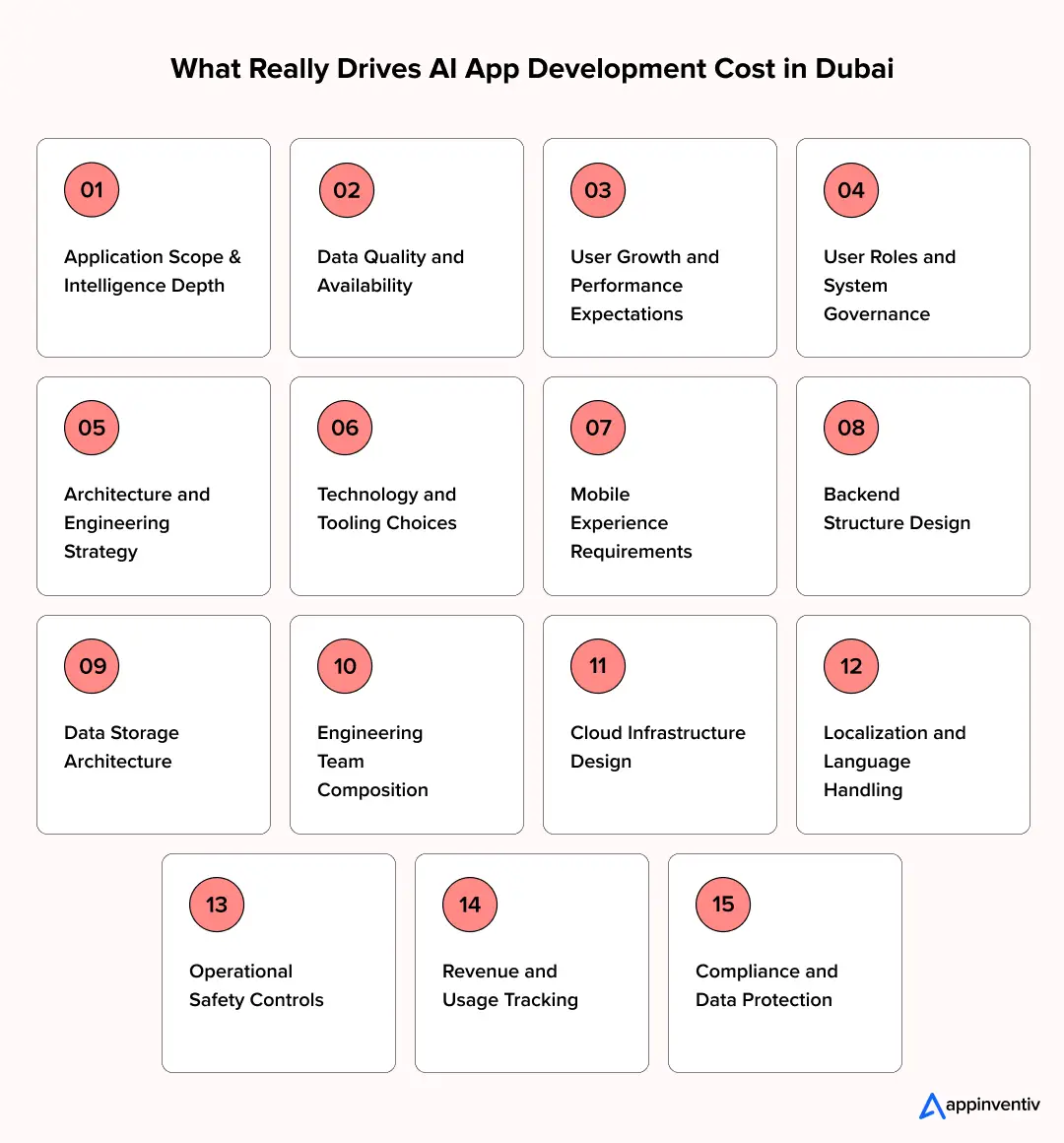
Application Scope and Intelligence Depth
As soon as a system moves beyond simple automation into prediction and learning, cost increases sharply. Training models, refining behaviour, and validating outcomes require specialised effort. Intelligent systems also demand ongoing tuning as usage grows. The deeper the intelligence required, the higher the cost to build an AI app in Dubai over time.
Data Quality and Availability
AI depends entirely on the quality of information it is fed. Disorganized systems slow development before it even starts. Teams spend time repairing data instead of building insight. Clean data always reduces cost and delivery time.
User Growth and Performance Expectations
Internal tools behave very differently from public or enterprise-wide platforms. Traffic growth increases pressure on performance and infrastructure. Downtime becomes unacceptable once users depend on the system. Uptime requirements directly impact build complexity.
User Roles and System Governance
Different users interact with AI in different ways. Admins, analysts, and operators each need controlled access. Every permission rule adds development logic. Governance becomes invisible work that still carries real cost.
Architecture and Engineering Strategy
Systems built for speed often struggle at scale. Scalable systems demand more effort early. Smart architecture avoids expensive rebuilds later. Long-term growth is shaped here more than anywhere else.
Technology and Tooling Choices
Some tools accelerate development but raise operating bills. Others seem cheaper early but limit growth. Stack decisions shape performance, maintenance, and flexibility. Every choice shows up later in cost.
Mobile Experience Requirements
Multi-device support expands testing and tuning work. Mobile experiences demand performance optimization. Smaller screens create design constraints that affect logic. Every platform adds development depth.
Backend Structure Design
Simple systems rely on simple pipelines. Intelligent systems need complex orchestration. Backend choices affect response time and stability. Architecture determines whether future scale is effortless or painful.
Data Storage Architecture
Single databases are easier to manage early. Hybrid systems support complexity at scale. Storage design shapes speed and reliability. Bad decisions here create expensive failures later.
Engineering Team Composition
Senior engineers reduce mistakes and rework. Junior-heavy teams move slower long-term. Experience shortens cycles and increases quality. Talent choice always affects total spend.
Cloud Infrastructure Design
Small systems need minimal environments. Growth requires redundancy and scaling models. Hosting cost grows quietly with usage. Infrastructure becomes a standing expense.
Localization and Language Handling
Dubai demands multilingual support. Layout and design must adapt to language direction. Testing expands across devices and scripts. Cultural alignment drives both adoption and spending.
Operational Safety Controls
AI systems need supervision. Protection against errors requires monitoring layers. Fail-safes prevent reputational damage. Safety is not optional at enterprise scale.
Revenue and Usage Tracking
Revenue logic is complex to build. Reporting systems add backend load. Tracking behaviour requires engineering effort. Monetisation always increases development weight.
Compliance and Data Protection
Data laws shape system design. Security cannot be added later. Compliance changes workflows and storage models. Regulation reduces risk but raises cost.
Hidden Cost Drivers Businesses Often Miss in AI Projects in Dubai
Some costs never appear in the original proposal. They surface after launch, once the system starts handling real usage, real data, and real expectations. Many businesses focus only on development spend and underestimate what it takes to operate an AI system day after day. These overlooked areas rarely show up in pricing tables, but they quietly reshape total investment over time.
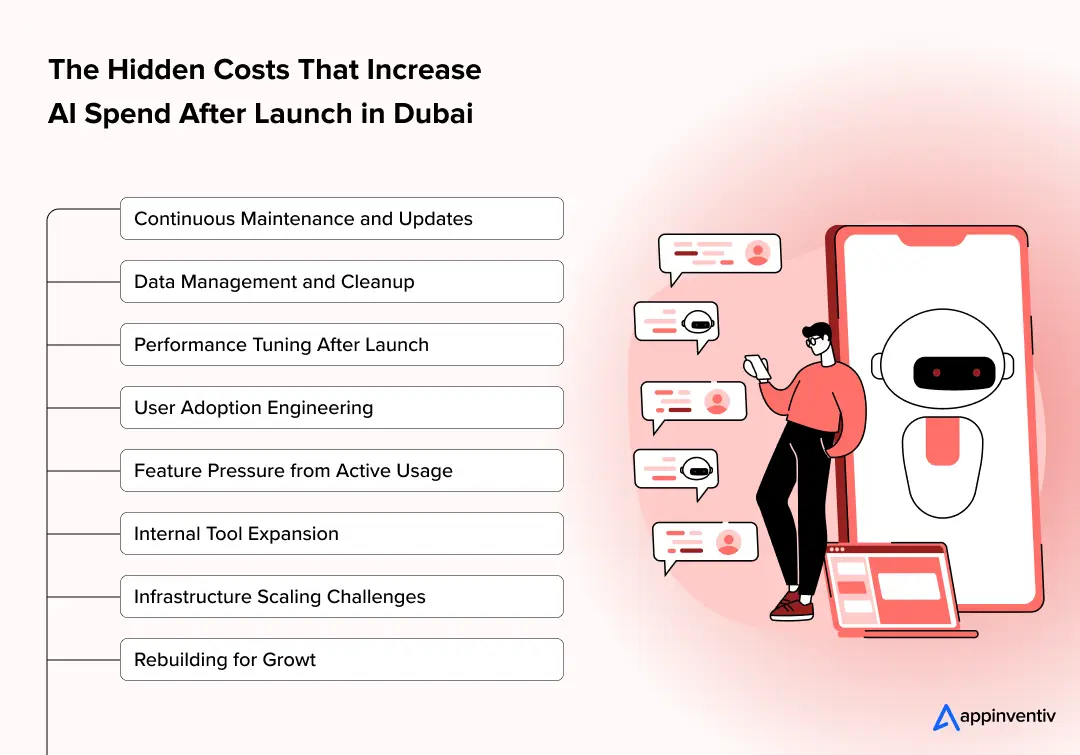
Continuous Maintenance and Updates
AI systems do not freeze after deployment. Models lose accuracy, logs grow, and performance shifts as usage increases. Regular tuning and small fixes become part of ongoing operations. Over time, maintenance costs usually turn out to be more than what most teams anticipate.
Data Management and Cleanup
New data never arrives perfectly structured. Inputs must be reviewed, cleaned, and validated continuously. When this is not planned upfront, teams waste time repairing data instead of improving intelligence. Data maintenance becomes a silent workload that grows with scale.
Performance Tuning After Launch
What performs well in testing often struggles under real conditions. Unexpected bottlenecks, slow responses, and unstable processing start appearing. Engineers are then pulled into optimisation cycles that were never budgeted. Performance issues always increase the cost to build an AI app in Dubai, once users rely on the system.
User Adoption Engineering
Usage does not grow automatically. Systems need feedback loops, prompts, and training resources to increase adoption. Engineering effort moves into improving usability and reducing friction. Growth without usability investment leads to wasted development.
Feature Pressure from Active Usage
Once users engage, new requests appear fast. Small changes snowball into system upgrades. Features not originally planned become difficult to refuse. Every added capability stretches the budget and timeline quietly.
Internal Tool Expansion
Dashboards grow as teams ask for more reporting. Admin controls multiply with more users and business units. Automation and workflows become heavier over time. Internal tools often become as large as the main system itself.
Infrastructure Scaling Challenges
As systems grow, hosting does not remain static. Storage expands, backups grow, and processing demands increase. Cloud cost moves with usage, not design. What feels small initially becomes a monthly concern later.
Rebuilding for Growth
Early shortcuts always come due. Systems built quickly often struggle as usage grows. Refactoring becomes necessary when architecture limits expansion. Rebuilding always costs more than building correctly once
Optimize Your Budget: Proven Tips for Building Your AI Application Efficiently in Dubai
Managing cost in AI development is less about cutting and more about deciding wisely. Most budget overruns start with uncertainty, not complexity. Teams that plan with clarity tend to spend less over time. These approaches focus on control without compromising value.
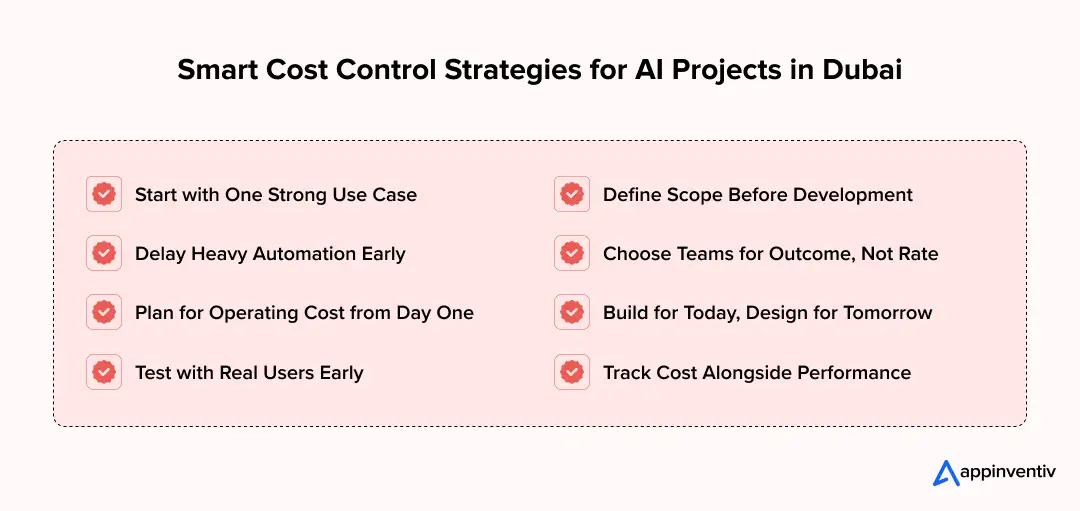
Start with One Strong Use Case
Trying to solve many problems at once spreads money too thinly. Focusing on one clear objective keeps engineering grounded. Teams learn faster from a contained system. Momentum grows when success is measurable.
Define Scope Before Development
Ambiguous requirements lead to constant direction changes. Each change disrupts work and inflates the overall AI app development cost in the UAE in 2026. A fixed scope creates stability during development. Clarity saves more than negotiation.
Delay Heavy Automation Early
Not every feature needs intelligence in the first version. Some problems are faster to solve with simpler logic. Real data reveals where AI truly adds value. Waiting prevents wasted effort.
Choose Teams for Outcome, Not Rate
Low cost per hour often hides long delivery times. Skilled teams reduce iteration and errors. Better decisions earlier avoid rework. Experience pays back quickly.
Plan for Operating Cost from Day One
Launching is not the final expense. AI systems demand continuous care. Ignoring this creates surprise spending later. Maintenance should be intentional.
Build for Today, Design for Tomorrow
There is no need to over-engineer early. Stability matters more than scale on day one. Flexible architecture keeps options open. Growth becomes easier later.
Test with Real Users Early
User behaviour changes assumptions quickly. Designs improve when tested early. Late discovery costs more. Real feedback prevents waste.
Track Cost Alongside Performance
Development without financial tracking invites overspend. Budget and performance should move together. Regular checks catch issues early. Transparency protects investment.
What Makes an AI Application Enterprise-Ready in Dubai
AI applications built for enterprises in Dubai must do more than automate tasks. They are expected to operate reliably under pressure, integrate into complex business environments, handle sensitive data responsibly, and deliver outcomes that justify long-term investment.
The difference between a working AI system and one that truly performs at enterprise level is not the model inside it but the structure surrounding it. The sections below outline the practical capabilities that separate experimental AI from a system that leaders can safely depend on.
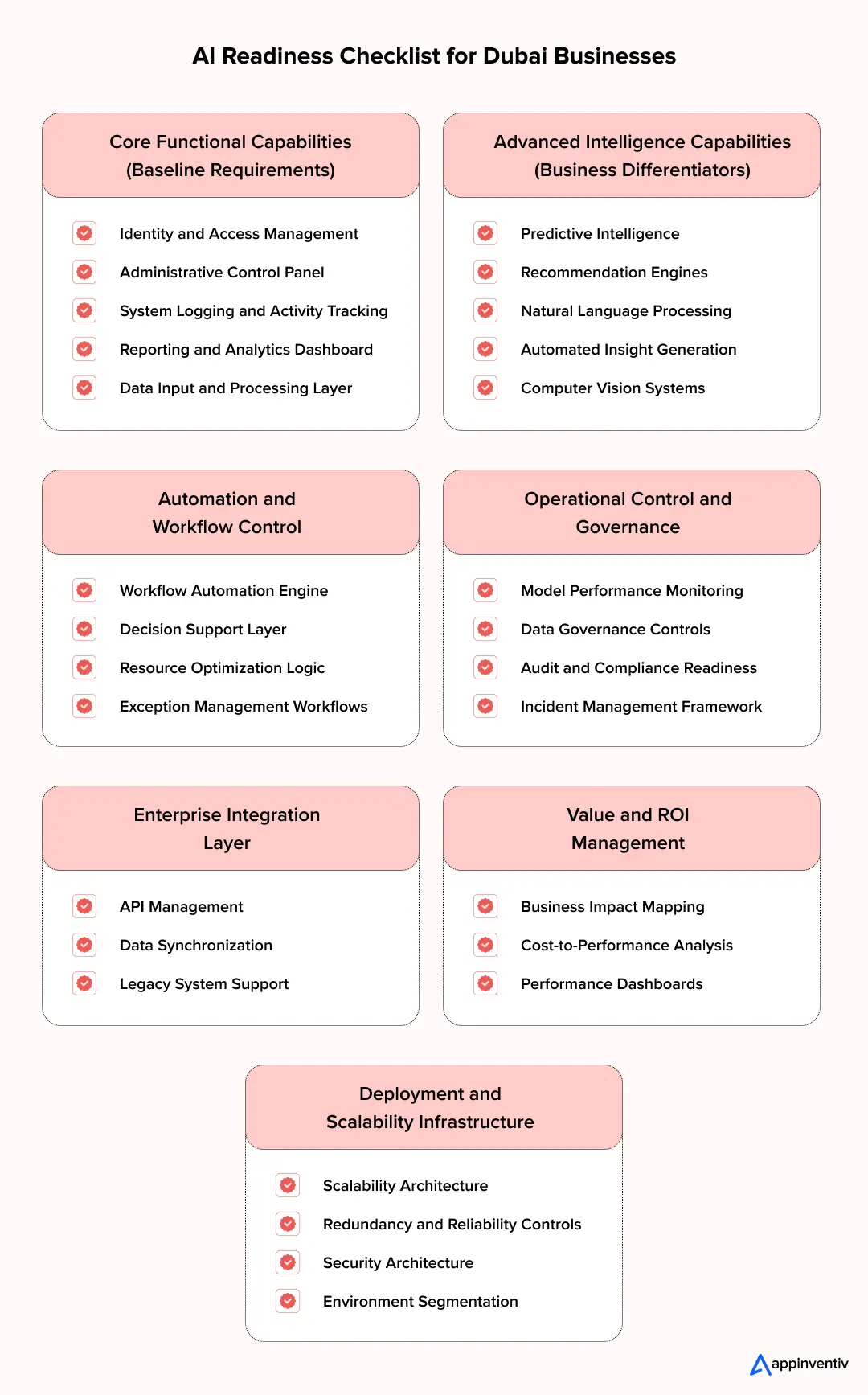
Core Functional Capabilities (Baseline Requirements)
These functions form the foundation of every enterprise-grade AI system. Without them, no level of intelligence can maintain stability, security, or trust across departments. They ensure the system operates reliably and remains manageable as usage expands.
Identity and Access Management
An enterprise system must clearly define who is allowed to do what. Different teams should have different access levels based on responsibility and risk exposure. Strong identity controls reduce breach risks and prevent accidental data misuse. This also simplifies compliance and internal audits.
Administrative Control Panel
Enterprise teams need visibility and control from one central interface. Configuration should not require engineering support for everyday changes. Admin tools must allow role changes, system tuning, and feature management without disrupting operations. The more complex the organization, the more critical this control layer becomes.
System Logging and Activity Tracking
Every action inside the AI system should be traceable. Logs make systems debuggable and defensible. When something goes wrong, leaders must know exactly where and why it happened. Lack of observability is often the first cause of operational failure.
Reporting and Analytics Dashboard
Executives do not rely on raw outputs. They rely on structured information. Dashboards convert technical performance into actionable intelligence. Without reporting, AI becomes invisible. Without visibility, leadership confidence disappears.
Data Input and Processing Layer
AI systems must control how data enters the system. Unchecked input turns into unreliable output. Structured pipelines validate information before processing. This prevents corrupt logic and unreliable predictions that cost credibility and money.
Advanced Intelligence Capabilities (Business Differentiators)
These capabilities transform AI from a reporting engine into a strategic engine. They influence decisions, reduce reactive behavior, and uncover opportunities early.
Predictive Intelligence
This allows businesses to see around corners. Instead of reacting to problems, teams act before they emerge. Revenue planning, risk detection, and operational forecasting depend on this layer. Predictive capabilities provide business advantage only when backed by reliable architecture.
[Also Read: A Comprehensive Guide on Using Predictive Analytics for Mobile Apps]
Recommendation Engines
Enterprise recommendation systems influence how services are consumed and decisions are taken. When well-built, they improve conversions and engagement. When poorly built, they damage trust. Precision matters more than volume at enterprise scale.
Natural Language Processing
Language intelligence reduces workload across support, operations, and engagement teams. Systems that interpret intent accurately replace repetitive tasks at scale. Multilingual capability is essential in regional business operations. Misinterpretation damages confidence.
Automated Insight Generation
Data is only useful when teams can interpret it quickly. These systems produce summaries, insights, and alerts on demand. Instead of combing through dashboards, leaders receive decision-ready information. This is where intelligence directly affects management.
Computer Vision Systems
Visual data is growing faster than text data. Enterprise systems that understand images and footage improve control and safety. Inspections, monitoring, and detection become automated. Manual review becomes exception-based instead of routine.
Automation and Workflow Control
This layer determines whether AI merely observes or actually acts. Action is what creates business value. Let’s look into the features that determine how deeply AI integrates into daily operations instead of remaining a standalone tool.
Workflow Automation Engine
Tasks that repeat should not consume human capacity. Automation ensures consistency and speed. Well-built workflows reduce errors and operational dependency. Poor automation creates confusion.
Decision Support Layer
AI insights must flow into business tools. Stand-alone outputs are useless. Decision systems embed intelligence into operations. This is where recommendation becomes execution.
Resource Optimization Logic
Modern enterprises operate under constant constraints. This layer balances cost, time, and capacity dynamically. Manual planning fails at scale. Automation succeeds through precision.
Exception Management Workflows
Every system fails sometimes. Good systems fail gracefully. Clear escalation paths prevent small errors from becoming crises. Enterprise leaders care more about recovery than perfection.
Operational Control and Governance
No enterprise trusts a system it cannot control. Governance defines safety at scale. These layers ensure intelligence operates within business rules, security boundaries, and compliance requirements.
Model Performance Monitoring
Systems drift as data changes. Without monitoring, AI quietly degrades. Continuous tracking corrects this. Unchecked AI models become dangerous tools.
[Also Read: Preventing AI Model Collapse: Addressing the Inherent Risk of Synthetic Datasets]
Data Governance Controls
Who uses data determines risk. Enterprises implement strict controls by design. Good governance avoids legal exposure later. Poor AI data governance always costs more eventually.
Audit and Compliance Readiness
Executives require defensible systems. Outputs must be explainable. Activity must be traceable. This protects leadership from accountability failures.
Incident Management Framework
Live systems break. Governance determines response speed. Clear response paths reduce impact. Confusion amplifies damage.
Deployment and Scalability Infrastructure
Performance under load separates enterprise from experiment. These components make the system reliable under real-world usage, not just in controlled environments.
Scalability Architecture
Systems should grow without chaos. Scaling must be predictable. A system that grows painfully burns goodwill.
Redundancy and Reliability Controls
Enterprise operations cannot afford downtime. Failover planning is non-negotiable. High availability is expected, not optional.
Security Architecture
Enterprise systems are attack targets. Security must be proactive. Encryption, monitoring, and isolation are the baseline.
Environment Segmentation
Production should not bleed into testing. Separation protects continuity. Discipline here prevents disaster.
Enterprise Integration Layer
AI becomes valuable only when it connects to operations. These features connect AI into existing business systems so insights actually influence operations.
API Management
Systems must exchange data precisely. Integration builds ecosystem intelligence. Isolated AI has limited value.
Data Synchronization
Consistency across tools prevents errors. Manual reconciliation is unsustainable. Automation maintains reliability.
Legacy System Support
Enterprises rarely rebuild everything. AI must work with what already exists. Compatibility defines adoption success.
Value and ROI Management
Intelligence without accountability is a cost, not investment. These capabilities help leadership measure whether the system is delivering real business value.
Business Impact Mapping
Leadership needs clarity on outcomes. Systems must connect outputs to value. Decision confidence relies on measurement.
Cost-to-Performance Analysis
Efficiency should be visible. Spending and performance must align. Hidden inefficiency always surfaces later.
Performance Dashboards
Executives need oversight. Insights must be immediate. Visibility builds trust.
How to Develop Your AI App in Dubai: The Right Approach
Developing an AI product in Dubai demands more than technical skill. It requires a structured build process that aligns business goals, data readiness, user needs, and system architecture from day one. Enterprises that approach development casually often face rework, rising AI app development cost in the UAE in 2026, and weak adoption. The following steps reflect how successful teams in the region move from concept to a production-ready system while managing risk, timeline, and AI solution investment cost in Dubai effectively.
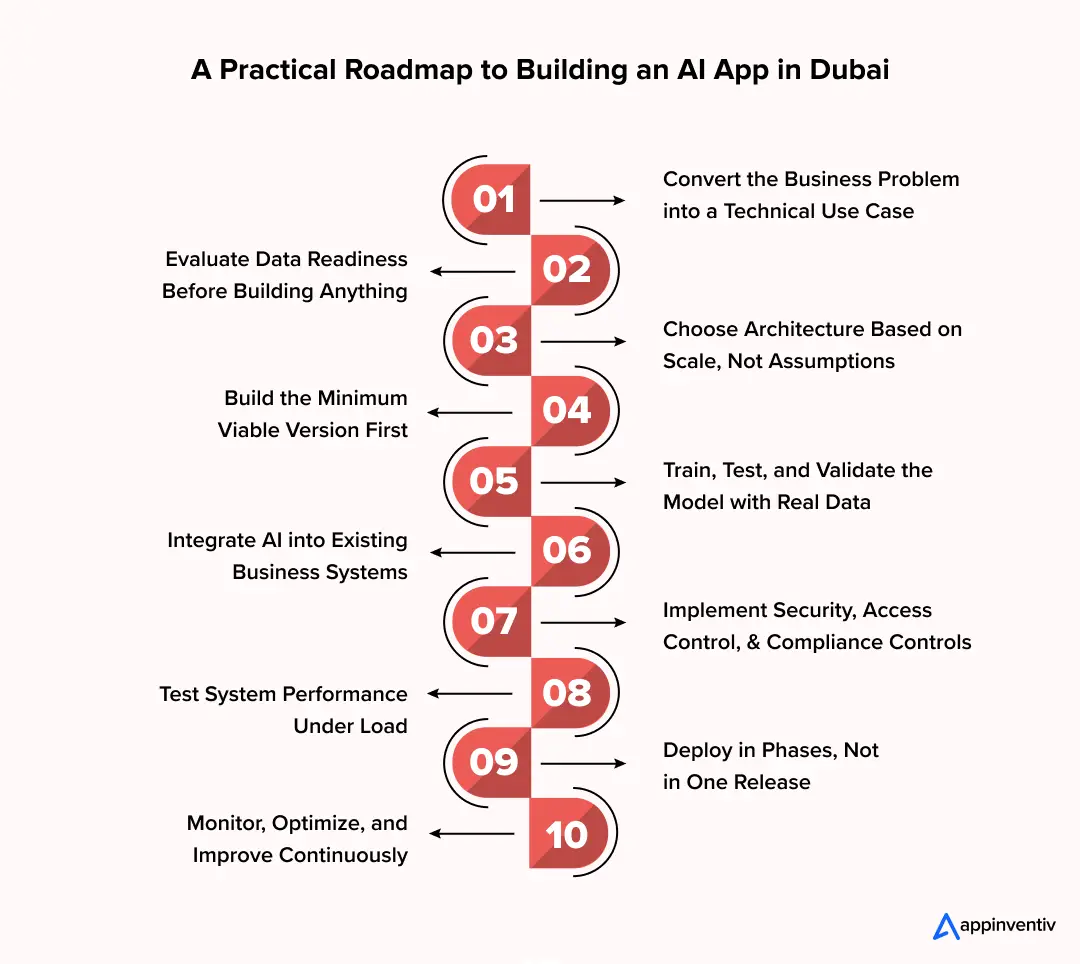 Step 1: Convert the Business Problem into a Technical Use Case
The first step of AI app development is translation, not technology. Leaders must clearly define what the AI system should improve, reduce, or automate. Successful teams map business goals into data problems and measurable outcomes before thinking about models. This avoids building impressive features with no commercial impact and keeps the cost to build an AI app in Dubai aligned with ROI instead of experiment.
Step 2: Evaluate Data Readiness Before Building Anything
No AI system performs better than its data foundation. Teams must assess where data lives, how clean it is, and how often it updates. This step directly affects NLP/ML app development cost in Dubai because poor data means longer engineering cycles. Businesses that skip this phase usually face delays and inflated budgets later.
Step 3: Choose Architecture Based on Scale, Not Assumptions
Infrastructure decisions shape both performance and long-term cost. Teams must decide whether the system will support real-time processing, batch operations, or hybrid flows. Selecting the wrong architecture is one of the most common reasons enterprises underestimate AI app development cost for businesses in UAE. Proper planning ensures the system works under real load and not just in testing.
Step 4: Build the Minimum Viable Version First
Enterprise teams should never build everything at once. A focused first version validates assumptions using real users and real data. It also keeps the AI mobile app development budget in the UAE under control. This phase proves value early and prevents expensive features from being built without evidence.
Step 5: Train, Test, and Validate the Model with Real Data
Model training is not a one-time activity. Engineers test multiple approaches, tune parameters, and validate results against practical outcomes. This stage is where teams control accuracy versus cost. Efficient training strategies reduce overall spend and help stabilize the average cost of custom AI app development in Dubai.
Step 6: Integrate AI into Existing Business Systems
AI systems deliver value only when connected to operations. Whether it is ERP, CRM, or financial systems, integration determines usability. This is where many projects struggle if planning is weak. Integration complexity is a major variable in the breakdown of the cost of AI software development in UAE.
Step 7: Implement Security, Access Control, and Compliance Controls
Security is built, not added. Enterprises must define permissions, data controls, and regulatory boundaries from the start. Fixing security afterward drives cost up sharply and increases operational risk. Teams who design governance early protect enterprise AI app ROI in the UAE in the long run.
Step 8: Test System Performance Under Load
Testing goes beyond functionality. Teams simulate traffic, data flow, and peak usage to identify system limits. This is where architectural mistakes surface before users suffer. Fixing issues here is far cheaper than fixing them after launch.
Step 9: Deploy in Phases, Not in One Release
Deployment should be gradual. Enterprises in Dubai usually roll out AI systems department by department, not all at once. This improves learning and limits exposure. Phased rollout also helps control AI solution investment cost in Dubai more predictably.
Step 10: Monitor, Optimize, and Improve Continuously
AI applications change as data and usage evolve. Enterprises monitor performance, retrain models, and refine outputs continuously. Ignoring this phase is the fastest way to destroy the enterprise AI app ROI in the UAE. Long-term value depends on sustained improvement, not just launch success.
Also Read: Agentic AI ROI guide
Monetizing Innovation: Revenue Models for AI Apps in Dubai
Ultimately, a significant investment in an AI solution like yours is made with a clear eye on the return. How will your AI app not only generate revenue but also robustly justify its development and ongoing operational expenses? Here are proven monetization strategies that resonate particularly well within the vibrant Dubai market:
| Revenue Model | Description | Best Suited For |
|---|---|---|
| Freemium Model | Offer basic AI functionalities for free to attract users, then charge for premium features or analytics. Effective for consumer-facing apps or small businesses. | Consumer-facing apps, small businesses |
| Subscription Model | Provide access to all features on a recurring basis (monthly or annually), offering stable revenue. Ideal for enterprise-grade AI tools or productivity apps. | Enterprise AI tools, analytics platforms, productivity-enhancing services |
| Pay-per-Use/Transaction Fee | Charge based on the number of AI queries or tasks executed. Common for API-based services or tasks with measurable outputs like document processing. | API services, AI-powered document processing, transaction-based services |
| Data Monetization (Strict Compliance) | Monetize anonymized, aggregated data (with user consent) for market research or industry insights, while ensuring strict adherence to UAE data privacy laws. | Market research, trend analysis, industry-specific insights |
| Advertising Model | Use AI to serve targeted ads, increasing relevance and generating revenue through effective ad placements. | Consumer apps, platforms with large user bases |
| Licensing & White-Labeling | License your AI technology or provide a white-label solution for businesses to integrate under their brand. Lucrative for specialized AI in niche markets. | Niche markets like FinTech, smart cities, advanced logistics |
| Consulting & Customization Services | Offer expert consulting, implementation support, and customization services for businesses integrating AI into their workflows, adding high-margin service layers. | Businesses seeking AI integration into workflows, IT infrastructure |
What are the challenges in developing Ai powered app in Dubai?
Building an AI application in Dubai offers enormous opportunity, but it also comes with its own operational, technical, and regulatory challenges. Markets move fast, customer expectations are high, and compliance standards continue to evolve. Businesses that underestimate the complexity of execution often run into delays, budget overruns, or systems that fail to scale under real-world load. Understanding these hurdles early is the difference between launching smoothly and rebuilding later.
Below are the most common challenges organizations face when developing AI applications in Dubai, along with practical ways enterprises overcome them.
| Challenge | What It Means in Reality | How Businesses Overcome It |
|---|---|---|
| Unclear AI Use Case | Teams invest in AI without tying it to a clear business outcome, leading to poor ROI | Start with business objectives and validate the use case before building |
| Poor Data Readiness | Data is scattered, incomplete, or outdated, slowing model development | Centralize data sources and clean datasets before model development begins |
| Model Accuracy Issues | Predictions fail in production due to weak training data or incorrect assumptions | Continuous training and validation using operational data |
| Integration with Existing Systems | AI struggles to connect with ERP, CRM, or internal tools | Use middleware and APIs designed for enterprise integration |
| Scalability Constraints | Systems work in testing but fail under real workloads | Design architecture for peak load and future growth |
| Cloud Cost Overruns | Compute costs spike when models scale | Implement usage monitoring and intelligent cloud resource optimization |
| Security Gaps | Sensitive business or customer data is exposed | Encryption, access controls, and security audits |
| Compliance Complexity | Regulatory exposure due to regional data requirements | Embed compliance controls from the design stage |
| Limited Performance Visibility | AI outputs lack explainability | Build reporting and transparency layers into the system |
| Talent Shortage | Skilled AI engineers are hard to recruit locally | Partner with experienced development teams to fill the gap |
| Delays Due to Testing Cycles | Bugs surface only in production environments | Implement continuous testing during development |
| Feature Bloat | AI roadmap grows without control | Maintain strict prioritization using phased development |
| Maintenance Neglect | Performance decays after launch | Allocate budget for ongoing tuning and monitoring |
| User Adoption Risk | Teams resist using new systems | Prioritize UI and workflow alignment |
| Model Drift | Accuracy drops as business conditions change | Regular retraining and evaluation |
| Data Privacy Risk | Mishandling user data creates legal exposure | Define data ownership policies and encryption standards |
| Budget Mismatch | AI spend exceeds planning | Build milestone-connected pricing models |
| Unrealistic Timelines | Underestimating build effort | Phase rollouts realistically from day one |
| Internal Hiring Bottleneck | Recruitment delays slow delivery | Outsource development to avoid recruitment risk |
| Infrastructure Complexity | Deployment environments become unmanageable | Standardize deployment with DevOps processes |
| Support Readiness | No team to manage updates | Establish post-launch support plans |
Let’s fix what’s slowing you down and build what scales.

Future Trends in AI Applications Businesses Can Expect in Dubai
Now that you understand the overall cost to build an AI app in Dubai, it’s time to stop experimenting with AI and start building systems that generate real business outcomes.
Most large businesses have already moved past trials and are now building systems they expect to run for years. The conversation has shifted from “Can this work?” to “How deeply can this be integrated into operations without friction?” The next phase of AI in the city is not about novelty. It is about reliability, oversight, and impact inside real business environments.
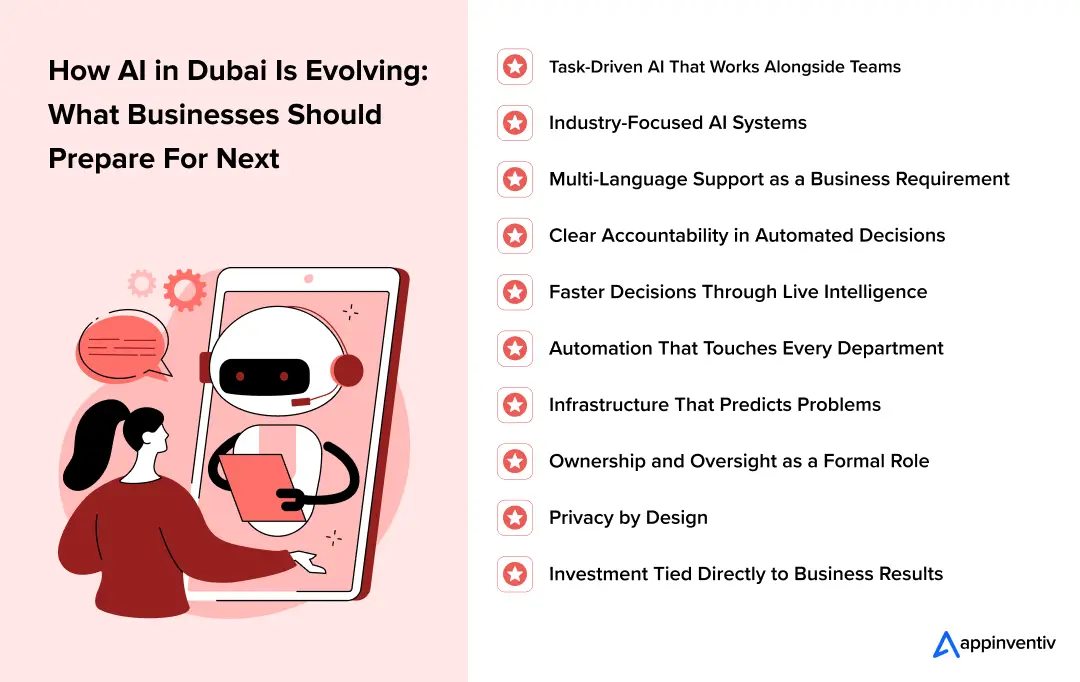
Trend 1: Task-Driven AI That Works Alongside Teams
Businesses will increasingly use AI systems that can take action on defined tasks without constant supervision. These systems will handle service queries, scheduling, internal coordination, and data requests in the background. Companies will rely on them as support layers within daily workflows instead of treating them as stand-alone tools. Over time, this will quietly change how teams work.
Trend 2: Industry-Focused AI Systems
Generic platforms are already giving way to software built for specific industries. Real-estate firms want systems that understand listings and tenant behaviour. Healthcare teams want engines that can work with medical workflows. Banks expect models that recognise financial patterns. Accuracy matters more than flexibility now, and businesses will favour software that speaks their language from day one.
Trend 3: Multi-Language Support as a Business Requirement
Dubai’s workforce and customer base operate across many languages and communication styles. Systems that cannot handle this reality struggle to scale. Future platforms will include language intelligence as a core function, not an add-on. Businesses will expect smooth conversation handling, document processing, and support interactions in more than one language without effort.
Trend 4: Clear Accountability in Automated Decisions
As systems take on more responsibility, leadership will demand transparency. Businesses will expect to understand how outputs are generated and why certain recommendations are made. Tools that cannot explain their logic will quickly lose trust. Clear audit trails and visible reasoning will matter just as much as performance.
Trend 5: Faster Decisions Through Live Intelligence
Waiting days for reports is becoming outdated. More organisations will rely on systems that respond instantly to change, whether it’s shifting demand, rising risk, or operational pressure. Decision-making will move closer to real time. Businesses that respond faster will hold an advantage over those that don’t.
Trend 6: Automation That Touches Every Department
Automation will not stay in one corner of the business. Customer service, finance, operations, and reporting will all see deeper system-driven support. Teams will stop thinking of automation as a project and start viewing it as part of everyday work. Over time, businesses will redesign workflows around intelligence rather than manual control.
Trend 7: Infrastructure That Predicts Problems
Technology failures are expensive, especially at enterprise scale. More businesses will depend on systems that monitor performance quietly in the background. Instead of fixing issues after disruption, teams will act before breakdowns happen. Infrastructure will become less reactive and more self-aware.
Trend 8: Ownership and Oversight as a Formal Role
AI will no longer be managed informally. Enterprises will assign responsibility for oversight, accuracy, and reliability. Just as cybersecurity teams now exist as standard, governance of intelligent systems will follow the same pattern. Businesses will invest as much in control as in capability.
Trend 9: Privacy by Design
Information security will not be treated as a layer added later. Protection will be built into systems from the beginning. Businesses will choose platforms that take responsibility for data handling seriously. Trust will become a selection factor, not just a legal requirement.
Trend 10: Investment Tied Directly to Business Results
Executives will stop funding projects that cannot prove their value. Systems that reduce cost, increase accuracy, or improve execution will survive. Systems that do not will disappear quietly. Over time, value will matter more than innovation for its own sake.
Why Appinventiv is Dubai’s Go-To Choice for Custom AI App Development in Dubai
When it comes to developing cutting-edge AI applications in Dubai, partnering with the right AI development company in Dubai makes all the difference. Appinventiv stands as Dubai’s fastest-growing AI app development company, bringing world-class AI expertise directly to your doorstep.
At Appinventiv, we leverage cutting-edge machine learning algorithms, natural language processing, and computer vision technologies to create intelligent applications that revolutionize business operations. Our AI development expertise spans predictive analytics, chatbot development, recommendation engines, and automated decision-making systems that drive measurable ROI for our clients.
Our team of certified AI engineers and data scientists possesses deep expertise in TensorFlow, PyTorch, and cloud-based AI platforms, enabling us to deliver scalable solutions that grow with your business needs.
With over 1,600+ creative technologists and a proven track record of developing 2,000+ successful applications, we can confidently say that Appinventiv delivers exceptional results.
For instance, we recently partnered with world-famous Americana Group to rebuild their last-mile operations using AI after facing growing inefficiencies across 2,100+ restaurants and multiple brands. We implemented an AI-driven delivery platform that increased automated order assignment from 42% to 82%, reduced geofencing violations by improving compliance from 20% to 80%, and processed more than 60.4 million orders without downtime.
Real-time analytics reduced reporting time by 90%, enabling leadership to take action in seconds instead of hours. The outcome was a delivery engine that scaled across regions and brands while cutting manual intervention and improving service consistency.
Furthermore, Flynas partnered with us to rebuild its mobile app as a revenue-focused digital platform rather than a basic booking utility. We redesigned the user experience and introduced an AI-powered chatbot to streamline flight search and reservations. The result was a faster, cleaner interface that eliminated friction across booking and support journeys. The app is now positioned as a performance driver rather than just an operational tool.
Ready to transform your business with cutting-edge AI solutions? Contact Appinventiv today and let’s turn your innovative ideas into market-leading applications that drive real results.
FAQs
Q. How much does it cost to build an ai app in Dubai?
A. There is no single “Dubai price tag” for an AI app, but there are clear cost bands that most projects fall into. Simpler builds, such as automation tools or rule-based intelligence, usually start in the AED 80,000–150,000 range. At this level, you are paying for basic capability, not depth or scale.
When businesses move into prediction models, smarter data handling, or system integrations, the cost to build an AI app in Dubai typically rises to AED 200,000–500,000. This is where AI begins to deliver tangible operational value instead of just functionality.
Large enterprise platforms with custom models, automation layers, and system-wide integrations often exceed AED 800,000, especially when reliability, security, and performance are non-negotiable.
In Dubai, cost is shaped less by location and more by ambition. The more responsibility you place on the system, the more the build grows. That is why budgeting is not just a finance exercise. It is a strategy decision.
Q. What Are Hidden Costs in AI App Development?
A. Most businesses budget for development. Fewer plans for what happens immediately after.
Data preparation is one of the first surprises. Cleaning, structuring, and validating data often takes more time than building features, and it regularly consumes a large part of the budget long before any modelling even begins.
Infrastructure is another silent expense. Early hosting may look inexpensive, but as usage grows, storage, computing power, and backup requirements increase steadily. What begins as a light monthly cost can turn into a serious operational line item once performance, uptime, and security become priorities.
External services also add up. Many systems rely on paid tools for messaging, location services, or language processing, and those usage-based charges rarely appear in the original estimate.
Finally, maintenance is not optional. Models need to be refreshed, performance needs monitoring, and security must be reinforced regularly particularly in a market like Dubai where data handling rules are strict.
The real risk is not cost overruns but is budgeting for launch and forgetting the cost of running the system.
Q. How Long Does Developing an AI App Take?
A. AI app development in Dubai typically moves through a structured timeline rather than a vague “few months” estimate. Discovery and planning take around 2 to 4 weeks, followed by another 3 to 5 weeks for UI and UX design. The core development phase usually runs between 8 to 16 weeks, depending on scope and complexity, while testing happens in parallel over 3 to 4 weeks to stabilize performance and security before launch.
Once the app goes live, maintenance becomes ongoing. Businesses generally plan for 10 to 15% of the annual build cost to cover updates, monitoring, and improvements. End-to-end, most AI apps reach launch within 3.5 to 6 months, with larger systems extending slightly based on integrations and compliance needs in Dubai.
Q. What’s the ROI Timeline for AI Apps in Dubai?
A. Most businesses expect immediate returns from AI apps, but that’s not realistic. Typical ROI timelines range from 8-18 months after launch. Simple automation apps might show results in 6-8 months, while complex predictive analytics solutions often take 12-24 months to prove their worth.
Dubai’s competitive market means faster payback periods, though. Companies using AI for customer service see cost savings within 4-6 months. E-commerce businesses implementing recommendation engines often recover development costs in 10-12 months through increased sales. The key is setting realistic expectations. The initial months focus on user adoption and data collection. Real value emerges once the AI learns from actual usage patterns. Smart businesses budget for at least 18 months of operation before expecting significant returns. Factor in ongoing maintenance and updates when calculating true ROI.
Q. What Can You Expect After Choosing Appinventiv as Your AI App Development Partner in Dubai?
A. Once you get in touch, we start by understanding your business before we discuss technology. You will speak with our team to walk through your goals, your current setup, and where you want the product to go. This is not a pitch call. It is a working session where ideas are clarified, concerns are addressed, and a clear direction is set. After that conversation, you receive a practical roadmap covering scope, timelines, and cost so you can move forward with confidence.
When the plan is approved, a dedicated team is assigned to your project. You get one point of contact, regular progress updates, and full visibility as work moves ahead. Design, development, and testing run together to avoid delays, and you are involved at every key review stage. You see how the product takes shape, give input as it grows, and stay informed at every step. The focus stays on clear communication, steady delivery, and results that match your business goals.

- In just 2 mins you will get a response
- Your idea is 100% protected by our Non Disclosure Agreement.

AI Voice Receptionist Development: Business Use Cases, Technology Architecture, and Cost
Key takeaways: Start with real call use cases, not tech. Define high-frequency intents, workflows, and escalation paths before building anything. Build a low-latency voice pipeline. Reliable telephony and real-time audio streaming make conversations feel natural. Set up the core AI loop. STT→LLM→TTS should handle intent, context, and responses in near real time. Ground responses with…
Key takeaways: Generative AI specialises in content synthesis and creation, while Agentic AI focuses on autonomous reasoning and multi-step task execution. Targeted benefits of generative AI and agentic AI in Australia include nearly a 35% reduction in operational bottlenecks and 70% faster workflows. Prioritise Gen AI for workforce augmentation and Agentic AI for high-stakes, autonomous…

How Much Does It Cost to Build a Conversational AI Chatbot in the UAE?
Key Takeaways AI chatbot development in the UAE typically costs AED 150,000–1,470,000 ($40K–$400K), based on complexity. Backend integration and compliance drive cost more than the chatbot interface itself. Arabic NLP, UAE hosting, and PDPL requirements increase budget and engineering effort. LLM + RAG enterprise chatbots sit at the higher end due to integration and infrastructure…