



























How to Hire LLM Developers? All You Need to Know


- Key Skills and Expertise to Look for When Hiring LLM Experts
- Should You Hire LLM Consultants or Developers
- Where or How to Find the Right LLM Developers
- Where Do We (Appinventiv) Come In
- How to Assess the Technical Expertise of LLM Developers
- Understanding the Cost of Hiring LLM Developers
- Best Practices for Onboarding and Integrating LLM Developers into Your Team
- Common Mistakes and Challenges in Hiring LLM Developers
- Why Appinventiv for Hiring LLM Experts
- Conclusion
- Frequently Asked Questions

Key takeaways:
- The success of any LLM initiative depends on hiring engineers with real, hands-on experience in machine learning and production deployment.
- Strong coding skills, sound problem-solving ability, and familiarity with modern LLM frameworks are non-negotiable.
- LLM developers & consultants can accelerate early-stage initiatives by providing domain insight, tooling direction, and architectural clarity.
- Rigorous technical evaluation through interviews, coding exercises, and project reviews is essential to ensure production-ready outcomes.
Getting the right LLM developers on your team matters more than you think. The wrong hire can slow everything down. And the right one can help you reach your business goals faster.
Large language models are now embedded across core business functions, from customer support and content workflows to analytics and internal knowledge systems. As adoption increases, more organizations are trying to hire LLM developers who can deliver dependable results, not experiments.
This requires more than coding ability. Teams need specialists who understand how LLMs behave in real business environments, where data is fragmented, usage is high, and accuracy, security, and compliance cannot be compromised.
Without this expertise, organizations risk deploying systems that fail under real-world conditions. This guide explains how to hire LLM developers who can build, scale, and sustain production-grade LLM systems.
So, let’s understand how to hire dedicated LLM developers in detail.
Secure your competitive advantage by accessing our vetted talent pool today. – Source: IBM

Why LLM Developers Are in High Demand
Here’s how fast this market is moving. In 2024, it was worth $6.7 billion. By 2034, experts predict it’ll hit $71.1 billion. That’s massive growth expected in just ten years.
LLMs are now part of core business systems. Businesses use them for customer interactions, search, internal knowledge tools, and automation. These systems must handle large data volumes, strict security rules, and real users.
That is why LLM developers for business applications are in demand. They do more than write code. They design systems that work with enterprise data, manage accuracy, control costs, and meet compliance requirements. Hiring top LLM developers has become a competitive requirement, not an experiment.
Executive Lens: Why This Matters
- Poor LLM hires increase security and compliance exposure
- Production failures erode trust in AI initiatives
- Strong hires accelerate AI ROI and reduce oversight burden
Bottom line: Companies need LLM developers for business applications. They need someone who can build these systems and keep them running smoothly. The demand isn’t slowing down anytime soon. So, let’s move on to the LLM developer hiring guide.
Key Skills and Expertise to Look for When Hiring LLM Experts
Before hiring LLM developers, enterprises need clarity on the technical capabilities required to build, deploy, and govern production-grade models. The focus should be on applied depth, not surface familiarity.
Strong Foundations in Machine Learning and NLP
LLM developers should understand supervised, unsupervised, and reinforcement learning, along with transformer architectures, embeddings, fine-tuning methods, and evaluation metrics. This knowledge ensures models are trained with intent, not trial and error.
Hands-on Experience with LLM Frameworks and Tooling
Proficiency in PyTorch or TensorFlow is essential, along with experience using Hugging Face, LangChain, vector databases, and inference optimization tools. These skills directly affect model performance, cost, and maintainability.
Production-Grade Engineering Skills
Beyond Python, developers should handle large-scale data pipelines, prompt engineering, model versioning, and performance monitoring. Clean data handling and reproducible workflows are critical for enterprise reliability.
Deployment, Scaling, and Cost Control Expertise
LLM experts must deploy models responsibly across cloud environments, managing latency, inference scale, and compute efficiency while enforcing safety, monitoring, and compliance. Experience with AWS, GCP, Azure, containerization, and MLOps pipelines is expected.
Business Outcome Mapping:
- Prevents runaway inference and token usage costs
- Avoids downtime under real user load
- Ensures predictable performance for enterprise SLAs
- Supports confident rollout to customer-facing use cases
Deep Understanding of Security, Privacy, and Risk Controls
LLMs introduce real data exposure risks. Hire LLM engineer should design for data isolation, access control, encryption, audit logging, and secure prompt handling. Familiarity with GDPR is baseline; enterprises should also expect experience with SOC 2, ISO 27001, data residency requirements, and internal AI governance policies. This ensures models are safe to operate in regulated, high-risk environments.
LLM Governance Layer and Risk Ownership
- Clear accountability for model behavior, outputs, and failures
- Defined owners for data, prompts, and deployment decisions
- Reduced ambiguity during incidents or audits
Explainability Expectations
- Traceability of outputs to prompts, sources, and retrieval layers
- Confidence scoring and rationale generation for high-impact decisions
- Enables internal reviews and regulator queries
Data Leakage & Hallucination Controls
- Secure prompt handling and data isolation
- Retrieval grounding to reduce fabricated responses
- Guardrails to prevent sensitive data exposure
Human-in-the-Loop & Override Mechanisms
- Human approval for high-risk or irreversible actions
- Kill-switches for abnormal or unsafe model behavior
- Ensures safe operation in production environments
For enterprises moving beyond prototypes into production-grade systems, it may be worth considering whether to hire RAG architects for enterprise AI who can own retrieval infrastructure design, governance enforcement, and long-term LLM scalability and not just implementation tasks.
Should You Hire LLM Consultants or Developers
The right choice depends on how mature your AI initiative is and what you need to achieve in the near and long term. LLM consultants and LLM developers solve different problems, and many enterprises engage both at different stages.
When Hiring LLM Developers Makes Sense
LLM developers are best suited for organizations building or operating AI systems over time. They work closely with internal teams, adapt models to evolving requirements, and support ongoing development, optimization, and maintenance. This approach fits businesses treating LLMs as a core, long-term capability.
When LLM Consultants Are the Better Fit
LLM consultants are valuable when clarity is needed before execution. They help define high-impact use cases, assess data and infrastructure readiness, design architectures, and establish governance and risk controls. Their involvement reduces early missteps and aligns technical decisions with business priorities.
How to Decide
If your goal is sustained product development and continuous improvement, hiring LLM developers is the practical path. If you need strategic direction, technical validation, or oversight for a critical initiative, LLM consultants provide that foundation.
In many enterprise programs, consultants set the direction, and developers carry it forward into execution.
Executive Lens: Why This Matters
- Consultants reduce early architectural and governance mistakes
- Developers ensure long-term system stability and cost control
- Right mix prevents rework, delays, and sunk AI costs
Where or How to Find the Right LLM Developers
Identifying the right LLM talent depends on your delivery model, timeline, and risk tolerance. Different sourcing options suit different business needs, from short-term experimentation to enterprise-scale AI programs.
Tech Talent Marketplaces
Online platforms are solid starting points. Hire top LLM developers from Upwork, Toptal, and Freelancer. You can browse profiles. Check their experience. Read reviews from past clients. These sites work well for both short projects and longer contracts.
AI-Focused Job Boards
Specialized job boards such as AIJobs and MLJobs attract professionals focused on machine learning and language models. Appinventiv also built JobGet, a leading recruitment platform designed to connect businesses with vetted talent. Posting roles on these platforms helps reach developers with relevant experience, portfolios, and proven project work.
LinkedIn and Professional Networks
LinkedIn is an effective channel for hiring LLM experts. You can search by specific skills, review work histories, and reach out to candidates directly. Many developers share portfolios and project work, making it easier to assess expertise. Joining AI-focused groups also helps expand your network.
Tech Meetups and Conferences
LinkedIn is a strong channel for hiring LLM experts, allowing you to search by skills, review work histories, and connect directly with candidates. Shared portfolios and project examples make it easier to evaluate expertise, while AI-focused groups help broaden your reach.
Referrals and Recommendations
Referrals remain a reliable way to find strong candidates. Recommendations from trusted contacts carry credibility and often lead to developers who align well with your team and working style.
Where Do We (Appinventiv) Come In
While marketplaces, job boards, and networks can help you discover individual LLM developers, Appinventiv fits in where enterprises need assured outcomes, speed, and accountability. Instead of evaluating profiles one by one, businesses can engage Appinventiv to access a structured AI delivery model.
We provide pre-vetted LLM engineers, architects, and MLOps specialists backed by AI consulting expertise. This means you are not just hiring talent, but gaining support across use-case definition, data readiness, model selection, security planning, and long-term scalability. For enterprises running mission-critical AI initiatives, this approach reduces hiring risk and accelerates execution without compromising governance or quality.
How to Assess the Technical Expertise of LLM Developers
Once you identify potential candidates, the next step is validating their skills. A structured assessment helps ensure you hire LLM developers who can deliver reliable, production-ready outcomes.
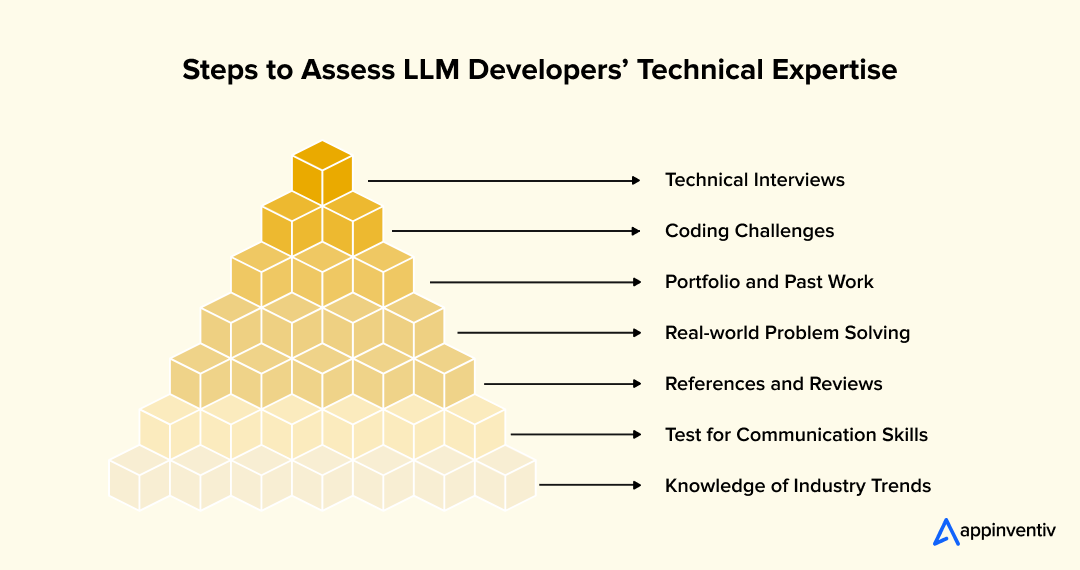
Technical Interviews
Use structured technical interviews to assess depth of knowledge. Discuss core machine learning concepts, programming fundamentals, and experience with models such as GPT or BERT. Ask candidates to solve problems or write code during the interview to evaluate how effectively they apply their knowledge in practice.
Coding Challenges
Use practical coding challenges to assess real-world capability. Ask candidates to work with large datasets, fine-tune an LLM, or solve a focused NLP problem. These exercises reveal code quality, problem-solving approach, and how well they perform under pressure.
For a clearer view of which approach fits your use case, refer to our blog on RAG vs Fine-Tuning.
Portfolio and Past Work
Review what the candidate has built before and assess their experience with language models and real-world projects. Open-source contributions signal active community involvement. Ask for clear examples where they improved model performance or solved concrete business problems.
Real-World Problem Solving
Present candidates with your actual business challenges, such as improving an LLM-based customer support system. This shows whether they can apply technical expertise to practical, business-specific problems.
Test for Communication Skills
Present candidates with real business challenges, such as improving an LLM-based customer support system, to assess whether they can apply technical expertise to practical, business-specific needs.
Knowledge of Industry Trends
Hire skilled LLM developers who stay updated. It is a sign of a great developer. Ask about recent developments in AI.
- What new technologies are they excited about
- How can LLM be integrated into finance, healthcare, and other industries
This helps determine whether they stay current with industry trends and bring fresh perspectives to your projects.
We build custom language models with a proven track record of solving complex business problems across multiple industries.

Understanding the Cost of Hiring LLM Developers
Cost considerations go beyond hourly rates. Pricing is shaped by skill depth, engagement model, project scope, and the level of responsibility required to build and operate production-grade LLM systems.
1. Freelance LLM developers vs. Full-time LLM developers
The cost of hiring LLM developers depends on the developers’ role. Both Freelance LLM developers vs. full-time LLM developers will have different pricing:
Freelancers:
Freelance LLM developers typically charge hourly or per-project rates. Expect anywhere from $50 to $150 per hour. Experience and project complexity drive the price.
For smaller projects, freelancers can be budget-friendly.
Full-time Developers:
Full-time hires join your team for the long-term. Annual salaries usually range from $70,000 to $150,000. It depends on their experience and skill level.
You’re paying a fixed salary, but you hire dedicated LLM developers who pay attention to your projects.
2. Geographical Factors
Location changes everything price-wise when you hire LLM developers.
US-based Developers:
Hiring top LLM developers for America will cost more. Higher living costs and strong demand push rates up. You’ll pay premium prices here.
Eastern Europe or India:
Hiring LLM experts from India or Eastern Europe often charges less. Rates might run $30 to $80 per hour for skilled talent. Quality varies, though. Always check portfolios and experience before hiring LLM developers for business.
Tips for Hiring Internationally:
Communication skills matter when you hire skilled LLM developers globally. Time zones can be tricky, too. Make sure their schedule works with your team’s hours.
3. Consulting Fees
Consultants:
LLM consultants provide targeted expertise for defined business and technical objectives. Their rates are typically higher, ranging from $100 to $300 per hour, depending on experience, scope of responsibility, and the level of strategic and technical oversight required.
Evaluating the Cost-to-Value Ratio:
Assess whether a consultant’s expertise justifies the investment. If they resolve complex challenges in days rather than months, the long-term savings can outweigh higher fees. Always compare cost against the business value delivered.
4. Executive Lens: Why This Matters
- Under-skilled hires drive hidden remediation costs
- Poor cost control leads to runaway inference spend
- Governance-aware teams protect long-term AI investments
Best Practices for Onboarding and Integrating LLM Developers into Your Team
Hiring is only the first step. Structured onboarding is essential to help LLM developers become productive quickly and deliver the full value of their expertise.
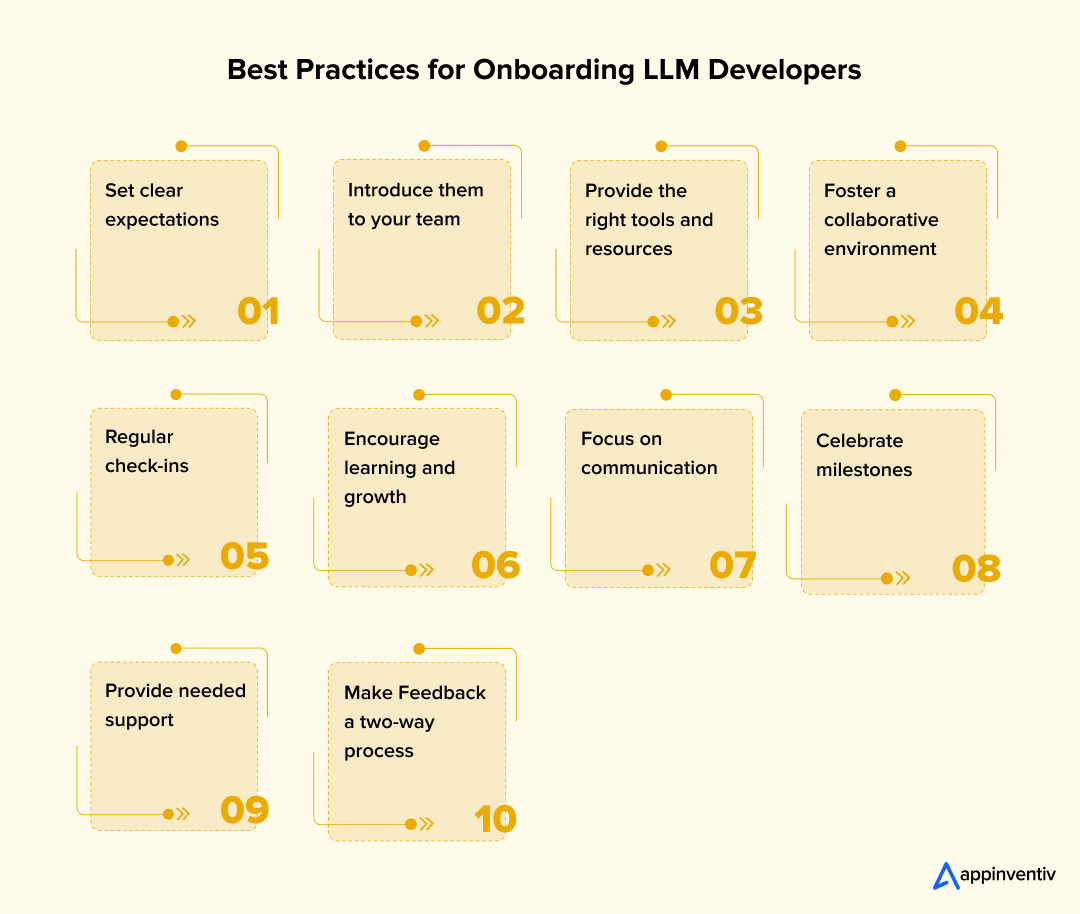
Set Clear Expectations
Start with the basics. Explain what you need, what are the goals, what are their responsibilities and set realistic timelines. Let them know how you’ll measure success. Clear expectations prevent confusion later. Everyone stays on the same page from day one.
Introduce Them to Your Team
LLM developers don’t work in isolation. Introduce them to everyone they’ll interact with. Product managers. Designers. Other LLM developers for business applications. Help them understand each person’s role. Good relationships build good teamwork. The project runs smoothly when everyone communicates well.
Provide the Right Tools and Resources
Give them what they need to work. Programming tools. Software access. Data storage systems. Training materials. Make sure they understand your company’s specific needs. Access to documentation helps them get up to speed faster.
Foster a Collaborative Environment
Listen to their ideas. Encourage them to speak up. If they suggest improvements, consider them seriously. Collaboration leads to better solutions. When developers feel heard, they invest more in the project’s success.
Regular Check-Ins
Stay in touch consistently. Weekly meetings work for most teams. Bi-weekly can work too. Review progress. Discuss roadblocks. Give feedback. Regular check-ins catch problems early. They also help developers feel supported and valued.
Encourage Learning and Growth
LLM development evolves constantly. New tools appear. Techniques improve. Encourage your developers to keep learning. Send them to workshops. Let them attend webinars. Conference attendance pays off. They bring back fresh knowledge that benefits everyone.
Celebrate Milestones
Recognize achievements along the way. Finished a feature? Celebrate it. Launched a model? Acknowledge the hard work. Small wins matter. Big milestones matter more. Celebrating success boosts morale. It motivates your team to keep pushing forward.
Provide Support When Needed
LLM work gets complicated. Problems will come up. Be ready to help when they do. Maybe they need extra resources. Maybe the project scope needs adjusting. Whatever they need, make sure they can access it.
Make Feedback a Two-Way Process
Feedback shouldn’t flow just in one direction. Yes, tell them how they’re doing. But also ask for their input. What could improve, what’s working and what’s not? Two-way feedback improves processes and quickly identifies issues.
Follow these practices, and you will enjoy the Benefits of hiring an expert LLM engineer. They will integrate smoothly. Work quality improves. Productivity goes up. Projects move forward successfully.
Common Mistakes and Challenges in Hiring LLM Developers
Hiring LLM developers isn’t always straightforward. Many companies make mistakes that cost them time and money. Here are the common ones to avoid.
Focusing Only on Technical Skills
Technical skills matter. But they’re not everything. Many companies hire LLM engineers who code well but can’t communicate. Or they don’t understand business needs. Look for people who can do both. They need to explain their work to non-technical team members too.
Rushing the Hiring Process
Desperation leads to bad hires. You need to hire LLM remote engineers fast, so you skip important steps. Don’t do this. Take time to check their portfolio. Run proper technical interviews. Talk to their references. A bad hire costs more than waiting a few extra weeks.
Not Checking Real-World Experience
A developer might know the theory perfectly. But
- Have they built actual LLM systems
- Have they deployed models that handle real users
Theory and practice are different things. Always ask for examples of projects they’ve completed.
Ignoring Cultural Fit
Skills alone won’t make someone successful on your team. Ask:
- Do they fit in your company culture
- Can they work with your existing team
- Will they stick around long-term
These questions matter just as much as coding ability.
Underestimating the Budget
Hire LLM engineers who aren’t just cheap but perform as well. Many companies lowball their budget and wonder why they can’t find anyone. Be realistic about costs. Remember, you’re investing in your business’s future. Cutting corners here usually backfires.
Not Defining Clear Requirements
What exactly do you need? Many companies start hiring without clear answers. Define your project scope first. Know what problems you’re solving. Understand what success looks like. This clarity helps you find the right person.
Overlooking Ongoing Support Needs
Building an LLM is just the start. Who maintains it? Who updates it? Who fixes problems? Think about long-term needs, not just the initial build. Make sure your hire can provide ongoing support or plan to bring on additional help.
Avoiding these mistakes when you hire LLM engineers can help you improve your chances of finding developers who actually deliver results.
Why Appinventiv for Hiring LLM Experts
At Appinventiv, we’ve built a reputation for delivering results. We’ve worked with leading companies and helped them grow through AI services and solutions. Here’s what makes us different.
LLM Delivery Impact (Illustrative)
- 30–40% reduction in LLM response latency
- Improved answer accuracy via RAG-based pipelines
- Reduced prompt leakage through secure orchestration
- Faster issue detection through production monitoring
Proven Expertise in AI Development
We’ve completed over 3,000 successful projects. We’ve worked across 35+ industries. Our team knows how to tackle tough challenges. We specialize in building and improving large language models that fit your exact business needs.
Strong Focus on AI Consulting and Execution
Beyond development, Appinventiv increasingly supports enterprises through AI consulting engagements. This includes use-case assessment, data readiness, model selection, risk evaluation, and roadmap planning. The result is LLM initiatives that are grounded in business priorities and built for long-term scale.
End-to-End Support
When you hire remote LLM engineers from us, they’re with you from start to finish. Our team of 1,600+ experts ensures success at every stage. We don’t just hand off a project and disappear. We work closely with you to create solutions that actually work.
Enterprise-Ready Delivery Model
Clients gain access to experienced LLM engineers, architects, and MLOps specialists who work within structured delivery frameworks. This ensures security, compliance, and performance expectations are met from day one.
Industry-Specific Experience
Every industry has unique needs. We get that. We’ve worked with healthcare companies. Financial firms. Retailers. And many more. If you hire expert LLM developers from us, this experience will help. Our experts will deliver solutions that solve real problems in your specific field.
Scalable Solutions
Your business will grow. Your AI solutions should grow with it. We build LLM models that scale. As your company expands, our solutions handle increased workload. We design everything with growth in mind.
Seamless Integration
Our LLM solutions fit into your existing systems. No major disruptions. No workflow chaos. Hire skilled LLM developers who make sure everything works together smoothly. Your efficiency improves. Your productivity increases. All without the headaches.
Certifications and Recognition
We hold ISO certification for quality and security. We follow global standards to protect your project. Deloitte Fast 50 recognized us for rapid growth and high-quality delivery. These aren’t just badges—they’re proof of our commitment.
Our experience, certifications, and track record make us a trusted partner for LLM development. Hire LLM engineers from Appinventiv, and rest assured that your business is ready to grow.
Who This Guide Is For
- Enterprises running production-grade LLM systems
- Businesses planning customer-facing AI applications
- Teams handling sensitive, proprietary, or regulated data
- Leaders accountable for AI risk, cost, and performance
We’ll match you with vetted LLM developers who have the exact skills your project needs right now.

Conclusion
Getting the right LLM developers changes everything for your business. The right team unlocks the full power of large language models while ensuring systems are safe, compliant, and production-ready. It is essential not to miss any steps when you hire LLM developers for enterprises, especially when AI governance, security, and risk controls are involved. The right experts improve customer support, automate time-consuming tasks, and enable smarter, defensible decision-making.
Appinventiv’s expert team supports you end-to-end, combining LLM engineering with AI governance services to ensure reliability, accountability, and long-term value. Hire LLM experts who build the right solutions and govern them responsibly. We integrate AI seamlessly into your operations, apply governance-by-design, and help turn ideas into scalable, compliant AI systems that deliver real business outcomes.
Frequently Asked Questions
Q. How can I hire experienced LLM developers for my business?
A. For most businesses, the most reliable way to hire experienced LLM developers is to work with a specialized AI development company such as Appinventiv. This approach gives you access to pre-vetted LLM engineers, solution architects, and MLOps experts who have already delivered production-grade AI systems. It also reduces hiring risk, shortens onboarding time, and ensures the work aligns with enterprise security, compliance, and delivery standards.
Q. What should I look for when hiring LLM developers?
A. When you hire remote LLM engineers, look for
- Their machine learning knowledge.
- Strong coding skills matter—especially Python.
- Check if they’ve used TensorFlow and PyTorch.
- Can they solve real-world problems
- How well do they explain their work
- Review their past projects.
- See if they’ve done similar work before.
These factors help you decide if they’re the right fit.
Q. What is the cost to hire LLM developers for enterprise needs?
A. The cost to hire LLM developers for business applications varies by location and experience. Full-time US developers typically earn $70,000 to $150,000 annually. Freelancers might charge $30 to $100 per hour. Developers in other countries often cost less. Consultants charge premium rates—usually $100 to $300 per hour. Their expertise level determines the final price.
Q. How to hire LLM developers for enterprises?
A. Essential steps to hire LLM developers for enterprises are mentioned below:
- Start by defining your project scope and budget first.
- Look for candidates on specialized platforms.
- Check if they’ve worked on enterprise-level projects before.
- Ask about their experience with cloud platforms like AWS or Azure.
- References from previous enterprise clients matter a lot here.
Consider hiring a team rather than individuals for complex projects. Partner with companies like Appinventiv for end-to-end support.
Q. What are the benefits of hiring an expert LLM engineer?
A. Expert LLM engineers save you time and money in the long run. They know how to avoid common mistakes that could cost thousands to fix later. They build models that actually work for your business needs.
Expert engineers understand security and compliance from day one. They can scale your LLM as your business grows. They also solve problems faster because they’ve seen similar challenges before.
Plus, they bring knowledge of the latest tools and best practices. An expert can train your team while building your solution. This means your business gains both a working product and in-house knowledge.

- In just 2 mins you will get a response
- Your idea is 100% protected by our Non Disclosure Agreement.
AI Inventory Management in Australia: Benefits, Use Cases, and Implementation Strategies
Key takeaways: Traditional ERP planning reacts to history; AI predicts demand shifts, reallocates stock dynamically, and prevents costly stockouts across distributed Australian networks. AI in inventory management in Australia typically reduces inventory levels 20–40% while maintaining service targets, unlocking significant working capital across multi-state operations. Enterprise implementations usually range from AUD 70,000 to AUD 700,000+,…
How to Hire RAG Architects for Enterprise AI
Key takeaways: Define your RAG architecture scope to avoid misaligned hiring decisions Identify end-to-end architectural ownership across retrieval, governance, and scaling Evaluate deep technical capabilities beyond prompt engineering and tools Validate governance and compliance readiness at the retrieval layer Test system-level thinking through real-world failure scenarios Choose the right hiring model based on scale, risk,…
Key Takeaways: Healthcare chatbots in the UAE are moving beyond queries to support triage, patient communication, and real clinical workflows across hospitals. Effective healthcare chatbot development depends on clean data, strong system integrations, and alignment with regulations like DHA, DOH, and MOHAP. Development costs typically range from AED 147,000 to AED 1,470,000+, depending on complexity,…









