


















How To Hire the Right Healthcare Developers As Per Your Business Needs?

- Understanding Your Business Needs & Technical Vision
- How to Hire Healthcare Developers?
- Benefits of Hiring Dedicated Healthcare Developers
- Different Types of Healthcare Developers & Teams You Should Consider
- Which Skills Make a Healthcare Software Developer Stand Out?
- What Is the Cost to Hire Healthcare Software Developers?
- Navigating the Challenges of Hiring in the Healthcare Sector
- Why is Appinventiv the Best Healthcare Software Development Company?
- Frequently Asked Questions

Key Takeaways
- The guide to the step-by-step approach to recruiting the right healthcare software developers to meet your business requirements.
- In-depth dissection of the major technical skills, certifications and healthcare-specific expertise required in developers.
- Guidelines for carrying out the evaluation of candidates using portfolios, technical interviews, and trial projects.
- Industry-specific ERM approaches help address regulatory, operational, and technology-driven risk exposure.
- ROI analysis and cost to assist you in budgeting your healthcare software development.
Developing efficient healthcare software requires more than just powerful engineering ability. It needs a group that understands how patients, doctors, and administrators actually apply technology in real-world contexts.
The number of developers with the ability to work in this space continues to increase, especially when you consider that the average healthcare professional in the US earns $147,524 a year. Most teams are discovering that hiring the right individual is not easy.
Healthcare systems are becoming increasingly complicated, and that pressure is exerted on the hiring decisions. The developer must be familiar with code, understand the rules and security requirements, and be able to develop systems that can grow without sacrificing safety.
An ill-fitting recruitment may slow project speed or introduce costly threats. The correct team, however, can assist in formulating solutions that transform the way care is given. The real question then is how to find developers who can work within this environment.
This guide explains how to hire healthcare software developers, helps identify the most important capabilities, and explains how to create a team that understands both technical realities and healthcare realities in the industry.
More than 70% of healthcare leaders are focusing on enhancing operational efficiency this year. Will you?

Understanding Your Business Needs & Technical Vision
More than 70% of healthcare C-suite executives across five nations report that enhancing operational efficiency and productivity gains will be among their top priorities this year. And that begins with finding the right healthcare software developers for hire.
Naturally, the software you use must be secure, scalable, and efficient in the first place to suit your business objectives. As Eve Cunningham, MD, Chief of Virtual Care and Digital Health at Providence, aptly put it, “The traditional office visit is dead.”
This shift towards virtual and remote care models emphasizes the growing need for robust, user-friendly, and compliant digital solutions that enhance patient outcomes while improving operational efficiency.
Important factors to consider before you hire healthcare developers:
- Define the Solution: Clearly define whether your requirement is for an EHR, a telemedicine platform, or a patient engagement software, and understand its specific technical requirements.
- Regulatory Compliance: Be familiar with healthcare regulations, including HIPAA, GDPR, and other similar laws, and ensure they are available in the software.
- Scalability: Consider how your data will grow and how many users you will have. You need solutions that scale as your business and patient volume increase.
- Connection with Existing Systems: Consider how your new software will connect with existing healthcare systems and databases.
Also Read: HealthTech Resurrection: A Guide to Modernizing Legacy Systems in Healthcare
By defining what you need, you are in a position to hire people who will not only develop technically sound solutions but also help your business to prosper in the long term.
For example, in a recent project, the team at Appinventiv helped a hospital client implement a bespoke in‑patient communication platform (see the YouCOMM case study), which aligned system integration, patient workflows and scaling considerations.
How to Hire Healthcare Developers?
After determining the major requirements to hire healthcare software developers, the next step is to implement a robust evaluation and selection process. This will ensure you select a team that is not only technically fit but also a good cultural fit within your organization.
The following are the key steps to hire the skilled healthcare developers for assessing and selecting the appropriate team.
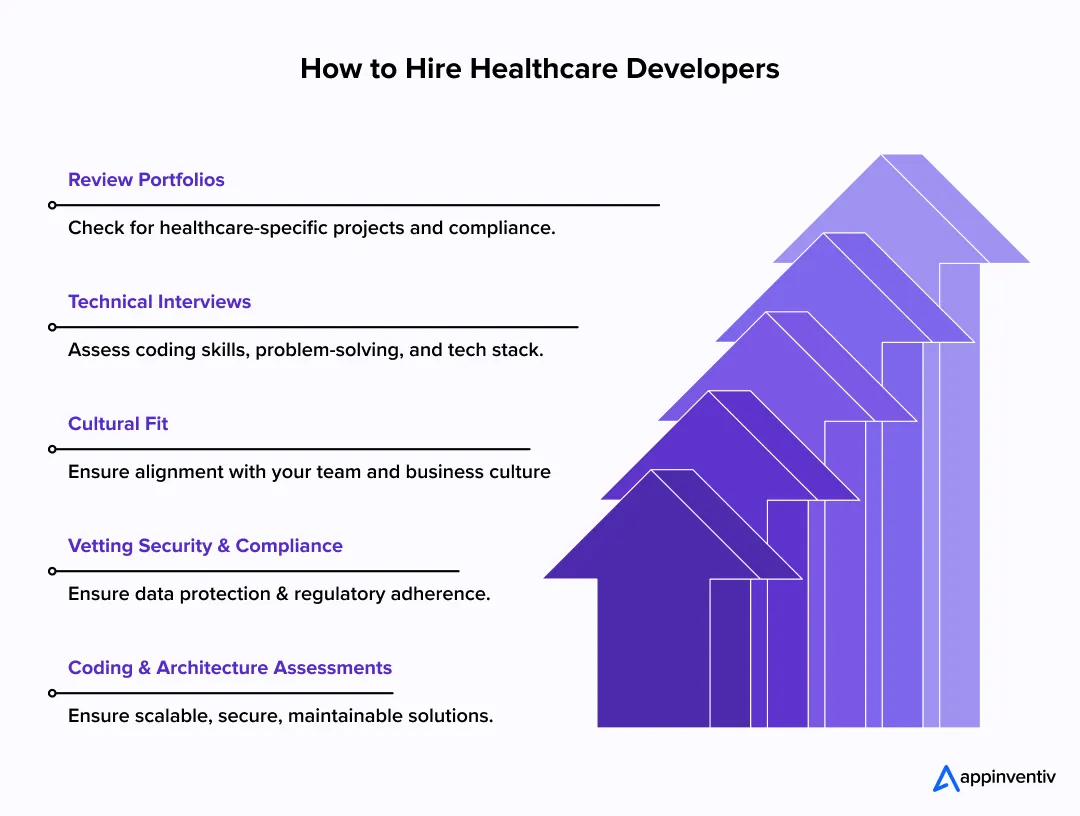
Step 1: Review Portfolios and Case Studies
Begin by reviewing the applicants’ or agencies’ portfolios and determining whether they have experience in the healthcare industry. Find examples of similar projects that have been done before, whether in the development of EHR systems, patient management software, or telemedicine.
What to look for:
- EHR/EMR systems, patient portals, and telemedicine (healthcare-specific apps).
- Knowledge of integration of healthcare information and systems (e.g., insurance, pharmacy).
- History of adherence to the regulations in the industry (HIPAA, GDPR)
As part of the vetting, review projects such as the Health‑e People app by Appinventiv, which consolidated data from over 200 devices and apps into a unified platform, demonstrating real proof of healthcare experience.
Step 2: Conduct Technical Interviews
When you hire medical software developers, the second step is to evaluate their technical skills through an interview. This is where you research their experience with the exact technologies and tools your project will need. Consider questioning them on their approach to:
- Healthcare Specific Challenges: What can they do to comply with healthcare rules? What do they do with sensitive patient data?
- Problem-solving Skills: Go ahead and give them a real-life healthcare scenario and ask them to give you a step-by-step description of how they would solve it.
- Technical Stack: Ensure their experience aligns with the technologies you plan to implement (e.g., cloud-based development solutions, mobile app development, APIs).
Step 3: Coding/Architecture Assessment
Conducting a practical technical test will give you an idea of how dedicated healthcare developers operate. This may take the form of coding difficult problems, architectural design, or studying previous code samples.
What to test:
- Skill in writing maintainable, readable code
- Cloud infrastructure (AWS vs Azure vs Google Cloud) and its uses in healthcare
- Scalable and secure system design
- Infrastructure as Code (IaC) capabilities to ensure compliant, reproducible, and auditable cloud environments using tools such as Terraform or AWS CDK
Step 4: Vetting Security & Compliance
When you hire healthcare developers, it is necessary to make sure that they follow the highest levels of security and compliance requirements.
The following is a checklist and a set of questions that you can apply to the potential developers in order to determine whether they can meet the requirements of security and compliance:
Security and Compliance Checklist:
- Data Encryption: Does the developer apply the encryption standards, such as AES-256, on data at rest and in the process of transfer?
- Multi-Factor Authentication (MFA: Has the developer authenticated users and role-based access controls (RBAC) using MFA?
- API Security: Are they protecting APIs by means of authentication and encryption, in order to avoid any illegal access to sensitive data?
- Access Logs/ Monitoring: Does it have a system that monitors and logs real-time access to sensitive health information?
- Regulatory Compliance: Does the developer have proven experience with healthcare compliance frameworks, including HIPAA, GDPR, and HITRUST? Are internal processes designed to maintain continuous compliance readiness?
- Audit Trails: Does it have detailed audit trails of all the modifications done to patient records and healthcare systems?
By making sure that developers adhere to these best practices, you will be in a position to prevent expensive security breaches and non-compliance fines.
Step 5: Check References and Reviews
Medical software developers for hire must have strong references in the healthcare industry. Interview these sources to receive feedback about:
- Quality of Work: Did they perform high-quality work on time and on budget?
- Communication: Did they respond and remain transparent during the project?
- Long-term Support: Have they given sufficient support and maintenance after launch?
Step 6: Test Cultural and Team Fit
What is essential is that your developers be knowledgeable about your organization’s culture and be able to integrate well with internal units, including IT personnel and business executives. Interview or hold a meeting with the key team members to evaluate:
- Communication: To what extent do they make complex technical ideas understood by non-technical stakeholders?
- Collaboration: Are they able to work with your internal team? Do they take the initiative to propose improvements or solutions?
Step 7: Shortlist & Trial Project
After reducing the options, you can start a trial project. This would enable you to assess their capabilities and performance at a smaller scale before committing to them in the long run.
Best practices for onboarding healthcare developers:
- Establish specific requirements for deliverables and schedule
- Check the quality of their work, communication and their approach to solving problems
- Evaluate their reaction to feedback and make changes
Through this careful evaluation and selection process, you will ensure you are not merely hiring developers with the right technical expertise, but also those who align with your business objectives and help you achieve long-term success with your healthcare solution.
Benefits of Hiring Dedicated Healthcare Developers
It is very important that we hire specific healthcare developers to develop secure and scalable solutions that are compliant and therefore suited to your business.
Such developers introduce professional skills, which guarantee that your project will be in conformity with the industry standards and regulatory procedures and will provide high-quality and customized outcomes.
- Healthcare Systems Specialization: Developers have expertise in healthcare regulations and technology.
- Scalability and Security: Interested in the development of secure and scalable solutions that meet the industry standards.
- Customization: Unique solutions that respond to unique business requirements and patient care objectives.
- Continuous Support: Support to maintain constant compliance and performance.
- Cost Efficiency: Decrease long-term costs by high-quality and efficient development, as well as by the reduction of post-launch problems.
Different Types of Healthcare Developers & Teams You Should Consider
Approximately 70 percent of the same survey respondents reported that investment in digital tools and services will be significant to their healthcare organizations.
When you hire healthcare developers, the team model you choose is a strategic choice. It influences the scalability, efficiency, and success of your digital solutions.
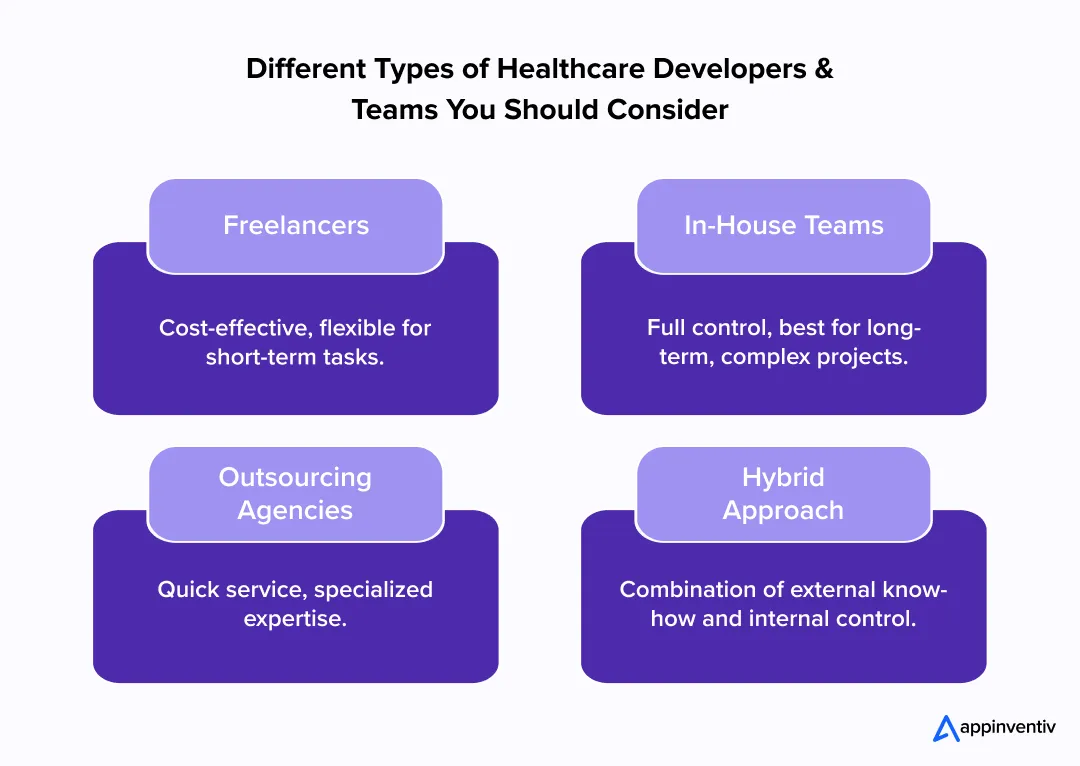
The following provides a list of different models of developers to consider:
| Hiring Model | Best For | Pros | Cons | When to Consider | Practical Tips |
|---|---|---|---|---|---|
| Freelancers | Specific features or short-term projects | Cost-effective, flexible, quick to onboard | Inadequate scalability, no long-term contract | In case of a minor task, such as feature development or bug fixing. |
|
| In-House Teams | Projects that are long-term and extensive | Having complete control, closer alignment to business objectives | Expensive, time-consuming recruitment process | When a solution is complex, persistent and updates and controls are required. | Include clauses for performance reviews, growth opportunities, and long-term maintenance in the contract. |
| Outsourcing Agencies | Availability of special knowledge, quicker service | Healthcare technology know-how, scalable | Communication problems, quality control | When you require specialized expertise in a hurry, but you do not want to employ it in-house. |
|
| Hybrid Approach | Flexibility and scalability with oversight | The best of the two worlds- External know-how and internal control | Good project management is required | If you want a flexible, scalable solution but still want oversight. |
|
Each model has different benefits and trade-offs. The key is to align your choice with your business needs, project complexity, and long-term goals. The right model can accelerate time-to-market, ensure scalability, and enhance the security of your healthcare solution.
Also Read: Top 18 Types of Healthcare Software to Elevate Your Medical Business
Which Skills Make a Healthcare Software Developer Stand Out?
“It drives me crazy that you can order Christmas presents on Amazon faster than you can connect with your healthcare provider.” – Crystal Broj, Enterprise Chief Digital Transformation Officer, Medical University of South Carolina.
This quote highlights a key problem in healthcare that requires faster, more efficient digital experiences. Medical software developers for hire need special attention to ensure they have not only technical competence and knowledge but also an understanding of the sector’s peculiarities.
The developers need to develop solutions that are secure, scalable and most importantly, capable of streamlining healthcare processes and enhancing patient experiences. To hire the right talent, consider the following major criteria.
Technical Expertise
A strong technical knowledge is critical, but healthcare developers should also have expertise in specific technologies that can advance healthcare solutions. These include general development skills as well as the professional knowledge in the healthcare sector.
- Core Skills: Identify developers that have been working with your specific technology stack (ex, mobile applications, web apps or cloud-based applications). They are also supposed to be proficient in programming languages, structures, and the tools needed to deliver a high-quality solution.
- Healthcare Tech Familiarity: The developer must have experience with healthcare systems and technologies, including EHR (Electronic Health Records), HL7 (Health Level Seven), FHIR (Fast Healthcare Interoperability Resources), and telemedicine integrations. Their introduction to such technologies will render the software suitable for the current systems’ environment in the healthcare setting.
- Emerging Technologies: As healthcare continues to evolve, having a specialist in AI (Artificial Intelligence), machine learning, data analytics, and IoT (Internet of Things) will help future-proof your offering and enable you to deliver state-of-the-art functionality.
For instance, Appinventiv’s work on the Soniphi Vitality wellness platform shows how voice, acoustics and advanced analytics were used in a health setting—this kind of hybrid tech‑plus‑domain experience is hard to replicate.
Knowledge in the Healthcare Domain
In addition to technical expertise, healthcare industry developers need deep industry knowledge. The development of healthcare software is not a typical application development because it requires a detailed understanding of healthcare operations, standards, and the issues faced by patients and providers.
- Industry Thinking: Developers should understand the interactions among technology, healthcare providers, insurers, and patients. This involves patient record management, billing, appointment scheduling, and clinical processes.
- Regulatory Knowledge: The Healthcare sphere is highly regulated, and developers will need to be familiar with the legislation governing healthcare information. One has to be conversant with laws such as HIPAA (Health Insurance Portability and Accountability Act) in the U.S., the GDPR (General Data Protection Regulation) in Europe, and other local laws. Developers should learn how to incorporate compliance in the development process.
- Patient Privacy and Data Protection: Developers of systems need to build systems focused on data security. They should also be trained in implementing encryption, access controls, and other data protection measures to safeguard patients’ sensitive information.
Teamwork and Interpersonal Interaction
The most important thing is communication, particularly within the healthcare industry. Technical specialists should not be confined to the role of developers; they must also be able to communicate with players who may not be technical and work within a group.
- Proper Communication: healthcare projects often involve multiple stakeholders, including clinical staff, administrators, and IT experts. The developers can communicate complex technological concepts to non-technical stakeholders so everyone understands the project’s objectives and expectations.
- Teamwork: The developers should learn to work in their internal teams (business analysts, project managers, and healthcare professionals). To develop a distinctive solution, it is necessary to collaborate with others who will ensure it fits your organization and meets industry requirements.
It is by focusing on these needs that you can be certain the developers you contract have the technical capability you require, as well as domain knowledge, safety awareness, and a cooperative ethos to develop working, compliant, and scalable healthcare solutions.
Essential Skills and Qualifications for Healthcare Software Developers
Besides technical skills, healthcare developers must have specialized skills and qualifications that are in line with industry requirements. The next table summarizes the major technical competencies and qualifications that are most desirable in healthcare software production.
| Technical Skill/Framework | Why It’s Important |
|---|---|
| HL7 (Health Level 7) | One of the most important standards used in the exchange of healthcare information electronically is to ensure interoperability among the systems. |
| FHIR (Fast Healthcare Interoperability Resources) | The current-day standard in healthcare data sharing is employed broadly in the development of apps that can be used to transfer patient data across systems. |
| SMART on FHIR | Expands FHIR to build applications to connect with EHR systems, making the solutions secure and scalable. |
| Mirth Connect | A healthcare integration engine that is utilized in connecting and sharing data among healthcare systems. |
| Cloud Solutions (AWS, Azure) | The developers should have the competence to deploy healthcare applications on scalable cloud applications to address expansion and uphold compliance. |
| AI & Machine Learning | Predictive analytics, patient monitoring, and healthcare outcome improvement. |
| IoT (Internet of Things) | Critical to wearable devices and remote patient monitoring, in which medical devices are part of healthcare applications. |
Relevant Certifications
- HCISPP (HealthCare Information Security and Privacy Practitioner): Reflects an understanding of health-related security and privacy rules, such as HIPAA.
- CPC (Certified Professional Coder): Assures the developers that they know the medical coding, which is very important in developing proper billing systems.
- CPHIMS (Certified Professional in Healthcare Information and Management Systems): Certifies skills in healthcare IT and management to guarantee that developers have knowledge of the entire healthcare IT process.
- RHIT (Registered Health Information Technician): Specializes in health information management as well as the integrity and security of patient data.
- HL7 Certification: This certificate is a well-known qualification of developers working with the interoperability of health data systems.
Looking for expert developers? Appinventiv is a top healthcare software development company with proven success.
What Is the Cost to Hire Healthcare Software Developers?
When you hire medical software developers, it is important to make informed decisions based on the cost structure. The cost of healthcare software development is a significant investment, and prices may fluctuate widely depending on the type of project, the location of the developers, and the hiring model you use.
The cost factors that are important here are as follows:
1. Types of Costs Involved
Knowing the various elements of costs will assist you in planning and budgeting:
- Development Costs: It relates to the direct costs of developers’ time, charged either on an hourly basis or a project-fee basis. The fees may vary depending on the complexity of the solution (e.g., EHR systems can be compared to simple health-tracking apps).
- Maintenance Costs: Once your system has been launched, it will need to be maintained, updated and/or trouble-shooted. This may involve bug fixing, performance enhancements and compliance.
- Testing and Quality Assurance: Tests must be rigorous, and in healthcare, the integrity of the data and the reliability of the system should be of utmost importance. This will add to your budget.
- Third-Party Tool or API Integrations: If your system requires third-party integrations (e.g., EHR systems, insurance portals, payment systems), you may incur additional licensing and implementation costs.
- Compliance & Security: Healthcare systems should comply with rigid regulations, such as HIPAA and GDPR. This necessitates secure development practices, which may increase development costs, yet they are required to avoid penalties.
2. Developer Rates by Region
Healthcare developer costs vary by geography, driven by local talent availability, regulatory expertise, and healthcare IT maturity. Selecting a region should balance cost efficiency with proven experience in compliance-driven healthcare development.
3. Budget Considerations
When making your budget, you need to consider the following:
- Short vs Long Term: Although you might save money in the short run by using developers in areas where rates are lower, you can think long-term about the quality, maintenance and scalability. Recruiting more qualified healthcare developers in more expensive areas might lead to higher initial expenditure. Still, it might be less expensive in the long run because code quality improves and fewer compliance problems arise.
- Fixed vs. Hourly Rates: Some developers or agencies charge a fixed rate for the entire project, while others charge per hour. In the case of clear projects, fixed rates are more predictable. But with projects that are more flexible and long-term in nature, hourly rates may be more flexible.
- Other Costs: Remember to include costs of infrastructure, e.g., cloud hosting charges, third-party software licensing and hardware requirements.
4. Hidden Costs to Watch Out For
Although you may have an estimate of the cost of the project initially, some hidden costs may arise, which include:
- Delays: Delays in development may increase costs, particularly when the project timeline exceeds the original scope. A good development team should be well-planned and experienced to prevent delays.
- Regulatory Changes: Healthcare laws continue to evolve, and keeping your system up to date may require unforeseen adjustments or extra effort.
- Quality Assurance and Testing: Testing quality is crucial to the development of health software. It is important to include large-scale QA cycles in your budget to ensure your data is safe and meets the requirements of your regulatory authorities.
5. Long-Term ROI Concerns
The price of the right healthcare developers is not merely the amount, but an investment that is likely to pay back in the long term:
- Improved Efficiency: A well-developed system will make an organization’s work much easier, eliminating manual tasks and increasing productivity.
- Compliance and Risk Reduction: The most obvious advantage of recruiting professional developers who are aware of industry standards is avoiding penalties and fines for noncompliance with healthcare regulations.
- Scalability: A scalable solution can save you money in the future by enabling your organization to grow without costly system upgrades.
The DiabeticU project by Appinventiv showcases how migrating from legacy on‑prem systems to a compliant, cloud‑native platform addressed scalability, cost inefficiencies and regulatory risk—all of which tie back to ROI rather than upfront cost alone.
Navigating the Challenges of Hiring in the Healthcare Sector
The recruitment of appropriate healthcare developers is not the only bit. Despite the presence of the best group, the process of development still has some hurdles to be avoided to make sure that the finished product meets your objectives as a business and as a regulatory body.
The following is a glimpse of some of the pitfalls that you can experience and how to overcome them:
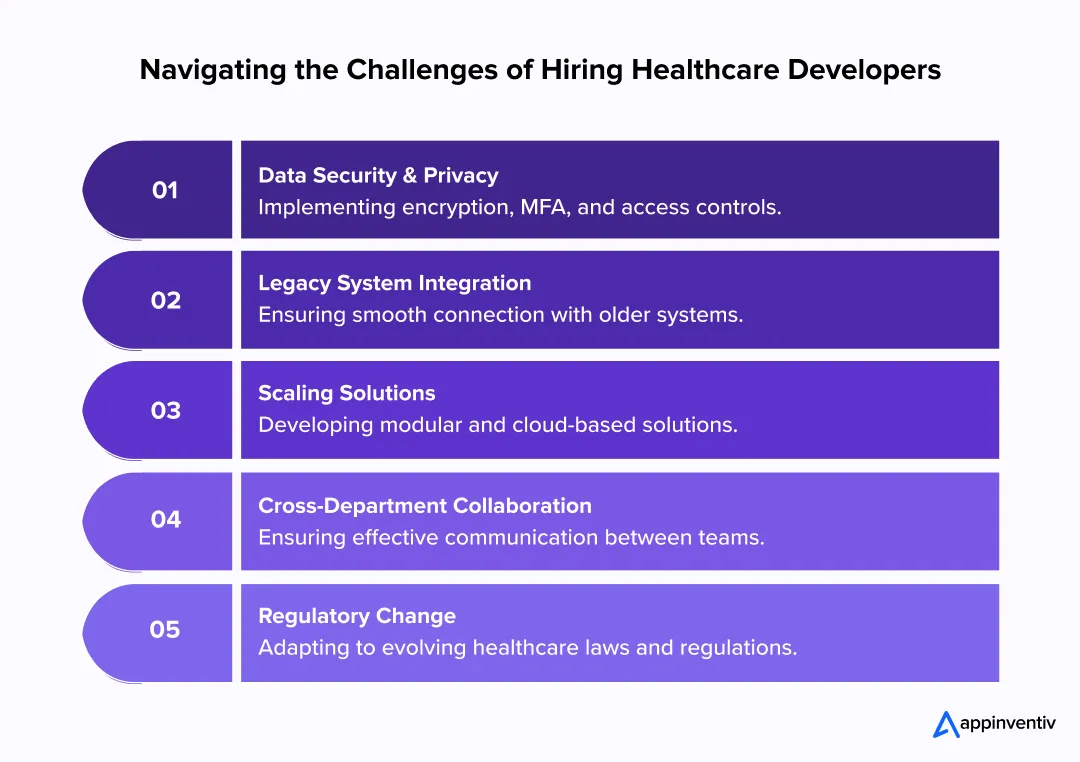
1. Providing Data Security and Privacy
Healthcare applications are used with patient data that is sensitive, hence security is a priority. Developers should develop systems that are functional as well as adhere to the healthcare data protection laws, such as HIPAA in the U.S and GDPR in the European region.
- Challenge: The breach of patient information through security weaknesses may impact your organization with huge fines as well as a damaged reputation.
- Solution: Select developers who are well-informed in the security measures designed to meet the particular requirements of healthcare, including end-to-end encryption, secure API connection and multi-factor authentication. Make sure that data privacy and compliance are part of the development process from the beginning.
2. The Interface with Legacy Healthcare Systems
Many healthcare enterprises still operate mission-critical legacy platforms built on older architectures, including COBOL-based hospital systems, on-premise EHRs, and HL7 v2 message pipelines. Connecting these environments with modern cloud-native applications often introduces technical complexity, delays, and added cost.
- Problem:
Legacy systems were not designed for modern interoperability, making real-time data exchange and workflow integration difficult. - Solution:
Hire developers experienced in legacy-to-modern healthcare integration, including HL7 v2 to FHIR mapping, middleware-based data translation, and phased modernization strategies. This ensures continuity of existing operations while enabling next-generation digital healthcare platforms.
3. Scaling Your Solution to Support Growth in Demand
As your healthcare solution expands, it must be capable of scaling without the need to compromise performance. Over time, developers are required to come up with systems that will be able to sustain increasing data loads, more users and other features.
- Problem: A non-scaling system will have performance problems, failures, and unhappy users.
- Solution: Make sure that your developers come up with cloud-based, modular architectures, which are capable of scaling as your business expands. This involves paying attention to data storage services, performance management, and utilisation of scalable cloud services such as AWS or Azure.
4. Cross-Department Co-operation Management
The creation of healthcare software would need the contribution of different departments–clinical teams, IT, compliance and business operations. It is necessary to align all these stakeholders in order to be successful, and it may be challenging to control.
- Challenge: The lack of clear communication between the technical and non-technical teams might result in misunderstanding, lack of speed, and scope creep.
- Solution: This can be achieved by creating a collaborative atmosphere through ensuring that the developers have good communication skills and also have the ability to translate the technical issues to non-technical stakeholders. It is important to check in regularly and document everything to get everyone straight and on course.
5. Dealing with Regulatory Change
The healthcare regulations are in a state of perpetual change. What is legal today might not be legal tomorrow due to new laws and standards that are being formulated across the world.
- Challenge: The inability to adjust to new regulations may lead to fines and system failure, or a lack of confidence in the work with patients.
- Solution: Consult developers who are dynamic regarding keeping up with the current changes in terms of regulation. An innovative development team will create systems that will be readily upgraded to the standards whenever they arise.
6. Securing User-Centric Design
The user experience is essential in healthcare. The system should be user-friendly and interactive, whether it is operated by a patient, a doctor or an administrator.
- Challenge: A complex system that is not easily navigable will result in a low adoption rate, frustration, and usage errors.
- Solution: Developers are advised to work together with UX/UI designers in order to make the system user-friendly. An in-depth understanding of healthcare processes and user needs will help build an efficient yet user-friendly experience.
7. Preventing Algorithmic Bias in AI Systems
As AI becomes embedded in clinical decision support, algorithmic fairness and transparency are critical.
- Challenge: Biased or unexplainable AI models can lead to unsafe clinical recommendations and regulatory exposure.
- Solution: Hire developers who understand AI ethics, model auditability, and bias detection techniques, ensuring clinical AI systems remain fair, explainable, and compliant.
Our experienced developers can help you create secure, scalable, and compliant healthcare software solutions.
Why is Appinventiv the Best Healthcare Software Development Company?
Appinventiv is a reliable healthcare software development company providing innovative, safe, and scalable solutions.
With 500+ digital health platforms delivered, 450+ healthcare clients served, and over 10 years of experience in HealthTech projects, we specialize in designing tailor-made applications that address the individual needs of your business and enhance patient care.
Having successfully collaborated with major healthcare organizations and startups to hire healthcare software developers, we bring deep expertise to every project.
- Substantial Healthcare Area Expertise: We are aware of the intricacies of healthcare, including EHR systems, telemedicine platforms and patient engagement solutions.
- Innovative Solutions: We develop solutions that are future-ready using technologies such as AI, IoT and data analytics.
- Secure Development Practices: We also ensure that we meet such healthcare standards as HIPAA and GDPR, and our security framework is highly effective in safeguarding patient information.
- Tailored Approach: Our solutions are designed to meet your business requirements, patient care objectives, and regulatory needs.
- Global Recognition: Healthcare organizations all over the world have trusted them to provide high-quality and effective software solutions.
- Scalable Products: Our solutions are constructed in a way that will expand alongside your company, and they are also able to expand as your demands grow.
- Exceptional UI/UX: Our attention is on developing convenient and usable interfaces to make the experience of healthcare professionals and patients more enjoyable.
Looking to build or modernize your healthcare software? Our experts can help you design a secure, compliant, and scalable solution. Explore Healthcare Software Solutions.
Frequently Asked Questions
Q. How to hire MVP developers for a healthcare product?
A. To hire healthcare developers for an MVP product, pay attention to applicants who have worked in a rapid prototyping environment, complied with HIPAA and GDPR, and worked within a healthcare system.
They are supposed to know about the scalability and security requirements. You should focus on those developers who can provide flexible and modular solutions that will be able to expand with your business and address industry-specific requirements.
Q. How to hire healthcare software developers?
A. To recruit software developers in healthcare, make sure that they will work with technology specific to healthcare (EHR, telemedicine, HIPAA compliance).
Seek experience in data security and protection. Authenticate their portfolio on healthcare projects, perform technical interviews, and gauge culture. Ensure that they are aware of the technological and regulatory issues in the healthcare industry.
Q. Where to find top healthcare developers?
A. The best healthcare software developers for hire are available in specialised sites such as Toptal, Upwork, or via the service of reputed development agencies. You can also be introduced to extremely qualified healthcare software developers who have the necessary expertise and experience through networking events, industry conferences, and online communities (e.g., GitHub, Stack Overflow).
Q. What compliance experience should healthcare developers have?
A. Healthcare developers should understand HIPAA, GDPR, HITRUST, and regional healthcare data laws. They must know secure data handling, encryption standards, audit trails, interoperability frameworks like HL7 or FHIR, and risk mitigation practices. Proven experience delivering compliant healthcare platforms reduces regulatory exposure, protects patient data, and ensures long-term operational reliability.
Q. Should you hire in-house or outsource healthcare development?
A. In-house hiring offers tighter control, domain alignment, and long-term continuity but requires higher investment and slower scaling. Outsourcing provides faster access to specialized healthcare expertise, compliance knowledge, and flexible scaling. The choice depends on project complexity, budget, timeline, and whether sustained internal healthcare technology capability is strategically necessary.

- In just 2 mins you will get a response
- Your idea is 100% protected by our Non Disclosure Agreement.
EHR Implementation for Healthcare Providers: Process, Features, and Total Cost Analysis
Key takeaways: A clear EHR implementation guide keeps teams on track and prevents delays. The full EHR implementation process includes planning, setup, moving data, training staff, and regular updates. The right features handle clinical work, billing, reports, and compliance for large healthcare organizations. EHR implementation costs vary based on design, integrations, data migration, training hours,…
Medical Device Software Integration: A Strategic Buyer’s Guide for Healthcare Enterprises
Key takeaways: Medical device software integration is a governance decision first. Define data ownership, clinical workflows, and regulatory scope before writing a single API. Build on recognized standards from the outset. FHIR, DICOM, and IEEE 11073 reduce ambiguity and simplify long-term scaling. Expect validation and security to drive real cost. Documentation, testing, and firmware controls…

How to Build a Custom Pediatric EMR and EHR System?
Key takeaways: Clinical Precision: Custom systems accommodate pediatric-specific data points like percentile curves and weight-based longitudinal dosing. Interoperability: Seamless data exchange via HL7 FHIR ensures your practice stays connected to pharmacies, labs, and state registries. Regulatory Resilience: Built-in compliance with HIPAA, HITECH, and MACRA/MIPS reduces legal friction. Enhanced Engagement: Parent portals reduce administrative overhead by…