





























Hire Custom Software Developers in Saudi Arabia for Secure, Scalable and Sovereign Enterprise Solutions


- Why Saudi Enterprises Are Reassessing How They Build Software
- Enterprise Software Hiring Models: What Works at Scale
- How Much Does It Cost to Hire Custom Software Developers in Saudi Arabia?
- Must-Have Skills & Competencies for Enterprise Software Developers
- Step-by-Step Hiring Guide for Saudi Enterprise Needs
- Challenges of Hiring Software Developers in Saudi Arabia for Enterprises
- Benefits of Hiring Software Developers in Saudi Arabia for Enterprises
- How to Choose the Best Software Developers in Saudi Arabia for Enterprises
- Why Appinventiv Is a Strategic Enterprise Partner in Saudi Arabia
- Frequently Asked Questions

Key Highlights
- Saudi enterprises are stepping away from speed-led outsourcing and choosing governed, security-first delivery aligned with sovereignty and regulatory needs.
- Enterprise software now leads in digital investment, as national platforms demand resilience, control, and clear audit trails.
- Hiring custom software developers is no longer about capacity. It is a risk decision that affects compliance, uptime, and stability.
- The right hiring model blends scale, governance, and flexibility, helping reduce risk as enterprise programs expand beyond early teams.
- Enterprise software spending in Saudi Arabia often ranges from $50,000 to $500,000+, shaped by compliance depth and system complexity.
- Enterprises that hire software developers in Saudi Arabia with enterprise-ready experience see better security, steadier delivery, and platforms built to last at a national scale.
If you sit through a few transformation reviews, a pattern starts to emerge. What begins as a system upgrade quickly turns into a broader discussion of risk. An audit deadline comes up. Usage grows faster than expected. Someone asks how resilient the platform really is.
Hiring custom software developers in Saudi Arabia means building enterprise platforms that align with data sovereignty requirements, SAMA compliance expectations, and security-first architecture for long-term national-scale operations.
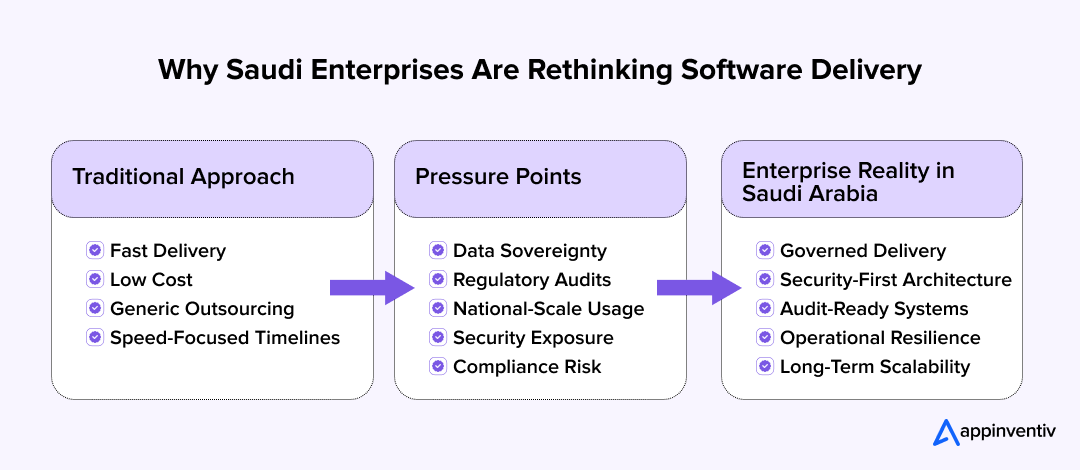
Across Saudi Arabia, enterprises in banking, healthcare, energy, telecom, and the public sector are modernizing core systems while launching platforms meant to operate at a national scale. These initiatives are highly visible, and the margin for error is small. Shifting is not just about speed. Data sovereignty, regulatory pressure, and long-term scalability shape it.
That reality is changing how software is built. Many enterprises are moving away from generic outsourcing models that optimize for output but offer limited control. Security-first, governed development approaches are becoming the norm. In this context, hiring custom software developers in Saudi Arabia becomes a strategic choice tied to governance and risk, not just delivery capacity.
Finding enterprise-ready talent is not simple. SAMA expectations, sovereignty mandates, and secure scaling requirements raise the bar. This guide helps enterprise leaders understand why, when, and how to hire software developers in Saudi Arabia, with a clear focus on building secure, scalable, and sovereign systems from the start.
Saudi enterprise software investments often range from $50,000 to $500,000+.
Why Saudi Enterprises Are Reassessing How They Build Software
The way large digital programs are discussed in Saudi Arabia has clearly shifted. Enterprise digital transformation Saudi Arabia initiatives are no longer incremental. Organizations are reworking core systems, digitizing mission-critical operations, and building platforms expected to operate at a national scale from day one.
This momentum is reflected in market growth, with the Saudi Arabia custom software development market projected to reach $2.4 billion by 2030, growing at a 20.4% CAGR.
This shift aligns with the national digital policy direction. Saudi Arabia’s Cloud First Policy, SAMA data residency framework, and Vision 2030 digital transformation roadmap have made sovereignty, auditability, and controlled delivery central requirements for enterprise software programs.
Accelerated Digital Transformation Across Industries
Enterprises across banking, healthcare, energy, telecom, and the public sector have moved past pilots. Software now sits at the center of daily operations, customer interactions, and regulatory reporting.
As these initiatives expand, software systems must handle:
- High transaction volumes
- Continuous availability
- Integration with legacy and national platforms
Expectations for enterprise software have increased significantly.
Data as a Strategic and Regulated Asset
Enterprise platforms now process large volumes of financial, healthcare, and operational data. As data grows, so does exposure to access risks, breaches, and cross-border compliance issues.
Saudi enterprises pursuing SAMA-compliant software development are paying closer attention to:
- Where data is stored
- Who can access and manage it
- How governance and auditability are enforced
Enterprise software in Saudi Arabia is increasingly adopting a data-residency-first architecture, keeping sensitive workloads within national cloud or private infrastructure environments.
Zero-trust access controls, encrypted credential vaults, continuous audit logging, and DevSecOps security pipelines ensure compliance checks and security testing run throughout delivery, not only at release.
Data management is no longer a background concern. It is discussed at the board level.
Limitations of Traditional Outsourcing Models
Many outsourcing models prioritize speed and cost. That approach works for low-risk applications, but it often breaks down in regulated environments.
Common challenges include:
- Limited visibility into delivery
- Inconsistent security practices
- Misalignment with local regulations
For critical systems, these gaps create unacceptable risk.
Shift Toward Controlled and Custom Development
As a result, enterprises are reassessing how software is built. More organizations are choosing custom development models that offer control, security, and local alignment.
The choice to hire custom software developers in Saudi Arabia is now viewed as a strategic enabler for:
- Sustained enterprise digital transformation
- Lower regulatory and operational risk
- Scalable and resilient software platforms
Enterprise Software Hiring Models: What Works at Scale
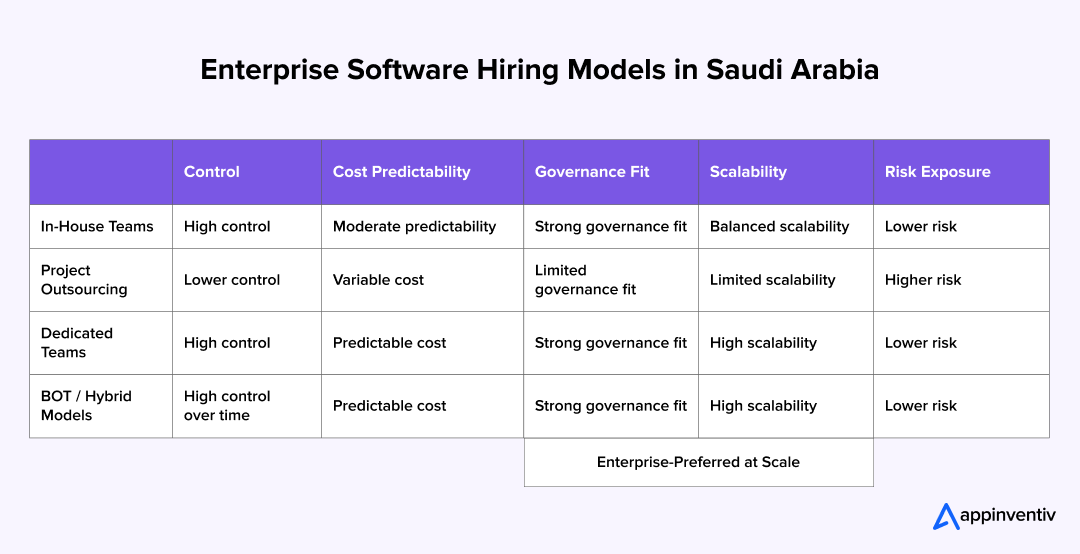
Once software programs grow beyond a few teams, the decision to hire enterprise software development Saudi Arabia resources stops being a background decision. It starts affecting delivery speed, risk, and control. This becomes even more critical as enterprise software continues to dominate the market, accounting for a $646.66 million market volume in 2025.
Saudi enterprises often review several hiring and engagement models before committing long-term. Each option changes how much visibility you have, how flexible teams can be, and where risk sits.
The right choice depends on program scale, regulatory exposure, and what the organization needs to sustain over time.
In-House Development Teams
Building an internal team gives you the most control. People, processes, and intellectual property stay fully inside the organization. Large enterprises often rely on in-house teams for core platforms that are expected to run for years.
Where it works well:
- Programs with stable, long-term investment
- Systems that depend on deep internal context
- Strong internal engineering leadership
Limitations to consider:
- Longer hiring and onboarding cycles
- Gaps in niche or emerging skills
- High fixed costs and retention pressure
Outsourcing to External Development Vendors
Outsourcing is often chosen when speed matters or specialized skills are needed quickly. Enterprises typically engage vendors for defined projects or short-term capacity support.
Where it works well:
- Time-bound initiatives
- Clearly scoped projects
- Temporary support during peak demand
Limitations to consider:
- Limited day-to-day visibility
- Varying security and quality standards
- Governance misalignment without close oversight
Dedicated Enterprise Software Development Teams
Dedicated teams sit between in-house and traditional outsourcing. The external team works long-term and operates like an extension of your internal organization.
Where it works well:
- Large digital transformation programs
- Ongoing modernization efforts
- Enterprises that need scale with control
Key advantages:
- Predictable capacity and cost
- Alignment with enterprise standards
- Faster ramp-up than internal hiring
Build Operate Transfer and Hybrid Models
BOT and hybrid models are often used when enterprises want to build internal capability gradually. An external partner sets up and manages the team before transitioning ownership internally.
Where it works well:
- Strategic, long-term platforms
- Organizations developing engineering maturity
- Programs needing strong early governance
Key benefits:
- Lower initial hiring risk
- Built-in knowledge transfer
- Greater long-term control
Choosing the Right Model at Enterprise Scale
No single hiring model fits every initiative when engaging Saudi Arabian software developers for enterprises. Many Saudi enterprises combine internal leadership with dedicated external execution.
The most effective approaches:
- Align with regulatory requirements
- Scale securely without losing control
- Provide clear governance and accountability
Choosing the right model early reduces friction and helps enterprise software programs scale in a secure, sustainable way. For Saudi enterprises, hiring models that combine dedicated teams with governance oversight tend to deliver the strongest balance of control, alignment with compliance, and scalable execution.
This dynamic becomes clearer in large retail environments where systems must operate consistently across locations. For IKEA, Appinventiv delivered an ERP-driven in-store platform that unified real-time inventory visibility, customer onboarding, and marketing data capture.
The solution is integrated with existing backend systems and supports structured rollouts across stores, showing how governed delivery models help enterprises scale operational platforms without losing control.
How Much Does It Cost to Hire Custom Software Developers in Saudi Arabia?
When you hire custom software developers in Saudi Arabia, most enterprise engagements land somewhere between $50,000 and $500,000 or more. Smaller initiatives stay closer to the lower end. Large platforms, especially those tied to regulation or national scale, often push beyond it. Architecture depth, security controls, and governance effort add up over time.
Cost Variations Across Hiring Models
| Hiring Model | Cost Structure | Best Suited For |
|---|---|---|
| In-house enterprise teams | High fixed cost across salaries and setup | Core, long-term platforms |
| Project-based outsourcing | Variable, tied to scope and timeline | Clearly defined initiatives |
| Dedicated development teams | Predictable monthly spend | Ongoing transformation work |
| Build-Operate-Transfer (BOT) | Moderate upfront, optimized later | Capability building and ownership |
Indicative Cost Range by Engagement Type
| Engagement Type | Typical Cost Range* |
|---|---|
| Small enterprise initiative | $50,000 to $120,000 |
| Mid-scale enterprise platform | $120,000 to $300,000 |
| Large or regulated system | $300,000 to $500,000+ |
*Actual figures vary based on compliance depth, team experience, and engagement length.
In regulated enterprise environments, systems typically fall into the $300,000+ tier due to continuous compliance testing, audit readiness, security governance, and long-term operational support requirements.
Also Read: How Much Does It Cost to Build a Mobile App in Saudi Arabia?
Key Cost Drivers in Enterprise Software Development
Several factors shape the final number:
- Project complexity: Heavy integrations, legacy systems, and uptime expectations increase effort.
- Duration of engagement: Long programs need stable teams and consistent oversight.
- Regulatory and compliance requirements: Sovereignty rules, SAMA alignment, and audits add work throughout delivery.
- Technology choices: Advanced stacks require senior engineers and architects.
- Talent availability: Enterprise-grade experience is in demand, especially in regulated settings.
What Enterprises Should Factor into Budget Planning?
Beyond build costs, budgets usually need room for:
- Ongoing support and maintenance
- Local infrastructure and hosting
- Security monitoring and compliance updates
- Documentation, handover, and governance work
When costs are viewed this way, Saudi enterprises can plan with fewer surprises and make hiring decisions that support stability, not just delivery speed. In practice, enterprise software cost in Saudi Arabia is shaped more by compliance depth, sovereignty controls, and long-term governance effort than by feature volume alone.
Cost ranges also start to make sense when viewed through real platform complexity. For Americana Restaurants, Appinventiv built a scalable ordering and delivery platform integrating mobile apps with POS and kitchen systems.
Designed for peak-time reliability and multi-brand expansion, the architecture illustrates how integrations, real-time processing, and scalability requirements directly influence both upfront development cost and ongoing operational investment.
Also Read: Redefining Mobile App Development Success in the Middle East – 6 Business Case Studies
Must-Have Skills & Competencies for Enterprise Software Developers
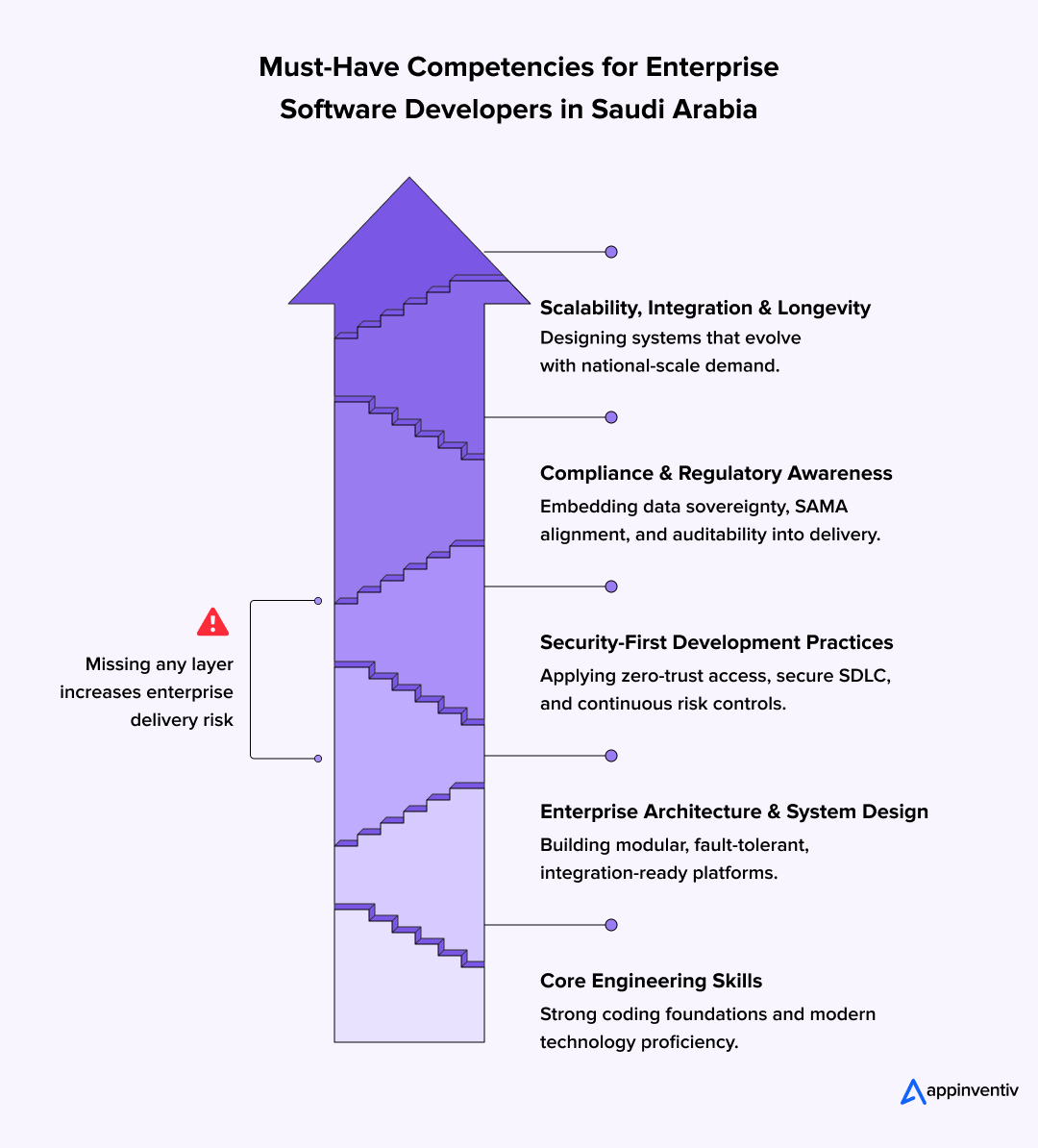
If you have ever staffed an enterprise program, you know the difference shows up quickly. A developer may write clean code, but struggle once governance, audits, and long-term ownership enter the picture.
In Saudi Arabia, enterprise platforms tend to run for years, sit inside regulated environments, and connect deeply with business operations. That is why when you hire enterprise software development Saudi Arabia teams, you require a higher bar. Technical ability has to come with experience in security, governance, and large-scale delivery.
Below are the core competencies to focus on when evaluating enterprise developers or delivery teams.
Enterprise Architecture and System Design
At enterprise scale, design decisions live for a long time. Developers need to think beyond the first release and plan for change.
Key competencies include:
- Designing modular or service-based architectures
- Planning for scalability, fault tolerance, and availability
- Making design choices that support long-term evolution
Developers with real architecture experience help avoid expensive redesigns later.
Security-First Development Practices
In enterprise environments, security is part of daily work, not a final checkpoint.
Look for experience in:
- Secure development lifecycle practices
- Role-based access and least privilege models
- Secure APIs and data protection
- Threat modeling and code reviews
These skills matter most in regulated and audit-heavy settings.
Compliance and Regulatory Awareness
Enterprise developers in Saudi Arabia must understand how regulation shapes delivery.
Relevant competencies include:
- Designing systems that support data sovereignty
- Awareness of SAMA and sector-specific expectations
- Building audit-ready logging and traceability
Teams with compliance awareness reduce friction during reviews and audits.
Cloud, Hybrid, and Infrastructure Expertise
Most enterprise platforms run across mixed environments.
Essential skills include:
- Cloud-native development and deployment
- CI/CD and infrastructure automation
- Hybrid designs that meet data residency needs
This ensures platforms scale without violating local requirements.
Integration and Enterprise System Experience
Enterprise software rarely works alone. Integration skills are critical.
Key integration capabilities include:
- Legacy, CRM, and ERP system integration
- API management and data synchronization
- Managing dependencies across systems
Strong integration experience protects operational stability.
Collaboration, Documentation, and Governance Discipline
Enterprise delivery is as much about process as code.
Important non-technical skills include:
- Clear documentation and knowledge transfer
- Working within formal change controls
- Coordinating with internal teams and vendors
These capabilities support transparency, accountability, and smoother long-term operations.
Step-by-Step Hiring Guide for Saudi Enterprise Needs
In Saudi Arabia, enterprise software hiring works best when structure comes first. A clear process reduces risk and sets expectations early, especially for long-term, regulated programs.
Below is a practical step-by-step framework enterprises can use to hire with confidence.
Step 1: Define Enterprise Objectives and Compliance Requirements
Start by aligning everyone on outcomes, not just features. Before reviewing candidates, be clear on:
- The business purpose of the initiative
- Data sensitivity and sovereignty needs
- Sector-specific compliance requirements, including SAMA-compliant software development standards, where relevant
- Expected scale, integrations, and system lifespan
This clarity keeps hiring aligned with governance from the beginning.
Step 2: Decide the Right Hiring and Engagement Model
The delivery model shapes cost, control, and accountability. Based on scope and duration, decide whether you need:
- Internal leadership with external execution
- A dedicated enterprise development team
- A BOT or hybrid approach for long-term capability building
Making this choice early avoids misalignment later.
Step 3: Identify the Right Talent Sources
When you hire custom software developers in Saudi Arabia, the process often combines multiple sources:
- Local talent for regulatory and domain alignment
- Regional or global partners with enterprise delivery experience
Prioritize teams that can demonstrate real experience with regulated, large-scale systems.
Step 4: Evaluate Technical and Architectural Capability
Enterprise evaluation goes beyond coding speed. Focus on:
- Architecture design and trade-off decisions
- Experience building secure, scalable platforms
- Comfort working with legacy systems and complex integrations
At this level, judgment matters more than velocity.
Step 5: Validate Security and Compliance Readiness
Security checks should happen before onboarding, not after issues appear.
- Review secure development practices
- Confirm familiarity with sovereignty and audit expectations
- Assess how security is enforced during delivery
This step prevents rework and compliance gaps.
Step 6: Assess Governance, Communication, and Transparency
Long-running programs depend on visibility and control.
- Review reporting and escalation structures
- Confirm documentation and knowledge-sharing practices
- Align with enterprise change management processes
Strong governance lowers operational risk.
Step 7: Plan Onboarding and Knowledge Transfer
Early structure speeds up delivery later.
- Define onboarding timelines and access controls
- Set documentation standards
- Plan for continuous knowledge transfer
Thoughtful onboarding creates stability for long-term collaboration.
Apply a structured approach to hire custom software developers in Saudi Arabia.

Challenges of Hiring Software Developers in Saudi Arabia for Enterprises
For most large enterprises driving enterprise digital transformation in Saudi Arabia programs, the challenge is not a lack of willingness or budget. It is finding developers who can operate inside regulated, long-running environments.
Enterprise programs often span years, touch legacy systems, and are subject to constant audit review. That context raises expectations well beyond general coding skills.
Scarcity of Enterprise Grade Talent
The gap usually appears after onboarding. Many developers know modern tools but have limited exposure to enterprise-scale systems. Experience with long-term ownership and high availability is harder to find.
- Limited experience in regulated environments
- Gaps in enterprise architecture exposure
- Little ownership of long-lived platforms
Regulatory and Compliance Readiness
Compliance is part of daily delivery, not a checklist at the end. Developers unfamiliar with regulated sectors often underestimate this shift.
- Compliance is treated as documentation
- Limited audit facing experience
- Weak understanding of delivery controls
Governance and Delivery Structure Alignment
Enterprise teams work within defined approvals and escalation paths. Developers who used to rely on informal models can struggle to adapt.
- Difficulty working with formal governance
- Slower alignment with change controls
- Friction with escalation processes
Legacy Systems and Integration Complexity
Most enterprises run mixed environments. Without integration experience, small changes can cause wider instability.
- Limited legacy system exposure
- Weak third-party integration skills
- Higher risk of technical debt
Retention and Knowledge Continuity
Demand for skilled developers is high. When key people leave midstream, progress slows, and system knowledge is lost.
- Higher attrition risk
- Delivery disruption during transitions
Benefits of Hiring Software Developers in Saudi Arabia for Enterprises
When hiring is done with an enterprise lens, the value goes beyond added capacity. The right developers support governance, reduce risk, and help platforms stay stable over time. This alignment plays directly into secure and scalable digital transformation.
Stronger Alignment with Data Sovereignty Requirements
When building data sovereignty-compliant software in Saudi Arabia, local experience changes how systems are designed. Data control is enforced through architecture, not manual fixes.
- Clear data control models
- Access policies built into systems
- Auditability designed from day one
Security Embedded into the Development Lifecycle
Security is treated as part of delivery, not a final review step. Issues are addressed before they reach production.
- Secure by design approach
- Fewer post-launch fixes
- Lower exposure to vulnerabilities
Improved Delivery Predictability and Accountability
Enterprise developers are used to structure and oversight. This makes progress easier to track and explain.
- Better planning discipline
- Clear documentation and reporting
- Stronger executive visibility
Scalability Designed for Long-Term Growth
The focus shifts from quick wins to sustainable platforms. Systems are built to grow without major rework.
- Regional and user scale readiness
- Future use cases considered early
- Reduced need for redesign
Reduced Operational and Compliance Risk
Strategic hiring lowers friction over time. Audits, outages, and rework become less frequent.
- Fewer compliance issues
- Lower disruption risk
- Improved long-term system resilience
Read Next: How to hire mobile app developers in Saudi Arabia
How to Choose the Best Software Developers in Saudi Arabia for Enterprises
Most enterprises realize this fairly quickly. When you hire enterprise software development Saudi Arabia teams, finding developers is not the hard part. The challenge starts when systems need to pass audits, scale without downtime, and stay stable long after launch.
For enterprise programs, evaluation has to move past pure technical skill and focus on governance, risk, and long-term delivery strength.
The framework below helps enterprises find software developers in Saudi Arabia and choose teams that can operate at enterprise scale.
Start with Enterprise and Regulatory Requirements
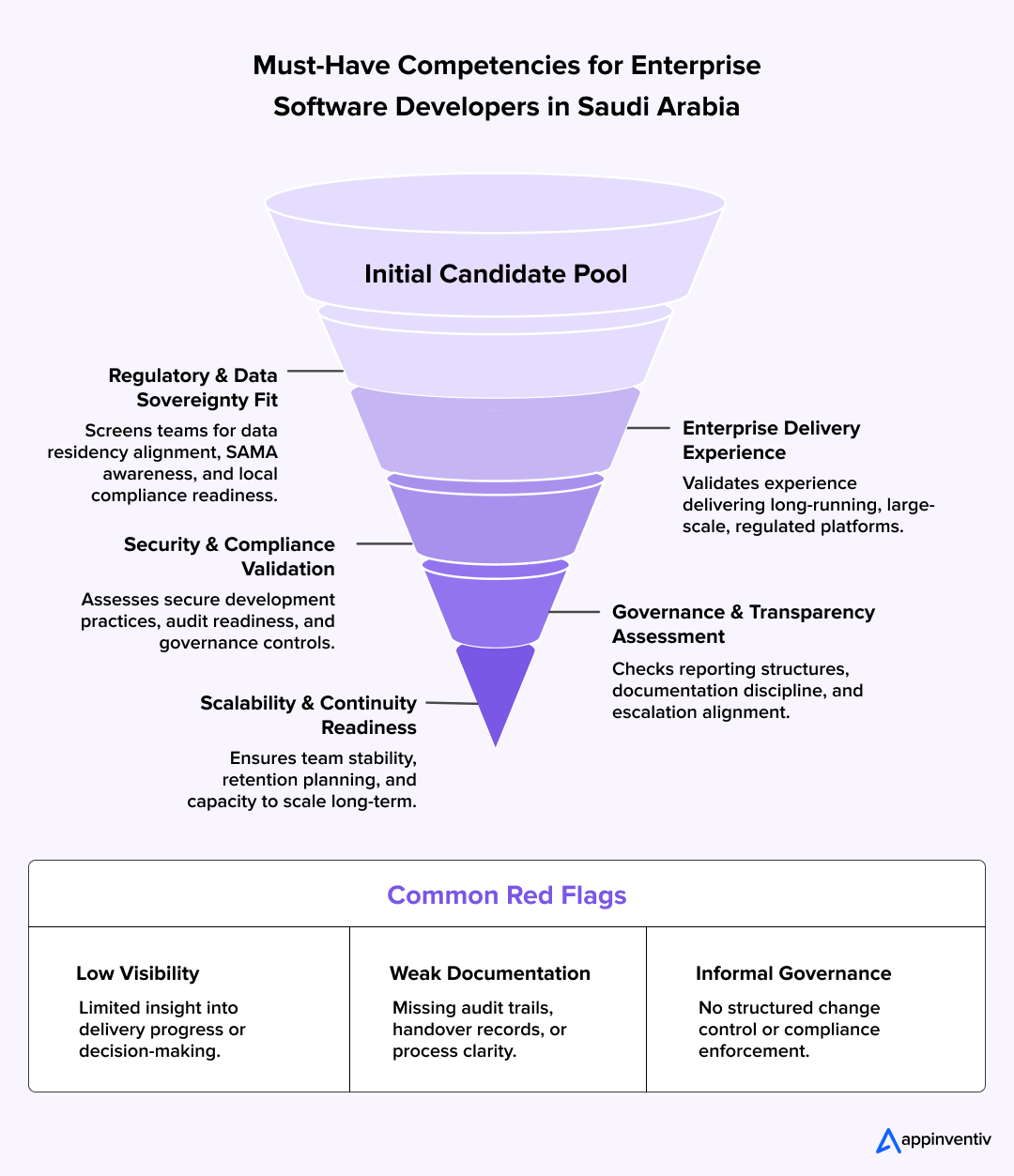
Before reviewing resumes or vendor pitches, lock in what cannot be compromised. Governance and compliance should filter candidates early.
Clarify:
- Data sovereignty and residency expectations
- Sector-specific regulations, such as SAMA
- Security standards and audit requirements
- Reporting and documentation obligations
This keeps unqualified options out of the process from the start.
Evaluate Enterprise Delivery Experience
Not all experience transfers well to enterprise environments. Look for teams that have worked on:
- Large, long-running software programs
- Regulated or compliance-driven systems
- Complex environments with multiple integrations
In practice, proven enterprise delivery matters more than certifications.
Assess Security and Compliance Capabilities
Security should show up in how teams actually work.
During evaluation:
- Review secure development practices and tools
- Ask how compliance is enforced during delivery
- Validate experience with audits and documentation
This helps avoid gaps that surface later.
Review Governance, Communication, and Transparency
Enterprise-ready teams operate with structure.
Assess:
- Reporting and progress tracking methods
- Ownership, escalation, and decision paths
- Documentation and knowledge transfer practices
Transparency is essential for maintaining control.
Validate Scalability and Team Continuity
Enterprise programs rarely stay static. Teams need to grow without disruption.
Consider:
- Ability to scale skills and capacity
- Retention and continuity planning
- Backup plans for critical roles
Scalability protects delivery timelines.
Look Beyond Cost and Short-Term Delivery
Cost matters, but short-term savings often create long-term risk.
Avoid decisions driven only by:
- Lowest initial pricing
- Aggressive timelines without governance clarity
- Limited visibility into team structure
Focus instead on partners aligned with enterprise risk and long-term goals.
Using a structured evaluation approach helps Saudi enterprises choose developers who can support secure, scalable, and sovereign software delivery over time.
Choose enterprise-ready teams built for governance, scale, and continuity.

Why Appinventiv Is a Strategic Enterprise Partner in Saudi Arabia
You usually feel it when a project becomes serious. Security teams want answers early. Compliance reviews stop being a formality. Operations ask what happens two or three years later.
For Saudi enterprises, choosing a software partner at this stage is no longer transactional. It directly affects stability, governance, and long-term risk. Appinventiv works in that space, where delivery has to hold up well beyond launch.
Over the last decade, Appinventiv has helped enterprises hire custom software developers in Saudi Arabia and supported large digital programs across the Middle East. The team has delivered over 1,000 projects across 35 industries and helped modernize hundreds of enterprise workflows.
That experience includes government and compliance-driven initiatives, backed by regional delivery centers and long-standing partnerships in the UAE. This regional presence helps keep governance tight and expectations clear.
Reliability is treated as a baseline. Platforms supported by Appinventiv consistently run at 99.90% SLA uptime for mission-critical systems. From a business standpoint, enterprises have also seen meaningful cost reductions through modernization and process optimization.
For enterprises modernizing national-scale platforms, hiring custom software developers in Saudi Arabia is now a governance and risk decision as much as a technology choice.
Frequently Asked Questions
Q. Is data sovereignty mandatory for enterprise software in KSA?
A. In many enterprise situations, yes. Saudi regulations expect sensitive data, especially in banking, healthcare, and government, to stay within the country. Even when rules are not explicit, enterprises are still expected to show clear data residency controls, strong access governance, and reliable audit trails to clear reviews and limit cross-border exposure.
Q. What makes a software company compliant in Saudi Arabia?
A. Compliance varies by sector, but the basics are consistent. This usually means alignment with SAMA guidelines, local data residency, secure development practices, audit readiness, and documented governance. When you hire custom software developers in Saudi Arabia, a compliant software company can clearly show how security, access control, logging, and change management are applied throughout everyday delivery.
Q. Why hire local software developers in Saudi Arabia?
A. Local developers understand how regulations work in practice, not just on paper. They are familiar with sovereignty rules, enterprise governance, and approval processes. This helps during audits, reviews, and change requests. For long-running programs, local presence lowers compliance risk, improves accountability, and makes collaboration with internal teams and regulators smoother.
Q. How much does it cost to build custom enterprise software in Saudi Arabia?
A. Most enterprises build land between $50,000 and $500,000 or higher, depending on scope. Cost is influenced by architecture complexity, security depth, compliance effort, integrations, and how long the program runs. Regulated or national platforms usually sit at the higher end due to ongoing governance, testing, and audit work.
Q. How long does it take to build enterprise-grade custom software in Saudi Arabia?
A. Timelines depend on scale and complexity. Smaller enterprise efforts may take three to six months. Larger or regulated platforms often run for twelve months or more. Discovery work, security reviews, integrations, and compliance checks add time, but they are necessary for stable, long-term enterprise systems.
Q. How do enterprises ensure SAMA audit readiness during software delivery?
A. Enterprise-grade delivery embeds audit logging, access governance, security testing, and compliance documentation into daily workflows, ensuring review readiness throughout development rather than at release.
Q. Where is enterprise data hosted for sovereignty compliance in Saudi Arabia?
A. Most regulated workloads operate on Saudi-based cloud regions or private data centers, ensuring residency, access control, and regulator-aligned auditability.

- In just 2 mins you will get a response
- Your idea is 100% protected by our Non Disclosure Agreement.

How to Build a Student Management System in Australia?
Key takeaways: Australia’s tightening regulatory landscape (TEQSA, ASQA, CRICOS) makes student management system development in Australia a compliance-driven necessity, not just a digital upgrade. Monetisation models such as SaaS subscriptions, institutional licensing, white-label partnerships, and hybrid pricing offer scalable commercial opportunities in Australia’s expanding EdTech market. Addressing challenges early - data privacy, legacy migration, multilingual…
Guide to Software Risk Management: Identifying and Mitigating Key Risks in Software Development
Key takeaways: Risk management is no longer a peripheral activity; it is a core component of Enterprise Risk Governance (ERG) that ensures software ROI. Successful projects define their risk appetite—the level of risk an organization is willing to accept—before the first line of code is written. By integrating risk assessment into the early discovery phase,…

Key takeaways: MVP to enterprise scaling requires planned architecture, governance, and cost controls for sustainable growth. Modular, reusable systems and automation can reduce development costs by 30–40%. Scaling should be triggered by repeatable demand and operational readiness, not just early traction. Avoid common pitfalls like premature scaling, overengineering, and lack of ownership clarity. Case studies…









