




















Hire Computer Vision Engineers: Reduce AI Development Costs by 45%

- Step-by-Step Process to Hire AI Computer Vision Engineers
- Key Roles and Responsibilities of AI Computer Vision Algorithm Engineers
- AI Computer Vision Engineer Skill Requirements
- Use Cases That Require AI Computer Vision Engineers
- Technical Interview Questions for AI Computer Vision Algorithm Engineers
- When to Hire an AI Computer Vision Algorithm Engineer
- Difference Between Algorithm Engineers, ML Engineers, and Vision Developers
- Red Flags to Watch For When Hiring AI Computer Vision Engineers
- Why Partner with Appinventiv for Computer Vision Services
- FAQs

Key takeaways:
- Start with the problem first. Define the use case, data, and deployment needs before hiring.
- Choose the right role mix. Algorithm engineers, ML engineers, and developers handle different parts of the system.
- Look beyond tools. Strong engineers focus on data quality, evaluation, and real-world performance.
- Follow a practical hiring flow. Define → map skills → pick hiring model → use real scenarios in interviews.
- Build a small team, not just one hire. Production systems need combined expertise across modeling, deployment, and integration.
If you’ve been looking into computer vision lately, you’ve probably noticed the shift. What once felt like a research-heavy space is now showing up in everyday products, from factory inspection lines to retail analytics and medical imaging tools.
The growth behind it is hard to ignore. According to Precedence Research, the market is expected to expand at over 30% CAGR, driven by businesses like yours relying more on automation and visual intelligence to solve real-world problems.
That said, hiring the right people is where things usually get tricky. Building a model is one thing. Getting it to work consistently with messy data, changing environments, and real users is something else entirely. Many teams only realize this when their first prototype starts behaving unpredictably.
This is where confusion often sets in. Should you hire someone focused on algorithms, someone who can handle production systems, or someone closer to product integration? Without a clear answer, your hiring process can slow down or move in the wrong direction.
In this guide, you’ll learn how to choose the right roles, evaluate skills, and structure interviews so you can build a computer vision team that works beyond the demo stage.
From algorithm design to production AI systems, Appinventiv helps enterprises hire computer vision engineers and launch scalable visual intelligence solutions faster.
Step-by-Step Process to Hire AI Computer Vision Engineers
Hiring for AI computer vision roles tends to be more nuanced than hiring for most software jobs. On paper, many candidates look similar. They list Python, PyTorch, and OpenCV. But once you start discussing real projects, the differences become obvious. Some engineers have spent time dealing with messy datasets, broken models, and real deployment environments. Others have mostly worked with curated examples or academic experiments.
Because of that, companies that plan to hire AI computer vision engineers usually slow the process down and look carefully at how candidates think through real problems. The goal is not simply to hire experts using the right tools, but to find someone who understands how visual AI behaves once it leaves a controlled environment.
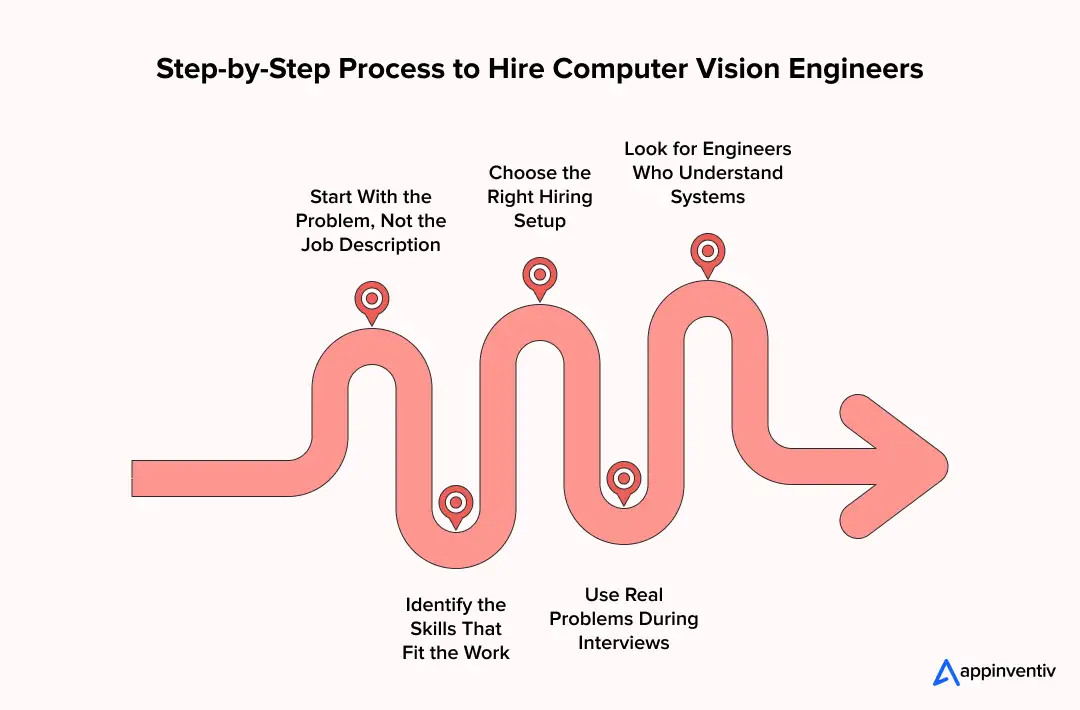
A practical hiring approach usually looks something like this.
1. Start With the Problem, Not the Job Description
A common mistake is writing a job description before fully understanding the problem. Computer vision projects vary widely by industry.
For example, a system that detects manufacturing defects requires very different expertise than a platform that analyzes store traffic or a robotics perception system.
Before attempting to hire AI engineers with expertise in computer vision, you’ll often need to step back and clarify a few things:
- What type of data will your system analyze?
- Does your task involve detection, segmentation, classification, or tracking?
- Where will the model run: cloud infrastructure, GPUs, or edge devices?
- How quickly does your system need to respond?
Once you have these answers, defining the right skill requirements becomes much easier.
2. Identify the Skills That Fit the Work
Computer vision work spans multiple stages, so when you start hiring, you should assess skills across key areas instead of focusing on tools alone.
| Category | Key Technologies / Skills |
|---|---|
| Frameworks | PyTorch, TensorFlow |
| Vision Libraries / APIs | OpenCV, Detectron2 |
| Model Types | YOLO, Faster R-CNN, U-Net |
| Data & Annotation | CVAT, LabelImg, Roboflow |
| Evaluation | IoU, mAP, precision, recall |
| Deployment | ONNX, TensorRT, Docker |
| Pipelines (MLOps) | MLflow, Kubeflow |
| Testing | Error analysis, edge-case validation |
| Cloud | AWS, GCP, Azure |
If you’re building production systems, you should prioritize candidates who’ve worked beyond model training, especially in data handling and deployment.
3. Choose the Right Hiring Setup
Not every company needs a large internal AI team immediately. Your hiring structure should depend on your project stage.
You might choose to:
- Hire one full-time engineer to start building internal expertise
- Bring in short-term specialists for specific tasks
- Work with an AI computer vision consultant during the early architecture phase
- Build a small vision system development team for long-term work
In some cases, you may also need to hire remote AI computer vision engineers if the expertise isn’t available locally. However, any of the above models can require too much effort, micromanaging, and might distract you from your actual business goals.
4. Use Real Problems During Interviews
Traditional interview questions won’t tell you how someone works with real systems.
Instead, you should ask candidates to walk through practical scenarios like:
- Why does a model suddenly lose accuracy with new images?
- How would they improve a dataset with labeling issues?
- How do they design a basic detection pipeline?
- What would they check if the inference speed drops?
These discussions help you understand how teams you’re considering think, not just what tools they know.
5. Look for Engineers Who Understand Systems
Computer vision doesn’t work in isolation. Once your model is ready, it becomes part of a larger system.
When you hire, you should look for engineers who’ve worked with:
- Backend teams building inference services
- Data teams managing image pipelines
- Product teams defining AI-driven features
- DevOps teams deploying models
If you’re building a complex platform, you’ll need engineers who can move comfortably between experimentation and production.
6. Hiring Models for AI Computer Vision Engineers
Once you’ve defined your requirements and evaluated skills, the next step is deciding both where to find talent and how to structure hiring. The right approach depends on your project scope, timeline, and internal capabilities.
Where to Find Talent
If you’re still shaping your hiring strategy, it can help if, before you start hiring AI developers for custom solutions, you narrow down your choice of platforms or resources you want to explore.
| Channel | Best For | What to Keep in Mind |
|---|---|---|
| Freelance Platforms | Quick access to specialists | High risk, requires extreme coordination and micromanagement |
| AI Communities (GitHub, Kaggle) | Finding hands-on engineers | Requires effort to evaluate and reach out. |
| Professional Networks (LinkedIn, Conferences) | Trusted referrals and experienced hires | Slower but more reliable sourcing |
Note: You can simply outsource to AI development firms like Appinventiv if you need a complete, ready-to-deploy team, instead of hiring individuals one by one. This reduces the risk factor to zero and gives you access to experts who have been building smart computer vision solutions for years.
8. Plan Your Budget
Once you define your hiring approach, the next step is understanding the cost. In computer vision, pricing varies widely because the work goes beyond coding into data, training, and deployment.
Hourly Rates by Experience:
| Experience Level | Typical Hourly Cost |
|---|---|
| Junior Engineer | $40 – $80 |
| Mid-Level Engineer | $80 – $150 |
| Senior / Specialist | $150 – $250+ |
Cost by Location:
| Region | Typical Hourly Cost |
|---|---|
| North America | $120 – $250+ |
| Europe | $100 – $200+ |
| South Asia | $40 – $100+ |
| Southeast Asia | $50 – $150+ |
Key Cost Drivers
- Project complexity: Real-time video systems cost more than basic image tasks
- Data preparation: Annotation and dataset cleanup can be time-intensive
- Deployment environment: Edge or GPU-based systems add complexity
- Experience level: Production-ready expertise comes at a premium
If you’re building for production, it’s usually better to prioritize experience over cost. Most delays and rework happen when systems fail outside controlled environments.
Note: These costs can vary based on factors like taxes, regional compliance requirements, data security regulations, and project-specific infrastructure needs. For instance, locations like India can be more cost-efficient for the same quality of talent compared to alternatives like North America.
Key Roles and Responsibilities of AI Computer Vision Algorithm Engineers
In day-to-day work, engineers usually move through a few key responsibilities. For instance:
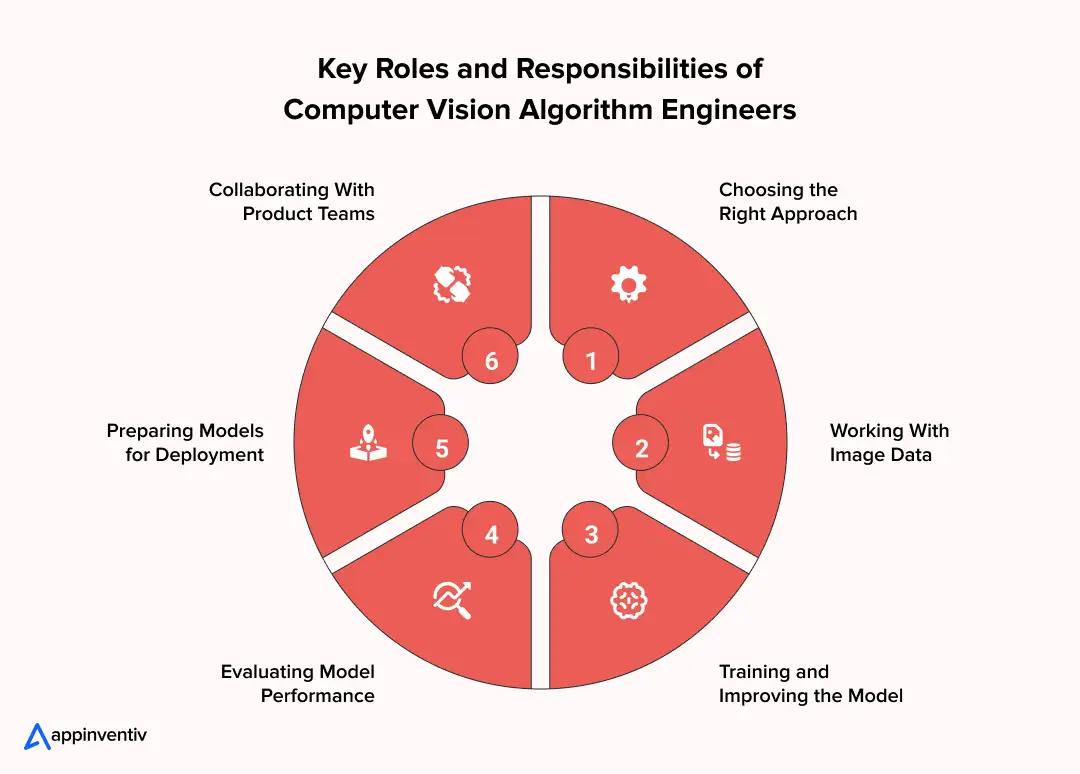
1. Choosing the Right Approach
Not every problem needs the same kind of model. A system that checks manufacturing defects will look very different from one that tracks objects in traffic footage.
Engineers usually spend time exploring different approaches before settling on one. Sometimes a simple model works. In other cases, the problem demands a deeper neural network.
Typical work at this stage includes:
- Trying different model types for detection or segmentation
- Comparing model accuracy against inference speed
- Testing whether classical image processing techniques are enough
- Selecting a model that fits the available hardware and dataset
This type of experimentation is one reason you’ll often look for computer vision engineers for AI rather than general developers.
2. Working With Image Data
Data quality can make or break a vision project. Images might be poorly labeled, inconsistent, or missing edge cases. Engineers often spend a surprising amount of time fixing the dataset before model training even begins.
Common tasks include:
- Reviewing and cleaning image datasets
- Setting rules for annotation teams
- Identifying gaps in the dataset
- Augmenting images to improve training results
When datasets become large or complicated, companies sometimes hire AI computer vision experts to help structure the training data.
3. Training and Improving the Model
Once the dataset is usable, the real experimentation begins. Engineers train models, evaluate the results, and adjust parameters until the system performs well enough.
That process usually involves:
- Training models using frameworks like PyTorch
- Adjusting training parameters such as batch size and learning rate
- Fine-tuning pretrained models for specific use cases
- Investigating errors and retraining models with improved datasets
Experienced machine vision engineers for AI products often bring practical insight at this stage, especially when models behave unpredictably.
4. Evaluating Model Performance
A model that looks good during testing can still fail once it sees new data. Engineers need to study how the system behaves in different situations.
Typical evaluation work includes:
- Measuring precision, recall, and related performance metrics
- Studying error patterns and confusion matrices
- Testing models with difficult edge cases
- Comparing performance across multiple experiments
Teams that are hiring computer vision engineers for production AI usually spend considerable time on this step before deploying anything.
5. Preparing Models for Deployment
After a model works reliably in testing, the next challenge is making it run efficiently. Real applications often require faster inference or smaller models.
Engineers may need to:
- Convert models to optimized formats such as ONNX
- Reduce model size through quantization or pruning
- Improve inference speed for video pipelines
- Adapt models for GPUs or edge devices
Organizations that expect large-scale deployment often hire dedicated AI computer vision engineers who understand these optimization techniques.
6. Collaborating With Product Teams
AI Computer vision engineers rarely work in isolation. Their models eventually become part of larger products or platforms.
In practice, this means working with other teams to:
- Integrate models into APIs or services
- Support product teams during feature development
- Coordinate with data teams on new training datasets
- Troubleshoot issues after deployment
For most companies, these engineers eventually become part of a broader AI vision development team responsible for maintaining the system over time.
When businesses start hiring AI computer vision developers, the role often sounds straightforward. In reality, the work spans data preparation, experimentation, and engineering. The most effective AI computer vision engineers are those who can move comfortably between those areas and keep the system running long after the first model is trained.
Work with experts who can handle data, models, and deployment end-to-end
AI Computer Vision Engineer Skill Requirements
When you start looking for AI computer vision engineers, the conversation usually begins with tools like Python, PyTorch, or OpenCV. But in real projects, the role goes far beyond frameworks.
Images are unpredictable. Lighting shifts, angles change, and datasets are rarely clean. That’s why you should evaluate skills across different layers of the system, not just model development.
Here’s a practical way to break that down:
| Layer | What You Should Look For | Common Technologies / Tools |
|---|---|---|
| Model Development | Building and training vision models | PyTorch, TensorFlow, Keras, OpenCV |
| Model Architectures | Understanding of detection, segmentation, classification | YOLO, Faster R-CNN, SSD, U-Net, Mask R-CNN |
| Data & Annotation | Handling messy datasets, labeling workflows, augmentation | CVAT, LabelImg, Roboflow, Supervisely |
| Evaluation & Testing | Measuring and debugging model performance | IoU, mAP, precision, recall, confusion matrix |
| Deployment & Optimization | Converting and optimizing models for production | ONNX, TensorRT, TorchScript, pruning, quantization |
| APIs & Integration | Connecting models to applications and services | REST APIs, FastAPI, Flask, OpenCV pipelines |
| MLOps & Pipelines | Automating training, versioning, and monitoring | MLflow, Kubeflow, Airflow |
| Infrastructure | Running models at scale on cloud or edge | AWS (SageMaker), GCP (Vertex AI), Azure ML, GPUs |
Alongside these tools, you should look for engineers who can:
- Work with imperfect, real-world datasets
- Run structured experiments and improve models iteratively
- Debug performance issues using metrics, not just accuracy
- Adapt models for speed, scale, and deployment constraints
When you’re hiring for production systems, experience across data, evaluation, and deployment usually matters more than familiarity with any single framework.
Use Cases That Require AI Computer Vision Engineers
In most cases, you don’t start with a hiring plan. You start with a bottleneck. Too many images to review, too much video to analyze, or too many documents to process manually.
That’s usually the point where you begin exploring computer vision. As the scope grows, you may hire AI computer vision engineers or choose to hire AI consultants with expertise in smart AI-powered computer vision solutions to guide early decisions before building a full team.
Here are some of the most common situations where you’ll need them:
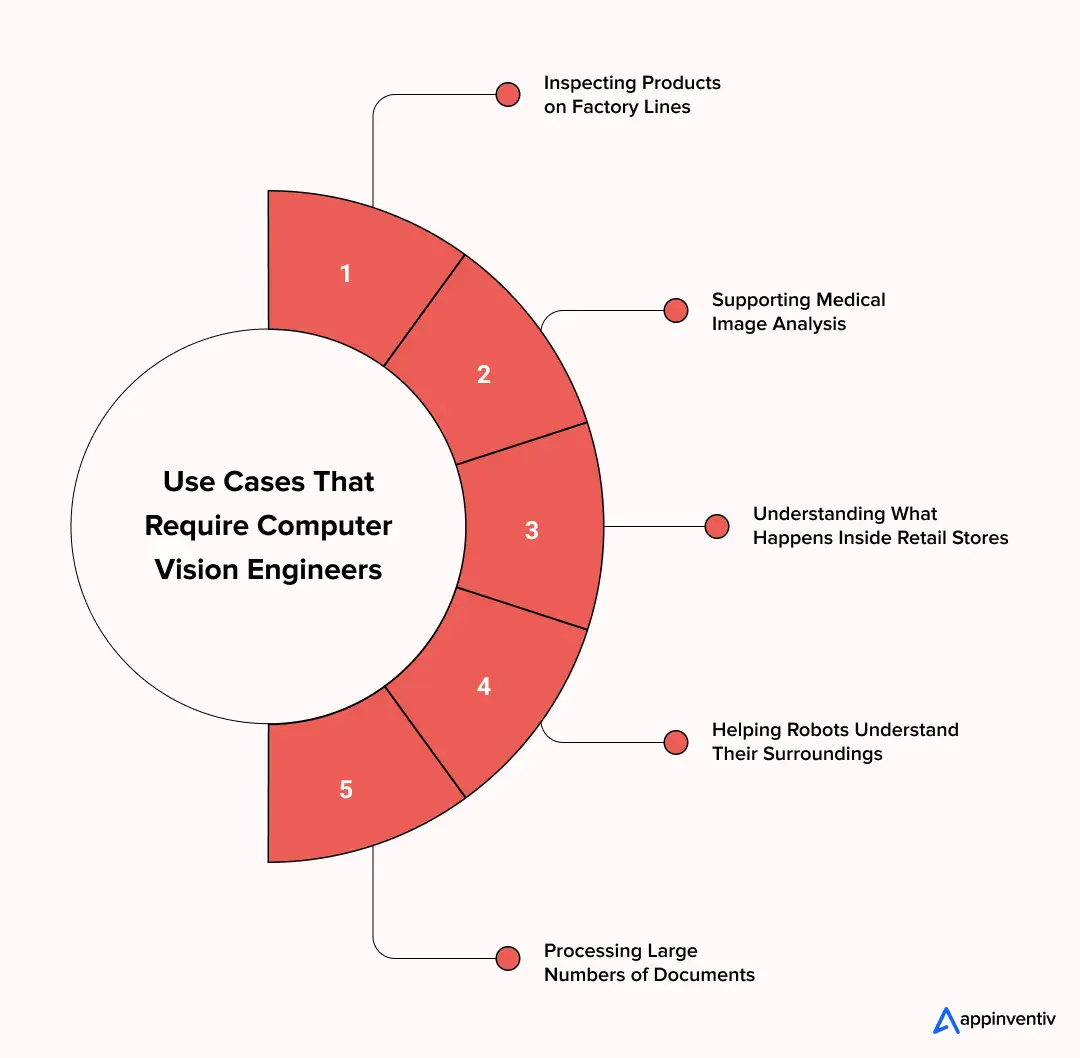
- Factory Inspection: Detect defects, missing components, or inconsistencies in production lines using real-time image analysis.
- Medical Imaging: Analyze CT scans, MRIs, or X-rays to detect patterns, segment regions, or assist clinical review.
- Retail Analytics: Track customer movement, measure footfall, and analyze in-store behavior using video data.
- Robotics & Automation: Enable object detection, tracking, and navigation for robots operating in dynamic environments.
- Document Processing: Extract text, identify fields, and convert scanned documents into structured data using OCR and vision models.
As visual data continues to grow, manual processes stop scaling. That’s typically when you move from experimentation to hiring and building systems that can handle this workload reliably.
Technical Interview Questions for AI Computer Vision Algorithm Engineers
When you sit down to interview someone for an AI computer vision role, it becomes obvious pretty quickly. Most candidates know the tools. Fewer have actually built something that worked outside a controlled setup.
That’s why good interviews lean on a handful of focused questions. Not too many. Just enough to see how the person thinks when things aren’t ideal.
Here are the ones that tend to separate real experience from surface-level familiarity.
1. Core Understanding of Vision Models
- Walk me through how a CNN processes an image.
Why it matters: You’re looking for more than surface-level answers. Strong candidates usually talk about kernels, feature maps, pooling, and how spatial information changes across layers.
- How do you decide between classification, detection, and segmentation?
Why it matters: This shows whether they can map a real problem to the right approach instead of defaulting to familiar methods.
2. Model Choices and Trade-offs
- When would you pick YOLO vs Faster R-CNN?
Why it matters: Good answers typically cover latency, throughput, object size sensitivity, and real-time vs batch processing scenarios.
- You have a model with good accuracy but high latency. What would you change?
Why it matters: Look for practical thinking like pruning, quantization, architecture changes, or inference optimizations.
3. Working With Real Data
- Your training data has noisy or incorrect labels. What do you do?
Why it matters: Experienced engineers usually mention relabeling strategies, identifying annotation issues, or filtering low-quality samples.
- You only have a small dataset. How would you improve results?
Why it matters: Expect discussion around augmentation, transfer learning, synthetic data, or narrowing the problem scope.
4. Evaluation and Debugging
- Which metrics do you trust for object detection, and why?
Why it matters: Strong answers include precision, recall, IoU, mAP, and when each metric can be misleading.
- Your model is producing too many false positives. How do you debug it?
Why it matters: Look for structured thinking, such as analyzing failure cases, adjusting thresholds, checking class imbalance, or reviewing dataset quality.
5. System Thinking
- Design a defect detection system for a production line.
Why it matters: This reveals whether they think beyond models. Good answers include data collection, annotation workflows, retraining loops, and deployment constraints.
- How would you handle real-time video inference at scale?
Why it matters: Look for discussion around frame sampling, batching, edge vs cloud decisions, GPU utilization, and pipeline bottlenecks.
In a real interview, you’ll notice something small but telling. Strong candidates don’t rush to answer. They pause, clarify assumptions, and sometimes push back on the problem.
That’s usually a sign they’ve worked on systems where things didn’t behave as expected.
Also Read: How to Hire Data Engineer Teams for Enterprise Success
When to Hire an AI Computer Vision Algorithm Engineer
Most teams don’t start by hiring. You usually begin by experimenting, maybe a quick model, maybe a basic integration, just enough to prove the idea works.
The real issues show up later. The model that worked in a demo starts failing with real-world images. Lighting changes, edge cases appear, and accuracy drops. That’s typically when you realize you need someone with deeper expertise.
Here are a few clear signals it’s time to bring in an AI computer vision algorithm engineer:
- Your Prototype Needs to Become a Product: If you’re moving beyond a proof of concept, you’ll need help improving accuracy, handling edge cases, and building repeatable pipelines.
- Model Performance is Inconsistent: When results vary across real-world data, you’ll need someone who can debug issues, refine datasets, and experiment with better approaches.
- You Need Real-Time Performance: If your system depends on speed, like video analytics or robotics, engineers can optimize models for latency, GPUs, or edge devices.
- Computer Vision is Core to Your Product: If visual AI is a key feature, you’ll need structured pipelines, reliable models, and clean integration into your product.
- Your Team Lacks Vision Expertise: If your current team is strong in software but new to vision systems, bringing in a specialist or consultant can prevent costly trial and error.
For many companies, the need becomes clear once the project moves beyond experimentation. When images or video start playing a central role in a product or workflow, that is usually the point where it makes sense to look for AI computer vision engineers who can turn early experiments into reliable systems.
Difference Between Algorithm Engineers, ML Engineers, and Vision Developers
When you start hiring, these roles can look similar on paper. But in practice, they sit at different stages of the same system. Mixing them up is one of the most common hiring mistakes.
Here’s a quick breakdown with the technical distinction:
| Role | Main Focus | Tech Stack / Tools | What They Handle | When You Need Them |
|---|---|---|---|---|
| AI Algorithm Engineer | Model accuracy | PyTorch, TensorFlow, OpenCV, CUDA | CNNs, YOLO, Faster R-CNN, U-Net, experimentation, dataset tuning | When you’re solving complex vision problems |
| ML Engineer | System reliability | ONNX, TensorRT, Docker, Kubernetes, MLflow | Pipelines, model deployment, scaling, monitoring, retraining | When you need production-ready systems |
| AI Computer Vision Developer | Product integration | OpenCV, REST APIs, Flask/FastAPI, mobile/web SDKs | Integrating models into apps, feature development, API connections | When adding vision features to products |
In practice, you’ll often start with an algorithm-focused role, then bring in ML engineers for scaling, and developers for product integration. Being clear on this upfront helps you avoid role overlap and hiring delays.
Red Flags to Watch For When Hiring AI Computer Vision Engineers
At first glance, most candidates look similar. Same tools, same frameworks, similar project descriptions. The difference usually shows up when you start discussing real work.
Over time, teams that hire AI computer vision engineers regularly begin to notice a few clear warning signs. Spotting these early can save a lot of time.
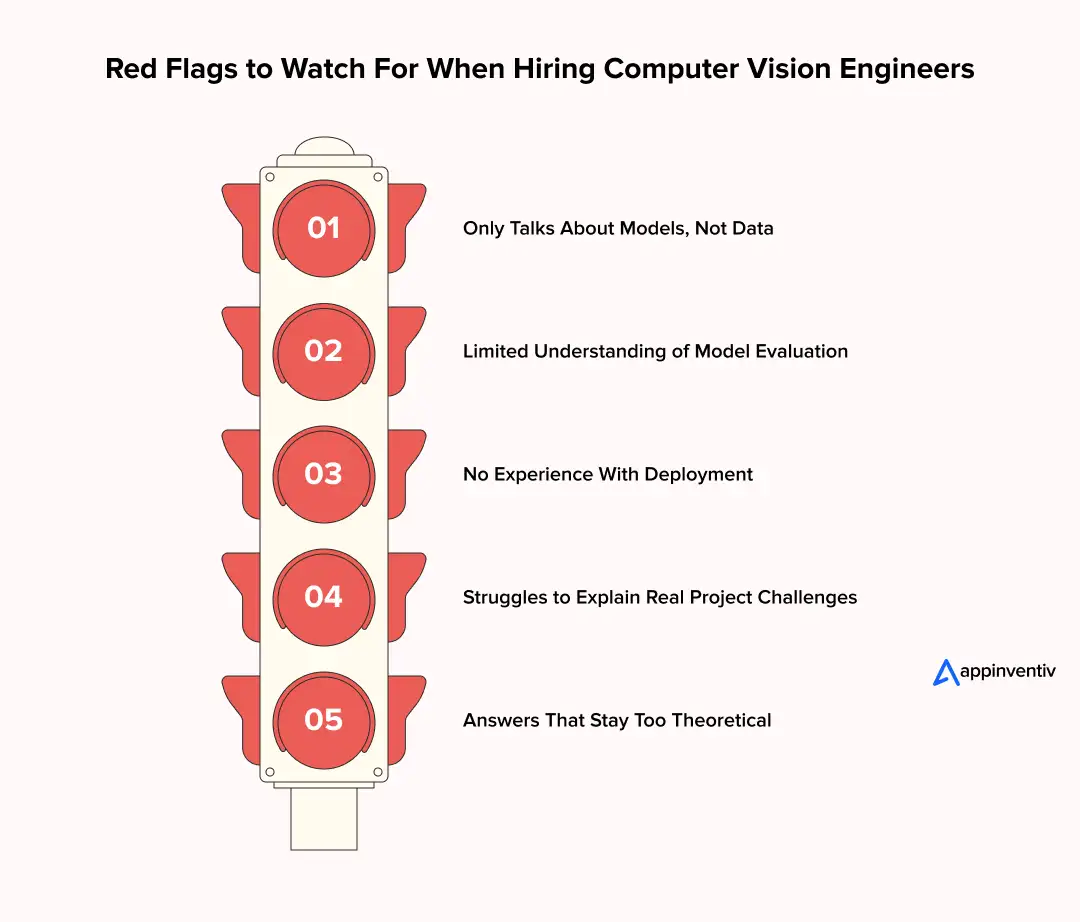
Common red flags to watch for:
- Focuses only on models, not data: Talks about architectures but ignores dataset quality, labeling issues, or edge cases. In real projects, data is usually where most problems come from.
- Relies only on accuracy for evaluation: Doesn’t mention metrics like precision, recall, or IoU. Limited understanding of how models actually behave in different scenarios.
- No exposure to deployment: Can train models, but hasn’t worked on making them run in production. No experience with inference speed, optimization, or real environments.
- Struggles to explain real project challenges: Can’t describe specific issues faced during past projects. Experienced engineers usually recall problems like data inconsistencies or model failures.
- Answers stay too theoretical: Explains concepts well but avoids practical details like debugging, system design, or implementation decisions.
In most cases, strong candidates naturally raise data issues, trade-offs, and deployment challenges without prompting. That’s usually a good signal that they’ve worked beyond controlled environments.
Hire engineers who can deliver real-world AI systems.
Why Partner with Appinventiv for Computer Vision Services
Most companies realize pretty quickly that building a computer vision system is not only about training a model. The harder part usually comes later. Data pipelines break, real images behave differently from training datasets, and models need constant tuning once they enter production. Appinventiv’s Computer Vision Services focus on solving these practical challenges so companies can move from experiments to systems that actually work in day-to-day operations.
The team has worked with organizations across a wide mix of sectors where visual data plays an important role. That includes retail, healthcare, manufacturing, logistics, and several others. Each industry brings its own challenges, from detecting defects on production lines to analyzing video streams in physical environments. With 35+ industries mastered, the experience helps teams approach computer vision projects with a clearer understanding of real-world constraints.
Behind these projects is a large engineering community. Appinventiv brings together 1600+ tech evangelists working across AI, data engineering, cloud platforms, and modern product development. Over time, these teams have contributed to 3000+ solutions designed and delivered, gaining exposure to a wide range of technical problems and deployment scenarios.
Planning to build a computer vision solution or scale an existing AI system? Connect with Appinventiv’s experts to explore how our computer vision services can help you turn computer vision ideas into reliable production systems.
FAQs
Q. What Skills Should a Computer Vision Engineer Have?
A. Companies planning to hire AI computer vision engineers usually look for a mix of machine learning knowledge and practical engineering skills. A strong candidate should understand image processing, deep learning models, and dataset preparation. Many enterprise AI computer vision engineers also work with tools like PyTorch, TensorFlow, and OpenCV. Experience deploying models and handling real datasets is equally important.
Q. How Do Companies Hire Engineers for AI Vision Systems?
A. Organizations typically follow a structured AI computer vision engineer hiring guide when they want to build an AI vision system development team. This process usually includes defining the use case, identifying the required skill set, conducting technical interviews, and evaluating candidates through practical tasks. Some companies also hire remote AI computer vision engineers or consultants for specialized projects.
Q. What Is the Difference Between ML Engineers and Computer Vision Engineers?
A. Machine learning engineers focus on building scalable ML pipelines and deploying models into production systems. In contrast, computer vision engineers for AI specialize in algorithms that interpret images and video. When you hire AI computer vision algorithm engineers, they usually expect deeper expertise in visual data processing, model training, and vision-specific architectures.
Q. How Many Engineers Are Required for Production Computer Vision Systems?
A. The number of engineers usually depends on the complexity of the system. A simple application might involve only one or two specialists. Larger projects often require an AI vision system development team that includes computer vision engineers for AI, machine learning engineers, and data engineers. Organizations hiring computer vision engineers for production AI often build small multidisciplinary teams to maintain system reliability.
Q. What Interview Tasks Should Be Used to Evaluate Computer Vision Engineers?
A. You’ll often evaluate candidates through practical exercises rather than theoretical questions. Tasks may include debugging a detection model, designing a vision pipeline, or analyzing dataset problems. These exercises help teams determine whether candidates meet the real AI computer vision engineer skill requirements needed for production systems.
Q. How Does Appinventiv Help Enterprises Build Computer Vision Teams?
A. Appinventiv supports companies that want to hire AI computer vision engineers or build a dedicated AI vision system development team. Through its computer vision services, the company helps organizations design system architecture, identify the right talent, and develop production-ready solutions. This approach allows enterprises to hire dedicated AI computer vision engineers and scale computer vision capabilities more efficiently.

- In just 2 mins you will get a response
- Your idea is 100% protected by our Non Disclosure Agreement.
AI Inventory Management in Australia: Benefits, Use Cases, and Implementation Strategies
Key takeaways: Traditional ERP planning reacts to history; AI predicts demand shifts, reallocates stock dynamically, and prevents costly stockouts across distributed Australian networks. AI in inventory management in Australia typically reduces inventory levels 20–40% while maintaining service targets, unlocking significant working capital across multi-state operations. Enterprise implementations usually range from AUD 70,000 to AUD 700,000+,…
How to Hire RAG Architects for Enterprise AI
Key takeaways: Define your RAG architecture scope to avoid misaligned hiring decisions Identify end-to-end architectural ownership across retrieval, governance, and scaling Evaluate deep technical capabilities beyond prompt engineering and tools Validate governance and compliance readiness at the retrieval layer Test system-level thinking through real-world failure scenarios Choose the right hiring model based on scale, risk,…
Key Takeaways: Healthcare chatbots in the UAE are moving beyond queries to support triage, patient communication, and real clinical workflows across hospitals. Effective healthcare chatbot development depends on clean data, strong system integrations, and alignment with regulations like DHA, DOH, and MOHAP. Development costs typically range from AED 147,000 to AED 1,470,000+, depending on complexity,…