



























Custom Software Development Cost in the Netherlands – A Regional Breakdown


- How Much Does Custom Software Development Cost in the Netherlands? A Comprehensive View
- Factors Affecting Custom Software Development Costs
- Hidden Software Development Costs
- Ways to Optimize Software Development Costs
- Revenue Models and Monetization Approaches
- Why Appinventiv for Custom Software Development in the Netherlands
- Frequently Asked Questions

Key takeaways:
- Custom software development cost in the Netherlands typically ranges from €35,000 to €400,000+, based on scope and delivery responsibility.
- Software development cost in the Netherlands varies by city, with Amsterdam at the higher end due to senior talent concentration.
- The key cost drivers include solution complexity, backend architecture, integrations, security, and GDPR compliance.
- Custom software development pricing in the Netherlands also depends on development stages, team structure, and project timelines.
- Budgets can be controlled through phased delivery, feature prioritization, and informed location and maintenance planning.
Across Europe, demand for tailored software continues to grow. The Netherlands stands out for its strong digital infrastructure, high adoption of cloud platforms, and a mature regulatory environment.
Businesses across industries now depend on custom-built software to manage operations, power customer-facing platforms, support internal workflows, and make informed decisions from data.
Because of this shift, conversations around software development cost in the Netherlands have changed. Cost is no longer a line item discussed only at the planning stage. It is part of wider investment decisions, long-term risk planning, and technology governance led by senior business and IT leaders.
The custom software development cost in the Netherlands varies significantly. Entry-level builds often start around €35,000 ($38,000), while large-scale, enterprise-grade software can exceed €400,000 ($435,000). These differences are driven by scope, architectural choices, compliance needs, and delivery expectations, not just development effort.
This Netherlands software development cost guide explains how those costs are formed. It breaks down custom software development pricing in the Netherlands using regional context, practical cost drivers, and realistic benchmarks to help organizations plan budgets with greater clarity and fewer assumptions.
In the Netherlands, software costs are shaped by compliance, delivery rigor, and long-term ownership. Appinventiv helps assess these factors early, before budgets are locked.
How Much Does Custom Software Development Cost in the Netherlands? A Comprehensive View
Cost discussions often start with a single number that rarely helps. In practice, software development cost in the Netherlands is shaped by multiple layers: complexity, delivery stages, team structure, location, and time commitment. Breaking these layers down gives a clearer picture of where budgets go and why they shift.
Cost Breakdown by Complexity Level
One of the strongest influences on the cost to build custom software in the Netherlands is overall complexity. This is not limited to feature count. It includes architectural depth, integration requirements, compliance exposure, and expectations around scalability and performance.
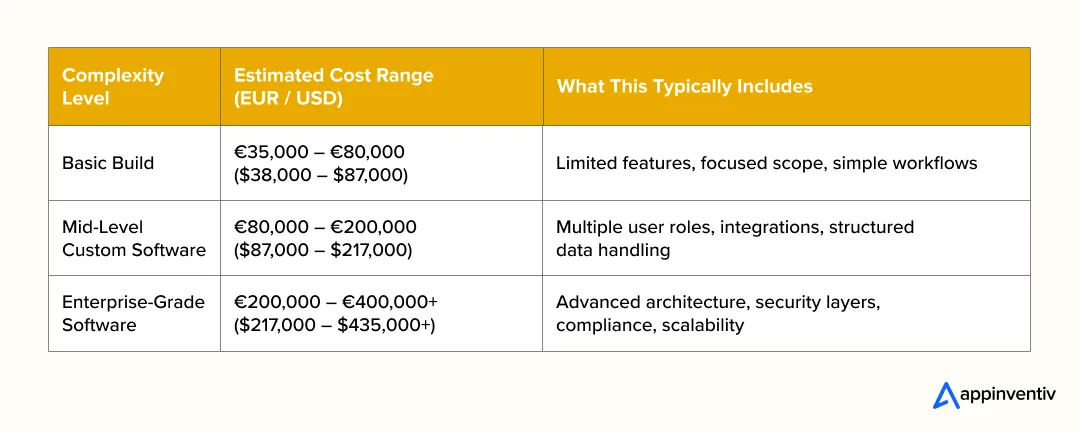
For larger organizations, enterprise software development cost in the Netherlands often sit at the higher end of this range. Governance reviews, documentation, and delivery accountability add measurable effort that is rarely optional.
Also Read: Cost to Build a Mobile App in the Netherlands
Cost Breakdown by Development Stages
Another way to understand custom software development pricing in the Netherlands is to look at how budgets are distributed across delivery stages. Coding is only part of the total cost.
| Development Stage | Typical Share of Budget | Cost Range (EUR / USD) | Focus Areas |
|---|---|---|---|
| Planning & Discovery | 8–12% | €5,000–€40,000 ($5,400–$43,500) | Requirements, architecture decisions |
| UI/UX Design | 10–15% | €7,000–€60,000 ($7,600–$65,000) | User flows, usability, validation |
| Development | 40–55% | €30,000–€220,000+ ($32,600–$239,000+) | Core build, integrations |
| Testing & Quality Assurance | 10–15% | €7,000–€60,000 ($7,600–$65,000) | Functional testing, security checks |
| Launch & Deployment | 5–8% | €4,000–€30,000 ($4,300–$32,600) | Cloud setup, release preparation |
| Ongoing Maintenance | Continuous | €1,500–€6,000/month ($1,600–$6,500/month) | Updates, fixes, support |
These distributions align with standard software project cost estimation practices followed by Dutch delivery teams.
How to Estimate Your Custom Software Development Budget
Cost estimation in the Netherlands is usually based on team composition and delivery responsibility, not just individual rates.
Most projects are priced at the company level, where the total cost includes:
- Engineering effort
- Product and delivery management
- Quality assurance
- Security and compliance oversight
- Documentation and support readiness
Hourly rates are still relevant, particularly for benchmarking. Netherlands software developer hourly rates typically range from €70 to €120 per hour ($75–$130), depending on role and seniority. However, final pricing is usually quoted as a project or phase-based cost, reflecting ownership and risk rather than raw hours.
A simplified estimation structure often looks like this:
**Total Cost = Delivery Team Cost
- Infrastructure and Hosting
- Third-Party Services
- Contingency**
For example, a mid-complexity project delivered over five months by a cross-functional team commonly falls between €120,000 and €180,000 ($130,000 – $195,000), depending on integrations, review cycles, and compliance requirements.
This is also where software development pricing models matter. Fixed-scope pricing offers predictability when requirements are stable. Time-and-materials pricing supports flexibility but requires closer financial governance.
Regional Cost Breakdown Within the Netherlands
Location plays a clear role in pricing. While the Netherlands is geographically compact, software development costs vary by city based on talent availability and operating costs.
Amsterdam
How much does software development cost in Amsterdam? It is a common question because of the highest-cost market. Strong concentration of senior engineers and architects. Pricing is often 10–20% higher than in other cities.
Utrecht
Slightly lower than Amsterdam. Popular for projects that need proximity to business hubs without peak pricing.
Eindhoven
Known for engineering and technical depth. Costs are often more balanced, especially for backend-heavy platforms.
Rotterdam and other cities
Competitive pricing with solid delivery quality. Often chosen for cost-sensitive builds without extreme complexity.
This variation explains why the custom software development cost in Amsterdam is usually higher than the national average.
Netherlands vs Other European Countries (Cost Comparison
Compared to other European markets, the Netherlands sits in the upper-mid to high cost range.
- Higher than Eastern European countries due to wages and compliance efforts
- Comparable to Germany and the Nordics for regulated projects
- More expensive than Southern Europe, but often preferred for delivery rigor
This positioning matters in the Netherlands IT development cost comparison exercises. Many organizations accept higher upfront costs in exchange for predictability, compliance readiness, and long-term stability.
Time and Effort Estimates
Time directly affects cost. In the Dutch market, longer timelines often reflect deeper review cycles, compliance checks, and stakeholder involvement rather than slow execution.
Typical delivery timelines include:
- Basic builds: 8–12 weeks
- Mid-complexity projects: 4–6 months
- Enterprise-scale software: 6–12 months or longer
Effort is distributed across product management, design, backend and frontend development, and quality assurance. As senior expertise and compliance oversight increase, the development team’s cost structure becomes heavier.
Understanding these layers makes the Netherlands’ software development cost comparisons more realistic and shifts planning discussions away from headline numbers toward informed, defensible decisions.
Factors Affecting Custom Software Development Costs
No two projects cost the same. Even within the Netherlands, pricing shifts based on a set of practical factors that affect effort, risk, and long-term responsibility. Understanding these variables helps explain why custom software development cost in the Netherlands can vary so widely between projects that appear similar on the surface.
Design Complexity and UI/UX Expectations
Design costs are often underestimated. In the Dutch market, UI and UX expectations are high. Software is expected to be clean, intuitive, and accessible across devices.
Complex user journeys, multiple user roles, and accessibility requirements increase design effort. This directly impacts software development cost in the Netherlands, especially for customer-facing platforms where usability influences adoption and retention.
Backend Complexity
Backend architecture is one of the strongest cost drivers in software development.
Projects involving:
- Multiple APIs
- High data volumes
- Role-based access
- Multi-tenant setups
require more planning, testing, and ongoing support. In regulated industries, backend decisions must also account for auditability and data handling rules, which increases the enterprise software development cost in the Netherlands over time.
Third-Party Integrations
Integrations often add hidden complexity. Dutch businesses frequently rely on local and regional services, including payment providers, banking interfaces, and logistics platforms.
For example, integrating payment flows with providers like Adyen requires additional validation, security checks, and ongoing updates. Each integration increases development effort and influences the overall cost to build custom software in the Netherlands.
Security and Data Compliance
Security is not optional in the Dutch market. Data protection obligations directly affect architecture, testing, and maintenance.
Software compliance with GDPR adds measurable effort across:
- Data storage design
- Access control
- Logging and audit trails
- Security testing
Meeting compliance requirements, including GDPR, affect software costs in the Netherlands beyond the build phase, with compliance’s impact on software costs continuing throughout the software lifecycle.
Platform Selection
Cost also depends on where the software will be used. Building for:
- Web only
- Mobile only
- Both web and mobile
changes the scope significantly. Native builds offer stronger performance but higher cost. Cross-platform approaches reduce initial spend but may introduce trade-offs later. These decisions influence custom software development pricing in the Netherlands more than many teams expect.
Advanced Technologies
Adding advanced capabilities such as AI-based analytics, automation, or predictive models increases both development and validation effort.
These features require:
- Specialized expertise
- Additional testing cycles
- Ongoing monitoring
As a result, projects using advanced technologies tend to sit at the higher end of the Netherlands’ software development cost comparisons, even when feature counts appear similar.
Feature Depth and Modularity
Finally, depth matters more than quantity. A small number of deeply integrated features often costs more than a long list of basic ones.
Modular design improves scalability and future updates, but it requires more upfront planning. This trade-off affects software project cost estimation and long-term maintenance budgets.
Taken together, these factors explain why software development pricing models in the Netherlands focus less on flat rates and more on scope clarity, delivery responsibility, and risk ownership.
If you are assessing custom software development cost in the Netherlands, Appinventiv helps define scope, timelines, and delivery responsibility with practical cost frameworks.

Hidden Software Development Costs
Initial build budgets rarely tell the full story. In many projects, the gap between estimated and actual spend appears after launch. These are not unexpected expenses. They are often overlooked. Understanding these hidden elements is essential when evaluating custom software development cost in the Netherlands.
Ongoing Maintenance and Support
Software does not stop evolving after release. Bug fixes, performance improvements, and security updates require continuous attention.
In the Netherlands, ongoing support costs are influenced by senior talent involvement and compliance monitoring. Over time, maintenance becomes a steady component of the overall software development cost in the Netherlands, not an occasional expense.
Hosting, Cloud Services, and Data Storage
Hosting costs scale with usage, data volume, and availability requirements. High uptime expectations and data residency rules often lead to higher infrastructure spending.
Cloud services, backups, and monitoring tools add recurring charges. These costs are part of the long-term development team cost structure, even though they sit outside core development work.
Security, Legal, and Licensing Fees
Compliance-related expenses are frequently underestimated.
Tools for access control, logging, encryption, and audits come with licensing fees. Legal reviews and compliance assessments also add cost. For regulated industries, GDPR and development cost in the Netherlands extends well beyond initial implementation.
Software Promotion and Internal Adoption
For customer-facing platforms, marketing and onboarding efforts are required to drive adoption. For internal software, training and change management are equally important.
These activities influence return timelines and should be factored into software project cost estimation, even though they are not part of development contracts.
Localization and Translation
Many Dutch businesses operate across multiple European markets. Supporting additional languages introduces design changes, content updates, and testing effort.
Localization costs may seem minor at first. Over time, they contribute meaningfully to custom software development pricing in the Netherlands, especially when updates are frequent.
Hidden costs rarely appear suddenly. They accumulate gradually. Factoring them in early leads to more accurate budgeting and fewer surprises once delivery moves beyond the launch phase.
Ways to Optimize Software Development Costs
Cost optimization does not mean cutting corners. In the Dutch market, it is more about making disciplined decisions early and avoiding unnecessary complexity later. The following approaches help control software development cost in the Netherlands without compromising quality or long-term viability.
Start with an MVP, Not the Full Scope
Many projects become expensive before they become useful. Building an MVP helps validate assumptions with real users before committing to a larger build.
For Dutch businesses, this approach reduces upfront exposure and improves software project cost estimation. It also creates room to adjust priorities based on feedback, rather than assumptions made months earlier.
Prioritize What Is Truly Needed
Not every requested feature adds business value. Feature-heavy roadmaps often inflate timelines and budgets without improving outcomes.
Focusing on essential workflows first helps manage custom software development pricing in the Netherlands. Secondary features can be planned as later phases, once usage patterns are clear and budgets are reassessed.
Choose Platforms and Frameworks Carefully
Platform decisions have long-term cost impact. Cross-platform frameworks can reduce initial build time and maintenance effort when requirements are aligned. Native development may still be necessary for performance-critical use cases.
The key is choosing based on business needs, not preference. These decisions directly affect the cost to build custom software in the Netherlands over time.
Balance Local Expertise with Global Delivery
Dutch teams bring strong domain knowledge and regulatory understanding. However, not all work requires local execution.
Many organizations manage costs through a hybrid delivery model. Strategic roles remain close to the business, while execution is supported by global teams. This approach enables a more balanced comparison of IT development costs in the Netherlands without compromising oversight or quality.
Select the Right Pricing Model Early
Pricing models influence how costs evolve. Fixed-scope models offer predictability but require stable requirements. Time-and-materials models provide flexibility but demand closer financial governance.
Choosing agile software development pricing models early helps avoid budget drift later in the project.
Cost optimization is rarely about doing less. It is about doing the right things at the right time. When applied thoughtfully, these practices help keep enterprise software development costs in the Netherlands aligned with business outcomes rather than inflated by avoidable decisions.
In a recent engagement with a European bank operating under strict regulatory conditions, Appinventiv delivered a custom AI-driven banking platform. The solution led to a 92% improvement in ATM service levels, a 35% reduction in manual processes, and a 20% increase in customer retention through predictive insights and automation.

Revenue Models and Monetization Approaches
Revenue planning often shapes early design and cost decisions. The way a product generates revenue influences architecture, security requirements, and long-term maintenance effort. For software built in the Dutch market, these choices also affect the overall custom software development cost in the Netherlands.
Common Revenue Models for Custom Software
Most business-focused platforms in the Netherlands follow one or more of the following models:
Subscription-based pricing
Users pay a recurring monthly or annual fee. This model supports predictable cash flow but requires strong uptime, regular updates, and ongoing support.
Licensing-based pricing
Software is licensed for a fixed period or usage scope. This is common for internal tools or regulated platforms where access control is critical.
SaaS pricing for business users
Pricing is often tiered based on user count, features, or data volume. This approach increases development effort upfront but allows revenue to scale over time.
These models directly influence software development pricing models and long-term operational costs.
Additional Monetization Strategies in the Netherlands
Beyond primary pricing models, many Dutch businesses introduce secondary revenue streams:
- Usage-based pricing tied to transactions or data volume
- Premium features or add-ons for advanced reporting or automation
- Integration fees for connecting with third-party services
- Support and maintenance contracts for regulated or mission-critical use cases
Each option affects software project cost estimation and should be evaluated alongside compliance and support obligations.
Revenue models are not just commercial decisions. They shape technical complexity, delivery timelines, and ongoing responsibility. Aligning monetization strategy early helps keep software development costs in the Netherlands predictable as the product evolves.
In the Netherlands, software costs are closely tied to compliance, delivery responsibility, and long-term ownership. Getting these decisions right early often determines whether projects stay controlled or drift over time.
Why Appinventiv for Custom Software Development in the Netherlands
Cost predictability and delivery discipline matter more in the Netherlands than broad claims of scale. Software decisions here are shaped by regulation, data protection, and long-term operational accountability. Appinventiv works with this reality in mind.
We support custom software development services in the Netherlands and European organizations that operate under GDPR, strict data governance rules, and structured procurement processes. Our teams plan software around compliance from the start—covering data access controls, audit readiness, documentation, and security testing. This approach helps prevent late-stage changes that often inflate software development costs in the Netherlands.
Rather than applying generic delivery models, Appinventiv focuses on what typically drives cost and risk in the Dutch market:
- Experience building software for regulated industries such as banking, healthcare, and education
- Strong emphasis on secure architectures and data residency considerations
- Delivery processes designed for phased rollouts, reviews, and governance checks
Our work in regulated European environments has been recognized through industry benchmarks such as the Deloitte Technology Fast 50 and Clutch Global Awards, reinforcing our focus on reliability and execution quality rather than volume.
For organizations in the Netherlands, partnering with Appinventiv means working with a team that understands how local compliance, technical rigor, and cost control intersect. The outcome is software that is planned with fewer assumptions, delivered with discipline, and built to operate confidently within the Dutch regulatory landscape.
Frequently Asked Questions
Q. What is the average software development cost in the Netherlands?
A. The average software development cost in the Netherlands typically falls between €80,000 and €200,000 (approximately $87,000–$217,000) for a mid-complexity project. This range reflects common business platforms with multiple user roles, integrations, and structured data handling.
Costs move lower for narrowly scoped builds and higher for platforms that require advanced security, compliance, or long-term scalability. The final number depends less on feature count and more on delivery responsibility, review cycles, and post-launch support expectations.
Q. Why is software development expensive in the Netherlands?
A. Software development in the Netherlands is considered expensive mainly due to three factors.
- First, developer rates are high. Senior engineers, architects, and security specialists command premium compensation.
- Second, regulatory requirements add effort. GDPR compliance affects design, testing, and ongoing maintenance.
- Third, delivery standards are high. Stakeholders expect reliability, documentation, and predictable operations.
Together, these factors raise the overall custom software development cost in the Netherlands, even when scope appears comparable to projects in other regions.
Q. Does location affect software development pricing in the Netherlands?
A. Yes. Location has a measurable impact on custom software development pricing in the Netherlands.
Amsterdam sits at the top of the pricing range. Other cities such as Utrecht, Eindhoven, and Rotterdam offer slightly lower rates while maintaining strong technical quality. Many organizations balance cost and expertise through hybrid delivery models, combining local leadership with distributed execution.
This approach often improves Netherlands IT development cost comparison outcomes without reducing control.
Q. What factors influence software development cost in the Netherlands?
A. Several factors shape pricing decisions:
- Design and UX complexity
- Backend architecture and data handling needs
- Number and depth of third-party integrations
- Security and compliance obligations
- Platform selection (web, mobile, or both)
- Delivery timeline and team seniority
These cost drivers in software development explain why similar projects can end up with very different budgets.
Q. What is included in custom software development pricing?
A. Standard custom software development pricing in the Netherlands usually includes:
- Requirements analysis and planning
- UI/UX design
- Backend and frontend development
- Testing and quality assurance
- Deployment support
However, pricing may or may not include hosting, long-term maintenance, compliance audits, or feature enhancements. Clarifying what is included early helps avoid misunderstandings during software project cost estimation.
Q. What hidden costs should I expect in software development projects?
A. Hidden costs rarely appear immediately. They accumulate over time.
Common examples include:
- Ongoing maintenance and support
- Cloud hosting and monitoring tools
- Security updates and compliance reviews
- Internal training and onboarding
- Feature adjustments after launch
In regulated environments, GDPR and development costs in the Netherlands often continue well beyond initial delivery. Accounting for these elements early leads to more accurate planning and fewer budget surprises later.

- In just 2 mins you will get a response
- Your idea is 100% protected by our Non Disclosure Agreement.
Maritime Insurance Claim Software Development for UAE Ports, Insurers, and Logistics Networks
Key takeaways: Manual claims management is too slow for the UAE’s high-volume ports; digital solutions streamline processes and reduce errors. Maritime insurance claim software centralizes data, automates workflows, and ensures compliance with UAE regulations and Takaful principles. Real-time integration with port and vessel systems enables faster claim registration, validation, and settlement. Advanced analytics and risk…

How to Build a Student Management System in Australia?
Key takeaways: Australia’s tightening regulatory landscape (TEQSA, ASQA, CRICOS) makes student management system development in Australia a compliance-driven necessity, not just a digital upgrade. Monetisation models such as SaaS subscriptions, institutional licensing, white-label partnerships, and hybrid pricing offer scalable commercial opportunities in Australia’s expanding EdTech market. Addressing challenges early - data privacy, legacy migration, multilingual…

Guide to Software Risk Management: Identifying and Mitigating Key Risks in Software Development
Key takeaways: Risk management is no longer a peripheral activity; it is a core component of Enterprise Risk Governance (ERG) that ensures software ROI. Successful projects define their risk appetite—the level of risk an organization is willing to accept—before the first line of code is written. By integrating risk assessment into the early discovery phase,…