

























How Much Does it Cost to Develop a Generative AI App?

- An Overview of Average Generative AI App Development Costs in 2026
- How to Approach Generative AI Development Cost Estimation?
- Key Factors Affecting Generative AI App Development Cost
- Hidden Costs You Shouldn’t Ignore in Generative AI Projects
- Examples of Generative AI App Types and What They Typically Cost
- How to Optimize Generative AI App Development Costs Without Slowing Innovation?
- Step-by-Step Generative Artificial Intelligence Application Development Process (& Costs)
- Build vs Buy vs Extend: Choosing the Right Generative AI Path
- How Do Generative AI Apps Make Money?
- How Appinventiv Helps Enterprises Control Generative AI App Development Costs?
- Frequently Asked Questions

Key Takeaways
- The cost of Generative AI application development ranges between $40,000 to $400,000+, depending on complexity, integrations, and security needs.
- McKinsey reports 64% of companies say AI is driving their innovation, emphasizing the strategic role of generative AI.
- Choosing the right generative AI model stack and optimizing data governance can significantly reduce project costs and complexity.
- Generative AI apps are monetized through subscriptions, licensing, data monetization, and custom solutions, offering various revenue opportunities.
Let’s picture this. You are sitting in a leadership meeting, coffee going cold, when someone asks, “So what is the cost to develop a Generative AI app for us?” All eyes turn your way. You know a vague answer will not survive a CFO review.
Generative AI has moved past experimentation. Boards now expect production-ready outcomes, not endless pilots. That means clear visibility into generative AI software development cost, realistic timelines, and defensible budgets. And that is where most organizations struggle. Traditional software costing models miss the real drivers behind the cost of implementing generative AI, from model operations to data governance and safety layers.
This guide breaks down the generative AI app development cost for businesses planning serious deployment. You will see the cost of developing Generative AI solutions across different complexity levels, understand enterprise generative AI development cost considerations, and learn how Generative AI development cost estimation actually works in real projects.
If you lead digital transformation, this is built for you. By the end, you will have a grounded view of investment, risk, and the real benefits of Generative AI app development cost decisions before approving the first build.
Only 53% of AI prototypes make it to production. Maximize your investment by developing scalable, effective solutions.

An Overview of Average Generative AI App Development Costs in 2026
For most enterprises, the cost to develop a Generative AI app typically ranges from $40,000 to $400,000+. The gap depends on complexity, integrations, and compliance needs.
Here’s a simple way to look at custom Generative AI development pricing:
| Complexity Level | Typical Scenario | Estimated Cost Range | Indicative Timeline |
|---|---|---|---|
| Basic | Single-feature chatbot or content helper for one team | $40,000 to $150,000 | 3 to 4 months |
| Moderate | Domain-specific assistant with integrations and analytics | $150,000 to $250,000 | 4 to 7 months |
| Advanced / Enterprise | Multi-use-case AI platform with orchestration and governance | $250,000 to $400,000+ | 7 to 12+ months |
How to Approach Generative AI Development Cost Estimation?
At some point, every discussion on generative AI comes down to the same request:
“Give me a number I can work with.”
You will never get a single perfect figure on day one. But you can get to a structured generative AI development cost estimation that is honest, defensible, and easy to refine.
A useful way to think about the generative AI app cost is this simple equation:
Total Cost = Build Cost + AI & Infra Cost + Data & Governance Cost
It looks basic, but it forces everyone in the room to look beyond just “development hours.”
A Simple Example with Numbers
Let’s take a mid-sized generative AI project for an enterprise support assistant.
- A 5-month build with a blended team of four people
(architect, backend engineer, frontend engineer, and QA / PM). - Assume a blended rate of $70 per hour.
Rough build effort:
- 4 people × 5 months × 4 weeks × 40 hours
- That is 3,200 hours in total.
- At $70 per hour, your build cost is about $224,000.
Now add a realistic allowance for AI and infrastructure:
- Model and API usage, vector DB, and cloud infra during build and early rollout
- Say $4,000 per month over 6 months.
- That is $24,000 in AI and infra cost.
Then include data and governance work:
- Data assessment, cleaning, setting up retrieval, access rules, safety layer, and compliance review
- Let’s assume $40,000 for this stream.
Your high-level generative AI development cost estimation becomes:
- Build cost: $224,000
- AI and infra cost: $24,000
- Data and governance cost: $40,000
Total estimated cost for one year ≈ $288,000
This is not a final quote, but it is a structured starting point. You can now adjust your generative AI development cost estimation based on your scope, risk appetite, and internal capabilities, instead of debating one vague number in isolation.
Key Factors Affecting Generative AI App Development Cost
Gartner research shows that only 53% of AI prototypes make it to production, highlighting the importance of understanding and managing cost drivers early.
Complexity decides everything. A focused assistant built for one workflow carries a very different investment profile than a multi-tenant platform running across business units. That is why any Generative AI app development cost breakdown must begin with complexity, not just feature lists.
Let’s walk through how this plays out in real enterprise builds.
Basic Generative AI Applications
This is where most organizations start. One use case. One workflow. One clear outcome.
A common example is the cost to develop a Generative AI chatbot app for internal Q&A or simple content assistance. Standard RAG now sits in this tier as a default capability, not an advanced add-on.
Typical setup:
- Single-channel chat or prompt interface
- Retrieval over one knowledge source
- Secure user access
- Basic usage tracking
These solutions work well for early pilots and departmental experiments. They also form the foundation for teams evaluating the cost to build a Generative AI MVP app before committing to scale.
Average cost range: $40,000 to $150,000
Short story here. Basic apps answer questions. They do not run operations yet.
Moderately Complex GenAI Applications
This is where AI shifts from assistant to operator.
Moderate implementations plug into internal systems and support multiple teams. The Key features of Generative AI app development at this level go beyond retrieval and chat.
What changes:
- Multi-source data access
- Role-based responses
- Saved prompt and workflow templates
- Analytics and feedback loops
Two enterprise-grade capabilities now become essential.
Agentic Tool-Use: The AI can independently call ERP, CRM, or ticketing APIs to complete tasks, not just recommend actions.
Enterprise Memory and Context Injection
The system retains organizational knowledge, prior interactions, and workflow state so responses remain consistent across sessions and departments.
This tier supports high-impact Use cases of Generative AI development across customer support, sales enablement, HR, and internal operations.
Average cost range: $150,000 to $250,000
At this stage, AI does work. Not just conversation.
Highly Complex Enterprise GenAI Platforms
Advanced deployments represent the enterprise AI layer vision.
Multiple business units. Multiple workflows. Multiple models. One governed foundation. This is where enterprise generative AI development cost reflects investment in orchestration, security, compliance, and observability.
Key features of Generative AI app development at this level include:
- Multi-channel access
- Multi-model orchestration
- Fine-grained access controls
- Approval and audit chains
- Full telemetry and monitoring
A defining capability here is Self-Healing Workflows. The AI detects its own failure, re-runs logic, or escalates to human review without breaking business operations. This is increasingly required in finance, healthcare, and other regulated environments.
Average cost range: $250,000 to $400,000+
Here, AI becomes infrastructure. Not a tool.
Generative AI Development Pricing Model and Model Routing Strategy
A modern generative AI development pricing model is no longer built around one giant model handling every request. Enterprises are moving toward Model Routing architectures to control generative AI software development cost at scale.
The idea is simple. A routing layer inspects each request.
- Simple tasks like classification, summarization, or retrieval go to efficient 8B parameter models with low inference cost.
- Complex reasoning, multi-step analysis, or high-risk decisions route to 400B+ parameter models with higher cost and higher accuracy.
This Model Routing strategy keeps performance high where it matters and spending low where it does not. Over time, it becomes one of the most effective levers for optimizing enterprise generative AI development cost while maintaining quality and reliability.
Data, Security, and Governance Effort
No generative AI system reaches production without governance. Light deployments need basic access control and retrieval setup. Moderate environments require data mapping, masking, structured logs, and monitoring.
Highly regulated industries add audits, red-teaming, compliance enforcement, and policy controls. This layer determines whether a pilot stays a demo or becomes a trusted enterprise system.
Location and Team Influence on Cost
Finally, people multiply the cost. Team composition, AI engineering maturity, and delivery geography directly influence generative AI software development cost. Combining experienced AI architects with cost-efficient delivery regions remains one of the strongest levers for controlling long-term investment.
Hidden Costs You Shouldn’t Ignore in Generative AI Projects
On paper, build costs look straightforward. In reality, several hidden elements quietly shape the cost of Generative AI application development long after development starts.
These factors directly influence the cost of generative AI software development and are often the reason early budgets miss the mark.
Understanding these factors affecting Generative AI app development cost helps enterprises plan realistic investments and avoid late-stage overruns.
| Hidden Cost Factor | What It Covers | Typical Cost Range |
|---|---|---|
| Evaluation and AI Quality Assurance | Response testing, evaluation datasets, human review, continuous answer scoring | 10% to 20% of the total build cost |
| Token Scaling and Usage Growth | Rising model inference spend as user adoption grows, inefficient prompt design, oversized model calls | A few hundred to tens of thousands per month |
| AI Infrastructure and Model Usage | Model tokens, cloud hosting, vector databases, orchestration layers | A few hundred to tens of thousands per month |
| MLOps and LLMOps Foundations | Model deployment pipelines, version control, observability, rollback systems, and performance tracking | $20,000 to $80,000+ setup |
| Human-in-the-Loop Oversight | Manual review for sensitive responses, escalation workflows, and compliance sign-offs | $15,000 to $60,000+ depending on domain risk |
| Safety, Compliance, and Guardrails | Policy controls, hallucination prevention, red-teaming, and audit readiness | $20,000 to $100,000+ |
| Shadow AI Governance | Guardrail layers that prevent employees from leaking sensitive data through AI tools | $20,000 to $50,000 |
| Change Management and User Adoption | Training, workflow updates, internal rollout programs | 10% to 20% of the program budget |
| Continuous Improvement | Prompt tuning, model upgrades, and new integrations | 15% to 25% of the build cost annually |
| Legal, Data, and Vendor Agreements | AI provider contracts, IP clarification, privacy policy updates | Variable based on complexity |
| Prompt Caching Optimization | Storing frequent prompt-response patterns to reduce repeated model calls and lower recurring inference spend | Up to 30% recurring cost reduction |
Examples of Generative AI App Types and What They Typically Cost
Below are examples of generative AI apps that are shaping how teams work today. As per a report by McKinsey, 64% of companies say AI is enabling their organization’s innovation, highlighting the growing importance of AI-driven solutions.
Their actual build costs are confidential, but we can estimate the enterprise generative AI development cost to build similar solutions in terms of scope and complexity.
This will help you benchmark your own initiative against what’s already working in the market.
Enterprise AI Assistants
ChatGPT, Gemini, and Claude-style assistants are now used for document summarization, internal Q&A, and knowledge discovery. A similar in-house assistant connects to internal data stores, email systems, ticketing tools, and access controls.
Typical custom Generative AI development cost: $180,000 to $400,000+
Workplace Knowledge Copilots
Tools like Microsoft Copilot and Notion AI support daily workflows by drafting content, summarizing meetings, and retrieving knowledge. Internal versions integrate with document repositories, project tools, and collaboration platforms.
Typical cost: $200,000 to $450,000+
Appinventiv parallel:
Solutions like YouComm in healthcare and MyExec, an AI business consultant, follow a similar pattern—AI sitting on top of critical workflows to assist nurses, clinicians, and business leaders with faster decision-making, alerts, and guided actions.
Generative AI Content Studios
Marketing-focused solutions generate copy, images, and campaign assets within brand and compliance rules. They include templates, approval workflows, and CMS integrations.
Typical cost: $150,000 to $350,000+
AI Customer Support Assistants
Support copilots read from FAQs, CRM systems, and past tickets to draft responses and resolve routine queries.
Typical cost to develop a Generative AI chatbot app: $150,000 to $300,000+
Appinventiv parallel:
The Mudra app uses AI and chatbot capabilities for financial insights and interactions. It sits close to what an enterprise-grade support assistant requires in terms of logic, security, and integration.
Developer and Operations Copilots
Engineering copilots assist with code explanation, debugging, and incident analysis by connecting to repositories and observability tools.
Typical cost: $220,000 to $450,000+
Across all categories, the Generative AI app development cost for businesses rises with integration depth, data sensitivity, and governance requirements.
How to Optimize Generative AI App Development Costs Without Slowing Innovation?
Generative AI projects do not have to be budget black holes. With a few deliberate choices, you can keep costs under control and still move fast. Below are practical ways to reduce spending without cutting the outcomes that matter.
1. Start with One High-Value Use Case
Trying to “do gen AI everywhere” in the first release is the fastest way to overspend. Instead, pick a single use case where impact is visible and measurable.
Good candidates are repeatable workflows with clear metrics. For example, first response time in support, time to prepare sales proposals, or hours spent reading internal documents.
Once that use case proves itself, you can reuse much of the foundation for the next one.
2. Build a Focused MVP, Not a Full Platform
You do not need every feature on day one. An MVP for generative AI should do one job very well for a defined group of users. Keep the first version tight on:
- User journeys
- Integrations
- Data sources
This lowers the cost to build a generative AI MVP app and gives you real-world feedback early. You can add channels, workflows, and automation once you know people actually rely on it.
3. Choose Models and Architecture with Cost in Mind
Bigger models are not always better. For many internal tasks, smaller or specialised models are cheaper, faster, and accurate enough. A cost-aware setup usually:
- Uses powerful LLMs only where needed
- Routes simple tasks to lighter or cheaper models
- Keeps an option to change providers if pricing or quality shifts
Designing this flexibility at the start costs less than re-architecting everything after your first large invoice.
4. Reuse a Common GenAI Foundation Across Use Cases
Treat your first project as the foundation for many, not a one-off build. You can reuse:
- Authentication and user management
- Vector databases and data connectors
- Guardrails, logging, and monitoring
- Core UI patterns for chat, search, and summarisation
The more you reuse, the lower the marginal cost of each new use case. This is where generative AI begins to look like a capability, not a string of isolated pilots.
5. Clean and Prioritize Data Early
Poor data is expensive in two ways. It slows development and makes outputs less reliable.
You do not need every system connected on day one. Pick the few that matter most, clean that data first, and model clear access rules.
Doing this early reduces rework later and avoids frustration when users receive outdated or inconsistent answers.
6. Phase Rollout to Match Budget and Risk
Instead of one large launch, plan your journey in stages:
- Discovery and PoC – validate the idea and basic approach.
- Pilot – test with a defined user group, refine prompts and flows.
- Scale – expand to more teams, locations, or channels.
Each step has its own budget and exit criteria. That makes approvals easier and keeps spending tied to proof, not just promise.
7. Align Team Structure with Scope
You do not always need a large, dedicated team from day one. For a narrow pilot, a smaller, cross-functional group may be enough.
As the scope grows, you can add deeper skills such as dedicated data engineering, security, and MLOps. Many enterprises also mix internal talent with external specialists to avoid building every capability in-house. The goal is simple: right skills, right size, right time.
8. Watch Run Costs as Closely as Build Costs
Generative AI has a “second budget” that starts after launch: tokens, compute, and storage. Put guardrails on:
- Maximum context length where it is not needed
- Number of calls per workflow
- Which use cases use which model tier
Simple changes, like better prompt design or caching frequent responses, can significantly lower monthly spend over time.
Appinventiv’s AI solutions empower businesses to transform with cutting-edge machine learning models.

Step-by-Step Generative Artificial Intelligence Application Development Process (& Costs)
The development journey for a generative AI app is not a single leap. It is a sequence of phases, each answering a different question: Should we build this? → Can it work? → Will it scale?
As the AI market is projected to be valued at $1.68 trillion by 2031, the stakes are high for getting it right.
Here is how the generative artificial intelligence application development process moves a typical enterprise-grade app from idea to production.
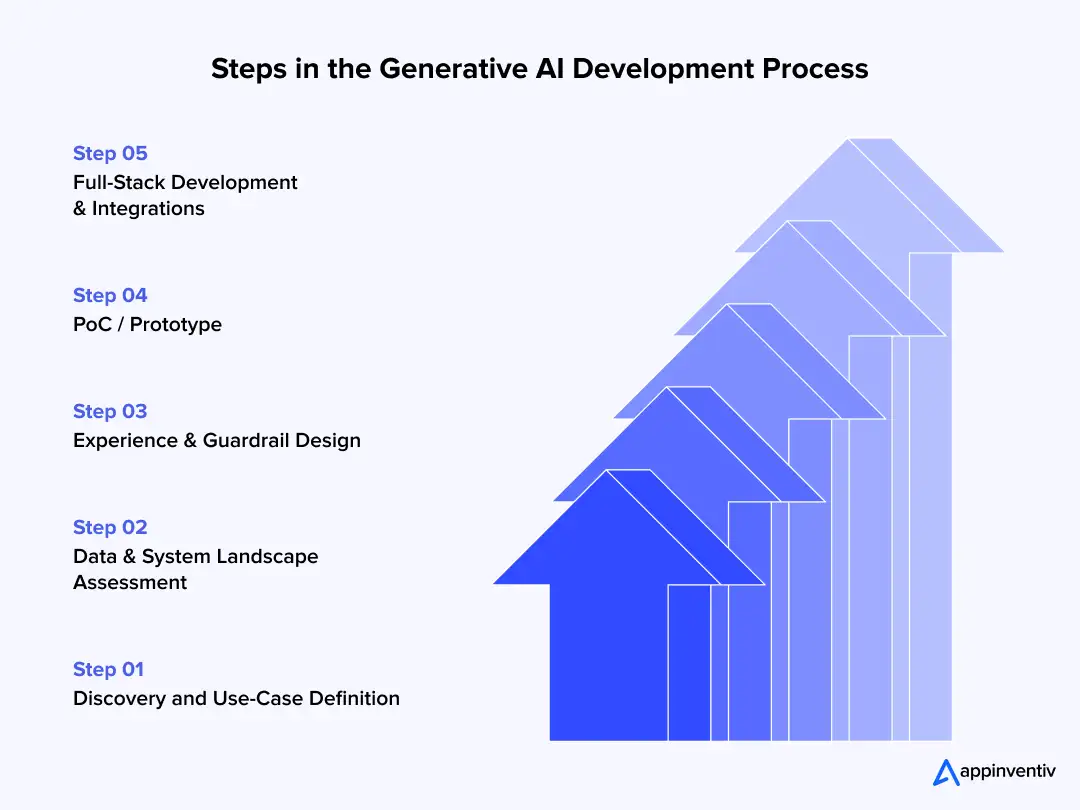
Step 1: Discovery and Use-Case Definition
This is where you turn “we want to use generative AI” into a focused problem statement. The team works with stakeholders to:
- Identify high-impact use cases of generative AI development and prioritise one or two to start with
- Define user personas, workflows, and success metrics
- Map current tools and data sources the app will need to tap into
- Outline risks, compliance concerns, and constraints
The outcome is a clear, documented scope: what you will build, for whom, and why it matters. Without this, cost and expectations drift very quickly once development starts.
Step 2: Data and System Landscape Assessment
Once the use case is clear, the next question is: What can the AI actually see and use? In this phase, teams:
- Inventory relevant data sources (CRMs, ERPs, document stores, ticketing tools, wikis, etc.)
- Assess data quality, freshness, and sensitivity.
- Decide how data will be accessed: direct queries, syncs, or retrieval pipelines.
- Identify gaps that block the use case (missing fields, fragmented records, unstructured content)
This step heavily influences both cost and feasibility. A simple data landscape keeps costs lean; a fragmented one demands more engineering and governance effort.
Step 3: Experience, Flow, and Guardrail Design
Here, the app becomes tangible. You decide how users will actually interact with the system and where safety boundaries sit. Key activities include:
- Mapping user journeys in detail (what they ask, see, and do)
- Designing the interface for chat, search, or embedded assistance
- Defining feedback flows (thumbs up/down, comments, flags)
- Specifying guardrails: what the app can and cannot answer or trigger
The important deliverables here are UX wireframes, interaction flows, and a clear set of rules for safe behaviour. Good design here prevents expensive rework later when adoption scales.
Step 4: Proof of Concept (PoC) or Prototype
The PoC answers a simple question: Can this approach work for our data and workflows? A typical PoC will:
- Implement a trimmed-down version of the app for a narrow subset of users
- Connect to a limited set of data sources
- Use one channel (for instance, a web UI or internal chat tool)
- Demonstrate a small number of key flows end-to-end
It is not meant to be production-ready. It is meant to prove technical feasibility and give stakeholders a realistic feel for the experience and quality.
Step 5: Model and Architecture Implementation
Once the PoC is validated, the focus shifts to engineering the AI core properly. In this phase, teams:
- Decide the model strategy (single provider, multi-provider, or hybrid with open-source models)
- Implement retrieval pipelines or fine-tuning where needed
- Set up vector databases and orchestration logic
- Start building basic monitoring around latency, failures, and cost
This is where your AI stack starts to look like a long-term asset instead of a quick experiment.
Step 6: Full-Stack Development and Integrations
With the core approach in place, you now build the full application around it. Work in this phase usually includes:
- Frontend development for web, mobile, or embedded interfaces
- Backend services and APIs to manage users, sessions, data access, and actions
- Integrations with CRMs, ERPs, support tools, document systems, or other internal platforms
- Role-based access control and authentication
This is often the largest single cost block, especially when the app touches multiple systems and departments.
Step 7: Testing, Evaluation, and Compliance Review
Here, traditional QA meets generative AI evaluation. The team will:
- Test the functional behaviour, performance, and security of the application
- Run structured evaluations of AI responses across many real-world scenarios
- Validate guardrails, redactions, and error handling
- Work with security, legal, or compliance teams where needed
For regulated industries, this phase can be extensive. Passing it is what turns a nice demo into something your organisation can safely rely on.
Step 8: Pilot Launch and Controlled Rollout
Instead of opening the app to everyone on day one, you start with a pilot. The focus is on:
- Rolling out to a limited group of users (a team, department, or region)
- Collecting feedback on usefulness, accuracy, and usability
- Monitoring token usage, latency, and incident patterns in real conditions
- Refining prompts, flows, and UX based on actual behaviour
At the end of this phase, you should know two things: Is the app delivering meaningful value, and what adjustments are needed before wider rollout?
Step 9: Scaling, LLMOps, and Continuous Improvement
Once the pilot proves its value, you expand to more teams or geographies and treat the app as a living product. Ongoing work usually includes:
- Adding new use cases and integrations on top of the same foundation
- Optimising prompts, models, and infrastructure for cost and performance
- Enhancing monitoring and reporting as adoption grows
- Updating guardrails and flows as policies and regulations evolve
This is where generative AI shifts from “project” to capability. Budgeting a consistent percentage of the initial build cost for continuous improvement keeps the system relevant and safe over time.
Also Read: How to Build an AI App? Steps, Features, Costs, Trends
Generative AI App Development Cost Breakdown by Stages
Understanding the cost and timeline of each step helps you align budgets with real milestones, not guesses.
| Step | Estimated Cost (USD) | Development Timeline |
|---|---|---|
| 1. Identify Business Case and Success Metrics | $5,000 – $15,000 | 1–2 weeks |
| 2. Define Use Cases, Scope, and Requirements | $10,000 – $30,000 | 2–4 weeks |
| 3. Assess Data and System Landscape | $15,000 – $40,000 | 2–4 weeks |
| 4. Design UX, Flows, and Guardrails | $10,000 – $35,000 | 3–5 weeks |
| 5. Build a Generative AI PoC/Prototype | $30,000 – $80,000 | 3–6 weeks |
| 6. Implement Model Strategy and AI Stack | $30,000 – $100,000 | 4–8 weeks |
| 7. Develop Full Application and Integrations | $50,000 – $200,000+ | 8–16 weeks |
| 8. Test, Evaluate, and Review Compliance | $20,000 – $80,000 | 3–6 weeks |
| 9. Pilot Launch and Controlled Rollout | $20,000 – $60,000 | 4–8 weeks |
| 10. Maintain, Optimise, and Extend (Annually) | ~15–25% of initial build cost per year | Ongoing |
Build vs Buy vs Extend: Choosing the Right Generative AI Path
Once you understand the cost to develop a Generative AI app, the next decision is practical. Buy, build, or extend. Each option shapes enterprise generative AI development cost, control, and speed to value.
This choice also determines the cost of implementing generative AI, long-term scalability, and the Generative AI development pricing model you commit to.
| Path | Best For | Cost Impact |
|---|---|---|
| Buy | Standard use cases and quick pilots | Lowest upfront cost, limited control over custom Generative AI development cost |
| Build | Complex workflows and strategic differentiation | Higher cost of Generative AI application development, full ownership |
| Extend | Enhancing existing enterprise systems | Balanced Generative AI app development cost for businesses, faster adoption |
Buying proves value quickly.
Building creates long-term competitive advantage.
Extending unlocks ROI from existing platforms.
The right path depends on your risk tolerance, integration depth, and the level of control you need over the cost of developing Generative AI solutions at scale.
Also Read: Custom Development or White Label Solutions: Which is Right for Your Business?
How Do Generative AI Apps Make Money?
Generative AI apps are not just a tool to optimize operations or enhance user experience—they can also be a revenue-generating asset. But how do they make money?
There are several monetization models for AI applications, depending on the type of app, its users, and its market.
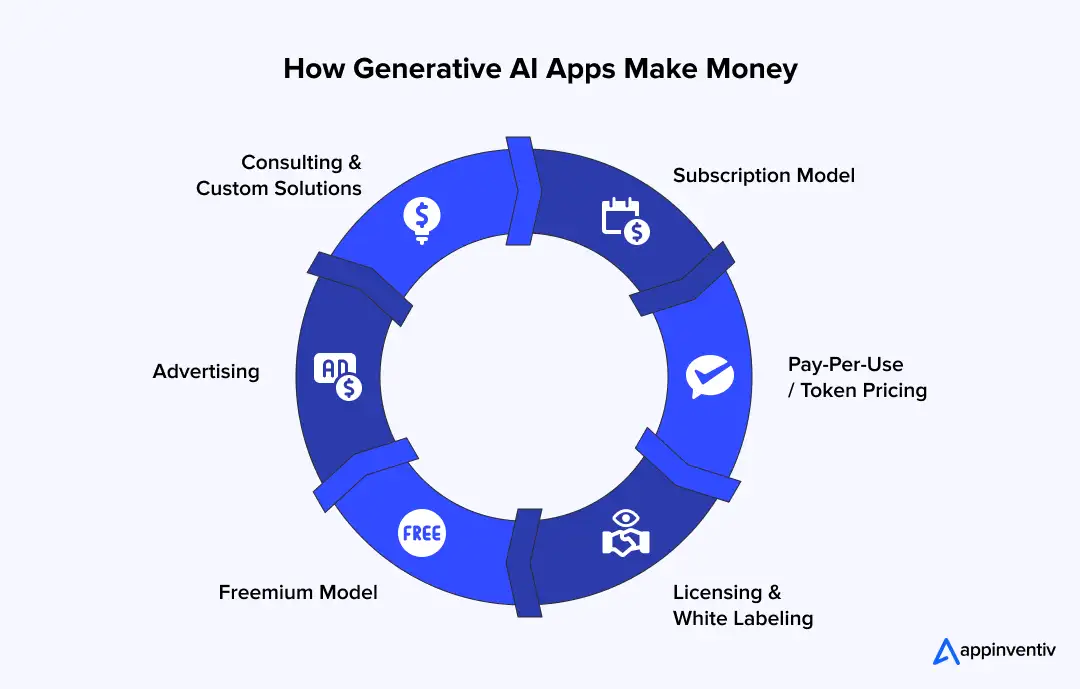
- Subscription Model: Users pay a recurring fee for access to premium features (e.g., Jasper, ChatGPT Plus).
- Pay-Per-Use / Token Pricing: Users are charged based on usage, typically tokens or processing volume (e.g., OpenAI API).
- Licensing & White-Label Solutions: AI platforms are licensed to other companies for their own use (e.g., YouComm).
- Freemium Model: Basic features are free, and users pay for premium functionality or extra usage (e.g., Grammarly, Canva).
- Data Monetization: AI apps that collect valuable data can sell insights or aggregate data (e.g., Palantir).
- Advertising: Displaying targeted ads within the app to generate revenue (e.g., TikTok).
- Consulting & Custom Solutions: AI providers offer custom generative AI development pricing for tailored solutions (e.g., Flynas).
Each generative AI development pricing model or monetization strategy can be adapted to suit your app’s features, depending on how you want to scale and generate ongoing revenue.
Take the next step towards unlocking powerful AI capabilities and driving innovation in your business.

How Appinventiv Helps Enterprises Control Generative AI App Development Costs?
Building generative AI inside an enterprise is not just a technical project. It is a strategic investment. At Appinventiv, a leading Generative AI development company, we help organizations move from experimentation to production while keeping the cost to develop a Generative AI app predictable and aligned with business value.
We have delivered 300+ AI-powered solutions across industries. Our team of 200+ AI engineers and data scientists designs systems that balance innovation with governance, scalability, and cost control. That means your custom Generative AI development cost is never driven by guesswork. It is shaped by clear use cases, right-sized architecture, and realistic rollout plans.
Whether you are launching your first AI assistant or scaling across departments, we guide every stage. From model selection to enterprise integrations. From security design to operational readiness. We have trained 150+ custom AI models, completed 75+ enterprise AI integrations, and 50+ bespoke LLMs fined-tuned for high-impact performance across 35+ industries.
Our approach focuses on long-term outcomes. Reusable AI foundations. Built-in compliance. Future-ready infrastructure. This ensures enterprises realize the real benefits of Generative AI app development cost decisions, not just short-term pilots.
The result is simple. A controlled enterprise generative AI development cost. A trusted partner. And AI systems that scale with confidence.
Frequently Asked Questions
Q. How can you reduce the costs of a generative AI project?
A. To reduce costs, focus on a clear, high-impact use case, start with a lean MVP, reuse infrastructure across projects, and optimize data quality and model usage. Phasing out the development and carefully selecting the right model stack can also help manage costs effectively.
Q. What are the different types of Generative AI solutions that can impact the cost?
A. Factors affecting Generative AI app development cost include complexity and specific requirements, like:
- Single-use assistants vs. enterprise platforms
- Open-source models vs. proprietary APIs
- Text generation vs. multimodal models (text, image, voice)
- Basic workflows vs. deep integrations
Each variation has a different cost of developing generative AI solutions along with development time, and model selection.
Q. How long does it take to develop a generative AI app?
A. Development typically takes 3 to 12 months, depending on the app’s complexity, integrations, and regulatory requirements. A simple proof-of-concept (PoC) can be done in 3–6 months, while fully scalable, enterprise-level solutions may take 9–12 months.
Q. How much does it cost to add Generative AI features to an existing app?
A. Adding generative AI features to an existing app typically costs between $30,000 to $150,000+, depending on the key features of generative AI app development, integrations required, and the amount of training or fine-tuning the model needs to fit within the app’s ecosystem.
Q. How does Appinventiv make Generative AI development more cost-efficient for businesses?
A. Appinventiv reduces generative AI app development cost for businesses by defining clear use cases, leveraging reusable AI infrastructure, optimizing model performance, and focusing on phased rollouts. Our experience in cross-industry AI solutions ensures we avoid unnecessary rework, deliver faster results, and optimize spend.

- In just 2 mins you will get a response
- Your idea is 100% protected by our Non Disclosure Agreement.

Simple Steps to Hire AI Governance Consultants in 2026
Key Takeaways Define AI risk tolerance and compliance goals before hiring consultants. Look for multidisciplinary teams combining governance, ML auditing, and MLOps expertise. Ensure consultants understand frameworks like the EU AI Act, NIST RMF, and ISO 42001. Prioritize experts who can operationalize governance inside ML pipelines. Embed responsible AI practices directly into CI/CD and model…
AI in Smart Homes in Australia: Use Cases, Cost & Real-World Impact
Key takeaways: The adoption of AI in Australian smart homes is primarily dictated by energy economics, insurance risk mitigation, and the evolving needs of an ageing population. AI development costs in smart homes range from AUD 70,000 to AUD 700,000+, depending on grid integrations, compliance engineering, and AI model complexity. Adherence to the Privacy Act…

Enterprise AI Integration in the Middle East: Scaling with Expert Architects
Key takeaways: Middle Eastern enterprises lead in AI adoption, driven by strong government support and investment in digital infrastructure. Successful AI integration requires robust data governance, compliance with local regulations, and tailored architectural design. Addressing talent gaps, localization needs, and legacy system challenges is crucial for scalable AI deployments. Systems integrators and big data architects…









