






























The Real Cost of Building Professional Delivery Management Software


- Calculating the Cost to Build Your Delivery Management Software
- The Critical Components: What Really Drives Your Delivery Management Software Development Costs
- How Team Structure and Geography Shape the Cost to Build Delivery Management Software
- Choosing Your Build Path: Custom, SaaS, or White-Label?
- What Are the Hidden Costs in Delivery Software Development?
- How to Keep Delivery Management Software Development Costs Under Control
- Maximizing ROI: Proven Pricing Models for Delivery Management Software
- How to Build a Delivery Management Software: Cost Breakdown Based on Development Stages
- Appinventiv: Your Trusted Partner for Building Advanced Delivery Management Software
- Frequently Asked Questions (FAQs)

Key takeaways:
- Custom delivery management software has complete flexibility, scale, and integration, which conforms to the distinctive requirements of business.
- Fluid connection to ERP, CRM, and payment systems also introduces a large amount of complexity and additional cost, but is the key to efficiency.
- It is important to design scalable systems to grow in the future to prevent the need to re-engineer the system in the future and experience costly re-engineering efforts.
- The cost to build a delivery management software ranges between $40,000 and $400,000 or more, depending on your unique requirements.
Your delivery operations are probably not “broken.” Orders still go out. Drivers still move. Customers still receive packages. But you can feel the strain.
Spreadsheets, phone calls, and half-connected tools work only until volume spikes or something goes wrong. One delayed route or missed SLA, and the cost shows up in refunds, overtime, and frustrated customers.
That is usually the moment the question lands on the table: Should we invest in delivery management software, and what does it really cost to build delivery management software?
The honest answer is: there is no single price tag. The budget can range from $40,000 to $400,000 or more, depending on several critical elements (details later). For instance, a modest build for basic dispatch and tracking can range between $40,000 and $200,000 while a multi-country platform with real-time routing, fleet optimization, and tight ERP integration can cost anywhere between $200,000 and $400,000 or higher. What matters more is understanding what you are really paying for – automation, visibility, and control over your last mile.
In this blog, we will break down how delivery management software costs are structured, what drives the numbers up or down, and how to plan a realistic budget that matches your growth ambitions.
Capitalize on this trend and build your business with a tailored delivery management solution.

Calculating the Cost to Build Your Delivery Management Software
Estimating the cost to build delivery management software can be tricky without understanding the key factors involved. Every project is unique, but you can use a simple formula to get a rough idea of the cost based on your project’s complexity:
Cost Estimate Formula:
Total cost to build delivery management system software = × Development Time (in months) × Hourly Rates of Developers
For instance, if the average developer’s hourly rate is $50 and the project timeline is 6 months, the total cost will be $48,000.
Here is an estimated cost breakdown to build a home delivery management system
| Project Type | Key Features | Estimated Cost | Timeline |
|---|---|---|---|
| Basic | Basic order tracking, single-route dispatch | $40,000 – $100,000 | 3-4 months |
| Mid-Complex | Multi-stop routes, real-time tracking, basic reporting | $100,000 – $200,000 | 4-6 months |
| Advanced | Dynamic route optimization, predictive analytics | $200,000 – $300,000 | 6-9 months |
| Enterprise Grade | AI-powered routing, full ERP integration, multi-region | $300,000+$400,000+ | 9-12 months+ |
The Critical Components: What Really Drives Your Delivery Management Software Development Costs
When CFOs ask, “Why does software development cost so much?”, they are rarely asking about developers’ hourly rates. What they really want to know is what is driving the spend under the hood. The cost to build delivery management software is shaped by a handful of very real choices. Below are the critical components that usually move the needle when you develop an enterprise delivery management system.
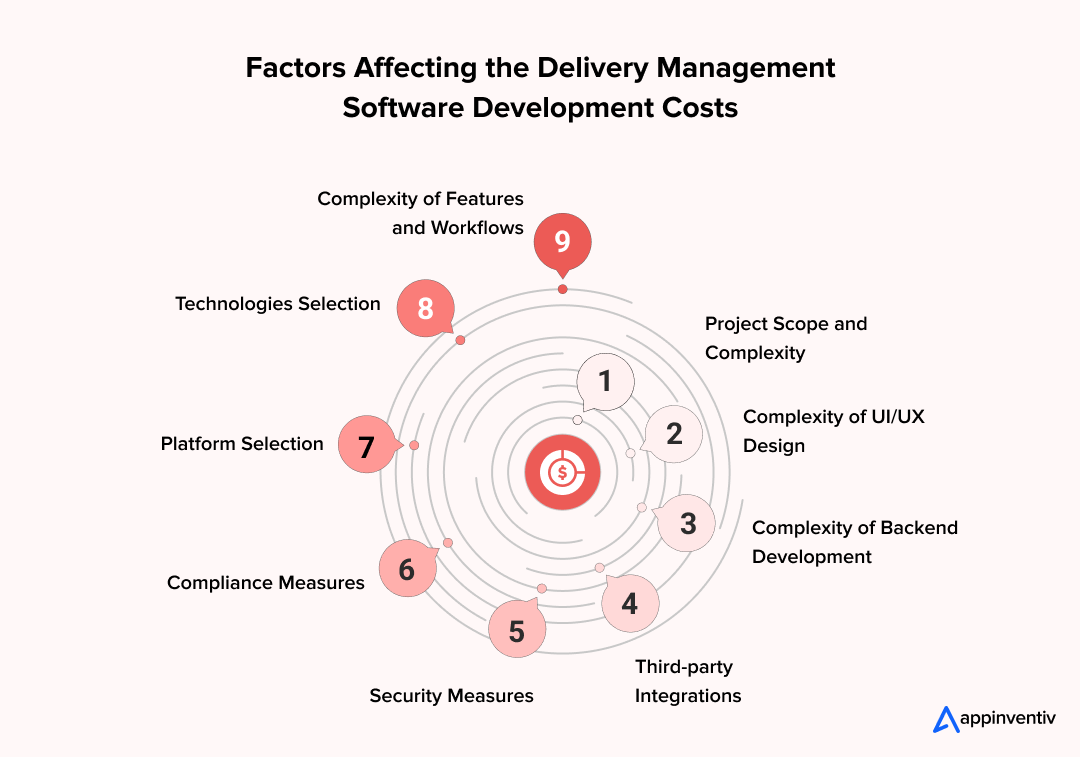
Project Scope and Complexity
The first group of factors affecting delivery management software development cost is simply what you are trying to build.
A regional MVP with basic order assignment and tracking will sit in a very different bracket compared to a multi-country, multi-brand platform with hub management, AI based routing, reverse logistics, and 3PL orchestration.
Key drivers here include:
- Number of modules: dispatcher console, driver app, customer tracking, admin, analytics
- Complexity of workflows: single vs multi-stop deliveries, returns, partial deliveries, COD
- Geographic coverage: one city, multiple regions, or global operations with localization needs
The wider and deeper the scope, the more effort you need across product, design, and engineering.
Complexity of UI/UX Design
Design is not just about how the platform looks. It is about how quickly a dispatcher can act and how few taps a driver needs to complete a stop.
A simple layout with basic screens for order lists, maps, and delivery details is one cost bracket. Add multiple user journeys, advanced map views, multi-lingual support, role-based dashboards, and you are paying for many more design hours, usability tests, and iterations.
In short, the more tailored each screen is for different user groups and markets, the higher the upfront design cost, but usually the lower the training and error cost later.
Complexity of Backend Development
Behind each “Assign route” or “Mark as delivered” button sits a web of services, databases, and APIs. A lean setup might handle basic order storage, route assignment, and tracking. An enterprise-grade backend has to juggle:
- Large order volumes across regions
- Real-time updates from thousands of devices
- Complex business rules for allocation, capacity, and SLAs
Every additional rule, exception path, and performance requirement adds development time and cost. This is one of the biggest cost centers when you develop an enterprise delivery management system that has to stay stable during peak season.
Third-party integrations
Integrations are often where estimates start to jump. Your delivery platform will likely need to talk to:
- eCommerce platforms and order management systems
- GPS and map providers
- Payment gateways for COD or in-app payments
- SMS, email, and WhatsApp notification services
- Sometimes social media or chat tools are used by support teams
If partners have clean, well-documented APIs, integration is straightforward. If you are dealing with legacy systems, custom connectors, or fragmented data, integration work can quietly consume a large chunk of the cost to build delivery management software.
Related Read: Guide on ERP Software Integration
Security measures
Once you start handling customer data, addresses, payment details, and driver locations, security is not optional. Basic authentication and simple access control are one level of effort. Add encryption at rest and in transit, strict role-based access, audit logs, secrets management, and regular security testing, and your scope expands.
Enterprises that run deliveries at scale usually invest more here upfront instead of waiting for a security incident to dictate their roadmap.
Compliance measures
If you operate in sectors like healthcare, finance, or work across multiple regions, compliance has a direct impact on cost.
You might need to:
- Respect data residency rules for different countries
- Align with GDPR-like regulations for data privacy
- Maintain audit trails for every change in order status
- Follow industry-specific guidelines for proof of delivery and record retention
Each requirement adds work in architecture, development, and testing. It is one of the quieter but significant factors affecting delivery management software development cost for regulated enterprises.
Platform selection
Your platform choices also change the bill. More platforms mean more design, more development, and more testing. Sometimes it is worth starting with one primary platform, then expanding once you see adoption and real usage patterns.
Technologies Selection
AI-powered delivery software development and advanced analytics can make a real difference in routing, capacity planning, and risk prediction. They also increase complexity. Using simple rule-based assignment and static routes is cheaper to build. Introducing:
- AI driven route optimization
- Predictive demand models
- Anomaly detection for delayed orders or risky deliveries
adds data engineering, model development, and ongoing tuning. These technologies are powerful, but they should be tied to a clear business case, not added as buzzwords.
Complexity of Features and Workflows
The broader your feature set, the higher your bill. A simple tool that handles single-drop deliveries with basic proof of delivery sits in one cost bracket, while an enterprise platform with multi-stop routes, returns, hubs, and 3PL partners pushes development effort up quickly.
Here is a table outlining the basic and advanced features to help you make the right choice when evaluating the cost to develop an enterprise delivery management system.
| Area | Basic features | Advanced features |
|---|---|---|
| Order handling | Single-drop deliveries, manual assignment | Multi-stop routes, auto-assignment, time-window commitments |
| Routing | Static routes, simple distance-based planning | Dynamic route optimization with traffic, capacity, and SLA constraints |
| Proof of delivery | Basic status update (delivered / not delivered) | Photos, e-signatures, OTP, geo-tagged proof, reason codes for failed attempts |
| Returns and reverse logistics | Manual handling of failed deliveries and returns | Structured reverse logistics flows, automated reattempts, return-to-hub logic |
| Hub and zone management | Single hub, limited zone control | Multiple hubs, zoning, load balancing, cross-docking support |
| Fleet and partner management | In-house fleet only | Mixed fleets, 3PL and partner onboarding, carrier rules, performance scorecards |
| Reporting and analytics | Basic daily/weekly summaries | Drill-down dashboards, SLA views, cost per drop, incentive and settlement reports |
| Integrations | One or two core systems (eCommerce or OMS) | Deep integrations with OMS, WMS, ERP, CRM, payment gateways, notification tools, and carrier platforms |
How Team Structure and Geography Shape the Cost to Build Delivery Management Software
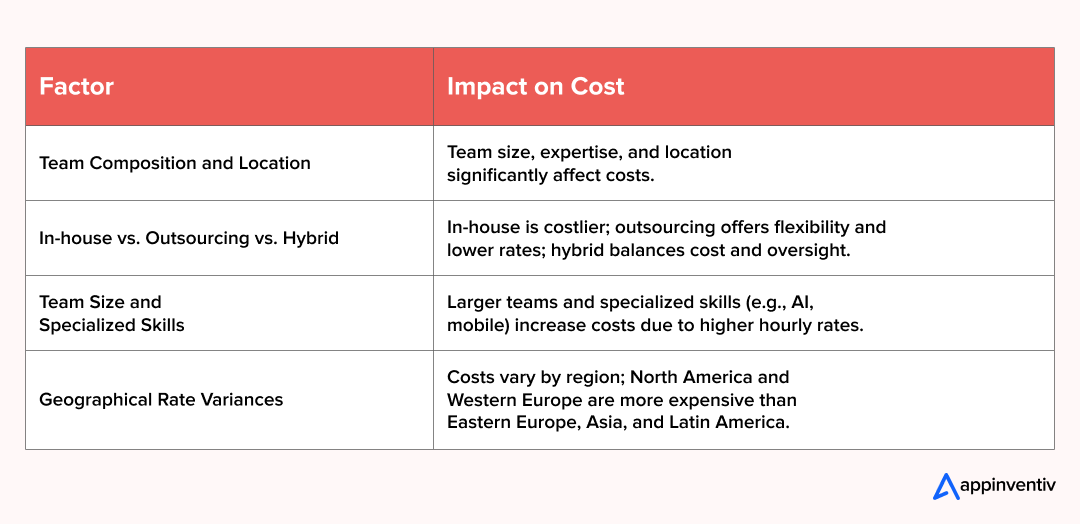
The collective expertise, optimal size, and geographical placement of your chosen development team exert a monumental influence on the overall delivery management system development cost. Here is how:
In-house vs. Outsourcing vs. Hybrid
It is costly to assemble a team internally due to maintenance costs such as salaries, extensive perks, office equipment, and constant professional training. Outsourcing, on the other hand, provides an unprecedented degree of flexibility and access to the various skill sets around the world, and at a competitive cost across regions. Another cost-efficient strategy can be a hybrid one, the combination of the internal control and the outside-in development.
Team Size and Specialized Skill Sets
The typical development team that will be required to work on such a project will have project managers, shrewd business analysts, intuitive UI/UX designers, skilled backend developers, competent frontend developers, dedicated mobile developers (on both iOS and Android platforms), stringent Quality Assurance (QA) engineers, and competent DevOps specialists.
The more specialized the skills required, the higher the associated hourly rates for these experts.
Geographical Rate Variances
Costs of development vary significantly in various regions of the globe. Like in the case of very experienced teams based in North America or Western Europe, they tend to attract higher rates as compared to equally competent talents based in Eastern Europe, some Asian countries, or Latin America. This geographical arbitrage can significantly impact the final delivery management software development cost.
Choosing Your Build Path: Custom, SaaS, or White-Label?
The decision to make a custom delivery management software, opt for a Software-as-a-Service (SaaS) solution, or go with a white-label product significantly impacts your budget, speed to market, and future flexibility. It decides what you pay upfront, what you pay every month, and how much you spend later on change requests.
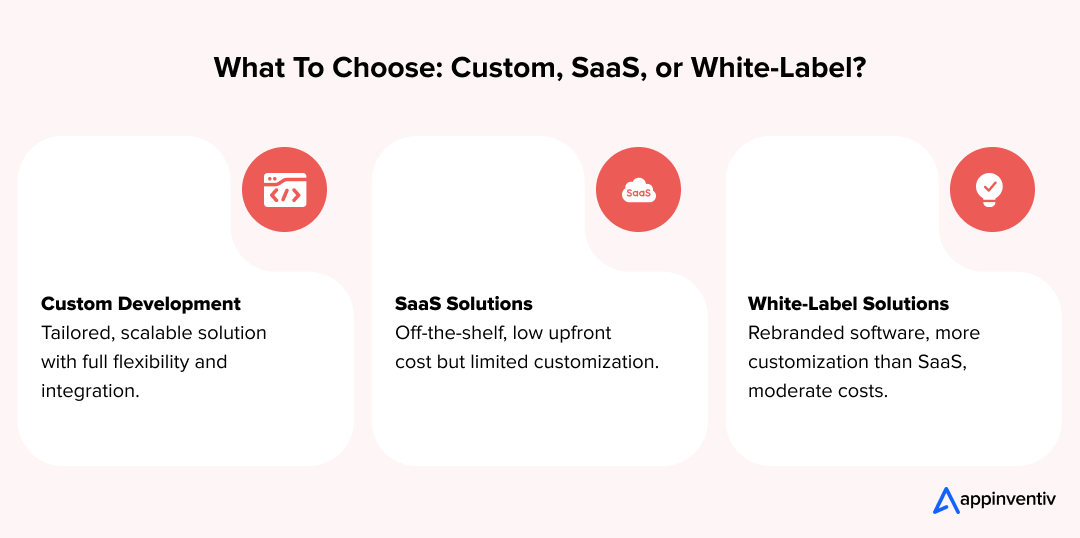
- Custom development
Highest upfront investment, since you fund the full build, integrations, and UX. The trade-off: lower “per delivery” cost over time and full control if you’re serious about scaling an enterprise delivery management system. - SaaS solution
Lowest entry cost with predictable monthly fees. Good for pilots or standard workflows, but the bill grows with users and volume. Heavy custom changes are either impossible or very expensive. - White-label product
Sits in the middle. You avoid full build costs but still pay more than SaaS for setup and customisation. You get faster go-live than custom, with a more “owned” feel than a pure subscription tool.
The choice hinges on your specific requirements, budget constraints, and strategic vision. For organizations aiming for long-term competitive advantage and unique operational efficiency, making custom delivery management software often proves to be the most rewarding investment.
Bonus Read: Custom Development vs White Label: Choose the Right Path
What Are the Hidden Costs in Delivery Software Development?
The proposal you see on paper usually covers one thing: the initial cost to build delivery management software. Once the platform is live, a second bill starts ticking quietly in the background. That long-term bill is where many delivery technology projects go off-plan.
Here are the big cost buckets leaders tend to underestimate when estimating the total delivery management system software costs.
Software maintenance
No real-world system stays “done.” Drivers switch devices, browsers update, OS versions change, and operations teams keep asking for small tweaks. You need ongoing effort for bug fixes, minor improvements, security patches, and keeping the tech stack current so the platform doesn’t feel outdated in two years.
Software hosting
Every order, location ping, proof-of-delivery photo, and notification runs through your infrastructure. As volumes grow, cloud bills for servers, databases, storage, maps, and messaging go up too. Hosting is a monthly cost, not a one-time line in the proposal.
Promotion and marketing
If you introduce new delivery promises, faster slots, better tracking, pickup points, etc., you have to tell customers about them. That often means campaigns, on-site banners, app messages, and CRM journeys. The tech alone won’t move adoption unless marketing spends a little time and budget pushing the new experience.
Legal and licensing fees
Finally, there are the quiet but non-negotiable costs: licenses for map APIs, SMS/WhatsApp providers, routing engines, and any paid SDKs you rely on. Add to that the legal work around contracts, data protection, and region-specific terms. None of this looks dramatic on day one, but together it shapes the real, long-term cost of running your delivery management system.
How to Keep Delivery Management Software Development Costs Under Control
You cannot avoid spending on technology, but you can be smart about where every dollar goes. Four decisions make a big difference to the overall cost to build delivery management software.
Developing an MVP instead of a “final product”
Start with a minimum viable product that covers your main delivery flows: order capture, dispatch, routing, tracking, and proof of delivery. Release it to one region or business unit first. This keeps initial spend tight and lets you test assumptions before committing to a full-scale on-demand delivery software cost.
Prioritizing necessary features, not wish-lists
Sit with operations and finance and agree on what is truly “must-have” for version one. Anything that does not clearly cut costs, reduce failures, or improve customer experience goes into a later phase. This simple discipline can remove weeks of UI, backend, and QA work.
Leveraging cross-platform development for driver platform
Driver based software is often the most expensive to maintain if you build separate native versions for iOS and Android. A solid cross-platform approach (one codebase, multiple platforms) can reduce build and maintenance effort while still giving drivers a smooth experience.
Focus on scalability from day one
Even if your initial needs are modest, designing for future scalability is crucial. A well-architected system can grow with your business without requiring costly re-engineering down the line. This forward-thinking approach directly impacts the long-term operational efficiency.
Outsourcing to cost-effective regions with the right partner
You do not need a full in-house team in a high-cost market to get enterprise-grade software developed. A hybrid model works well: keep strategy and product ownership with your internal team, and outsource design, development, and QA to a proven partner in a more cost-effective region.
Maximizing ROI: Proven Pricing Models for Delivery Management Software
At some point, someone on the finance side will ask a simple question: “When does this thing pay for itself?” The answer is not only in cost savings. A well planned platform can unlock new revenue streams and protect margin at scale. That is where the real benefits of delivery management software start to show. Below are practical ways to turn the key features of delivery management software into a clear ROI story.
1. Turn Efficiency into Hard Savings
Auto dispatch, smart routing, and real time tracking cut empty miles, overtime, and failed deliveries. Fewer wasted trips and tighter routes directly reduce cost per drop. If you deliver high volumes every day, even a small percentage gain here quickly covers a big part of the build cost.
2. Monetize Premium Delivery Options
Once you can promise accurate slots and on time performance, you can charge for it. Features like time window booking, live tracking links, and reliable proof of delivery allow you to introduce:
- Same day or express delivery fees
- Paid time slots for peak periods
- Service tiers for key accounts
You are not just keeping customers happy, you are creating a priced product around delivery reliability.
3. Sell Excess Capacity in a Controlled Way
With accurate visibility of routes, load, and spare capacity, some enterprises choose to open their network to partners or smaller brands. Your own fleet becomes a mini 3PL, with per stop or per parcel pricing. The platform gives you the controls, contracts, and reporting you need to do this without losing grip on service levels.
4. Use Data to Renegotiate and Reprice
Strong reporting is one of the most underrated key features of delivery management software. Lane level performance, cost by region, and partner scorecards give you the evidence to:
- Renegotiate rates with 3PLs
- Reprice certain zones or service types
- Rework SLAs that are impossible to meet at the current cost
That data driven pricing work often returns more value than any single new feature.
5. Reduce Risk and “Soft Costs” at Scale
Better audit trails, clear proof of delivery, and cleaner data reduce disputes, chargebacks, and customer service time. Legal and finance teams spend less time on escalations and more time on growth work. It is not a flashy revenue line, but it is a real part of the payback.
When you add these benefits together, the platform stops being a pure cost center. It becomes an asset that protects margin, opens new products, and gives you room to grow without adding trucks and headcount at the same pace.
How to Build a Delivery Management Software: Cost Breakdown Based on Development Stages
To build delivery management software that actually works in the field, you need a structured product lifecycle, not just a feature list. Here is how the process typically looks when done in a mature, enterprise way. Here’s how the process to build delivery management software usually looks in practice.
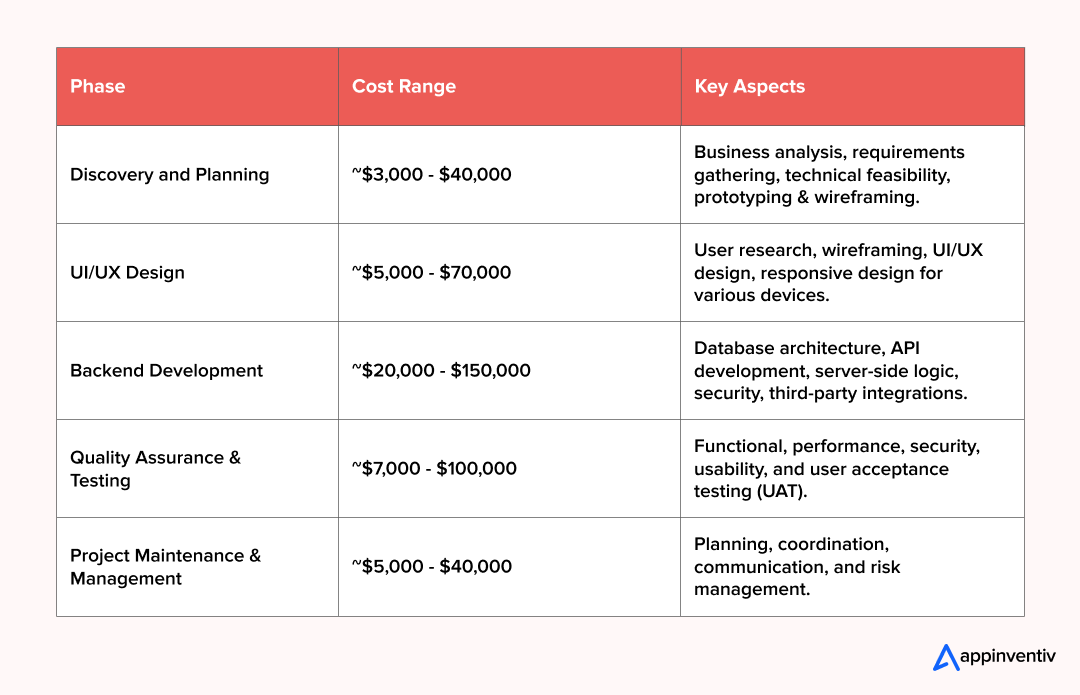
Discovery and Planning
(Typically 5-10% of total project cost: ~$3,000 – $40,000)
This is the “sit in the truck” phase. You talk to the people who actually move orders every day: hub managers, dispatchers, drivers, support teams.
You map how an order is created, assigned, routed, delivered, and closed. You note where things slow down, where data gets retyped, and where you are losing money or trust.
Out of this, you should walk away with three things:
- A shortlist of problems the software must solve first
- Clear KPIs you want to move (on-time rate, cost per drop, first-attempt success, NPS)
- A phased rollout plan: which region, business line, or use case goes first
This is also where high level budget and timelines start to become real instead of “we’ll see during development.”
UI/UX Design
(Typically 10-20% of total project cost: ~$5,000 – $70,000)
Once you know what needs to change, you decide how your users will interact with the new system.
Design here is not about pretty screens. A dispatcher might be juggling hundreds of orders on a single monitor. A driver is looking at a 6-inch screen in the sun, with patchy network. Your interface has to work for them on their busiest day, not just in a lab.
The design team typically:
- Maps day-in-the-life journeys for dispatchers, drivers, and support
- Creates wireframes and click-through prototypes for the console and driver software
- Tests those prototypes with a small group of real users and adjusts based on their feedback
If drivers can complete a delivery with a few taps and dispatchers can spot problems at a glance, you’re on the right track.
Also Read: Top 11 UX Design Principles for Startups
Software Development
(Typically 50-70% of total project cost: ~$20,000 – $150,000)
This is the most critical stage where developers set up the backend services for orders, routes, drivers, notifications, and analytics. Frontend teams work on the web console and admin area. Mobile teams build the driver software, often with offline support. In parallel, integration work starts with your existing stack.
Typical development work includes:
- Backend and database design for orders, routes, and tracking
- Web console for operations, configuration, and reporting
- Android/iOS or cross-platform driver software
- APIs and connectors to eCommerce platforms, OMS, WMS, ERP, CRM, and logistics partners
Work usually runs in sprints, so you can see a working version early, test it with operations, and make adjustments before everything is “finished.”
Testing and Quality Assurance
Typically 15-25% of total project cost: ~$7,000 – $100,000)
This is where you find out if the system holds up in real life.
QA teams walk through full scenarios: bulk order import, last-minute route changes, failed deliveries, returns, and COD reconciliation. They look for both obvious bugs and subtle edge cases that will annoy your teams later.
Testing normally covers:
- Functional testing of all key flows end to end
- Performance testing for peak days and spikes in volume
- Security checks around customer data and access control
- Field tests with a small group of drivers and one or two hubs
You treat this phase like a dress rehearsal. If drivers can complete their day without calling the dispatcher every hour, your investment is ready to pay off.
Project Maintenance & Management
(Typically 10-15% of total project cost: ~$5,000 – $40,000)
Once the software goes live, it needs care and active ownership.
On the technical side, you have regular updates, bug fixes, performance tuning, and security patches. On the business side, you watch how the system is used and whether it is actually moving the KPIs you agreed on in the discovery phase.
Ongoing work here looks like:
- Monitoring uptime, response times, and integration health
- Reviewing delivery metrics by route, region, and partner
- Collecting feedback from operations and drivers and feeding it into a backlog
- Planning new features such as better routing logic, new reports, or additional integrations
This is the phase where the investment starts to pay off. Small, continuous improvements guided by real data usually create more value than one big annual “version 2.0” project.
Also Read: Software Development for Startups: A Complete Guide
Appinventiv: Your Trusted Partner for Building Advanced Delivery Management Software
By now it is clear that the cost to build delivery management software is not a flat number. It depends on your routes, partners, tech stack, and how ambitious you want your first release to be. The hard part is not just writing code. It is choosing the right scope, build path, and team so you do not overspend and still get an enterprise-grade platform.
This is exactly where Appinventiv fits in. We work with product, ops, and technology experts to design the right MVP, phase advanced features smartly, and align the build with clear ROI targets instead of vague “digital transformation” goals.
In our 10+ years of software engineering experience, we have delivered 2000+ software products for 35+ industries, including logistics, retail, eCommerce, and on-demand delivery. Our team of 1600+ tech evangelists includes product designers, engineers, consultants, data analysts, DevOps experts, AI developers and so on.
Here is what working with Appinventiv looks like in numbers
- 95% on-time delivery record
- 500+ legacy processes transformed into modern digital workflows
- 15+ global recognitions and awards
- 95% client satisfaction rate
- 90% repeat clientele
- 2x productivity gains through agile delivery models
- 99.50% security compliance across engagements
You are not just hiring a development team. You are getting a partner that has already seen what works and what breaks when you develop an enterprise delivery management system at scale.
Case Study of an Omnichannel Retailer
To give you a quick glimpse of our expertise in delivering unparalleled custom software development services, here is a case study of one of our esteemed clients.
Challenge: Our client, a reputed omnichannel retailer operating in three metro cities, was managing deliveries with a mix of spreadsheets, calls, and a basic tracking plug-in. Missed slots, poor visibility, and high last-mile cost were eating into the margin.
Solution: Appinventiv helps them scope and build a custom on demand delivery app: a dispatcher console, cross-platform driver app, integrated routing, and real-time tracking for customers. The rollout starts with one city, then expands once the numbers prove out.
Within the first 9–12 months, their metrics look like this:
- 18% reduction in cost per delivery
- 22% improvement in on-time delivery rate
- 30% fewer failed or reattempted deliveries
- 15% higher drop density per route
- 25% reduction in manual calls between drivers and dispatch
The same platform then becomes the base for adding premium delivery slots, partner fleets, and richer analytics without rebuilding from scratch.
If you are evaluating the benefits of delivery management software and want a clear, grounded view of what it will cost to build and run, we can help you map that out. From MVP planning to full-scale rollout, Appinventiv can work with your teams to design, build, and grow a delivery platform that actually matches your business reality.
Contact us today and bring your idea to life.
Frequently Asked Questions (FAQs)
Q. How much does delivery management software cost?
A. The cost to build delivery management software starts at $40,000 and can cost you up to $400,000+ or more (based on the project complexity, functionality, and integration).
Discuss your project idea with us and get a more precise estimate tailored to your specific needs.
Q. How long does it take to develop a delivery management software?
A. It will take 3-12 months with varying degrees of complexity to develop delivery management software. For instance,
A simple version of MVP and the order tracking and driver apps takes 3-5 months
Mid-level systems, which include real-time GPS and ERP/CRM integration, require 6-9 months
High-profile packages based on AI route optimization, IoT tracking, and cloud system (e.g., AWS) will need 9-12 months
Q. What features should a delivery management system include?
A. The features that a delivery management system ought to possess include real-time GPS tracking to update the location as accurately as possible, route optimization powered by artificial intelligence to optimize the number of stops and time, and a smooth integration with ERP/CRM systems to automate the process of synchronizing the data.
It must also be cloud-based, scalable, and have secure payment gateways, and easy to access mobile applications to the drivers and clients. Moreover, automated alerts, cross-warehouses synchronization, and insights into performance will increase the efficiency of operations, decrease the delivery time, and increase satisfaction among clients.
Q. How does delivery software help logistics companies?
A. Delivery software assists logistic companies through minimizing operations, better route mapping, and creating shorter delivery times. It also facilitates real-time tracking in such a way that any company can track the shipping and give the customer appropriate delivery information. The route optimization AI reduces the use of fuel and time, making it less expensive. The ERP/CRM integration enables easy synchronization of the data among the platforms.
Moreover, the software used in delivering the goods also includes performance analytics that can enable the companies to detect bottlenecks, make better decisions, and ultimately achieve higher customer satisfaction and retention.
Q. How much does AI-powered delivery management software development cost?
A. AI-powered delivery management software generally costs between $40,000 and $400,000, depending on the feature and complexity. Low-end solutions with GPS tracking and route optimization range between $40,000 and $200,000, and high-end solutions with AI-powered analytics, multi-warehouse synchronization, and real-time tracking cost between $200,000 and $400,000. Cloud infrastructure, third-party integration, and security compliance are additional costs. The investment is justified in the form of long-term cost savings through increased delivery efficiency, cost reduction, and customer satisfaction.
Q. What are the challenges in building delivery management software?
A. Building a delivery management software is beset by several challenges, such as integration with legacy systems such as ERP and CRM, which is time-consuming and complicated. Real-time tracking and AI-optimized route planning necessitate strong data processing and infrastructure.
Scalability is also an issue, as the system needs to be able to process increasing amounts of data and user loads, particularly during peak usage times.
Security and compliance, especially for sensitive customer and order information, are also complicating factors.

- In just 2 mins you will get a response
- Your idea is 100% protected by our Non Disclosure Agreement.
Maritime Insurance Claim Software Development for UAE Ports, Insurers, and Logistics Networks
Key takeaways: Manual claims management is too slow for the UAE’s high-volume ports; digital solutions streamline processes and reduce errors. Maritime insurance claim software centralizes data, automates workflows, and ensures compliance with UAE regulations and Takaful principles. Real-time integration with port and vessel systems enables faster claim registration, validation, and settlement. Advanced analytics and risk…

How to Build a Student Management System in Australia?
Key takeaways: Australia’s tightening regulatory landscape (TEQSA, ASQA, CRICOS) makes student management system development in Australia a compliance-driven necessity, not just a digital upgrade. Monetisation models such as SaaS subscriptions, institutional licensing, white-label partnerships, and hybrid pricing offer scalable commercial opportunities in Australia’s expanding EdTech market. Addressing challenges early - data privacy, legacy migration, multilingual…

Guide to Software Risk Management: Identifying and Mitigating Key Risks in Software Development
Key takeaways: Risk management is no longer a peripheral activity; it is a core component of Enterprise Risk Governance (ERG) that ensures software ROI. Successful projects define their risk appetite—the level of risk an organization is willing to accept—before the first line of code is written. By integrating risk assessment into the early discovery phase,…









