




















How Much Does It Cost to Build a Conversational AI Chatbot in the UAE?

- Cost to Build a Conversational AI Chatbot in the UAE
- 8 Key Factors Affecting the Cost of Chatbot Development
- AI Chatbot Development Cost Breakdown by Industry in the UAE
- Build vs Buy: Custom AI Chatbot Development vs SaaS Chatbot Platforms in the UAE
- Hidden AI Chatbot Development Costs Businesses Often Overlook
- What ROI Should UAE Businesses Expect From AI Chatbot Investment?
- How to Choose the Right AI Chatbot Development Partner in the UAE
- How Appinventiv Helps You Build Cost-Efficient AI Chatbots in the UAE?
- FAQs

- AI chatbot development in the UAE typically costs AED 150,000–1,470,000 ($40K–$400K), based on complexity.
- Backend integration and compliance drive cost more than the chatbot interface itself.
- Arabic NLP, UAE hosting, and PDPL requirements increase budget and engineering effort.
- LLM + RAG enterprise chatbots sit at the higher end due to integration and infrastructure depth.
- Most UAE businesses see ROI within 6–12 months through efficiency and conversion gains.
Most companies in the UAE do not begin with the idea of deploying a chatbot.
They start with rising support costs, slower response times, and customers dropping off when queries go unanswered.
In markets like Dubai and Abu Dhabi, where users expect instant, multilingual support across WhatsApp, apps, and web, traditional support models struggle to keep up. Hiring more agents only increases costs. Basic chatbots break the moment conversations go off-script.
That gap is what is accelerating conversational AI adoption across the region. Banks, insurers, retail groups, and even public sector platforms are introducing AI-driven systems that understand context, manage bilingual conversations, and connect to backend systems to resolve real requests rather than just provide static answers.
The question that follows is straightforward: what does it cost to build such a system?
There is no single number. A limited FAQ assistant sits at one end of the spectrum. An enterprise-grade platform powered by LLMs, real-time integrations, and compliance-ready infrastructure sits at the other.
PwC estimates that AI could contribute approximately $320 billion to the Middle East economy by 2030, with the UAE leading regional adoption. That trajectory is influencing investment decisions across sectors.
This guide examines the AI chatbot development cost in the UAE, outlines the primary cost drivers, and helps structure a realistic investment plan.
Get a realistic cost estimate aligned with your architecture, integrations, and compliance needs.
Cost to Build a Conversational AI Chatbot in the UAE
If you are evaluating how much it costs to develop an AI chatbot in the UAE, expect a realistic investment between AED 150,000 to AED 1,470,000 (approximately $40,000 to $400,000). The variation is not cosmetic. It reflects differences in AI architecture, integration depth, model strategy, and regulatory requirements.
For enterprises comparing the conversational AI chatbot cost in Dubai, pricing is largely driven by backend complexity rather than the chat interface itself.
Conversational AI Chatbot Cost Breakdown at a Glance
| Chatbot Type | Typical Cost Range | Architecture Scope |
|---|---|---|
| Basic Rule-Based Chatbot | AED 150,000 – 275,000 ($40,000 – $75,000) | Decision trees, static workflows, limited API calls |
| NLP-Based AI Chatbot | AED 275,000 – 735,000 ($75,000 – $200,000) | Intent models, entity extraction, CRM/ERP integration, Multilingual (Arabic/English) functionality |
| LLM + RAG Enterprise Chatbot | AED 735,000 – 1,470,000 ($200,000 – $400,000) | Custom LLM integration, vector databases, multi-system orchestration |
1. Basic Rule-Based Chatbot
AED 150,000 to AED 275,000 (approximately $40,000 to $75,000)
Architecture typically includes:
- Flow builders with predefined decision trees
- Keyword-trigger mapping
- Limited REST API integrations
- Static response library
No dynamic intent detection or no contextual memory, minimal backend orchestration. Suitable for FAQ automation but not complex service execution.
2. NLP-Based AI Chatbot (Mid-Level)
AED 275,000 to AED 735,000 (approximately $75,000 to $200,000)
Here, the system includes:
- Intent classification models
- Entity extraction pipelines
- Conversation state management
- Context retention across multi-turn conversations
- Real-time API orchestration layer
- Multilingual (Arabic/English) functionality
Integration complexity also increases cost. For example:
- CRM sync via secure APIs
- ERP ticket creation
- Authentication layers for user-specific data
- Role-based response control
This tier represents most production deployments driving the current conversational AI chatbot cost in Dubai discussions.
3. Advanced LLM + RAG Enterprise Chatbot
AED 735,000 to AED 1,470,000 (approximately $200,000 to $400,000)
This architecture typically includes:
- LLM integration (Azure OpenAI, enterprise LLM stack, or hybrid models)
- Retrieval-Augmented Generation pipeline
- Vector database deployment
- Embedding models for semantic search
- Prompt orchestration layers
- AI Guardrails for hallucination control
- Real-time system integrations
Additional cost drivers:
- Token usage optimization strategies
- LLM Model fine-tuning or domain adaptation
- Conversation analytics dashboards
- Scalable microservices architecture
This tier defines the upper range of the enterprise chatbot pricing in the UAE, especially in banking, telecom, and government projects.
Also Read: AI Software Development in the UAE: From Pilots to Enterprise-Grade Systems (2026)
What Makes Chatbot Development Cost Different in the UAE?
In the UAE, structural requirements often influence the final cost of AI chatbot development more than surface-level features.
- Arabic language handling increases cost: Dialect variation, morphological complexity, and right-to-left interface alignment require additional training and validation, impacting Arabic chatbot development cost and broader NLP chatbot cost Middle East benchmarks.
- Compliance and regional hosting add budget layers: UAE-based cloud deployment, PDPL-aligned data governance, encryption standards, and access controls increase infrastructure and security investment.
- Legacy system integration raises complexity: Banks, insurers, and government entities often operate on older core systems, requiring structured API orchestration and secure data mapping.
As a result, the conversational AI chatbot cost in Dubai is driven less by interface design and more by architecture depth and system connectivity.
8 Key Factors Affecting the Cost of Chatbot Development
The AI chatbot development cost in the UAE is largely determined by architectural and operational complexity. Two chatbots may look similar from the user side, yet differ significantly in backend design, intelligence level, and compliance layers.
The following factors usually drive the largest cost differences in UAE deployments.
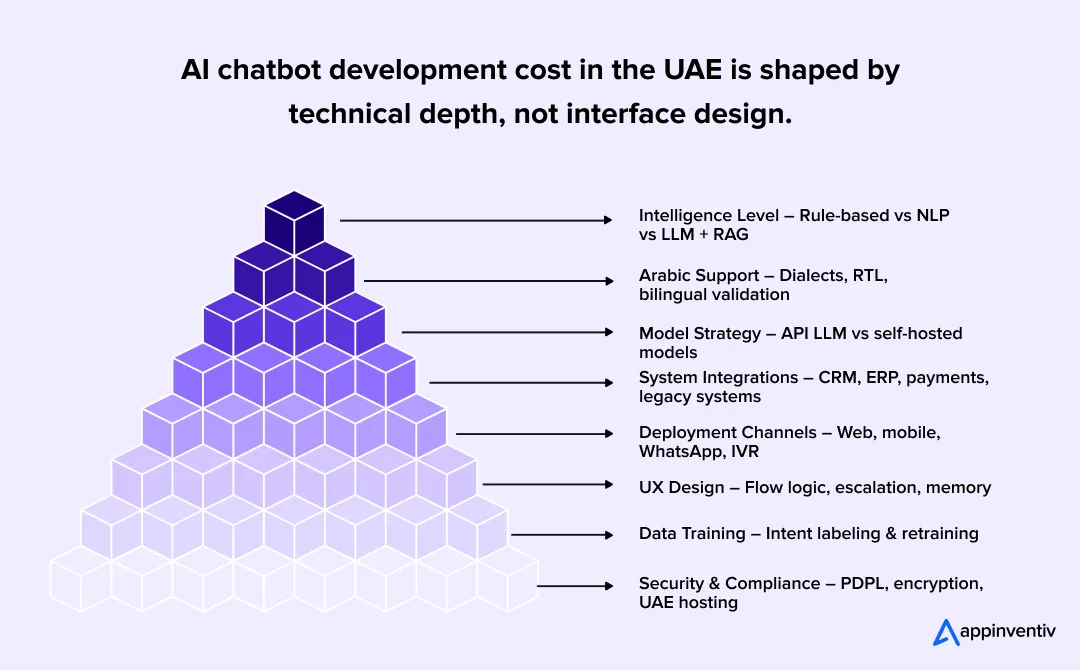
Bottom Line: Backend complexity defines the conversational AI chatbot cost in Dubai.
1 Chatbot Type and Intelligence Level
The intelligence layer establishes the cost foundation.
A rule-based chatbot operates on predefined logic. It follows structured flows and responds to mapped keywords. These systems are predictable and relatively inexpensive but limited in flexibility.
In contrast, NLP-driven chatbots introduce machine learning components that interpret user intent and extract relevant entities. They require training datasets, intent validation cycles, and context management layers to handle multi-turn conversations.
LLM-powered systems take this further by enabling dynamic reasoning and contextual generation. These architectures often include retrieval mechanisms to ground responses in enterprise knowledge bases.
Cost increases as you move up the intelligence ladder because the system may require:
- Intent classification models and training datasets
- Conversation state management logic
- Retrieval-augmented generation layers
- Guardrails and response validation pipelines
- Scalable microservices to manage AI workloads
This progression directly impacts the overall chatbot implementation cost in enterprise UAE environments.
2 Language Support: Arabic and Multilingual Capability
In the UAE market, bilingual support is often mandatory rather than optional.
Arabic NLP presents structural challenges. The language includes complex morphology, root-based word structures, and dialect variations across GCC regions. These characteristics require additional dataset preparation and model tuning compared to English-only systems.
Technical adjustments typically involve:
- Dialect normalization during preprocessing
- Expanded intent libraries to handle linguistic variation
- Right-to-left interface alignment across platforms
- Extended QA cycles for bilingual accuracy testing
Supporting Arabic alongside English increases development and validation effort. This is why Arabic chatbot development cost tends to be higher and why it influences broader NLP chatbot cost Middle East benchmarks.
Also Read: English-Arabic App Development: Key Business Challenges and How to Solve Them
3 AI Model Selection
Model strategy affects both initial development and long-term operational spend.
Organizations in the UAE typically choose between API-based LLM integration or privately hosted open-source models. API-based models reduce infrastructure overhead but introduce usage-based pricing. Private hosting requires infrastructure provisioning and maintenance but may provide cost stability for high-volume deployments.
There is also a decision between prompt-based deployment and fine-tuning.
- AI prompt engineering allows faster implementation and lower upfront cost
- Fine-tuning requires curated datasets, GPU cycles, and model validation
- Hybrid approaches combine retrieval layers with prompt orchestration
These decisions define the overall LLM integration cost in the UAE and can significantly shift total project budgets.
4 Integration Complexity
Integration depth often determines the true cost to build an AI chatbot in the UAE
In UAE enterprises, chatbots are rarely isolated tools. They must connect to existing business systems to execute real transactions. That means building secure orchestration layers capable of handling authentication, validation, and error management.
Typical integration environments include:
- CRM platforms for customer data retrieval
- ERP software for order or ticket processing
- Payment gateways for transaction execution
- Identity verification systems for secure access
- Legacy core systems in banking or insurance
Real-time synchronization increases complexity because it requires:
- API rate management
- Secure token-based authentication
- Data mapping between disparate systems
- Monitoring and logging infrastructure
In many cases, enterprise AI integration work consumes a significant portion of the total development effort.
5 Deployment Channels
Every additional channel increases architecture complexity.
A chatbot deployed only on a website is relatively straightforward. But UAE businesses often require multi-channel deployment across web, mobile apps, WhatsApp Business API, and sometimes IVR systems.
Each channel introduces technical requirements such as:
- Channel-specific SDK or API integration
- Session management across platforms
- Message routing logic
- Rate limit handling for WhatsApp
- Speech-to-text and text-to-speech engines for IVR
Omnichannel deployments require centralized conversation management to ensure context continuity. This added orchestration layer increases infrastructure effort and contributes to the overall conversational AI chatbot cost in Dubai.
6 UI/UX and Conversational Design
AI performance alone does not guarantee usability. Structured conversational design plays a critical role in user adoption and system efficiency.
Well-designed systems include:
- Clear flow mapping for high-frequency intents
- Fallback logic when intent confidence is low
- Human handover mechanisms
- Conversation memory management
- Analytics dashboards to track drop-offs and resolution rates
Poor design increases retraining and support costs later. Investment in structured conversational architecture reduces long-term chatbot maintenance cost UAE and improves operational stability.
7 Data Training and Optimization
AI accuracy depends heavily on training quality.
Before deployment, historical chat logs must be cleaned, labeled, and structured into intent datasets. Industry-specific terminology requires additional annotation effort. Validation testing ensures accuracy thresholds are met before production release.
Post-deployment, systems require continuous optimization through:
- Intent performance monitoring
- Feedback loop integration
- Periodic model retraining
- Knowledge base updates
These ongoing processes contribute to both operational expense and long-term custom chatbot development cost considerations.
8 Security and Compliance Requirements
In the UAE, regulatory alignment directly impacts system architecture.
Many enterprises must comply with UAE PDPL and internal data governance frameworks. This affects where data is stored, how it is encrypted, and who can access it.
Security architecture may include:
- Encryption at rest and in transit
- Role-based access controls
- Secure API gateways
- Audit logging mechanisms
- Data residency within UAE cloud regions
Infrastructure decisions such as local cloud hosting influence overall chatbot hosting cost in the UAE, and for AWS-based systems, may affect AWS chatbot deployment cost UAE depending on region selection and scaling requirements.
Compliance-driven architecture also introduces governance layers that shape the broader data residency compliance cost UAE and, in sensitive sectors, the PDPL compliance chatbot cost.
At this stage, it becomes clear that the conversational AI chatbot cost in Dubai is not a flat number. It is the result of multiple layered technical decisions, each affecting development effort, infrastructure scale, and long-term sustainability.
Talk to our AI experts to evaluate feasibility, cost drivers, and ROI potential.
AI Chatbot Development Cost Breakdown by Industry in the UAE
After working across sectors in the UAE, one thing becomes obvious. The cost of building an AI chatbot does not move because of the industry name. It moves because of what the chatbot is expected to do behind the scenes.
If it only answers queries, the architecture stays lighter. If it connects to regulated systems or executes transactions, the stack becomes more layered. That difference changes the budget quickly.
Below is a realistic snapshot of how costs usually vary.
Industry-Wise Investment Overview
| Industry | Where the Complexity Comes From | Typical Investment (AED) |
|---|---|---|
| Healthcare | EMR connectivity, patient data controls, audit logging, bilingual validation | AED 700,000 – 1,470,000 ($190,000 – $400,000) |
| Real Estate | CRM sync, listing databases, WhatsApp automation, lead routing | AED 250,000 – 600,000 ($68,000 – $163,000) |
| Fintech | Secure APIs, identity verification, encrypted workflows, transaction monitoring | AED 600,000 – 1,300,000 ($163,000 – $355,000) |
| E-Commerce | Order and inventory sync, payment integration, traffic scaling | AED 300,000 – 800,000 ($82,000 – $218,000) |
| Education | LMS integration, authenticated access, multilingual workflows | AED 200,000 – 550,000 ($54,000 – $150,000) |
| Banking | Core system integration, MFA, fraud controls, structured logging | AED 800,000 – 1,470,000 ($218,000 – $400,000) |
| Retail | POS connectivity, loyalty systems, high concurrency handling | AED 250,000 – 650,000 ($68,000 – $177,000) |
| Hospitality | Booking engine integration, multilingual support, real-time guest workflows | AED 350,000 – 900,000 ($95,000 – $245,000) |
AI In healthcare and banking, require more integration and governance which tend to outweigh the AI modeling effort. Real estate and retail projects are usually more about speed and system coordination. While, AI in retail and E-commerce demand stable infrastructure during traffic spikes.
The interface may look similar across industries, but the backend responsibility is not. The deeper the integration, the higher the data sensitivity, and the closer the chatbot sits to transactional systems, the more it’s going to cost to develop.
Build vs Buy: Custom AI Chatbot Development vs SaaS Chatbot Platforms in the UAE
When evaluating the cost of AI chatbot development in the UAE, many businesses face the same question early on: should we build a custom solution or subscribe to a SaaS chatbot platform?
At first glance, SaaS looks attractive. Lower upfront cost. Faster deployment. Minimal engineering involvement.
But the right decision depends on how central the chatbot is to your operations.
| Decision Area | SaaS Chatbot Platform (Buy) | Custom AI Chatbot (Build) |
|---|---|---|
| Primary Use Case | FAQs, basic lead capture | Core business workflows & transactions |
| Upfront Investment | Lower subscription entry | Higher initial development cost |
| Integration Depth | Limited, connector-based | Deep CRM, ERP, payments, legacy integration |
| Arabic NLP Capability | Basic translation support | Dialect-aware Arabic + RTL optimization |
| Compliance & PDPL | Platform-dependent controls | Architecture built for UAE data residency & governance |
| AI Architecture Control | Vendor-defined models | Full control over NLP, LLM, RAG, fine-tuning |
| Scalability | Cost rises with usage tiers | Designed for high-volume enterprise scale |
| Customization Flexibility | Template-driven | Built around your internal workflows |
| Long-Term Economics | Recurring subscription escalation | Lower per-interaction cost at scale |
| Best Fit In UAE | Startups, low-risk automation | Banks, retail groups, government, regulated sectors |
When SaaS Chatbot Platforms Make Sense?
SaaS tools are typically suitable for:
- Basic FAQ automation
- Simple lead capture workflows
- Limited integration requirements
- Low data sensitivity use cases
They offer pre-built templates and drag-and-drop builders. For small businesses with straightforward needs, this can work.
However, SaaS platforms often come with constraints:
- Limited control over AI model configuration
- Restricted integration flexibility
- Ongoing subscription costs tied to usage tiers
- Data hosted outside UAE unless enterprise plans are selected
- Limited customization for Arabic NLP depth
For regulated industries or enterprises in Dubai, these limitations surface quickly.
When Custom Conversation AI Chatbot Development Is the Better Choice?
Custom development becomes the smarter option when the chatbot is not just a support tool but a business engine.
Enterprises in the UAE often require:
- Deep integration with CRM, ERP, or core systems
- Role-based access control and audit logging
- Compliance with UAE PDPL and internal governance standards
- Hosting within UAE cloud regions
- Advanced Arabic and multilingual NLP support
- LLM-based reasoning or RAG architecture
A custom-built chatbot allows full control over architecture, AI model selection, infrastructure, and security layers. It is built around your workflows, not around the limits of a third-party template.
Yes, the upfront RAG chatbot development cost may be higher than a SaaS subscription. But over time, enterprises gain:
- Greater scalability
- Lower per-interaction cost at high volumes
- Stronger compliance posture
- Long-term architectural flexibility
For organizations evaluating serious deployments, especially those analyzing the enterprise use cases in Dubai, custom development typically delivers stronger strategic value.
In the UAE market, SaaS works for simple automation. Custom development works when the chatbot must integrate deeply, operate securely, and scale reliably.
Let’s design your custom conversational AI system that integrates deeply and scales securely across the UAE.

Hidden AI Chatbot Development Costs Businesses Often Overlook
When organizations estimate the cost of AI chatbot development, most of their attention goes to the build. Scope is defined. The budget is approved. The system goes live. It feels like the major investment is behind you.
In practice, that is when the second layer of cost begins.
Once real users start interacting with the chatbot, patterns shift. Queries evolve. Traffic fluctuates. Infrastructure responds. Some of these costs are modest at first. Others grow gradually as adoption increases.
Ongoing Model Retraining: No AI model development remains perfectly accurate over time. New products launch. Policies change. Users phrase questions differently. Without periodic retraining and dataset refinement, intent precision declines. Maintaining performance requires regular validation cycles and technical oversight.
API Usage Costs (LLM Tokens): When the chatbot relies on LLM APIs, every interaction consumes tokens. At low volumes, usage appears manageable. At enterprise scale in Dubai, especially in retail or banking, token consumption can increase monthly operating expenses significantly.
Cloud Infrastructure (AWS, Azure UAE Regions): Hosting within UAE regions is often chosen for governance reasons. That decision brings recurring costs tied to compute, storage, database queries, and bandwidth. As conversation volume rises, auto-scaling policies increase infrastructure spend.
Maintenance and Updates: Conversational systems evolve. Security patches, API adjustments, integration changes, and workflow improvements continue long after launch. Treating the chatbot as a one-time delivery typically leads to performance gaps later.
These operational factors often define the true cost of ownership beyond the initial development cost that is reflected in early proposals.
What ROI Should UAE Businesses Expect From AI Chatbot Investment?
Once the conversation moves past the AI chatbot development cost in the UAE, the tone usually changes. The real concern is not the upfront number. It is whether the investment pays for itself.
In most deployments, AI chatbot ROI in the UAE does not come from one dramatic metric. It builds gradually through operational savings, faster response cycles, and better conversion rates.
Here is how that usually plays out.
Lower Support Overhead
Support teams spend a surprising amount of time answering the same questions like, order status, account access, appointment availability, policy details, etc.
When those repetitive queries shift to a chatbot, human agents focus on exceptions instead of volume. Over time, this reduces the pressure to expand headcount as customer numbers grow.
Many mid-to-large businesses see noticeable savings within the first year, particularly in sectors like retail, e-commerce, and hospitality where inquiry volume is high.
Faster Lead Response, Better Conversions
In Dubai’s competitive markets, speed matters.
If a real estate prospect submits an inquiry at 11:30 PM and receives a relevant response instantly, the likelihood of follow-up improves. The same applies to hotel bookings and online retail.
AI powered chatbots do not replace sales teams, but they reduce the delay between interest and engagement. That time gap often determines revenue.
Round-the-Clock Availability Without Linear Costs
Expanding a support team means salaries, shifts, and management overhead. Scaling a chatbot mostly means adjusting infrastructure.
For UAE businesses serving international audiences, 24/7 availability is expected. AI systems make that possible without proportional payroll growth.
That structural difference becomes more visible as user volume increases.
Internal Efficiency Gains
Not all returns are customer-facing.
Some organizations deploy conversational AI internally for HR, IT, or policy-related questions. Employees get answers quickly instead of raising tickets or sending emails.
The savings here are subtle but real. Reduced friction improves productivity, and that has long-term value.
When Does ROI Typically Show?
In many UAE projects, measurable impact starts appearing between six and twelve months. High-traffic businesses tend to see results faster. Lower-volume operations may take longer.
The payback speed depends on how deeply the chatbot integrates into workflows. A basic FAQ bot generates modest gains. A system connected to real transactions creates stronger financial impact.
Over time, the conversational AI chatbot cost in Dubai becomes easier to justify when viewed against cumulative operational savings and conversion improvements.
In short, ROI is not about replacing humans. It is about shifting effort to where it creates more value.
Also Read: How AI Agents Are Innovating Businesses in the Middle East and How to Build Them Right
How to Choose the Right AI Chatbot Development Partner in the UAE
By this point, the AI chatbot development cost in the UAE is only part of the discussion. The more important question is who is actually building it.
In the UAE, cost to build an AI chatbot in the UAE tends to grow in scope once real requirements surface. Multilingual expectations, internal system dependencies, and regulatory oversight rarely stay simple. The partner you select will influence not just launch timelines, but also help you with AI strategy consultation and manage system stability years down the line.
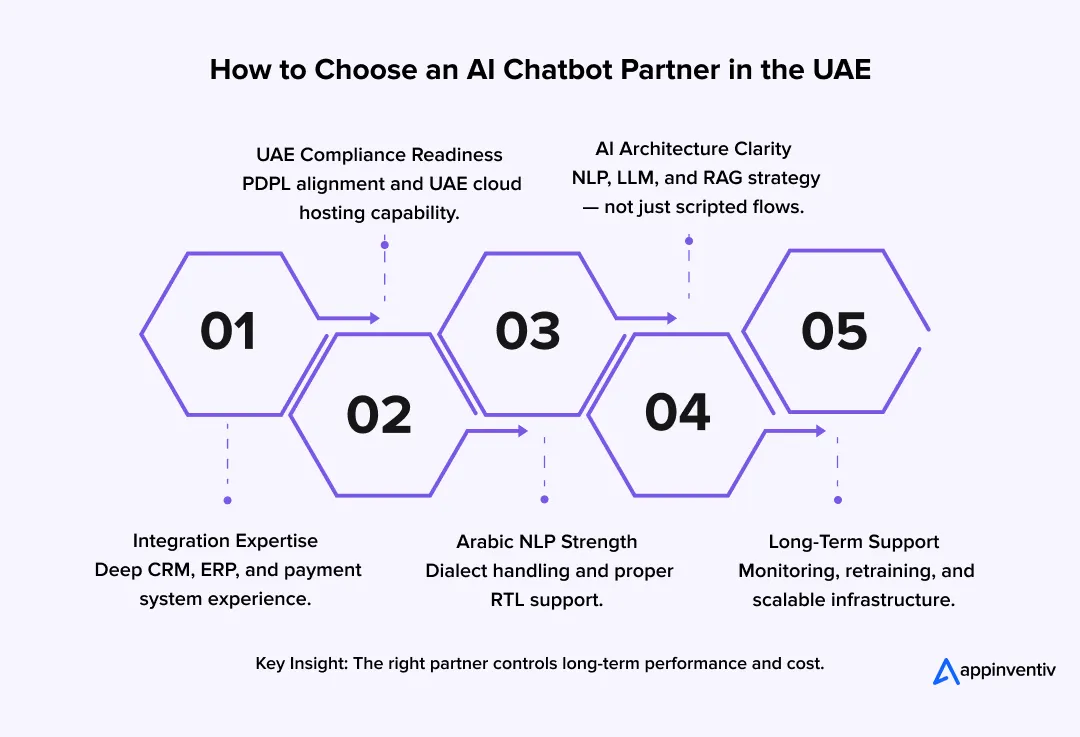
Proven Experience With Enterprise Integrations
Most vendors can demonstrate a polished front end. The real test begins when the chatbot must interact with live infrastructure.
If your business depends on CRM records, ERP workflows, payment gateways, or legacy platforms, integration becomes the defining challenge. A mature partner will spend time understanding your system architecture before recommending a solution. Without that groundwork, integration gaps often appear late in the project and create avoidable delays.
Strong Understanding of UAE Compliance and Data Residency
In regulated sectors across the UAE, compliance shapes design decisions early. Data residency, access permissions, encryption standards, and audit logging are not secondary considerations.
A credible development partner understands how hosting within UAE cloud regions affects architecture. If compliance is treated as an afterthought, the cost and complexity of retrofitting controls can increase significantly.
Real Multilingual Capability, Not Just Translation
Arabic support introduces technical nuances. Dialect variation, sentence structure differences, and right-to-left interface behavior require structured validation. Intent accuracy must be tested across both Arabic and English, especially in customer-facing deployments.
Teams that treat multilingual capability as a simple content translation task often struggle with consistency once traffic increases.
AI Architecture Maturity
There is a difference between automation and engineered AI systems.
Some providers rely primarily on scripted flows. Others understand when structured logic is sufficient and when NLP or LLM integration becomes necessary. The ability to explain model trade-offs, scalability limits, and infrastructure implications reflects architectural maturity.
That clarity also protects businesses from unplanned increases in the overall conversational AI chatbot cost in Dubai as usage expands.
Long-Term Support and Optimization Capability
A chatbot does not remain static. Customer behavior shifts. Internal systems evolve. Regulatory guidance updates.
Sustaining performance entails ongoing monitoring, retraining, and an adjustment of infrastructure. Accuracy and the quality of response deteriorate over time without the systematic monitoring after the deployment.
Selecting a partner in the UAE market is less about comparing proposals and more about evaluating depth. The first sign of an expert AI chatbot development company in the UAE turns out to be their architectural maturity, regional awareness, and commitment in the long term.
Get a tailored AI chatbot cost breakdown aligned with your integrations, compliance needs, and growth plans in the UAE.
How Appinventiv Helps You Build Cost-Efficient AI Chatbots in the UAE?
By the time most companies speak to us about conversational AI, they already know the AI chatbot development cost in the UAE range. What they want clarity on is something else.
- Will this actually work inside our systems?
- Will it hold up under real traffic?
- Will we need to rebuild it in a year?
That is where our approach tends to differ.
We have launched more than 80 Gen AI applications and trained and deployed 75+ custom Gen AI models across production environments. These are not experimental pilots. They run in sectors where downtime, inaccuracies, or integration failures are not tolerated.
In the UAE, we have worked with brands such as Domino’s, KFC, Pizza Hut, IKEA, and Adidas, helping them scale digital systems that manage real customer volume. Alongside this, we maintain 20+ strategic partnerships in the UAE, which helps us stay aligned with regional business and infrastructure expectations.
We Focus on Integration Before Interface
A chatbot that looks impressive in a demo is easy to build. The real test begins when it needs to connect to CRM platforms, ERP systems, booking engines, or authentication layers.
We as an AI chatbot development company, design conversational AI systems around those integrations from the start. That means building structured API orchestration, handling real-time data securely, and planning for scale early. It keeps complexity controlled as the system grows and prevents unexpected jumps in the overall development cost of conversational AI chatbot in Dubai later on.
What That Looks Like in Practice: Flynas
With Flynas, we worked on a high-volume airline platform where customer journeys cannot afford friction.
The AI-powered chatbot capabilities were designed to support booking-related queries, guide users through flight selection and modifications, and assist across multi-step interactions. Instead of functioning as a simple help widget, the system was integrated into live workflows so users could move from inquiry to action smoothly.
Airline traffic fluctuates heavily. The architecture had to stay responsive even during peak demand. That required careful backend planning, not just conversational design.
What That Looks Like in Practice: Mudra
For Mudra, a financial management application, conversational AI played a different role.
Here, the chatbot was designed to help users interpret financial data, navigate budgeting workflows, and receive contextual explanations inside the app. Financial systems require precision, so the conversational layer was built with structured validation and controlled access to sensitive data.
It was not about generating creative responses. It was about delivering reliable, explainable assistance.
Built for the UAE Market, Not Adapted Later
Arabic and English support are usually expected together. We treat multilingual capability as part of system design, not an afterthought. Intent accuracy is validated across both languages, and interface behavior is tested carefully in right-to-left environments.
Security decisions are also made early. Access control, encrypted communication, and region-aligned cloud deployment are embedded into the architecture. That way, the cost of conversational AI development in the UAE remains predictable instead of expanding due to late compliance adjustments.
We do not see conversational AI as a feature you bolt onto a website. We see it as part of the operational backbone.
When it is designed that way, it scales properly, integrates cleanly, and continues delivering value long after launch.
FAQs
Q. How much does it cost to build an AI chatbot in the UAE?
A. In most UAE projects, budgets land somewhere between AED 150,000 and AED 1,470,000 (roughly $40,000 to $400,000). A small internal FAQ assistant sits near the lower end. A fully integrated conversational AI system that connects to CRM, payments, or core platforms naturally moves toward the higher end. The scope changes the number.
Q. Why does AI chatbot development cost more in the UAE?
A. Two words: architecture and regulation.
Arabic support is more technical than people assume. Hosting decisions often lean toward UAE cloud regions. And once compliance and internal security teams get involved, additional controls are required. Those layers add effort compared to lighter global deployments.
Q. What is the cost difference between a rule-based chatbot and an AI-powered one?
A. A rule-based bot might cost AED 150,000 to AED 250,000 ($40,000 to $68,000). It works well for structured flows.
Once you introduce NLP, contextual understanding, or LLM integration, budgets typically shift upward, often crossing AED 400,000 and scaling from there depending on integrations.
Q. Should a business build custom or use SaaS tools?
A. If the goal is basic automation, SaaS can work.
If the chatbot needs to access live systems, handle Arabic properly, or meet regulatory expectations, custom development usually makes more sense long term. The decision depends on how central the chatbot is to operations.
Q. How much does Arabic NLP add to the cost?
A. Supporting Arabic properly is not a translation exercise. Dialect handling, intent testing, and right-to-left behavior require additional work. In practical terms, this can increase effort by 15 to 25 percent depending on complexity.
Q. What is the total cost over three years?
A. The initial build is only part of it. Infrastructure, LLM token usage, retraining, updates, and scaling all add up. Over three years, many businesses end up spending between 1.3 and 2 times the original build cost, depending on traffic growth.
Q. How long does development usually take?
A. A smaller deployment may take two to three months. Once integrations and AI layers are involved, chatbot development timeline in the UAE typically stretches to four to six months. Enterprise systems can take longer.
Q. What ROI can UAE businesses expect?
A. ROI usually shows up in reduced support pressure and faster response cycles. In high-traffic sectors like retail or banking, improvements become noticeable within the first year.
Q. How should a company choose a development partner?
A. Look beyond the demo. Ask how the system will integrate with your existing stack. Ask how Arabic is validated. Ask what happens when usage doubles. The answers will tell you more than a proposal document.
Q. Can startups in the UAE afford conversational AI?
A. Yes, but scope needs to be controlled. Many startups begin with focused use cases and expand gradually. Large-scale enterprise builds are not the only path.

- In just 2 mins you will get a response
- Your idea is 100% protected by our Non Disclosure Agreement.

AI Inventory Management in Australia: Benefits, Use Cases, and Implementation Strategies
Key takeaways: Traditional ERP planning reacts to history; AI predicts demand shifts, reallocates stock dynamically, and prevents costly stockouts across distributed Australian networks. AI in inventory management in Australia typically reduces inventory levels 20–40% while maintaining service targets, unlocking significant working capital across multi-state operations. Enterprise implementations usually range from AUD 70,000 to AUD 700,000+,…
How to Hire RAG Architects for Enterprise AI
Key takeaways: Define your RAG architecture scope to avoid misaligned hiring decisions Identify end-to-end architectural ownership across retrieval, governance, and scaling Evaluate deep technical capabilities beyond prompt engineering and tools Validate governance and compliance readiness at the retrieval layer Test system-level thinking through real-world failure scenarios Choose the right hiring model based on scale, risk,…

Key Takeaways: Healthcare chatbots in the UAE are moving beyond queries to support triage, patient communication, and real clinical workflows across hospitals. Effective healthcare chatbot development depends on clean data, strong system integrations, and alignment with regulations like DHA, DOH, and MOHAP. Development costs typically range from AED 147,000 to AED 1,470,000+, depending on complexity,…









