






























Proving the ROI of Copilot AI Sales Enablement Software for Global Teams


- Where Copilot Actually Touches Revenue in the Sales Lifecycle
- The ROI Metrics That Matter (And the Ones That Don’t)
- What High-ROI Organizations Do Differently With Copilot
- Global Sales Teams: Why ROI Breaks Without Regional Strategy
- Real-World ROI Patterns from Copilot-Led Sales Enablement
- Where Copilot ROI Often Fails (And Why)
- Building a Defensible Business Case for Copilot in Sales
- How Does Appinventiv Help Enterprises Build Sales Copilots With ROI?
- Frequently Asked Questions

Key Takeaways
- The ROI of Copilot AI sales enablement software shows up in revenue moments, not in generic productivity reports.
- Organizations that treat Copilot as an AI-powered sales enablement platform tied to sales process maturity see measurable outcomes within two quarters.
- Global sales teams require region-aware deployment models to avoid uneven adoption and misleading ROI signals.
- CRM data discipline has a direct and visible impact on AI sales copilot ROI.
- Sustainable results depend on governance, enablement, and measurement, not licensing scale.
Copilot adoption in sales has moved quickly. In many organizations, the conversations around accountability are faster.
What began as an experiment to reduce manual work has now reached executive review cycles. Sales leaders are no longer asked whether teams are using Copilot; they are asked whether it is driving measurable results.
According to reports, sales teams using AI tools see up to 40% increases in productivity and 20–30% revenue growth compared to peers without AI adoption. This highlights just how pivotal AI Copilot can be for sales teams.
CFOs are not interested in hours saved, usage dashboards do not persuade CROs, and boards want to know whether AI Copilot for sales teams is improving deal quality, forecast reliability, and revenue consistency.
This shift has changed how Copilot AI sales enablement software is evaluated. The discussion is no longer about breadth of capability, but about business impact.
For global teams, this scrutiny is sharper. Different regions sell differently, data quality varies, and governance expectations are uneven. A single Copilot rollout rarely performs the same way everywhere.
This blog focuses on how ROI is actually created, measured, and sustained when Copilot is used as a sales enablement system rather than a standalone tool.
Turn proven productivity and revenue gains from AI sales tools into measurable Copilot outcomes.

Where Copilot Actually Touches Revenue in the Sales Lifecycle
Not every sales activity carries the same revenue weight. Copilot delivers value by improving decisions or execution at specific points in the sales cycle.
Pre-Sales Intelligence and Account Readiness
Before the first meaningful customer interaction, sellers often rely on fragmented research. In AI-enabled customer experience environments, account history, past interactions, industry context, and internal notes often live in different systems.
An AI sales assistant for enterprises helps consolidate this information into a usable view. The immediate benefit is speed, and the more meaningful benefit is consistency. Reps start conversations better prepared, not because they worked longer hours, but because the system reduced friction.
This is one of the clearest examples of how AI sales copilot works in enterprise sales. The revenue effect is indirect but real. Better prepared conversations reduce early-stage drop-off and shorten the path to qualification.
Opportunity Management and Deal Progression
Once an opportunity exists, execution quality matters more than creativity. Deals stall for predictable reasons: updates are delayed, context is lost between meetings, and sales managers review incomplete information.
Enterprise sales automation with AI helps maintain continuity. Copilot-generated summaries and reminders improve hygiene. More importantly, they reduce variation across reps.
Sales productivity with AI copilot improves when fewer deals slip simply because information was missed or follow-up lagged. The revenue signal appears as steadier pipeline movement rather than sudden performance spikes.
Rep Execution and Follow-Through
Follow-through is where many sales motions weaken. Notes are incomplete, commitments are forgotten, and next steps are vague.
AI-driven sales coaching software embedded in daily workflows helps reinforce discipline. Not by policing behavior, but by making expectations visible.
This is one of the more understated AI sales enablement use cases. It does not replace coaching; it supports it. Over time, execution becomes more predictable, which matters more to revenue leaders than individual hero performances.
Forecasting and Revenue Confidence
Forecasting is where Copilot’s impact becomes visible to leadership. AI copilot for sales forecasting does not create certainty; it improves signal quality.
When data is timely and summaries reflect reality, forecast conversations change. Fewer last-minute surprises and defensive explanations. More confidence in planning decisions.
The revenue impact of AI sales Copilots here is not about precision; it is about credibility.
Also Read: How AI Sales Forecasting Software Enhances Accuracy
The ROI Metrics That Matter (And the Ones That Don’t)
Measuring the ROI of AI sales enablement software is less about data availability and more about judgment.
Most sales organizations already track dozens of metrics. The problem is not a lack of numbers, but a lack of clarity about which numbers truly change because of Copilot.
In the current environment, that distinction matters more than ever.
Revenue targets are tighter, buying cycles are longer, and forecast scrutiny is sharper. Technology budgets are no longer protected by enthusiasm for innovation. Any investment in Copilot AI sales enablement software must withstand a structured review.
Let’s break down what should be measured, what should be contextualized, and what should be ignored.
Revenue-Aligned Metrics That Signal Real Impact
If Copilot is positioned as an AI-powered sales enablement platform, its success must connect to revenue motion.
Revenue & Operational Benchmarks (2025–2026 Industry Standards)
Based on current enterprise deployments across the Appinventiv ecosystem, the following benchmarks represent “Success” for a mature AI sales implementation:
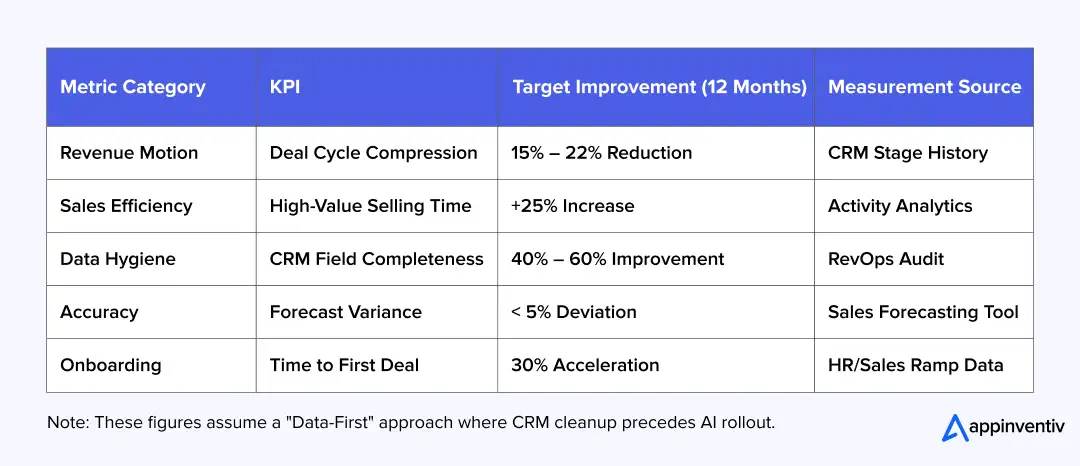
Note: These figures assume a “Data-First” approach where CRM cleanup precedes AI rollout.
Deal Cycle Compression
One of the earliest measurable shifts is a reduction in average deal cycle length. This does not mean every deal closes faster. It means fewer deals stall because of administrative friction.
When the AI copilot for sales teams improves preparation quality and consistency in follow-through, the time between meaningful interactions shortens.
The key is not to compare month to month or compare quarter over quarter. Patterns matter more than spikes.
Opportunity Progression Rate
A healthier pipeline moves forward more predictably.
Track:
- Percentage of opportunities advancing to the stage within defined timeframes
- Reduction in “aging” deals
- Consistency across sales regions
If enterprise sales automation with AI is working, fewer deals remain stuck without explanation.
The improvement is rarely dramatic; it is steady, and steady improvements compound.
Win-Rate Stability (Not Just Increase)
Organizations often look for a win-rate jump after Copilot deployment. That expectation is misplaced.
A more realistic metric is reduced volatility in win rates. Consistency across quarters signals improved execution discipline.
The revenue impact of AI sales copilots often shows up as predictability before it shows up as growth. Boards value predictability.
Forecast Variance Reduction
Forecasting confidence is one of the most underappreciated ROI signals.
Measure:
- Variance between forecast and actual revenue
- Frequency of late-stage forecast revisions
- Regional forecast deviation patterns
AI copilot for sales forecasting strengthens pipeline signal quality. When forecast conversations become less defensive, Copilot is doing more than summarizing meetings. It is improving data trust.
Operational Metrics That Support the ROI Narrative
Revenue metrics show impact, operational metrics explain why. These are not vanity numbers; they are causal indicators.
Selling Time Ratio
Track the ratio between customer-facing activity and administrative effort.
If sales productivity with AI Copilot improves, this ratio should shift gradually. Reps may not feel dramatically less busy, but the nature of their busyness changes.
Less time writing summaries and more time preparing for complex conversations. That difference accumulates over quarters.
CRM Completeness and Data Freshness
An AI sales assistant for enterprises relies on structured data. If CRM hygiene improves post-Copilot rollout, that is not accidental.
Measure:
- Timeliness of opportunity updates
- Completion rates of required fields
- Reduction in manual corrections by sales operations
Improved data quality often precedes revenue impact. Ignore it at your own risk.
Onboarding Acceleration
In global organizations, onboarding speed directly affects revenue timing. AI sales enablement use cases often include:
- Automated knowledge retrieval
- Contextual deal summaries
- Territory briefings
New hires ramp faster when institutional knowledge is easier to access.
Onboarding acceleration is a credible component of the cost-benefit analysis of AI sales software, especially in high-turnover regions.
Also Read: AI Copilot Use Cases for Businesses: Transforming Workflows
Metrics That Often Inflate ROI Claims
Not all improvements should be presented as financial return. Some metrics are useful internally but weaken credibility externally.
Generic “Hours Saved”
This is the most common reporting mistake. If hours are saved but not reallocated effectively, revenue does not change. Productivity without redeployment is idle capacity.
CFOs understand this immediately. Unless hours saved correlate with measurable business activity, treat them as supporting data, not headline ROI.
Tool Usage Without Outcome Context
High AI copilot adoption in sales looks impressive on dashboards. It means little if usage does not connect to improved execution.
Usage is a health indicator, not an outcome.
Engagement Metrics in Isolation
Clicks, prompts, document generation counts. These numbers create activity narratives that rarely withstand executive scrutiny.
Overreporting them creates skepticism.
The Modern Environment: Why ROI Measurement Has Changed
Five years ago, productivity improvements were enough. Today, they are not. Several factors shape how Copilot AI software business case reviews are conducted now:
Budget Consolidation
Technology budgets are being rationalized. Tools that do not show revenue contribution are consolidated or removed.
Copilot must demonstrate integration with core revenue workflows.
Data Governance Scrutiny
Regulatory expectations around AI usage have increased. Internal compliance teams are more involved.
In some regions, AI outputs must be auditable. In others, usage must be logged. These requirements slow adoption and delay ROI.
Ignoring governance realities leads to unrealistic projections.
Global Revenue Diversification
Revenue streams are increasingly distributed across regions.
An AI copilot for global sales teams must perform under varying maturity levels. ROI calculations must reflect that heterogeneity.
Uniform assumptions produce distorted results.
Building a Layered ROI Model (What Executives Actually Want)
Strong organizations do not rely on a single metric; they build layered evaluation models. A mature AI sales copilot ROI framework includes:
Layer 1: Operational Improvement
- Data quality improvements
- Reduction in administrative workload
- Adoption stabilization
Layer 2: Execution Improvement
- Opportunity progression stability
- Reduced pipeline aging
- Improved deal review efficiency
Layer 3: Financial Impact
- Revenue acceleration
- Improved forecast confidence
- Reduced revenue volatility
Each layer supports the next. Skipping layers leads to fragile ROI narratives.
Time Horizon Discipline
One of the most common errors in evaluating AI Copilot for sales teams is impatience. Operational shifts may appear within weeks, while revenue shifts take quarters. If performance is judged too early, Copilot is labeled ineffective before behavioral change stabilizes.
A defensible build vs buy sales AI business case must clearly define time horizons. Without that discipline, investment confidence erodes.
When Standard Metrics Are Not Enough
Some organizations outgrow generic measurement frameworks.
They begin exploring custom AI sales enablement software integrations to:
- Connect Copilot outputs with deal scoring models
- Align summaries with performance analytics
- Embed AI-driven sales coaching software directly into review workflows
This is typically not a starting point; it is a second-phase optimization step, but it reflects maturity.
The Technical Architecture of AI Sales Enablement: Platform Deep-Dives
To move beyond generic productivity, your AI stack must be integrated at the data layer. Here is how global leaders handle the technical hurdles of the most common integrations:
Microsoft 365 Copilot & Gong Integration
For teams using Gong for revenue intelligence, “siloed” insights are the enemy of ROI.
- Technical Step: Use the Microsoft 365 Copilot Connector for Gong via the Microsoft 365 Admin Center.
- The ROI Unlock: By indexing Gong call metadata (summaries, action items, and sentiment) directly into the Copilot Graph, sellers can ask, “What was the unresolved objection in the last three Gong calls for Account X?” without leaving Teams.
Security Tip: Ensure OAuth 2.0 authentication is used to maintain Gong’s workspace-level permissions within the Microsoft environment.
Salesforce Einstein & GDPR Compliance
For global teams, the “Trust Layer” is a technical requirement, not a buzzword.
- Handling GDPR: Use the Einstein Trust Layer to enable PII (Personally Identifiable Information) masking. Before data is sent to a Large Language Model (LLM), Salesforce automatically strips sensitive customer identifiers.
- Data Residency: Configure your data cloud to ensure that EU-based customer data remains within restricted regions while the AI processes only anonymized metadata for global forecasting.
- Auditability: Implement Event Monitoring to log every AI-generated interaction, ensuring your legal team has a “Human-in-the-loop” audit trail for GDPR Article 22 compliance (automated decision-making).
What This Means for Leadership
When evaluating the ROI of AI sales enablement software, leadership should ask:
- Are we measuring business motion or tool engagement?
- Have we defined realistic time horizons?
- Are regional variations distorting our interpretation?
- Is Copilot reinforcing process discipline or masking weak fundamentals?
These questions matter more than adoption percentages.
Copilot does not generate revenue in isolation; it amplifies what already exists. If sales processes are disciplined, data is structured, and leadership alignment is strong, Copilot improves consistency.
If those conditions are weak, Copilot exposes the weakness faster. ROI measurement must account for that reality.
Our AI Copilot development services help teams implement, integrate, and scale responsibly.

What High-ROI Organizations Do Differently With Copilot
Organizations that extract measurable ROI from Copilot AI sales enablement software do not treat it as a productivity accessory. They treat it as a controlled extension of their revenue system.
Across implementations involving Microsoft 365 Copilot, Dynamics 365 Sales Copilot, Salesforce AI layers, and hybrid CRM environments, one consistent pattern emerges: success correlates more with structural alignment than with feature adoption.
High-performing teams approach Copilot as a sales infrastructure decision.
Anchoring Copilot to Sales Process Architecture
In mature environments, Copilot is never deployed broadly without first mapping it to the existing sales motion.
Before implementation, leading organizations conduct structured workflow mapping exercises:
- Stage-by-stage opportunity flow
- Internal approval checkpoints
- Deal review cadence
- CRM data entry expectations
- Regional escalation pathways
Only after this mapping do they determine where the Copilot should intervene.
For example:
- In Dynamics 365 Sales environments, Copilot is configured to assist with opportunity summaries and forecast preparation, not generic email drafting.
- In Salesforce ecosystems, Copilot-like AI modules are aligned with structured opportunity scoring and stage exit criteria.
- In Microsoft Teams-heavy environments, Copilot is embedded within collaboration flows to reduce context switching.
Sales enablement software with AI Copilot delivers sustainable ROI when tied to defined friction points such as incomplete deal documentation, inconsistent follow-up, or delayed opportunity updates. Automating peripheral tasks rarely produces measurable impact.
At Appinventiv, we have observed that organizations that begin with workflow audits see measurable improvement in forecast stability within two reporting cycles. Those that skip this step typically report “usage growth” but struggle to demonstrate revenue impact.
Defining Role-Specific Value Across the Revenue Organization
One of the most common deployment mistakes is assuming that AI copilot for sales teams creates uniform value. It does not. In practice, value distribution varies significantly:
For Field Sales Representatives
- Faster access to historical deal context
- Structured meeting recap assistance
- Reduced manual CRM documentation
For Sales Managers
- Consolidated opportunity summaries
- More efficient pipeline review preparation
- Reduced time validating data integrity
For Revenue Operations
- Improved data completeness
- Reduced correction cycles
- Stronger alignment between CRM fields and forecasting models
Enterprise copilot AI sales software generates higher ROI when expectations are role-specific. Metrics are also segmented by role.
For example:
- Sellers are evaluated on opportunity velocity and the turnaround time from meeting to follow-up.
- Managers are evaluated on the forecast variance reduction they achieve.
- RevOps teams are evaluated on data quality improvement rates.
Organizations that articulate Copilot value at the role level typically stabilize AI Copilot adoption in sales within three to four months, compared to fragmented adoption patterns seen in broad, undifferentiated rollouts.
Investing in Structured Adoption and Governance
Adoption does not stabilize organically.
In the current regulatory and operational environment, AI deployment in sales intersects with internal compliance frameworks, including:
- GDPR data handling requirements in EU regions
- SOC 2 audit obligations
- ISO 27001-aligned information governance
- Internal AI usage policies and model auditing standards
High-performing organizations create structured Copilot governance frameworks, including:
- Approved prompt templates
- Defined human-review thresholds for external communications
- Logging mechanisms for AI-generated summaries
- Access tiering by geography and role
This is particularly relevant in AI sales enablement for global teams where regulatory variance is real.
Organizations that formalize governance early avoid later rollback decisions. In several global deployments, we have seen ROI calculations disrupted because legal teams intervened post-launch, restricting certain Copilot functionalities. Structured governance from the outset preserves both credibility and continuity.
Also Read: AI-powered Data Governance: Reshaping Data Strategy
Global Sales Teams: Why ROI Breaks Without Regional Strategy
Global sales transformation initiatives often assume technology uniformity equals performance uniformity.
This assumption rarely holds.
AI copilot for global sales teams exposes underlying differences in data maturity, language nuance, compliance tolerance, and selling behavior.
Data Readiness and CRM Discipline by Geography
In multinational organizations, CRM hygiene varies significantly across regions.
Some territories enforce structured data entry policies with defined review cycles. Others rely more heavily on informal documentation.
Copilot performance directly reflects this maturity.
When CRM data is structured and current:
- AI-generated summaries are trusted
- Forecast insights align with manager expectations
- Pipeline analytics are stable
When data is incomplete:
- Outputs require manual correction
- Adoption confidence drops
- ROI signals weaken
Across implementations involving both Microsoft Dynamics 365 and Salesforce Sales Cloud, we have consistently seen that regions with stronger CRM governance achieve 15–25% faster, measurable improvements in opportunity progression metrics.
Ignoring regional data readiness leads to distorted ROI comparisons and internal skepticism.
Language, Regulatory, and Policy Constraints
AI sales enablement for global teams must operate within varying legal environments.
For example:
- EU regions may restrict storage or reuse of certain conversational data.
- APAC territories may require additional review of AI-generated customer-facing content.
- Internal corporate AI policies may mandate human validation for specific deal stages.
ROI models that assume unrestricted functionality across all regions tend to overstate financial return.
In practice, organizations that build compliance-aware deployment models experience smoother scaling and fewer retroactive adjustments.
Designing Region-Aware Deployment Frameworks
High-performing organizations do not deploy Copilot based solely on organizational structure. They deploy based on readiness.
Effective region-aware models include:
- Pre-launch CRM data audits
- Regional prompt adaptation libraries
- Tiered functionality access
- Phased rollout tied to performance checkpoint
This approach may extend implementation timelines by several weeks. However, it reduces post-launch friction and improves credibility during executive review.
In our experience, structured regional rollout improves long-term AI sales copilot ROI consistency by stabilizing adoption curves across geographies.
Real-World ROI Patterns from Copilot-Led Sales Enablement
Rather than isolated case anecdotes, recurring patterns across implementations offer more reliable insight.
Short-Term Signals (0–90 Days)
Within the first quarter of deployment, organizations typically observe:
- Increased CRM update frequency
- Faster meeting-to-summary turnaround
- Reduced manual reporting preparation
These reflect the operational benefits of Copilot AI as a sales enablement software. However, they are early-stage indicators.
At Appinventiv, in AI-enabled sales automation deployments across retail and logistics clients, operational efficiency gains have consistently preceded revenue improvements by one to two quarters.
Short-term ROI should be reported as operational stabilization, not revenue growth.
Medium-Term Signals (3–6 Months)
Once adoption stabilizes, measurable execution improvements emerge:
- Reduced pipeline aging
- Improved opportunity stage transition rates
- Stronger alignment between deal documentation and forecast projections
In several deployments integrating AI copilots within CRM and analytics layers, revenue predictability improved before absolute revenue increased.
This distinction matters. Predictability improves capital planning and resource allocation, even before growth acceleration occurs.
Long-Term Signals (6–12 Months)
Sustained ROI appears as systemic improvement:
- Reduced forecast variance across regions
- Consistent pipeline hygiene
- Lower reliance on manual sales operations oversight
At this stage, some organizations evaluate whether their current solution represents the best copilot AI sales enablement software for enterprises or whether deeper integration, customization, or AI integration services are required.
This is often where discussions shift toward custom AI sales enablement software aligned with proprietary deal-scoring models or industry-specific compliance frameworks.
Where Copilot ROI Often Fails (And Why)
In most cases, Copilot deployments do not fail because the technology underperforms. They fail because the surrounding system is not prepared for it.
Copilot AI sales enablement software is designed to amplify structured workflows, disciplined data entry, and defined sales motions. When those conditions are absent, the AI layer exposes operational weaknesses rather than correcting them.
Across implementations involving Microsoft 365 Copilot, Dynamics 365 Sales, Salesforce AI layers, and hybrid CRM environments, failure patterns tend to repeat. Understanding these patterns is critical for protecting long-term AI sales copilot ROI.
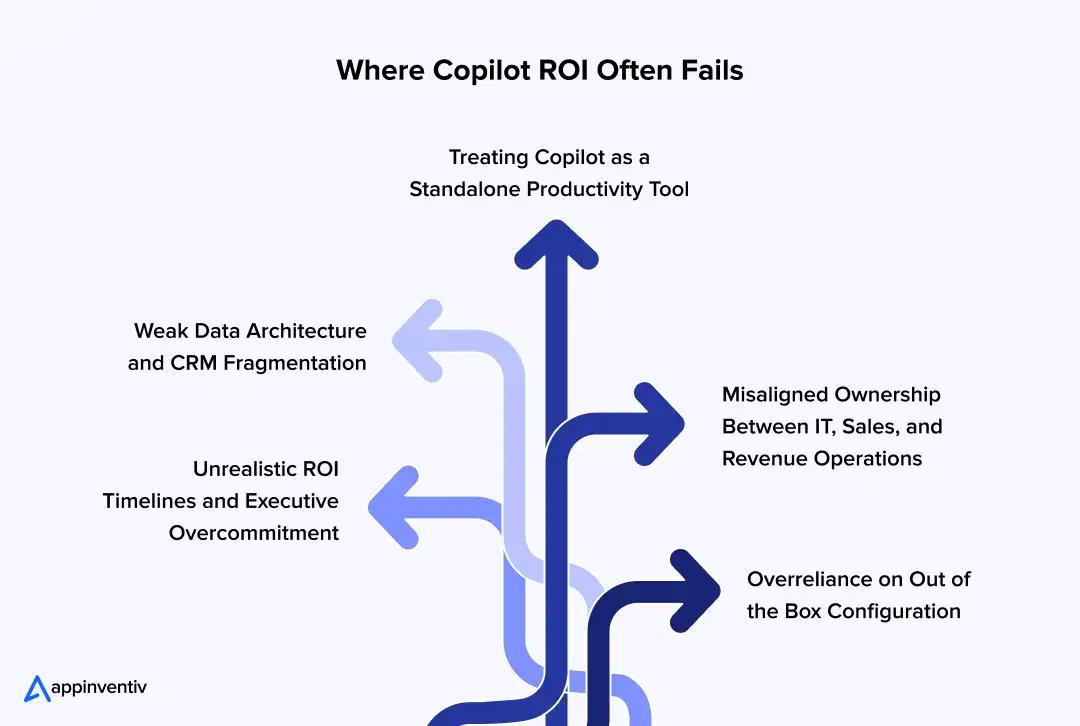
Treating Copilot as a Standalone Productivity Tool
One of the most common strategic errors is positioning Copilot as a personal efficiency assistant rather than as part of a structured revenue system.
Top AI copilot sales enablement solutions cannot compensate for undefined stage criteria, informal approval processes, or inconsistent deal qualification standards. When sellers are unclear about stage exit requirements or internal escalation protocols, Copilot-generated summaries simply document confusion more efficiently.
In practice, this creates the illusion of progress without operational improvement.
For example, in several CRM-integrated deployments, we have observed that teams initially reported high engagement with AI-generated opportunity summaries. However, pipeline health metrics remained unchanged because stage definitions were ambiguous. The AI layer reflected existing inconsistencies rather than correcting them.
Successful implementations treat Copilot as an extension of the sales process architecture. Before deployment, organizations typically:
- Audit opportunity stage definitions
- Clarify approval flows
- Align sales documentation standards
- Standardize CRM data entry requirements
When enterprise sales automation with AI is layered on top of structured workflows, performance stabilizes. When layered on fragmented processes, it accelerates fragmentation.
The distinction determines whether Copilot becomes a revenue accelerator or an administrative assistant.
Weak Data Architecture and CRM Fragmentation
AI accuracy is a reflection of data quality.
Enterprise CRM systems often contain inconsistent field definitions, duplicate records, incomplete contact hierarchies, and redundant workflows created over years of incremental updates. These issues may be manageable in manual review environments but become highly visible once AI begins generating insights.
In environments where data normalization is incomplete, Copilot outputs may:
- Surface outdated opportunity information
- Misinterpret stage movement
- Generate summaries lacking critical deal context
- Produce inconsistent forecasting signals
When this occurs, user trust declines quickly. Sellers begin double-checking outputs, managers revert to manual validation, adoption slows, and ROI stalls.
Data readiness is not optional in enterprise copilot AI sales software deployments; it is foundational.
Organizations that demonstrate sustained ROI typically conduct:
- Pre-deployment CRM schema audits
- Field-level consistency reviews
- Duplicate record resolution exercises
- Workflow simplification initiatives
In regulated industries, additional considerations apply. Data lineage documentation, access logging, and role-based access controls must align with frameworks such as GDPR, SOC 2, and ISO 27001.
Without technical groundwork, AI-driven sales coaching software and forecasting support tools cannot operate reliably. The AI layer does not compensate for architectural weakness rather highlights it.
Misaligned Ownership Between IT, Sales, and Revenue Operations
Another predictable failure pattern involves organizational misalignment.
When Copilot AI for sales is positioned purely as an IT modernization initiative, revenue accountability becomes diluted. Conversely, when revenue leadership drives adoption without technical governance oversight, compliance risks increase.
High-ROI deployments reflect shared ownership.
Revenue leadership defines measurable business outcomes, such as forecast variance reduction or stabilized opportunity velocity. Sales operations teams maintain CRM data discipline and enforce stage governance. IT ensures system integration, data security, and alignment with compliance requirements.
This tri-layer ownership model is especially important for AI sales enablement within global teams, where regional governance requirements vary and internal AI policies may differ across jurisdictions.
In implementations where one function dominates decision-making, friction emerges:
- IT-led initiatives may prioritize feature enablement over behavioral adoption.
- Sales-led initiatives may overlook data architecture constraints.
- Operations-led initiatives may optimize reporting without addressing seller workflows.
Shared accountability prevents post-deployment stagnation and protects AI sales copilot ROI over multiple quarters.
Unrealistic ROI Timelines and Executive Overcommitment
Another less-discussed failure driver is mismanagement of the timeline.
Operational improvements typically appear within the first quarter and revenue stability improvements follow later. Absolute revenue growth often requires sustained behavioral change over multiple quarters.
When Copilot AI software business cases promise immediate revenue acceleration without acknowledging the time required for process adaptation, credibility erodes quickly.
Responsible deployment frameworks distinguish between:
- Operational efficiency gains
- Execution discipline improvements
- Financial impact realization
Separating these timelines creates realistic expectations and prevents premature disinvestment.
Overreliance on Out-of-the-Box Configuration
Standard Copilot configurations are designed for broad applicability. In complex sales environments — particularly those with multi-tier distribution models, regulated deal structures, or custom pricing frameworks — generic configurations may not align with business reality.
In such environments, organizations often need:
- Custom prompt libraries aligned to internal terminology
- Integration with revenue intelligence platforms such as Gong or Clari
- Alignment with proprietary deal scoring algorithms
- Industry-specific compliance filters
This is where discussions shift toward custom AI sales enablement software augmentation rather than simple feature activation.
Organizations that acknowledge configuration limitations early and plan for structured optimization avoid long-term plateau effects.
Copilot does not generate failure; it reveals structural weakness. When sales processes are well defined, CRM architecture is stable, governance frameworks are clear, and ownership is shared, copilot AI sales enablement software strengthens execution and improves forecast credibility.
When these foundations are absent, the AI layer surfaces inconsistency faster than manual processes ever could. Understanding this distinction is essential for leaders evaluating the long-term revenue impact of AI sales copilots.
Building a Defensible Business Case for Copilot in Sales
A credible Copilot AI software business case does not begin with features. It begins with financial discipline.
Executives evaluating Copilot AI sales enablement software expect clarity on costs, risks, time horizons, and measurable impact. Without that structure, ROI conversations remain theoretical.
Start With Baselines, Not Assumptions
Before implementation, leadership should document current-state metrics across regions and roles:
- Average deal cycle length
- Forecast variance over the last four quarters
- Opportunity progression rates
- Administrative time allocation per seller
- Sales operations intervention frequency
Without baseline data, AI sales copilot ROI becomes anecdotal. With baseline clarity, even moderate improvement becomes defensible.
In our experience, organizations that formalize baseline documentation significantly reduce post-deployment skepticism.
Account for the Full Cost Structure
The ROI of AI sales enablement software must reflect more than license fees.
A realistic evaluation includes:
- Per-user licensing costs
- CRM integration and configuration effort
- Data normalization initiatives
- Governance and compliance review overhead
- Change management and enablement programs
In global deployments, additional cost layers may include regional compliance validation and localized configuration adjustments.
Ignoring these components produces fragile ROI projections.
Define Realistic Time Horizons
Operational efficiency gains typically appear within the first quarter. Execution consistency improvements follow. Financial impact, particularly revenue acceleration, may require multiple quarters of behavioral stabilization.
Boards are increasingly cautious about AI investment promises. A mature business case separates:
- Operational ROI
- Execution ROI
- Financial ROI
This sequencing strengthens credibility.
Address Risk and Governance Explicitly
Modern AI deployment decisions intersect with regulatory and internal policy scrutiny.
A defensible business case should clarify:
- Data handling standards aligned with GDPR or regional requirements
- Access controls and audit logging practices
- Human review thresholds for AI-generated outputs
- Escalation procedures in case of model inaccuracies
Ignoring governance concerns delays approval. Addressing them upfront accelerates alignment.
Evaluate Build vs Buy With Strategic Clarity
For many organizations, native Copilot AI for sales within Microsoft or Salesforce ecosystems is sufficient during early adoption phases.
However, complexity increases when:
- Sales models involve multi-tier distribution structures
- Deal scoring relies on proprietary logic
- Compliance requirements demand industry-specific filtering
- Advanced revenue intelligence integration is required
In such cases, a build vs buy sales AI business case may justify augmenting standard capabilities with custom AI sales enablement software aligned to internal systems.
The decision should be guided by workflow complexity and governance maturity, not by feature comparison alone.
Also Read: How to Build an AI Copilot for Enterprises?
Present ROI in Scenarios, Not Certainties
Executives respond better to structured scenarios than optimistic projections.
A disciplined business case may outline:
- Conservative scenario: operational efficiency stabilization
- Moderate scenario: improved pipeline velocity and forecast confidence
- Advanced scenario: measurable revenue acceleration over 12 months
This approach protects credibility and demonstrates financial maturity.
A strong Copilot AI software business case does not rely on enthusiasm for AI. It relies on measurable baselines, transparent cost accounting, governance readiness, and realistic timelines.
When structured properly, Copilot AI sales enablement software transitions from a productivity tool to a decision-making infrastructure for revenue.
That distinction determines whether adoption remains experimental or becomes strategic.
It’s time for a structured implementation approach.

How Does Appinventiv Help Enterprises Build Sales Copilots With ROI?
Proving the ROI of AI Copilot development services is no longer about showing a “sparkle” icon in an app. It is about a disciplined architectural alignment between your sales process and your data stack.
How Appinventiv Accelerates Your AI Business Case:
- Technical Readiness Audit: We analyze your CRM schema and data quality to ensure your AI isn’t “hallucinating” on bad data.
- Custom Logic Integration: We build custom Copilot Studio actions that connect your proprietary deal-scoring models directly into the AI workflow.
- Global Compliance Framework: We implement the Einstein Trust Layer or Azure OpenAI security guardrails to meet GDPR and SOC 2 standards.
Rather than focusing solely on activation metrics, our AI governance consulting company centers on measurable execution improvement and long-term revenue stability.
Organizations seeking structured guidance in evaluating Copilot AI for sales, or considering hybrid and custom AI sales enablement software models, benefit from implementation frameworks that combine technical depth with revenue accountability.
Ready to move from AI experimentation to measurable revenue impact? Schedule a 30-minute revenue architecture discussion with our AI Sales Specialists
Frequently Asked Questions
Q. How Do AI Sales Copilots Deliver Measurable ROI?
A. At its core, an AI copilot pays for itself by eliminating the “administrative tax” that keeps your best reps away from customers. Most sales teams lose nearly half their week to CRM updates, lead research, and drafting follow-ups. By automating these “grunt work” tasks, a copilot effectively hands back 10 to 15 hours per week to every rep.
Beyond time-saving, the ROI shows up in Deal Velocity. Because the AI can flag stalled deals or suggest the exact piece of content a prospect needs to see next, sales cycles shrink. You aren’t just doing things faster; you’re doing them more accurately, leading to a visible lift in total revenue without increasing your headcount.
Q. What KPIs Prove the Value of AI Sales Enablement Tools?
A. If you want to prove the software is working, stop looking at “log-in rates” and start looking at these five “North Star” metrics:
- Win Rate Lift: Are your “B” players starting to close deals like your “A” players? AI levels the playing field.
- Sales Cycle Length: Track the number of days from “Discovery” to “Closed-Won.” AI should be trimming the fat here.
- CRM Hygiene: High-quality AI tools update the CRM automatically. If your data completeness scores are up, your forecast accuracy will follow.
- Response Time (Lead-to-Lead): In a global market, speed is a currency. AI helps reps respond to inquiries in minutes, not days.
- Ramp Time: How quickly can a new hire in Singapore or London hit their first quota? AI copilots act as an “on-the-job” coach, cutting training time by nearly half.
Q. How Can Global Sales Teams Benefit from AI Copilots?
A. Managing a team across different time zones and cultures is inherently messy. AI copilots act as the “universal glue” for global operations in three specific ways:
- Breaking the Language Barrier: They don’t just translate; they localize. A copilot can help a rep in Tokyo draft an email that feels culturally resonant for a buyer in New York.
- 24/7 Virtual Support: While your US managers are asleep, your EMEA and APAC teams still have access to real-time coaching and technical answers via the AI.
- Unified Messaging: It ensures that whether a prospect is talking to a rep in Berlin or Sao Paulo, the value proposition and compliance standards remain identical. It scales “what works” across the entire planet instantly.
Q. Are AI Sales Copilots Worth the Investment for Enterprises?
A. For an enterprise, the question isn’t “Can we afford this?” but rather “Can we afford to be the only ones still doing this manually?”
The investment is justified because AI provides predictability. Large-scale organizations often struggle with “pipeline hallucinations”—forecasts based on gut feelings rather than data. AI copilots strip away the bias, giving leadership a clear-eyed view of where the revenue is actually coming from. When you factor in the reduction in rep burnout (and the high cost of turnover), the software usually pays for itself within the first two quarters.
In 2026, an AI copilot isn’t a luxury; it’s a utility—like high-speed internet or a phone line. You can try to sell without it, but you’ll be significantly outpaced by those who don’t.

- In just 2 mins you will get a response
- Your idea is 100% protected by our Non Disclosure Agreement.

AI Inventory Management in Australia: Benefits, Use Cases, and Implementation Strategies
Key takeaways: Traditional ERP planning reacts to history; AI predicts demand shifts, reallocates stock dynamically, and prevents costly stockouts across distributed Australian networks. AI in inventory management in Australia typically reduces inventory levels 20–40% while maintaining service targets, unlocking significant working capital across multi-state operations. Enterprise implementations usually range from AUD 70,000 to AUD 700,000+,…

How to Hire RAG Architects for Enterprise AI
Key takeaways: Define your RAG architecture scope to avoid misaligned hiring decisions Identify end-to-end architectural ownership across retrieval, governance, and scaling Evaluate deep technical capabilities beyond prompt engineering and tools Validate governance and compliance readiness at the retrieval layer Test system-level thinking through real-world failure scenarios Choose the right hiring model based on scale, risk,…

Key Takeaways: Healthcare chatbots in the UAE are moving beyond queries to support triage, patient communication, and real clinical workflows across hospitals. Effective healthcare chatbot development depends on clean data, strong system integrations, and alignment with regulations like DHA, DOH, and MOHAP. Development costs typically range from AED 147,000 to AED 1,470,000+, depending on complexity,…