





























AI Inventory Management in Australia: Benefits, Use Cases, and Implementation Strategies


- Understanding the Difference between AI Inventory and Traditional Inventory Systems
- What is the Need for AI Inventory Management for Aussie Businesses?
- What Are the Core Benefits of Using Artificial Intelligence in Inventory Control?
- Top Use Cases of AI Inventory Management in Different Industries of Australia
- Real-World Examples of Australian Business Giants Deploying AI for Inventory Management
- Essential Features for an AI Inventory Management System Development
- How to Implement AI for Inventory Management in Australia?
- What Are Some Core Challenges in Implementing AI in Inventory Systems in Australia and How to Overcome Them
- How Much Does It Cost to Implement AI Inventory Management in Australia?
- What Is the Future of AI in Inventory Management in Australia?
- Why Appinventiv Is a Trusted Partner for AI Inventory Transformation in Australia
- FAQs

Key takeaways:
- Traditional ERP planning reacts to history; AI predicts demand shifts, reallocates stock dynamically, and prevents costly stockouts across distributed Australian networks.
- AI in inventory management in Australia typically reduces inventory levels 20–40% while maintaining service targets, unlocking significant working capital across multi-state operations.
- Enterprise implementations usually range from AUD 70,000 to AUD 700,000+, depending on integration complexity, number of sites, data readiness, and automation depth.
- Successful adoption requires disciplined data preparation, integration with legacy ERP/WMS platforms, and phased pilots to minimise operational risk during transition.
- Benefits of AI inventory management for Australian businesses include lower waste, higher fulfilment rates, and resilient supply chains capable of absorbing disruption without service degradation.
Businesses in Australia are navigating a uniquely volatile logistics landscape. Geographic isolation and high coastal shipping costs create a thin margin for error, particularly as the total cost of inventory distortion reached an estimated $1.7 trillion in 2024, a figure roughly equivalent to Australia’s total GDP. Traditional systems are failing to meet this challenge, making AI inventory the need of the hour.
As a result, for a CEO, the conversation has shifted. It is no longer about basic digitisation of a warehouse management system. The focus is now on the deployment of AI in inventory management in Australia to transition from reactive restocking to predictive orchestration.
The goal is clear: reducing the working capital tied up in safety stock while simultaneously streamlining inventory management and increasing fulfilment rates. This requires a sophisticated AI architectural approach that respects Australian data sovereignty and local market nuances.
If you are interested in exploring more about the advantages of AI for inventory control, this blog is for you. It examines how AI is reshaping inventory operations in the Australian context, where it delivers measurable value, and how businesses can implement it without introducing new operational or governance risks. So, without further ado, let’s get started:
Our AI experts evaluate your data maturity, integration landscape, and expected ROI before recommending a phased roadmap.

Understanding the Difference between AI Inventory and Traditional Inventory Systems
Traditional Inventory Management Systems (IMS) generally operate on “if-then” logic and historical averages. While functional for stable environments, they lack the elasticity required for modern Australian commerce.
In contrast, AI-driven systems in Australia utilise Machine Learning (ML) architectures, specifically Long Short-Term Memory (LSTM) networks and XGBoost. These systems ingest non-traditional data such as local weather patterns, port congestion at Botany or Fremantle, and sentiment analysis to adjust stock levels dynamically.
Here are the key differences between traditional and AI powered inventory systems:
| Feature | Traditional Inventory Systems | AI-Driven Inventory Management |
|---|---|---|
| Data Processing | Static historical sales data | Real-time multi-modal data (Satellite IoT, Weather, Port Telementry) |
| Forecasting | Moving averages & linear trends | Transformer-based Neural Networks & Ensemble Learning |
| Stock Triggers | Fixed reorder points | Dynamic, Probability-based Replenishment (XAI-explained) |
| Risk Handling | Reactive to disruptions | Agentic “Digital Twin” simulations of Indo-Pacific shocks |
What is the Need for AI Inventory Management for Aussie Businesses?
The transition toward artificial intelligence in inventory management in Australia is no longer a luxury for early adopters; it is a critical response to the structural shifts in the domestic economy. For an Australian business, the friction between escalating customer expectations and the physical constraints of local logistics has made manual forecasting a liability.
The following drivers are accelerating the immediate need for AI for inventory management in Australian businesses:
Regional Supply Chain Fragility
Australia’s geographic isolation and reliance on long-haul maritime routes make the markets uniquely vulnerable to external shocks. Relying on static safety stock buffers is no longer a viable strategy when lead times for critical components or retail goods can fluctuate by weeks due to Indo-Pacific shipping volatility.
Labour Constraints and Rising Operational Costs
With industrial wages rising and a highly competitive talent market, the cost of manual inventory auditing and human-led demand planning has become prohibitive. AI-driven intelligent automation allows high-value staff to shift from spreadsheet-based reconciliation to strategic supplier management and high-level problem solving.
Growth of eCommerce and Omnichannel Retail
As Australian consumers move fluidly between physical storefronts and digital marketplaces, inventory must be “liquid.” AI is required to ensure that a product sitting in a Melbourne warehouse is visible and allocatable to a click-and-collect order in Perth, preventing the “phantom stock” crises that erode brand trust.
Also Read: Headless Commerce for Omnichannel Retail in Australia
Government Push Toward Digital Transformation
The Australian government’s focus on the National AI Centre (NAIC) and updated 2026 digital standards highlights a clear regulatory direction. Enterprises are being encouraged to adopt secure, sovereign-hosted AI to bolster national supply chain resilience and maintain competitive parity with global incumbents.
Rising Consumer Expectations
In a landscape where Amazon has normalised rapid fulfilment, “out of stock” is often synonymous with “lost customer.” Meeting these expectations requires a predictive engine that anticipates demand spikes before they occur, ensuring that marketing spend translates directly into fulfilled orders.
Overwhelming Data Volumes
The sheer volume of data generated by modern ERP, POS, and IoT sensors has outpaced human cognitive capacity. AI is necessary to synthesise millions of data points into actionable insights, identifying patterns in SKU velocity and regional demand that traditional systems simply cannot detect.
Supplier Reliability Issues
Global shipping delays and shifting manufacturing landscapes have made supplier lead times notoriously unpredictable. AI-driven systems monitor these external signals in real-time, automatically adjusting reorder points and safety stock levels to buffer against the unreliability of international logistics.
The inability to synthesise these variables in real-time results in capital leakage. Without AI, businesses often find themselves over-capitalised in slow-moving stock while missing revenue opportunities on high-demand items due to a lag in the replenishment cycle.
What Are the Core Benefits of Using Artificial Intelligence in Inventory Control?
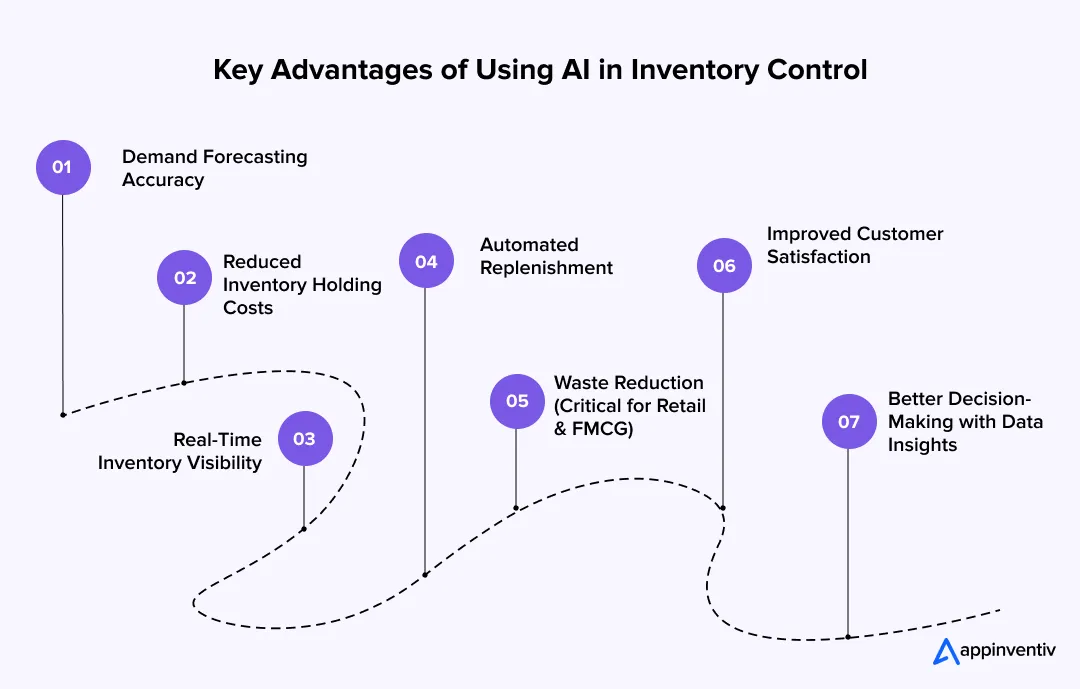
Transitioning to artificial intelligence in inventory management in Australia offers more than incremental efficiency; it fundamentally reconfigures the cost basis of the supply chain. For local businesses, the primary advantage lies in the mitigation of “dead capital” – stock that occupies expensive domestic floor space without moving. Here are some other benefits of AI inventory management for Australian businesses:
1. High-Precision Demand Forecasting
Unlike traditional linear regression models, AI accounts for the “noise” inherent in the Australian market. By synthesising erratic variables, ranging from sudden interest rate shifts affecting consumer sentiment to extreme weather events impacting East Coast logistics, AI models for demand forecasting offer a granular view of future requirements.
This level of foresight allows procurement teams to commit to stock positions with a confidence level that legacy systems cannot replicate.
2. Radical Reduction in Carrying Costs
Warehousing space in major hubs like Sydney and Melbourne is currently at a premium. By leveraging AI applications in inventory optimisation for Australian businesses, organisations can maintain leaner safety stocks without risking availability.
The ability to mathematically determine the absolute minimum stock required to meet a 98% or 99% service level directly translates to improved cash flow and reduced insurance premiums on stored goods.
3. End-to-End Operational Visibility
The fragmented nature of Australian distribution often involving multiple third-party logistics (3PL) providers, frequently results in data silos. AI acts as a connective tissue, providing a “single source of truth” across transit points.
This real-time visibility ensures that stock is not just accounted for, but is strategically positioned closer to the end-user, reducing the “last mile” cost burden.
4. Waste Mitigation and Sustainability
In sectors such as FMCG, pharmaceuticals, and cold-chain retail, the cost of expiry is a direct hit to the bottom line. AI-driven replenishment triggers prioritise “First-Expired, First-Out” (FEFO) logic with automated precision.
Beyond the immediate financial recovery, this aligns with the increasing pressure from Australian regulators and boards to meet Environmental, Social, and Governance (ESG) targets regarding waste reduction.
5. Enhanced Customer Retention
In a competitive landscape where Amazon Australia and global incumbents have set a high bar for fulfilment, stockouts are a primary driver of customer churn. AI driven intelligent systems ensure that high-velocity items are always available, protecting brand equity and ensuring that marketing spend is not wasted on promoting unavailable products
Top Use Cases of AI Inventory Management in Different Industries of Australia
Strategic deployment of AI in inventory management allows Aussie innovators to pivot from reactive stocking to predictive orchestration. Therefore, to help you make the right use of AI in Melbourne, Sydney, Perth and other regulated regions, here are some key applications of AI in inventory management in Australia. This will highlight where high-impact automation meets local operational demands.
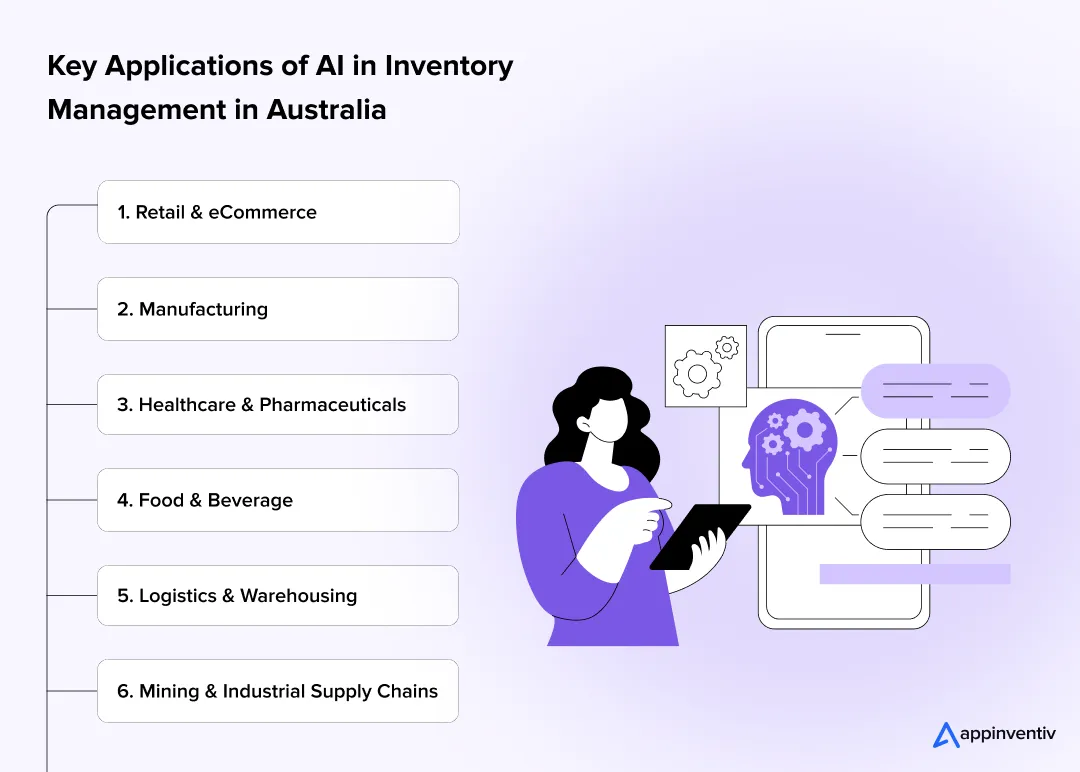
1. Retail & eCommerce
AI synchronises store-level stock with digital storefronts to enable efficient “ship-from-store” models, reducing regional freight overheads. Research indicates that Australian retailers using AI for inventory see a significant reduction in out-of-stock incidents.
The core functions of AI in the Australian retail sector include:
- Predict hyper-local demand patterns
- Enable micro-fulfilment centre logic
- Optimise seasonal markdown timing
2. Manufacturing
For local producers, AI monitors port congestion and raw material transit to adjust production schedules dynamically. This resilience is vital as Australian manufacturers now prioritise supply chain visibility as a core objective in 2026.
The core functions of AI in the Australian manufacturing sector include:
- Mitigate Indo-Pacific shipping delays
- Automate raw material procurement
- Synchronise floor-level production needs
3. Healthcare & Pharmaceuticals
In a TGA-regulated environment, AI tracks life-cycles and temperature-sensitive stock to ensure patient safety and compliance. These systems reduce clinical waste by ensuring high-value medications are utilised before their fixed expiry dates.
The core functions of AI in the Australian healthcare sector include:
- Monitor TGA-compliant expiry windows
- Automate cold-chain logistics alerts
- Track high-value clinical assets
4. Food & Beverage
Cold chain logistics in Australia’s climate require high-velocity turnover to protect margins and reduce waste. AI integrates with IoT to adjust pricing or promotions based on real-time shelf-life data of perishable goods.
The core functions of AI in the Australian food and beverage sector include:
- Implement dynamic FEFO rotation
- Reduce environmental spoilage costs
- Forecast fresh produce requirements
5. Logistics & Warehousing
The focus for a logistics and warehousing company in Australia is often slotting optimisation to reduce labour costs per order. AI identifies “fast-movers” to position them in accessible zones, directly increasing warehouse throughput.
The core functions of AI in the Australian logistics sector include:
- Optimise warehouse slotting layouts
- Direct robotic picking paths
- Forecast peak labour requirements
6. Mining & Industrial Supply Chains
Remote mining operations use AI to pre-position critical spare parts, preventing “unplanned downtime” that can cost millions per day. This proactive MRO strategy is essential for maintaining output in the Pilbara and beyond.
The core functions of AI in the Australian mining sector include:
- Predict heavy machinery failures
- Pre-position remote site spares
- Manage complex MRO inventories
Real-World Examples of Australian Business Giants Deploying AI for Inventory Management
The theoretical benefits of AI-driven supply chains are increasingly being validated by Australia’s business giants. The following examples of companies like Woolworths, Wesfarmers, Amazon, etc. highlight how sector leaders are navigating the complexities of regional supply chains while adhering to Australian data sovereignty and operational excellence standards.
Woolworths: Transforming Demand Forecasting
Woolworths has overhauled its replenishment engine to move away from legacy manual forecasting. By integrating predictive AI that accounts for hyper-local variables across its national network, the retailer has significantly increased forecast accuracy and reduced food waste. This shift ensures that stock is positioned closer to the consumer, supporting their click-and-collect and “Scan&Go” initiatives.
- Outcome: Improved demand precision and reduced manual intervention in replenishment operations.
Wesfarmers: Scaling Agentic Commerce
Across its portfolio, including Bunnings and Kmart, Wesfarmers is leveraging strategic AI partnerships to embed “agentic AI” capabilities into their supply chains. This involves moving beyond simple data tracking to using AI agents that proactively manage product availability and merchandising logic.
- Outcome: Enhanced team productivity and streamlined inventory management across major retail banners.
Amazon Australia: Robotics and Predictive Slotting
Amazon’s expansion into the Australian market, particularly with its massive robotics-fulfilment centres in Western Sydney, relies on AI to manage millions of SKUs. Their system uses deep learning to predict which items will be ordered in specific postcodes, pre-positioning stock to enable one-day delivery for Prime members across major metro hubs.
- Outcome: Maximised warehouse density and a reduction in “click-to-delivery” latency by automating pathfinding for picking robots.
Rapid Teachers, Vyrb, JobGet, ReelMedia, Dr. Morepen, MyExec
Essential Features for an AI Inventory Management System Development
Modern AI inventory management software development in Australia focuses on moving beyond simple record-keeping toward autonomous decision engines. For forward-thinking businesses, it means the feature set must balance advanced predictive power with the rigorous security standards expected by Australian boards and regulators. To help you plan your AI inventory system strategically, we have categorised the entire feature set into two core parts: basic and advanced.
Basic Features of an AI Inventory Management System
These foundational elements replace manual data entry with automated precision, ensuring that the “digital twin” of your warehouse matches physical reality at all times.
| Feature Module | Business Impact |
|---|---|
| Centralised Inventory Dashboard | Provides a “single pane of glass” view across regional hubs, eliminating siloed data and “phantom stock.” |
| Automated Purchase Order (PO) Generator | Triggers replenishment orders based on real-time SKU velocity without manual intervention. |
| Unified Multi-Node Synchroniser | Bridges the gap between CBD storefronts and regional distribution centres for consistent stock levels. |
| High-Speed Scan Ingestion Engine | Integrates with Barcode/QR/RFID hardware to ensure millisecond-accurate data entry into the core system. |
| Mobile Stocktake Interface | Empowers warehouse staff with real-time auditing tools, reducing the time spent on manual reconciliation. |
Advanced Features of an AI Inventory Management System
These advanced capabilities leverage deep learning to provide a competitive edge, allowing firms to simulate market shocks and automate complex procurement logic.
| Feature Module | Business Impact |
|---|---|
| Predictive Demand Sensing Engine | Processes external signals (weather, interest rates, port congestion) to adjust forecasts before shifts occur. |
| Cost-to-Serve Analytics Module | Mathematically determines SKU profitability by factoring in the high cost of Australian coastal freight. |
| Dynamic Buffer Recalibrator | Automatically adjusts safety stock levels in response to fluctuating lead times at Botany or Fremantle ports. |
| AI-Led Slotting Architect | Reconfigures warehouse pick-paths and bin locations dynamically to maximise throughput and reduce labour. |
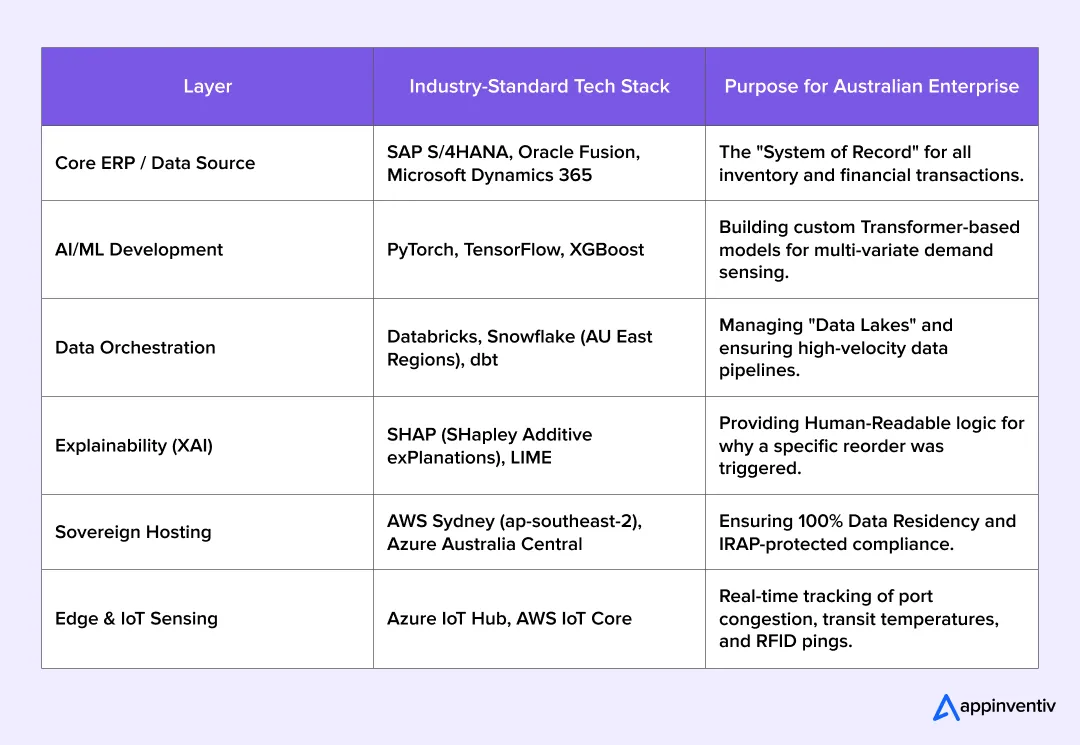
| Sovereign Cloud Data Vault | Ensures all AI-processed data is partitioned and hosted on Australian-based nodes (IRAP-protected). |
| Natural Language Logic (GenAI) Interface | Allows leadership to query supply chain status and risk reports using simple, conversational English. |
How to Implement AI for Inventory Management in Australia?
Transitioning to an AI-led inventory model requires a pragmatic, phase-gated approach to manage technical debt and operational risk. For an Australian business, this journey must prioritise local data sovereignty and seamless integration with existing ERP frameworks like SAP, Oracle, or Microsoft Dynamics 365. To help you cover this journey successfully, here are the key steps to implement AI in inventory operations for Australian businesses:
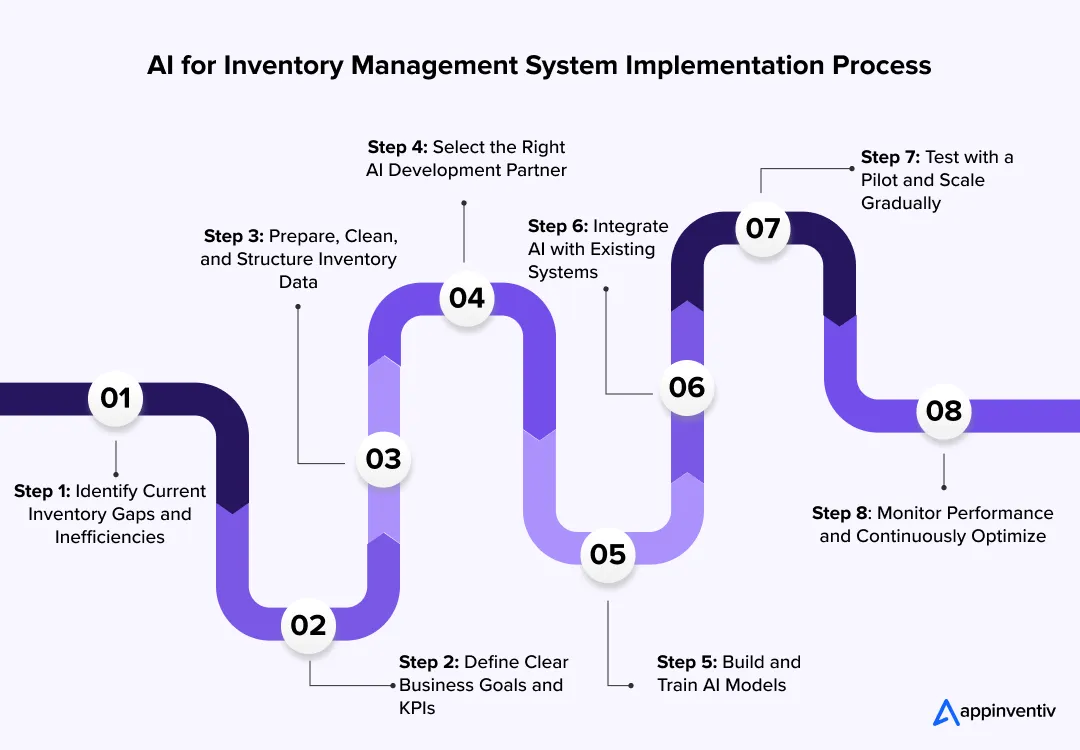
Step 1: Identify Current Inventory Gaps and Inefficiencies
Before deploying any neural networks, businesses must identify where manual intervention is currently leaking margin. Whether it is high “out-of-stock” rates in regional Western Australia or high carrying costs in Sydney hubs, pinpointing these friction points ensures the AI solution addresses high-value commercial problems first.
Step 2: Define Clear Business Goals and KPIs
Success in an Australian business context is measured by capital efficiency. Leadership must establish clear benchmarks, such as a 15% reduction in safety stock or a 22% improvement in order fulfilment speed. These KPIs should also include compliance-related goals, ensuring the system meets local audit requirements and board-level risk appetites.
Step 3: Prepare, Clean, and Structure Inventory Data
AI is only as effective as the data feeding it. This stage involves centralising fragmented data from various 3PL providers and internal silos. Cleaning this data (removing duplicates and correcting inaccuracies) is essential for training a reliable predictive model that understands the nuances of Australian seasonality.
Step 4: Select the Right AI Development Partner
The complexity of the local market necessitates a trusted tech partner with deep execution experience. Thus, when you hire AI inventory management developers in Australia, the focus should be on their ability to handle complex integrations with legacy ERPs (like SAP or Oracle) and their adherence to the “Essential Eight” security framework.
Step 5: Build and Train AI Models
Generic AI models often fail to account for the “tyranny of distance” in Australia. Therefore, the AI development company in Australia you hire must build custom machine learning models trained on historical domestic sales data and shipping volatility. This ensures the resulting logic is tuned to local consumer behaviour and the specific transit lag of the Indo-Pacific routes.
Step 6: Integrate AI with Existing Systems
The AI engine must talk to your existing tech stack without disrupting daily operations. In 2026, the focus shifts from “replacing” to “augmenting” legacy environments through a Composable AI Architecture.
- API-First Connectivity: Integration via MuleSoft or Dell Boomi enables real-time data flow from Point-of-Sale (POS) and Warehouse Management Software (WMS).
- Event-Driven Ingestion: Platforms like Confluent or Apache Kafka stream data from regional Australian hubs directly into the inference engine for intraday adjustments.
- Sovereign Data Security: Sensitive metadata is protected via AWS Key Management Service (KMS) with Australian-managed keys, ensuring compliance with SOCI Act standards.
Step 7: Test with a Pilot and Scale Gradually
Deploy the AI in a controlled environment, such as a single distribution centre or a specific product category. Monitoring this pilot allows for fine-tuning the algorithms in a real-world scenario before a full-scale national rollout. This small step helps mitigate the risk of widespread operational disruption.
Step 8: Monitor Performance and Continuously Maintain
AI systems require ongoing “drift” monitoring to stay accurate as market conditions evolve. Regular audits of the system’s recommendations against actual outcomes ensure the model remains aligned with shifting Australian economic trends and consumer preferences, maintaining long-term ROI.
Also Read: How to Build an Inventory Management Software in Australia
Appinventiv Insight
In 2026, Australia’s ‘tyranny of distance’ is solved by code, not just logistics. We’ve found that transitioning to agentic inventory models isn’t just a technical upgrade; it’s a capital strategy.
By deploying IRAP-compliant, sovereign-hosted AI, our Aussie partners typically reclaim 25% of trapped working capital within the first nine months of deployment.
What Are Some Core Challenges in Implementing AI in Inventory Systems in Australia and How to Overcome Them
While the upside of intelligent inventory is clear, the path to a fully autonomous supply chain in Australia is governed by a tightening regulatory framework. Leaders must navigate specific hurdles, from fragmented legacy data to the December 2026 Privacy Act mandates, that require a “boots on the ground” strategy rather than a purely theoretical one.
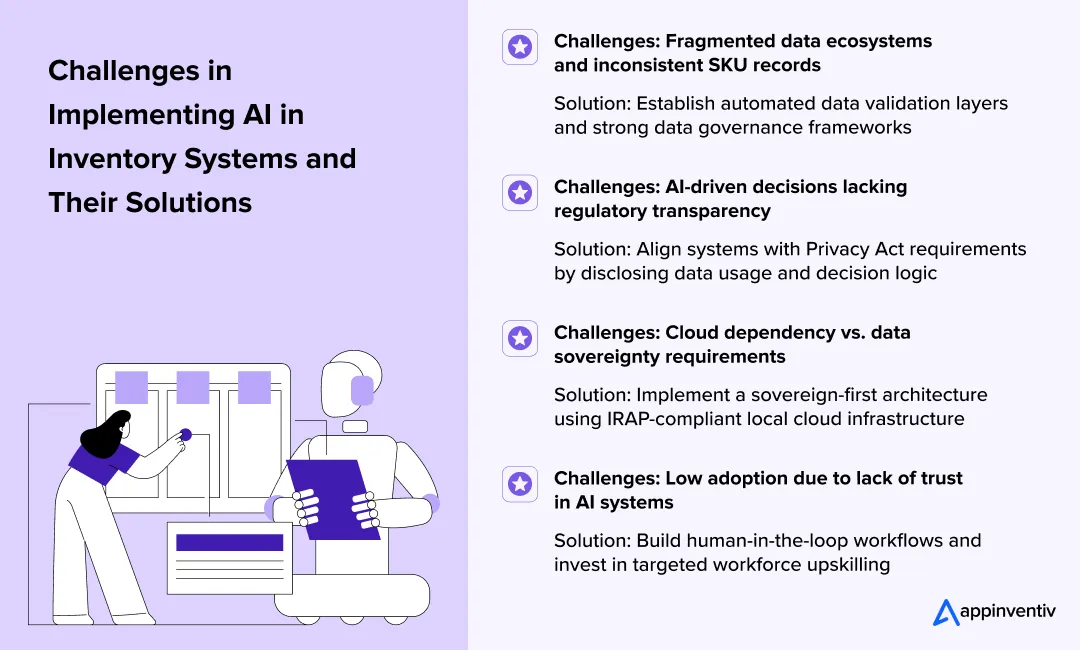
The “Garbage In, Garbage Out” Reality & Data Governance
Machine learning models are only as sharp as the data they consume. Many Australian wholesalers are still grappling with fragmented “data swamps” where records in one state do not match SKU labels in another.
- The Tension: Establishing a robust governance framework is the first move.
- The Solution: Implement automated data validation layers during ingestion. This is now a prerequisite for meeting the National AI Centre (NAIC) Guidance for AI Adoption (2025), which mandates that organisations “measure and manage risks” throughout the AI lifecycle to maintain public trust.
2. The 2026 Privacy Act & Automated Decision-Making (ADM)
A significant shift is occurring in how AI logic must be disclosed. As of 10 December 2026, new transparency obligations under the Privacy Act 1988 require businesses to be explicit about how they use “computer programs” to make decisions.
- The Tension: Balancing proprietary algorithmic advantages with mandatory disclosure.
- The Solution: Appinventiv solves this by deploying Explainable AI (XAI) frameworks, ensuring that every replenishment trigger is backed by a “Human-readable” logic trail for audit purposes.
3. Sovereignty, Security, and the SOCI Act
In an era of heightened cyber awareness, where data is stored is just as critical as how it is processed. For entities in critical sectors (like Mining or Energy), inventory AI must now align with the Security of Critical Infrastructure (SOCI) Act.
- The Tension: Balancing high-compute cloud needs with strict residency.
- The Solution: Implement a “Sovereign-First” security framework. By utilising IRAP-protected local cloud nodes (like AWS Sydney or Azure Australia Central), businesses can ensure their AI-driven supply chain remains compliant with the SOCI Act and broader national security expectations.
4. Bridging the Internal Skills Gap & Human-in-the-Loop
Digital transformation projects in Australia often stall because the warehouse floor or procurement team does not trust the “black box” of AI.
- The Tension: Human intuition vs. algorithmic decision-making.
- The Solution: Success involves a focused upskilling program and maintaining a “human-in-the-loop.” To combat “Algorithm Aversion” on the warehouse floor, we implement “Human-in-the-loop” (HITL) workflows.
This ensures that while the AI handles the 24/7 heavy lifting of SKU optimisation, high-stakes operational triggers, such as bulk-buying AUD 1M+ of inventory, require a strategic sign-off, aligning with the National AI Centre’s (NAIC) 2025 Best Practices.
How Much Does It Cost to Implement AI Inventory Management in Australia?
The capital outlay for AI-driven supply chain transformation is rarely a flat fee; it is a function of architectural depth, data cleanliness, and the scale of the Australian distribution network. For a Tier 1 enterprise, the cost to implement AI inventory management in Australia typically ranges from AUD 70,000 to AUD 700,000, depending on whether the goal is a targeted pilot or a national “digital twin” rollout.
Businesses must weigh the initial AI system development costs in Australia against the long-term reduction in “dead stock” and emergency freight overheads. The primary cost drivers include the complexity of integrating with legacy ERPs (SAP/Oracle) and the rigorous requirements for local data hosting to meet Australian sovereignty standards.
| Complexity Level | Estimated Cost (AUD) | Typical Features | Delivery Timeline |
|---|---|---|---|
| Modular Pilot | AUD 70,000 – 150,000 | Predictive demand for 1-2 product categories; basic API integration. | 3 – 6 Months |
| Enterprise Core | AUD 150,000 – 400,000 | Full-scale ML forecasting; multi-warehouse sync; automated replenishment. | 6 – 9 Months |
| Advanced Autonomous | AUD 400,000 – AUD 700,000+ | Generative AI risk reporting; IoT sensor integration; custom digital twin. | 9 -12+ Months |
What Is the Future of AI in Inventory Management in Australia?
As we move ahead into 2026, the baseline for AI inventory management in Australia is shifting from simple predictive analytics toward fully autonomous, “self-healing” supply chains. Static dashboards are being replaced by agentic AI capable of independently negotiating with suppliers and rerouting shipments to bypass congestion at Port Botany or Brisbane.
- Autonomous planning and execution: AI systems will increasingly trigger procurement, transfers, and replenishment actions automatically within governance limits, reducing human intervention to exception handling.
- Digital twins for supply networks: Enterprises are building virtual replicas of inventory flows to simulate disruptions such as floods, strikes, or port closures before they occur, strengthening resilience planning.
- AI + robotics convergence in warehouses: Predictive inventory intelligence is being integrated with automated picking, sorting, and storage systems to boost throughput while addressing persistent labour shortages.
- Hyper-local demand sensing: Advanced AI models will forecast demand at postcode or suburb level, enabling micro-fulfilment strategies and lowering last-mile delivery costs across major Australian cities.
- Generative AI for executive decision support: Natural-language systems will summarise supply risks and recommend actions.
These emerging AI trends indicate that inventory management is evolving from a planning function into a continuously optimised control system for the entire supply network.
Why Appinventiv Is a Trusted Partner for AI Inventory Transformation in Australia
Navigating the technical and regulatory hurdles of AI inventory management software development in Australia requires a tech partner who treats delivery as a commercial mission, not just a coding exercise.
At Appinventiv, our approach is defined by 11+ years of APAC delivery experience, during which we have successfully deployed more than 3000 digital assets, including 400+ AI projects across the region. As an experienced AI and logistics software development company in Australia, we don’t just build AI software; we engineer resilience into the Australian supply chain.
Our commitment to the local market is evidenced by our 96% client retention rate and the five agile delivery centres we maintain across Australia to ensure high-touch collaboration. This execution depth is why we have been recognised as one of APAC’s high-growth companies by Statista and the Financial Times for two consecutive years.
Our local footprint is defined by:
- Infrastructure & Sovereignty: Our deployments prioritise local data sovereignty, utilising IRAP-protected cloud nodes to ensure sensitive commercial data never leaves Australian shores.
- Compliance-First Engineering: We specialise in aligning AI architectures with the Essential Eight and the December 2026 Privacy Act mandates, ensuring your inventory logic is transparent and audit-ready.
- Deep Tech Integration: From Computer Vision for autonomous stocktaking to DLT (Blockchain) for verified cross-border logistics, we bridge the gap between legacy systems and the intelligent future.
- Explainable AI (XAI) Maturity: We ensure your supply chain logic is transparent and audit-ready for 2026 standards.
By partnering with us, enterprises typically realise efficiency gains of around 35%, underpinned by a 99.50% security compliance SLA that meets rigorous ISO and SOC2 standards. We ensure every SKU on your balance sheet is working toward your bottom line
FAQs
Q. How is AI used in inventory management in Australia?
A. AI in inventory management in Australia is primarily used to solve the “tyranny of distance.” It automates demand forecasting by processing local variables like port delays and regional weather, triggers automated replenishment to reduce stockouts, and optimises warehouse slotting to lower the high cost of manual labour in domestic distribution centres.
Q. How much does it cost to implement AI inventory systems in Australia?
A. The cost to implement AI inventory management in Australia typically starts at AUD 70,000 for a modular pilot and can exceed AUD 700,000 for a full-scale enterprise transformation. Total investment depends on the complexity of legacy ERP integrations and the scale of the distribution network.
To gain an in-depth understanding of this cost range, please refer to the above blog.
Q. How long does it take to implement AI inventory management in Australian businesses?
A. A standard AI implementation for inventory control in Australia follows a phased approach, which typically ranges between 3 and 12+ months. For instance, a pilot usually takes 3 to 6 months, while a comprehensive enterprise-wide rollout generally requires 9 to 12+ months to ensure data integrity and system stability.
Q. What ROI can Australian businesses expect from AI inventory management?
A. With the right use AI in inventory management system in Australia, businesses typically see a 20-35% improvement in operational efficiency. The ROI is driven by a significant reduction in carrying costs, fewer lost sales due to stockouts, and decreased waste in perishable or seasonal categories.

- In just 2 mins you will get a response
- Your idea is 100% protected by our Non Disclosure Agreement.
How to Hire RAG Architects for Enterprise AI
Key takeaways: Define your RAG architecture scope to avoid misaligned hiring decisions Identify end-to-end architectural ownership across retrieval, governance, and scaling Evaluate deep technical capabilities beyond prompt engineering and tools Validate governance and compliance readiness at the retrieval layer Test system-level thinking through real-world failure scenarios Choose the right hiring model based on scale, risk,…

Key Takeaways: Healthcare chatbots in the UAE are moving beyond queries to support triage, patient communication, and real clinical workflows across hospitals. Effective healthcare chatbot development depends on clean data, strong system integrations, and alignment with regulations like DHA, DOH, and MOHAP. Development costs typically range from AED 147,000 to AED 1,470,000+, depending on complexity,…
Hire Computer Vision Engineers: Reduce AI Development Costs by 45%
Key takeaways: Start with the problem first. Define the use case, data, and deployment needs before hiring. Choose the right role mix. Algorithm engineers, ML engineers, and developers handle different parts of the system. Look beyond tools. Strong engineers focus on data quality, evaluation, and real-world performance. Follow a practical hiring flow. Define → map…