
- InventivAI
- Featured Insight
 Leader in AI-First Product Engineering Read Full Article
- About
- Services
 IT Managed & Outsourcing
 - Industries
- Portfolio
- Resources RECOMMENDED BlogsView All Blogs
-
 Contact Us
Leader in AI-First Product Engineering Read Full Article IT Managed & Outsourcing Contact Us

Tootle was created as a GPS-based mobile application that rethought how people interacted with maps, directions, and location discovery in everyday situations. Rather than treating navigation as a purely functional task, the product was shaped as a Tootle GPS navigation app that emphasized personalization, familiarity, and context, allowing users to feel guided instead of directed as they moved from one place to another.
The platform was also shaped with a clear commercial objective. Tootle partnered with businesses and surfaced location-based promotions within the app, guiding users directly to promoted destinations and generating revenue through commission on those interactions. This balance between user experience and monetization defined the platform’s overall direction.
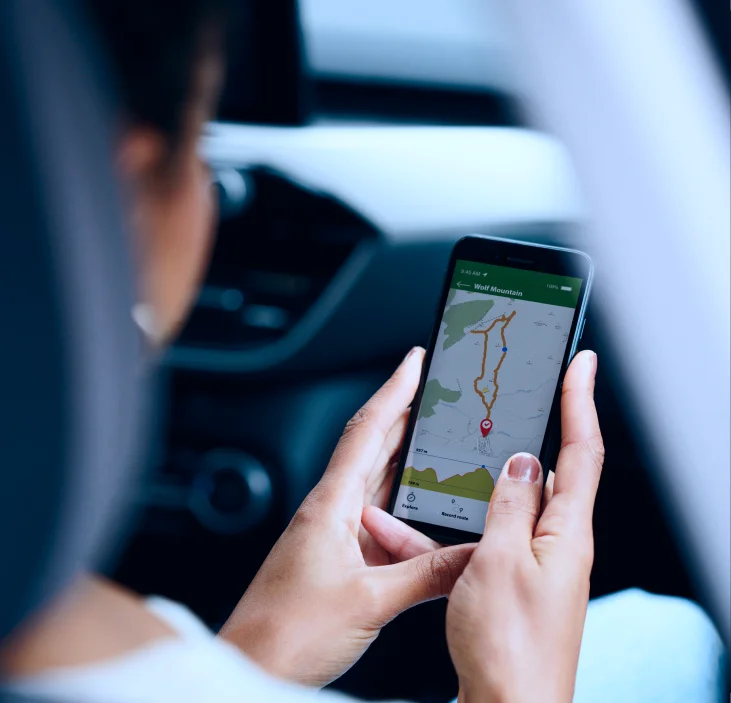

Tootle’s navigation was designed around real movement, adapting to user behavior with clear, calm directions. Routes balanced efficiency and promotions, supporting a commission model without harming trust.
The platform needed to
Blend promoted locations into routes without unnecessarily extending travel time.

Adjust routing logic dynamically instead of relying on a single fastest-path rule.

Preserve a consistent navigation experience even as priorities shifted.

Support a backend structure that could scale with listings, promotions, and partnerships.

We implemented a weighted routing approach that evaluated distance, timing, relevance, and promotion together. Routes were recalculated continuously, allowing small detours when they aligned naturally with the journey and removing them when they added friction.
The outcome was an AI-powered GPS navigation app that stayed practical. Users received predictable guidance, businesses gained visibility through context rather than disruption, and the platform remained stable as new features and partnerships were introduced.
Work with a team that understands navigation, personalization, and the business realities behind location-driven platforms.





One consistent challenge involved the evolving nature of requirements. The client frequently revisited ideas and adjusted priorities. Instead of enforcing rigid constraints, we responded by presenting structured alternatives at each decision point, often outlining two or three clear paths with practical trade-offs. This approach maintained progress without limiting flexibility.
Customizing the platform introduced the risk of complexity within the Tootle GPS navigation app. The challenge was to allow meaningful customization while keeping the core experience intuitive. This was addressed by separating essential navigation flows from deeper preference controls, allowing users to engage gradually.
Advertising and commissions were central to Tootle’s model, which meant the backend needed to support these use cases from the start. Additional planning during architecture design prevented limitations later when business partnerships expanded.
We began by observing how users actually navigate cities, not how routes are expected to work on paper. People follow habits, adjust on instinct, and value guidance that feels steady rather than intrusive. The platform needed to adapt to individual behavior while quietly accommodating business needs without making those trade-offs visible.


Key solution features








The navigation platform is being developed as a phased system shaped by continuous stakeholder feedback and real usage insights.
Sequential releases allow product direction and technical decisions to evolve with emerging business priorities.
The platform treats navigation as interactive and responsive, enabling future personalization and business integrations.
Create a location-based product designed around real user behavior and real commercial outcomes.

Building a Tootle GPS navigation app usually costs between $60,000 and $350,000, but it depends on several things. The number and complexity of features, the level of personalization included, which platforms were targeted (iOS, Android, or both), and the backend setup all influenced the price. Post-launch support and updates were also added to the total cost.
Have a similar project idea in mind? Connect with our experts today and get a detailed cost estimation.
For a tailored navigation platform with AI-driven guidance, the process often took 9 to 18 months. That timeline changed depending on design and development cycles, how real-time data sources were added, and how routing algorithms were tested. Ensuring the app worked smoothly across devices also added time.
Also Read: A Comprehensive Guide on Building Waze Navigation App
Tootle stood out as an AI-powered GPS app because it went beyond simple directions. It adapted to real-time conditions, gave travel suggestions based on context, and included a commission-based system connecting users with services. This approach made the experience feel more personal and responsive to each user.
Yes. For the smart navigation mobile app, Appinventiv stayed involved after launch, improving performance, adding features gradually, and adjusting the architecture for growing demand. This helped the platform expand without downtime and kept the experience smooth for users.